Nuclear Troubles Send French Winter Power Prices Soaring

By Michael Kern – Apr 19, 2023 https://oilprice.com/Latest-Energy-News/World-News/Nuclear-Troubles-Send-French-Winter-Power-Prices-Soaring.html
France’s power prices for early 2024 are double the German prices for next winter as the huge French nuclear fleet continues to show signs of weak output and availability.
The French power price for the first quarter of 2024 was at $455 (416 euros) per megawatt-hour (MWh) on Wednesday. That’s more than double the price for the same period in Germany, where the power price was at $185 (169 euros) per MWh for early 2024, according to data compiled by Bloomberg.
France has had troubles at many of its nuclear reactors, half of which have been shut down for repairs and maintenance at several times over the past year.
Germany, meanwhile, took its last three nuclear power plants offline on Saturday, ending more than six decades of commercial nuclear energy use, Germany ended the nuclear power era despite continued concerns about energy security and energy supply after the Russian invasion of Ukraine and the end of pipeline natural gas deliveries from Russia, which was the largest gas supplier to Europe’s biggest economy before the war.
In France, concerns about the operations at France’s large nuclear power fleet resurfaced last month after the French nuclear safety authority, ASN, told energy giant and large nuclear reactor operator EDF to review its program of reactor checks, following the finding of another crack at a nuclear power plant.
This led to an 8% one-day surge in French power prices for next year, the biggest jump since the end of January.
For much of last year, France’s nuclear power generation was well below capacity, as more than half of the country’s reactors were offline at one point in the autumn due to repairs or maintenance.
At the moment, French nuclear power plants are producing 17.5% less than the average output rate for 2020 and 2021. That’s down from 23% last year, so there is some progress, but concerns remain.
Whaa -at ? Bill in North Carolina legislature would define nuclear as source of CLEAN energy

North Carolina Public Radio | By Rusty Jacobs, April 19, 2023
“…………………………… The bill, which advanced through the Senate Agriculture, Energy and Environment Committee on Wednesday, would change statutory language from “renewable” to “clean” energy, and would add nuclear facilities to that category along with wind and solar.
“I am for the least cost (sic) energy consumers have to buy,” Newton said…………..
Sen. Mike Woodard (D-Durham), a member of the Agriculture, Energy and Environment Committee, expressed reservations about a bill that would change statutory language from “renewable” to “clean” energy and add nuclear facilities to that category along will wind and solar.
…………….The bill now goes to the Senate Rules Committee. https://www.wunc.org/environment/2023-04-19/bill-north-carolina-legislature-nuclear-source-clean-energy
US nuclear taxes — the true costs

Fortunately, there is a rapidly growing movement in our nation called, “Back from the Brink,” supported by 333 elected officials across the country, that supports the elimination of all nuclear weapons while laying out four precautionary steps necessary in the process. Rep. James McGovern (D-Mass.) has demonstrated the courage to support this effort with the recent introduction of H. Res 77.
Ultimately, “Budgets are moral documents,” as theologian Rev. Jim Wallis has noted. What role do nuclear weapons play in that morality?
We find ourselves as a nation grappling with economic, environmental, social and racial justice issues, seemingly oblivious to the fact that the very existence of nuclear weapons — and all that they entail, from mining, production, testing, stockpiling, dismantling and potential for their use — are among the greatest perpetrators of these injustices.
Nuclear weapons threaten us every moment of every day.
BY ROBERT DODGE, – 04/19/23
Every April we fund our nation’s budget and economic priorities on Tax Day. This year finds our nation emerging from the global COVID-19 pandemic and still struggling with years of infrastructure neglect.
This neglect has impacted the health and wellbeing of our communities, resulting in water shortages, contamination, and toxic legacies
…………………………………… We continue to face the growing existential challenges, economic burden, and impact of climate change nationally and globally.
And then there is the ongoing war in Ukraine, which potentially threatens the entire world.
This year the increased risk of nuclear war hangs over us more than at any time since the Cuban missile crisis
The Bulletin of Atomic Scientists moved their Nuclear Doomsday Clock to 90 seconds till midnight earlier this year, the closest to global catastrophe it has ever been.
Russian President Putin’s preparations to place tactical nuclear weapons in neighboring Belarus would lower the threshold of nuclear war, further heightening the risk.
It’s fair to ask, ‘Who determines our priorities and how do we fund them?’
Ultimately, “Budgets are moral documents,” as theologian Rev. Jim Wallis has noted. What role do nuclear weapons play in that morality?
We find ourselves as a nation grappling with economic, environmental, social and racial justice issues, seemingly oblivious to the fact that the very existence of nuclear weapons — and all that they entail, from mining, production, testing, stockpiling, dismantling and potential for their use — are among the greatest perpetrators of these injustices.
Nuclear weapons threaten us every moment of every day.
While most reasonable people recognize that these weapons cannot and must not ever be used, approximately 12,512 weapons remain in the nuclear arsenals of the world. We also know that the use of even a tiny fraction (less than half a percent) of these weapons over a single populated region would cause catastrophic climate change resulting in a global famine putting potentially 2 billion people at risk.
These weapons also threaten us by robbing precious resources that could be redirected to the many needs that our communities cry out for. The Nuclear Weapons Cost Program of the Nobel Prize winning Physicians for Social Responsibility Los Angeles, now in its 34th year, attempts to determine the full cost of nuclear weapons programs to our communities. There have been many excellent calculations of portions of our nuclear weapons costs including the ICAN report on global costs. These reports deal primarily with the cost of warheads, delivery systems and development alone, in an attempt to compare one nation to another.
In our report, we include verifiable costs of all nuclear programs that would not be spent if nuclear weapons did not exist. These include funding of the nuclear missile defense system, environmental cleanup and legacy programs dealing with communities that have been contaminated by the mining, development, testing and stockpiling of these weapons. Also included is nuclear nonproliferation funding and funding to safeguard and sequester nuclear weapons in Russia and former Soviet Union States.
Determining the full cost of U.S. nuclear weapons programs is a tedious process, as the United States is not fully transparent in these figures.
We have chosen to list only figures that we can provide reference to. There are other reports that estimate the forecast to be much higher, including Dr. Timmon Wallis in “Warheads to Windmills: How to Pay for a Green New Deal.” In 2013, with the release of the “Black Budget” by Edward Snowden, it was estimated that there were some $9 billion in “top secret” nuclear operations that were never publicly released. While likely still being funded, it has become impossible to track those expenditures and thus they are not included in our report.
The total costs of all U.S. nuclear weapons programs for the 2022 Tax Year which funds our Fiscal Year 2023 budget is $90.34 Billion.
What does this mean to our communities? In Jackson, Miss., with its 148,761 residents earning a per capita income 62 percent of the national average, their tax dollar contribution to nuclear weapons programs is about $25 million. For Flint, Mich., with its 80,628 residents earning a per capita income of 50 percent of the national average, their nuclear contribution is over $10.8 million. The Navajo Nation — whose 143,435 residents have experienced the health legacy of nuclear weapons, having been victims of significant radiation exposure from nuclear weapons testing and development for decades, and whose per capita income is 40 percent of the national average — will spend over $15.6 million on nuclear weapons programs.
The nation’s poorest county of Buffalo County, S.D., with its 1,923 largely indigenous Crow Creek Sioux Tribe residents, earning on average 32 percent of the national average, will spend about $167,000 dollars as their contribution to nuclear weapons programs. Is this their priority? Does it add in any way to their security, health or wellbeing? In reality, these weapons are among the greatest threats to their security.
In a participatory democracy, is this how they would choose to spend their treasure? Polls show that a 66 percent majority of Americans favor the abolition of nuclear weapons and that 58 percent are also fearful of nuclear war.
…………. Fortunately, there is a rapidly growing movement in our nation called, “Back from the Brink,” supported by 333 elected officials across the country, that supports the elimination of all nuclear weapons while laying out four precautionary steps necessary in the process. Rep. James McGovern (D-Mass.) has demonstrated the courage to support this effort with the recent introduction of H. Res 77.
Will Environmental, social, and governance (ESG) investment managers follow the govt in backing nuclear?

By Chloe Cheung, 19 Apr 23, https://www.ftadviser.com/investments/2023/04/19/will-esg-investment-managers-follow-the-govt-in-backing-nuclear/
Wind turbines and solar panels are commonly associated with low-carbon energy, but nuclear power is also being considered in the pursuit of net zero.
In a move to encourage private sector investment, chancellor Jeremy Hunt said in the spring Budget that the UK green taxonomy will class nuclear power as ‘environmentally sustainable’, subject to consultation.
Although nuclear fuels are not renewable, the classification would enable nuclear power to have the same investment incentives as renewable energy.
But despite being low-carbon, it is not uncommon to come across ESG funds and investment companies that exclude nuclear power generation. So will investment managers follow the UK government’s approach to nuclear power?
William Argent, lead adviser to the VT Gravis Clean Energy Income Fund, says the fund’s responsible investment statement does not currently allow exposure to nuclear power generation assets.
“There may be some very modest exposure to companies involved in the nuclear energy supply chain, providing services; but we do not have exposure to companies that own nuclear energy generation plants themselves,” he adds.
While the UK government wants to class nuclear power as ‘environmentally sustainable’, Argent says his position on nuclear energy has, at this stage, not changed. “We exclude it as a commonly perceived ‘controversial activity’.
“There would need to be a shift in that perception among our investors and more widely. We would not consider changing the stance unless there was a broader acceptance.”
Other funds avoiding companies that generate revenue from nuclear power generation include Quilter Cheviot’s Climate Assets Funds.
“While we recognise that nuclear power does not generate greenhouse gas emissions, and therefore it has a role to play in the net-zero pathway and transition away from fossil fuels, we do not consider it a ‘sustainable investment’,” says Claudia Quiroz, lead fund manager of the Climate Assets Funds, and head of sustainable investment at Quilter Cheviot.
Citing environmental and safety issues that “outweigh” zero emission credentials, she says: “Nuclear energy generates a significant mass of radioactive waste. In addition, however it is disposed of, that radioactive waste will remain for generations to come.
“Safety concerns, both accidental and deliberate, also exist. While the operation of nuclear power plants is undoubtedly safer than previous generations and an accidental disaster on the scale of Chernobyl is unlikely, safety challenges do remain.
“Nuclear power plants are also easy targets for malevolent acts such as terrorist threats, cyberattacks or acts of war.”
Although Quiroz describes the UK government’s intended sustainable classification of nuclear energy as ultimately a positive move, she adds that as sustainable investors, it will not change the fund’s philosophy on investing in nuclear energy.
Online forum: Militarism will cost us the earth, 24 April — GPJA’s Blog
Online Forum: Militarism will cost us the earth On Monday, 24 April 2023, from 1pm to 2pm Links to share: Facebook, https://www.facebook.com/PeaceMovementAotearoa/posts/6089067574473894 Tweet, https://twitter.com/PeaceMovementA/status/1648135785756114944 Has the rapidly escalating climate emergency finally shifted governments’ thinking away from narrow outdated notions of military security based on endless preparations for war towards prioritising spending on human health and […]
Online forum: Militarism will cost us the earth, 24 April — GPJA’s Blog
Germany and Finland: Two sides of the nuclear power coin in Europe

“What we see in Germany is a measured but speedier version of a European trend: the decline of the nuclear industry,”
“It’s a progressive closure — the replacement rate is insufficient for nuclear energy to survive.”
The shutdown of the remaining German reactors coincides with the startup of a new reactor on the Finnish coast
IGNACIO FARIZA. El Pais, Madrid – APR 19, 2023
As chance would have it, the shutdown of the Germany’s remaining nuclear reactors coincided exactly with the opening of a new one in Finland, the first in over 15 years in the European Union (EU). Both countries are highly vulnerable to the vagaries of Russian energy sources, but represent two opposing European visions of the always controversial nuclear energy.
The timing could not have been more incongruous. Almost 12 years after Angela Merkel’s administration decided to abandon nuclear power following the Fukushima (Japan) disaster, three plants were disconnected from the grid and mothballed: Isar 2 (Bavaria); Neckarwestheim 2 (Baden-Württemberg); and Emsland (Lower Saxony). A few hours later, in the early hours of the morning, the largest reactor in Europe was inaugurated 1,000 miles to the north. After almost 15 years of construction and many cost overruns, the Olkiluoto Nuclear Power Plant started producing 1.6 gigawatts (GW) of electricity, about one seventh of Finland’s total electricity demand.
The start-up of the Finnish reactor was a rocky road: it was first scheduled to be completed in 2009 and cost $12 billion, three times more than the original estimate. With Finnish conservatives holding a firm grip on power, more nuclear power projects are expected. Petteri Orpo, the front-runner in the prime minister race, often says in campaign speeches that nuclear power should be “the cornerstone of Finnish energy policy.”
The brutal energy shock aggravated by the Russian invasion of Ukraine has recently rekindled the debate about the role of nuclear power in Europe. Germany delayed the closure of its reactors by four months amid the energy crisis, and several political parties (including Merkel’s center-right CDU party) have reversed their original positions. The International Energy Agency (the Organization for Economic Cooperation and Development’s energy arm) has emerged as a leading advocate for nuclear reactors in a context increasingly dominated by renewable energy. A report by the International Energy Agency last summer noted the growing momentum for nuclear energy in many countries given rising fuel prices and growing concerns about stable energy supplies……………….
Although wind and photovoltaic energy are gaining traction in Germany, Europe’s biggest economy and most populous country, fossil fuels will have to fill some of the gap left by the nuclear plant shutdowns (6% of Germany’s electricity in 2022). Highly polluting coal plants still produce a third of the country’s electricity but will have to close by 2038……………………….
Consultant and environmentalist Mycle Schneider, author of one of the most comprehensive annual report on the global state of nuclear power, doesn’t see it that way. “What we see in Germany is a measured but speedier version of a European trend: the decline of the nuclear industry,” he told EL PAÍS in an e-mail. “It’s a progressive closure — the renewal rate is insufficient for nuclear energy to survive.”
Schneider, a German expert based in Paris, says in the last 30 years EU countries have connected 16 new reactors, closed 47 and started construction on only two: Flamanville 3 (in France) and Olkiluoto 3. “Since the construction of these facilities began, the cost of solar [photovoltaic] energy has plunged by 90% and wind power by 70%. It’s simply impossible for a nuclear plant to compete with those low costs,” he said. Over the same period, the EU has added 157 GW of solar energy capacity, wind has added 175 GW, and nuclear has accounted for a 24 GW loss in capacity.
Paris and Berlin dominate the debate
Apart from the diverging paths of Berlin and Helsinki, the nuclear energy debate is still dominated by the two major continental powers: Germany, which has the unwavering support of Spain and Austria, and France, supported by several Eastern European countries.
Broad swaths of German society vehemently oppose nuclear energy, unlike French society and its government. France depends highly on nuclear energy, even during 2022 when a plague of technical issues caused shutdowns of many power plants. 60% of France’s electricity is nuclear, perhaps because prior to its 2016 corporate restructuring, Areva — a global power in nuclear plant construction — was majority-owned by the French state. Areva was the lead engineering firm for Olkiluoto 3. However, the future of nuclear energy will not be driven by France, Germany or the EU, says Zurita, but by “China, India, South Korea and the other emerging countries” that are growing so rapidly. https://english.elpais.com/international/2023-04-19/germany-and-finland-two-sides-of-the-nuclear-power-coin-in-europe.html
Germany, Poland and others are pushing for new sanctions on Russia’s nuclear energy.
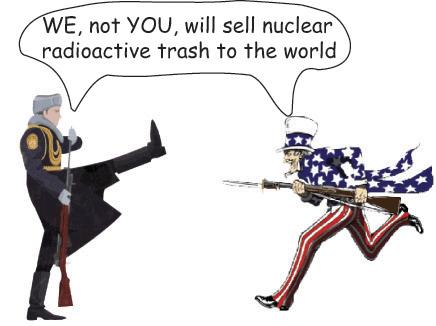
CNBC, APR 19 2023, Silvia Amaro @SILVIA_AMARO
- In a document seen by CNBC, Poland and the Baltic States called for sanctions on the civil nuclear energy activities too.
- According to data published by Europe’s statistics office Eurostat in 2021 — the year that preceded Russia’s invasion of Ukraine — Moscow was the third biggest provider of uranium to the EU.
- Asked whether a new set of actions to target Russia would feature nuclear energy, a spokesperson for the European Commission said the institution has no comment on ongoing confidential discussions.
…………………………………… “Across the EU, we must keep making ourselves independent from Russia,” Robert Habeck, the German economy and climate minister, said over the weekend.
“The nuclear sector is still outstanding. It is not justifiable that this area is still given preferential treatment. Nuclear technology is an extremely sensitive area, and Russia can no longer be seen as reliable partner within it,” he said.
In a document seen by CNBC, Poland and the Baltic States also called for sanctions on civil nuclear energy activities.
“Between March and December 2022, Russia exported just over $1 billion-worth of materials and technology of relevance to the nuclear energy sector,” the Royal United Services Institute, a think tank, said in a report in February.
“This trade included exports to members of NATO and the EU. In fact, not only has the value of Russian nuclear-related exports not shrunk since February 2022, the data reviewed by the author suggests that it may be expanding, with a handful of loyal customers still eager to do business with Russia’s nuclear sector,” the same report said.
According to data published by Europe’s statistics office Eurostat in 2021 — the year before Russia’s invasion of Ukraine — Moscow was the third biggest provider of uranium to the EU.
Ukrainian officials, as well as environmental groups, have previously criticized how the European Union has so far not curbed nuclear revenues for the Kremlin.
……………………… Further highlighting the complexity of the matter, Hungary announced in August that it would build two new nuclear reactors with the Russia state-owned firm Rosatom.
Russia to set up a small nuclear reactor in the Arctic Republic of Sakha
Rosatom and the Corporation for the Development of the Far East and the
Arctic have signed a cooperation agreement relating to the construction of
a Russian small nuclear reactor power plant in the Republic of Sakha (also
known as Yakutia).
World Nuclear News 18th April 2023
https://www.world-nuclear-news.org/Articles/Fresh-cooperation-agreement-on-SMR-plan-for-Yakuti
France’s radioactive waste management agency Andra wants to increase storage capacity at Cires waste dump
French radioactive waste management agency Andra has applied to the
department of Aube in north-eastern France for environmental permission to
increase the current authorised storage capacity of Cires, the country’s
dedicated disposal facility for very-low-level radioactive waste (VLLW).
World Nuclear News 12th April 2023
https://www.world-nuclear-news.org/Articles/Application-to-raise-capacity-of-French-very-low-l
1 This Month

of the week – Shut Down Drone Warfare!


Tell the Ukrainian Government to Drop Prosecution of Peace Activist Yurii Sheliazhenko

Petition to revoke the licensing of the Near Surface Nuclear Disposal Facility (NSDF) at Chalk River. https://www.ourcommons.ca/petitions/en/Petition/Details?Petition=e-7247
To see nuclear-related stories in greater depth and intensity – go to https://nuclearinformation.wordpress.com
-
Archives
- April 2026 (57)
- March 2026 (251)
- February 2026 (268)
- January 2026 (308)
- December 2025 (358)
- November 2025 (359)
- October 2025 (376)
- September 2025 (257)
- August 2025 (319)
- July 2025 (230)
- June 2025 (348)
- May 2025 (261)
-
Categories
- 1
- 1 NUCLEAR ISSUES
- business and costs
- climate change
- culture and arts
- ENERGY
- environment
- health
- history
- indigenous issues
- Legal
- marketing of nuclear
- media
- opposition to nuclear
- PERSONAL STORIES
- politics
- politics international
- Religion and ethics
- safety
- secrets,lies and civil liberties
- spinbuster
- technology
- Uranium
- wastes
- weapons and war
- Women
- 2 WORLD
- ACTION
- AFRICA
- Atrocities
- AUSTRALIA
- Christina's notes
- Christina's themes
- culture and arts
- Events
- Fuk 2022
- Fuk 2023
- Fukushima 2017
- Fukushima 2018
- fukushima 2019
- Fukushima 2020
- Fukushima 2021
- general
- global warming
- Humour (God we need it)
- Nuclear
- RARE EARTHS
- Reference
- resources – print
- Resources -audiovicual
- Weekly Newsletter
- World
- World Nuclear
- YouTube
-
RSS
Entries RSS
Comments RSS
 nuclear-news