TODAY. Shouldn’t we all get out of nuclear, before the next nuclear failure (whether it be financial, security, accident, pollution ………)?

Today the global military-industrial-political-corporate -media is awash with its sorrow and regret, and recriminations against Germany’s action in shutting down nuclear power.
However, I thought that CNN gave the whole story a pretty fair coverage, concluding with:
“There will be a moment of decision as to whether nuclear really has a future”
Otherwise, the main media felt obligated to express concerns of the nuclear lobby – that Germany is in the thrall of the evil Green Party, that nuclear can save the climate, that renewable industries can’t really succeed, that the public demands that nuclear stations stay open
Meanwhile the G7 countries are now going to discuss “the essential contribution” of nuclear energy to achieving climate and energy security!!
All this going on as the IAEA’s nuclear security chief warns that ‘we are living on borrowed time’ after two landmine explosions near Europe’s largest atomic power station in Ukraine.
Just who is telling the truth, and who is lying about nuclear power?
Is nuclear power really clean as the industry claims?
really safe?
really effective against climate change?
really affordable? really a good investment?
really has no problem to worry about with its radioactive wastes.
really welcomed by the public?
The final shutdown of Germany’s nuclear power has led CNN to ask that remarkable question – “whether nuclear really has a future”
U.S. Senate Weighs Big Plans for Small Reactors

NRC reporting on alternative sources of nuclear fuel, in particular, would be especially noteworthy for SMR developers. Fueling most SMR designs is so-called high-assay low-enriched uranium (HALEU), which has a higher uranium-235 content than larger reactors’ fuel. Currently, the world’s only commercial HALEU provider is TENEX, a Russian state-owned company: a source that has become particularly problematic in the wake of Russia’s aggression in Ukraine. Licensing a more geopolitically tenable HALEU supply chain, then, is a priority for any U.S.-based SMR project.
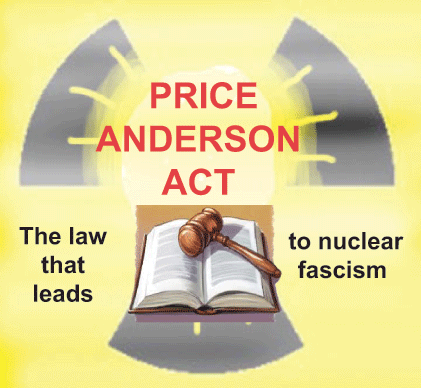
The Price-Anderson Act’s present iteration expires in 2025, and time is ticking. Lawmakers can certainly renew it elsewhere.
But a failure to renew it would throw the entire nuclear industry into uncertainty—SMRs included—potentially delaying deployment,
The ADVANCE Act could give nuclear SMR developers more than a few advancements
RAHUL RAO, 15 Apr 23 IEEE Spectrum,
Small modular reactors (SMRs) power many of today’s nuclear enthusiasts’ clean-energy dreams. ………….
In the U.S., SMR designers, operators, and fuel suppliers must all pass the Nuclear Regulatory Commission (NRC), the U.S. government’s nuclear arbiter. Unfortunately, SMRs don’t fit neatly into the NRC’s aged regulatory scheme, one built for old and established large reactors. That’s at least part of the reason why, on 3 April, a bipartisan group of U.S. senators unveiled the ADVANCE Act, a bill containing a package of nuclear reforms.
Anyone hoping for total renovation of the NRC will be disappointed; the act retains the philosophy that NRC approval is necessary. But the act would order a platter of small, subtle changes to the NRC’s innards. At least some SMR proponents are optimistic that—if the act passes—those changes could smooth the ways for a growing number of SMR developers.
…………. For one, applicants today must pay around $300 for each hour of the NRC’s time. When a single review can take tens of thousands of hours, these fees pile up. Larger firms like Rolls-Royce might be able to afford them, but smaller SMR developers—more than a few of them nascent startups—may struggle. The act would offset some of those costs: around half, according to an NIA estimate.
The act would also establish prizes. “Those prizes involve the first [developers] going through the different regulatory frameworks that the NRC has,” says Erik Cothron, an analyst at the NIA. For instance, the bill would reward the first reactor designer to receive the stamp of Part 53, a new SMR-specific licensing process that Congress ordered the NRC to create in 2018.
Nuclear-themed prizes may make for a fun day at the fair, but their dividends are more than short-term. The prizes, the NIA analysts say, would also pay back developers who might have to bear with a sluggish NRC whose regulators are themselves still learning how to navigate new regulatory routes.
Additionally, the act would require reports on several NRC-related topics, such as: how to license nuclear reactors for applications beyond electricity (such as heating); how to speed up approvals for reactors at previously developed “brownfield” sites (such as depreciated fossil fuel power plants); and how effectively the NRC might license alternative sources of nuclear fuel.
Reports like these might seem like busywork for bureaucrats, but analysts say they serve an important risk-reducing role, giving SMR developers (and investors) a clearer picture of and more confidence in the path ahead.
NRC reporting on alternative sources of nuclear fuel, in particular, would be especially noteworthy for SMR developers. Fueling most SMR designs is so-called high-assay low-enriched uranium (HALEU), which has a higher uranium-235 content than larger reactors’ fuel. Currently, the world’s only commercial HALEU provider is TENEX, a Russian state-owned company: a source that has become particularly problematic in the wake of Russia’s aggression in Ukraine. Licensing a more geopolitically tenable HALEU supply chain, then, is a priority for any U.S.-based SMR project.
Of course, all speculation is moot unless the ADVANCE Act clears Congress.
The Act isn’t Congress’s first recent recent attempt at nuclear reforms. The ADVANCE Act shares multiple provisions and supporters with an earlier bill called the American Nuclear Infrastructure Act (ANIA), first introduced in 2020. However, ANIA never saw the light of legislative day.
The Act isn’t Congress’s first recent recent attempt at nuclear reforms. The ADVANCE Act shares multiple provisions and supporters with an earlier bill called the American Nuclear Infrastructure Act (ANIA), first introduced in 2020. However, ANIA never saw the light of legislative day.
If the ADVANCE Act followed ANIA’s fate, it wouldn’t deal a mortal wound to SMR developers. But one of the ADVANCE Act’s other provisions is crucial to U.S. nuclear energy as a whole: It would renew the Price-Anderson Act, which mandates civilian nuclear plants carry insurance that would compensate members of the public for severe accidents.
The Price-Anderson Act’s present iteration expires in 2025, and time is ticking. Lawmakers can certainly renew it elsewhere. But a failure to renew it would throw the entire nuclear industry into uncertainty—SMRs included—potentially delaying deployment, according to Adam Stein, an analyst at the Breakthrough Institute think tank, which helped give input on earlier drafts of the bill’s text. https://spectrum.ieee.org/small-modular-reactors-advance-act
UN’s nuclear chief warns ‘we are living on borrowed time’ after two landmine explosions near Europe’s largest atomic power station in Ukraine

- UN has often expressed fears over the safety of Ukraine’s Zaporizhzhia plant
- Two landmine explosions took place outside plant’s perimeter this month
- Russian forces took control of the six-reactor plant in Ukraine in March last year
Daily Mail, By ARTHUR PARASHAR, 14 April 2023
A UN nuclear chief has warned ‘we are living on borrowed time’ after two landmine explosions near Europe’s largest atomic power station in Ukraine.
Rafael Grossi, director general of the International Atomic Energy Agency (IAEA), has repeatedly expressed fears over the safety of Ukraine’s Zaporizhzhia plant.
……….. We are living on borrowed time when it comes to nuclear safety and security at the Zaporizhzhia nuclear power plant,’ Mr Grossi said yesterday.
‘Unless we take action to protect the plant, our luck will sooner or later run out, with potentially severe consequences for human health and the environment,’ he added.
Two landmines exploded outside the plant’s perimeter fence – the first on April 8, and another four days later on Wednesday, according to the statement.
It was not immediately clear what caused the blasts, it said.
Grossi met senior Russian officials in Kaliningrad last week and prior to this with Zelensky in Zaporizhzhia to discuss a safety plan.
He also warned yesterday that the plant continued to depend on a single still-functioning power line, posing ‘a major risk to nuclear safety and security’.
A back-up power line damaged on March 1 has still not been repaired, the IAEA said.
It added that the staffing situation at the plant remained ‘complex and challenging’, in part because of staff shortages.
Last month, Grossi warned that a nuclear disaster was very possible due to the ‘perilous’ situation at the plant.
‘The plant’s lack of access to the grid and necessary repair work on its last emergency power line could cause a complete loss of power, making it reliant on diesel generators for the seventh time since Russia captured it,’ Grossi said at the time.
I once again call for a commitment from all sides to secure nuclear safety and security protection at the plant,’ he added.
Emergency diesel generators had been activated to power the plant’s safety systems, according to Ukrainian nuclear energy agency Energoatom, which has warned of the risk of an accident.
Without the electricity produced by these generators, the overheating of the reactor fuel could cause a nuclear accident, as in Japan’s Fukushima in 2011……………………………………..more https://www.dailymail.co.uk/news/article-11972139/UNs-nuclear-chief-warns-living-borrowed-time-two-explosions-near-Zaporizhzhia.html
Nuclear storage dump opponents sweep into Theddlethorpe parish council
Residents have organised against storage plans
The Lincolnite, By Daniel Jaines Local Democracy Reporter 13 Apr 23
Candidates opposing a nuclear storage dump have surged to power in Theddlethorpe in a demonstration of local opposition.
Eight of the ten seats on two Theddlethorpe Parish Councils – St Helen’s and All Saints – have been filled uncontested by people against to Nuclear Waste Service’s plans for a Geological Disposal Facility in the village.
Nearby residents were in uproar after it was announced last year that the Theddlethorpe Gas Terminal could become the entry point for a nuclear storage facility to dispose of around 10% of the UK’s nuclear waste.
The new councillors, who will automatically become councillors after the May 4 local elections, are all part of Theddlethorpe Residents Association.
Members Brian Swift and Andrew Spink formed it after their application to join the parish councils were rejected in 2021.
Mr Swift said: “We were both turned down, but shortly after this we got together with a few neighbours and formed the Theddlethorpe Residents Association with the aim to give the parish a collective voice and to counter the PC’s negative stance.”
Since its inception, the residents association has garnered more than 120 members and holds regular events.
However, Mr Swift said the anti-GDF sentiment of the members would not mean other views would be unwelcome.
“Despite the fact that the majority of the councillors are now anti-GDF ,we are keen to stress that all points of view are welcome. Our priorities are to carry out the parish council’s functions to the best of our ability and to do our utmost to see that the village thrives and continues to be the friendly, united place we all call home,” he said………………………. more https://thelincolnite.co.uk/2023/04/nuclear-storage-dump-opponents-sweep-into-theddlethorpe-parish-council/—
Nuclear is not the solution to our energy troubles.
France pays a price for its energy security. President Macron has announced plans to build 6 new reactors by 2050 – and they’re much needed to replace the country’s ageing fleet of power stations – but he was warned very publicly just two months ago that he needs to have a credible programme to deal with the fourth issue: nuclear waste and both from the new planned plants and from the new ones. Right now, France’s nuclear waste facilities are close to over-flowing. In reality, if you’re worried about reactor safety, you should really be a lot more worried about nuclear waste. The full decommissioning process for a nuclear plant takes between 20 and 30 years. ……………….Furthermore, those small, modular nuclear power stations on which the Tory position relies? According to research published last year by Stanford University and the University of British Columbia, they produce more waste than conventional nuclear power plants.
Reaction Giga Watt, April 13, 2023
Both the current UK government and the likely next government want to embrace nuclear power.
Rishi Sunak has commissioned an energy review that will focus on “carbon capture and storage, small modular reactors and the like”. Keir Starmer’s proposed “Great British Energy” would invest in nuclear energy alongside wind, solar, tidal and other emerging technologies. There’s nothing new about nuclear power and if it was the solution to all our problems – and on the face of it, it should be – the world would have already fully embraced nuclear, risks and all. So why haven’t we?
………… burning fossil fuels is very much not consequence free and we’re only just starting to get serious about those consequences and no amount of “clean” coal, unleaded fuel, catalytic converters, wonderful though they are, can make up for this.
Secondly, nuclear power is scary: the world’s first public demonstrations of nuclear power were at Hiroshima and Nagasaki. Roughly once a decade since then, the world has provided us with reminders of just how frightening nuclear power can be: the Cuban Missile Crisis, Three Mile Island, Exercise Able Archer, Chernobyl, Fukushima and Zaporizhzhia are all examples from the past 60 years where the perils of a nuclear world have been brought home to us.
………………………………………………………………….. It’s also true that the rise of more sophisticated terrorist organisations made the public and thereby politicians wary of the nuclear industry especially from 9/11 onwards. If terrorists can fly two large aeroplanes into the heart of the biggest financial centre in the world then surely an isolated power station would be a much easier target………….. At Zaporizhzhia in Ukraine during the current conflict, the issue is less about the impact on the reactors themselves from Russian shelling but the impact on waste storage facilities and power supplies to cooling and safety systems
……….As the Zaporizhzhia reactors were being switched off, they still needed to be continuously cooled with water from the Dnieper to ensure safe shutdown because they produce so much heat. Uranium-filled fuel rods, the source of nuclear fission within the reactor, are immersed in water for around 10 years after they are used before they reach a temperature at which they can be safely handled. It’s this efficiency that makes nuclear power an unusual part of the energy mix as, unlike gas or coal, you can’t easily turn the output up or down. Nuclear energy just is.
This means that in a system that requires flexibility, and remembering that UK electricity demand can swing between 40 GWs and 20 GWs in just one day, nuclear power is unsuited to modern demands. ………………….
France pays a price for its energy security. President Macron has announced plans to build 6 new reactors by 2050 – and they’re much needed to replace the country’s ageing fleet of power stations – but he was warned very publicly just two months ago that he needs to have a credible programme to deal with the fourth issue: nuclear waste and both from the new planned plants and from the new ones. Right now, France’s nuclear waste facilities are close to over-flowing. In reality, if you’re worried about reactor safety, you should really be a lot more worried about nuclear waste. The full decommissioning process for a nuclear plant takes between 20 and 30 years. ……………….Furthermore, those small, modular nuclear power stations on which the Tory position relies? According to research published last year by Stanford University and the University of British Columbia, they produce more waste than conventional nuclear power plants.
Part of the problem with waste is that, even as we approach the 70th anniversary of the first nuclear power stations, there is still no global consensus on how best to handle high level nuclear waste because the timeframes are so immense. What seems like an obvious solution today – for example, storing waste in deep geological repositories hundreds of metres below the ground – may end up being a total disaster in 500 or even 5,000 years’ time. What do those timescales mean? It means asking Henry VIII, King of England in 1523, to make decisions about the country we live in today. Unsurprisingly we have ended up with a halfway house: everyone agrees that toxic waste can be treated and converted into less dangerous (but still very dangerous) forms; everyone also agrees that it’s probably best if it’s stored underground but no one can yet agree what underground means and what the risks will be over the centuries to come.
And if the timescales are immense, then so are the costs: the Sellafield facility in Cumbria is being decommissioned with a current cost estimate of £121 billion which does not included the placing of the waste from the site into a geological disposal facility, the location and timing of which are to be determined, which will cost another £53 billion.
At least Henry VIII would not have had to deal with our fifth hurdle: the British planning system and an island cluttered with around 65 million people and it’s this, perhaps above all, that makes new nuclear projects vanishingly unlikely. I don’t want to live next to a nuclear power station of any size and I doubt many Reaction subscribers would either but because we live in an age of Nimbyism, it’s doubtful that any of us will be asked to do so anyway. Even if we are, and if the project is approved, investment is found and if construction starts, you can look forward to the project, counting from today, delivering power in roughly 2035 and that’s being very optimistic.
……………………. over the past ten years, the UK has done so much to change its energy mix that investing in nuclear now, with all the cost, time and controversy involved, would be a significant mistake. It seems unlikely that it will take Sunak and Starmer, arch-pragmatists that they both are, very long to work this out. https://reaction.life/nuclear-is-not-the-solution-to-our-energy-troubles/
Ukraine-Russia war – live: Damning Pentagon leak has not affected relations, Kyiv says
Sravasti Dasgupta,Liam James,Vishwam Sankaran, Independent UK, 15 Apr 23
Documents hinted Ukraine faced challenges in massing troops, equipment, and ammunition
Top officials in Kyiv said that information on Ukraine’s war efforts against Russia — that was part of leaked US Pentagon documents — was already known and not surprising.
The leaked documents hinted that Ukraine faced challenges in massing troops, equipment, and ammunition and that Kyiv may fall short of counter-offensive goals.
A senior Ukrainian official told BBC that the problems faced by the country were already known, adding that the leaks would not affect relations between the two countries.
Meanwhile, Moscow’s defence ministry has claimed that military pilots from Belarus have completed training to use Russia’s tactical nuclear weapons.
Belarusian defence minister Viktor Khrenin threatened the West that “it could be the next step” to also host part of Moscow’s strategic arsenal, claiming: “We are already preparing the sites that we have.”
On the battlefield in Ukraine, Kyiv has been forced to concede ground in the bloody battle for Bakhmut after being bombarded with “particularly intense” Russian artillery fire over the past 48 hours, Britain’s Ministry of Defence said.
It suggested Ukraine may fall short of its goals to launch a counter-offensive against Russia.
Ukraine’s National Security and Defence Council head Oleksiy Danilov said the leaks did not affect the military’s plans, adding that “everything will be decided at the last moment”.
1 This Month

of the week – Shut Down Drone Warfare!


Tell the Ukrainian Government to Drop Prosecution of Peace Activist Yurii Sheliazhenko

Petition to revoke the licensing of the Near Surface Nuclear Disposal Facility (NSDF) at Chalk River. https://www.ourcommons.ca/petitions/en/Petition/Details?Petition=e-7247
To see nuclear-related stories in greater depth and intensity – go to https://nuclearinformation.wordpress.com
-
Archives
- April 2026 (68)
- March 2026 (251)
- February 2026 (268)
- January 2026 (308)
- December 2025 (358)
- November 2025 (359)
- October 2025 (376)
- September 2025 (257)
- August 2025 (319)
- July 2025 (230)
- June 2025 (348)
- May 2025 (261)
-
Categories
- 1
- 1 NUCLEAR ISSUES
- business and costs
- climate change
- culture and arts
- ENERGY
- environment
- health
- history
- indigenous issues
- Legal
- marketing of nuclear
- media
- opposition to nuclear
- PERSONAL STORIES
- politics
- politics international
- Religion and ethics
- safety
- secrets,lies and civil liberties
- spinbuster
- technology
- Uranium
- wastes
- weapons and war
- Women
- 2 WORLD
- ACTION
- AFRICA
- Atrocities
- AUSTRALIA
- Christina's notes
- Christina's themes
- culture and arts
- Events
- Fuk 2022
- Fuk 2023
- Fukushima 2017
- Fukushima 2018
- fukushima 2019
- Fukushima 2020
- Fukushima 2021
- general
- global warming
- Humour (God we need it)
- Nuclear
- RARE EARTHS
- Reference
- resources – print
- Resources -audiovicual
- Weekly Newsletter
- World
- World Nuclear
- YouTube
-
RSS
Entries RSS
Comments RSS
 nuclear-news