Corruption in the Ukraine government, as Zelensky skims $millions from USA for diesel, while buying cheap diesel from Russia

“Zelensky’s been buying discount diesel from the Russians,” one knowledgeable American intelligence official told me. “And who’s paying for the gas and oil? We are. Putin and his oligarchs are making millions” on it.
Many government ministries in Kiev have been literally “competing,” I was told, to set up front companies for export contracts for weapons and ammunition with private arms dealers around the world, all of which provide kickbacks.
TRADING WITH THE ENEMY Amid rampant corruption in Kiev and as US troops gather at the Ukrainian border, does the Biden administration have an endgame to the conflict? Seymour Hersh, Substack, Apr 12
The Ukraine government, headed by Volodymyr Zelensky, has been using American taxpayers’ funds to pay dearly for the vitally needed diesel fuel that is keeping the Ukrainian army on the move in its war with Russia. It is unknown how much the Zelensky government is paying per gallon for the fuel, but the Pentagon was paying as much as $400 per gallon to transport gasoline from a port in Pakistan, via truck or parachute, into Afghanistan during the decades-long American war there.
What also is unknown is that Zelensky has been buying the fuel from Russia, the country with which it, and Washington, are at war, and the Ukrainian president and many in his entourage have been skimming untold millions from the American dollars earmarked for diesel fuel payments. One estimate by analysts from the Central Intelligence Agency put the embezzled funds at $400 million last year, at least; another expert compared the level of corruption in Kiev as approaching that of the Afghan war, “although there will be no professional audit reports emerging from the Ukraine.”
“Zelensky’s been buying discount diesel from the Russians,” one knowledgeable American intelligence official told me. “And who’s paying for the gas and oil? We are. Putin and his oligarchs are making millions” on it.
Many government ministries in Kiev have been literally “competing,” I was told, to set up front companies for export contracts for weapons and ammunition with private arms dealers around the world, all of which provide kickbacks. Many of those companies are in Poland and Czechia, but others are thought to exist in the Persian Gulf and Israel. “I wouldn’t be surprised to learn that there are others in places like the Cayman Islands and Panama, and there are lots of Americans involved,” an American expert on international trade told me.
The issue of corruption was directly raised with Zelensky in a meeting last January in Kiev with CIA Director William Burns. His message to the Ukrainian president, I was told by an intelligence official with direct knowledge of the meeting, was out of a 1950s mob movie. The senior generals and government officials in Kiev were angry at what they saw as Zelensky’s greed, so Burns told the Ukrainian president, because “he was taking a larger share of the skim money than was going to the generals.”
Burns also presented Zelensky with a list of thirty-five generals and senior officials whose corruption was known to the CIA and others in the American government. Zelensky responded to the American pressure ten days later by publicly dismissing ten of the most ostentatious officials on the list and doing little else. “The ten he got rid of were brazenly bragging about the money they had—driving around Kiev in their new Mercedes,” the intelligence official told me………………………………………………………………………….. https://seymourhersh.substack.com/p/trading-with-the-enemy?utm_source=post-email-title&publication_id=1377040&post_id=114123549&isFreemail=false&utm_medium=email
CONTAINING THE BOMB: AN ASSESSMENT OF NUCLEAR WEAPONS FREE ZONES

Center for International Maritime Security, By LtCol Brent Stricker
This article is part of a series that will explore the use and legal issues surrounding military zones employed during peace and war to control the entry, exit, and activities of forces operating in these zones. These works build on the previous Maritime Operational Zones Manual published by the predecessor of the Stockton Center for International Law, the International Law Department, of the U.S. Naval War College. A new Maritime Operational Zones Manual is forthcoming.
Nuclear Weapons Free Zones (NWFZ) are an attempt to prohibit the use or deployment of nuclear weapons within a nation’s territory. None of the signatories to these treaties possess nuclear weapons, where NFWZs stand as a pledge not to develop these weapons. The established nuclear powers of the world have similarly pledged to respect some NFWZs.1 It remains to be seen whether such pledges will be observed or dismissed as a simple “scrap of paper.”2
Background
The legality of the use of nuclear weapons is an unsettled issue. The International Court of Justice issued an advisory opinion stating the threat or use of nuclear weapons must be examined under the United Nations Charter Article 2(4) prohibition on the use of force and Article 51’s right of self-defense.3 The Court could not “conclude definitively whether the threat or use of nuclear weapons would be lawful or unlawful in an extreme circumstance of self-defense in which the very survival of the state was at stake.”4
The Nuclear Non-Proliferation Treaty (NPT) was an early attempt to limit and eventually eliminate nuclear weapons. Article 1 of the NPT prohibits Nuclear Weapons States (NWS) from transferring nuclear weapons to a Non-Nuclear Weapon State (NNWS) or encouraging a NNWS to develop nuclear weapons. Article 6 of the NPT requires states to “pursue negotiations in good faith on effective measures relating to cessation of the nuclear arms race at an early date and to nuclear disarmament, and on a treaty on general and complete disarmament under strict and effective international control.”
Since the signing of NPT, the number of NWS has expanded. Two of the newly acknowledged nuclear powers, India and Pakistan, never signed the treaty. North Korea signed and subsequently withdrew. Finally, Israel, a suspected and unacknowledged nuclear power, never signed the treaty.5……………………………………………………………………..
Current Nuclear Weapons Free Zones
There are currently nine NWFZs in existence. Five of these were created by regional agreements. Three of them were created by international treaty but only occur in unpopulated areas: Outer Space, the Moon, and the seabed. The last NWFZ was created unilaterally by Mongolia. NWFZs cover more than two billion people and 111 countries.13
African NWFZ (ANWFZ)
The Treaty of Pelindaba established the African NWFZ. It was opened for signature on April 11, 1996, and came into effect on July 15, 1990.[14] Article 3 of the treaty renounces nuclear weapons, and the signatories pledge “not to conduct research on, develop, manufacture, stockpile or otherwise acquire, possess or have control over any nuclear explosive device by any means anywhere” and “not to seek or receive any assistance in the research on, development, manufacture, stockpiling or acquisition, or possession of any nuclear explosive device.” Article 4 is a prohibition on stationing nuclear weapons on their territory, but it allows individual nations the ability to allow foreign aircraft and ships to visit or exercise innocent passage without reference to whether such aircraft and ships may be armed with nuclear weapons. This thereby creates a loophole allowing nuclear weapons within the NWFZ…………………………………………….
South Pacific NWFZ (SPNFZ)
The Treaty of Rarotonga established the South Pacific Nuclear Free Zone. It was signed on August 6, 1985, and came into effect on December 11, 1985. All five acknowledged NWS have signed onto its Protocols. Annex 1 to the treaty describes the South Pacific Nuclear Free Zone, which includes both territorial land, waters, and the high seas. Article 3 of the treaty pledges signatories “not to manufacture or otherwise acquire, possess or have control over any nuclear explosive device by any means anywhere inside or outside the South Pacific Nuclear Free Zone” and “not to seek or receive any assistance in the manufacture or acquisition of any nuclear explosive device.” Article 5 prohibits stationing nuclear weapons on the territory of signatory states.
Article 5 also includes a loophole allowing signatory states to allow visits and transit by foreign aircraft and ships that may be armed with nuclear weapons. Article 7 includes a prohibition on dumping radioactive matter within the SPNFZ.”16
A second loophole appears in Article 3(c) of the treaty. There is no prohibition on the research of nuclear weapons. This leaves signatories the option to research nuclear weapons. The most likely being Australia if it needs to rapidly develop such weapons for nuclear deterrence.17
Australia poses a unique challenge to the SPNFZ due to its defensive alliance with the United States. The Australia, New Zealand, and the United States Security Treaty (ANZUS) was signed in 1951, joining the three nations in a collective security arrangement.18 New Zealand banned nuclear-powered vessels in 1984 and later created its own nuclear-free zone with the passage of the New Zealand Nuclear Free Zone, Disarmament, and Arms Control Act 1987. In response, the Reagan Administration suspended New Zealand’s obligations under the ANZUS Treaty.19 Australia remains a party.
Australia has publicly stated in its 2017 Foreign Policy White Paper it would rely on the deterrence power of the United States’ nuclear weapons.20 Australia also hosts US military installations that are vital to worldwide command and control.21 Undoubtedly, these facilities would be part of the Communication, Command, Control, and Intelligence (C3I) the United States would rely on during a nuclear crisis. Australia is in a dilemma then of being a party to the SPNFZ and an ally of an NWS poised to potentially assist in a nuclear attack. The treaty does not address this issue of C3I by a signatory state, with Article 3(c) only prohibiting the manufacture or acquisition of nuclear weapons.22…………………
Southeast Asian NWFZ (SEANWFZ)
The Bangkok Treaty established the Southeast Asian Nuclear Weapon Free Zone. The treaty was signed on December 15, 1995, and went into effect on March 28, 1997. The ten members of the Association of South East Asian Nations (ASEAN) agreed not to “develop, manufacture or otherwise acquire, possess or have control over nuclear weapons; station or transport nuclear weapons by any means; test or use nuclear weapons.”23 The Treaty also prohibited control, stationing, or testing of nuclear weapons in the SEANWFZ.24 The Bangkok Treaty thus closed the visit, transit, research, and control loopholes for vessels and aircraft with nuclear weapons.
Finally, the Bangkok Treaty prohibited dumping or discharging into the atmosphere of radioactive material or waste.25
The SEANWFZ is striking due to the size of the zone defined in the treaty. The zone is expanded to include the continental shelf and exclusive economic zones of the signatory nations.26 The Zone embraces an area of strategic importance to maritime shipping. The treaty would prevent the 5 NWS from transporting nuclear weapons through this zone. This is likely why no NWS has signed onto the treaty’s protocols and provides a negative security assurance to the ASEAN signatories.27
Central Asian NWFZ (CANWFZ)
The Central Asian Nuclear Weapons Free Zone was created by the Treaty of Semipalatinsk. The treaty was signed on September 8, 2006, and went into effect on Mar 21, 2009. The CANWFZ is defined as the land, internal waters, and airspace of the signatories.28 Kazakhstan, Kyrgyzstan, Tajikistan, Turkmenistan, and Uzbekistan, all former Soviet Republics, agreed to prohibit research, development, manufacture, stockpiling, acquisition, possession, or control over any nuclear weapon. The treaty also prohibited the location of such weapons in the zone. ………………………
Kazakhstan, Kyrgyzstan, and Tajikistan have a similar problem to Australia noted above. They are members of the 1992 Tashkent Collective Security Treaty, which includes the Russian Federation, one of the five acknowledged NWS. Article 4 of the treaty requires the Member States to provide all assistance, including military assistance, if one member is attacked.29 It remains to be seen how this will affect the CANWFZ.
Mongolian NWFZ
The Mongolian Nuclear Weapons Free Zone is unique as a unilateral action by domestic law similar to the New Zealand Nuclear Free Zone noted above. Mongolia made this declaration in 1992 and called for a regional NWFZ.30 This seemed improbable as Mongolia is surrounded by the Russian and Chinese NWS. The Mongolian NWFZ was recognized with UN General Assembly Resolution 53/77 D.31
Mongolia’s history makes its NWFZ unique, considering it was caught between the two struggling NWS for most of its existence…………………………………………
Latin American and the Caribbean NWFZ
The Treaty of Tlatelolco created the Latin American NWFZ. It was signed on February 1967 and went into effect on April 25, 1969. Article 1 of the treaty prohibits “the testing, use, manufacture, production or acquisition, by any means, of any nuclear weapon [signatory states] by order of third parties or in any other way,” and “the receipt, storage, installation, location or any form of possession of any nuclear weapon, directly or indirectly, by [signatory states], by mandate to third parties or in any other way.”
The Latin American and Caribbean NWFZ has a similar problem shared by Australia and the CANWFZ due to the mutual defense obligations imposed by the Inter-American Treaty of Reciprocal Assistance. This treaty was signed in 1947 by all of the states in North and South America, including the nuclear-armed United States. While it may be in decline with the withdrawal of member states and attempts to replace this treaty with sub-regional treaties, it remains valid international law.
Antarctica, the Moon, and Seabed NWFZ
It is interesting to note that the first NWFZs were created in places that humans normally do not inhabit: Antarctica, Outer Space, and the deep seabed. Article V of the Antarctic Treaty prohibits nuclear explosions or the dumping of radioactive material on the continent. Article IV of the Outer Space Treaty prohibits the stationing of nuclear weapons or weapons of mass destruction in space or on celestial bodies. This prohibition also prohibits the militarization of celestial bodies. The Outer Space Treaty does not address military activities in orbit, though. Article I of the Seabed Arms Control Treaty prohibits the emplacement of nuclear weapons and other weapons of mass destruction including structures to test, launch, or store such devices on the deep seabed.
It has been speculated that support for these NWFZs by the five acknowledged NWS was to limit the area to deploy nuclear weapons and the increased pressure on the arms race this would impose.36 The strategic value of making Antarctica off-limits for nuclear weapons seems to belie this argument since all NWS, acknowledged or not, are located in the Northern Hemisphere. The future possibilities for weaponizing outer space may render the Space NWFZ irrelevant.
2017 United Nations Nuclear Prohibition Treaty
The Treaty on the Prohibition of Nuclear Weapons could create the largest NWFZ in the world. It was proposed on 23 December 2016 with UN General Assembly Resolution 71/258. It was open for signature on September 20, 2017, and in effect on January 22, 2021.37 The NWS acknowledged and unacknowledged, do not support the treaty.38
Under Article 1 of the treaty: “Each State Party undertakes never under any circumstances to:
(a) Develop, test, produce, manufacture, otherwise acquire, possess or stockpile nuclear weapons or other nuclear explosive devices;
(b) Transfer to any recipient whatsoever nuclear weapons or other nuclear explosive devices or control over such weapons or explosive devices directly or indirectly;
(c) Receive the transfer of or control over nuclear weapons or other nuclear explosive devices directly or indirectly;
(d) Use or threaten to use nuclear weapons or other nuclear explosive devices;
(e) Assist, encourage or induce, in any way, anyone to engage in any activity prohibited to a State Party under this Treaty;
(f) Seek or receive any assistance, in any way, from anyone to engage in any activity prohibited to a State Party under this Treaty;
(g) Allow any stationing, installation, or deployment of any nuclear weapons or other nuclear explosive devices in its territory or at any place under its jurisdiction or control.”
………………………………… more https://cimsec.org/containing-the-bomb-an-assessment-of-nuclear-weapons-free-zones/
Macron speaks out against war with China- the furious USA reaction shows American insecurity?
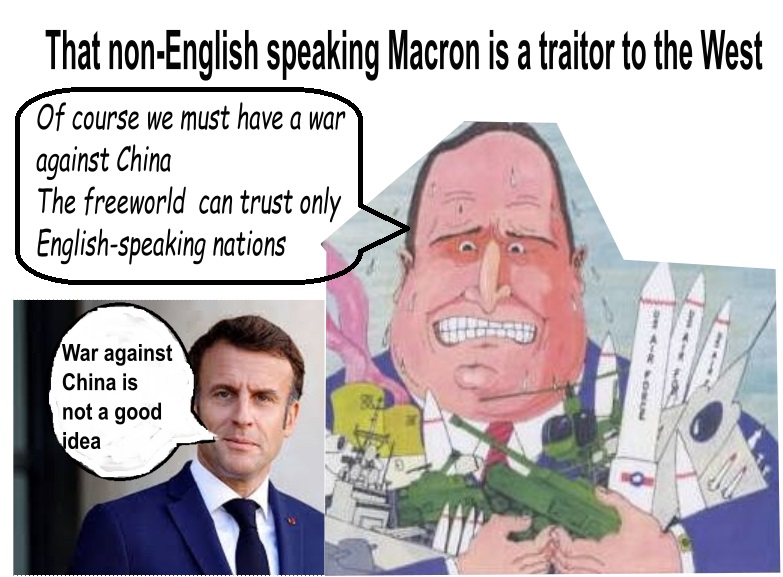
Confronting Russia and China is an integral part of Washington’s imperial game, as is the American need to subordinate Europe as a colony of vassals.
Macron speaks out in a rare moment of clarity and the American backlash is knee-jerk and nasty… because how dare those European vassals get out of line!
| Macron’s musings on Europe’s ‘Strategic Autonomy’: Much ado about nothing, but US insecurity is palpable Finian Cunningham, Strategic Culture, 2023-04-12 |
French President Emmanuel Macron has got the Americans in a flap with his comments advocating greater European strategic autonomy and for the old continent to avoid becoming embroiled in a U.S.-China confrontation over Taiwan.
Macron made his remarks while traveling back from China where he appeared to have been well received by President Xi Jinping. The trip reportedly garnered several lucrative trade deals for French businesses at a time when Élysée Palace is assailed with nationwide public protests and strikes over economic woes.
The American chagrin over Macron’s musings about European strategic autonomy is revealing in at least two ways.
The New York Times sniffily accused Macron of playing the “Gaullist card” while the Wall Street Journalcensured the French leader for “blundering on Taiwan”, adding, “He weakens deterrence against Chinese aggression and undermines U.S. support for Europe”.
Republican Senator Marco Rubio was palpably miffed and demanded that Macron should clarify “quickly” whether he was speaking for Europe as a whole or for France alone. In a huff, Rubio said, “You guys [European leaders] handle Ukraine” because the U.S. would henceforth focus its attention on “China’s threats”.
You have to laugh at the misplaced sense of American chivalry. This is the usual American trope of believing that they are once again salvaging Europe from conflict, as in the First and Second World Wars. Uncle Sam, as Rubio suggests, is going to abandon Europe to its bloody squabbling while getting on with “dealing” with purported “Chinese aggression”.
The reality is diametrically opposite. Europe is embroiled in the worst war since the Second World War precisely because its supine leaders are slavishly following Washington’s agenda of waging a proxy against Russia and destroying the strategic Russian-European energy trade. U.S.-led NATO expansionism over decades – under the guise of “protecting Europe – has produced this dangerous juncture. The war in Ukraine is driven by Washington’s need to shore up its unwieldy hegemonic ambitions. Confronting Russia and China are an integral part of Washington’s imperial game, as is the American need to subordinate Europe as a colony of vassals.
It’s an audacious affectation for American politicians and media to project that they are doing Europe some kind of noble favor over Ukraine and saving the European damsels from the “barbarian Russians”. It’s so corny and false, yet thanks to Western media brainwashing the old trope still works.
What the furore over Macron’s comments shows is just how under the American thumb (make that heel) the European leaders are. For a European president to aver that his country and other members of the European Union should make their interests a priority in pursuing independent relations with China and in particular to avoid a conflict over Taiwan is, one would think, a rather mundane matter of common sense, reason and normal prerogative. That the American political class has reacted in such a furious way shows, ironically, just how abjectly subordinate the Europeans really are. Macron speaks out in a rare moment of clarity and the American backlash is knee-jerk and nasty… because how dare those European vassals get out of line!
More importantly, the American anger may be overbearing and bullish but it nonetheless reveals how fragile the sense of insecurity in Washington is.
The American establishment is increasingly sensing that there is a chronic systemic crisis in U.S. global power. The presumed unipolar American order is waning and a multipolar world is ineluctably emerging. The once-mighty U.S. dollar is no longer affording the security it once did. China, Russia, and the Global South are pushing more and more strongly for a multipolar order that will make the American dollar and its unique, arbitrary privileges redundant. When that fully happens, the debt-strapped U.S. capitalist economy and its erstwhile global dominance will crash like so many empires before it.
This is why Washington is so apoplectic about Macron’s “insolent” outburst. American power relies on subservience and adherence to its diktat. Mutterings by vassals of independence must be stamped out ruthlessly so that the idea does not get around or maybe even be adopted………………………
despite his geopolitical impotence and reliable vassalage, the American fury at Macron’s comments is instructive. That’s the real story. The mere whiff of dissent is enough to send Washington into a near-panic because it knows how fragile its imperial power has become.
Macron is irrelevant but the torrid American reaction is notable. https://strategic-culture.org/news/2023/04/12/macron-musings-europe-strategic-autonomy-much-ado-about-nothing-but-us-insecurity-palpable/
An operational domain’: Fear UK nuclear power plan for moon may lead to militarisation of space
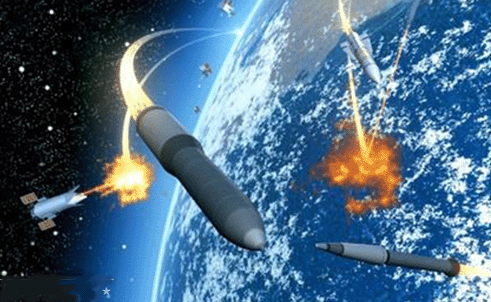
Rolls-Royce’s director of future programmes Abi Clayton tellingly said: ‘The technology will deliver the capability to support commercial and defence use cases.’
These activities are all completely contrary to the legal commitments the UK made a half century ago to preserve space for peace.
It may mirror the plot of classic ‘70s British sci-fi series, Space 1999, which also features a moon base and the threat posed by radioactive waste, but the UK/Ireland Nuclear Free Local Authorities also have real concerns that the development of a future British moon base powered by nuclear fission could represent a further unwanted development along the road to the militarisation of space.
Today is the UN International Day of Human Space Flight. On April 12, 2011, the UN General Assembly established the day on the 40th anniversary of Major Yuri Gagarin becoming the first human being to circle the Earth in his spacecraft ‘Vostok’. UN delegates reaffirmed ‘the important contribution of space science and technology in achieving sustainable development goals and increasing the well-being of States and peoples, as well as ensuring the realization of their aspiration to maintain outer space for peaceful purposes’.
Last week, the UK Space Agency announced a £2.9 million grant is to be awarded to Rolls-Royce SMR to collaborate with academic institutions to develop mini-reactors for deployment in space, with most media reports focusing on its potential to power a future moon base as part of the UK’s commitment to an international project to colonise the Earth’s near neighbour (Project Artemis). However, in welcoming the new funding, Rolls-Royce’s director of future programmes Abi Clayton tellingly said: ‘The technology will deliver the capability to support commercial and defence use cases.’
Whilst projects in outer space can be both benign and beneficial, the UK Space Strategy and UK Space Defence Strategy both identify that ‘NATO has made space one of five operational domains’,[1] and the UK Space Defence Strategy is subtitled ‘Operationalising the Space Domain’.[2] To make this a reality, the UK Government is intent upon investing £6.4 billion in a ‘Defence Space Portfolio’[3] for defence ‘in and through space’.[4]
For these purposes, the UK has joined the US and France in developing its own Space Command, and a nuclear moon base could in time become a part of the ‘portfolio’ from which UK Space Command operates,[5] in line with the government and military’s desire to ‘assure our access to, and operational independence in, space’.[6]
These activities are all completely contrary to the legal commitments the UK made a half century ago to preserve space for peace.
“Ironically the UK was in 1967 one of the first three co-signatories of the Outer Space Treaty which pledged the sponsors to ensure ‘that the Moon and other celestial bodies shall be used exclusively for peaceful purposes’”,[7] said Councillor Lawrence O’Neill, Chair of the NFLA Steering Committee.
“Our fear is that any future nuclear-powered moon-base could be ultimately crewed by military personnel from Space Command conducting operations that would be far from benign and beneficial, whether this be the permanent surveillance of perceived hostile states on Earth or more sinisterly as a platform for offensive weapons systems to project military power ‘through space’.
“And of course, once one major power establishes such a base, then the others, all not wishing to be outdone, will seek to do the same.”
The NFLA also has real practical concerns about the environmental impact of such a nuclear-powered base.
Councillor O’Neill added: “We have worries about the transfer of nuclear materials into space. It is not unknown for rockets to malfunction and explode on take-off or in early flight, indeed sadly this has led to the loss of human life, nor for radioactive material to be distributed across the surface of the Earth by exploding space vehicles, witness the accident involving Soviet satellite Kosmos 954.[8] And the UK Government’s own Committee on Radioactive Waste Management dismissed the idea of blasting radioactive waste into space on the grounds of both risk and cost.
“And in turn, a nuclear-powered moon base would generate radioactive waste. Where would this be put? If it came back to Earth, there would remain the risk of an accident on re-entry and states parties to the Outer Space Treaty also pledge to ‘avoid harmful contamination of space and celestial bodies’ so burial in situ below the lunar surface or blasting it into space would be unlawful”.
Lastly there is also a latent threat posed from outer space itself to the facility.
n 2016, NASA announced the findings of their Lunar Reconnaissance Orbiter (LRO) mission. Observing the lunar surface since launch in 2009, NASA scientists reported that ‘200 impact craters (had) formed during the LRO mission, ranging in size from about 10 to 140 feet (approximately 3 to 43 meters) in diameter’. Consequently, NASA recommended that ‘equipment placed on the moon for long durations – such as a lunar base – may have to be made sturdier. While a direct hit from a meteoroid is still unlikely, a more intense rain of secondary debris thrown out by nearby impacts may pose a risk to surface assets.’
In concluding Councillor O’Neill said: “We have all been concerned recently with the potential damage that could be caused on Earth to Ukrainian nuclear facilities from shelling and missile strikes so what happens if a meteoroid, or a fragment thereof, with massive kinetic energy hits a nuclear reactor based on the surface of the moon?[9]
German government rejects new call to delay nuclear shutdown
The German government has dismissed calls for a last-minute delay in shutting down the country’s last three nuclear power plants this weekend
By FRANK JORDANS – Associated Press, Apr 12, 2023
BONN, Germany (AP) — The German government dismissed calls Wednesday for a last-minute delay in shutting down the country’s last three nuclear power plants this weekend.
Opposition politicians and even some members of the Free Democrats, a libertarian party that’s part of Chancellor Olaf Scholz’s governing alliance, have demanded a reprieve for the remaining reactors, which were already operating without requisite safety checks.
“The nuclear phase-out by April 15, that’s this Saturday, is a done deal,” Scholz spokesperson Christiane Hoffmann said.
Successive German governments planned a phase-out of nuclear power. The last three plants originally were scheduled to shut down on Dec. 31, 2022. Scholz ordered a postponement last year amid concerns that Germany might face an energy shortage due to the war in Ukraine.
Lawmakers approved the extension on the condition the plants, which began operation more than 30 years ago, would cease operating by mid-April of this year……………..
[Keeping the reactors going] would be both illegal and costly, according to Environment Ministry spokesperson Bastian Zimmermann. The ministry oversees nuclear safety in Germany.
Zimmermann said the three reactors — Emsland, Neckarwestheim and Isar II — last underwent safety checks in 2009 and such inspections normally need to occur every 10 years. The requirement was only suspended due to the shutdown planned for the end of 2022, he said.
Any further lifetime extension for the plants would require comprehensive and lengthy security checks again, Zimmermann said.
The country is still searching for a location to permanently store almost 2,000 containers of highly radioactive waste for thousands of generations.
The Economy Ministry dismissed concerns that Germany won’t be able to meet its energy needs without the nuclear power plants, which currently produce about 5% of the country’s electricity.
Ministry spokesperson Beate Baron said recent studies showed Germany would be able to maintain its power supply with coal and gas-fired power plants and renewables such as wind and solar, while remaining a net exporter of electricity.
Baron said the government wants to phase in the use of hydrogen that can be produced without greenhouse gas emissions and fired up quickly on days when there’s little sun or wind for renewables. https://www.atchisonglobenow.com/news/world/german-government-rejects-new-call-to-delay-nuclear-shutdown/article_93c1beb6-7d8a-51ed-b48d-68ac8ba0fbb3.html
Netherlands energy experts recommend limiting energy demand, see little or no role for nuclear power, but Cabinet wants nuclear anyway.
Cabinet moving forward with nuclear plant plans, despite experts seeing “limited role” NL Times 13 Apr 23,
Minister Rob Jetten for Climate and Energy will move forward with plans to build two new nuclear power plants, he said at the presentation of Expert Team Energy System 2050’s advice on making the Netherlands climate neutral. In that advice, presented in The Hague on Wednesday, the team of experts sees “no or a limited role” for nuclear energy…………….
The final decision on the nuclear power plants will be made in about a year and a half,” Jetten said. “This advice will also be taken into account.”
In the report, the expert team said that new nuclear power plants only make sense if the demand for electricity doubles or triples and the Netherlands has to supply energy to neighboring countries.
The report was also critical of the Cabinet’s choice of Borssele as the destination for the nuclear power plants. According to the Cabinet, Borssele already has knowledge, experience, and support for working with nuclear power, and the energy can be converted into hydrogen. But experts don’t see it as a good choice. “A lot of electricity is already being generated at the coast with wind farms at sea. With nuclear power plants added, the electricity grid is overloaded.”………………………………………
For the energy transition to succeed, it is necessary to limit the energy demand. And that will require cooperation from citizens. The experts see many opportunities in local energy systems. In 2050, many neighborhoods should be energy-neutral or even energy-positive, using energy generated in the district for their limited consumption. If the energy generated remains in the neighborhood, it puts little strain on the high-voltage grids.
Citizen involvement and fairness are the most essential conditions for a successful energy transition, the experts said. “In order to achieve our climate goals, our energy system must be CO2 neutral within 20 years. We can only do that if we put citizens first and offer them opportunities and support to participate, now, here, later, and elsewhere,” co-author Aniek Moonen said. As an example of a fairer policy, she mentioned tackling poorly insulated homes and investing in locally generated energy.
The (South) Korean Nuclear Threat
13 APR 2023, By Dr Jeffrey Robertson, Australian Institute of International Affairs
South Korea is in the midst of a debate to secure nuclear weapons and few outside realise the seriousness and level of the debate. Few inside realise the question is much bigger than just South Korea, with great implications for the region, including Australia.
Debate on securing an independent nuclear weapons capacity once sat on the fringe of mainstream politics in Seoul. The extreme left and right, ex-military, religionists, and mavericks seeking attention were its champions. This is no longer the case. Today it is widely accepted, even common. Polls taken over the last year put public support in the 70-80 percent range. Securing nuclear weapons is now mainstream, viable, and if trends continue, even likely.
What makes South Korea want nuclear weapons? There’s a ready response from those pushing the agenda. North Korea’s missile and nuclear tests, Russia’s invasion of Ukraine, and concerns regarding a rising China. Each can readily be used to justify the pursuit of nuclear weapons. Yet, each are just squalls on the surface of the sea. Underneath, more powerful currents are pushing the pursuit of nuclear weapons: national pride, the desire to be more independent, and a healthy dose of domestic political opportunism.
National pride is a core contributor to the decision to pursue nuclear weapons. For both Koreas, there’s a keen sense of historical injustice marked by invasions from all sides, including occupation, and division. For South Koreans, there’s also a competitive streak that stretches from the individual to the national desire to be number one. There’s even speculation that the U.S. would be willing to allow Seoul to secure nuclear weapons in order for it to play a larger role in balancing China, placing South Korea at a new level of partnership with Washington. Among many, securing a nuclear weapons capacity provokes a certain element of national pride: more than just a middle power – a member of the nuclear weapons club.
The desire to be more independent is also an important contributing factor……………………………..
Domestic political opportunism is the icing on the cake…………………………… The current president, Yoon Suk-yeol, has made remarks supporting the acquisition of nuclear weapons, and the Mayor of Seoul – a position that is a stepping stone to the presidency – has also stated his support. Nuclear weapons will see multiple candidates jump on the bandwagon in the lead-up to the April 2024 legislative elections, and likely more than one candidate in the 2027 presidential elections.
Proliferation, from France to North Korea, is a story of national pride, independence, and political opportunism. South Korea is no different.
t is likely the consequences of this momentous decision to pursue an independent nuclear weapons capacity have not been fully thought through. ………………………………..
n the 1960s, Australia made the decision to forego nuclear weapons in the context of a global diplomatic and strategic understanding that proliferation could be controlled. Since that time, debates about Australia securing nuclear weapons have arisen, but they’ve never been mainstream. Debates in recent years have been more brain-storming and speculation than serious policy-specific programming. A South Korean decision to pursue nuclear weapons would substantially transform strategic outlooks across the region and lead to a more serious debate in Australia. The current nuclear submarine debate would look like a Sunday School picnic.
Jeffrey Robertson is an Associate Professor of Diplomatic Studies at Yonsei University and a Visiting Fellow at the Asia Institute, University of Melbourne. He researches the diplomatic practice and foreign policy of middle powers with a focus on the Korean Peninsula. He writes and updates research at https://junotane.com and on Twitter @junotane. https://www.internationalaffairs.org.au/australianoutlook/the-south-korean-nuclear-threat/
Finland’s NATO Move Leaves Others to Carry On the “Helsinki Spirit”
Finland’s membership in NATO marks the end of the nation’s admirable tradition as a global peacemaker.
MEDEA BENJAMINNICOLAS J.S. DAVIES, Apr 11, 2023
On April 4, 2023, Finland officially became the 31st member of the NATO military alliance. The 830-mile border between Finland and Russia is now by far the longest border between any NATO country and Russia, which otherwise borders only Norway, Latvia, Estonia, and short stretches of the Polish and Lithuanian borders where they encircle Kaliningrad.
In the context of the not-so-cold war between the United States, NATO and Russia, any of these borders is a potentially dangerous flashpoint that could trigger a new crisis, or even a world war. But a key difference with the Finnish border is that it comes within about 100 miles of Severomorsk, where Russia’s Northern Fleet and 13 of its 23 nuclear-armed submarines are based. This could well be where World War III will begin, if it has not already started in Ukraine.
In Europe today, only Switzerland, Austria, Ireland and a handful of other small countries remain outside NATO. For 75 years, Finland was a model of successful neutrality, but it is far from demilitarized. Like Switzerland, it has a large military, and young Finns are required to perform at least six months of military training after they turn 18. Its active and reserve military forces make up over 4% of the population–compared with only 0.6% in the U.S.–and 83% of Finns say they would take part in armed resistance if Finland were invaded.
On April 4, 2023, Finland officially became the 31st member of the NATO military alliance. The 830-mile border between Finland and Russia is now by far the longest border between any NATO country and Russia, which otherwise borders only Norway, Latvia, Estonia, and short stretches of the Polish and Lithuanian borders where they encircle Kaliningrad.
In the context of the not-so-cold war between the United States, NATO and Russia, any of these borders is a potentially dangerous flashpoint that could trigger a new crisis, or even a world war. But a key difference with the Finnish border is that it comes within about 100 miles of Severomorsk, where Russia’s Northern Fleet and 13 of its 23 nuclear-armed submarines are based. This could well be where World War III will begin, if it has not already started in Ukraine.
In Europe today, only Switzerland, Austria, Ireland and a handful of other small countries remain outside NATO. For 75 years, Finland was a model of successful neutrality, but it is far from demilitarized. Like Switzerland, it has a large military, and young Finns are required to perform at least six months of military training after they turn 18. Its active and reserve military forces make up over 4% of the population–compared with only 0.6% in the U.S.–and 83% of Finns say they would take part in armed resistance if Finland were invaded.
Only 20 to 30% of Finns have historically supported joining NATO, while the majority have consistently and proudly supported its policy of neutrality. In late 2021, a Finnish opinion poll measured popular support for NATO membership at 26%. But after the Russian invasion of Ukraine in February 2022, that jumped to 60% within weeks and, by November 2022, 78% of Finns said they supported joining NATO.
As in the United States and other NATO countries, Finland’s political leaders have been more pro-NATO than the general public. Despite long-standing public support for neutrality, Finland joined NATO’s Partnership for Peace program in 1997. Its government sent 200 troops to Afghanistan as part of the UN-authorized International Security Assistance Force after the 2001 U.S. invasion, and they remained there after NATO took command of this force in 2003. Finnish troops did not leave Afghanistan until all Western forces withdrew in 2021, after a total of 2,500 Finnish troops and 140 civilian officials had been deployed there, and two Finns had been killed………………………………
Finland will find that its tragic choice to abandon a policy of neutrality that brought it 75 years of peace and look to NATO for protection, will leave it, like Ukraine, dangerously exposed on the front lines of a war directed from Moscow, Washington and Brussels that it can neither win, nor independently resolve, nor prevent from escalating into World War III………………………..
NATO membership will integrate Finland’s arms industry into NATO’s lucrative arms market, boosting sales of Finnish weapons, while also providing a context to buy more of the latest U.S. and allied weaponry for its own military and to collaborate on joint weapons projects with firms in larger NATO countries. With NATO military budgets increasing, and likely to keep increasing, Finland’s government clearly faces pressures from the arms industry and other interests. In effect, its own small military-industrial complex doesn’t want to be left out……………………..
Finnish law prohibits the country from possessing nuclear weapons or allowing them in the country, unlike the five NATO countries that store stockpiles of U.S. nuclear weapons on their soil–Germany, Italy, Belgium, Holland and Turkey. But Finland submitted its NATO accession documents without the exceptions that Denmark and Norway have insisted on to allow them to prohibit nuclear weapons. This leaves Finland’s nuclear posture uniquely ambiguous, despite President Sauli Niinistö’s promise that “Finland has no intention of bringing nuclear weapons onto our soil.”……………………..
Perhaps most regrettable is that Finland’s membership in NATO marks the end of the nation’s admirable tradition as a global peacemaker………………….more https://www.commondreams.org/opinion/finland-nato-russia-helsinki-spirit
Germany’s phaseout of nuclear power is irreversible
Economics Minister Robert Habeck believes that Germany’s forthcoming
phase-out of nuclear energy is irreversible, despite all opposition. After
the shutdown on April 15, the last three power plants would “go into
dismantling sooner or later,” the Green politician told the newspapers of
the Funke media group.
Der Spiegel 10th April 2023
April 15, Germany’s Greenpeace to celebrate nuclear phaseout
After decades of hard work by many courageous people, Germany is phasing
out nuclear power. So that this success can finally become reality, we want
to demonstrate with you in Munich. Ever since Greenpeace Germany was
founded in 1980, we have been fighting against the military and civilian
use of dangerous nuclear power, for example in Wackersdorf, Gorleben and
Gundremmingen.
Also under pressure from the anti-nuclear movement, the then
existing coalition of SPD and Greens decided in 2002 to take a first step
towards phasing out nuclear power. They agreed with the power plant
operators that a certain amount of electricity may still be generated
before the reactors have to be shut down. A specific expiration date has
not been set. The final exit was decided in the summer of 2011 by the then
government consisting of CDU/CSU and FDP. The reactor catastrophe in
Fukushima had occurred shortly before.
Greenpeace Germany 3rd April 2023
https://www.greenpeace.de/klimaschutz/energiewende/atomausstieg/atomausstiegsfest
On April 15, Germany is finally due to phase out nuclear power. But the FDP
and the Union keep demanding that the nuclear reactors should continue to
run. We are currently assuming that the nuclear phase-out will last. We
invite you to three central demonstrations and shutdown parties on April
15th.
Bund 27th March 2023
Concern over funding ‘stigma’ from Theddlethorpe nuclear storage
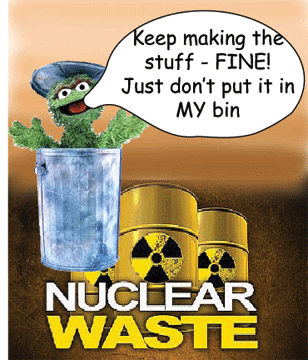
Only a ‘handful’ of applications made
By Daniel Jaines Local Democracy Reporter , The Lincolnite, 12 April 23
There are concerns that community groups in Theddlethorpe are not applying for a share of nearly £1million due to of the money’s links with a potential nuclear storage dump.
Only a handful of applications from Theddlethorpe community groups have been received for the grants.
The money is being made available due to Nuclear Waste Services exploring a potential for the area to host a Geological Disposal Facility.
The money is set to be handed out over the next 15-20 years — with £1million a year allocated while local studies are carried out, and £2.5million a year while drilling boreholes and further exploring the geology of the area.
Lincolnshire County Council’s Environment and Economy Scrutiny Committee were told on Tuesday that few groups had come forward to claim it.
Councillor Matthew Boles said: “It would strike me that the reason there’s a very small uptake in applying for these grants is that the local residents have attached stigma to it.
“They might feel that if they apply for this money they’re somehow supporting and are in favour of it.”
However, council officers said they didn’t believe this was the case.
Councillor Martin Griggs and some others also worried that the £1m budget would be difficult to match after the first year.
Councillors also raised concerns about any strings being attached to the bids and a lack of detailed information around infrastructure needs and the 4,000 jobs NWS has said the GDF works could create over its lifetime………………………….
Councillors were told that Lincolnshire County Council had challenged the jobs figures and called for a more localised report……………… https://thelincolnite.co.uk/2023/04/concern-over-funding-stigma-from-theddlethorpe-nuclear-storage/
Massive undersea works to commence for HinkleyPoint C nuclear project
Two huge vessels have arrived off the coast of Somerset as offshore work
continues on the UK’s newest nuclear power station, Hinkley Point C. Named
Neptune and Sea Challenger, they are ‘jack-up’ vessels, used to create six
vertical shafts into the seabed.
The shafts will be used to install
components for the power station’s cooling water system. The plant will
eventually be cooled by water flowing through six miles (10km) of tunnels.
Hinkley Point C has been under construction by EDF Energy for five years.
Once the shafts, which will go 20m (70ft) into the seabed, are installed,
miners will dig a horizontal connection between them and the cooling
tunnels.
BBC 11th April 2023
1 This Month

of the week – Shut Down Drone Warfare!


Tell the Ukrainian Government to Drop Prosecution of Peace Activist Yurii Sheliazhenko

Petition to revoke the licensing of the Near Surface Nuclear Disposal Facility (NSDF) at Chalk River. https://www.ourcommons.ca/petitions/en/Petition/Details?Petition=e-7247
To see nuclear-related stories in greater depth and intensity – go to https://nuclearinformation.wordpress.com
-
Archives
- March 2026 (237)
- February 2026 (268)
- January 2026 (308)
- December 2025 (358)
- November 2025 (359)
- October 2025 (376)
- September 2025 (257)
- August 2025 (319)
- July 2025 (230)
- June 2025 (348)
- May 2025 (261)
- April 2025 (305)
-
Categories
- 1
- 1 NUCLEAR ISSUES
- business and costs
- climate change
- culture and arts
- ENERGY
- environment
- health
- history
- indigenous issues
- Legal
- marketing of nuclear
- media
- opposition to nuclear
- PERSONAL STORIES
- politics
- politics international
- Religion and ethics
- safety
- secrets,lies and civil liberties
- spinbuster
- technology
- Uranium
- wastes
- weapons and war
- Women
- 2 WORLD
- ACTION
- AFRICA
- Atrocities
- AUSTRALIA
- Christina's notes
- Christina's themes
- culture and arts
- Events
- Fuk 2022
- Fuk 2023
- Fukushima 2017
- Fukushima 2018
- fukushima 2019
- Fukushima 2020
- Fukushima 2021
- general
- global warming
- Humour (God we need it)
- Nuclear
- RARE EARTHS
- Reference
- resources – print
- Resources -audiovicual
- Weekly Newsletter
- World
- World Nuclear
- YouTube
-
RSS
Entries RSS
Comments RSS
 nuclear-news