The week’s nuclear news – to 10 April

Some bits of good news – Community rewilding in UK. Reintroducing elephants, sharks and other big beasts could help keep the Paris agreement alive.
Pandemic. Coronavirus Disease (COVID-19): Weekly Epidemiological Update. Countries set out way forward for negotiations on global agreement to protect world from future pandemic emergencies.
Climate. Three consecutive years of rapidly increasing carbon dioxide emissions
Antarctica’s melting ice sheet could retreat much faster than previously thought.
The temperature of the world’s ocean surface has hit an all-time high. Ocean Heat, An El Nino on the Way, Potential New Global Temperature Record by 2024 — robertscribbler.
Nuclear. It’s all about nuclear weapons and the risk of nuclear war, again this week. I’m wondering if the world has got “nuclear-war-fatigue”. So little awareness in the general public and media compared to previous times of urgent danger of nuclear war. Some sort of complacent acceptance that we’ve all got to keep the wonderful nuclear weapons industries going –it means jobs jobs jobs and ever-rising value of those shares. We’ll give the boys the shiny new toys – fingers crossed that they don’t actually play with them.
Christina notes. Nuclear war – it’s a manly thing. The China-bogey-man distraction from the real threat of GLOBAL HEATING
CLIMATE. Intergovernmental Panel on Climate Change (IPCC) report fails to mention military or conflict emissions. France’s riverside reactor build plans “irresponsible” – expert. Rethinking Paris: France braces for 4°C warming in “turning point” strategy — (wonder how France’s nuclear reactors will cope?)
CIVIL LIBERTIES. Washington Says “Journalism Is Not A Crime” While Working To Criminalize Journalism.
CULTURE. Americans now fear cyberattack more than nuclear attack. ‘Everything Russian’ must be eradicated in Crimea – Zelensky aide.
ECONOMICS. Classic Megaproject Early Mistakes Will Create A Fiscal Disaster For Netherlands Nuclear.
ENERGY. IPCC report shows the winners in energy transition – wind and solar, and the losers – nuclear power and carbon capture. China on track to triple its terawatt-scale wind and solar target. Renewable energy overtakes nuclear power as the EU’s largest source of primary energy production. European nuclear power generation to continue at historically low levels.
HEALTH. Mental illness plagues Japan’s nuclear disaster survivors. Childhood thyroid cancer cases confirmed in the Fukushima Health Management Survey and others.
MEDIA. Japan – Citizens’ Nuclear Information Center news roundup April/May 2023.
NUCLEAR TECHNOLOGY. Nuclear life extension plans tested by obsolete components. Saudi quest to become a nuclear player is coming up short. Current State of Post-Accident Operations at Fukushima Daiichi Nuclear Power Station (Jun. to Dec. 2022). Nuclear fusion is a never-ending dream,
OPPOSITION to NUCLEAR. Crowd turns out for town hall on plutonium pits, nuclear waste storage. Campaigners continue to take a stand against the plan for new nuclear power at Bradwell. Saskatchewan must remember opposition to nuclear waste.
PERSONAL STORIES. Northampton nuclear weapons activist Ira Helfand wins peace award.
POLITICS. SCOTT RITTER: The Future of US Nuclear Strategy. US Department of Energy is once again promoting large nuclear reactors, despite lack of supply chain and absurdly unaffordable costs. More warheads, more nuclear waste to New Mexico. Santa Fe fearful, as Carlsbad leaders support efforts.
. AUKUS, NUCLEAR TECHNOLOGY AND AUSTRALIA’S FUTURE – (this article says it all!) Bigger threat than China’: Defence leaders urge release of ‘scary’ climate report. Absolutely disingenuous – DARC – the Deep-Space Advanced Radar Capability – Australia to join USA’s plan for Space as a War-fighting Domain– https://www.youtube.com/watch?v=-KhkdjqSNic
POLITICS INTERNATIONAL and DIPLOMACY. G7 countries are likely to back nuclear power. The West Has Been Planning To Crush China For A Very Long Time. India and Pakistan Must Negotiate Nuclear Responsibilities. Many Speakers Voice Concern over Increase in Dangerous Nuclear Weapons Rhetoric amidst Ongoing War against Ukraine, as Disarmament Commission Opens Session. Convincing major powers to abide by ASEAN’s nuclear treaty is challenging. AUKUS nuclear submarine cooperation seriously jeopardizes peace, stability in Asia-Pacific: embassy.
PROTESTS. 8 peaceful protestors arrested at the Nevada National “Security” Site. Four arrested after blockade of two gates at Trident nuclear base in Scotland.
PUBLIC OPINION. The British government doesn’t want to talk about its nuclear weapons. The British public does.
SAFETY. Fukushima. New images from inside Fukushima reactor spark safety worry. New Images From Inside Fukushima Nuclear Plant Are Causing Big Worries. Foundation in Fukushima nuclear plant reactor likely badly damaged. Disturbing Clues at Fukushima Nuclear Plant May Be an Omen for Another Disaster. Fukushima Now Part 1: Railroading the Contaminated Water Release is Unacceptable! Current State of Post-Accident Operations at Fukushima Daiichi Nuclear Power Station (Jun. to Dec. 2022).
Japan’s nuclear regulators find errors in Japan Atomic Power’s safety documents for the Tsuruga plant. Navy’s nuclear-powered super submarine ‘Trident’ fixed with super glue. The Other Atomic Concern in Taiwan—Nuclear Reactors .
SECRETS and LIES. Second batch of Classified Documents Detailing US Ukraine War Secrets Is Leaked Online. ‘A nightmare for the Five Eyes’: New batch of classified documents leaked to social media.
SPINBUSTER. Busting the spin about nuclear wastes – a Letter to the editor of the Hill Times.
WASTES. NMED’s Permit Allows LANL Loopholes for Radioactive Liquid Waste Treatment Facility.
WAR and CONFLICT.
- Ukrainian forces mount highly dangerous attack on Zaporizhzhia site. Failed Ukrainian nuclear plant attack revealed – The Times.
- ‘Brink of nuclear war’: North Korea warning on military drills.
- White House: U.S. withdrew from Afghanistan to wage war with Russia, China.
- DID THE UK DEPLOY A NUCLEAR-ARMED SUBMARINE TO THE FALKLANDS CONFLICT?
- Researchers simulate damage from nuclear weapons use in Northeast Asia.
- European war games: 9,000 U.S. troops, 17,000 from 26 NATO allies, partners in 10 nations.
WEAPONS and WEAPONS SALES.
- Worst-kept secret? In tweet, ex-PM Barak seems to confirm Israel has nuclear weapons. Ex-PM Ehud Barak Confirms Israel Has Nuclear Weapons: Why it Matters.
- B61-12 nuclear sharing: Finnish flag raised at NATO Air Command HQ .
- Blinken demands NATO allies cough up more wealth, weapons for Ukraine war.
- NATO’s biggest infrastructure investment in 30 years: U.S. Army expands base in Poland.
- NATO orders Poland to deliver 200 APC to Ukraine as “mortars, missiles and MiGs are arriving”.
- US Navy sends nuclear-powered guided-missile submarine to Middle East.
- US deploys nuclear submarine to West Asia.
April 9 Energy News — geoharvey

Opinion: ¶ “Will Washington Halt The Global Renaissance Of Nuclear Power?” • New rules mandated by US Congress were supposed to provide a streamlined licensing process for small reactors, which are in advanced stages of development. Instead, the NRC staff simply cut and pasted the existing rules for conventional reactors into a 1,200-page regulation. [Foreign […]
April 9 Energy News — geoharvey
Absolutely disingenuous – DARC – the Deep-Space Advanced Radar Capability – Australia to join USA’s plan for Space as a War-fighting Domain.
“So, what worries me most is China’s use of space to complete the kill chain necessary to generate long-range precision strikes against the maritime and air components scheme of maneuver. That’s what concerns me the most,” Brig. Gen. Anthony Mastalir, commander of Space Forces Indo-Pacific, said.
By COLIN CLARKon April 07, 2023
SYDNEY — The vast landmass of Australia, possessed of clear skies free of city lights or pollution, is the perfect spot to place the most acute space situational awareness systems. Which is why Brig. Gen. Anthony Mastalir, the head of Space Forces Indo-Pacific says it’s “absolutely critical” to get a new radar system there as quickly as can be.
“When you look at a place like Australia as a landmass, you have a lot of opportunity to contribute to that space picture,” Mastalir told Breaking Defense during an interview during the Sydney Dialogue, put on by the Australian Strategic Policy Institute. “The Australians, the defense Space Command folks and the acquisition arms, they absolutely understand that, so they’re moving aggressively to embrace some of these opportunities and bring systems like DARC — deep space radar capability — here on the continent.”
DARC, officially the Deep-Space Advanced Radar Capability, was designed by Johns Hopkins Applied Physics Laboratory to provide global monitoring of geosynchronous orbits in all kinds of weather and during daylight. According to the APL, it relies heavily on commercial technology. The Space Force received DARC technology from APL last year, with demonstrations taking place at White Sands Missile Range in New Mexico.
Ultimately, the operational DARC program calls for three transmit/receive sites, spaced at mid-latitudes around the world, to detect and track satellites. Northrop Grumman won a $341 million contract from US Space Force’s Space Systems Command last February to begin building the global system, with the first location in Australia targeted for calendar year 2025. That will be followed by one in Europe and a third in the US, with those locations yet to be announced.
FY24 budget justification documents show $174M requested for DARC in the next fiscal year. It further states that “The total cost of the DARC Rapid Prototype Middle Tier of Acquisition (MTA) effort is 844.6M. DARC Site 1 is not fully funded across the Future Years Defense Program.” $40 million is set aside for early work on sites 2 and 3.
“The DARC program will field a resilient ground-based radar providing our nation with significantly enhanced space domain awareness for geostationary orbit,” Pablo Pezzimenti, vice president for integrated national systems at Northrop Grumman said in a statement announcing the first contract award. “While current ground-based systems operate at night and can be impacted by weather conditions, DARC will provide an all-weather, 24/7 capability to monitor the highly dynamic and rapidly evolving geosynchronous orbital environment critical to national and global security.”
Discussions are underway about where to locate the system in Australia once it’s ready. Before anything can be released officially, negotiations must conclude on a treaty level document known as the Technology Safeguards Agreement. Negotiations began in mid-2021. Mastalir declined to discuss the talks, noting they are led by the Department of Commerce.
Russia And China Remain Top Concerns
During the panel Mastalir appeared on at the Sydney Dialogue, the general said that Russia had clearly possessed space superiority at the beginning of the invasion of Ukraine but had lost it. After the panel, Breaking Defense asked him to explain his remarks.
“Russia clearly is a dominant space power, relative to Ukraine. So they entered that conflict in that position,” he said. “Now you see no less than seven or eight different commercial entities, everything from GPS jammer detection, communications to tactical ISR that are bringing products to bear to support the Ukrainians. And has Russia been able to deny the adversary, in this case, Ukraine, from benefiting from space? And the answer, I think, is no — not really.”
His assessment is that the two countries have reached perhaps the most dangerous state for two militaries slugging it out on the battlefield: parity.
“Now parity, parity is dangerous, right? Because when you have parity — and I think this is what we’re kind of seeing play out — you have these prolonged conflicts, and a lot of destruction and death. And that’s not a situation that we ever want to be in as the United States.”
Asked if there are lessons for the United States military and intelligence community in light of what he called “a potential paradigm shift.” the general said it raises many difficult policy and operational questions.
That includes the question of how commercial operators are protected, or not, by the government if they are being used for military operations.
“Number one, who’s going to defend those assets? Is there a responsibility for the United States to protect and defend commercial on-orbit capability that’s assisting the US military?” The related issue is, “to what extent should we integrate commercial across all of our space capabilities?”
Given these complexities, what keeps the general up at night in this region?
So, what worries me most is China’s use of space to complete the kill chain necessary to generate long-range precision strikes against the maritime and air components scheme of maneuver. That’s what concerns me the most,” Mastalir said. “I have to have the ability to deny China in this situation, as a potential adversary, the ability to do that. And so those are the kinds of things that that you know, worry me the most now.”
He stressed that the simple possession of such capabilities “doesn’t mean it’s wrong. But if you look at our efforts to maintain a free and open Indo-Pacific, you quickly run into a situation where our ends, and what we see in terms of behavior coming from China, their ends don’t necessarily align.”
Theresa Hitchens in Washington contributed to this report.
Ukrainian forces mount highly dangerous attack on Zaporizhzhia site
In the dead of night last October a Ukrainian special forces team boarded a
40ft armoured patrol boat, taking up positions at its three heavy
machineguns and Mk19 automatic grenade launcher. They were among nearly 600
elite troops scattered along the north bank of the Dnipro River, which
carves through Zaporizhzhia region.
The teams boarded more than 30 vessels
bristling with weapons, formidable gifts from friends in the West. Their
orders: to launch an assault to recapture the Zaporizhzhia nuclear power
plant from the Russians on the opposite bank.
Kyiv has never acknowledged
attacking Europe’s largest nuclear power station but Ukrainian special
forces, military intelligence and navy personnel involved have revealed to
The Times details of the highly dangerous operation to recover the site.
Times 7th April 2023
G7 countries are likely to back nuclear power
Climate, energy and environment ministers from the Group of Seven advanced
economies are considering stressing the importance of nuclear power for
energy security in a joint statement to be issued after a meeting later
this month, according to a draft of the statement. The statement, seen
Friday, is likely to note that G7 countries welcome Japan’s plan to release
treated water from the crippled Fukushima No. 1 nuclear power plant into
the ocean in a transparent way and in close coordination with the
International Atomic Energy Agency, according to the draft. The G7 climate,
energy and environment ministers are scheduled to meet in Sapporo on April
15-16. Parliament is currently deliberating legislation that would extend
the life of nuclear plants beyond 60 years as the government aims to ensure
stable electricity supply and promote decarbonization at the same time.
Japan Times 8th April 2023
‘A nightmare for the Five Eyes’: New batch of classified documents leaked to social media

Helene Cooper, Julian E. Barnes, Eric Schmitt and Thomas Gibbons-Neff, SMH, April 8, 2023
Washington: A new batch of classified documents that appear to detail US national security secrets from Ukraine to the Middle East to China has surfaced on social media sites, alarming the Pentagon and adding turmoil to a situation that seemed to have caught the Biden administration off guard.
The scale of the leak – analysts say more than 100 documents may have been obtained – along with the sensitivity of the documents themselves, could be hugely damaging, US officials said. A senior intelligence official called the leak “a nightmare for the Five Eyes”, in a reference to the US, Britain, Australia, New Zealand and Canada, the so-called Five Eyes nations that broadly share intelligence.
The latest documents were found on Twitter and other sites on Friday (US time), a day after senior Biden administration officials said they were investigating a potential leak of classified Ukrainian war plans, include an alarming assessment of Ukraine’s faltering air defence capabilities. One slide, dated February 23, is labelled “Secret/NoForn”, meaning it was not meant to be shared with foreign countries………………….
One analyst described what has emerged so far as the “tip of the iceberg”.
Earlier, senior national security officials dealing with the initial leak, which was first reported by The New York Times, said a new worry had arisen: Was that information the only intelligence that was leaked?
By Friday afternoon, they had their answer. Even as officials at the Defence Department and national security agencies were investigating the source of documents that had appeared on Twitter and on Telegram, another surfaced on 4chan, an anonymous, fringe message board. The 4chan document is a map that purports to show the status of the war in the eastern Ukrainian city of Bakhmut, the scene of a fierce, months-long battle.
But the leaked documents appear to go well beyond highly classified material on Ukraine war plans. Security analysts who have reviewed the documents tumbling onto social media sites say the increasing trove also includes sensitive briefing slides on China, the Indo-Pacific military theatre, the Middle East and terrorism………………………………………………………………………… more https://www.smh.com.au/world/north-america/a-nightmare-for-the-five-eyes-new-batch-of-classified-documents-leaked-to-social-media-20230408-p5cz07.html
DID THE UK DEPLOY A NUCLEAR-ARMED SUBMARINE TO THE FALKLANDS CONFLICT?
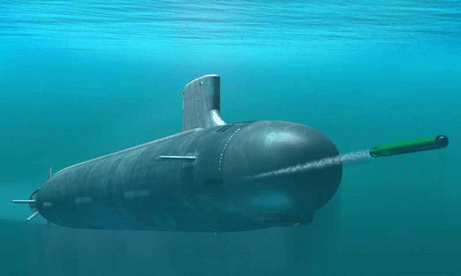
Evidence suggests Britain sent one of its Polaris submarines, which carried 16 ballistic missiles with thermonuclear warheads, to the Falklands during the 1982 war.
RICHARD NORTON-TAYLOR, 6 APRIL 2023 Declassified UK
The war in Ukraine has provoked concern about the use of nuclear weapons, heightened by Russia’s plan to base tactical nuclear arms in Belarus.
While the US and Russia have kmade no secret of their development of these dangerous, indeed potentially devastating, additions to traditional nuclear arsenals, British military planners have also been in on the act – rather more quietly.
The British government, far from taking measures to reduce nuclear tensions in recent years, itself announced, in 2021, that it planned to increase the cap on Britain’s nuclear stockpile to 260 warheads, a 40 per cent increase on previous commitments.
More recently, Britain has refused to comment on reports of a planned new deployment of US tactical nuclear weapons to the American air force base in Lakenheath in Suffolk.
With the exception of the Scottish National Party and Green Party, all British political parties are backing, with growing enthusiasm, the policy of maintaining a Trident missile submarine “continuously at sea”, at an initial estimated cost – not disputed by the Ministry of Defence – of more than £200bn.
The deployment of British nuclear weapons was belatedly highlighted during the 1982 Falklands conflict after the government failed to cover up their presence on ships in the naval task forces. Declassified revealed last year that British warships deployed to the South Atlantic were secretly carrying 31 nuclear depth charges.
But there have been repeated suggestions, never convincingly denied, that even more devastating weapons were deployed during the conflict.
A number of sources have indicated that a submarine equipped with Polaris strategic nuclear missiles – then Britain’s major nuclear weapons system and the forerunner to the current Trident – was diverted to the South Atlantic within range of Argentina.
Polaris
The claims were originally spelled out in a paper on “Sub Strategic Trident” by the widely respected academic, Paul Rogers, emeritus professor of peace studies at Bradford University………………………………………………………..
….the implications of the analysis – that the Thatcher government was prepared to threaten nuclear use against a non-nuclear state………………………………………………….
First use
This was all more than 40 years ago, but is still relevant today, given that the UK has maintained a nuclear posture that includes first-use of nuclear weapons since at least the 1960s. ……………………………….
Confusion, uncertainty
Successive British governments have deliberately used confusion – they call it uncertainty – over the circumstances in which nuclear weapons would be used to boost their argument that they are a “credible” deterrent. …………………………………………
Putin’s deployment of tactical nuclear weapons to Belarus has been condemned by NATO. But as Daniel Hogsta, executive director of ICAN, the International Campaign to Abolish Nuclear Weapons, has pointed out, the US stations nuclear weapons in five European countries – Belgium, the Netherlands, Germany, Italy and Turkey, and now in Britain as well, it seems – and is currently modernising its arsenal.
……………………………………… Putin’s earlier implied threats to use nuclear weapons in the war in Ukraine is rightly viewed as a dangerous and destabilising position to take. It is also uncomfortably close to the UK’s position during the Falklands War over 40 years ago. https://declassifieduk.org/did-uk-deploy-nuclear-armed-submarine-to-falklands-conflict/
More warheads, more nuclear waste to New Mexico. Santa Fe fearful, as Carlsbad leaders support efforts

“legacy waste” from past programs still waiting for disposal at Los Alamos was being disregarded in favor of the new streams the NNSA intended to generate.
“It’s heart-wrenching when you hear the young people concerned with manufacturing bombs.”
Adrian Hedden, Carlsbad Current-Argus 6 Apr 23,
Two meetings on nuclear waste were held in New Mexico this week, on different sides of the state with very different reactions from attendees.
On Tuesday, a townhall-style meeting was held in Santa Fe which more than 300 persons attended and about 200 participated online.
Most expressed fears and concerns that a federal plan to transport surplus plutonium to the Waste Isolation Pilot Plant near Carlsbad would endanger local communities along the transportation routes.
The next night at a meeting at the city golf course in Carlsbad, about 30 business leaders, elected officials and invited guests took a much warmer tone with the federal government and its plans for New Mexico and the nearby WIPP site.
Under the federally proposed plan, surplus plutonium would move via truck from the Pantex Plant near Amarillo, Texas to Los Alamos National Laboratory (LANL) in northern New Mexico for processing, then to the Savannah River Site in South Carolina for additional preparation before finally heading to WIPP for disposal.
By then, the 34 metric tons of plutonium set for disposal would meet characterization standards for transuranic (TRU) nuclear waste, meaning the program would not result in any waste of a higher radioactivity than that which the repository was intended to store.
But the program would see waste traveling through New Mexico, and especially the northern portion of the state, multiple times.
That’s a problem for Santa Fe County Commissioner Anna Hansen, who moderated the Tuesday meeting at the Santa Fe Convention Center with the Department of Energy’s National Nuclear Security Administration (NNSA) – the agency devising the plan – and argued it could burden her community with the risk of exposure.
At the same time, the NNSA also was planning to ramp up the production of plutonium pits, the triggers for nuclear warheads, at Los Alamos and Savannah River site, hoping to produce up to 80 pits a year by 2030.
Some of the waste from that program would also be destined for WIPP as it’s the only deep geological repository in the U.S. for nuclear waste.
“People feel betrayed,” Hansen said in an interview with the Carlsbad Current-Argus, arguing the two NNSA programs marked an “expansion” of WIPP’s operations beyond what New Mexico originally agreed to when the facility was developed.
She said “legacy waste” from past programs still waiting for disposal at Los Alamos was being disregarded in favor of the new streams the NNSA intended to generate.
“They still feel frustrated that the legacy waste at LANL has not been cleaned up and new waste is being generated and also going to WIPP,” Hansen said of attendees at the Santa Fe meeting. “It’s heart-wrenching when you hear the young people concerned with manufacturing bombs.”
Jack Volpato, chair of the Carlsbad Mayor’s Nuclear Task Force, commended the NNSA and the WIPP project at the Wednesday meeting in Carlsbad for supporting the local community, its workforce and economy in the decades since the site was opened……………………………………………………………………………
Hansen, the Santa Fe County commissioner, said the NNSA’s plans were extraneous to WIPP’s original mission and what should be its primary purpose: to get nuclear waste “off the hill” in Los Alamos.
That’s the only true benefit to the people of New Mexico who host the WIPP site, she said.
“It’s a complete expansion of WIPP’s mission to be putting new and generated waste,” Hansen said. “It’s insanity to move surplus plutonium around the country. We don’t want to continue being left behind. Waste from all over the country has been coming here.”………………………………………………… https://www.currentargus.com/story/news/2023/04/06/nuclear-waste-new-mexico-santa-fe-carlsbad-nuke-plutonium-department-energy-bombs-nuke-warhead/70080266007/
Saskatchewan must remember opposition to nuclear waste

A reader wants Saskatchewan people to recall a protest against nuclear waste 12 years ago now that nuclear power is being debated.
Don Kossick, Saskatoon, Apr 09, 2023 https://thestarphoenix.com/opinion/letters/letter-saskatchewan-must-remember-opposition-to-nuclear-waste
The recent 2023 federal budget showed clear support for small modular nuclear reactors or SMRs. It introduces a new 15 per cent refundable clean electricity investment tax credit.
Nuclear projects — both large-scale and SMRs — are eligible for the credit, which is available to both new projects and the refurbishment of existing facilities.
For Saskatchewan, it emboldens government, universities, institutions and uranium companies that have been pressuring for SMRs to be built in Saskatchewan.
With the SMRs will come the push for nuclear waste sites in Saskatchewan. Unfortunately, there is a short memory about the response of many communities in northern Saskatchewan who have rejected nuclear waste sites.
A north to south, community to community walk of 800 kilometres was organized in 2011, by the northern based Committee for Our Future Generations that opposed nuclear waste sites and presented the concerns of northern and southern communities to the Saskatchewan legislature.
The consideration of a nuclear waste dump site at Creighton was officially withdrawn by the federal Nuclear Waste Management Organization in 2015. The Creighton area had “geological complexities.”
The nuclear consortium and their friends need to back off trying to impose energy sources such as nuclear power that has its own deadly impact and is not sustainable.
Our governments need to put monies into renewable, sustainable alternatives that do not involve ripping up and polluting the environment for, in some cases, hundreds upon hundreds of years.
Convincing major powers to abide by ASEAN’s nuclear treaty is challenging
A. Muh. Ibnu Aqil (The Jakarta Post) 9 Apr 23,
While China’s expressed intent to sign the protocol for ASEAN’s nuclear weapon free zone treaty should be supported, convincing other nuclear weapon states to follow suit may be a challenge, experts have said.
In 1995, 10 ASEAN member states signed the Southeast Asian Nuclear-Weapon-Free Zone Treaty (SEANWFZ) or the Bangkok Treaty, designating the region as one free of nuclear weapons.
The treaty also has a protocol open to signature by recognized nuclear weapon states China, France, Russia, the United Kingdom and the United States, but none have signed the protocol, objecting to the inclusion of continental shelves and exclusive economic zones in the nuclear weapon free zone. https://www.thejakartapost.com/world/2023/04/09/convincing-major-powers-to-abide-by-aseans-nuclear-treaty-is-challenging.html
Failed Ukrainian nuclear plant attack revealed – The Times

An elite force tried to seize the Zaporozhye NPP last autumn, the newspaper’s sources have claimed.
A “highly dangerous” Ukrainian operation to capture the Zaporozhye nuclear power plant last year ended in failure due to heavy Russian resistance, The Times reported on Friday, citing sources.
According to Kiev’s military personnel interviewed by the British newspaper, the attack involved some 600 elite Ukrainian soldiers who tried to cross the Dnieper River on October 19 by boat.
The operation hinged on the presumption that Moscow’s troops would not be able to fire artillery so close to the nuclear power plant, which is the largest in Europe, one officer told The Times.
However, the paper’s sources said the team met unexpected resistance. Moscow’s forces had “mined everything” and “even pulled up tanks and artillery” to fire on Kiev’s forces while they were on the water, the officer added.
The assault was supported by Ukrainian artillery, including US-made HIMARS systems, but Russian resistance resulted in only a fraction of the Ukrainian force coming ashore. After a three-hour firefight on the outskirts of Energodar, where the plant is located, the Ukrainian soldiers were forced to retreat, the report says.
Some senior Ukrainian officials viewed the offensive as controversial, with the president of Ukraine’s nuclear operator Energoatom, Pyotr Kotin, telling The Times: “it is very dangerous to do such things near nuclear material. Any damage will bring radiation to the people and to the whole world.”
The report corroborates a Russian Defense Ministry statement at the time claiming that on October 19 Kiev’s forces attempted – without success – to mount an amphibious operation in the area, involving up to two Ukrainian companies and a total of 37 boats. The military claimed Ukraine lost over 90 soldiers in the operation.
Russia and Ukraine have repeatedly accused each other of shelling the Zaporozhye NPP, which has been under Moscow’s control since last February. Russian officials have on numerous occasions warned that Kiev’s attacks could trigger a nuclear disaster.
The International Atomic Energy Agency (IAEA) has called on both parties to create a safe zone around the facility, but the negotiations on the matter have failed to achieve a breakthrough.
In late March, Rafael Grossi, the nuclear watchdog’s chief, said the idea was no longer being considered. Instead of establishing a safe zone, the IAEA now wants Kiev and Moscow to promise not to target the plant, or use it for staging attacks.
Ukraine will eventually reveal ‘horrible’ losses – ambassador
https://www.rt.com/russia/574421-ukraine-losses-horrible-russia/ 9 Apr 23
The true number of casualties will be acknowledged only once the conflict is over, Vadim Pristaiko has said.
Ukraine will reveal the extent of its “horrible” losses once its conflict with Russia is over, Vadim Pristaiko, Kiev’s ambassador to the UK, said in an interview released on Friday.
Asked by British tabloid the Daily Express to comment on casualties among Ukrainian military personnel and civilians, Pristaiko said “it has been our policy from the start not to discuss our losses.”
When the war is over, we will acknowledge this. I think it will be a horrible number,” he added.
Pristaiko dismissed any possibility of talks between Moscow and Kiev – at least until Russia withdraws its troops from the territories Ukraine claims as its own. “So, we have to fight to the very last of them or, very unfortunately, the last of us as well,” the envoy said.
The ambassador also commented on the assault brigades that Ukraine says it has assembled for a much-anticipated spring offensive against Russia. “Whoever says there are 40,000 men in these brigades, I would like to point out that we have mobilized a million men,” Pristaiko stated.
Both sides of the Ukraine conflict rarely provide data on their losses. However, last autumn, EU Commission President Ursula von der Leyen put Kiev’s fatalities at 100,000, a claim that was disputed by Ukraine and later removed from the official’s website. In December, Mikhail Podoliak, a senior aide to Ukrainian President Vladimir Zelensky, put the death toll among Kiev’s military at between 12,000 and 13,000 people.
Russia has not officially updated its losses since last September, when Moscow’s Ministry of Defense estimated that 5,937 service members had died.
Pristaiko’s comments come as Ukrainian and Western officials claim that Ukraine will launch a counteroffensive in the coming weeks. Commenting on statements about a potential Ukrainian push, Kremlin Press Secretary Dmitry Peskov noted that the Russian military “thoroughly tracks all the relevant information” on the matter.
8 peaceful protestors arrested at the Nevada National “Security” Site

Nonviolent Activism, North America
By Nevada Desert Experience, April 8, 2023 https://worldbeyondwar.org/8-arrested-at-the-nevada-national-security-site/
On Good Friday, April 7, 2023 , 8 concerned citizens were arrested and cited for trespass at the Nevada National “Security” Site insisting on nuclear weapons abolition. On April 10, 2023 Brian Terrell and John Amidon will appear in Beatty Justice Court for trespass citations from October 2022.
The NDE Sacred Peace Walk engaged the Department of Energy and the Nye County Sheriff’s department in dialogue and civil resistance. Jacques Linder, Philadelphia, PA, Richard Bishop, Missoula, MT, Sylver Pondolfino, Staten Island, NY, Tessa Epstein, Salt Lake City, Utah, Mark Babson, Salem, Oregon, George Killingsworth, Berkeley, CA, Theo Kayser, St. Louis, MO, Catherine Hourcade, Stockton, CA were arrested, cited for trespass and released at the NNSS.
Mark Babson said “I felt the arresting officers were listening to us. It is so vital we continue this work because we have the ability to make a significant choice that will effect the survival of our species and that of other living beings.”
Brian Terrell and John Amidon will appear in Beatty Justice Court, Monday morning for previous trespass citations at the NNSS from last October, 2022. Both have pleaded not guilty as both had permission and land use permits from the Western Shoshone National Council, the legal owners of this land.
Many Speakers Voice Concern over Increase in Dangerous Nuclear Weapons Rhetoric amidst Ongoing War against Ukraine, as Disarmament Commission Opens Session
United Nations 3 Apr 23
The Disarmament Commission’s 2023 substantive session began today by bringing into sharp focus the nuclear risks faced by the international community, as speakers stressed the alarming increase of dangerous nuclear rhetoric amidst the ongoing war in Ukraine and the crucial need to prioritize disarmament, non-proliferation and arms control measures.
Under-Secretary-General and High Representative for Disarmament Affairs Izumi Nakamitsu, delivering opening remarks, issued a warning that the risk of a nuclear weapon being used, whether intentionally or by mistake, is currently higher than it has been at any point since the height of the cold war.
“I want to be clear: risk reduction is not a substitute for nuclear disarmament, indeed the only way to eliminate the risks associated with nuclear weapons is to completely eliminate the nuclear weapons themselves,” she stressed.
The Under-Secretary-General emphasized that the acquisition of more nuclear weapons, as well as the development of more sophisticated delivery systems, do not reduce the risk of a nuclear incident. She underscored that the Treaty on the Non-Proliferation of Nuclear Weapons is the foundation of the nuclear disarmament and non-proliferation regime, expressing concern over the erosion of confidence and trust in the critical framework……………………………………………………………….
During the discussion, multiple speakers called on Member States to align themselves with the conclusions of the Conference on the Establishment of a Middle East Zone Free of Nuclear Weapons and Other Weapons of Mass Destruction. They highlighted that the establishment of a nuclear-free zone in the Middle East is crucial for achieving peace in that region.
In addition to nuclear proliferation, cyber and space are increasingly becoming critical to international security, many speakers pointed out, with Portugal’s representative warning that the development of space-based weapons poses significant risks to destabilizing the international security environment. These weapons could potentially target critical space infrastructure such as satellites used for communication and navigation and threaten daily life………………………………………. more https://press.un.org/en/2023/dc3847.doc.htm
‘Brink of nuclear war’: North Korea warning on military drills
Aljazeera, 6 Apr 23,
Pyongyang’s state media publishes warning as United States and South Korea continue joint military exercises.
North Korea has accused the United States and South Korea of escalating tensions “to the brink of nuclear war” through their joint military drills and promised to respond with “offensive action,” according to state media KCNA.
A commentary published by KCNA on Thursday criticised the continuing exercises as “a trigger for driving the situation on the Korean peninsula to the point of explosion.”
…………………… US and South Korean forces have been conducting a series of annual springtime exercises since March, including air and sea drills involving a US nuclear-powered aircraft carrier as well as B-1B and B-52 bombers, and their first large-scale amphibious landing drills in five years. On Wednesday, B52s were deployed for their first use on the peninsula in a month.
……………………. North Korea views such exercises as a rehearsal for invasion.
Pyongyang carried out a record number of weapons tests last year and has been ramping up its military activity in recent weeks. It has unveiled new, smaller nuclear warheads, fired its longest-range intercontinental ballistic missile – the Hwasong 17 – and tested a nuclear-capable underwater drone that is under development. It also fired cruise missiles from a submarine…………………………………… https://www.aljazeera.com/news/2023/4/6/brink-of-nuclear-war-north-korea-warning-on-military-drills
—
1 This Month
Chernobyl: The Lost Tapes – A good documentary on Chernobyl on SBS available On Demand for the next 3 weeks– https://www.sbs.com.au/ondemand/tv-program/chernobyl-the-lost-tapes/2352741955560

of the week–London Campaign for Nuclear Disarmament

Tell the Ukrainian Government to Drop Prosecution of Peace Activist Yurii Sheliazhenko
To see nuclear-related stories in greater depth and intensity – go to https://nuclearinformation.wordpress.com
-
Archives
- April 2026 (139)
- March 2026 (251)
- February 2026 (268)
- January 2026 (308)
- December 2025 (358)
- November 2025 (359)
- October 2025 (376)
- September 2025 (257)
- August 2025 (319)
- July 2025 (230)
- June 2025 (348)
- May 2025 (261)
-
Categories
- 1
- 1 NUCLEAR ISSUES
- business and costs
- climate change
- culture and arts
- ENERGY
- environment
- health
- history
- indigenous issues
- Legal
- marketing of nuclear
- media
- opposition to nuclear
- PERSONAL STORIES
- politics
- politics international
- Religion and ethics
- safety
- secrets,lies and civil liberties
- spinbuster
- technology
- Uranium
- wastes
- weapons and war
- Women
- 2 WORLD
- ACTION
- AFRICA
- Atrocities
- AUSTRALIA
- Christina's notes
- Christina's themes
- culture and arts
- Events
- Fuk 2022
- Fuk 2023
- Fukushima 2017
- Fukushima 2018
- fukushima 2019
- Fukushima 2020
- Fukushima 2021
- general
- global warming
- Humour (God we need it)
- Nuclear
- RARE EARTHS
- Reference
- resources – print
- Resources -audiovicual
- Weekly Newsletter
- World
- World Nuclear
- YouTube
-
RSS
Entries RSS
Comments RSS
 nuclear-news