Ukraine’s Zaporizhzhia power plant: How prepared is Europe for a future nuclear disaster?
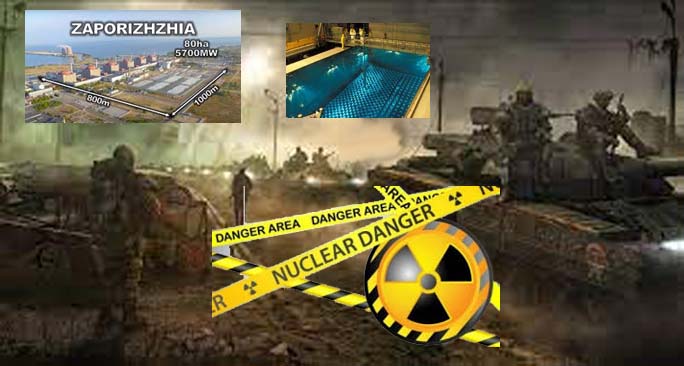
It raises the question, too, of whether we should rely on nuclear power at all.
It raises the question, too, of whether we should rely on nuclear power at all.
euro news.next, By Camille Bello 31/03/2023
Russia’s invasion has repeatedly knocked out Ukraine’s electricity grid, causing blackouts at the Zaporizhzhia nuclear plant – Europe’s largest – where a constant power supply is needed to prevent the reactors from overheating.
On March 9, the plant blacked out for the sixth time since the occupation, forcing nuclear engineers to switch to emergency diesel generators to power its essential cooling equipment running.
“Each time we are rolling a dice,” Rafael Mariano Grossi, the director general of the United Nations’ International Atomic Energy Agency (IAEA), warned at the time. “And if we allow this to continue time after time, then one day, our luck will run out”.
On Monday, during a meeting with Ukraine’s president Volodymyr Zelensky, Grossi reiterated the situation “isn’t getting any better” as relentless fighting in the area keeps the facility at risk of a disaster.
The IAEA watchdog has called for a “protection zone” around the plant but has failed to devise terms that would satisfy both Ukraine and Russia.
Grossi told the AP on Tuesday he believed a deal was “close”. However, Zelenskyy, who opposes any plan that would legitimise Russia’s control over the facility, said he was less optimistic a deal was near. “I don’t feel it today,” he said.
Is Zaporizhzhia really at risk?
Nuclear power plants are designed to withstand a wide range of risks, but no operating nuclear power plant has ever been caught up in modern warfare.
Because of the repeated crossfire, Zaporizhzhia’s last reactor was shut down in September as a precautionary measure. But external power is still essential to run critical cooling and other safety systems.
Fears about Zaporizhzhia have exacerbated existing concerns around our lack of preparedness for any nuclear-related incident, laying bare anxieties not necessarily around war-related incidents but about climate change and Europe’s old reactors, for instance.
It raises the question, too, of whether we should rely on nuclear power at all.
March 11 marked the 12-year anniversary of the massive earthquake and tsunami that caused the second-worst nuclear accident in history at the Fukushima Daiichi Nuclear Power Plant in Japan.
The anniversary of the catastrophic meltdown that left 160,000 people displaced and cost the Japanese government over €176 billion, was another reminder of the potential threat of a nuclear spill, but a number of other recent events have also raised the alarm in Europe, not least the war in Ukraine.
‘We are not properly prepared’
Europe’s nuclear power reactors are ageing – they were built on average 36.6 years ago – and recent checkups in France have found cracks in several facilities.
Some energy experts have warned that the extreme weather events brought on by climate change could pose a serious threat to the EU’s 103 nuclear reactors, which account for about one-quarter of the electricity generated in the bloc.
Jan Haverkamp, a senior nuclear energy and energy policy expert for Greenpeace, said the chances of Europe seeing a large accident like Fukushima were now “realistic” and “we should take them into consideration”.
“We are not properly prepared,” he told Euronews Next…………………………………………………….
The maintenance of a nuclear plant depends on a number of factors, such as its design and its supervision history. But there are other factors that come into play, such as error-prone humans, earthquakes, tsunamis, fires, flooding, tornadoes or even in the case of Zaporizhzhia, acts of war…………………………………………………………………………………… more https://www.euronews.com/next/2023/03/31/chernobyl-fukushima-europe-prepared-nuclear-disaster-ukraine-earthquake-meltdown-radiation
Nuclear winter webinar.

March 31, 2023
more https://beyondnuclear.org/nuclear-winter-webinar/ The Samuel Lawrence Foundation is hosting its “First Friday” Zoom Event at 11:30 AM PST (2:30 PM EST), Friday, April 7, 2023 featuring Brian Toon, Department of Atmospheric and Oceanic Sciences, Laboratory for Atmospheric and Space Physics, University of Colorado at Boulder on “Nuclear Winter: The Environmental Consequences of a Nuclear Exchange.” The event is moderated by Professor Paul Dorfman, Chair of Nuclear Consulting Group, University of Sussex, UK. Professor Toon is a world renowned researcher on the environmental and climate consequences of nuclear war. Even a limited conflict between nuclear-armed India and Pakistan, an exchange of 100 nuclear weapons, would have global climate changing consequences. Click here to register for the April 7th webinar.
THE LAST THING THE UKRAINIAN PEOPLE NEED IS DEPLETED URANIUM

27 Mar 2023 • by Kate Hudson, Stop the War Coalition
KATE HUDSON: THE USE OF DU RUNS COUNTER TO THE BASIC RULES AND PRINCIPLES OF INTERNATIONAL HUMANITARIAN LAW
In a shocking development, the government has announced it will be sending depleted uranium (DU) rounds to Ukraine along with Challenger 2 tanks. As we know from several wars in the past few decades, the health consequences for Ukrainian civilians will be high. DU is a chemically toxic and radioactive heavy metal and it’s a by-product of the enrichment process used to make reactor-grade uranium. Its chemical and physical properties have made it popular for a range of military and commercial uses: its density and its ability to self-sharpen attracted the attention of the US Department of Defense (DoD) in the late 1950s. The military was looking to increase the armour piercing capacity of munitions and to strengthen the armour of tanks. DU seemed to fit the bill. But its use has had a devastating impact on the populations caught up in numerous conflicts, with the terrible type of health consequences that we associate with radiation impacts.
………………………. The risk is not that DU munitions will cause a nuclear explosion. It’s that the impact of their use causes toxic or radioactive dust to be released and if this is subsequently inhaled or ingested in other ways, it has very significant negative health consequences. After the first Gulf War the DoD Office of the Special Assistant for Gulf War Illnesses (OSAGWI) identified a number of DU exposure scenarios including through wounds caused by DU fragments, inhalation of airborne DU particles, ingestion of DU residues, or wound contamination by DU residues.
DU munitions were used on a large scale by the US and UK in the Gulf War in 1991 and in Iraq in 2003. Their use has caused a sharp increase in the incidence rates of some cancers, such as breast cancer and lymphoma, in the areas where it has been used. It has also been implicated in a rise in birth defects from areas adjacent to the main Gulf War battlefields. Other health problems associated with DU include kidney failure, nervous system disorders, lung disease and reproductive problems.
A report funded by the Norwegian Ministry of Foreign Affairs in 2013 showed that more than 400 tonnes of DU ammunition were estimated to have been used in 1991 and 2003, the vast majority by US forces. The report showed that the Iraqi government’s Radiation Protection Centre had identified between 300 and 365 contaminated sites by 2006, mostly in the Basra region in southern Iraq. As well as warning of contamination being spread by poorly regulated scrap metal dealers, including children, it also shared evidence that DU munitions were fired at light vehicles, buildings and other civilian infrastructure including the Iraqi Ministry of Planning in Baghdad – in spite of official assurances of military-only armoured targets.
Its use in the former Yugoslavia by NATO forces in 1995 and 1999 led to the same type of consequences. It was also used by the US in Syria in 2015. The impacts have not been confined to local populations – they have also affected the troops involved in or close to their use, and also military clean-up teams sent to deal with the impact of the DU. The severe health consequences have led to the terms ‘Gulf War syndrome’ and ‘Balkan syndrome’ entering our vocabulary. The Ministry of Defence disputes the risks of DU, yet it recommends ‘ongoing surveillance’ for veterans with embedded DU fragments.
No treaty explicitly banning the use of DU is yet in force, but it is clear that its use runs counter to the basic rules and principles of International Humanitarian Law. In 2006, the European Parliament strengthened its previous calls for a moratorium by calling for an introduction of a total ban, classifying the use of DU, along with white phosphorus, as inhumane. Since 2007, repeated UN General Assembly resolutions have highlighted serious concerns over the use of DU weapons. The UK, together with the US, France and Israel are the only states that have consistently voted against the resolutions.
The British government must put an immediate end to its use of DU – inflicting it on the people of Ukraine is the last thing they need. https://www.stopwar.org.uk/article/the-last-thing-the-ukrainian-people-need-is-depleted-uranium/?link_id=14&can_id=6af7fc84f5bc6c4d25d736c71bd0eab7&source=email-europe-for-peace-stop-the-war-in-ukraine-3&email_referrer=email_1865172&email_subject=uniting-european-anti-war-forces
IAEA head warns on danger of intensified fighting near Zaporizhzhia nuclear power plant
The head of the United Nations atomic energy commission said on Wednesday
that intensified fighting near Europe’s largest nuclear power plant poses
a threat to the facility’s safety. The increasing combat makes it urgent
to find a way to prevent a catastrophic nuclear accident at the
Zaporizhzhia nuclear power plant, said International Atomic Energy Agency
director general Rafael Mariano Grossi. “It is obvious that this area is
facing perhaps a more dangerous phase,” he said of the facility, which is
in a partially Russian-occupied part of Ukraine. “We have to step up our
efforts to get to some agreement over the protection of the plant.”
Morning Star 30th March 2023
https://morningstaronline.co.uk/article/w/un-agency-warns-rising-combat-near-ukraine-nuclear-plant
Inglorious inertia: The Australian Albanese Government and Julian Assange
Australian Independent Media, April 1, 2023, Dr Binoy Kampmark
The sham that is the Assange affair, a scandal of monumental proportions connived in by the AUKUS powers, shows no signs of abating. Prior to Prime Minister Anthony Albanese assuming office in Australia, he insisted that the matter dealing with the WikiLeaks publisher would be finally resolved. It had, he asserted, been going on for too long.
Since then, it is very clear, as with all matters regarding US policy, that Australia will, if not agree outright with Washington, adopt a constipated, non-committal position. “Quiet diplomacy” is the official line taken by Albanese and Australian Foreign Minister Penny Wong, a mealy-mouthed formulation deserving of contempt. As Greens Senator David Shoebridge remarks, “‘quiet diplomacy’ to bring Julian Assange home by the Albanese Government is a policy of nothing. Not one meeting, phone call or letter sent.”
Kellie Tranter, a tireless advocate for Assange, has done sterling work uncovering the nature of that position through Freedom of Information requests over the years. “They tell the story – not the whole story – of institutionalised prejudgment, ‘perceived’ rather than ‘actual’ risks, and complicity through silence.”
The story is a resoundingly ugly one. It features, for instance, stubbornness on the part of US authorities to even disclose the existence of a process seeking Assange’s extradition from the UK, to the lack of interest on the part of the Australian government to pursue direct diplomatic and political interventions
Former Australian Foreign Minister Julie Bishop exemplified that position in signing off on a Ministerial Submission in February 2016 recommending that the Assange case not be resolved; those in Canberra were “unable to intervene in the due process of another’s country’s court proceedings or legal matters, and we have full confidence in UK and Swedish judicial systems.” Given the nakedly political nature of the blatant persecution of the WikiLeaks founder, this was a confidence both misplaced and disingenuous.
The same position was adopted by the Australian government to the United Nations Working Group on Arbitrary Detention (WGAD), which found that same month that Assange had been subject to “different forms of deprivation of liberty: initial detention in Wandsworth prison which was followed by house arrest and his confinement at the Ecuadorean embassy.” The Working Group further argued that Assange’s “safety and physical integrity” be guaranteed, that “his right to freedom of movement” be respected, and that he enjoy the full slew of “rights guaranteed by the international norms on detention.”………………………….
At the time, such press outlets as The Guardian covered themselves in gangrenous glory in insisting that Assange was not being detained arbitrarily and was merely ducking the authorities in favour of a “publicity stunt”………………………………
The new Australian High Commissioner to the United Kingdom, Stephen Smith, has kept up that undistinguished, even disgraceful tradition: he has offered unconvincing, lukewarm support for one of Belmarsh Prison’s most notable detainees. ……………………………………
As with his predecessors, Smith is making his own sordid contribution to assuring that the WikiLeaks founder perishes in prison, a victim of ghastly process.
As for what he would be doing to impress the UK to reverse the decision of former Home Secretary Priti Patel to extradite the publisher to the US, Smith was painfully predictable. “It’s not a matter of us lobbying for a particular outcome. It’s a matter of me as the High Commissioner representing to the UK government as I do, that the view of the Australian government is twofold. It is: these matters have transpired for too long and need to be brought to a conclusion, and secondly, we want to, and there is no difficulty so far as UK authorities are concerned, we want to discharge our consular obligations.”……………………… https://theaimn.com/inglorious-inertia-the-albanese-government-and-julian-assange/
;
An obnoxious clause in Canada’s draft Act for Implementing the United Nations Declaration on the Rights of Indigenous Peoples (UNDRIP)

First -let’s see what the Assembly of First Nations of Canada (AFN) say about Small Modular Nuclear Reactors
The AFN resolution from 2018 against SMRs, available HERE says:
THEREFORE BE IT RESOLVED that the Chiefs-in-Assembly:
1. Demand that free, prior and informed consent is required to ensure that no storage or disposal of hazardous
materials shall take place in First Nations lands and territories.
2. Demand that the Nuclear Industry abandon its plans to operate Small Modular Nuclear Reactors in Ontario and
elsewhere in Canada.
3. Demand that the Government of Canada cease funding and support of the Small Modular Nuclear Reactors
program.
4. Direct that the National Chief and appropriate staff work to ensure that the Nuclear Industry and the Canadian Government abandon this program.
Now see what the Government includes in this draft Act
In the Environment section of Canada’s draft Act for Implementing the United Nations Declaration on the Rights of Indigenous Peoples (UNDRIP)- the specific SMRs text is found, in Chapter 1, Shared priorities. https://www.justice.gc.ca/eng/declaration/ap-pa/ah/p3.html
The Government of Canada will take the following actions……………
44. Increase capacity for Indigenous peoples to meaningfully engage, make informed decisions, and participate financially in clean energy alternatives like Small Modular Reactors (SMRs). SMRs in Canada are developing along three parallel streams including near-term on-grid, next generation and micro/off-grid, and there is potential for multiple benefits including use in remote Indigenous communities for abating emissions of heavy industry and increasing energy security. (Natural Resources Canada)
Julian Assange – when “quiet diplomacy” means diddly squat

How could a conversation between President Biden, PM Albanese and PM Sunak, which he was in just two weeks ago, not be the most important kind of quiet diplomacy to use to free Julian Assange? And why wasn’t it used?
by Rex Patrick | Mar 31, 2023 | What’s the scam? https://michaelwest.com.au/julian-assange-when-quiet-diplomacy-means-diddly-squat/
Foreign Affairs Minister Penny Wong has all but confirmed in Parliament the government is doing nothing to bring the world’s foremost political prisoner home. What’s the scam with “quiet diplomacy”?
Despite claiming the government is deploying “quiet diplomacy” to urge the US to free Julian Assange, and despite the government committing to a $368b spend on submarines – the biggest transfer of public money in Australia’s history – to US and UK weapons makers, there is no evidence whatsoever that our elected representatives have even muttered one word on the matter.
Thursday at 2:14 pm, Senator Shoebridge stood up in question time and asked Senator Wong a question about Julian Assange. He asked whether Prime Minster Anthony Albanese had used the opportunity created by the March 14, AUKUS ‘Kabuki Show’ to lobby for the release of Assange.
Senator Wong did all things possible to avoid having to say “no.”
Shoebridge acknowledged the implied “no” when he asked further:
How could a conversation between President Biden, PM Albanese and PM Sunak, which he was in just two weeks ago, not be the most important kind of quiet diplomacy to use to free Julian Assange? And why wasn’t it used?
Wong again ducked and weaved and then said, “We are doing what we can between government and government, but there are limits to what that diplomacy can achieve.”
wo and half hours later, in the last working minute of the day that Parliament was set to rise until May, the Department of Foreign Affairs sent me the response to an FOI request for “all cablegrams sent between the Department of Foreign Affairs and Trade and the Embassy of Australia, Washington DC, since 24 November 2022 that relate to Julian Paul Assange”. They advised:
“Thorough searches conducted by the Consular Operations Branch and the United States, United Kingdom & Canada Branch found no documents.”
The scam is, that while the government purports to be working quietly in background on the release of Julian Assange, the reality is that they are doing nothing.
It’s disgraceful deceit.
China’s new warning to Australia over nuclear submarine deal
China has fired off another dire warning to Australia, amid growing tension over the nuclear submarine deal with the US and Britain.
Carla Mascarenhas, 1 Apr 23
Global superpowers unite against US
‘Anytime, anywhere’: Kim’s nuke threat
Dan appears on Chinese TV
China has fired off a frightening warning to Australia over its nuclear submarines deal with the US and the UK, declaring it may trigger an unpredictable global arms race.
The Chinese foreign ministry said on Thursday that once a Pandora’s box is opened, the “regional strategic balance will be disrupted and regional security will be seriously threatened”.
The United States, Australia and UK this month unveiled details of a plan to provide Australia with nuclear-powered attack submarines from the early 2030s to counter China’s ambitions in the Indo-Pacific.
“China firmly opposes the establishment of the so-called ‘trilateral security partnership’ between the United States, the United Kingdom and Australia,” said Tan Kefei, a spokesman at the Chinese defence ministry, during a regular press briefing.
“This small circle dominated by Cold War mentality is useless and extremely harmful.”
Mr Tan added such co-operation was an extension of the nuclear deterrence policy of individual countries, a game tool for building an “Asia-Pacific version of NATO” and seriously affected peace and stability in the Asia-Pacific region………………………………………………………….
Richard Dunley, a naval and diplomatic historian, said the deal “looks best from Washington – they get major wins in terms of basing, maintenance support and recapitalisation in their yards”.
He noted the Australian perspective was “less clear”.
“The cost is astronomical,” he wrote on Twitter.
Huge but still unknown amounts will be paid to the US in subsidies and then to buy the Virginias. This capability will only realise materialise mid-next decade, and is only a stopgap.”
carla.mascarenhas@news.com.au https://www.news.com.au/world/asia/chinas-new-warning-to-australia-over-nuclear-submarine-deal/news-story/16904f97d0a534af20dd69815f9c1986
Canadian First Nations do not want small nuclear reactors on their lands

Decolonizing energy and the nuclear narrative of small modular reactors https://policyoptions.irpp.org/magazines/february-2022/decolonizing-energy-and-the-nuclear-narrative-of-small-modular-reactors/
Kebaowek First Nation is calling for an alternative to a planned SMR project, one that won’t undermine proper consultation and leave a toxic legacy.
by Lance Haymond, Tasha Carruthers, Kerrie Blaise, February 7, 2022 In early 2021, the Canadian Nuclear Safety Commission began reviewing the application from a company called Global First Power to build a nuclear reactor at the Chalk River Laboratories site about 200 kilometres northwest of Ottawa.
This project, known as a micro modular reactor project, is an example of the nuclear industry’s latest offering – a small modular reactor (SMR).SMRs are based on the same fundamental physical processes as regular (large) nuclear reactors; they just produce less electricity per plant. They also produce the same dangerous byproducts: plutonium and radioactive fission products (materials that are created by the splitting of uranium nuclei). These are all dangerous to human health and have to be kept away from contact with people and communities for hundreds of thousands of years. No country has so far demonstrated a safe way to deal with these.
Despite these unsolved challenges, the nuclear industry promotes SMRs and nuclear energy as a carbon-free alternative to diesel for powering remote northern communities. The Canadian government has exempted small modular reactors from full federal environmental assessment under the Impact Assessment Act. Many civil society groups have condemned this decision because it allows SMRs to escape the public scrutiny of environmental, health and social impacts.
The proposed new SMR in Chalk River, like the existing facilities, would be located on Algonquin Anishinabeg Nation territory and the lands of Kebaowek First Nation – a First Nation that has never been consulted about the use of its unceded territory and that has been severely affected by past nuclear accidents at the site.
At this critical juncture of climate action and Indigenous reconciliation, Kebaowek First Nation is calling for the SMR project at Chalk River to be cancelled and the focus shifted to solutions that do not undermine the ability of First Nations communities to be properly consulted and that do not leave behind a toxic legacy.
While these reactors are dubbed “small,” it would be a mistake to assume their environmental impact is also “small.” The very first serious nuclear accident in the world involved a small reactor: In 1952, uranium fuel rods in the NRX reactor at Chalk River melted down and the accident led to the release of radioactive materials into the atmosphere and the soil. In 1958, the same reactor suffered another accident when a uranium rod caught fire; some workers exposed to radiation continue to battle for compensation.
What makes these accidents worse – and calls into question the justification for new nuclear development at Chalk River – is that this colonized land is the territory of the Algonquin Anishinabeg Nation territory (which consists of 11 First Nations whose territory stretches along the entire Ottawa River watershed straddling Quebec and Ontario). Kebaowek First Nation, part of the Algonquin Nation, was among those First Nations never consulted about the original nuclear facilities on their unceded territory, and is still struggling to be heard by the federal government and nuclear regulator. Its land has never been relinquished through treaty; its leaders and people were never consulted when Chalk River was chosen as the site for Canada’s first nuclear reactors; and no thought was given to how the nuclear complex might affect the Kitchi Sibi (the Ottawa River).
History is being repeated at Chalk River today as the government pushes ahead with the micro modular reactor project without consent from Kebaowek. Assessments of the project have been scoped so narrowly that they neglect the historical development and continued existence of nuclear facilities on Kebaowek’s traditional territory. The justification for an SMR at this location without full and thorough consideration of historically hosted nuclear plants – for which there was no consultation nor accommodation – is a tenuous starting point and one that threatens the protection of Indigenous rights.
The narrative of nuclear energy in Canada is one of selective storytelling and one that hides the reality of the Indigenous communities that remain deeply affected, first by land being taken away for nuclear reactor construction, and later by the radioactive pollution at the site. All too fitting is the term radioactive colonialism coined by scholars Ward Churchill and Winona LaDuke, to describe the disproportionate impact on Indigenous people and their land as a result of uranium mining and other nuclear developments. In country after country, the uranium that fuels nuclear plants has predominantly been mined from the traditional lands of Indigenous Peoples at the expense of the health of Indigenous Peoples and their self-determination.
Kebaowek First Nation has been vocal in its objection to the continuation of the nuclear industry on its lands without its free prior and informed consent, as is its right under the United Nations Declaration on the Rights of Indigenous Peoples (UNDRIP). Despite requests for the suspension of the SMR project, pending adequate provisions for Indigenous co-operation and the Crown’s legal duty to initiate meaningful consultation, Kebaowek has yet to see its efforts reflected in government decisions and Crown-led processes.
Nuclear is a colonial energy form, but it is also bio-ignorant capitalism – a term coined by scholars Renata Avila and Andrés Arauz to describe the ways in which the current economic order ignores the planetary climate emergency, human and ecological tragedies, and the large-scale impact on nature. The narrative of nuclear as a “clean energy source” is a prime example of this bio-ignorance. Decision-makers have become fixated on carbon emissions as a metric for “clean and green,” ignoring the radioactive impacts and the risks of accidents with the technology.
It is more than 70 years since Chalk River became the site for the splitting of the nucleus. The continuation of nuclear energy production on unceded Indigenous territory without meaningful dialogue is a telling example of continued colonial practices, wherein companies extract value from Indigenous land while polluting it; offer little to no compensation to impacted communities; and abide by timelines driven by the project’s proponents, not the community affected. We need to move away from this colonial model of decision-making and decolonize our energy systems.
The challenge of climate change is urgent, but responses to the crisis must not perpetuate extractivist solutions, typical of colonial thinking, wherein the long-term impacts – from the production of toxic waste to radioactive releases – lead to highly unequal impacts.
The authors thank Justin Roy, councilor and economic development officer at Kebaowek First Nation, and M.V. Ramana, professor at the School of Public Policy and Global Affairs at the University of British Columbia, for contributing to this article.
TEPCO visually confirms melted nuclear fuel at Fukushima plant
THE ASAHI SHIMBUN, March 31, 2023 , This article was written by Keitaro Fukuchi, Ryo Sasaki and Takuro Yamano.
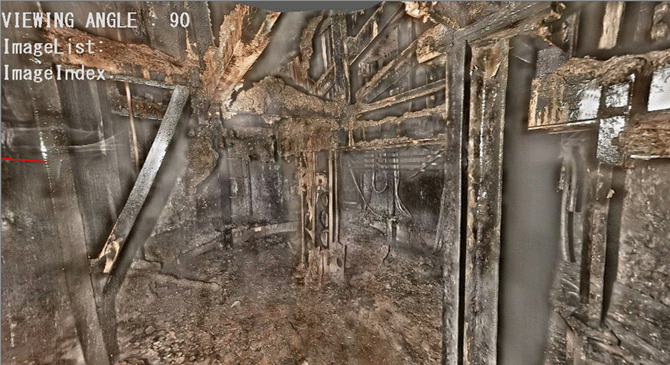
A robotic study provided the first visual confirmation that melted nuclear fuel broke through a pressure vessel at the Fukushima No. 1 nuclear power plant, the government and Tokyo Electric Power Co. said March 30.
Images taken by the robot under the No. 1 reactor at the plant also confirmed heavy damage to a concrete “pedestal” under the pressure vessel.
The inspection by the robot started on March 29. It was the first such study at the No. 1 reactor, one of the three reactors that melted down at the plant following the Great East Japan Earthquake and tsunami in 2011.
More than 90 percent of the nuclear fuel at the No. 1 reactor is believed to have fallen from the pressure vessel.
The robot found a large amount of melted fuel debris under the pressure vessel.
……………. TEPCO still faces the difficult challenge of how to remove the fuel debris and how to protect the damaged pedestal from future earthquakes.
The meltdown at the No. 1 reactor is believed to be worse than those at the No. 2 and No. 3 reactors at the plant.
The International Research Institute for Nuclear Decommissioning estimates the No. 1 reactor building contains 279 tons of melted fuel debris.
Naoyuki Takaki, a professor of nuclear safety engineering at Tokyo City University, said the fuel debris “cannot be taken out unless it is broken down into small pieces.”
Takaki said the method for cutting up such chunks will depend on the ratio and hardness of metal mixed in with the melted fuel.
But the information on objects within the fuel debris is limited so far.
“To put it briefly, it is unknown,” Takaki said.
The No. 1, No. 2 and No. 3 reactors at the Fukushima plant contain an estimated total of 880 tons of melted fuel debris.
TEPCO officials aim to start removal work of the fuel debris at the No. 2 reactor in the latter half of fiscal 2023. The initial plan is to take out a few grams, analyze their elements and hardness, and then increase the amount to be removed.
No timetable is set for such work at the No. 1 and No. 3 reactors.
The damaged pedestal has raised concerns that an earthquake could knock down the structure…………………………….more https://www.asahi.com/ajw/articles/14874722
Germany will complete nuclear phase-out as planned but technology’s risks remain – env min
31 Mar 2023, Benjamin Wehrmann
The era of nuclear power in Germany will end on 15 April as planned, the country’s environment minister has said.
Minister Steffi Lemke stressed that the phase-out would not endanger the power supply security in Germany or other countries, arguing that ending nuclear power will ultimately make the country a safer place.
However, despite nuclear power production in Germany coming to an end, the risk of nuclear accidents remains due to the ageing reactor fleet in neighbouring countries and previously “unthinkable” threats such as sabotage or war-related damage to reactors in Ukraine, Lemke said.
The renewable power industry welcomed the nuclear exit’s completion, stating that wind and solar power are ready to replace the reactors, whereas a survey suggests most people in the country appear to be sceptical whether the energy system is ready to run without them.
The three remaining nuclear plants in Germany will be shut down for good on 15 April, following a three-month extension granted in the context of the European energy crisis, environment minister Steffi Lemke confirmed to journalists in Berlin.
“The technology’s era is over” in the country, Lemke said, arguing that this will make Germany a safer place and put a stop to generating nuclear waste. Germany’s energy security will not be jeopardised by the decommissioning of the three plants, Isar 2 and Neckarwestheim 2 in southern Germany and Emsland in the north, Lemke said……………………………………
31 Mar 2023, 11:38
Germany will complete nuclear phase-out as planned but technology’s risks remain – env min
The era of nuclear power in Germany will end on 15 April as planned, the country’s environment minister has said. Minister Steffi Lemke stressed that the phase-out would not endanger the power supply security in Germany or other countries, arguing that ending nuclear power will ultimately make the country a safer place. However, despite nuclear power production in Germany coming to an end, the risk of nuclear accidents remains due to the ageing reactor fleet in neighbouring countries and previously “unthinkable” threats such as sabotage or war-related damage to reactors in Ukraine, Lemke said. The renewable power industry welcomed the nuclear exit’s completion, stating that wind and solar power are ready to replace the reactors, whereas a survey suggests most people in the country appear to be sceptical whether the energy system is ready to run without them.
The three remaining nuclear plants in Germany will be shut down for good on 15 April, following a three-month extension granted in the context of the European energy crisis, environment minister Steffi Lemke confirmed to journalists in Berlin.
“The technology’s era is over” in the country, Lemke said, arguing that this will make Germany a safer place and put a stop to generating nuclear waste. Germany’s energy security will not be jeopardised by the decommissioning of the three plants, Isar 2 and Neckarwestheim 2 in southern Germany and Emsland in the north, Lemke said.
The country has managed to restructure its gas supply following the loss of Russia as a trade partner, which has been the main cause of the energy crisis, and would replace the capacity of the outgoing reactors with new renewable power installations and gas-fired power stations, said Lemke. Power exports to nuclear power state France reached record levels during the energy crisis, which underlined the fact that nuclear plants do not automatically provide a safeguard in crisis situations, she said.
Completing the nuclear exit in Germany had originally been planned for the end of 2022, but the war in Ukraine and its repercussions had led parliament to decide a limited runtime extension to support the power system and allow Germany and neighbouring countries to ensure supply security. Opposition politicians from the conservative Christian Democrats (CDU) and from the government coalition party Free Democrats (FDP) had repeatedly advocated for further extending the plants’ runtime. However, chancellor Olaf Scholz’s government ultimately restricted the extension to mid-April.
Nuclear power has become expendable and that’s good news. Renewable power will take it from here.
Simone Peter, head of renewables association BEE
“Ageing nuclear plants are one of the greatest risks in Europe” – Lemke
Fully dismantling the roughly 30 plants in the country and deciding on a long-term nuclear waste storage solution are tasks that will take several decades, the Green Party minister said. “These tasks will be a challenge in the next few years,” Lemke said. Nuclear power has been used in Germany for 60 years and it’s now clear that it is “a high-risk technology that ultimately cannot be fully controlled.” Three generations have benefitted from nuclear power use in Germany, but about 30,000 generations will be affected by the ongoing presence of nuclear waste, she argued. Finding a final repository, especially for highly radioactive waste, will now be “a very difficult but unavoidable” task.
At the same time the risk of nuclear accidents would not be completely unavoidable, Lemke added. Ageing reactors in the immediate neighbourhood, sabotage of energy infrastructure and the “previously unthinkable” scenario of reactors operating in an active warzone, such as the Zaporizhzhia plant in Ukraine, continue to pose real danger for people in Germany and elsewhere in Europe, she stressed. “Ageing nuclear plants are one of the greatest risks in Europe,” Lemke said, but stressed that every country had the right to decide on the technology’s use on its own territory.
Inge Paulini, head of the Federal Office for Radiation Protection (BfS), pointed out that seven reactors abroad currently operate within less than 100 kilometres from the German border, which means they still pose a direct threat to the population. “Germany’s nuclear phase-out doesn’t mean all risk is gone,” Paulini said, arguing that the need for an effective and state-of-the-art radiation protection programme had not been forgotten in the country.
The German Renewable Energy Federation (BEE) commented that the nuclear exit’s completion is a step that is both “feasible and necessary” from the energy industry’s perspective. Beyond the immediate risk of nuclear accidents, new plants simply could not compete economically with renewable power and are too inflexible in their use to serve as a capacity backup to iron out fluctuations in renewable power generation, BEE head Simone Peter said.“We cannot afford inflexibility on the power market as the share of renewable energy is growing,” she argued, adding that more nuclear power ultimately meant blocking renewable expansion.
“Nuclear power has become expendable and that’s good news. Renewable power will take it from here,” said Peter………………………………………………… https://www.cleanenergywire.org/news/germany-will-complete-nuclear-phase-out-planned-technologys-risks-remain-env-min
Pilgrim Nuclear owner agrees to wastewater study, but says it won’t pay for it

March 31, 2023, Barbara Moran, WBUR,
The company decommissioning the Pilgrim Nuclear Power Station agreed, again, to cooperate with an independent environmental study, but refused U.S. Senator Ed Markey’s demand that they pay for it. The study would evaluate the risks involved with discharging more than a million gallons of radioactive wastewater into Cape Cod Bay.
The company, Holtec, had committed to an independent study at 2022 U.S. Senate hearing chaired by Sen. Markey, but more recently claimed that they had no funding available for the study.
………………….. The funding for an independent study will likely continue to be a point of contention.
At a recent public meeting of the Nuclear Decommissioning Citizens Advisory Panel (NDCAP) in Plymouth, a spokesman for Sen. Markey argued that the money should come from a trust fund set aside for decommissioning. According to a Holtec report released today, there is $518 million remaining in the fund.
“Holtec is trying to push the bill for an independent study back on the ratepayers who already paid into the decommissioning trust fund for years. That is unacceptable,” said Sen. Markey. “Holtec can’t pretend it’s meeting its commitments while dodging its debt to the community.”
Also on Friday, Holtec officially asked the Environmental Protection Agency to amend Pilgrim’s wastewater permit. While the EPA doesn’t oversee radioactivity in wastewater, Holtec still needs an updated permit to legally discharge any water from the spent fuel pool into the bay. Experts say it could take the EPA at least a year to issue a permit.
Holtec’s announcements come amid growing concern from fishermen, business leaders, area residents and state and local officials who oppose the dumping.
About 50 protesters gathered outside Plymouth Town Hall before the most recent NDCAP meeting on March 27, holding signs with slogans like “Dump in our Bay? No way!” as passing motorists honked their horns in support. The meeting itself was standing-room-only, with about 100 people filling Plymouth’s Great Hall.
The wastewater in question is the 1.1 million gallons used to cool spent nuclear fuel rods. The water is known to hold both radioactive and non-radioactive pollutants, though the exact quantities of radioactive isotopes are unclear.
Holtec has also agreed to allow the state to conduct its own analysis of the water. Representatives from Holtec and the Massachusetts Departments of Environmental Protection and Public Health are scheduled to collect water samples on April 5. Each group will analyze the water samples separately and should have results within a month.
It is uncertain, however, whether a state analysis of the water or an independent scientific review will quell public concerns about discharging Pilgrim’s wastewater into an ecosystem already stressed by pollution and climate change.
…………………….. The Healey-Driscoll Administration has also expressed “serious concerns” about Holtec’s plan to discharge wastewater from the nuclear plant into Cape Cod bay “and is monitoring this situation closely,” according to a statement from MassDEP.
…………………….. Ken Buesseler, a marine radiochemist at the Woods Hole Oceanographic Institution, said more data is needed to fully understand the risks.
“We’ve been told it’s fine, don’t worry,” said Buesseler. “But we’re not seeing data that can help us assess which radioactive elements are there, and so we really can’t say what the damage or risk would be if this water were to be released.”
Opponents of the dumping argue that even if an analysis finds that the discharge is safe, it could still lead to stigma and economic harm.
“What is the reputational harm to irradiating Cape Cod Bay? And how does that impact our aquaculture, our commercial fishermen, our hotel, motel and overnight-stay economy?” asked Andrew Gottlieb, the executive director of the Association to Preserve Cape Cod and a member of the NDCAP………………………. more https://www.wbur.org/news/2023/03/31/holtec-pilgrim-radioactive-water-cape-cod-bay
Illinois Senate votes to lift nuclear construction ban
WSIU Public Broadcasting | By Andrew Adams | Capitol News Illinois, March 31, 2023
Environmental, anti-nuclear groups oppose the legislation
The Illinois Senate approved a measure on Thursday that would lift a 1980s-era moratorium on nuclear power plant construction.
Senate Bill 76, sponsored by Sen. Sue Rezin, R-Morris, was approved on a 39-13 vote. The bill now goes to the House of Representatives for consideration………………
Rezin said on the Senate floor that the bill would specifically allow for the construction of small modular nuclear reactors, or SMRs. ………………………………….
Senate proponents of the bill, including Sens. Bill Cunningham, D-Chicago, and Patrick Joyce, D-Essex, said that lifting the ban would help the state attract investment in new technology………………………….
“By lifting this ban, it allows Illinois, should they choose, to go after federal dollars that are provided by this administration, the Biden administration, who is embracing, supporting and investing in advanced nuclear reactors,” Rezin said.
Sen. Ram Villivalam, D-Chicago, said the bill was “still not fully baked,” adding that the question of what is done with nuclear waste still doesn’t have a solution.
“Whether it’s one pound or a thousand pounds, it’s still nuclear waste,” he said. …………
The state’s ban went into effect in 1987 and was intended to remain in effect until the federal government identifies a national nuclear waste disposal strategy. In 1987, Congress identified a site in Nevada as the nation’s repository for nuclear waste, although later opposition from the state and the White House quashed that plan. No national disposal site has been designated.
Some of the state’s largest environmental groups, including the Illinois Environmental Council, oppose the measure. Jack Darin, the head of the Illinois chapter of the Sierra Club, told Capitol News Illinois earlier this month that his organization doesn’t believe nuclear energy is “clean energy,” citing concerns over the environmental impact of nuclear waste.
David Kraft, the head of the Nuclear Energy Information Service, an anti-nuclear advocacy group based in Chicago, has said the bill will weaken the state’s landmark energy policy, the 2021 Climate and Equitable Jobs Act.
“Small modulars are not climate solutions, they’re not job generators until the 2030s and they’ll generate more nuclear waste,” Kraft said in a Thursday interview.
Kraft added he’s worried that lawmakers are not fully considering the safety implications of SMR technology…………………………….. https://www.northernpublicradio.org/illinois/2023-03-31/senate-votes-to-lift-nuclear-construction-ban
1 This Month
Chernobyl: The Lost Tapes – A good documentary on Chernobyl on SBS available On Demand for the next 3 weeks– https://www.sbs.com.au/ondemand/tv-program/chernobyl-the-lost-tapes/2352741955560

of the week–London Campaign for Nuclear Disarmament

Tell the Ukrainian Government to Drop Prosecution of Peace Activist Yurii Sheliazhenko
To see nuclear-related stories in greater depth and intensity – go to https://nuclearinformation.wordpress.com
-
Archives
- April 2026 (139)
- March 2026 (251)
- February 2026 (268)
- January 2026 (308)
- December 2025 (358)
- November 2025 (359)
- October 2025 (376)
- September 2025 (257)
- August 2025 (319)
- July 2025 (230)
- June 2025 (348)
- May 2025 (261)
-
Categories
- 1
- 1 NUCLEAR ISSUES
- business and costs
- climate change
- culture and arts
- ENERGY
- environment
- health
- history
- indigenous issues
- Legal
- marketing of nuclear
- media
- opposition to nuclear
- PERSONAL STORIES
- politics
- politics international
- Religion and ethics
- safety
- secrets,lies and civil liberties
- spinbuster
- technology
- Uranium
- wastes
- weapons and war
- Women
- 2 WORLD
- ACTION
- AFRICA
- Atrocities
- AUSTRALIA
- Christina's notes
- Christina's themes
- culture and arts
- Events
- Fuk 2022
- Fuk 2023
- Fukushima 2017
- Fukushima 2018
- fukushima 2019
- Fukushima 2020
- Fukushima 2021
- general
- global warming
- Humour (God we need it)
- Nuclear
- RARE EARTHS
- Reference
- resources – print
- Resources -audiovicual
- Weekly Newsletter
- World
- World Nuclear
- YouTube
-
RSS
Entries RSS
Comments RSS
 nuclear-news