Small Modular Nuclear Reactors may not be the holy grail for energy security, net zero
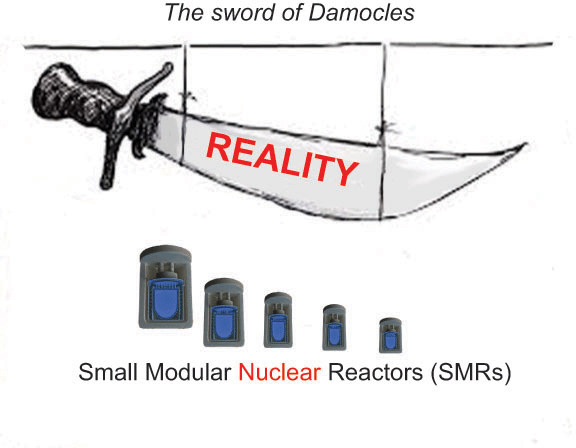
So, if SMRs are the current political flavour of the month, how have we reached this position when there is still no formal approval of the technology from regulators, let alone practical evidence of how it can operate in the real world?
It’s possible to achieve both energy security and the UK’s climate goals without blowing the budget on next-gen nuclear technologies, according to Andrew Warren.
Andrew Warren, Chairman of the British Energy Efficiency Federation. https://electricalreview.co.uk/2023/03/29/smrs-may-not-be-the-holy-grail-for-energy-security-net-zero/
Electrical Review covered in-depth the array of announcements that were made during the Spring Budget, but there was arguably one announcement above all that was most pertinent to the net zero drive. That was when Chancellor Jeremy Hunt reconfirmed – for the fifth time – that the Government intends to create a new Great British Nuclear agency.

It is a name that of itself may bring comfort to all those living on the nuclear-free island of Ireland.
So what will this agency do? Well, the Chancellor explained that, when launched, it will run a competition this year for the UK’s first Small Modular Reactor (SMR). The plan is for it to eventually award £1 billion in co-funding to a winner to build out an SMR plan.
This competition has some distinct echoes. Back in March 2016, the Government launched a competition to identify the best value SMR design for the UK. To the best of my knowledge, nobody has ever claimed that prize, of £250 million.
This re-announcement prompted me to consider the background to this Budget announcement.
It comes at a time in which private sector funding for larger nuclear power stations is proving to be extremely difficult. There is a lengthy list of large pension funds that have publicly refused to get involved with providing capital for the hapless Sizewell C pressurised water reactor project in Suffolk. Meanwhile, European Commission President Ursula von der Leyen is rumoured to be promoting the inclusion of SMRs within the European green investment taxonomy, whilst simultaneously excluding pressurised water reactors which make up most of the existing nuclear fleet.
So, if SMRs are the current political flavour of the month, how have we reached this position when there is still no formal approval of the technology from regulators, let alone practical evidence of how it can operate in the real world?

In January, the UK Government announced that six SMR vendors had applied for their designs to be formally assessed with a view to commercialisation in Britain. The companies have joined a much publicised Rolls-Royce-led consortium and will be subjected to an assessment process carried out by the UK’s Office of Nuclear Regulation (ONR), which will look in exhaustive detail at reactor designs proposed for construction.
Designs that successfully complete the Generic Design Assessment (GDA) – which is expected to take between four and five years – will then be ready to be built anywhere in the country, subject to meeting site-specific requirements.
Why do we need new reactor designs?
Recent results of orders placed for larger nukes are uniformly poor, with reactors invariably late and over budget. Some of the worst cases, notorious projects in Olkiluoto, Finland and Flamanville, France, have seen construction periods of 18 years and costs of three to four times above the expected level.

So, SMRs are being increasingly seen as the new saviours for the nuclear industry. This category embodies a range of technologies, uses and sizes, but relies heavily on features that were the selling points for larger designs. They are smaller than current stations which produce 1,200MW to 1,700MW of electricity. Instead, sizes range from 3MW to about 500MW. The Rolls-Royce design is a 470MW pressurised water reactor, which is bigger than one of the reactors at Fukushima in Japan that suffered serious damage in the 2011 tsunami.
These advanced designs are not new – sodium-cooled fast reactors and high temperature reactors were built as prototypes in the 1950s and 1960s – but successive attempts to build demonstration plants have been short-lived failures. It is hard to see why these technologies should now succeed given their poor record.
A particular usage envisaged for some of the technologies is production of hydrogen. However, as Professor Stephen Thomas of Greenwich University recently pointed out to me, to produce hydrogen efficiently, reactors would need to provide heat at 900°C. This, he said, is “a temperature not yet achieved in any power reactor, not feasible for a pressurised water reactor or boiling water reactor and one that will require new exotic and expensive materials.”
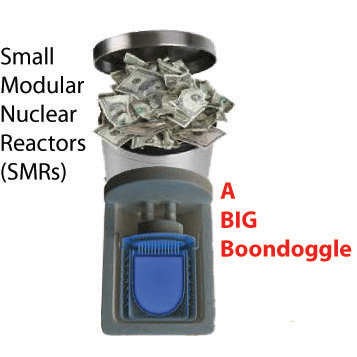
Developers of SMRs like to give the impression that their designs are ready to build, the technology proven, the economic case established and all that is holding them back is Government inactivity. However, taking a reactor design from conception to commercial availability is a lengthy and expensive process taking more than a decade and certainly costing more than £1 billion.
How can the economics of SMRs be tested?
The main claim for SMRs over their predecessors is that being smaller, they can be made in factories as modules using cheaper production line techniques, rather than one-off component fabrication methods being used at Hinkley Point C. The idea is that the module would be delivered to the site on a truck essentially as a ‘flatpack’. This would avoid much of the on-site work which is notoriously difficult to manage and a major cause of the delays and cost overruns that every European large reactor project suffers from.
However, any savings made from factory-built modules will have to compensate for the scale economies lost. A 1,600MW reactor is likely to be much cheaper than 10 reactors of 160MW.
And it will be expensive to test the claim that production line techniques will compensate for lost scale economies. The first reactor constructed will need to be built using production lines if the economics are to be tested. But once the production lines are switched on, they must be fed. Rolls-Royce assumes its production lines will produce two reactors per year and that costs will not reach the target level until about the fifth order. So, if we assume the first reactor takes five years to build, there will be another nine reactors in various stages of construction before a single unit of electricity has been generated from the first, and the viability of the design tested.
This could mean that perhaps about 15 SMRs will need to be under construction before the so-called ‘nth of a kind’ settled-down cost is demonstrated. But once the initial go ahead is given, there will be pressure on the Government to continue to place orders before the design is technically and economically proven, so the production lines do not sit idle.
Will SMRs be a major contributor to meeting the UK’s climate change targets?

The selling point for nuclear power is that it is a relatively low-carbon source of power that can replace fossil fuel electricity generation in the UK and elsewhere. However, by the time SMRs might be deployable in significant numbers, realistically after 2035, it will be too late for them to contribute to reducing greenhouse gas emissions. Electricity is acknowledged to be the easiest sector to decarbonise. If the whole economy is to reach net zero emissions by 2050, then this sector will have to reach that point long before then, probably by 2035. So SMRs appear to be too little, too late.

There is also a fear that SMRs will create more waste than conventional reactors, according to a study recently published in Proceedings of the American National Academy of Sciences. The research notes that SMRs would create far more radioactive waste, per unit of electricity they generate, than conventional reactors by a factor of up to 30. Some of these smaller reactors, with molten salt and sodium-cooled designs, are expected to create waste that needs to go through additional conditioning to make it safe to store in a repository.
And yet, despite the past failures of nuclear power and increasing public scepticism, there remains an appetite within the British Government to give the nuclear industry one more chance.
It remains to be seen whether the Government follows its instinct to continue supporting the sector or whether the amount of public money at risk makes such a decision politically impossible, given the massive underwriting these projects require by consumers and taxpayers.
Nuclear’s specious claims
The claims being made for SMRs will be familiar to long-time observers of the nuclear industry: costs will be dramatically reduced; construction times will be shortened; safety will be improved; there are no significant technical issues to solve; nuclear is an essential element to our energy mix.
In the past such claims have proved hopelessly over-optimistic and there is no reason to believe results would turn out differently this time. Indeed, the nuclear industry may well see itself in this ‘last-chance saloon’.
The risk is not so much that large numbers of SMRs will be built; it is my belief that they won’t be. The risk is that, as in all the previous failed nuclear revivals, the fruitless pursuit of SMRs will divert resources away from options that are cheaper, at least as effective, much less risky, and better able to contribute to energy security and environmental goals. Given the climate emergency we face, surely it is time to finally turn our backs on this failing technology.
Andrew Warren is a former special advisor to the House of Commons environment committee. Special thanks to Greenwich University’s Professor Stephen Thomas for his advice for this piece.
Covering (Up) Antiwar Protest in US Media

March 18 DC peace march almost completely blacked out in US corporate media
FAIR, DAVE LINDORFF, 30 Mar 23
In the early morning of March 20, 2003, US Navy bombers on aircraft carriers and Tomahawk missile-launching vessels in the Persian Gulf and the Mediterranean, along with Air Force B-52s in Britain and B-2s in Diego Garcia, struck Baghdad and other parts of Iraq in a “Shock and Awe” blitzkrieg to oust Iraqi dictator Saddam Hussein and occupy that oil-rich country.
Twenty years on, the US news media, as is their habit with America’s wars, published stories looking back at that war and its history (FAIR.org, 3/22/23), most of them treading lightly around the rank illegality of the US attack, a war crime that was not approved by the UN Security Council, and was not a response to any imminent Iraqi threat to the US, as required by the UN Charter.
Oddly, none of those national media organizations’ editors saw as relevant or remotely newsworthy a groundbreaking protest rally and march outside the White House of at least 2,500–3,000 people on Saturday, March 18, 2023, called by a coalition of over 200 peace and anti-militarism organizations to commemorate the 20th anniversary of the Iraq invasion.
The Washington Post, like the rest of the national news media, failed to mention or even run a photo of the rally in Lafayette Park. It didn’t even cover the peaceful and spirited march from the front of the White House along Pennsylvania and New York avenues to the K Street Washington Post building to deliver several black coffins as a local story—despite the paper’s having a reporter whose beat is actually described by Post as being to “to cover protests and general assignments for the metro desk.” An email request to this reporter, Ellie Silverman, asking why this local protest in DC went unreported did not get a response.
National press a no-show
The rally, organized by the ANSWER Coalition and sponsors such as Code Pink, Veterans for Peace, Black Alliance for Peace and Radical Elders, drew “several thousand” antiwar, anti-military protesters, according to ANSWER Coalition national director Brian Becker. He said the demonstration’s endorsers were calling for peace negotiations and an end to US arms for Ukraine, major cuts in the US military budget, an end to the US policy of endless wars, and freedom for Julian Assange and Indigenous prisoner Leonard Peltier.
………………………………………………… Filling the hole
Fortunately, alternative media, which have proliferated online, are filling in the hole in protest coverage, though of course readers and viewers have to seek out those sources of information. There was a news report on the march in Fightback News (3/23/23), for example, and commentary on the World Socialist Web Site (3/21/23) and Black Agenda Report (2/22/23).
Foreign coverage of the March 18 antiwar event in the US was substantial, which should embarrass editors at US news organizations
…………………………… Efforts to get either the Washington Post or New York Times to explain their airbrushing out the March 18 antiwar protest in Washington were unsuccessful. (Both publications have eliminated their news ombud offices, citing “budget issues.”)
………………………. more https://fair.org/home/covering-up-antiwar-protest-in-us-media/
Australia Isn’t A Nation, It’s A US Military Base With Kangaroos, and happy to have Julian Assange imprisoned


Caitlin Johnstone 1 Apr 23 https://caitlinjohnstone.substack.com/p/australia-isnt-a-nation-its-a-us?utm_source=post-email-title&publication_id=82124&post_id=111947244&isFreemail=true&utm_medium=email
One of the many, many signs that Australia is nothing more than a US military and intelligence asset is the way its government has consistently refused to intervene to protect Australian citizen Julian Assange from political persecution at the hands of the US empire.
In a new article titled “Penny Wong moves to dampen expectation of breakthrough in Julian Assange case,” The Guardian quotes Australia’s foreign minister as saying, “We are doing what we can, between government and government, but there are limits to what that diplomacy can achieve.” Wong said this when asked if Prime Minister Anthony Albanese discussed the world’s most famous press freedom case with the US president and British prime minister when he met with them together two weeks ago.
Wong refused to say whether her government’s leader had raised the issue with his supposed US and UK counterparts, repeating instead the same line she’s been bleating since Labor took over: that the Assange case “has dragged on long enough and should be brought to a close.” Which if you listen carefully isn’t actually a statement in favor of releasing the WikiLeaks founder or blocking extradition — it’s just saying the case should be concluded hastily, one way or another.
These statements came in response to questions from Greens Senator David Shoebridge, who took a jab at the Labor government’s “quiet diplomacy” approach to the Assange case.
“The idea that quiet diplomacy must be so silent that the government can’t tell the public or the parliament if the PM even spoke to the president is bizarre,” Shoebridge said.
Wong told Shoebridge that Australia is powerless to intervene to protect the acclaimed Australian journalist, saying, “We are not able as an Australian government to intervene in another country’s legal or court processes.”
While it is true that Australia can’t force the US to end the political imprisonment and persecution of Assange for exposing US war crimes, it obviously can conduct diplomacy with its supposed ally in order to protect an Australian citizen. Even nations with whom Australia has no form of alliance are vocally confronted by Canberra when they imprison Australian citizens, like the statement Wong released yesterday regarding China’s detention of Chinese-Australian journalist Cheng Lei in which the foreign minister explicitly and unequivocally calls for “Ms Cheng to be reunited with her family.”
Just yesterday alone Wong tweeted to demand justice for Cheng and for American journalist Evan Gershkovich, who has been arrested in Russia on espionage charges.
“It is one year since Australian citizen Cheng Lei faced a closed trial in Beijing on national security charges,” tweeted Wong. “She is yet to learn the outcome. Our thoughts are with Ms Cheng and her loved ones. Australia will continue to advocate for her to be reunited with her children.”
“Australia is deeply concerned by Russia’s detention of Wall Street Journal Moscow correspondent Evan Gershkovich. We call on Russia to ensure access to consular and legal assistance,” Wong tweeted a few hours later.
Now guess how many times Penny Wong has tweeted the word “Assange”?
Answer: zero.
What is the basis for this discrepancy? Why has Australia’s foreign minister been publicly demanding that China release Cheng Lei and return her to her children, without making the same demands of the US for Julian Assange? Assange has children too, and he has been imprisoned for four times longer than Cheng — more than ten times longer if you count the period of his arbitrary detention in the Ecuadorian embassy in London before his arrest. Why are we seeing more action from the Australian government to defend an Australian journalist in China than to defend an Australian journalist fighting extradition to a nation we’re supposedly allied with which upholds itself as the leader of the rules-based international order?
The answer is that Australia is not a real country. It’s an American colony. It’s a giant US military base with kangaroos.
That’s why the Albanese government’s “quiet diplomacy” to free Assange is so quiet that it can’t actually be said to exist.
Regular readers may recall that the last time we discussed an interaction between Senators Wong and Shoebridge was when the former condescendingly dismissed the latter’s efforts to find out if the Australian government is allowing the US military to bring nuclear weapons into the country. Wong angrily told Shoebridge that the US has a standing “neither confirm nor deny” position with regard to where it keeps its nuclear weapons, and that the Australian government understands and respects that position.
We’re so far under Washington’s thumb that we’re not even allowed to know if there are American nukes in our country, and our own government can’t even advocate in defense of its own citizen when he’s being persecuted for the crime of good journalism.
Add that to the fact that Australia has been pressed into an AUKUS pact which makes us much less safe and a hostile relationship with China which hurts our own economic and security interests, the stationing of a US nuclear intelligence site which makes us a nuclear target, and the US staging literal coups of our government whenever its elected leaders threaten US strategic interests, and it becomes clear that our so-called “country” is functionally just a US aircraft carrier that happens to be the size of a continent.
Which would be bad enough if these bastards weren’t pushing us to play a front-and-center role in World War Three. We’ve got to start fighting against our enslavement to the US empire and against the Pentagon puppets in our own government like our lives depend on it, because they very clearly do.
AUKUS Exists To Manage The Risks Created By Its Existence

Australia would be at risk of being attacked by China because the US wants to use Australia to attack China.
The only way China attacks Australia is if Australia’s role as a US military asset makes us a target when the US attacks China
“NATO exists to manage the risks created by its existence,” Professor Richard Sakwa once wrote in an attempt to articulate the absurdity of the military alliance’s provocative nature on the world stage. At some point Australians must wake up to the fact that this is equally true of AUKUS: we’re told the military alliance exists for our protection, but its very existence makes us less safe.
As former prime minister Paul Keating recently observed in the Australian Financial Review, this government’s justification for the AUKUS alliance and the obscenely expensive nuclear submarine deal that goes with it has been all over the map, first claiming that it’s to protect our own shores from a Chinese attack, then pivoting to claiming it’s to protect sea lanes from being blocked off by China after Keating dismantled the first claim at the National Press Club two weeks ago.
One thing Canberra has struggled to do is to explain exactly why China would launch an unprovoked attack on Australia or its shipping routes; the former couldn’t yield any benefit that would outweigh the immense cost even if it succeeded, and the latter is absurd because open trade routes are what makes China an economic superpower in the first place.
Luckily for us, the Pentagon pets cited in the Australian media’s recent propaganda blitz to promote war with China explained precisely what the argument is on Canberra’s behalf. They say Australia would be at risk of being attacked by China because the US wants to use Australia to attack China.
…………………………………………………… In their haste to make the case for more militarism and brinkmanship, these war propagandists admit what’s long been obvious to anyone paying attention: that the only thing putting Australia in danger from China is its alliances and agreements with the United States. The difference between them and normal human beings is that they see no problem with this.
Other empire lackeys have been making similar admissions. In a recent article by Foreign Policy, Lowy Institute think tanker Sam Roggeveen is quoted as saying the AUKUS nuclear submarine deal will make it “almost impossible” for Australia to avoid getting entangled in a war between the US and China:………………
The only way China attacks Australia is if Australia’s role as a US military asset makes us a target when the US attacks China
…………………………………………………AUKUS has nothing to do with “defence”. You don’t need long-range submarines to defend Australia’s easily-defended shores, you need long-range submarines to attack China. Australia’s “defence posture” is an attack posture.
………………
AUKUS is not a defence partnership because it’s got nothing to do with defence, and it’s also not a defence partnership because it is not a “partnership”. It’s the US empire driving Australia to its doom, to nobody’s benefit but the US empire.
AUKUS exists to manage the risks created by its existence, and the same is true of ANZUS and all the other ways our nation has become knit into the workings of the US war machine. If we’re being told that our entanglements with the US war machine will make it almost impossible for us to avoid entering into a horrific war that will destroy our country, then the obvious conclusion is that we must disentangle ourselves from it immediately.
The problem is not that Australia’s corrupt media are saying our nation will have to follow the US into war with China, the problem is that they’re almost certainly correct.
The Australian media aren’t criminal in telling us the US is going to drag us into a war of unimaginable horror; that’s just telling the truth. No, the Australian media are criminal for telling us that we just need to accept that and get comfortable with the idea.
No. Absolutely not. This war cannot happen. Must not happen. We cannot go to war with a nuclear-armed country that also happens to be propping up our economy as our number one trading partner. We need to shred whatever alliances need to be shredded, enrage whatever powers we need to enrage, kick the US troops out of this country, get ourselves out of the Commonwealth while we’re at it, bring Assange home where he belongs, and become a real nation. https://caitlinjohnstone.substack.com/p/aukus-exists-to-manage-the-risks?utm_source=post-email-title&publication_id=82124&post_id=111711350&isFreemail=true&utm_medium=email
Nuclear Power Classified as Environmentally Sustainable in UK’s Green Taxonomy
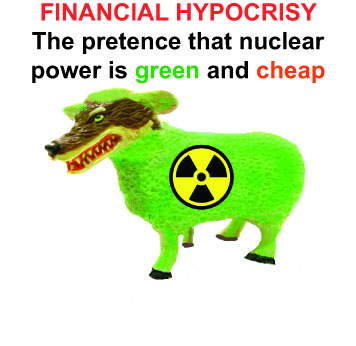
On March 15, 2023, the UK’s Chancellor of the Exchequer, Jeremy Hunt, announced that nuclear power will be classified as “environmentally sustainable” in UK’s green taxonomy, “giving it access to the same investment incentives as renewable energy.” …………………………………..
The inclusion of nuclear in the UK Taxonomy, while controversial, is not surprising given the UK’s stated commitment to building its nuclear fuel capacity. In a 2022 policy paper titled “British energy security strategy,” the Johnson government committed to increase the portion of energy generated from nuclear power to 25%, and to launch a variety of related initiatives, including “backing Great British Nuclear with funding to support projects to get investment ready and through the construction phase.”
…………………….. The Sunak government has not yet released its energy security strategy, but Sunak hinted that its strategy will continue the ongoing commitment to increase the UK’s nuclear energy capacity, by focusing on carbon capture and storage, small modular reactors and the like.
…………………………. It is worth noting, however, that although that the EU Taxonomy Delegated Act is in force, a regulation for UK’s green taxonomy is not and there is no clear timeline for implementation. Rather, the UK government announced in December 2022 a delay in implementation following stakeholder engagement and in light of the complexity inherent in a climate taxonomy, which involves “multiple sectors of the economy and various legislative and regulatory frameworks.”
EU agrees to a compromise on nuclear energy amid French pressure
Get local insights from Lisbon to Moscow with an unrivalled network of journalists across Europe, expert analysis, our dedicated ‘Brussels Briefing’ newsletter. Customise your myFT page to track the countries of your choice.
The EU has reached a compromise on new targets for renewable energy after
agreeing to make an exception for nuclear power in certain sectors amid
pressure from France. Negotiators from member states and the European
parliament agreed to increase the overall binding target of renewable
energy consumed in the EU to 42.5 per cent by 2030, up from 32 per cent,
according to a statement. They also set an “indicative” target of
reaching 45 per cent by the end of the decade.
France had pushed for nuclear energy to be included in countries’ efforts to reach those targets. But at the end of a long night of negotiations, the countries
agreed on a more limited concession counting nuclear power towards the
target for industry. Nuclear-sceptic countries including Germany and
Austria had argued against the inclusion of atomic power, saying that such
a move would undermine efforts to expand solar, wind and other renewable
sources of energy.
FT 30th March 2023
https://www.ft.com/content/02adde01-3b27-4743-8c17-2e39ab682660
Top UN official urgently calls for de-escalating nuclear tensions over Belarus
, UN News,
Urgent efforts must be made to de-escalate the situation following Russia’s announcement last weekend that it plans to station tactical nuclear weapons in Belarus, the UN disarmament chief warned the Security Council on Friday.
“The risk of a nuclear weapon being used is currently higher than at any time since the depths of the cold war,” said Izumi Nakamitsu, UN High Representative for Disarmament Affairs. “The war in Ukraine represents the most acute example of that risk.”
The Security Council met on the heels of President Vladimir Putin’s announcement last Sunday that it had reached an agreement with its neighbour, which has been any ally in Moscow’s invasion of Ukraine, to station non-strategic nuclear weapons inside Belarusian territory, which would be in place for aerial use, by July.
Dangerous rhetoric
Ms. Nakamitsu said the absence of dialogue and the erosion of the disarmament and arms control architecture, combined with dangerous rhetoric and veiled threats, are key drivers of this potentially existential risk posed by nuclear escalation.
“When it comes to issues related to nuclear weapons, all States must avoid taking any actions that could lead to escalation, mistake or miscalculation,” she said, recalling that all States parties to the Treaty on the Non-Proliferation of Nuclear Weapons, or the NPT – nuclear-armed States and non-nuclear weapon States alike – must strictly adhere to its commitments and obligations.
“They should return to dialogue to de-escalate tensions urgently and find ways to develop and implement transparency and confidence-building measures,” she said, appealing to States parties to the treaty to fully adhere to their obligations and to immediately engage in serious efforts to reduce nuclear risk……………………………………
https://news.un.org/en/story/2023/03/1135222
Concern about Turkey’s Akkuyu Nuclear Power Plant
https://www.ekathimerini.com/opinion/1207709/nuclear-concern/ 1 Apr 23, The announcement by Turkish President Recep Tayyip Erdogan that nuclear fuel will be loaded into the first power unit of the Akkuyu Nuclear Power Plant on April 27 this year should set the alarm bells ringing in the international community and Western allies in particular.
It must be ensured that the nuclear power plant in Mersin Province, on Turkey’s southern coast, will be used only for peaceful purposes and that the unstable leadership of Greece’s neighbor across the Aegean will not be tempted by its aspirations for the role of regional superpower, developing into an even more threatening risk factor.
The issue should not only concern Greece. https://www.ekathimerini.com/opinion/1207709/nuclear-concern/
Nuclear weapons: Challenge to our existence
Louise Lansberry, Seattle March 31, 2023, https://www.seattletimes.com/opinion/letters-to-the-editor/nuclear-weapons-challenge-to-our-existence/
“Abolish nuclear weapons for a safer world” and “The climate crisis is coming for your children” [March 26, Opinion] each raised the most critical existential threats to our planet and its 8 billion souls. Many Americans are coming around to acknowledging the climate crisis, even if our government fails to deal appropriately with this growing disaster.
On the other hand, very few Americans are even aware of the equal, if not more critical danger of nuclear weapons. Kudos to Shampa Biswas for providing a very clear explanation of the inadequate ways that the nuclear nations are dealing with this threat to civilization whether these weapons might be used intentionally, or just as concerning, through an accident of some sort.
These twin challenges to our very existence — climate and nuclear weapons — need to be tackled now.
Fire on Trident nuclear submarine at Scots navy base prompts safety concern for nearby locals.
Fire on Trident nuclear submarine at Scots navy base prompts safety
concern for nearby locals. The fire on-board HMS Victorious last year
raised concerns from local councillors about what was being done to keep
residents safe in the event of a nuclear incident.
Daily Record 30th March 2023
https://www.dailyrecord.co.uk/news/scottish-news/fire-trident-nuclear-submarine-scots-29592800
Glasgow Live 30th March 2023
https://www.glasgowlive.co.uk/news/fire-trident-nuclear-submarine-prompts-26592968
The Scottish Greens condemn UK Government plans for a major investment in nuclear power
The Scottish Greens have condemned UK Government plans for a major
investment in nuclear power, which they say is no solution to the climate
crisis. The Party says that nuclear power is costly and will leave a toxic
legacy. It has called for assurances that taxpayers in Scotland will not
pay for nuclear reactors across the UK when the Scottish Government is
opposed to nuclear power.
Scottish Greens 30th March 2023
https://greens.scot/news/nuclear-energy-is-no-solution-to-the-climate-crisis
1 This Month


Tell the Ukrainian Government to Drop Prosecution of Peace Activist Yurii Sheliazhenko

Petition to revoke the licensing of the Near Surface Nuclear Disposal Facility (NSDF) at Chalk River. https://www.ourcommons.ca/petitions/en/Petition/Details?Petition=e-7247


of the week – STOP SMALL MODULAR REACTORS IN CANADA
To see nuclear-related stories in greater depth and intensity – go to https://nuclearinformation.wordpress.com
-
Archives
- March 2026 (176)
- February 2026 (268)
- January 2026 (308)
- December 2025 (358)
- November 2025 (359)
- October 2025 (376)
- September 2025 (258)
- August 2025 (319)
- July 2025 (230)
- June 2025 (348)
- May 2025 (261)
- April 2025 (305)
-
Categories
- 1
- 1 NUCLEAR ISSUES
- business and costs
- climate change
- culture and arts
- ENERGY
- environment
- health
- history
- indigenous issues
- Legal
- marketing of nuclear
- media
- opposition to nuclear
- PERSONAL STORIES
- politics
- politics international
- Religion and ethics
- safety
- secrets,lies and civil liberties
- spinbuster
- technology
- Uranium
- wastes
- weapons and war
- Women
- 2 WORLD
- ACTION
- AFRICA
- Atrocities
- AUSTRALIA
- Christina's notes
- Christina's themes
- culture and arts
- Events
- Fuk 2022
- Fuk 2023
- Fukushima 2017
- Fukushima 2018
- fukushima 2019
- Fukushima 2020
- Fukushima 2021
- general
- global warming
- Humour (God we need it)
- Nuclear
- RARE EARTHS
- Reference
- resources – print
- Resources -audiovicual
- Weekly Newsletter
- World
- World Nuclear
- YouTube
-
RSS
Entries RSS
Comments RSS
 nuclear-news