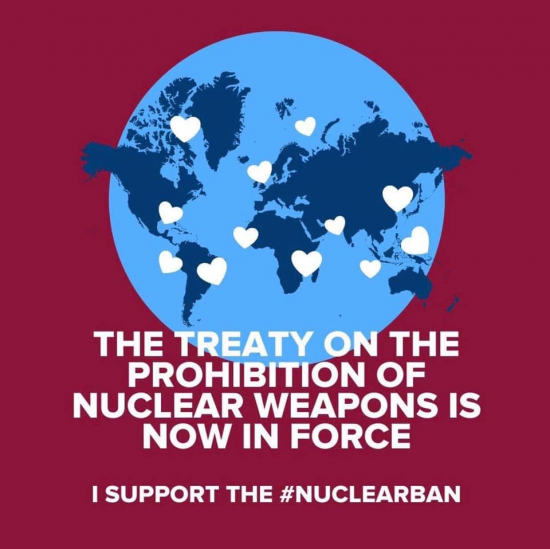
As of 29 March 2023, the TPNW has 68 states parties and a further 27 countries have signed but not yet ratified the Treaty. This means that only four more states need sign or accede before the Treaty exceeds 50% of all states.
As fear of nuclear war surged to the highest levels since the Cold War in 2022, the global arsenal of nuclear weapons available for use by the armed forces of the nine nuclear-armed states has increased, shows the latest edition of the Nuclear Weapons Ban Monitor, which was launched on 29 March 2023. See the key findings and download the report here.
In collaboration with the Federation of American Scientists, the Nuclear Weapons Ban Monitor publishes the latest available data on global nucleal forces. At the beginning of 2023, the nine nuclear-armed states had a combined inventory of approximately 12,512 nuclear warheads, of which 2,936 are retired and awaiting dismantlement. The remaining 9,576 nuclear warheads are available for use by the military, and have a collective destructive power that is equal to more than 135,000 Hiroshima bombs.
Hans M. Kristensen, the director of the Nuclear Information Project at the Federation of American Scientists and contributor to the Nuclear Weapons Ban Monitor, said: “Every year, the global inventory of nuclear warheads decreases slightly, including in 2022 when it decreased from 12,705 warheads at the beginning of the year to the estimated 12,512 warheads in January 2023, but this is only still true because Russia and the United States each year dismantle a small number of their older nuclear warheads that have been retired from service. Russia, China, India, North Korea, and Pakistan all expanded their stockpiles of warheads in 2022, however, bringing about a corresponding increase of 136 warheads from the 9,440 warheads that were available for use in early 2022, to 9,576 in 2023.”
“This increase is worrying, and continues a trend that started in 2017. If this does not stop, we will soon se an increase also in the total number of nuclear weapons in the world, for the first time since the Cold War,” said the editor of the Nuclear Weapons Ban Monitor, Grethe Østern of Norwegian People’s Aid.
While all of the nine nuclear-armed states (China, France, India, Israel, North Korea, Pakistan, Russia, the United Kingdom, and the United States) refuse to join the TPNW, the Ban Monitor notes that their conduct is not compatible with the TPNW, including by continuing to develop, produce and stockpile nuclear weapons. Once again, their conduct in 2022 was also manifestly incompatible with the TPNW’s obligation to eliminate nuclear weapons. There was no evidence that any of the nuclear-armed states have the will purposefully to pursue nuclear disarmament. China, France, Russia, the United Kingdom, and the United States therefore also continued to fail to comply with their existing obligation under Article VI of the Treaty on the Non-Proliferation of Nuclear Weapons (NPT) to ‘pursue negotiations in good faith’ on nuclear disarmament.
But it is not just the nuclear-armed states whose activities are incompatible with the TPNW. A total of 35 non-nuclear-armed states, including the world’s 32 so-called umbrella states, also contravened one or more of the prohibitions of the TPNW last year, chiefly by assisting and encouraging continued possession of nuclear weapons on their behalf.
Europe has the highest number of countries whose actions run counter to the TPNW and that vote against the Treaty in the UN. They perpetuate the idea that nuclear weapons are legitimate and necessary and are a major obstacle to nuclear disarmament.
In spite of this, the Ban Monitor points out, the TPNW gained strength in 2022. The speed with which new countries are ratifying or acceding to the Treaty accelerated, following a dip during the COVID-19 pandemic. An important milestone, the Treaty’s First Meeting of States Parties was held in Vienna in June 2022, where a declaration and first action plan was adopted and unprecedented international attention was given to the rights of people affected by nuclear weapons and the need for victim assistance and environmental remediation of areas affected by nuclear-weapons testing. Five states under the US “nuclear umbrella” attended the Vienna meeting as observers, showing early signs of a willingness to at least engage constructively with the Treaty.
As of 29 March 2023, the TPNW has 68 states parties and a further 27 countries have signed but not yet ratified the Treaty. This means that only four more states need sign or accede before the Treaty exceeds 50% of all states………………………………………………..
People exposed to ionizing radiation have an increased risk of developing heart disease, according to new data published in BMJ.
Experts conducted a meta-analysis of 93 studies involving patients with cardiovascular disease who had also been exposed to ionizing radiation. After comparing the patients’ individual radiation dose estimates to their medical histories, experts concluded that there is a causal association between radiation exposure and cardiovascular disease, which appears to be dose dependent.
“The study suggests that radiation exposure, across a range of doses, may be related to an increased risk of not just cancer, as has been previously appreciated, but also of cardiovascular diseases,” noted one of the study’s senior authors Andrew Einstein, MD, PhD, professor of medicine at Columbia University Vagelos College of Physicians and Surgeons.
Risk increased with higher doses and decreased with lower doses. Individuals who were exposed more often over a longer period of time had different risks than those who had just recently been exposed, the experts noted, but more research is needed to validate this finding……………………….
“The effect of lower doses of radiation on the heart and blood vessels may have been underestimated in the past,” Einstein said. “Our new study suggests that guidelines and standards for protection of workers exposed to radiation should be reconsidered, and efforts to ensure optimal radiation protection of patients should be redoubled.” https://healthimaging.com/topics/cardiac-imaging/risk-heart-disease-radiation-exposure
China is willing to sign a treaty making Southeast Asia a nuclear weapons-free zone, in Beijing’s latest effort to woo its neighbours and counter Washington’s decision to speed the sale of nuclear-powered submarines and technology to Australia.
Chinese Foreign Minister Qin Gang made the pledge at a meeting with Kao Kim Hourn, secretary general of the Association of Southeast Asian Nations, in Beijing on Monday. It would make China the first major nuclear power to commit to the zone.
Asean secretary general Kao Kim Hourn (left) and Chinese foreign minister Qin Gang in Beijing on Monday. Photo: Xinhua
China is willing to sign a treaty making Southeast Asia a nuclear weapons-free zone, in Beijing’s latest effort to woo its neighbours and counter Washington’s decision to speed the sale of nuclear-powered submarines and technology to Australia.
Chinese Foreign Minister Qin Gang made the pledge at a meeting with Kao Kim Hourn, secretary general of the Association of Southeast Asian Nations, in Beijing on Monday. It would make China the first major nuclear power to commit to the zone.
“China is willing to take the lead in signing the protocol to the Southeast Asia Nuclear Weapon Free Zone treaty and advocate with Asean for solidarity and win-win cooperation to safeguard regional security and stability,” he said.
The treaty has been in force since 1997 and obliges the 10 Asean member states “not to develop, manufacture or otherwise acquire, possess or have control over nuclear weapons; station or transport nuclear weapons by any means; or test or use nuclear weapons”.
None of the five recognised nuclear-armed states – China, France, Russia, Britain and the US – has acceded to the treaty’s protocol, which implies a commitment not to use nuclear weapons within the zone or against any contracting state.
Chinese President Xi Jinping said in 2021 that Beijing was ready to sign the protocol – also known as the Bangkok Treaty – “at the earliest possible date”, just months after the US-led Aukus alliance with Australia and Britain was unveiled.
The latest pledge comes at a time when China is increasingly vigilant towards Aukus, which two weeks ago announced a pathway for Australia to acquire three, possibly five, US nuclear-powered submarines by the early 2030s.
In his meeting with Kao, Qin said China’s domestic and foreign policies had maintained “a high degree of stability and continuity”, according to a Chinese foreign ministry readout.
Qin said China’s policies would “inject more stability into regional peace and tranquillity, while providing more strong momentum for regional development and prosperity”………………….
Beijing is strongly opposed to Aukus and the Quad – a US-led partnership with Japan, India and Australia – which together form the centrepiece of Washington’s strategy of building alliances to contain China, in its view.
The Aukus announcement – which may pave the way for Canberra to eventually build its own attack submersibles – was described by Chinese foreign ministry spokesman Wang Wenbin as “nothing but selfish”. The US, Australia and Britain “had gone further down a wrong and dangerous road”, he said.
The deal also intensified regional concerns in Southeast Asia. Hours after the announcement, Malaysia said it was important for all countries to refrain “from any provocation that could potentially trigger an arms race or affect peace and security in the region”.
President Yoon Seok-yeol’s administration says ‘health and safety’ top priority despite improving Seoul-Tokyo ties.
South Korea has ruled out lifting a ban on Japanese seafood imports from the area around the Fukushima nuclear plant despite warming relations between Seoul and Tokyo.
“
“Seafood imports from near the tsunami-stricken plant will “never come into” South Korea due to health concerns related to leaked radiation, the administration of President Yoon Seok-yeol said on Thursday.
With regard to the import of Japanese seafood products, the government’s stance remains unchanged that the health and safety of the people are the top priority,” the presidential office said in a statement, South Korea’s Yonhap News Agency reported.
South Korea has banned Japanese seafood imports from eight prefectures, including Fukushima, since 2013 due to fears of radiation contamination from the meltdown of the plant following an earthquake and tsunami.
Polish RadioMarch 29, 2023 Germany, UK deliver battle tanks to Ukraine: officials Germany delivered the 18 advanced main battle tanks after Ukrainian crews were trained to operate them, British broadcaster the BBC reported. Eighteen is four more than previously agreed, according to news outlets. German Defence Minister Boris Pistorius said the Leopards 2s “have made […]
he announcement by President Vladimir Putin over the weekend that Russia will deploy tactical nuclear weapons in Belarus marked a further escalation of potentially cataclysmic tensions over the war in neighboring Ukraine. As the Associated Press reported, “Putin said the move was triggered by Britain’s decision this past week to provide Ukraine with armor-piercing rounds containing depleted uranium.”
There’s always an excuse for nuclear madness, and the United States has certainly provided ample rationales for the Russian leader’s display of it. American nuclear warheads have been deployed in Europe since the mid-1950s, and current best estimates say 100 are there now—in Belgium, Germany, Italy, the Netherlands, and Turkey.
Count on U.S. corporate media to (appropriately) condemn Putin’s announcement while dodging key realities of how the USA, for decades, has been pushing the nuclear envelope toward conflagration. The U.S. government’s breaking of its pledge not to expand NATO eastward after the fall of the Berlin Wall—instead expanding into 10 Eastern European countries—was only one aspect of official Washington’s reckless approach.
During this century, the runaway motor of nuclear irresponsibility has been mostly revved by the United States. In 2002, President George W. Bush withdrew the U.S. from the Anti-Ballistic Missile Treaty, a vital agreement that had been in effect for 30 years. Negotiated by the Nixon administration and the Soviet Union, the treaty declared that its limits would be a “substantial factor in curbing the race in strategic offensive arms.”
His lofty rhetoric aside, President Barack Obama launched a $1.7 trillion program for further developing U.S. nuclear forces under the euphemism of “modernization.” To make matters worse, President Trump pulled the United States out of the Intermediate-Range Nuclear Forces Treaty, a crucial pact between Washington and Moscow that had eliminated an entire category of missiles from Europe since 1988.
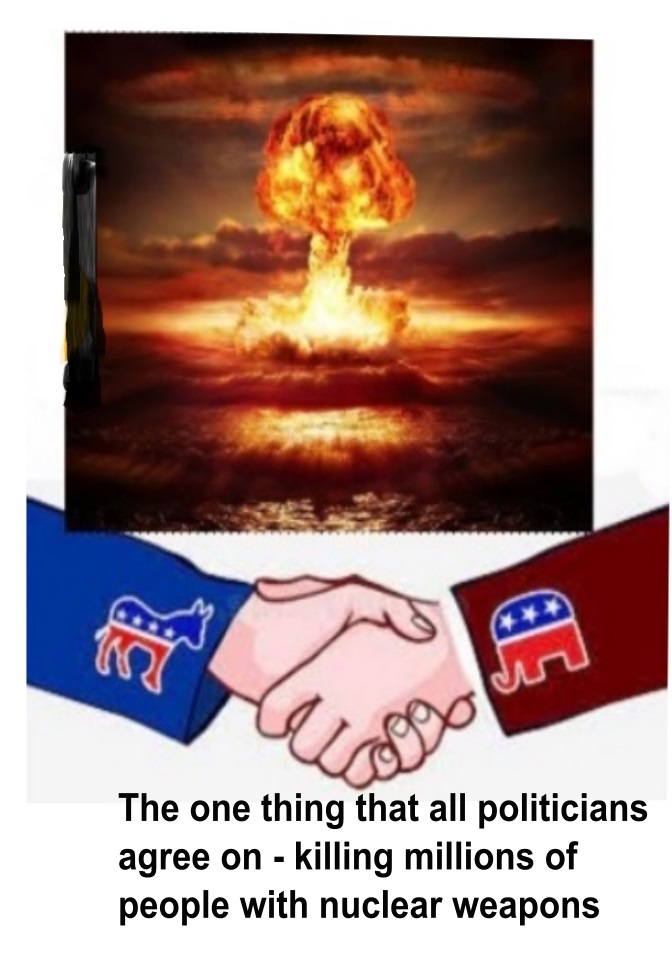
The madness has remained resolutely bipartisan. President Joe Biden quickly dashed hopes that he would be a more enlightened leader about nuclear weapons. Far from pushing to reinstate the canceled treaties, from the outset of his presidency Biden boosted measures like placing ABM systems in Poland and Romania. Calling them “defensive” does not change the fact that those systems can be retrofitted with offensive cruise missiles. A quick look at a map would underscore why such moves were so ominous when viewed through Kremlin windows.
Contrary to his 2020 campaign platform, President Biden has insisted that the United States must retain the option of first use of nuclear weapons. His administration’s landmark Nuclear Posture Review, issued a year ago, reaffirmed rather than renounced that option. A leader of the organization Global Zero put it this way: “Instead of distancing himself from the nuclear coercion and brinkmanship of thugs like Putin and Trump, Biden is following their lead. There’s no plausible scenario in which a nuclear first strike by the U.S. makes any sense whatsoever. We need smarter strategies.”
Daniel Ellsberg—whose book The Doomsday Machine truly should be required reading in the White House and the Kremlin—summed up humanity’s extremely dire predicament and imperative when he told the New York Times days ago: “For 70 years, the U.S. has frequently made the kind of wrongful first-use threats of nuclear weapons that Putin is making now in Ukraine. We should never have done that, nor should Putin be doing it now. I’m worried that his monstrous threat of nuclear war to retain Russian control of Crimea is not a bluff. President Biden campaigned in 2020 on a promise to declare a policy of no first use of nuclear weapons. He should keep that promise, and the world should demand the same commitment from Putin.”
We can make a difference—maybe even the difference—to avert global nuclear annihilation. This week, TV viewers will be reminded of such possibilities by the new documentary The Movement and the “Madman” on PBS. The film “shows how two antiwar protests in the fall of 1969—the largest the country had ever seen—pressured President Nixon to cancel what he called his ‘madman’ plans for a massive escalation of the U.S. war in Vietnam, including a threat to use nuclear weapons. At the time, protestors had no idea how influential they could be and how many lives they may have saved.”
In 2023, we have no idea how influential we can be and how many lives we might save—if we’re really willing to try.
Here’s the other thing we would have discovered: SNC Lavalin does not need to lobby government at all. It has tentacles that reach deeply into our civil service. What SNC Lavalin wants, SNC Lavalin gets.
SNC-Lavalin got the sweetheart deal of all time when then-prime minister Stephen Harper ‘sold’ Atomic Energy of Canada to SNC-Lavalin. Over the years, AECL had received at least $20-billion in public funds for the bargain basement price of $15-million, writes Green Party Leader Elizabeth May. Image courtesy of Wikimedia Commons
I am cursed with an excellent memory which makes me hang on to the unanswered questions. It also makes me want more sunlight, more inquiries, and more answers.
I wish we had had that public inquiry into the SNC-Lavalin Group Inc. scandal and I wish the RCMP had not dropped the matter.
My hunch is that we would have discovered two important things.
In December 2018, then-PCO clerk Michael Wernick did not inappropriately pressure former justice minister Jody Wilson-Raybould at the request of the prime minister. Wernick inappropriately pressured Wilson-Raybould as a favour to his old boss, former clerk of PCO, Kevin Lynch, then chair of the board of SNC Lavalin. I may be quite wrong, but this scenario better fits the facts. Wernick denied he inappropriately pressured Wilson-Raybould and said he told Lynch he would have to talk directly to Wilson-Raybould or to the director of public prosecutions about the matter. SNC Lavalin said Lynch requested a call with Wernick to convey that the company remained open to a deferred prosecution agreement.
But here’s the other thing we would have discovered. SNC-Lavalin does not need to lobby government at all. It has tentacles that reach deeply into our civil service. What SNC-Lavalin wants, SNC-Lavalin gets.
This is a statement that remains true whether the occupant of the Prime Minister’s Office is Liberal or Conservative.
SNC-Lavalin got the sweetheart deal of all time when then-prime minister Stephen Harper “sold” Atomic Energy of Canada to SNC-Lavalin. Over the years, AECL had received at least $20-billion in public funds for the bargain basement price of $15-million.
SNC-Lavalin is the driving force behind the new mania for so-called “small modular reactors”—SMRs.
The two SMRs slated for New Brunswick—ARC and Moltex—keep their promotional materials free of SNC-Lavalin references. You have to dig.
Here, for example, is the lead from this industry press release: “Canadian Nuclear Laboratories (CNL), Canada’s premier nuclear science and technology organization, is pleased to announce that it has entered into a collaboration agreement with ARC Clean Energy Canada (ARC Canada), a New Brunswick-based team working to develop and licence its sodium-cooled advanced small modular reactor (SMR) technology.”
Looking for details in the release, you get this: Canadian Nuclear Laboratories is a world leader in nuclear science and technology offering unique capabilities and solutions across a wide range of industries. Actively involved with industry-driven research and development in nuclear, transportation, clean technology, energy, defence, security and life sciences, we provide solutions to keep these sectors competitive internationally.
It’s the same thing with the Moltex announcement. You have to go to SNC-Lavalin’s website to find its central role in CNL and CNEA: “Canadian Nuclear Laboratories (CNL) is a world leader in nuclear science and technology. … We (SNC-Lavalin) are a majority partner in a consortium which manages and operates CNL, which is currently managing its ageing infrastructure and renewing its laboratories. This investment will ensure the organization stays at the top of its field while strengthening Canada’s status in the international scientific community.”
Looking at other SMR announcements, such as the Bruce Power BWRX-300 small modular reactor (SMR) at Darlington, Ont., SNC Lavalin is again a key player with partners Ontario Power Generation (OPG), GE Hitachi Nuclear Energy (GEH), and Aecon.
Thanks to The Hill Times for publishing Ole Hendrickson’s critical research in December 2020. That article established the links between SNC-Lavalin, its commercial partners, and the nuclear weapons industry.
“In 2015, the Harper government contracted a multinational consortium called Canadian National Energy Alliance—now comprised of two U.S. companies, Fluor and Jacobs, along with Canada’s SNC-Lavalin—to operate AECL’s nuclear sites, the main one being at Chalk River. Fluor operates the Savannah River Site, a South Carolina nuclear-weapons facility, under contract to the U.S. Department of Energy. Jacobs also has contracts at DOE weapons facilities and is part of a consortium that operates the U.K. Atomic Weapons Establishment.”
It is never too late to peel back the layers and ask some hard questions. As federal and provincial governments shovel more millions into unproven technology and false claims of SMRs as a climate solution, shouldn’t we demand transparency on where the new bodies are being buried? And should we not inquire into the deeply buried responsibility of a single corporation for its continual engagement in manipulating federal and provincial policies away from renewable energy resources towards that corporation’s publicly developed, but now privately owned, nuclear technologies?
Green Party Leader Elizabeth May represents Saanich-Gulf Islands, B.C.
Negotiators from EU countries and the European Parliament hold their final scheduled round of negotiations on Wednesday, to set more ambitious EU goals to expand renewable energy this decade.
The goals are key to Europe’s efforts to slash CO2 emissions by 2030 and quit Russian fossil fuels. But the negotiations have become mired in a dispute over whether fuels produced using nuclear power should be counted towards the renewable targets.
France is leading a campaign for “low-carbon hydrogen” – the term used to describe hydrogen produced from nuclear energy – to be put on an equal footing with hydrogen made from renewable electricity.
Backing France are countries including Romania, Poland, Hungary and the Czech Republic, who want more recognition of CO2-free nuclear energy’s contribution to climate goals.
Germany, Spain, Denmark, Portugal and Luxembourg are among the countries opposed. They say mixing nuclear into the renewable targets would distract from Europe’s need to massively expand wind and solar.
At a meeting of EU countries’ ambassadors on Friday, countries doubled down on their existing positions, EU officials said – leaving some doubtful that Wednesday’s negotiations will succeed in finishing the law.
EU countries’ ambassadors were meeting again on Monday to attempt to unblock the talks.
Countries are also at odds over other parts of the law, including which types of wood fuel can count as renewable energy.
France, one of the most nuclear-powered countries in the world, has a particular stake in whether nuclear power is credited under the targets, given its plans to build new reactors and upgrade its large existing fleet.
French energy minister Agnès Pannier-Runacher will convene a meeting of pro-nuclear countries’ ministers on Tuesday to discuss the issue, a French ministry source said.
Paris has been disappointed by other recent EU moves to prioritise renewable technologies over nuclear.
European Commission President Ursula von der Leyen last week said “cutting-edge nuclear” projects would be granted access to only some EU incentives to support green industries, while “strategic” technologies like solar panels would be granted the full benefits.
The office of French Energy Minister Agnès Pannier-Runacher slammed European Commission President Ursula von der Leyen’s recent comments about nuclear not being “strategic” for EU decarbonisation and is planning a counter-offensive at the EU energy ministers meeting in Brussels on Tuesday (28 March).
Nuclear power, whether existing or in development, is not mentioned in the list of “strategic” technologies listed in the European Commission’s Net-Zero Industry Act (NZIA), presented on 16 March.
Ahead of an EU summit last week, the French President’s office called for clarity on the matter, urging member states to decide “once and for all” whether nuclear power is an asset for the bloc’s decarbonisation or not.
Von der Leyen responded after the first day of the summit, saying: “only the net-zero technologies that we deem strategic for the future – like solar panels, batteries and electrolysers, for example – have access to the full advantages and benefits” – which is not the case for nuclear power.
These comments only stoked further tensions with Paris.
EU not ‘consistent’ on tech neutrality………………………………………………….
Speaking on Monday (27 March) before a meeting of the EU’s Energy Council in Brussels, the office of French Energy Minister Agnès Pannier-Runacher drove the point home.
The Commission president’s comments were “unfortunate” and “clearly not consistent with the climate challenge to which nuclear power and renewables are intended to respond,” the minister’s office said, recalling that the strategic nature of nuclear power is recognised “without ambiguity” in the EURATOM Treaty‘s preamble…………………
Nuclear alliance
Faced with Brussels’ reservations on nuclear power, Pannier-Runacher will bring together the 11 member states taking part in the nuclear alliance set in motion at the last EU summit in Stockholm.
The Ukrainian state may be discriminating against the nation’s largest religious denomination, the Ukrainian Orthodox Church (UOC), the UN’s human rights watchdog said in a report published on Friday. The government of President Vladimir Zelensky is currently in the process of kicking UOC monks out of their homes.
The apparent mistreatment of the church, which has historic links to the Russian Orthodox Church, was highlighted in a report released by the UN’s Office of the High Commissioner for Human Rights (OHCHR). It cited several draft laws submitted to the Ukrainian parliament as well as the actions of the SBU, Ukraine’s domestic security agency, against the clergy.
The UN body is “concerned that the State’s activities targeting the UOC could be discriminatory,” it said. The report cited “vague legal terminology and the absence of sufficient justification” in proposed legislation, explaining why it drew the OHCHR’s negative attention.
The report covered the period between August 2022 and January 2023, but more recent acts by the government have deepened the saga of the UOC. Earlier this month, the Ukrainian Culture Ministry ordered monks belonging to the jurisdiction to vacate their homes at the Kiev Pechersk Lavra, an iconic monastery in the Ukrainian capital.
Zelensky described the move as strengthening Ukraine’s “spiritual independence” and implied that the UOC was a tool that Russia used “to manipulate the spirituality of our people, to destroy our holy sites [and] to steal valuables from them.”
The president ignored pleas by UOC clergy to meet them and try to diffuse the situation.
Kiev previously expelled the UOC from two of the cathedrals above the monastery. Within days of that decision, the government-backed Orthodox Church of Ukraine (OCU) was allowed to hold services on the premises.
The OCU was created with the support of then-president Poroshenko in what many political observers perceived as an attempt to bolster his re-election chances. Culture Minister Aleksandr Tkachenko said the expelled monks, who have until this Wednesday to move out, could stay in their homes by leaving the UOC and joining the OCU.
We need to stop thinking of climate change as future hazard. It is happening right now, and it is damaging our national security as well as our way of life.
Global warming has not yet reached the Paris-agreed limit of 1.5C, and already the shocks to global weather are ravaging communities around the world.
Speaking as the IPCC delivered their latest assessment, UN secretary general Antonio Guterres called it a “ticking climate time bomb”. In a troubled world, with real concerns about cost of living, the creeping dangers posed by climate change are too easily ignored. But we do so at our peril.
Borders are no protection against its effects and, as authoritarian states mount a challenge to the entire international system, climate change further amplifies existing threats to UK national security. Heat, drought, water shortages, food scarcity and fuel conflict drive huge numbers of people from their homes.
Changes in the climate are having a devastating social and economic effect, putting severe pressure on many of the most vulnerable countries. This can exacerbate unrest and play a role in the outbreak of war. Ethnic tensions in Sudan in 2003 were inflamed when drought and hunger took hold. As then UN secretary general Ban Ki-moon warned at the time: “The Darfur conflict began as an ecological crisis, arising at least in part from climate change.” For decades before clashes erupted, the Sahara Desert had advanced a mile a year into Sudan.
As the “mainstream” ‘Establishment” “corporate” world enthuses over (demonstrably uneconomic) small nuclear reactors, it really is time to put a searchlight onto the nuclear industry.
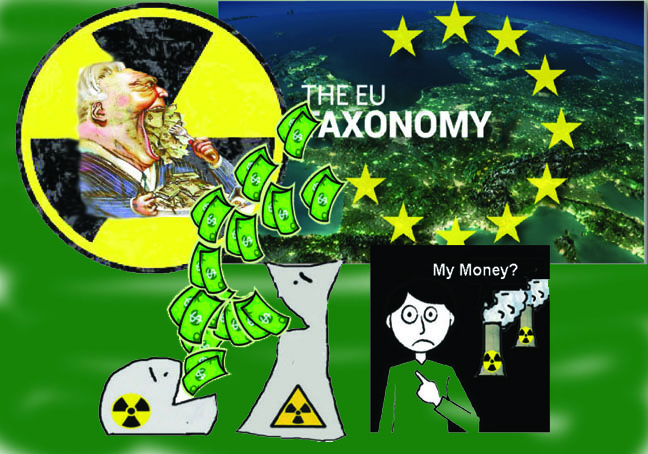
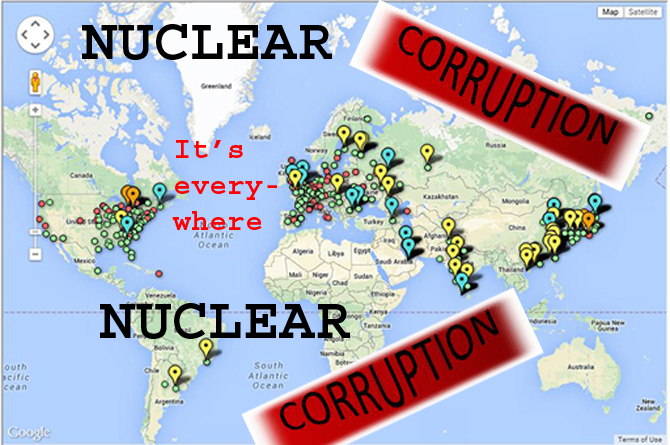
Can there be any other industry so enmeshed in corruption as the nuclear industry?
I won’t try to enter here into the wholescale government lying and deception of the public that has gone on in Russia and China – poisoning whole regions with radioactive waste.
Just a brief look at what’s gone on in North America should be enough to raise our suspicions about the companies and individuals leading the push for small nuclear reactors.
Illinois, in March 2022, a federal grand jury indicted the powerful Speaker of the House, Michael Madigan, on racketeering and bribery charges for allegedly using his official position to corruptly solicit and receive personal financial rewards for himself and his associates.
How about the Ohio First Energy case, with the fraud conviction of Larry Householder, the former Speaker of the House, and in South Carlina the gaoling of Kevin B. Marsh, former SCANA CEO and Chairman of the Board of Directors?
Canada’s SNC- Lavalin should take the cake for corruption. There’s the 2019 $10 million hospital bribery case. And between 2004 and 2011 $117,803 flowed from SNC-Lavalin to federal party funds, including Liberal and Conservative. Which politicians received the money remains a mystery. In late November 2018, former SNC-Lavalin vice-president Norman Morin quietly pleaded guilty to charges of violating Canada’s election financing laws. Because Morin accepted the plea deal, the evidence gathered for the trial was never presented in court.
The company faced charges of fraud and corruption in connection with nearly $48 million in payments made to Libyan government officials between 2001 and 2011.
CBC news detailed SNC-Lavalin’s corruption scandals – MUHC contract scandal…….Corruption scandal in Bangladesh …….Libya scandal……Elections Financing in its story – A closer look at SNC-Lavalin’s sometimes murky past.
So many murky areas around nuclear deals – the political gymnastics as powerful individuals like Bill Gates and Elon Musk get involved in government measures that facilitate their nuclear/space enterprises.
The secrecy involved in the nuclear industry lends itself to corruption. The industry chips away at laws that impose safety or transparency limits on it.
To give one scary example – President Vladimir Zelensky has signed an amendment that reduced financial oversight of politicians. The measure “practically kills” efforts to combat money-laundering, the head of the Anti-Corruption Action Centre (AntAC) claimed. The body is funded by the US government and EU member states and elites in Kiev have long been hostile to its work, despite their dependence on Western funding and support. This, as Ukraine aims to build, with USA’s Westinghouse, new nuclear reactors.
We get to hear of some of the shenanigans that corrupt nuclear executives get up to. As the clearly illogical and unaffordable small nuclear reactor push goes on, it is critically time to focus on why on earth this is happening, and who is getting paid to lie about it?
Inside the ‘clandestine world’ of SNC-Lavalin’s fallen star Riadh Ben Aissa, Financial Post, Brian Hutchinson, Financial Post Staff | March 18, 2015 “……..This is one of the details revealed in a 98-page document prepared by Swiss prosecutors (called an acte d’accusation en procédure simplifiée, it is comparable to a North American plea bargain agreement) and obtained by the Financial Post. It brings to light previously unknown details of how Mr. Ben Aissa, a 56-year-old citizen of both Tunisia and Canada, and now facing charges in Canada on a different matter, directed 12.5 million euros and US$21.9 million into Swiss bank accounts controlled by Saadi Gaddafi, from 2001 to 2007.
These were kickbacks, paid to Saadi by Mr. Ben Aissa in return for certain Libyan contracts awarded to SNC. According to Swiss authorities, tens of millions more dollars moved through Mr. Ben Aissa’s own Swiss accounts, from September 2001 to March 2011. The money came from SNC……..
the Swiss proceedings raise new questions about SNC, its vulnerability, and its future, which even its current CEO, Robert Card, has publicly worried may be at risk of either breaking up, ceasing to exist or being taken over. Since it found itself embroiled in scandal, the company has seemed in perpetual crisis, with more drama this week in its boardroom, with the sudden resignation of its chairman, and in a Montreal courtroom, where Mr. Ben Aissa and another former SNC executive began a preliminary hearing over allegations of bribery in a Canadian hospital deal.
While some might question how SNC did not know about Mr. Ben Aissa’s conduct in Libya, some insiders still seem inclined to blame him alone for setting into motion the company’s stunning fall from grace.
“Good luck sorting out Riadh Ben Assia’s clandestine world,” former SNC chairman Gwyn Morgan wrote in a brief response to questions put to him by email about certain activities that allegedly took place during his leadership……..
SWwiss authorities identified five specific areas of corruption where SNC cash was used to obtain contracts in Libya. ……
Last month, the RCMP laid criminal charges against SNC Lavalin itself, in connection to allegedly corrupt activities in Libya. The charges came as a blow; sources claim the company’s management and its lawyers had negotiated with Canadian authorities for two years, in an attempt to avoid prosecution. A criminal conviction for corruption could result in the company being prohibited — “debarred” — from bidding on public works projects in Canada…….
On Monday, SNC announced the resignation of Ian Bourne, its board chairman, effective immediately. He’d been in the position just two years, having replaced Mr. Morgan in 2013. SNC did not give specific reasons why Mr. Bourne decided to leave.
The same morning, two former SNC executives walked into a Montreal courtroom for the start of a preliminary hearing on other corruption-related matters. One was Pierre Duhaime, SNC’s former CEO and president. The second was Mr. Ben Aissa, back in Canada after his Swiss incarceration and extradition. Both are charged with fraud, related to alleged construction bid-rigging in Montreal, in what one police investigator has called the “biggest corruption fraud in Canadian history.”
Mr. Duhaime, Mr. Ben Aissa, former SNC controller Stéphane Roy and five other men, among them Canada’s former spy watchdog, Arthur Porter, allegedly participated a corrupt scheme that saw an international consortium led by SNC win a $1.34-billion hospital construction and maintenance contract for the McGill University Health Centre (MUHC), in 2010. Dr. Porter has publicly refuted the allegations and none have been proven in court. Mr. Duhaime has pleaded not guilty. Mr. Ben Aissa is also in court fighting the allegations………. http://business.financialpost.com/legal-post/inside-the-clandestine-world-of-snc-lavalins-fallen-star-riadh-ben-aissa
A closer look at SNC-Lavalin’s sometimes murky past CBC, 12 Feb 19 One of Canada’s biggest engineering companies is at the centre of what appears to be a growing scandal engulfing Prime Minister Justin Trudeau and his government.
The Globe and Mail reported Thursday that SNC-Lavalin lobbied the government to agree to a deferred prosecution agreement or remediation agreement. The company faces charges of fraud and corruption in connection with nearly $48 million in payments made to Libyan government officials between 2001 and 2011.
Trudeau denies he directed his former justice minister and attorney general, Jody Wilson-Raybould, to intervene in the prosecution. Wilson-Raybould was shuffled out of her position last month and has refused to comment on the story. Days after the story broke, the federal ethics commissioner confirmed he will investigate claims the prime minister’s office pressured Wilson-Raybould to help SNC-Lavalin avoid prosecution.
SNC-Lavalin has pleaded not guilty to the charges. The case is at the preliminary hearing stage. If convicted, the company could be banned from bidding on any federal government contracts for 10 years.
But the Libya case is just one scandal among many linked to SNC-Lavalin in the past decade.
Allegations of criminal activity are what led to the resignations in February 2012 of top executives Riadh Ben Aïssa and Stéphane Roy. CEO Pierre Duhaime followed them out the door the following month.
MUHC contract scandal…….
Corruption scandal in Bangladesh …….
Libya scandal……
Elections Financing
In late November 2018, former SNC-Lavalin vice-president Normand Morin quietly pleaded guilty to charges of violating Canada’s election financing laws.
According to the compliance agreement reached with the company in 2016, Morin orchestrated a scheme between 2004 and 2011 that used employees to get around the restrictions on companies donating directly to federal political parties. Morin would get employees to donate to political parties, riding associations or Liberal leadership candidates. The company would then reimburse them for their donations through false refunds for personal expenses or fictitious bonuses.
In total, $117,803 flowed from SNC-Lavalin to federal party funds during that period. The Liberal Party of Canada got the lion’s share — $83,534 to the party and $13,552 to various riding associations. Another $12,529 went to contestants in the 2006 Liberal Party leadership race won by Stephane Dion. The Conservative Party of Canada received $3,137 while Conservative riding associations got $5,050.
Ottawa, Monday, March 27, 2023 – Environmental and civil society groups are giving a thumbs-down after the federal government announced new funding on Friday towards the development of small modular nuclear reactors (SMRs). The groups will be looking closely at the numbers in Tuesday’s budget.
The “Prime Minister Trudeau and President Biden Joint Statement,“ issued on Friday March 24, committed Canada to provide funding and in-kind support for a US-led program to promote SMRs.
The Canadian government’s Strategic Innovation Fund has already given close to $100 million to corporations working on experimental SMR technologies. In addition, the Canada Infrastructure Bank has committed $970 million to Ontario Power Generation’s plan for a 300-megawatt SMR at Darlington. Federal funding is benefiting US-based companies GE-Hitachi and Westinghouse, and Canada’s SNC-Lavalin, among others.
All the funded SMR projects are still in the research and development phase. Worldwide, no SMRs have ever been built for domestic use.
In addition, the federal government is giving Atomic Energy of Canada Limited $1.35 billion a year to conduct nuclear research and development and to manage its toxic radioactive waste. Nearly all this funding is transferred to a consortium of SNC-Lavalin and two US-based companies (Fluor and Jacobs) that that are heavily involved in nuclear weapons and SMR research.
Over 100 groups from all across Canada have criticized the federal government’s plan to promote SMR nuclear technology, stating that:
SMRs are a dirty, dangerous distraction that will produce radioactive waste of many kinds. Especially worrisome are those proposed reactors that would extract plutonium from irradiated fuel, raising the spectre of nuclear weapons proliferation.
SMRs will take too long to develop to address the urgent climate crisis in the short time frame necessary to achieve Canada’s goals.
SMRs will be much more expensive than renewable energy and energy efficiency. Small reactors will be even more expensive per unit of power than the current large ones, which have priced themselves out of the market.
Nuclear power creates fewer jobs than renewable energy and efficiency. Solar, wind and tidal power are among the fastest-growing job sectors in North America. The International Energy Agency forecasts that 90% of new electrical capacity installed worldwide over the next five years will be renewable.
The federal government needs to invest urgently in renewables, energy conservation and climate action, not slow, expensive, speculative nuclear technologies.
QUOTES:
“Taxpayer dollars should not be wasted on a future technology whose time is past, like nuclear reactors, when truly clean renewable solutions are up-and-running and getting more affordable all the time.” – Dr. Gordon Edwards, Canadian Coalition for Nuclear Responsibility
“Let’s compete to be world leaders in renewables. Pouring public funding into speculative reactor technologies is sabotaging our efforts to address the climate crisis.” – Dr. Ole Hendrickson, Sierra Club Canada Foundation
The SMR technologies are all at the early R&D stage, yet the funding is not following good governance practices by requiring high standards of peer review.“ – Dr. Susan O’Donnell, Coalition for Responsible Energy Development in New Brunswick


 nuclear-news