Germany walks fine line on nuclear weapons
DW, William Noah Glucroft, March 24, 2023
Germany is not a nuclear power, but it is part of US nuclear strategy. In light of the war in Ukraine and the undoing of Cold War-era arms control, the country’s balanced approach is coming under more pressure.
……………………………………………… Nuclear balancing act
Germany’s opposition to nuclear weapons competes with the expectation that it supports the security status quo. NATO nuclear sharing — the US-led military alliance’s long-standing policy that permits the stationing of US nuclear weapons on non-US territory — means German warplanes could carry them in the event of nuclear war.
As many as 20 such warheads remain at the Büchel Air Base in western Germany, according to an estimate by the Nuclear Threat Initiative. The think tank, based in Washington, DC, counted some 130 others at the Ramstein Air Base, until they were removed between 2001 and 2005.
The nuclear balancing act adds tension both to German domestic politics as well as to the Euro-Atlantic alliance. Any disagreement, however, has taken a back seat after Russia’s war in Ukraine………………………………………………………………………. https://www.dw.com/en/germany-walks-fine-line-on-nuclear-weapons/a-65109735
Strengthening the international maritime force: NATO gathers global fleet commanders to study Ukraine war — Anti-bellum

NATO currently has 70 members and partners on six continents. ==== NATOAllied Maritime CommandMarch 24, 2023 NATO Maritime Operational Commanders focus on deterrence, defence during annual conference NATO’s Allied Maritime Command (MARCOM) hosted Allied and Partner nation fleet commanders, operational directors, and other senior leaders for the Maritime Operational Commanders’ Conference (MOCC) 2023 at its […]
Strengthening the international maritime force: NATO gathers global fleet commanders to study Ukraine war — Anti-bellum
UK could fuel radioactive disaster in Ukraine – Russia
24 Mar 23, https://www.rt.com/russia/573527-ukraine-uranium-radioactive-disaster/
Depleted uranium shells promised to Kiev by the UK would “cause irreparable harm” to soldiers and civilians alike, Moscow claimed.
The potential use of British-supplied depleted uranium shells by Ukraine would have a devastating impact on the country’s economy and population, lasting for centuries to come, the Russian Defense Ministry warned on Friday.
Speaking at a briefing, Lieutenant General Igor Kirillov, who is in charge of Russia’s Nuclear, Biological and Chemical Defense Forces, issued a scathing criticism of the UK’s plans to support Kiev with armor-
rounds containing depleted uranium.
He noted that such munitions have only ever been deployed in combat by NATO countries, most notably during the Iraq War, when the US used at least 300 tons of depleted uranium-piercing rounds containing uranium.
“As a result, the radiation situation in the [Iraqi] city of Fallujah was much worse than in the cities of Hiroshima and Nagasaki after the nuclear bombings by the United States,” Kirillov stated, recalling that Fallujah had been dubbed “the second Chernobyl,” while the local population suffered from a skyrocketing number of cancer cases.
The West is well aware of the consequences of using such weapons, the general stressed. Even though it “will cause irreparable harm” to the health of Ukrainian troops and civilians, “NATO countries, in particular the UK, express a readiness to supply this type of weapon to the Kiev regime,” Kirillov stated.
He warned that the use of the munitions will contaminate farmland. “In addition to infecting its own population, this will cause tremendous economic damage to the agro-industrial complex of Ukraine… reducing any export of agricultural produce from Ukrainian territory for many decades, if not centuries to come,” the general said.
The UK’s plans to send depleted uranium shells to Ukraine for use with Challenger 2 battle tanks were first unveiled on Monday, prompting an outcry from the Russian Foreign Ministry, which called the move a sign of “absolute recklessness, irresponsibility and impunity” on the part of London and Washington.
While the US has said it does not plan to support Ukraine with such ammunition, it shrugged off Russian concerns over the matter, describing depleted uranium shells as “a commonplace type of munition” which has “been in use for decades.”
Second U.S. Citizen Headed to German Prison for Anti-Nuclear Weapons Actions
BY JOHN LAFORGE. 23 Mar 23, https://www.counterpunch.org/2023/03/23/second-u-s-citizen-headed-to-german-prison-for-anti-nuclear-weapons-actions/
While dread of nuclear war between Russia and NATO states over Ukraine have reached new heights, especially in Europe, a second U.S. citizen has been ordered to serve prison time in Germany for protest actions demanding that U.S. nuclear bombs stationed at Germany’s Büchel NATO base, southeast of Cologne, be withdrawn.
Dennis DuVall, 81, member of Veterans for Peace, U.S. Air Force veteran of the war in Vietnam, and veteran anti-nuclear activist, is to report to the federal prison in Bautzen, Germany, 32 miles east of Dresden (JVA Bautzen, Breitscheid Str. 4, 02625 Bautzen, Germany), on Thursday March 23 to begin a 60-day sentence.
On July 15, 2018, DuVall was one of 18 people who clipped through the chain link fence and enter the base in order to — as the group said in a statement — “bring an end to the ongoing criminal conspiracy to unleash uncontrollable and indiscriminate heat, blast, and radiation with every B61 nuclear bomb deployed at Büchel NATO base.”
Charged with trespass and damage to property, DuVall explained to German trial and appeals courts that he has a legal obligation under the Nuremberg Principles to join in nonviolent protests to prevent or halt the planning and preparation for nuclear attacks which is taking place at Büchel. Well-reported exercises like the annual “Steadfast Noon” are often described as nuclear attack rehearsals.
Today, with NATO materially at war in Ukraine, the needless forward-basing of U.S. H-bombs at six European NATO base’s facing Russia has never been more provocative or destabilizing. NATO’s latest “Strategic Concept” (June 2022) reaffirmed its ever-present threat to launch nuclear first-use attacks using U.S., French and British weapons.
In Cochem District Court on May 11, 2020, DuVall was the first U.S. citizen to be convicted in Germany for civil resistance against the ongoing threat to attack Russia with the U.S. nuclear weapons stationed at Büchel, 170-kiloton B61-3, and 50-kiloton B61-4 free-fall hydrogen bombs.
For years, Büchel protest defendants have warned of the base’s threat of nuclear annihilation, and have urged court authorities “to send a message to the German government to remove B61 H-bombs from Büchel NATO base, and return them to the United States for dismantling and disposal.” In trial testimony on May 11, 2020, DuVall reminded the District Court Judge that “the threat of nuclear weapons is a clear and present danger to the European community, and nuclear war is an existential threat to the web of life on our planet.”
In refusing to pay a court-imposed fine, DuVall explained to the public prosecutor in the case that “it is a matter of conscience I share with many other U.S., Dutch, and German Büchel defendants not to pay money to those who willingly protect weapons of mass murder deployed at Büchel NATO base.”
The first U.S. citizen to be jailed in similar protests, yours truly (writer John LaForge), was released February 28 from Glasmoor prison near Hamburg after serving 50 days.
“It is my right and my duty,” says DuVall, “to work toward the abolition of nuclear weapons, and it is the responsibility of the German government to sign and ratify the Treaty on the Prohibition of Nuclear Weapons, and to ensure the prompt removal of U.S. B61 thermonuclear weapons from Büchel NATO base.”
John LaForge is a Co-director of Nukewatch, a peace and environmental justice group in Wisconsin, and edits its newsletter.
Macron’s nuclear power plan hits trouble
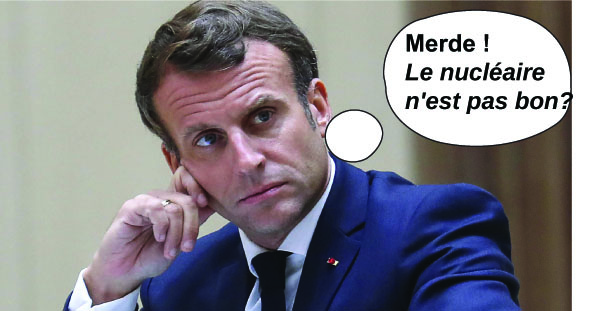
In a POLITICO interview, Luxembourg’s leader Xavier Bettel slams French push to include nuclear energy in EU’s green tech plan.
BY SUZANNE LYNCH AND JAKOB HANKE VELA, MARCH 22, 2023
French President Emmanuel Macron is facing an uphill battle to persuade EU leaders to designate nuclear energy as a key green technology of the future, after one of his allies blasted his plan on the eve of a summit in Brussels.
Luxembourg’s Prime Minister Xavier Bettel told POLITICO in an interview that while it is up to individual countries to choose their own energy mix, nuclear power must not benefit from an official “European label” that would give the vital French industry a boost.
Bettel’s criticism risks reinforcing divisions between Macron and his fellow leaders as they meet in Brussels to discuss the green tech plans at the European Council summit starting Thursday.
“Nuclear is neither sustainable, nor safe, nor fast,” Bettel said in an interview. “Some people think they are selling nuclear power as the answer to everything,” he continued, but pointed out that it can take at least 10 years for a plant to be operational.
“Secondly, we have had incidents at the international level which are worrying and which have had catastrophic repercussions for many other countries. And thirdly, we still have a problem with nuclear waste. We still don’t know how to deal with it, so we can’t say that it is safe and sustainable.”
France’s energy diet is dominated by nuclear power and Macron’s government has been lobbying Brussels to include nuclear energy in the EU’s Net Zero Industry Act — a package of plans unveiled last week by the European Commission.
The proposals in the act would allow “strategic net-zero” projects to qualify for a fast-track permitting process and smoother access to funding, part of the effort by Brussels to jump-start the transition away from fossil fuels to greener forms of energy.
Bettel said it’s up to each national government to decide its own energy mix, but argued that nuclear power should not be seen as good for the environment. “Everyone can do what they want,” he said. “But for me, the European label on nuclear energy — it would be in fact wrong to call it a green energy, or safe, or renewable.”
As POLITICO previously reported, in recent days France has not only lobbied to include nuclear energy in the EU’s Net Zero Industry Act, but it is also making a renewed push to give nuclear-based hydrogen a bigger role in meeting EU renewable energy goal,
Several diplomats said they expect the issue of nuclear to be discussed by leaders during Thursday and Friday’s summit. In particular, France — as well as countries like the Czech Republic — have been pushing for the phrase “technological neutrality” to be included in the language of the summit conclusions, which will be signed off on by leaders in Brussels. That would represent an oblique acknowledgment that all forms of energy, including nuclear, could form part of the EU’s green tech plan.
AUKUS – “These are the horrors”

Instead of humiliatingly accepting the smirking American ‘we neither confirm nor deny the presence of nuclear weapons visiting your country’, the Albanese government could reassert a little of our lost sovereignty by stating up front, no nuclear weapons never.
The AUKUS submarines will not be here to defend Australia, but only to attack China in a subordinate role with the American forces.
Pearls and Irritations, By Richard Tanter, Mar 24, 2023
AUKUS. This is a horror for which I now fear for the lives of my children and their children. Every time a Labor member of parliament or senator puts foot outside their office to appear in public, turns up at a public meeting, we need to ask them: why have you betrayed us? Why have you allowed this to happen? What are you going to do?
Transcript of a speech at the Anti-AUKUS Rally, Naarm, State Library of Victoria lawn, 18 March 2023.
These are horrors.
This is a horror for which I now fear for the lives of my children and their children.
This is now changing the direction of Australia for the next forty or fifty years.
We have never seen anything like this in peacetime Australia. At any stage.
This must not stand.
But it’s with the suite of profound horrors that we must start with.
The horrors of AUKUS
Firstly, the automatic involvement in war.
We have already been tied to the United States by the bases – by Pine Gap, by North West Cape, by the Space Surveillance Telescope that take us into space warfare, by the many other Australian bases to which the US has access.
We are already tied in, hard-wired in many cases, to the American war machine.
And the ADF is barely an autonomous force today.
But AUKUS takes us very much further down that road.
We already know what the submarines are there for.
In a rational world I actually think submarines are very important for the defence of Australia – but not in the form of this politically-driven, call-from-Washington-inspired scheme for long-range, long-endurance nuclear-powered submarines whose only rational use is to attack China.
Not on their own – Keating’s right about that calling them toothpicks thrown at a mountain – but in concert with American submarines and carrier task forces.
Maybe not immediately nuclear-armed, but almost certainly capable of nuclear-attack as well.
The AUKUS submarines will not be here to defend Australia, but only to attack China in a subordinate role with the American forces.
The horror of that fiscal black hole.
What does that $368 billion actually amount to? As if we have any idea of what the value of a dollar will be in forty years time – the lifetime cost of AUKUS will be an order of magnitude higher, certainly two or even four trillion dollars.
But what that means in terms of the sacrifice from what’s needed from government for decent health and survival for the Australian people is itself horrific.
This moves us towards what I think is an almost irrevocable position of enmity as far as the Chinese are concerned.
Principally because the only rational strategic role for those submarines is to contribute, potentially, to an American existential threat to China.
Even if we stop tomorrow, is China going to forget that?
Why should they?
We’ve revealed our hand.
We have a Minister for Defence who is effectively the minister for Washington, and this is where we have come to.

The horror of the sacrifice zone that the high-level nuclear waste storage site that is to be somewhere built in Australia.
I have to say that of all things that have shocked me about this scheme, this is one that has shocked me most.
Not just because I made the mistake of thinking that Albanese might be halfway reasonable because in my role as a former president of ICAN I had relations with those people, and he pledged he would support a nuclear ban treaty.
Well, that’s not happening now unless we make it happen.
But the announcement of a nuclear waste dump for high-level toxic nuclear waste, radioactive for thousands of years, is another world all together.
I had foolishly thought that they would follow their own mantra for the past year of saying that ‘this will be a sealed reactor full of highly enriched uranium, and to prevent diversion to nuclear weapons, the US will deliver it sealed, and when the fuel is exhausted it will return to the United States sealed for disposal, somewhere safe, where no-one else can get at it …’
More fool me. More fool me.
They betrayed us again, and that nuclear sacrifice zone of high level waste is going to be a huge problem – and struggle – for decades and decades.
What really troubles me as someone who works on strategic issues and thinks that defence issues are real and important, is that this the largest defence expenditure – if we can use the word ‘defence’ with a straight face in this context – this massive defence expenditure actually disables our genuinely necessary defence capabilities.
There will be very little money left over for anything else in defence.
Worst of all, it disables the possibility of what we have come here today to call for – an independent defence and foreign policy – because there will be nothing left.
I heard one of those defence experts quoted in that authoritative source, Nine Entertainment’s Red Alert on the front pages of The Age – the same report that said yes, we have allies, we have Diego Garcia – all 27 square kilometres of it grabbed by the Brits and rented by the Americans, and we have Guam – the tiny American colony almost wholly taken up by US military bases – it would be funny if it wasn’t so awful and so telling about the government’s grasp of the actual facts – I saw that one of those experts said ‘we have to accept that if there is a war with China ‘that means Pine Gap goes’.
Actually I think that’s quite true, under certain circumstances. But the blitheness, the casualness with which that is said tells us a lot about how these people think.
Because if ‘Pine Gap goes’ in a nuclear missile attack, then Alice Springs and most of its 25,000 citizens ‘go’ too. No need to think about that, is there?
Just the casualness with which this is proposed and debated, apart from the ignorance, is stunning and revealing.
And the last part of the horror for me is the nuclear permissiveness which is now beginning to swell in discussions in Canberra security circles.
The momentum that is going to be built out of this first step of nuclear-powered submarine will mean we’re already going to have naval training for this; we’re going to have expanded nuclear engineering programs at places like the ANU.
We’re going to have military and naval careers built around this.
We’re going to have an industry here which has a deep interest in going the next step from naval nuclear propulsion to a civilian nuclear power industry.
We also know, because this is preceded by the US B-52 bombers at RAAF Tindal near Katherine in the Northern Territory – not nuclear-armed bombers at present, but quite definitely possibly nuclear-armed in the future at the stroke of a presidential pen –that those bombers will be used as part of an attack on China.
And what’s really important to understand now is that the South pacific Nuclear Weapon Free Zone, which Australia signed and says it’s proud of, has a loophole in it sponsored by the Australians to meet US needs, which says there are to be no nuclear weapons in the territories of the member states, like Australia, except in the case of ‘transits’ or ‘visits’.
Transits and visit in these days of American rotational deployments can cover an awful lot of interpretations.
The Albanese government could do one very simple thing to address this fear: it could declare that under no circumstances will any nuclear weapons from any country be allowed into Australia.
Not for a visit, not of layover in transit, just never.
No nuclear-armed aircraft, warships or submarines will ever be allowed to enter Australia.
The USS Asheville nuclear-powered attack submarine in Perth at the moment at Stirling Naval Base, and its successors, will never be allowed to return without a verifiable declaration that they come without nuclear weapons.
Instead of humiliatingly accepting the smirking American ‘we neither confirm nor deny the presence of nuclear weapons visiting your country’, the Albanese government could reassert a little of our lost sovereignty by stating up front, no nuclear weapons never.
The strategy of AUKUS
The strategic part of what’s happening at the American bases in Australia (aka ‘joint facilities’) is part of all this.
You know what is happening at Pine Gap, the giant American-built and American-paid for joint surveillance station outside Alice Springs.
You know about the wonderfully-named Harold E. Holt Naval Communications Station on the tip of North West Cape in Western Australia – a critical submarine communications base for American nuclear submarines and in the future for these AUKUS submarines. It’s immensely important, and probably another priority target, most likely nuclear under certain circumstances.
But just down the road the US has built a giant and highly advanced space telescope.
That doesn’t sound very much, does it.
But what it’s there for is our contribution to American plans for space warfare, to ensure what the US calls ‘space dominance’. And you understand perfectly well how critical space is for all militaries – and indeed our whole society – today.
We are deeply and increasingly plugged into that activity.
All governments have talked for the last thirty years about ‘the joint facilities’ – we don’t have any American bases, of which Australia has full knowledge and concurrence of any activities conducted at these bases.
When you peel that back, and when you talk to ministers – I can tell you I am continually shocked by their ignorance, as well as their deceptions………………………………………………………………………………………………………….. more https://johnmenadue.com/these-are-the-horrors-of-aukus/
Climate change may pose key risk to French reactors – said the country’s Court of Auditors

Each year, the volume of water withdrawn to cover the needs of the French population amounts to 33.5bcm, half of which is used to cool nuclear power plants.
Some 98% of this water is released back into rivers but at a higher temperature, which is regulated on a plant-by-plant basis.
MURIEL BOSELLI, Paris, 22 Mar 2023 https://www.montelnews.com/news/1466974/climate-change-may-pose-key-risk-to-french-reactors–court
The impact of global warming on France’s nuclear fleet could become “critical” by 2050, with three to four times more outages than today, said the country’s Court of Auditors in a report published late on Tuesday.
“These outages are concentrated, admittedly on short summer periods, but are increasingly long and can prove critical by increasing the risks of pressure on the grid,” said Annie Podeur, president of the second chamber of the court, during a hearing at the Senate.
These outages and capacity cuts led to “losses amounting to several TWh per year”, Podeur said, citing the record unavailability in 2003 of 6 GW of nuclear power, or 10% of France’s installed nuclear capacity.
Extreme heat
Increased risk of extreme heat and droughts amid climate change could impact nuclear plants, which use water to cool down.
Combined with this, the report pointed to the expected significant increase in power demand in the years to come, which would strain the grid.
Each year, the volume of water withdrawn to cover the needs of the French population amounts to 33.5bcm, half of which is used to cool nuclear power plants.
Some 98% of this water is released back into rivers but at a higher temperature, which is regulated on a plant-by-plant basis.
The reduced availability of water resources amid drought could exacerbate conflicts about usage with agriculture, tourism and other industries, said Podeur.
Predicting river flows
Climate models should be updated to include river flow levels for the coming years, recommended the report, adding that EDF needed greater storage capacity for water to cool reactors during periods of low flows.
Last summer, which was particularly hot and dry, France’s nuclear safety authority ASN authorised EDF to exceed temperature limits for certain plants to continue producing power.
This decision was taken after the utility stopped a record number of reactors for maintenance and corrosion probes.
The court urged EDF to quantify the total costs of adapting its fleet to deal with climate change.
The utility spent EUR 1bn on currently operational reactors from 2006-2021 and plans to invest only EUR 612m from 2023-2038, added Podeur.
EDF has estimated that outages related to heat and drought result in a loss of annual nuclear production of around 1%.
TODAY. NuScam – the sad little canary that’s scared of a tweet

NuScale, maker of the pioneering (supposedly little) Small Modular Nuclear Reactors, must have had a little hissy fit at my beautiful picture of NuScale’s SMR plunging down a bottomless money hole.
I mean, that is pretty much what is in fact happening. But I can understand that NuScale was not all that thrilled with my artwork – they had it removed from Twitter, explaining that –
“This person has taken and modified our rendering without our permission and in a derogatory fashion. “
Well, that’s true. Unfortunately sometimes “derogatory” = “true”.
And “true” can be painful. NuScale is seen as the canary in the coal mine for SMRs,
NuScale and the Utah Municipal Power Systems, its partner in an SMR project planned for Idaho, announced early in January, that the target price for the power from their proposed modular reactor had risen by 53% from $58/MWh to $89/MWh.
So NuScale has a lot more to be sad about than just my little picture, and somebody else’s tweet of it. The reality is that the business prospects for all those hyped-up small nuclear reactors are looking very gloomy indeed.
NuScale, Rolls Royce and the rest of them might soon have to face up to the fact that SMRs can survive only as tax-payer funded toys for the military – nuclear submarines, military stations on the moon, whatever new follies that the macho boys think up.
1 This Month

of the week – Shut Down Drone Warfare!


Tell the Ukrainian Government to Drop Prosecution of Peace Activist Yurii Sheliazhenko

Petition to revoke the licensing of the Near Surface Nuclear Disposal Facility (NSDF) at Chalk River. https://www.ourcommons.ca/petitions/en/Petition/Details?Petition=e-7247
To see nuclear-related stories in greater depth and intensity – go to https://nuclearinformation.wordpress.com
-
Archives
- April 2026 (103)
- March 2026 (251)
- February 2026 (268)
- January 2026 (308)
- December 2025 (358)
- November 2025 (359)
- October 2025 (376)
- September 2025 (257)
- August 2025 (319)
- July 2025 (230)
- June 2025 (348)
- May 2025 (261)
-
Categories
- 1
- 1 NUCLEAR ISSUES
- business and costs
- climate change
- culture and arts
- ENERGY
- environment
- health
- history
- indigenous issues
- Legal
- marketing of nuclear
- media
- opposition to nuclear
- PERSONAL STORIES
- politics
- politics international
- Religion and ethics
- safety
- secrets,lies and civil liberties
- spinbuster
- technology
- Uranium
- wastes
- weapons and war
- Women
- 2 WORLD
- ACTION
- AFRICA
- Atrocities
- AUSTRALIA
- Christina's notes
- Christina's themes
- culture and arts
- Events
- Fuk 2022
- Fuk 2023
- Fukushima 2017
- Fukushima 2018
- fukushima 2019
- Fukushima 2020
- Fukushima 2021
- general
- global warming
- Humour (God we need it)
- Nuclear
- RARE EARTHS
- Reference
- resources – print
- Resources -audiovicual
- Weekly Newsletter
- World
- World Nuclear
- YouTube
-
RSS
Entries RSS
Comments RSS
 nuclear-news