China marketing nuclear power to Uganda

Uganda announces plans to start nuclear power generation
Energy minister says preparation ongoing to pave way for 1st nuclear power project
Hamza Kyeyune |09.03.2023,
KAMPALA, Uganda
Uganda announced Thursday it will begin construction of the country’s first nuclear facility, the Buyende Nuclear Power Plant, in partnership with China National Nuclear Corporation that would assist the East African country in developing capabilities for peaceful use of atomic energy.
Currently in Africa, only South Africa has an active nuclear power plant, while Russia’s state-owned energy corporation Rosatom commenced construction of Egypt’s first nuclear facility last year………..
https://www.aa.com.tr/en/africa/uganda-announces-plans-to-start-nuclear-power-generation/2841543
March 10 Energy News — geoharvey

World: ¶ “Ukraine War: Why Russia’s Infrastructure Strikes Strategy Isn’t Working” • A coordinated wave of Russian attacks on Ukraine’s power infrastructure was the first in almost a month. Western officials believe missiles and other precision-guided weaponry Russia needs to carry out such attacks with any measure of effectiveness is in short supply. [BBC] Bombed […]
March 10 Energy News — geoharvey
How the nuclear lobby scuttled the EU’s anti-greenwashing tool
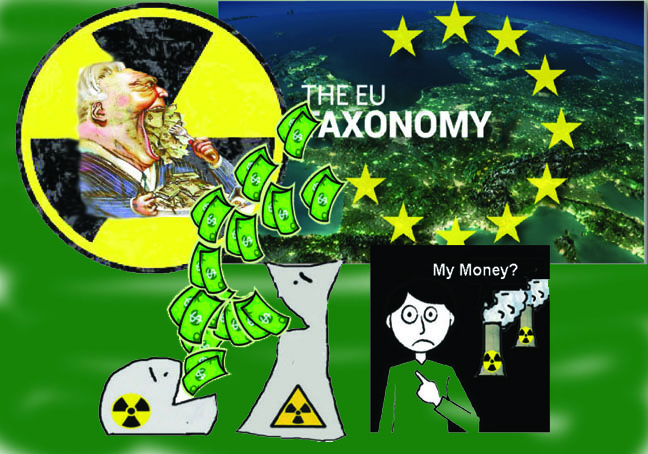
Succumbing to member states’ pressure and giving nuclear energy a “sustainable” label in a key regulation could derail the EU’s climate progress.
Aljazeera, Christiana Mauro, Senior advisor at the Biosphere Institute , Kacper Szulecki, Research professor in climate governance, 8 Mar 23,
One year ago, hopes were high for what was considered to be the most important environmental legislation in Europe. The European Union’s taxonomy regulation was meant to become the global “gold standard” for science-based policy that directs investment towards climate-friendly goals.
Their argument is that the “sustainable” label given to nuclear energy and natural gas breaches the EU’s climate commitments, violates EU environmental law and is incompatible with the “do no significant harm” criteria of the taxonomy regulation itself. The EC refused to revoke the act leading the complainants to launch a lawsuit at the European Court of Justice.
As we await the court’s decision, it is important to recall how this legislation was undermined by the nuclear lobby and what the consequences will be if it is not struck down
………………………………………………………………the EU taxonomy regulation ….. was supposed to be a list of scientifically-based technical criteria to set apart economic activities that are genuinely sustainable from those that are harming the environment.
It defined environmentally sustainable activities as contributing substantially to specific environmental objectives that will speed up the decarbonisation of the economy, comply with safeguards and “do no significant harm” to the environment.
Nuclear energy and natural gas initially failed to meet the taxonomy criteria. Of course, that went against big interests in the energy sector and predictably a lobbying blitz was launched to reverse this decision.

A report by Reclaim Finance, an NGO which scrutinises the impacts of financial actors on climate, revealed a lobbying campaign worth millions of euros was initiated to amend the regulation in favour of the natural gas and nuclear industries.
Lobbyists met frequently with EU representatives during critical phases of the deliberations over the taxonomy. Russia, which would have been a major financial and geopolitical beneficiary of the financial incentives that would ensue from the inclusion of gas and nuclear, was an extremely active “stakeholder” during the entire legislative process.
But there were also EU countries which sought to put pressure on the European Commission to change the regulation’s provisions. At the forefront of that effort were Poland, France, the Czech Republic, Hungary, Romania, Slovakia and Slovenia, whose leaders wrote a joint letter arguing for the inclusion of nuclear power in the regulation.
The document used various common claims and arguments in support of nuclear sustainability. We were part of a team of fact-checkers from four EU countries who determined that 20 statements in the letter were false or misleading.
Among them were assertions that nuclear power is “environmentally friendly”, “essential to the transition towards clean energy sources”, a “promising source of hydrogen” and “affordable”.
A full analysis of the letter can be found here.
Why nuclear energy is not green
Why nuclear energy is not green is perhaps less obvious to the general public than natural gas. This likely is due to efforts by governments – such as the seven mentioned above – and organisations to mislead it.
False narratives of “clean” nuclear are also peddled by intergovernmental organisations such as the International Atomic Energy Agency (IAEA), the OECD, and the UN Economic Commission for Europe (UNECE).

A common claim – which is also made in the letter to the EC – is that nuclear energy has a low carbon emission status. But if nuclear power can be said to produce lower carbon emissions, it is only true at the point of generation. When the entire life cycle of nuclear power plants is taken into consideration this contention crumbles.
Nuclear energy’s “upstream” activities that are necessary for operation, such as mining uranium, as well as transporting fuel, building and then decommissioning a power plant, and managing the radioactive waste that is a by-product of the process – are all linked to CO₂ emissions. Thus, the carbon footprint of nuclear energy generation is considerable, and according to some estimates, considerably higher than that of renewables.

Nuclear technology also needs significant amounts of cooling water and creates waste that is so toxic to the environment that no permanent storage solution has been developed for 70-odd years. It also represents a risk of seriously and permanently harming large swaths of territories in the case of an accident – which is now growing amid the current militarisation of civil nuclear facilities in Ukraine.
Posing an unmanageable danger to the environment, nuclear power falls short, even as a so-called “transitional activity”, defined in the regulation as an economic activity for which low-carbon alternatives are not available. This is because its financing today would derail the implementation of renewables by diverting investment away from them.
As Amory Lovins, a Stanford University professor and energy expert, says: “a low- or no-carbon energy source that costs more or takes longer to deploy will make climate change worse than one that is cheaper or faster, because the latter could have saved more carbon per euro and per year.”
Energy demand in Europe can easily be met by non-nuclear power sources, and considering the unreliability of nuclear power, with its ageing and deteriorating reactors, and vulnerability to extreme weather events, it is unlikely to have any energy contribution to make at all in the transition to renewables.
Even the most favourable calculations of the cost of nuclear energy show no advantage over renewable, which is seeing costs of deployment plummeting.
Government schemes keep consumer nuclear electricity prices artificially low. In fact, nuclear energy can only be made “competitive” with “hugely significant” government financing, as the EU Energy Commissioner inadvertently admitted in a recent speech. Hence, the seven governments’ letter also pleaded for “active support” for nuclear energy.
The profusion of nuclear delusions
There is a long history of attempts to link nuclear technology to overoptimistic technocratic environmental achievements that never materialise.
Media-hyped nuclear fiction abounds. For example, a recent fusion experiment in the US was touted as a major milestone in the search for an abundant source of clean energy. Predictably, it had a rather anticlimactic ending for anyone paying attention.
The energy generated in the experiment was significantly less than the amount needed to power the lasers involved in it. And the laboratory where the celebrated breakthrough took place was established to develop thermonuclear weapons, not civil nuclear energy projects, which explains its multibillion-dollar budget.
Such nuclear myths are usually debunked by independent experts whose critical voices are often buried beneath irresponsibly promoted fantasies. The morass of disinformation is meant in part to mask the industry’s own failures, but also the military interests of nuclear governments, by pushing unsupported theories to legitimise public funding. It is meant to confuse, demoralise and disable any organised effort to change things.
And the media, instead of challenging this intentional misleading of the public, has played a part in it. European media, for example, reported on the letter of the seven EU countries lobbying for nuclear to be included in the EU taxonomy regulation without checking the veracity of its claims.
Thus, a misinformed public and passive media have allowed political actors to influence regulations that are supposed to be politically neutral. Well-intentioned, vital, and comprehensive legislation, years in the making, has been subverted.
In its current form, this delegated act is likely to derail key 2030 and 2050 climate goals, and damage the Green Deal by influencing negatively green taxonomies being developed around the world. It will encourage greenwashing practices, redirect capital flows towards polluting sectors, and upset progress made on implementing the objectives of the Paris Agreement. https://www.aljazeera.com/opinions/2023/3/8/how-the-eus-most-promising-anti-greenwashing-tool-was-scuttled
Electricite De France (EDF) discovers a “significant defect” on a weld in Penly nuclear reactor.

Nuclear: EDF discovers a “significant defect” on a weld in Penly. A deep
crack with “a risk of leaking” was discovered on an emergency circuit
of a shutdown reactor.
The Nuclear Safety Authority is asking EDF to review
its repair plans. The impact on nuclear production remains uncertain.
Almost a year and a half after the discovery of a generic problem of
microcracks which will have cost it several tens of billions of euros in
2022 and which will have considerably weighed on the production of
electricity, EDF has encountered in recent weeks a new bad surprise. The
operator indicated on the website of the Penly power plant that it had
detected a “significant stress corrosion defect” on an emergency circuit of
the site’s number 1 reactor. This circuit is located within the radioactive
zone, in the “reactor building”.
Les Echos 7th March 2023
War in space: U.S. officials debating rules for a conflict in orbit

Christian Davenport, The Washington Post, Wed, March 8, 2023
Ukraine’s use of commercial satellites to help repel the Russian invasion has bolstered the U.S. Space Force’s interest in exploiting the capabilities of the private sector to develop new technologies for fighting a war in space.
But the possible reliance on private companies, and the revolution in technology that has made satellites smaller and more powerful, is forcing the Defense Department to wrestle with difficult questions about what to do if those privately owned satellites are targeted by an adversary.
White House and Pentagon officials have been trying to determine what the policy should be since a top Russian official said in October that Russia could target the growing fleet of commercial satellites if they are used to help Ukraine.
Konstantin Vorontsov, deputy director of the Russian Foreign Ministry’s department for nonproliferation and arms, called the growth of privately operated satellites “an extremely dangerous trend that goes beyond the harmless use of outer-space technologies and has become apparent during the latest developments in Ukraine.”
He warned that “quasi-civilian infrastructure may become a legitimate target for retaliation.”
In response, White House press secretary Karine Jean-Pierre reiterated earlier comments from her counterpart at the Pentagon that “any attack on U.S. infrastructure will be met with a response, as you’ve heard from my colleague, in a time and manner of our choosing.”
But what that response will be is unknown, as officials from a number of agencies try to lay out a policy framework on how to react if a commercial company is targeted…………………………………
The discussions come as the Pentagon is investing in more systems that were originally developed for civilian use but also have military applications. In the National Defense Strategy released late last year, the Pentagon vowed to “increase collaboration with the private sector in priority areas, especially with the commercial space industry,
leveraging its technological advancements and entrepreneurial spirit to enable new capabilities.”
Several companies are developing small rockets that would launch inexpensively, and with little notice. SpaceX, meanwhile, has launched its Falcon 9 rocket at a record cadence, firing it off 61 times last year
The company is on track for even more launches this year.
“We think in a few years we’ll be in the 200, 300, 400 range,” Space Force Maj. Gen. Stephen Purdy Jr. said during a conference this month, referring to total space launches. “There’s a massive increase in commercial launch.”
He said the Space Force would like to get to the point where “we’re constantly launching, and there’s a schedule. There’s a launch in two hours, and there’s launch in 20 hours. Your satellite is not ready? Okay, get on the next one.”
For its next round of national security launch contracts, the Space Force has proposed an approach specifically designed to help small launch companies compete.
One track of contracts will be reserved for the most capable rockets – those able to hoist heavy payloads to every orbit the Pentagon wants to plant a satellite. Stalwarts such as SpaceX and the United Launch Alliance, the joint venture of Lockheed Martin and Boeing, would probably compete for those. Blue Origin, the venture owned by Jeff Bezos, could also potentially bid its New Glenn rocket, though it has yet to fly. (Bezos owns The Washington Post.)
But the Space Force has proposed offering a second track for smaller rockets, allowing start-ups to enter one of the most reputable and lucrative space marketplaces that could be worth billions of dollars over several years. Those companies include Rocket Lab, which has recently christened its launch site on the Eastern Shore of Virginia, adding to its facility in New Zealand, and Relativity, which is scheduled to launch the world’s first 3D printed rocket on Wednesday…………..
 |
https://news.yahoo.com/war-space-u-officials-debating-120515128.html
Nuclear and space lobbies increase their grip on universities, a new example in UK

Bangor University in Wales will develop a nuclear thermal fuel system to
support deep space exploration with funding provided by the UK Space
Agency. It is one of eight projects receiving a total of GBP1.6 million
(USD1.9 million) in funding through the agency’s Enabling Space Exploration
fund.
World Nuclear News 7th March 2023
https://www.world-nuclear-news.org/Articles/Welsh-university-to-develop-space-nuclear-propulsi
Crack in piping of Penly nuclear reactor further complicates EDF’s situation.
Unlike the microcracks detected on other reactors (such as those of Chooz,
in the Ardennes, and Civaux, in Vienne, 1,450 MW, the most powerful and
most recent), the defect observed at Penly is described as particularly
important:
the ASN describes a crack extending over 155 millimeters (mm),
“that is approximately a quarter of the circumference of the piping”.
The nuclear policeman adds that its maximum depth is 23 mm, for a pipe
thickness of 27 mm.
Although the Penly 1 reactor had already been
identified as being among the most sensitive to the phenomenon of stress
corrosion, this portion of the circuit in particular was considered
“non-sensitive” by EDF, due to its geometry. The licensee, like ASN,
considers that the presence of corrosion could be explained by the double
repair to which the piping was subjected during the construction of the
reactor.
Time News 8th March 2023
Pentagon to deploy tanks to Ukraine “as quickly as possible” — Anti-bellum
Defense NewsMarch 8, 2023 US Army is moving to get tanks to Ukraine ‘as quickly as possible’ The U.S. Army is already executing on a plan to send M1 Abrams tanks to Ukraine, the Army’s acquisition chief said Wednesday. The Pentagon announced early this year it would send General Dynamics Land Systems-made Abrams tanks to […]
Pentagon to deploy tanks to Ukraine “as quickly as possible” — Anti-bellum
1 This Month

of the week – Shut Down Drone Warfare!


Tell the Ukrainian Government to Drop Prosecution of Peace Activist Yurii Sheliazhenko

Petition to revoke the licensing of the Near Surface Nuclear Disposal Facility (NSDF) at Chalk River. https://www.ourcommons.ca/petitions/en/Petition/Details?Petition=e-7247
To see nuclear-related stories in greater depth and intensity – go to https://nuclearinformation.wordpress.com
-
Archives
- April 2026 (79)
- March 2026 (251)
- February 2026 (268)
- January 2026 (308)
- December 2025 (358)
- November 2025 (359)
- October 2025 (376)
- September 2025 (257)
- August 2025 (319)
- July 2025 (230)
- June 2025 (348)
- May 2025 (261)
-
Categories
- 1
- 1 NUCLEAR ISSUES
- business and costs
- climate change
- culture and arts
- ENERGY
- environment
- health
- history
- indigenous issues
- Legal
- marketing of nuclear
- media
- opposition to nuclear
- PERSONAL STORIES
- politics
- politics international
- Religion and ethics
- safety
- secrets,lies and civil liberties
- spinbuster
- technology
- Uranium
- wastes
- weapons and war
- Women
- 2 WORLD
- ACTION
- AFRICA
- Atrocities
- AUSTRALIA
- Christina's notes
- Christina's themes
- culture and arts
- Events
- Fuk 2022
- Fuk 2023
- Fukushima 2017
- Fukushima 2018
- fukushima 2019
- Fukushima 2020
- Fukushima 2021
- general
- global warming
- Humour (God we need it)
- Nuclear
- RARE EARTHS
- Reference
- resources – print
- Resources -audiovicual
- Weekly Newsletter
- World
- World Nuclear
- YouTube
-
RSS
Entries RSS
Comments RSS
 nuclear-news