Greenpeace will sue the European Commission over its decision to include gas and nuclear as “clean”
Greenpeace will take the European Commission to court over its decision to
include gas and nuclear energy in the EU’s list of investments that can be
labelled as “green”, the campaign group said on Thursday.
Greenpeace requested a formal review in September of the Commission’s decision,
arguing the European Union had violated its own climate laws by labelling
some gas and nuclear energy investments as green.
Reuters 9th Feb 2023
Fears of ‘catastrophic’ nuclear horror as Turkey’s reactor rocked by horror earthquake
Turkey’s Akkuyu Nuclear Power Plant is facing a major risk, an expert has
warned, as the death toll of the disastrous earthquake racks up. The
disaster in Turkey and Syria has so far left 11,224 confirmed dead, with
the World Health Organisation warning that the final death toll could be as
high as 20,000.
Rescue teams in Turkey and Syria worked through the night
to recover more bodies from the rubble of thousands of buildings destroyed.
Following the disaster, an expert told Express.co.uk that Turkey’s nuclear
power plant, which lies just 16 miles away from an earthquake fault and is
currently under construction, could be at risk.
Express 8th Feb 2023
The US Department of Energy has made it easier to share nuclear information with Mexico and harder to do so for Colombia and Egypt.
US DOE changes rules for nuclear information exchange with Mexico, Colombia, Egypt
S and P Global, William Freebairn,
Mexico rules relaxed after nuclear cooperation agreement reached
Work with Colombia, Egypt now requires specific permission
The US Department of Energy has made it easier to share nuclear information with Mexico and harder to do so for Colombia and Egypt.
In a new rule effective Feb. 9, DOE expanded the requirements for sharing nuclear energy technology with Mexico, doing away with a limit that had only allowed such general sharing on matters related to upgrades and operation of its single nuclear power plant, Laguna Verde, or research reactors. Now, the country becomes a generally-authorized destination for sharing nuclear technology without those limits, DOE said
Under rules in Part 810 covering the exchange of certain non-public commercial nuclear energy technology, countries may be generally authorized, meaning information can be shared with those countries as well as citizens of those countries working at nuclear facilities in the US.
The DOE changes, which were announced in a secretarial determination Dec. 29, also included removing Colombia and Egypt from the list of generally authorized destinations, DOE said. These destinations, and the sharing of information with citizens of those countries in the US, will now require a specific authorization from DOE, it noted……… (Subscribers only) https://www.spglobal.com/commodityinsights/en/market-insights/latest-news/electric-power/021023-us-doe-changes-rules-for-nuclear-information-exchange-with-mexico-colombia-egypt
TODAY. The evil of the nuclear industry – France to transfer public interest savings funds to the nuclear industry?

Just when I think that the nuclear industry can’t sink any further into hypocrisy and depravity – it comes up with a new trick against the poor and against the public good.
France – such a leader in many good things – philosophy, cheese, etc – has also been a leader in nuclear evil – nuclear colonialism. And now the nuke-obsessed French government comes up with an evil trick against its own population – to transfer Livre A social benefit savings to the nuclear industry.
France’s Livret A savings accounts are a unique system that enable any adult or child in the country to have a simple tax-free savings account . The system has been going for 200 years, and is used to provide funds for social benefit measures, especially social housing.
What’s a Livret A in France? Livret A is a simple savings account with instant withdrawal access that’s historically been very popular in France, a kind of on demand tax free savers account. In May 2022, there were 55 million accounts holding a total amount of 358,8 billion euros between them. French families felt confident in these government backed accounts that are easy to open while making a difference for the country. They are a great idea for kids and grand kids; for the first car or a deposit on a house later.
Media ‘Spy Balloon’ Obsession a Gift to China Hawks
The Pentagon says it believes this spy balloon doesn’t significantly improve China’s ability to gather intelligence with its satellites.
Minimizing US provocation
The unstated premise of much of this coverage was that the US was minding its own business when China encroached upon it–an attitude hard to square with the US’s own history of spying.
JULIANNE TVETEN 10 Feb 23 https://fair.org/home/media-spy-balloon-obsession-a-gift-to-china-hawks/
For over a week, US corporate media have been captivated by a so-called “Chinese spy balloon,” raising the specter of espionage.
NBC News (2/2/23), the Washington Post (2/2/23) and CNN (2/3/23), among countless others, breathlessly cautioned readers that a high-altitude device hovering over the US may have been launched by China in order to collect “sensitive information.” Local news stations (e.g., WDBO, 2/2/23) marveled at its supposed dimensions: “the size of three school buses”! Reuters (2/3/23) waxed fantastical, telling readers that a witness in Montana thought the balloon “might have been a star or UFO.”
While comically sinister, the term “Chinese spy balloon”—which corporate media of all stripes swiftly embraced—is partially accurate, at least regarding the device’s provenance; Chinese officials promptly confirmed that the balloon did, indeed, come from China.
What’s less certain is the balloon’s purpose. A Pentagon official, without evidence, stated in a press briefing (2/2/23) that “clearly the intent of this balloon is for surveillance,” but hedged the claim with the following:
We assess that this balloon has limited additive value from an intelligence collection perspective. But we are taking steps, nevertheless, to protect against foreign intelligence collection of sensitive information.
Soon after, the Chinese Ministry of Foreign Affairs’ website (2/3/23) stated that the balloon “is of a civilian nature, used for scientific research such as meteorology,” according to a Google translation. “The airship,” the ministry continued, “seriously deviated from the scheduled route.”
Parroting Pentagon
Despite this uncertainty, US media overwhelmingly interpreted the Pentagon’s conjecture as fact. The New York Times (2/2/23) reported that “the United States has detected what it says is a Chinese surveillance balloon,” only to call the device “the spy balloon”—without attributive language—within the same article. Similar evolution happened at CNBC, where the description shifted from “suspected Chinese spy balloon” (2/6/23) to simply “Chinese spy balloon” (2/6/23). The Guardian once bothered to place “spy balloon” in quotation marks (2/5/23), but soon abandoned that punctuation (2/6/23).
Given that media had no proof of either explanation, it might stand to reason that outlets would give each possibility—spy balloon vs. weather balloon—equal attention. Yet media were far more interested in lending credence to the US’s official narrative than to that of China.
n coverage following the initial reports, media devoted much more time to speculating on the possibility of espionage than of scientific research. The New York Times (2/3/23), for instance, educated readers about the centuries-long wartime uses of surveillance balloons. Similar pieces ran at The Hill (2/3/23), Reuters (2/2/23) and the Guardian (2/3/23). Curiously, none of these outlets sought to provide an equivalent exploration of the history of weather balloons after the Chinese Foreign Affairs statement, despite the common and well-established use of balloons for meteorological purposes.
Even information that could discredit the “spy balloon” theory was used to bolster it. Citing the Pentagon, outlets almost universally acknowledged that any surveillance capacity of the balloon would be limited. This fact apparently didn’t merit reconsideration of the “spy balloon” theory; instead, it was treated as evidence that China was an espionage amateur. As NPR’s Geoff Brumfiel (2/3/23) stated:
The Pentagon says it believes this spy balloon doesn’t significantly improve China’s ability to gather intelligence with its satellites.
One of Brumfiel’s guests, a US professor of international studies, called the balloon a “floating intelligence failure,” adding that China would only learn, in Brumfiel’s words, at most “a little bit” from the balloon. That this might make it less likely to be a spy balloon and more likely, as China said, a weather balloon did not seem to occur to NPR.
Reuters (2/4/23), meanwhile, called the use of the balloon “a bold but clumsy espionage tactic.” Among its uncritically quoted “security expert” sources: former White House national security adviser and inveterate hawk John Bolton, who scoffed at the balloon for its ostensibly low-tech capabilities.
Minimizing US provocation
The unstated premise of much of this coverage was that the US was minding its own business when China encroached upon it–an attitude hard to square with the US’s own history of spying. Perhaps it’s for this reason that media opted not to pay that history much heed.
In one example, CNN (2/4/23) published a retrospective headlined “A Look at China’s History of Spying in the US.” The piece conceded that the US had spied on China, but, in line with the headline’s framing, wasn’t too interested in the specifics. Despite CNN‘s lack of curiosity, plenty of documentation of US spying on China and elsewhere exists. Starting in 2010, according to the New York Times (5/20/17), China dismantled CIA espionage operations within the country.
And as FAIR contributor Ari Paul wrote for Counterpunch (2/7/23):
The US sent a naval destroyer past Chinese controlled islands last year (AP, 7/13/22) and the Chinese military confronted a similar US vessel in the same location a year before (AP, 7/12/21). The AP (3/21/22) even embedded two reporters aboard a US “Navy reconnaissance aircraft that flew near Chinese-held outposts in the South China Sea’s Spratly archipelago,” dramatically reporting on Chinese military build up in the area as well as multiple warnings “by Chinese callers” that the Navy plan had “illegally entered what they said was China’s territory and ordered the plane to move away.”
The US military has also invested in its own spy balloon technology. In 2019, the Pentagon was testing “mass surveillance balloons across the US,” as the Guardian (8/2/19) put it. The tests were commissioned by SOUTHCOM, a US military organ that conducts surveillance of Central and South American countries, ostensibly for intercepting drug-trafficking operations. Three years later, Politico (7/5/22) reported that “the Pentagon has spent about $3.8 million on balloon projects, and plans to spend $27.1 million in fiscal year 2023,” adding that the balloons “may help track and deter hypersonic weapons being developed by China and Russia.”
In this climate, it came as no surprise when the US deployed an F-22 fighter jet to shoot down the balloon off the Atlantic coast (Reuters, 2/4/23). Soon after, media were abuzz with news of China’s “threat[ening]” and “confrontational” reaction (AP, 2/5/23; Bloomberg, 2/5/23), casting China as the chief aggressor.
Perpetuating Cold War hostilities
Since news of the balloon broke, US animus toward China, already at historic highs, has climbed even further.
Secretary of State Antony Blinken postponed a trip to China. President Biden made a thinly veiled reference to the balloon as a national security breach in his February 7 State of the Union address, declaring, “If China threatens our sovereignty, we will act to protect our country.” Rep. Raja Krishnamoorthi, Democratic ranking member of the newly formed House Select Committee on China, asserted that “the threat is real from the Chinese Communist Party.”
Rather than questioning this saber-rattling, US media have dispensed panicked spin-offs of the original story (Politico, 2/5/23; Washington Post, 2/7/23; New York Times, 2/8/23), ensuring that the balloon saga, no matter how much diplomatic decay ensues, lasts as long as possible.
“The devil is always in the details”: Nuclear watchdog urges public to attend Diablo Canyon meetings

KCBX | By Benjamin Purper, February 10, 2023
There are several upcoming opportunities for Central Coast residents to comment on the future of the Diablo Canyon Nuclear Power Plant. They come amid the ongoing debate over how, and if, the plant’s life should be extended.
The plant near Avila Beach was scheduled to close in 2024 and 2025, until the California legislature voted last year to try to delay that deadline. They authorized a $1.4 billion loan to the plant’s operator, utility Pacific Gas & Electric (PG&E), to go through the process of extending Diablo’s life until 2030…….
David Weisman is with the nonprofit Alliance for Nuclear Responsibility, which describes itself as a nuclear watchdog group. He’s an avid speaker at all the various hearings and public comment opportunities related to Diablo Canyon.
“As with everything Diablo, the devil is always in the details, and those remain extraordinarily complex. They involve a multiple number of agencies both at the state level and clearly at the federal level. It falls upon certain advocacy organizations to have to take on this rather enormous task of parsing through all the different parts of this picture that have to come together to make the governor’s dream a reality,” Weisman said.
The most recent big news about Diablo has to do with PG&E’s application to renew its federal license. The utility can’t continue to operate the plant without a license renewal from the federal Nuclear Regulatory Commission (NRC).
After the legislature passed the bill to try to extend Diablo’s life, Pacific Gas & Electric asked the NRC to reconsider an old application to renew the plant which they submitted in 2009. PG&E withdrew that application in 2018 after deciding they would be decommissioning the plant, and no longer needed to renew the license.
In January, the NRC rejected that request to reuse the old renewal application, meaning PG&E now has to submit a new one — a lengthy process that will likely happen later this year. The denial was met with praise from those advocating for more scrutiny on the extension process, including Weisman himself.
“Quite clearly, the plant has been on a downgraded situation, on a glide path to closure. And maintenance has been allowed to lapse, and equipment purchases, capital improvements have been deferred. So the NRC in this case is quite right in asserting, ‘The plant you’d like us to review is not in the state it was when we last did that.'”
However, Weisman said of the NRC, “they are also capable of granting exemptions as they see fit.”
……………… Weisman acknowledges the climate and energy concerns, but said the public has not seen enough data to conclude that keeping Diablo Canyon open is the way to address them.
……. “Finally, if we do a cost comparison analysis, is it cost effective to actually continue the operation of Diablo Canyon? Something you would have hoped the legislators would have had in front of them on the night they voted on this bill at 1:07 in the morning — but they didn’t,” Weisman said.
…………… Weisman, a long-time critic of PG&E, said he feels another reason for the public to scrutinize what’s happening with Diablo is PG&E’s history of bankruptcy, safety incidents and more.
“They’re not splitting atoms just for fun. This is a company that’s been twice bankrupt in as many decades, a convicted a corporate felon [for] obstruction of justice, wildfire incidents, pipeline explosions at San Bruno. I would say we should all be aware, and pay attention and follow the money,” he said.
………………… Next week, the Diablo Canyon Independent Safety Committee is meeting Wednesday and Thursday at the Avila Lighthouse Suites, with a livestream option via Zoom as well. More information on that is online at dcisc.org. https://www.kcbx.org/environment-and-energy/2023-02-10/the-devil-is-always-in-the-details-nuclear-watchdog-urges-public-to-attend-diablo-canyon-meetings
.
U.S. Court of Appeals rejects New Mexico’s challenge to Nuclear Waste License

10th Cir. Tosses New Mexico’s Challenge to Nuclear Waste License
Bloomberg Law, Feb. 11, 2023
- NRC granted license to store spent nuclear fuel near border
- New Mexico lacks jurisdiction to bring challenge, court found
New Mexico lost its challenge to the Nuclear Regulatory Commission’s decision to grant a license to store nuclear waste in the state, after the Tenth Circuit dismissed the state’s petition for review on Friday.
A three-judge panel for the US Court of Appeals for the Tenth Circuit agreed with the federal government that the petition should be dismissed, finding that New Mexico lacked jurisdiction to bring the action under the Hobbs Act and Atomic Energy Act.
New Mexico didn’t participate in the licensing proceeding or qualify as an aggrieved party, Judge Robert E. Bacharach wrote for the three-judge panel. The …………………. [Subscribers only] https://news.bloomberglaw.com/environment-and-energy/10th-cir-tosses-new-mexicos-challenge-to-nuclear-waste-license
US takes another step toward gearing up nuclear plutonium pit factory
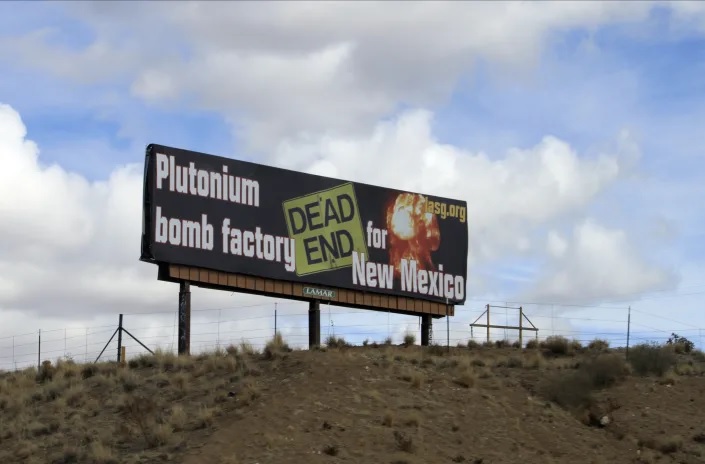
SUSAN MONTOYA BRYAN, Sat, February 11, 2023
ALBUQUERQUE, N.M. (AP) —
The U.S. agency in charge of producing key components for the nation’s nuclear arsenal has cleared the way for new equipment to be installed at a New Mexico laboratory as part of a multibillion-dollar mission, but nuclear watchdog groups say the project already is behind schedule and budgets have ballooned.
Approval for moving equipment into place at Los Alamos National Laboratory was first outlined in an internal memo issued by the deputy secretary of energy in January. The National Nuclear Security Administration, which is overseen by the U.S. Department of Energy, made a public announcement Thursday.
SUSAN MONTOYA BRYAN
Sat, February 11, 2023 at 8:42 AM GMT+11·3 min read
ALBUQUERQUE, N.M. (AP) —
The U.S. agency in charge of producing key components for the nation’s nuclear arsenal has cleared the way for new equipment to be installed at a New Mexico laboratory as part of a multibillion-dollar mission, but nuclear watchdog groups say the project already is behind schedule and budgets have ballooned.
Approval for moving equipment into place at Los Alamos National Laboratory was first outlined in an internal memo issued by the deputy secretary of energy in January. The National Nuclear Security Administration, which is overseen by the U.S. Department of Energy, made a public announcement Thursday.
The work will include the design, fabrication and installation of gloveboxes and other special equipment needed to make the plutonium cores. The work will be split between Los Alamos in northern New Mexico and the Savannah River Site in South Carolina, with the locations facing a congressional mandate to make at least 80 of the cores each year by 2030.
The deadline for meeting that capacity has been pushed back, with the memo being the latest evidence that the minimum equipment necessary will be in place at Los Alamos by August 2030, or four years later than expected…………………………………………..
Greg Mello, director of the watchdog Los Alamos Study Group, said the NNSA has made contradictory statements about the delays and what they mean for the overall plutonium pit project. He pointed to NNSA statements in 2017 and 2018 in which the agency predicted problems if it were producing pits while also replacing gloveboxes and other equipment at the same time.
“There is more they aren’t saying,” Mello said. “We believe NNSA and LANL will struggle mightily, with further setbacks, failures and accidents in a misguided attempt to produce any meaningful number of pits in that cramped, aging facility.”
SUSAN MONTOYA BRYAN
Sat, February 11, 2023 at 8:42 AM GMT+11·3 min read
ALBUQUERQUE, N.M. (AP) —
The U.S. agency in charge of producing key components for the nation’s nuclear arsenal has cleared the way for new equipment to be installed at a New Mexico laboratory as part of a multibillion-dollar mission, but nuclear watchdog groups say the project already is behind schedule and budgets have ballooned.
Approval for moving equipment into place at Los Alamos National Laboratory was first outlined in an internal memo issued by the deputy secretary of energy in January. The National Nuclear Security Administration, which is overseen by the U.S. Department of Energy, made a public announcement Thursday.
The work will include the design, fabrication and installation of gloveboxes and other special equipment needed to make the plutonium cores. The work will be split between Los Alamos in northern New Mexico and the Savannah River Site in South Carolina, with the locations facing a congressional mandate to make at least 80 of the cores each year by 2030.
– ADVERTISEMENT –
https://s.yimg.com/rq/darla/4-10-1/html/r-sf-flx.html
The deadline for meeting that capacity has been pushed back, with the memo being the latest evidence that the minimum equipment necessary will be in place at Los Alamos by August 2030, or four years later than expected.
The nuclear agency contends that installation of the equipment isn’t necessary for Los Alamos to produce 30 pits per year, and that the lab will be building war reserve pits using existing equipment as the project proceeds.
Agency spokeswoman Shayela Hassan said in an email to The Associated Press that the NNSA expects an increasing number of pits to be produced each subsequent year until the new equipment is installed. She said that’s when the capability will be in place to produce 30 pits each year “with moderate confidence.”
The long-shuttered Rocky Flats Plant outside Denver was capable of producing more than 1,000 war reserve pits annually before work stopped in 1989 due to environmental and regulatory concerns. In 1996, the DOE provided for limited production capacity at Los Alamos, which produced its first war reserve pit in 2007. The lab stopped operations in 2012 after producing what was needed at the time.
Greg Mello, director of the watchdog Los Alamos Study Group, said the NNSA has made contradictory statements about the delays and what they mean for the overall plutonium pit project. He pointed to NNSA statements in 2017 and 2018 in which the agency predicted problems if it were producing pits while also replacing gloveboxes and other equipment at the same time.
“There is more they aren’t saying,” Mello said. “We believe NNSA and LANL will struggle mightily, with further setbacks, failures and accidents in a misguided attempt to produce any meaningful number of pits in that cramped, aging facility.”
The memo provides formal cost and schedule estimates for getting equipment in place at Los Alamos, but it’s unclear when construction will begin. The cost has been pegged at roughly $1.85 billion.
More details about spending and schedules are expected when the NNSA submits its budget request to Congress next month.
In January, the Government Accountability Office said in a report that NNSA plans for reestablishing plutonium pit production do not follow best practices and run the risk of delays and cost overruns.
The GAO described the modernization effort as the agency’s largest investment in weapons production infrastructure to date, noting that plutonium is a dangerous material and making the weapon cores is difficult and time consuming. https://news.yahoo.com/us-takes-another-step-toward-214207395.html
Australia’s Taiwan nightmare

As one stands back from all of this, it become very clear that Canberra has completely ignored Malcolm Fraser’s vital warning that, “Giving America the power to say when Australia goes to war is the most dangerous position that Australia can bear”.
Any shooting war with China will very likely be a war that has ultimately been provoked by Washington to serve US interests. It is equally likely that the US will deafen us all with a propaganda onslaught
By Richard Cullen, Feb 6, 2023 https://johnmenadue.com/how-australia-created-the-taiwan-nightmare-for-itself/?fbclid=IwAR30kyoG_TGvb9CXqA4TW5uUl-Rhskpz9OIXbeAxc66AqzW7nirLr6v6IWo
Australia has been persuaded, enticed and strongarmed into taking gravely dangerous decisions. But Australia is a sovereign state and its fingerprints are, ultimately, all over the formation of its terrible abdication of national independence.
We need to pay particular attention to a definitive insight advanced by Paul Keating: Taiwan is not a vital Australian interest. In fact, it is an entity that could help unravel decades of remarkable, positive development in Australia, if we allow this to happen.
We know that the US is now a deeply disturbed super-power. Last year, the respected American commentator, Tom Plate, writing in the South China Morning Post, emphasised the “unseemly primal lust” with which the US jumped into the Ukraine war converting a “regional crisis into an increasingly global one”. Plate added that only the US had been able to parlay “its exceptional brand of American exceptionalism into a preposterous permanent innocence”.
The profound dangers arising from Australia’s far too close association with Washington’s global-control agenda have been stressed for over 50 years, first by Gough Whitlam, as he became Prime Minister in 1972, and even more emphatically by his once arch-rival, (former Prime Minister) Malcolm Fraser, who published a lengthy book in 2014 arguing that, “[G]iving America the power to say when Australia goes to war is the most dangerous position that Australia can bear.” He added that, “If America [unilaterally] uses forces deployed out of Australia, how can an Australian Prime Minister say we are not involved?”
Sensing the rising risk of grave danger, former Prime Minister, Paul Keating, around two years ago, argued with customary clarity that: “Taiwan is not a vital Australian interest. We have no alliance with Taipei”.
The former US Secretary of State, Colin Powell said, in 2004, that: “Taiwan is not independent. It does not enjoy sovereignty as a nation”. Almost 20 years later, Taipei enjoys dwindling recognition, now in the low-teens, from a handful of smaller states. Beijing is recognised as the sole, ultimate sovereign of China (including Taiwan) by the vast majority of nation-states, some 170 of whom recently reaffirmed their commitment to this centrally important One China principle.
Keating stressed that Australia should not be drawn into a military engagement over Taiwan, “US-sponsored or otherwise”, and said Taiwan was “fundamentally a civil matter” for China. These comments, predictably, were not well received in Taipei. If anything, the distressed nature of this response implicitly confirmed the position Keating outlined. Taiwan has been an intrinsic part of China for over 300 years, at least, since well before the French Revolution and the creation of the US and long before Australia was first settled by Europeans.
As for Japan’s leaders, Keating calls them the Bourbons of the Pacific – they have learned nothing and forgotten nothing, we’re still trying to find our security from Asia rather than in Asia. Furthermore, Professor Ravina, from the University of Texas, reminded us last year that, “Japan looks a lot like a one-party state” adding that, “the Liberal Democratic Party (LDP) has governed Japan almost exclusively since the end of World War II”. Declassified CIA documents, Ravina says, have confirmed that the LDP was covertly supported by the US “with millions of dollars” after it was established.
Japan is now avidly re-militarising at great expense, with a malevolent eye fixed on China yet again. Canberra has recklessly adopted Japan as a new primary military ally, despite the active veneration of Japan’s military history – which embodies an almost unparalleled record of military barbarism – by certain influential elite-factions.
Meanwhile, the current Democratic Progressive Party (DPP) leadership in Taiwan refuses to endorse the One China principle (unlike the main opposition Kuomintang Party (KMT)) and it keeps testing how far it can push a pro-independence stance short of moving audaciously in that direction. This is combined with much mutual cross-strait political glaring – even as the economic coupling continues to deliver outstanding reciprocal benefits, year after year. Within the DPP, the more extreme faction is anxious to keep pushing the independence project. Any sort of candid negotiations with Beijing over this fraught relationship are simply off the agenda for the DPP. There is at least an even-chance that the DPP will retain power, at the expense of the KMT, at the next Presidential Election in January, 2024.
Although the US ritually claims it still supports the One China principle it does so within the context of persistent, Taiwan-separatist dog-whistling. This was highlighted in a recent Common Dreams article by the prominent peace activist, Joseph Gerson, who insisted that the US should “cease encouraging Taiwanese independence”.
Malcolm Fraser told the ABC, in 2014, that he saw no difference between the Abbott Coalition Government in Australia and the Labor Governments led by Rudd and Gillard in their misguided, excessively pro-Washington policy setting, when he criticised the way Gillard had put American troops into Darwin. Fraser also forcefully highlighted the acute danger posed to Australia by the presence of US spy-bases in Australia in his book – especially Pine Gap.
In 2018, Prime Minster Turnbull, flicked the switch to serious China-thumping over Huawei (without any “smoking gun” evidence, in Turnbull’s later, own words). Since then, we have witnessed the desperately ill-conceived, uncertain and hugely expensive AUKUS nuclear submarine decision and the latest agreement to station nuclear-capable US bombers near Darwin. Very recently, the new Labor Government in Canberra has eagerly announced a plan to acquire an expensive set of the latest mobile missiles from the US.
Arguably worst of all, is the shocking Force Posture Agreement (FPA), signed with the US in 2014 by Foreign Minister Julie Bishop, which provides the legal basis for, as Bevan Ramsden recently revealed, “the comprehensive US militarisation of Australia, especially the Northern Territory, thus setting up Australia as a US forward base from which to launch its next war”.
Meanwhile, Australia and its mainstream media outlets have happily played host to diplomatically disgraceful, ongoing levels of China-threat war-drumming from the Japanese Ambassador in Canberra. John Menadue recently told us that, “The Japanese Embassy in Canberra is leading the anti-China campaign in Australia.” While Allan Behm wonders if this particular Ambassador, who describes himself a former spymaster, aspires “to be a legend in his own lunchtime”. One can be forgiven for wondering if this Canberra-based, Japanese campaign may be part of a wider US-shaped project to guard against any back-sliding on China-glaring, following the change of government last year in Australia.
Then there is the Australian Strategic Policy Institute (ASPI), which maintains a constant focus on advancing the grand China Threat narrative. John Queripel recently argued persuasively that, when you follow the money you discover that ASPI is a “front for US propaganda”.
As one stands back from all of this, it become very clear that Canberra has completely ignored Malcolm Fraser’s vital warning that, “Giving America the power to say when Australia goes to war is the most dangerous position that Australia can bear”. And, in the course of doing so, they have made the severe geopolitical risk faced by Australia far worse. Canberra has now placed the essence of the decision on when Australia may go to war against China into the hands of the three least trustworthy, triggering-parties one can imagine: Washington, Tokyo and Taipei. In all three places, reckless Anti-Beijing elements enjoy inordinate influence.
What a catalogue of cringe-making, very expensive, immature belligerence Australia has racked-up. And let’s not forget that all of this, piled-on, antagonistic military activity and expenditure is primarily directed at Australia’s leading current and best-ever, long-term trading partner. It takes one’s breath away.
Any shooting war with China will very likely be a war that has ultimately been provoked by Washington to serve US interests. It is equally likely that the US will deafen us all with a propaganda onslaught claiming that any Beijing military action responding to provocations was unprovoked – and don’t dare think otherwise. Any such war will almost certainly visit extreme harm on the global economy and surely prove to be catastrophic for the Australian political-economy and devastating for Taiwan, just for starters. US arms suppliers can be expected to power onwards and upwards, however.
Australia has certainly been persuaded, enticed and strongarmed into taking the gravely dangerous decisions outlined above. But Australia is a sovereign state. It has agency. Australia’s fingerprints are, ultimately, all over the formation of this terrible abdication of national independence.
If matters are ever to be put right, we first must not forget that America is, as Professor Adam Tooze argues, addicted to greatness and haunted by its loss and it has crafted “an extraordinarily aggressive techno-military objective” to champion its superiority over China.
Next, we have to remember how, once-upon-a-time, 50 years ago, we began growing up as a sovereign state within Asia. We must recollect what we have been told so clearly by Whitlam and Fraser and avow that Australia’s national interest is our paramount concern. We can be entirely sure that Washington, Tokyo and Taipei are never going to tell us this: they will each work to advance their own dangerously tilted agendas.
Finally, we have to pay particular attention to the conclusive insight provided by Paul Keating: Taiwan is not a vital Australian interest. In fact, it is an entity that could very much help unravel decades of remarkable, positive development in Australia, if we allow this to happen.
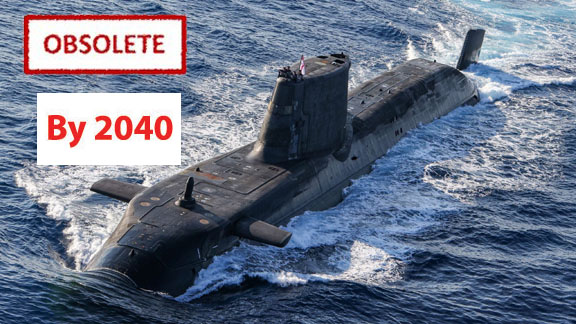
Growing signs Australia’s new nuclear submarine will be British design
Breaking Defense , (Sponsored by Northrop Grumman) By COLIN CLARK and TIM MARTIN February 10, 2023
SYDNEY and BELFAST — With the formal announcement of Australia’s path to obtain nuclear attack submarines expected to happen in Washington next month, speculation about the likely solution AUKUS is beginning to leak out.
The most intriguing hints center on a British boat — but not the Astute-class — based in part on rare public comments by Australian Defense Minister Richard Marles and his British counterpart, UK Defence Secretary Ben Wallace……………………………………
From the first announcement of the AUKUS effort, Australia has said it intends to build boats at home. However, developing the nuclear expertise from a tiny pool of a few dozen individuals to potentially thousands of people will take time, as will development of the highly skilled welders and other technical experts needed to build and maintain nuclear powered boats. Developing a new design and building a new shipyard to produce it seems unrealistic, given the lack of domestic expertise — especially if the goal is to deploy nuclear attack submarines before the conventionally powered Collins-class attack subs are retired.
That has prompted talk of America supplying Australia with refitted Los Angeles-class boats or providing Virginia-class boats that would be crewed by Australians, but both options pose many obstacles. America doesn’t seem able to build nuclear attack boats quickly enough to meet its stated requirement of 66, which prompted two top defense lawmakers in the Senate to caution President Joe Biden against committing the US to supplying Australia with nuclear boats.
Given the concerns about personnel and Marles’ comments, there is reason to think Britain’s next-generation sub, which will require a much smaller crew than do any of the American boats are in play……………….
“Among the ‘straws in the wind’ are the UK’s ambitions to rebuild its own submarine fleet. The Royal Navy would like to see a rise from the planned seven Astute-class attack submarines to perhaps 12 boats in the long term.
In a speech in December 2022, the UK chief of the defence staff, Admiral Sir Tony Radakin, said of AUKUS that ‘if we have the courage to do this properly’ it could help grow the UK’s own submarine numbers in the decades to come, clearly assisted in part by potential economies of scale under AUKUS.”

Jonathan Mead
Back in November 2021, the man who led the day-today work on the AUKUS boats in Australia, Vice Adm. Jonathan Mead, told an Australian Senate committee that his country intended to select a “mature design” for its nuclear submarine. “It is our intention,” Mead said then, “that when we start the build program, the design will be mature and there will be a production run already in existence.” That would appear to make the British offering a candidate…………………
Sidharth Kaushal, a sea power expert at the Royal United Services Institute think tank, told Breaking Defense:
“The point of friction that introduces with the UK [revolves around] the Australians operating with the US Navy primarily in the Indo-Pacific and their preference for things like prompt strike capabilities, including cruise missiles and potentially hypersonic missiles. The [US Navy] Virginia-class payload module can host those weapons but the [Royal Navy’s] Astute-class can torpedo launch cruise missiles but doesn’t necessarily offer prompt strike capabilities.”
All seven Astute-class submarines are due to be in service with the Royal Navy by 2026, each with a life cycle of 25 years. …………….
“There’s much more work to be done when you look at areas of joint production…but for the initial project of delivering a new Australian submarine there’s going to be some compromises,” Kaushal said. “For the US, this works out quite nicely but their big challenge of course remains, that their production lines are struggling to meet US Navy requirements.”
Should the Virginia-class be selected for the Australian requirement, the US would also benefit from new basing facilities for the future submarines, he added.
“It would effectively give the US an additional SSN base separate to Guam, which is of course an inherently vulnerable location and will be more so going forward,” Kaushal explained.
Operationally, how the future Australian submarines operate in the Indo-Pacific looks to be particularly difficult to assess in light of China formidable ASW capabilities, like Type 56 Corvettes and Y-8 maritime patrol aircraft, combined with the often shallow waters of the South China Sea which can make nuclear submarine missions more difficult.
“China is investing in a pretty substantial sensor network in the South China Sea that includes under sea hydrophones, large unmanned underwater vehicles all linked up to artificial islands they have built,” Kaushal said. ………………………………. https://breakingdefense.com/2023/02/growing-signs-australias-new-nuclear-sub-will-be-british-design/
Here are eight reasons why the US has no interest in pushing for peace in Ukraine

Washington’s priority is to contain Russia and how the fighting ends for Kiev is a sideshow to the main objective
By Andrey Sushentsov, Valdai Club program director, 10 Feb 23, https://www.rt.com/news/571220-eight-reasons-us-war-ukraine/
It now appears that the US is not even remotely interested in supporting a peaceful resolution to the Ukrainian conflict, preferring to see the military campaign continue. Overall, strategic planning in Washington gives little thought to the parameters for ending the crisis: Whether Ukraine will remain within its current borders, lose its territories or disappear altogether.
Despite mounting casualties and the destruction of Ukraine’s military, appetite for military action has not diminished, neither in Kiev nor in Washington. Many international experts rightly identify the US as the key player in a large coalition advocating for continued hostilities in Ukraine. In less than a year of crisis, Kiev has exhausted its own military resources and the means to replace them, and is totally dependent on external assistance.
Though the US is taking the lead in coordinating and strategizing support from the West, it would be wrong to equate Ukrainian and American interests. While continuing to pay lip service to Kiev’s political demands, Washington is carefully assessing the right moment to initiate negotiations. The need for diplomatic efforts to resolve the conflict has been increasingly emphasized by US military leaders, most notably the Chairman of the Joint Chiefs of Staff Mark Milley. The idea continues to circulate in the British press that the American tactic is to escalate the conflict in order to later de-escalate it: to pressure Russia with a wave of large-scale deliveries of military equipment and to put Kiev in a more favorable negotiating position.
However, it cannot be overlooked that the continuation of the military crisis in Ukraine is in line with US military and political interests. There are a total of eight arguments suggesting that the Americans intend to prolong this conflict.
First, there is the relative weakening of Russia, which has had to devote considerable resources to eliminating the military threat from Ukraine, as well as to achieving its political objectives of securing equal status in post-Cold War European security architecture. The Western media narrative that Russia is on the verge of defeat, while far from reality, gives the impression that all the West needs to do so is adopt a wait-and-see attitude. The lack of decisive Russian military victories leads to the perception that Ukraine is winning.
Second, the US has a vested interest in breaking up EU-Russian energy cooperation. This has developed over many decades, beginning during the Cold War. The sabotage of the Nord Stream pipelines, apparently conducted with the assistance of another NATO state, was the culmination of a long-term American strategy to dismantle the extensive links between Moscow and key West European economies. The Americans want to shift European energy consumption away from Russia and create a more difficult environment for broader European industry, so that American goods face less competition, thus strengthening their own position.
Third, the US wants to eliminate any impulse for strategic autonomy among EU states. The Ukrainian crisis provides a golden opportunity for this, as the US and its allies in Eastern Europe have managed to create a moment of moral panic in the information space, preventing any reflection on the causes and consequences of the crisis. Strategic decisions on arms transfers are being taken under pressure from the media and a radicalized section of the public, without any analysis of the consequences. Leaders and elites who might have been able to reflect with detachment and sobriety on the consequences of the slide of EU-Russia relations into a deep crisis, are now outnumbered and essentially voiceless.
Fourth, the US does not want to see the defeat of Ukraine, into which much financial, political and symbolic capital has been invested over the past year. In the eyes of the West, Ukraine is its “champion”. The old narrative of European civilization struggling against the barbaric East, going back to the days of ancient Greece and its confrontation with the Persian hordes, is being played out here. Ukraine’s defeat would be a sensitive symbolic defeat for the West and would leave an “open wound” in the minds of many intellectuals.
Fifth, the US has not retreated from the ideological imperative to defend what it interprets as “freedom”. In the situation around Ukraine, there is a Manichean presentation of the struggle for “freedom against unfreedom”. Washington also sees this ideological imperative manifest in the domestic situation in Ukraine, which of course is only possible if you look at the political processes in Kiev “through your fingers”. By playing along with this narrative, Vladimir Zelensky’s government seeks to present itself to the West in such ideological categories.
The sixth US objective is to encourage Western Europe to remilitarise. Washington is aware that prolonged military competition is not possible using American forces alone. Moreover, the US is conscious of the growing threat from China and realizes that its resources will soon be diverted to a confrontation in the Pacific. In the European theater, Washington is therefore looking for ways to strengthen the EU’s military-industrial complex so that national defense budgets can be raised to at least 2 percent of GDP.
Seventh, the US seeks to consolidate its European allies around a platform of fighting its “rising” adversaries such as Russia, China and Iran. Here, the US is trying to be resourceful in building coalitions willing to produce and sell expensive, high-tech weapons.
Eighth, the US is also pursuing its own re-industrialisation through Ukraine. The expansion of the military-industrial complex is seen as an important goal for America. After the Cold War, it was reoriented to produce a limited number of high-tech products, whereas modern conventional warfare requires the large-scale production of relatively inexpensive generic artillery, tank and aircraft systems.
All this makes the US extremely uninterested in working for a peaceful solution to the conflict in the short term. The Americans believe that time is on their side and that the eight objectives listed above will be achieved. This makes their strategy rather flexible and demonstrates that their priority is to contain Russia rather than secure the future security and prosperity of Ukraine.
Highlands Against Nuclear Power (HANP)
A NORTH campaign group, which was set up ten years ago to oppose the
transport of nuclear material from Dounreay, plans to broaden its remit and
change its name. Highlands Against Nuclear Transport (HANT) is set to
become Highlands Against Nuclear Power (HANP) in a bid to extend its role
to include proposed new nuclear plants, nuclear weapons and the proposed
Geological Disposal Facility (GDR).
However, HANT chairman, Tor Justad,
stressed the new body would continue to campaign on nuclear transport
issues as well. He said: “Producing electricity with nuclear power is twice
as expensive as with renewables, poses unacceptable risks of accidents,
provides bi-products for nuclear weapons, produces carbon at all stages of
development and is the technology of the past with no solution to dealing
with the 100 tonnes of UK nuclear waste stored at Sellafield as the
proposed GDR is only at an early consultation stage.”
John O’Groat Journal 9th Feb 2023
When the Great Tide returns

Seventy years ago, on the night of 31 January/1 February, the ‘Great
Tide’ surged down the Essex Coast from Harwich all the way round to London,
bringing floods, death and destruction to communities and environments
along the sea, rivers and creeks that compose the 350 mile coastline.
Passing almost silently and unexpectedly in an age where phones were rare,
radios silent and police relied on foot and bicycle, the Great Tide exacted
its toll on poor communities like Jaywick and Canvey; our biggest peacetime
catastrophe, barely remembered beyond the older generation today.
Such a fate awaits any new nuclear development at Bradwell, harbouring dangerous
wastes into the far future on a battered, exposed and diminishing
coastline. It must not happen. As far as possible we must try to avoid the
calamity that overwhelmed our Essex shores on that fateful and perilous
night seventy years ago.
BANNG 7th Feb 2023
UK’s Nuclear Free Local Authorities send seven magnificent suggestions to the new Secretary of State

‘Magnificent Seven’ suggestions sent to new Secretary of State 10th February 2023
On hearing the news that Grant Shapps has been appointed to head up Rishi Sunak’s new Energy Security and Net Zero Department, the Nuclear Free Local Authorities lost no time in sending him their ‘magnificent seven’ wish list of urgent priorities.
Councillor Lawrence O’Neill, Chair of the NFLA Steering Committee, said:
“The new department is rightly called Energy Security and Net Zero. It is the NFLA’s belief that it can achieve both if it focuses on reducing energy demand through a UK-wide emergency programme of home insulation and energy efficiency measures and upon increasing generating capacity using the renewable technologies we have from the sustainable sources we find in nature, such as solar, wind, tidal, and geothermal, coupled with green hydrogen and other innovative storage solutions.
“We should also be investing in local, divested energy networks by encouraging households, communities, local authorities and energy co-operatives to become energy-independent by generating their own sustainable clean energy, rather that indulging in vast expenditure on large nuclear power plants that are reliant on overseas contractors, money, technology and uranium, and that leave behind the deadly costly legacy of radioactive waste and contaminated reactor buildings.
“The NFLA is calling on the British Government to abandon the nuclear nightmare. Every pound spent on the nuclear energy folly is a pound that could be redirected to creating a renewable energy future.”
Solar’s stunning journey from lab curiosity to global juggernaut wiping out fossil fuels
One of the four Australian solar researchers who have won the world’s most
prestigious engineering prize says it won’t be long before solar is at a
cost level across the world where it will “wipe fossil fuels out of the
global economy.
Renew Economy 10th Feb 2023
1 This Month
23 April – WEBINAR – Why new nuclear reactors are the wrong tools for decarbonization Thursday, April 23 • 1 AM – 2 AM AEST
World Nuclear Power. Reactors 1951-2026, 75 Years of Nuclear Power.
Interactive Map– https://dv.worldnuclearreport.org/

Chernobyl: The Lost Tapes – A good documentary on Chernobyl on SBS available On Demand for the next 3 weeks– https://www.sbs.com.au/ondemand/tv-program/chernobyl-the-lost-tapes/2352741955560

of the week–London Campaign for Nuclear Disarmament


Tell the Ukrainian Government to Drop Prosecution of Peace Activist Yurii Sheliazhenko
To see nuclear-related stories in greater depth and intensity – go to https://nuclearinformation.wordpress.com
-
Archives
- April 2026 (231)
- March 2026 (251)
- February 2026 (268)
- January 2026 (308)
- December 2025 (358)
- November 2025 (359)
- October 2025 (376)
- September 2025 (257)
- August 2025 (319)
- July 2025 (230)
- June 2025 (348)
- May 2025 (261)
-
Categories
- 1
- 1 NUCLEAR ISSUES
- business and costs
- climate change
- culture and arts
- ENERGY
- environment
- health
- history
- indigenous issues
- Legal
- marketing of nuclear
- media
- opposition to nuclear
- PERSONAL STORIES
- politics
- politics international
- Religion and ethics
- safety
- secrets,lies and civil liberties
- spinbuster
- technology
- Uranium
- wastes
- weapons and war
- Women
- 2 WORLD
- ACTION
- AFRICA
- Atrocities
- AUSTRALIA
- Christina's notes
- Christina's themes
- culture and arts
- Events
- Fuk 2022
- Fuk 2023
- Fukushima 2017
- Fukushima 2018
- fukushima 2019
- Fukushima 2020
- Fukushima 2021
- general
- global warming
- Humour (God we need it)
- Nuclear
- RARE EARTHS
- Reference
- resources – print
- Resources -audiovicual
- Weekly Newsletter
- World
- World Nuclear
- YouTube
-
RSS
Entries RSS
Comments RSS
 nuclear-news