TODAY Complacency about nuclear safety – a killer waiting to strike!
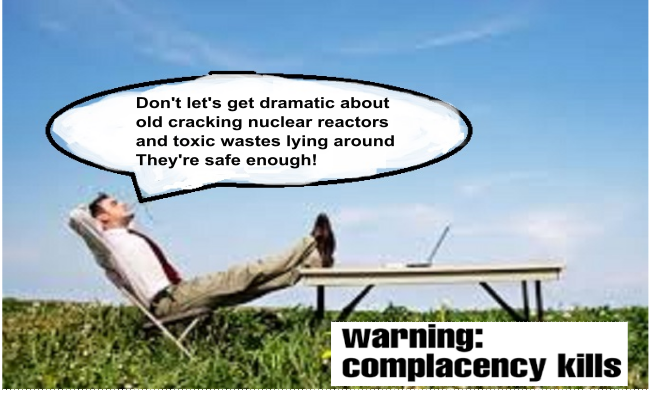
Worrying about Chernobyl, Fukushima, Three Mile Island, Santa Susana, Windscale, Church Rock, Tokaimura , Maya…. all those devastating nuclear accidents? That’s so old-fashioned!
True – caesium, strontium, plutonium, americium, cobalt. iodine 131,polonium – these are killer isotopes produced by nuclear fission- and released bit by bit in the nuclear fuel cycle – or suddenly in an accident.
But, aw shucks, our big boys, nuclear engineers etc – they can cope with all that. I mean some of them (though not all nuclear engineers), think that the safety rules should be relaxed. After all, how can the nuclear industry survive if we keep strict rules on when old reactors must be shut down?
And more to the point, well – I hate to break this secret news, but really, nobody can afford the financial cost of shutting down creaky old reactors, and disposing of the pools and canisters of highly toxic radioactive trash.
So much cheaper and easier to just keep it all going – at least until the next nuclear disaster!(when with any luck, our children, not us, will cop the pain and the cost)
So – thinking along these lines:
- Finland will extend the life of its nuclear reactors by over 20 years, and its “intermediate” wastes onsite until 2090. (“Intermediate” is a nicer word for “highly toxic”)
- Japan to extend life of nuclear power stations, and also remove rules specifying the operational periods of reactors.
- France planning to allow its nuclear reactors to operate beyond 60 years, despite its current problems of corrosion and cracks.
- Belgium, already dodgy in its safety assessments, plans to delay phaseout of its nuclear reactors.
- Russia? The mind boggles – Russia has traditionally been slack on nuclear safety. Is it any better now?
- Ukraine? Omigawd! THey want to build new ones!
- Oh and Turkey’s going ahead building its Akkuya nuclear power station, all too near to the 7.8 magnitude earthquake’s epicentre.
All this while global heating threatens all the nuclear power plans situated on coastlines – as sea level rises. While global heating threatens to deprive nuclear reactors of the water supply they need for cooling, threatens to make them shut down as temperatures rise, threaten them with floods, wildfires, and other weather extremes
Dumping 1M gallons of radioactive water in Hudson is ‘best option,’ per Indian Point nuclear plant owner

Gothamist, Rosemary Misdary, Feb 18, 2023
The owner of the defunct Indian Point nuclear facility says it’s planning to dump about 1 million gallons of radioactive water into the Hudson River. The move, which the company describes as the “best option” for the waste, could happen as early as August.
A Feb. 2 meeting of the Indian Point Decommissioning Oversight Board heated up when the plant’s owner Holtec International disclosed the plan as part of its lengthy closure process. The contaminated water could just naturally — and safely — decay in storage onsite.
Environmental groups and residents are also concerned this could harm their community, as the Hudson River is already a federally designated toxic Superfund site. Rich Burroni, Holtec’s site vice president for Indian Point, agreed to give the community at least a month’s notice before any radioactive discharge into the Hudson River begins.
But Holtec is well within its legal rights and permits to discharge waste at the same rate as it did when operating, and it does not need federal, state or local approval to dump the contaminated water. This practice is standard for nuclear plants.
Nearly two years have passed since Indian Point shut down its third and final reactor in the village of Buchanan, located on the Hudson’s east bank about 30 miles north of Midtown. Toward the end of its 59-year lifespan, the plant had more than a 2,000 megawatt capacity — providing electricity to more than 2 million homes, or 13% of the state’s power demand.
Holtec received about $2.4 billion in funds, shouldered by ratepayers, to decommission the plant. And it wants to do so in 12 years, which is in accordance with town’s wishes to repurpose the site. But Holtec and the surrounding community are still debating what to do with Indian Point’s radioactive remnants.
“Yes, you can do it [discharge radioactive water]. It’s normal practice. But should you when you have other options that might avoid this additional release of radioactivity to the environment?” said Edwin Lyman, director of nuclear power safety at the Union of Concerned Scientists, a nonprofit science advocacy organization. “It may only cause a low risk to the environment as far as we know, but there are other options here, and why not try to minimize the harm?”……………………………………………
Options are limited when it comes to disposing of radioactive waste, and only three methods are typically used for tainted water. ……………………………………………………..
Lyman said a fourth option would be leaving the radioactive water onsite to decay over time into non-harmful helium. “Keep storing indefinitely and eventually the problem will solve itself,” he said.
For tritium, this process would take just over 24 years. Lyman considers this the best option because it minimizes the effects on the environment. It’s also viable because other radioactive material — spent fuel generated from operating the plant — remains onsite and will take hundreds of thousands of years to decay. This material includes plutonium and uranium.
Lyman said this waste has no place to go and will be there for a long time, so there’s no rush to deal with the radioactive water while spent fuel continues to sit on the property. Most radioactive waste is stored where it is generated. And federal regulations allow 60 years for decommissioning. That spent fuel could remain at the site even after the decommissioning is completed, according to the Nuclear Regulatory Commission.
“In the long term, it’s going to degrade, and the only way to protect the environment from that degradation is to bury it in a deep geological repository,” Lyman said…………………………………..
The next meeting for the Indian Point Decommissioning Oversight Board will take place on April 27 at 6 p.m. at Cortlandt Town Hall. Participants have the option to attend virtually. https://gothamist.com/news/dumping-radioactive-water-hudson-river-best-option-indian-point-nuclear-plant-owner-holtec
Small modular nuclear reactors: a good deal for Southwest Virginia?

FEBRUARY 16, 2023 By Rees Shearer, https://www.virginiamercury.com/2023/02/16/small-modular-nuclear-reactors-a-good-deal-for-southwest-virginia/
In announcing his 2022 Virginia Energy Plan, Gov. Glenn Youngkin said, “A growing Virginia must have reliable, affordable and clean energy for Virginia’s families and businesses.” The governor’s plan to promote and subsidize small modular nuclear reactors (SMRs) in Southwest Virginia fails all three of the governor’s own criteria:
- SMRs can’t be reliable, when they cannot reliably be built and brought on line in a predictable and timely fashion.
- SMRs can’t be affordable, because nuclear power is close to the costliest of all forms of electric power generation.
- SMRs can’t be clean, since they produce extremely toxic high- and low-level nuclear waste, which has no safe storage or disposal solution.
Appalachia has long served as a sacrifice zone for rapacious energy ambitions of other regions. Southwest Virginians have had reason to hope that would change as opportunities for low-cost solar development emerged in recent years. Instead, politicians like Youngkin are making too-good-to-be-true promises about SMRs, sidelining opportunities to promote solar, which can produce power in a matter of weeks, not decades.
Imposing SMRs on Southwest Virginia is disturbing. My father worked for the Atomic Energy Commission in the 1950s. The promise the nuclear industry and the government touted then, “electricity, too cheap to meter,” has never been realized. Tennessee Valley Authority and other utilities abandoned nuclear plants under construction, leaving costly monuments to that folly and sticking electricity customers with the bill.
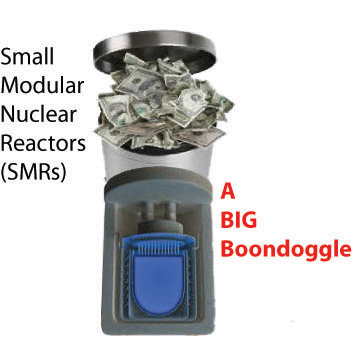
It’s not at all clear that SMR technology will succeed, or when. Levelized cost charts of electric power generation rate nuclear as among the very most expensive means to generate electric power at utility scale. If nuclear waste management, insurance and decommissioning costs are included, actual costs are far higher. (Some of these costs are already socialized for nuclear power, such as insurance in the Price-Anderson Act.)
The first commercial SMR is not expected to be completed until 2029, but already its developers have raised the target price of its power by 53%. This is not a surprise; nuclear power construction history documents an extremely strong correlation between new designs and cost increases and project delays. Indeed, the Lazard analysis shows that nuclear is the ONLY grid-wide generation source to increase in price between 2009 and 2021. The increase was 36%!

Nuclear waste and reprocessing are also serious concerns. Make no mistake, un-reprocessed nuclear waste, for all practicable purposes, is forever. The fact that we have become accustomed to risk does not, by any means, reduce risk. Nor will SMRs generate less waste than their larger forbears. Indeed, a recent Stanford University study concluded that “small modular reactors may produce a disproportionately larger amount of nuclear waste than bigger nuclear plants.”
Safeguarding this waste is already costing taxpayers and utility customers tens of billions of dollars. Since the United States has failed to designate a central storage facility, nuclear power plants are forced to continue to store the waste in pools on site.

Yet nuclear waste recycling, known as reprocessing, is no panacea. In November, the governor spoke in Bristol in support of recycling nuclear waste from SMRs: “I think the big steps out of the box are the technical capability to deploy in the next 10 years and on top of that to press forward to recycling opportunities for fuel.” He may have had in mind BWX Technologies of Lynchburg, which is beginning reprocessing of uranium at its Nuclear Fuel Services plant in Erwin, Tennessee, for nuclear weapons.

Transportation of SMR nuclear wastes along Virginia mountain roads or railroads across the border to Erwin presents further risk of accident and contamination. Longstanding concerns about transportation and security of nuclear wastes have never been adequately addressed.
Given these questions about cost, practicality and safety, the governor’s choice of SMRs as the cornerstone for future energy development in the coalfields of Southwest Virginia risks leaving residents here with nothing. This is especially worrisome as it pulls state support from proven, cheaper and more readily deployable solar and energy storage applications.
It also redirects government resources away from homegrown economic projects, like the New Economy Program, based on cleaning up and repurposing unrestored mine lands for a burgeoning utility solar energy industry, employing local residents and adding productive purpose to restored land and benefiting the tax base.
Counties across eastern and Piedmont Virginia are benefiting from a property tax bonanza flowing from utility-scale solar development. Coalfield counties are being told to ignore a sure solar bet and place their few economic development chips on a risky, unproven, costly, pie-in-the-sky energy prospect.
Why should SWVA be forced to endure the burden of risky and more costly electric energy, subsidized by the state to benefit powerful corporations, which seek to exploit our region and its people? Why indeed, while the rest of Virginia benefits economically from low-cost, safe solar energy?
This same shell game occurred when state mining regulation allowed mountaintops to be blown away and thousands of acres of forestland despoiled. Once again, government officials are choosing to make decisions that benefit the interests of corporations outside the region instead of the people who actually live here.
Southern Co boosts cost estimate, delays timing for nuclear reactors

Feb 16 (Reuters) https://www.reuters.com/business/energy/southern-co-boosts-cost-estimate-delays-timing-nuclear-reactors-2023-02-16/ – U.S. energy company Southern Co (SO.N) on Thursday delayed the timing and boosted cost estimates for its Georgia Power utility’s share of two nuclear reactors being built in Georgia.
The Vogtle plant reactors in Burke County, Georgia, already billions of dollars over budget and years behind schedule, are the only nuclear power units under construction in the United States.
In an investor presentation, Southern forecast Georgia Power costs would rise to $10.593 billion, up from a prior forecast of $10.383 billion in its third quarter results in October.
Southern also pushed back the in service dates for the new reactors to May or June of 2023 for Unit 3 and late in the fourth quarter of 2023 to the end of the first quarter of 2024 for Unit 4.
“After careful consideration and given our experience on Unit 3 and the degree of critical work ahead of us, we are further risk adjusting our Unit 4 schedule,” Southern Co Chief Executive Thomas Fanning said on a call with investors.
Fanning, who will be succeeded by Georgia Power’s CEO Chris Womack in the coming months, said Unit 3 required additional fixes to pipes, a valve and flow through the reactor’s cooling pumps. He added that the company expects testing on Unit 4 to reveal more needed fixes.
“We’re just trying to get anything we can see right now,” Fanning said.
In January, Southern said in a filing with the U.S. Securities Exchange Commission that it expected Unit 3 to enter service during April 2023. In its third quarter earnings, the company said it expected Unit 3 to enter service in the first quarter of 2023 and Unit 4 in the fourth quarter of 2023.
When Georgia approved the Vogtle expansion in 2009, the two 1,117-megawatt Westinghouse AP1000 reactors were expected to cost about $14 billion in total for all owners and enter service in 2016 and 2017.
Some analysts have estimated total costs, including financing, have ballooned to more than $30 billion following delays related to the pandemic, the nuclear accident at Japan’s Fukushima plant in 2011 and the 2017 bankruptcy of Westinghouse, the project’s former contractor.
The Vogtle owners include Georgia Power (45.7%), Oglethorpe Power Corp (30%), Municipal Electric Authority of Georgia (22.7%) and Dalton Utilities (1.6%).
Oglethorpe and Dalton have said they wanted to freeze their spending on the project.
The World’s Dumping Ground for Nuclear Waste Doesn’t Want Fukushima’s Wastewater
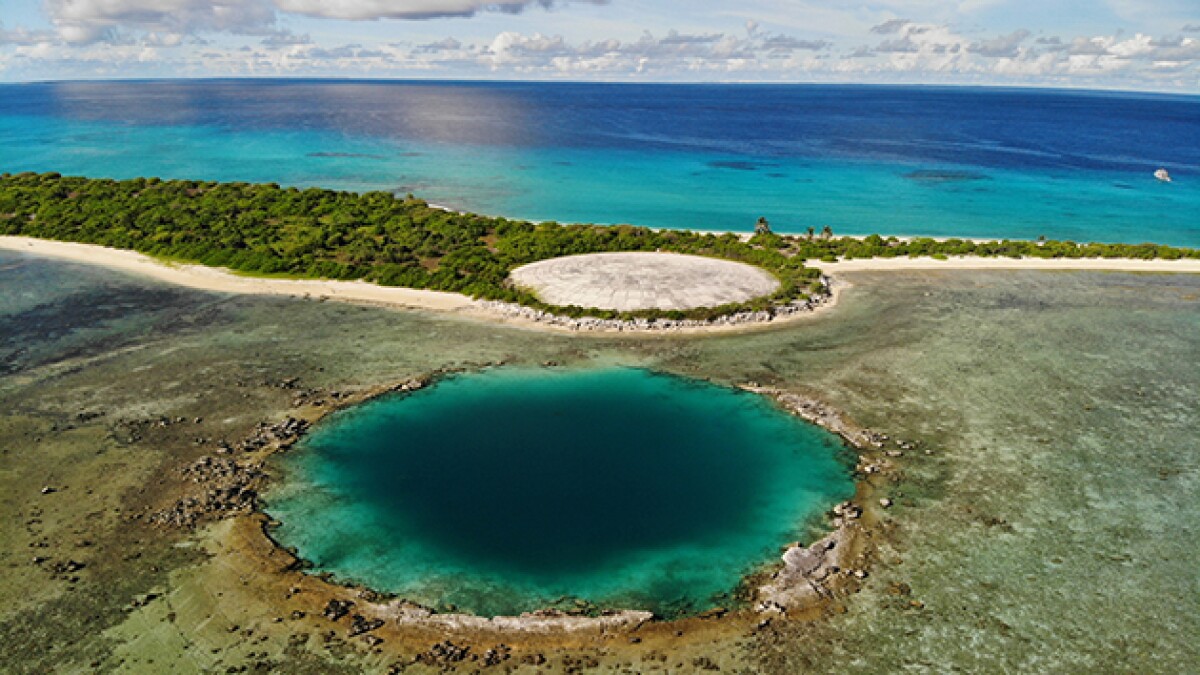
Japan’s plan to discharge more than 1,000 tanks of nuclear wastewater into the Pacific has incensed island nations.
VICE, By Hanako Montgomery 17 Feb 23,
TOKYO — In the middle of the Pacific Ocean, a group of tropical islands has never seen winter. But one morning 70 years ago, a loud bang followed by a flash of light made it “snow” for the first time.
Fluttery and white, the powdery material sank into the Marshall Islands’ deep blue lagoons. It lightly covered the palm trees that lined Rongelap Atoll, astounding those who came out of their thatched homes to watch it settle on roofs. Children played with it, scooping the dust into their mouths.
But within hours, the atoll’s residents mysteriously began falling ill. Hair fell out in clumps. Skin burned. People vomited. They were evacuated two days later, but the damage was already done. Years later, the Rongelapese would suffer heightened cases of cancer, miscarriages, and birth deformities.
This was the fallout of Castle Bravo, the U.S.’ largest-ever thermonuclear bomb test that sprinkled radioactive debris on that warm March day. Now, residents of the island nations that include Fiji, the Marshall Islands, and French Polynesia invoke the nuclear accident and its subsequent contamination to oppose Japan’s plan to release its nuclear wastewater into the Pacific.
“We have a legacy of being the dumping ground when it comes to the issue of nuclear waste,” James Bhagwan, a Fijian anti-nuclear activist and secretary-general of the Pacific Conference of Churches, told VICE World News.
“Pacific Islanders have a spiritual bond with both land and ocean. So this again speaks to the issue of poisoning a part of us, our family,” he said.
The comparison Bhagwan drew between the controlled release of treated wastewater and an atmospheric nuclear test gone wrong may sound like a stretch. But it speaks to how much Pacific Island nations fear Japan’s planned discharge in the coming months of more than 1.3 million metric tons of contaminated water into the world’s largest ocean.
The nuclear waste sits in over 1,000 water tanks in Japan’s northeastern prefecture of Fukushima, the product of the meltdown of the Daiichi nuclear reactors there in 2011. …………………………………….
In objecting to the release, Motarilavoa Hilda Lini, a Vanuatu stateswoman, has cited the slogan of the Nuclear Free and Independent Pacific movement: “If it is safe, dump it in Tokyo, test it in Paris, and store it in Washington, but keep our Pacific nuclear-free.”…………………………………………………………..
Ken Buesseler, a marine radiochemist and one of five experts on the Pacific Islands Forum’s panel of independent scientists, questioned TEPCO’s ability to sufficiently remove radioactive material from the liquid. He cited how, in 2020, the company had to retreat about 70 percent of the stored wastewater because it was found to contain amounts of radioactive substances exceeding standards.
“That doesn’t give me a lot of confidence,” he told VICE World News. Monitoring the wastewater after it was released into the ocean would be too late, Buesseler added, as once it’s in the ocean, TEPCO can’t get it back.
He also faulted the company for analyzing only about a quarter of the 1,061 tanks and providing testing results on just seven radioactive substances out of the dozens TEPCO said it would monitor. This, he said, ignored the possibility that there would be variation among the tanks, potentially overlooking harmful levels of more radioactive substances such as cesium-137 and strontium-90………………………………………………
Though the deadline for Japan’s release of the treated wastewater is fast approaching, the country is yet to fully convince Pacific Island nations that its plan won’t be harmful. The tanks fill up day by day, swelling to their 1.3 million ton limit.
Now, the Pacific Islands are running out of time to defend their oceans, the environmentalist Bhagwan said, warning Japan of the consequences that could lay ahead.
“The culture of shame will be laid upon the Japanese government and the people of Japan in years to come. Do they want that to be part of their legacy?” he said. https://www.vice.com/en/article/4axjk9/japan-nuclear-disaster-fukushima-wasterwater-pacific-islands
Biden says three aerial ‘objects’ US shot down likely not related to China surveillance
President Biden addressed recent aerial objects during a Thursday press briefing
By Chris Eberhart | Fox News, 17 Feb 23
Three aerial objects that were shot down after the military’s take-down of the Chinese spy balloon aren’t believed to be connected to China or other surveillance operations, President Biden said Thursday.
The intelligence committee is still assessing the three unknown aerial objects. “We don’t yet know what these three objects were, but nothing right now suggests they were related to China’s spy balloon program or that they were surveillance vehicles from any other country,” the president said during Thursday afternoon’s press briefing.
“These three objects were most likely balloons tied to private companies, recreation or research institutions studying weather or conducting other scientific research,” Biden said.
Fighter jets shot down at least four aerial objects, including a Chinese spy balloon that flew across country from Alaska to South Carolina, over an eight-day stretch.
………………. “But make no mistake, if any object presents a threat to the safety security of American people, I will take it down.” Reporters shouted questions at the president, but he left without taking any. https://www.foxnews.com/politics/biden-says-three-objects-shot-down-most-likely-from-private-companies-not-from-china
EDF posts record net loss after nuclear fleet hit by repairs
French energy company EDF has reported a significant downturn in its 2022 results after repairs choked its nuclear power output and government measures tightened, but it saw UK profits soar due to high electricity prices.
Annabel Cossins-Smith 17 Feb 23, https://www.power-technology.com/news/edf-posts-record-losses-after-nuclear-troubles/
rench energy giant EDF on Friday posted a record loss for 2022 after necessary repairs to its nuclear power reactors saw a serious decline in electricity output.
A company spokesperson said in a press release that in November last year just 30 of 56 reactors were operational but that this number has now risen to 43. It cited stress corrosion on 16 of its reactors as a key reason for its output decline, stating that 10 of these have been or are currently being treated.
The state-controlled gas and electricity supplier saw a net loss, excluding non-recurring items, of $13.5bn (€12.7bn) last year, a significant decline from its profits of $5bn (€4.7bn) in 2021. Its raw earnings (EBITDA) stood at -$5.3bn (-€5bn), compared with a positive EBITDA of $19bn (€18bn) in 2021.
“The target for 2023 is to improve operational performance,” EDF CEO Luc Rémont said on a call, Bloomberg reports. “The aim is to achieve an EBITDA that will be significantly higher than in 2021.”
The company also posted a net financial debt of $68.6bn (€64.5bn), up 50% from 2021. An EDF statement cited issues with cash flow from operations, hybrid bonds and a $3.7bn (€3.5bn) capital increase as reasons behind this.
However, EDF’s UK profits soared, largely due to electricity price rises in the country. This took its underlying profits to $1.4bn (£1.2bn), up from a loss of $25m (£21m) in 2021.
The company has said that its losses in France in particular come in part due to government price caps. The French government set these to protect consumers from soaring energy prices, shortly before taking majority control of the company last year.
“The French government’s exceptional regulatory measures to limit the increase in sales prices to consumers in 2022 had an adverse estimated effect of -€8.2 billion (-$8.7bn) in EBITDA”, a company press release stated. It added that “before these measures, EBITDA benefited from market price rises passed on to customers for an estimated amount of €8.7 billion ($9.2bn)”.
EDF began legal proceedings against the French government in August last year, claiming $8.8bn (€8.3bn) in damages after the company was forced to sell more of its power to rivals at prices below market rates as a way to counter its monopoly position in France.
The government is also continuing efforts to nationalise the company. Power stations operated by EDF provide almost 70% of France’s electricity, mainly through its nuclear fleet.
NASA Gets High on Its Nuclear Supply

Why can’t our species sit down, seek some peace and quiet, and sort out our priorities? Consider race, sex, and class injustices. Consider human trafficking, animal trafficking, and habitat loss. Wars and famines. The steady disintegration of the ice caps that keep the nuclear nations physically apart, and keep Earth itself balanced, and watered with the seasons. Shouldn’t these be our preoccupations? Instead, we’re keen to expand the outsized footprint of human commerce and conflict.
BY LEE HALL https://www.counterpunch.org/2023/02/16/nasa-gets-high-on-its-nuclear-supply/
NASA’s going nuclear. It was decreed before most of us were born. Back in 1955, the Air Force set out to design a nuclear-propelled stage for an intercontinental ballistic missile at the Los Alamos Scientific Laboratory. In 1958, a few months after the Soviets launched Sputnik, Congress held hearings on Outer Space Propulsion by Nuclear Energy. And the Air Force project was reassigned to the newly created National Aeronautics and Space Administration.
NASA was founded as “a defense agency of the United States for the purpose of chapter 17 of title 35 of the United States Code.” Its council—including the U.S. President and Secretaries of State and Defense, and the Chair of the Atomic Energy Commission—would forge “cooperative agreements” with the Army, Navy, Air Force, and Marines.
NASA’s military roots are deep.
Since 1961, NASA has deployed “more than 25 missions carrying a nuclear power system.” Today, the federal Defense Advanced Research Projects Agency (DARPA) is making a nuclear fission reactor and rocket for NASA to test in 2027. The Demonstration Rocket for Agile Cislunar Operations aims to replace chemical propellants with nuclear propulsion systems at least three times as efficient, enabling crewed flights to reach Mars.
Chemical propulsion isn’t totally passé. The demo rocket will be nuclear-powered in space, but chemically launched—to limit the potential for an accidental release of radioactive materials on the ground. NIMBY!
In 1961, John F. Kennedy found the perfect aerospace engineer for the U.S. space mission. In 1962, JFK publicly vowed that U.S. Americans would be first to set foot on the moon.
JFK’s pick, Wernher von Braun, had reached the rank of major in Nazi Germany’s Allgemeine SS paramilitary forces, invented the V-2 rockets. These monstrosities were linked to many thousands of deaths—of civilians, soldiers, and concentration camp prisoners who were forced to build Germany’s vengeance weapons./

Historian Michael J. Neufeld found that von Braun was not in charge of assignments or punishments of concentration camp prisoners, but had been in “direct contact with them and with decisions how to deploy them.” While von Braun wasn’t directly killing people, the ruin and loss of others’ lives in the course of the work didn’t seem to trouble the scientist.
In the United States, von Braun designed TV satellites and early intercontinental ballistic missiles. As part of Hermes, General Electric’s missile-making project for the U.S. Army, von Braun helped refurbish V-2s taken from Germany after the war. And von Braun led the Saturn V rocket project that launched Apollo 11, fulfilling JFK’s promise.
The Wrong Stuff
Such is the story of NASA’s formative years. Today, the agency touts its moon missions through “graphic novels and interactive experiences” for young people. Artemis 3, NASA’s first crewed mission since 1972, will feature female and Black astronauts. Take that, Gil Scott-Heron.
The European Space Administration has floated the concept of an international “village” on the moon. NASA’s Artemis Accords allow extraterrestrial mining. Israel has launched a rocket made by Elon Musk’s SpaceX. The governments of China, India, and Russia all have space stations in the works.
As the space domain becomes more contested and congested, the U.S. military Space Force is on display, maintaining Space Domain Awareness. This adolescent language might be laughable, but for the coiled aggression, obscene spending, and the natural resource depletion behind it. It might be laughable, but for the failure of humanity to ensure everyone is housed and fed on Earth. Let them eat interactive experiences?
But here we go, bringing nuclear rockets to Mars.
The Mars Project was written in 1948, and published in 1953. It contained the first technical specification for a crewed Mars flight. Its author was Wernher von Braun. (Per Twitter, the book prophesied that Elon Musk would be involved in a human Mars landing. If von Braun were looking for a 21st-century protégé, an oft-noted habit of prioritizing production over people could fortify Musk’s candidacy.)
By 1969, von Braun’s designs included nuclear thermal propulsion. Nixon sidelined von Braun’s career. And “nuclear power went out of fashion after the disasters of the 1980s,” says Joshua Frank, author of Atomic Days: The Untold Story of the Most Toxic Place in America.
“People had turned on atomic energy, so the industry was coming up with the most ridiculous ideas about what to do with all of its deadly stuff, and there was talk about dumping radioactive waste in space, or on the moon.”
Could the new boosters of nuclear technology resurrect these ridiculous plans, asks Frank, “in order to sidestep the valid concerns that radioactive waste is a poison that lasts millennia? Fortunately, at least for now, it’s simply not cost-effective to rocket nuclear waste to space. If it were, you can bet Elon Musk would be loading up his space fleet today.”
The resurgence of nuclear space projects raises these and many other questions.
To What End?
Jim Reuter of NASA’s Space Technology Mission Directorate says nuclear thermal propulsion will show our “transportation capability for an Earth-Moon economy.” The economy theme is a popular one. While Toyota develops Lunar Cruisers for NASA crews, Honda has an R&D contract with Japan’s space agency for lunar EVs. Hyundai, Kia, and Boston Robotics are all working on proprietary technologies for lunar robots and vehicles. And so on. A recent Bloomberg article titled Space Startups Are Trying to Make Money Going to the Moon sounds positively moonstruck:
“In the future, private companies could ferry people and cargo to and from the moon, creating a base to conduct science and, eventually, mine resources and even lunar ice as an ingredient to make rocket propellant. It’s a grand vision that could start to take shape this year and eventually lead to a marketplace in which companies could use the lunar environment to turn a profit…”
Anthony Calomino, a NASA research engineer, has said: “It’s important for the United States to remain a primary and dominant player in space. It is the next frontier.”
So, the main reasons for colonizing Space are: (a) because it’s there; (b) fear of missing out; (c) because there’s stuff to extract and profits to be made up there; and (d) because nobody puts a possessive nation of Homo sapiens in the corner.
Curb the Anthropocene
Why can’t our species sit down, seek some peace and quiet, and sort out our priorities? Consider race, sex, and class injustices. Consider human trafficking, animal trafficking, and habitat loss. Wars and famines. The steady disintegration of the ice caps that keep the nuclear nations physically apart, and keep Earth itself balanced, and watered with the seasons. Shouldn’t these be our preoccupations? Instead, we’re keen to expand the outsized footprint of human commerce and conflict.
If living organisms are out there, how will they withstand our acquisitive onslaughts? We lack the standing to colonize other planets. Our penchant for colonizing is, itself, a treacherous flaw. The sensitive among us are beginning to understand, and attempting to remediate, the vast and continuing harm done by the colonial mindset.
Meanwhile, humanity relentlessly drives other species and the climate itself past the brink of breakdown. If there were ever a time to “leave no trace” on nature, it’s now—on Earth and beyond.
Lee Hall holds an LL.M. in environmental law with a focus on climate change, and has taught law as an adjunct at Rutgers–Newark and at Widener–Delaware Law. Lee is an author, public speaker, and creator of the Studio for the Art of Animal Liberation on Patreon.
Ukraine approves second sanctions package targeting Russian nuclear industry
FEBRUARY 16, 2023 By HANNA SHTEPA, Sanctions News
Effective as of 14 February 2023, Ukraine introduced sanctions against 200 individuals, mainly Russian politicians, officials, managers and employees of state-owned nuclear enterprises.[1] This became the second sanctions package against the Russian nuclear sector in response to the ongoing occupation of the Zaporizhzhia Nuclear Power Plant by Russia.
The Decision imposes extensive sanctions, including asset freeze; ban on trade operations; ban on transit of resources, flights and transportation within the territory of Ukraine; suspension of the performance of economic and financial obligations; restriction on the exit of capital from Ukraine; prohibition on participating in privatization and lease of state property, as well as public and defense procurement; ban on securities transactions; termination of trade agreements and joint projects; prohibition on the transfer of technologies and on the rights to objects of intellectual property rights; cancellation of visas and entry bans; deprivation of state awards of Ukraine; and ban on acquiring title to land plots. Among others, the sanctions affect the following individuals:…………………………………….more https://sanctionsnews.bakermckenzie.com/ukraine-approves-second-sanctions-package-targeting-russian-nuclear-industry/
Coalition for Responsible Energy Development in New Brunswick (CRED-NB) informs Senate with analysis of “advanced” small nuclear reactors
On Feb. 14, our Coalition made our case against SMRs to the MLAs on the Climate Change and Environmental Stewardship committee of the Legislative Assembly of New Brunswick. Our presentation used the best scientific analysis to critique the “advanced” SMRs for development in New Brunswick. CRED-NB core member Susan O’Donnell presented on behalf of the Coalition. Our written presentation in English is HERE (and HERE in French). The video of the session is on YouTube, HERE. Check out the video to learn more about the SMR plans and what our elected representatives have to say about them.
There were 13 presentations over two days. Other presentations to watch for are, on Feb. 14: J.P. Sapinski, M.V. Ramana. On Feb. 15: Gordon Edwards, Chief Hugh Akagi + Chief Ron Tremblay + Kim Reeder, and Louise Comeau + Moe Quershi. Each has a one-hour time slot, with 20 minutes by presenters followed by 40 minutes of Q&A with the MLAs on the committee. The full schedule of presentations is HERE. The link to the video archive is HERE (scroll through or search to find the webcast archive from Feb. 14 and 15).
*on Thursday, the House of Commons Standing Committee on Science and Research released the report from the SMR study:
The link to the national report is here:
tiny pdf button top right of this page:
https://www.ourcommons.ca/DocumentViewer/en/44-1/SRSR/report-3/
The report recommends that the federal government pay half the development costs of SMRs
*Today the front page of the business section of New Brunswick’s Telegraph Journal has this story, attached:
Moltex wants $250 million in public funds (half its development costs)
Operational life of Finland’s nuclear reactors extended till 2050, and wastes to be stored onsite till 2090
The government has extended the permits for the Loviisa nuclear plant until
2050. The plant’s reactors had been scheduled to shut down in 2027 and
2030. Fortum, which operates the two reactors, also received permission to
store low and intermediate nuclear waste on the site until the end of 2090.
YLE 16th Feb 2023
France’s nuclear output plummeted in 2022
France’s nuclear output plummeted by 22.6% year on year in 2022, down 81.7
TWh to 279 TW, EDF said on Friday, citing lower nuclear fleet availability
amid inspections and reactor repairs.
Last November, EDF cut its full-year
French nuclear output estimate to 275-285 TWh, down from 280-300 TWh
previously, due to 10-year maintenance schedules and strikes, as well as
extended outages at four nuclear reactors. The French utility’s nuclear
generation slumped to a 33-year low in 2022 as the country became a net
power importer for the first time since 2001, according to data previously
released from TSO RTE.
EDF posted an operating loss of EUR 19.36bn for 2022
due to the record low nuclear output and government caps on energy bills,
it said this morning.
Montel 17th Feb 2023
https://www.montelnews.com/news/1444244/frances-nuclear-output-plunges-23-in-2022–edf
Scotland’s Minister Matheson reassures the Nuclear Free Local Authorities (NFLA) that no small nuclear power station will be permitted near Grangemouth refinery.
The Scottish Nuclear Free Local Authorities have been reassured by a recent
reply from Scottish Government Net Zero Minister Michael Matheson that
Small Modular Reactors are not under consideration at the Grangemouth
refinery complex.
Following media speculation that INEOS was contemplating
co-locating an SMR next to its colossal refinery to power operations, the
Convenor of the Scottish NFLA, Councillor Paul Leinster, wrote to the
minister expressing grave concerns that the combination of a nuclear power
station next to the chemical refinery represents ‘a disaster
waiting-to-happen’.
Covering an area of 1,700 acres and with 2,000 staff,
INEOS’s own website describes Grangemouth as a ‘world-scale
petrochemicals plant’ which produces about 7 million tonnes of fuels, much
of which is used in Scotland, and 1.4 million tonnes of other products per
year. These products are synthetic ethanol, ethylene, propylene,
polyethylene and polypropylene used in the food packaging, construction,
automotive and pharmaceutical industries.
In his letter, Cllr Leinster
described an accident involving an SMR and the INEOS refinery as ‘a
monumental calumny for Scotland against which any Hollywood disaster movie
would pale by comparison’. To the NFLA, ‘it would be madness to partner a
nuclear power plant with Scotland’s biggest explosive chemical factory’.
In his response, dated 12 January, Michael Matheson was quick to reassure the
NFLA that Scottish Ministers ‘remain committed’ to their ‘long-standing
government policy to withhold support for any new nuclear power stations to
be built in Scotland’ and that officials have been advised by INEOS that
‘Small Modular Reactors do not currently form part of their net zero road
map for Grangemouth’.
NFLA 17th Feb 2023
Rolls Royce’s “small” nuclear reactor will occupy 5.3 acres.
The UK/Ireland Nuclear Free Local Authorities have today received a reply
from Rolls-Royce as to just how big their proposed ‘Small’ Modular
Reactor will be.
During last year’s World Cup, the NFLA’s then Chair,
Councillor David Blackburn, wrote to Tom Samson, Chief Executive Officer at
Rolls-Royce, to point out the general state of confusion amongst nuclear
activists, pro- and anti-, alike, with media reports claiming that an SMR
would occupy a surface area amounting to between ‘one and a half and ten
football pitches’ and asking for clarification.
Now Dan Gould, Head of Communications at Rolls-Royce SMR, has provided a final score – 5.3 acres –
an area ‘incorporating the entirety of the SMR unit’.
NFLA 16th Feb 2023
1 This Month
Chernobyl: The Lost Tapes – A good documentary on Chernobyl on SBS available On Demand for the next 3 weeks– https://www.sbs.com.au/ondemand/tv-program/chernobyl-the-lost-tapes/2352741955560

of the week–London Campaign for Nuclear Disarmament

Tell the Ukrainian Government to Drop Prosecution of Peace Activist Yurii Sheliazhenko
To see nuclear-related stories in greater depth and intensity – go to https://nuclearinformation.wordpress.com
-
Archives
- April 2026 (139)
- March 2026 (251)
- February 2026 (268)
- January 2026 (308)
- December 2025 (358)
- November 2025 (359)
- October 2025 (376)
- September 2025 (257)
- August 2025 (319)
- July 2025 (230)
- June 2025 (348)
- May 2025 (261)
-
Categories
- 1
- 1 NUCLEAR ISSUES
- business and costs
- climate change
- culture and arts
- ENERGY
- environment
- health
- history
- indigenous issues
- Legal
- marketing of nuclear
- media
- opposition to nuclear
- PERSONAL STORIES
- politics
- politics international
- Religion and ethics
- safety
- secrets,lies and civil liberties
- spinbuster
- technology
- Uranium
- wastes
- weapons and war
- Women
- 2 WORLD
- ACTION
- AFRICA
- Atrocities
- AUSTRALIA
- Christina's notes
- Christina's themes
- culture and arts
- Events
- Fuk 2022
- Fuk 2023
- Fukushima 2017
- Fukushima 2018
- fukushima 2019
- Fukushima 2020
- Fukushima 2021
- general
- global warming
- Humour (God we need it)
- Nuclear
- RARE EARTHS
- Reference
- resources – print
- Resources -audiovicual
- Weekly Newsletter
- World
- World Nuclear
- YouTube
-
RSS
Entries RSS
Comments RSS
 nuclear-news