We’ve Forgotton The Potential Horrors of What a Nuclear Winter Would Be Like

The results revealed 3.2 percent of UK respondents and 7.5 percent of US respondents had heard about the consequences of a nuclear war from contemporary media or culture.
In the event of a nuclear attack on Ukraine from Russia, nearly one in five people involved in the study supported retaliation with nuclear weapons. For those who had seen the infographics ahead of time, that figure dropped by 13 percent in the UK and 16 percent in the US – showing how education makes a difference in public opinion.
15 February 2023, By DAVID NIELD https://www.sciencealert.com/weve-forgotton-the-potential-horrors-of-what-a-nuclear-winter-would-be-like—
Under the shadow of the Cold War, many in the world feared the impending prospect of a nuclear winter. According to a new report, our focus has since drifted from its horrors, leaving us with a general lack of awareness that could be dangerous for the future of humankind.
It goes without saying that the threat of a nuclear blast is no trivial event. Decades of pop culture have left society with a relatively strong association between global calamity and atomic weapons.
But the exact details on exactly what we might expect from such an escalating conflict have become hazy in the past few decades.
The facts themselves are fairly clear. Besides the many millions who would be killed directly from the blasts, climate models predict the debris resulting from nuclear war would block out much of our sunlight for up to a decade. The consequences for survivors would be devastating: a decline in global temperature, followed by widespread crop failure, and then mass starvation.
In spite of this dark threat, just a small percentage of today’s population claim to be well informed about the precise consequences of a nuclear war – and many of those people are relying on outdated information spread amid the political tensions between superpowers in the 1980s.
“In 2023 we find ourselves facing a risk of nuclear conflict greater than we’ve seen since the early eighties,” says Paul Ingram, a global risk researcher and diplomacy expert at the Centre for the Study of Existential Risk (CSER) run by the University of Cambridge in the UK. Ingram is the sole author of the report, which has not been peer reviewed.
“Yet there is little in the way of public knowledge or debate of the unimaginably dire long-term consequences of nuclear war for the planet and global populations.”
An online poll of 1,500 people in the UK and 1,500 people in the US was used to prepare the new report. The participants were quizzed on how much they know about a potential nuclear winter, and where they had got their information from. The survey allowed multiple sources to be picked, so they’re not mutually exclusive.
The results revealed 3.2 percent of UK respondents and 7.5 percent of US respondents had heard about the consequences of a nuclear war from contemporary media or culture. A greater fraction of people said their recollection of information spread in the 1980s, during a period of increasing hostility in the US-Soviet Union Cold War, informed their views of the risk of a nuclear winter. Unsurprisingly, few people relied on recent academic papers.
Using hypothetical news reports as a prompt, Ingram also looked at how people would want their governments to respond in the event of a nuclear strike. Half of those surveyed were shown infographics on the effects of nuclear winter before they answered, while the other half were not.
In the event of a nuclear attack on Ukraine from Russia, nearly one in five people involved in the study supported retaliation with nuclear weapons. For those who had seen the infographics ahead of time, that figure dropped by 13 percent in the UK and 16 percent in the US – showing how education makes a difference in public opinion.
“There is an urgent need for public education within all nuclear-armed states that is informed by the latest research,” says Ingram. “We need to collectively reduce the temptation that leaders of nuclear-armed states might have to threaten or even use such weapons in support of military operations.”
The nuclear winter infographics used by the researchers were published in a 2022 peer-reviewed study. The smallest nuclear war theorized involved 100 nukes of 15 kilotons each (about the same size used on Hiroshima), which represents just 0.1 percent of the total combined nuclear arsenal of Russia and the US.
That ‘small’ war would lead to 27 million direct fatalities and 225 million additional deaths from starvation, scientists calculate. At the top end of the scale, all-out nuclear war, we’re looking at 400 million direct deaths and more than 5 billion people dying of starvation because of the consequences of nuclear war.
With so many factors to consider, estimates differ when it comes to the impact of a nuclear war – but even the best case scenarios will clearly be unimaginably terrible. What this report shows is that a big part of avoiding the self-destruction of our species is in raising awareness of what we might be about to do to ourselves.
“Ideas of nuclear winter are predominantly a lingering cultural memory, as if it is the stuff of history, rather than a horribly contemporary risk,” says Ingram.
The report is available to read in full online at the Centre for the Study of Existential Risk.
Australia’s dangerous and ill-judged obsession with the American “Alliance”
After that Australian forces, or rather their equipment, was aligned to a newer kind of threat from irregular or insurgent forces in Western Asia, conflicts in which Australia had little or no direct interest but was engaged there to keep the US on-side

The proposed long term acquisition of nuclear submarines has completely upended our diplomatic and strategic positioning, as revealed (perhaps unintentionally) by Defence Minister Richard Marles when he told a gathering in London this month that the AUKUS goal is to create “a more seamless defence industrial space” between the three countries, affirming that Australia is more tied at the hip to the US than previously admitted – because we would not have national control over the submarines in relation to their location and deployment, thereby severely compromising our national sovereignty.
The submarines would have little purpose for independent defence if ranged against China
Pearls and Irritations. By Andrew Farran, Feb 16, 2023
How might the renown mid-20th century linguist Ludwig Wittgenstein have addressed the current defence strategic review?
As the perceptive mid-20th century Cambridge based English/Austrian linguist Ludwig Wittgenstein explained, the answer you get to a question depends on how the question is formed. The same wisdom could have been conveyed to military planners in the past when they set out to plan force structures for twenty or more years ahead. Wrong question. Wrong answers.
Looking back, think of all the military expenditure over the past twenty years and more that has been wasted as being unusable or irrelevant to purpose. Think of the lost opportunities for sound force development and the money saved that might have been available for under-resourced schools, hospitals and welfare assistance falling short of need.
After World War Two planning remained where it had left off, with established formations around divisions, battalions and platoons, essentially ground forces and an expensive aircraft carrier unsuitable for serious combat. After much debate a viable carrier fleet was seen as unattainable and unaffordable with the loss of the existing fleet air arm. Upgrades on traditional lines were undertaken following the Korean War but thereafter with Vietnam becoming the main preoccupation (misconceived), and keeping faith with the US on military commitments, the conventional wisdom in military circles was that future conflict would involve containing insurgents in Asian jungles and the protection of naval approaches around continental Australia and its resources of a conventional nature.
Nonetheless a parallel objective was the search for a silver bullet that would provide cover for all contingencies whether existing or not. Hence the embrace by government of the F111 fighter/bomber not withstanding the tribulations of its procurement and eventual deployment (the latter being relatively little as it happened). After that Australian forces, or rather their equipment, was aligned to a newer kind of threat from irregular or insurgent forces in Western Asia, conflicts in which Australia had little or no direct interest but was engaged there to keep the US on-side – being our insurance in case of larger dangers closer to home.
…………………………. The real threat to America today is largely internal given rising levels of rioting and disaffection (racial and otherwise). But concern over America’s decline vis a vis China, whether real or not, is now front and centre on force structure issues.
…………….. As before we have looked for a magic pudding that would enhance our profile and please our once great and powerful friends. Hence as was the case with the F111s, and more recently the F-35s we have become fixated with nuclear powered submarines, having decided they are needed for long range deployment.
There is much that is unreal about this move. Firstly long range deployment implies that China is the potential or envisaged enemy requiring Australian engagement at that level. While China might be seen as flexing its muscles lately it has done nothing in this regard that is different from the United States. Both seek to protect and advance their relative status. But for neither side would this be advanced by military conflict.
……………..
wider world has a vested interest in the avoidance of counter-productive warfare and a deep felt need for viable multilateralism.
(See Jeffrey Sachs, “The new geopolitics”.)
………………………… The proposed long term acquisition of nuclear submarines has completely upended our diplomatic and strategic positioning, as revealed (perhaps unintentionally) by Defence Minister Richard Marles when he told a gathering in London this month that the AUKUS goal is to create “a more seamless defence industrial space” between the three countries, affirming that Australia is more tied at the hip to the US than previously admitted. – because we would not have national control over the submarines in relation to their location and deployment, thereby severely compromising our national sovereignty.
That would be a high price to pay even if we were engaged in a major war as was the case in 1942; but it is not and should not be the price we pay on speculation over assumed threats that are anything but imminent. The submarines would have little purpose for independent defence if ranged against China which can deploy a growing number of nuclear powered and armed submarines together with some 50 conventional powered ones (bearing in mind too that North Korea could deploy just as many given that the Korean War remains unresolved).
The Strategic Review currently underway will certainly strengthen our capacity to protect our immediate off-shore regions and coastline with new technologies including drones for enhanced surveillance, medium range missiles and sea mines, and survivable platforms to support them – while appreciating at the same time that in a high conflict situation the Chinese or any other militarily powerful nation could lob missiles on our vulnerable locations with disconcerting accuracy (including cities, Pine Gap and North West Cape). That point could well be the end of us sooner than we would like to think
So why buy into this unless doing so would make a difference when we know it would not. There is a lot more to this issue for the government to consider than when Prime Minister Menzies and his Cabinet decided on Australian forces being deployed in Vietnam or when Prime Minister Howard and his kitchen cabinet decided similarly in the case of Iraq – both gigantic mistakes. https://johnmenadue.com/the-defence-strategic-review-and-australias-alliance-obsession/
Media Ignores Evidence That West Opposed Ukraine Peace Deal
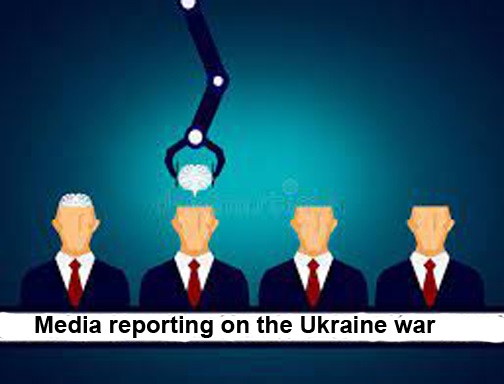
So we now have a NATO Foreign Minister, a journalist with sources “close to Zelensky” and a former Israeli PM all saying that Western leaders opposed a peace deal because they wanted to “weaken”, “press” or “smash” Putin.
there’s credible evidence that Western leaders stymied negotiations which might have led to a peace deal because they wanted to weaken Russia
BY NOAH CARL, 14 FEBRUARY 2023 https://dailysceptic.org/2023/02/14/media-ignores-evidence-that-west-opposed-ukraine-peace-deal/
As I noted in a previous article, the former Israeli Prime Minister Naftali Bennett revealed in a recent interview that in March of last year Western leaders blocked a draft peace deal between Russia and Ukraine.
There seems to be some disagreement over exactly what he said, as the interview was in Hebrew. Based on the English subtitles on YouTube, I quoted him as saying, “They blocked it.” But others insist he said, “They broke off negotiations.” Either way, he clearly implied that the West stymied negotiations that might have led to a peace deal.
What’s more telling is the reason he gave as to why the West did so, namely “to keep smashing Putin”. This tallies closely with Roman Romanyuk’s account of why Western leaders opposed negotiations in April:
Behind this visit and Johnson’s words lies much more than a simple reluctance to engage in agreements with Russia. The collective West, which back in February suggested that Zelenskyi surrender and run away, now felt that Putin is actually not as all-powerful as they imagined him to be. Moreover, right now there was a chance to “press him”. And the West wants to use it.
As Caitlin Johnstone points out, it also lines up with what the Turkish Foreign Minister Mevlut Cavusoglu said on April 20th last year:
Following the NATO foreign ministers’ meeting, it was the impression that … there are those within the NATO member states that want the war to continue, let the war continue and Russia gets weaker. They don’t care much about the situation in Ukraine.
So we now have a NATO Foreign Minister, a journalist with sources “close to Zelensky” and a former Israeli PM all saying that Western leaders opposed a peace deal because they wanted to “weaken”, “press” or “smash” Putin.
These seem like newsworthy revelations, don’t they? Not according to the mainstream media.
I checked whether the revelations have been mentioned by any of the following outlets: the BBC, CNN, the Times, the Guardian, the Telegraph, the New York Times, the Washington Post, or the Wall Street Journal. With the exception of one op-ed in the New York Times which quoted Cavusoglu’s statement, they’ve been completely ignored.
The point here isn’t that there definitely would have been a peace deal if not for the actions of Western leaders. We can’t know that. The point is: there’s credible evidence that Western leaders stymied negotiations which might have led to a peace deal because they wanted to weaken Russia.
With the exception of Tucker Carlson and a few lesser-known outlets, why hasn’t the media covered this? One of the current headlines on the BBC News homepage is ‘Rihanna reveals pregnancy at Super Bowl show’. Which is more newsworthy: Rihanna’s personal life, or the revelation that Western leaders may have sabotaged peace? I’m reminded of this meme: [on original]
A few days ago, in fact, a BBC Ukraine journalist got up and hugged Zelensky at a press conference. However much you support a particular cause, as a journalist you’re supposed to show a modicum of impartiality. Based on this incident, I wouldn’t expect any dramatic shifts in coverage.
Japan to extend life of nuclear power stations, and also remove rules specifying the operational periods of reactors.
Japan’s Nuclear Regulation Authority (NRA) has approved draft legislation
to extend the operating life of the country’s nuclear power reactors beyond
60 years. It also approved an amendment to the Nuclear Reactor Regulation
Law to remove the rule specifying the operational periods of reactors.
World Nuclear News 14th Feb 2023
https://www.world-nuclear-news.org/Articles/NRA-approves-use-of-Japanese-reactors-beyond-60-ye
With weasel words, Australia’s top military brass, and sycophant Richard Marles, justify allowing U.S. nuclear weapons in Australia

US nuclear-armed bomber visits allowed under Australian treaty obligations The Age, Matthew Knott, February 15, 2023
American B-52 bombers armed with nuclear warheads could rotate through Australia without breaching treaty obligations, the nation’s most senior defence public servant has indicated.
The Australian public would never be informed whether such aircraft are carrying nuclear weapons under the so-called US policy of “warhead ambiguity” in which it neither confirms nor denies if particular forms of military equipment are nuclear-armed.
While adamantly refusing to address hypothetical scenarios, Foreign Minister Penny Wong said: “The responsible way of handling this is to recognise that the US has a ‘neither confirm nor deny position’ which we understand and respect.”
It was revealed last year that the United States is preparing to build dedicated facilities for up to six B-52 bombers at Tindal air base, south of Darwin, for use in the Northern Territory dry season.
Nuclear weapons opponents and the Chinese government blasted the plan on the basis it could escalate tensions in the Asia-Pacific and accelerate an arms race in the region………………….
Australia is prohibited from permanently housing nuclear weapons in the country under its treaty obligations. But Moriarty, speaking in general terms, suggested US nuclear-armed bombers could temporarily pass through Australia without breaching international law.
“The stationing of nuclear weapons in Australia is prohibited by the South Pacific Nuclear-free Zone Treaty to which Australia is fully committed,” Moriarty said.
“There is no impediment under this treaty or the Nuclear Non-proliferation Treaty to the visit of foreign aircraft to Australian airfields or transit of Australia’s airspace, including in the context of our training and exercise programs and Australia’s force posture co-operation program with the United States.”
The B-52 is a long-range, heavy bomber that can carry out ocean surveillance and anti-ship operations and “can carry nuclear or precision guided conventional ordnance”, according to the US government……………
Greens defence spokesman David Shoebridge said: “It is highly alarming that Australian military facilities are being made available for the US to launch its nuclear-capable bombers.
“This decision not only makes us a nuclear target – it further erodes our sovereignty.
“The US has made it clear it won’t tell anyone when their B-52’s are nuclear armed or not. This leaves Australia in the dark about our role in the USA’s global nuclear strategy.”
Defence Minister Richard Marles said that while Australia had agreed to an increased tempo of American rotations in northern Australia, there had been no change in policy regarding the presence of nuclear-armed weapons.
“America maintains a policy of ambiguity in terms of the nature of assets that are on their platforms and they do that so as to amplify their extended nuclear deterrence,” he told the ABC.
Asked whether US nuclear-armed bombers should be allowed in Australia, opposition defence spokesman Andrew Hastie said: “Of course, we want to see a greater presence of the American military in the Indo-Pacific.”……………………………………………
When the ABC’s Four Corners revealed the plan to build dedicated facilities for the B-52s in October, Chinese Foreign Ministry spokesman Zhao Lijian said: “Such a move by the US and Australia escalates regional tensions, gravely undermines regional peace and stability, and may trigger an arms race in the region.”
Greens foreign affairs spokesman Jordan Steele-John said: “Nuclear-capable B-52 bombers have no place on Australian bases, on Australian shores or in Australian airspace. They are an offensive weapon that will destabilise our region.” https://www.theage.com.au/politics/federal/us-nuclear-armed-bomber-visits-allowed-under-australian-treaty-obligations-20230215-p5ckrs.html—
Russia’s Grip on Nuclear-Power Trade Is Only Getting Stronger.
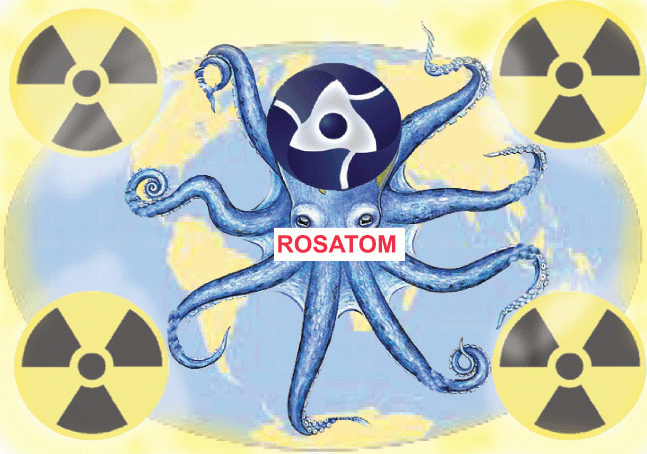
New data shows exports in the strategic industry jumped more than 20% last year, as
long-term projects boost Russian influence. Russia’s nuclear exports have
surged since the invasion of Ukraine, boosting the Kremlin’s revenue and
cementing its influence over a new generation of global buyers, as the US
and its allies shy away from sanctioning the industry. Exclusive trade data
compiled by the UK’s Royal United Services Institute show that Russian
nuclear fuel and technology sales abroad rose more than 20% in 2022.
Bloomberg 14th Feb 2023
Rising seas threaten ‘mass exodus on a biblical scale’, UN chief warns

An increase in the pace at which sea levels are rising threatens “a mass
exodus of entire populations on a biblical scale”, the UN secretary
general has warned. The climate crisis is causing sea levels to rise faster
than for 3,000 years, bringing a “torrent of trouble” to almost a
billion people, from London to Los Angeles and Bangkok to Buenos Aires,
António Guterres said on Tuesday.
Some nations could cease to exist,
drowned under the waves, he said. Significant sea level rise is already
inevitable with current levels of global heating, but the consequences of
failing to tackle the problem are “unthinkable”. Guterres said:
“Low-lying communities and entire countries could disappear for ever. We
would witness a mass exodus of entire populations on a biblical scale. And
we would see ever fiercer competition for fresh water, land and other
resources.
Guardian 14th Feb 2023
Global leaders are dropping the ball on climate change
Global leaders are dropping the ball on climate change
Greta Thunberg
We cannot just buy, invest or build our way out of the climate and environmental crisis. Nevertheless, money is still very much at the heart of the problem.
The ‘Icefin’ bore deep into an Antarctic glacier. What it found were temperatures warmer than melting point
Antarctica’s Thwaites glacier holds enough water to raise global sea levels by 65 centimetres. New research shows steep terraces and fissures in the glacier shelf are speeding up its melting.
-
Archives
- February 2026 (228)
- January 2026 (308)
- December 2025 (358)
- November 2025 (359)
- October 2025 (376)
- September 2025 (258)
- August 2025 (319)
- July 2025 (230)
- June 2025 (348)
- May 2025 (261)
- April 2025 (305)
- March 2025 (319)
-
Categories
- 1
- 1 NUCLEAR ISSUES
- business and costs
- climate change
- culture and arts
- ENERGY
- environment
- health
- history
- indigenous issues
- Legal
- marketing of nuclear
- media
- opposition to nuclear
- PERSONAL STORIES
- politics
- politics international
- Religion and ethics
- safety
- secrets,lies and civil liberties
- spinbuster
- technology
- Uranium
- wastes
- weapons and war
- Women
- 2 WORLD
- ACTION
- AFRICA
- Atrocities
- AUSTRALIA
- Christina's notes
- Christina's themes
- culture and arts
- Events
- Fuk 2022
- Fuk 2023
- Fukushima 2017
- Fukushima 2018
- fukushima 2019
- Fukushima 2020
- Fukushima 2021
- general
- global warming
- Humour (God we need it)
- Nuclear
- RARE EARTHS
- Reference
- resources – print
- Resources -audiovicual
- Weekly Newsletter
- World
- World Nuclear
- YouTube
-
RSS
Entries RSS
Comments RSS
 nuclear-news