On February 16, 2022, a full week before Putin sent combat troops into Ukraine, the Ukrainian Army began the heavy bombardment of the area (in east Ukraine) occupied by mainly ethnic Russians. Officials from the Observer Mission of the Organization for Security and Co-operation in Europe (OSCE) were located in the vicinity at the time and kept a record of the shelling as it took place. What the OSCE discovered was that the bombardment dramatically intensified as the week went on until it reached a peak on February 19, when a total of 2,026 artillery strikes were recorded. Keep in mind, the Ukrainian Army was, in fact, shelling civilian areas along the Line of Contact that were occupied by other Ukrainians.
We want to emphasize that the officials from the OSCE were operating in their professional capacity gathering first-hand evidence of shelling in the area. What their data shows is that Ukrainian Forces were bombing and killing their own people.This has all been documented and has not been challenged.
So, the question we must all ask ourselves is this: Is the bombardment and slaughter of one’s own people an ‘act of war’?
We think it is.And if we are right, then we must logically assume that the war began before the Russian invasion (which was launched a full week later) We must also assume that Russia’s alleged “unprovoked aggression” was not unprovoked at all but was the appropriate humanitarian response to the deliberate killing of civilians. In order to argue that the Russian invasion was ‘not provoked’, we would have to say that firing over 4,000 artillery shells into towns and neighborhoods where women and children live, is not a provocation? Who will defend that point of view?
No one, because it’s absurd. The killing of civilians in the Donbas was a clear provocation, a provocation that was aimed at goading Russia into a war. And –as we said earlier– the OSCE had monitors on the ground who provided full documentation of the shelling as it took place, which is as close to ironclad, eyewitness testimony as you’re going to get.
This, of course, is a major break with the “official narrative” which identifies Russia as the perpetrator of hostilities. But, as we’ve shown, that simply isn’t the case. The official narrative is wrong. Even so, it might not surprise you to know that most of the mainstream media completely omitted any coverage of the OSCE’s fact-finding activities in east Ukraine. The one exception to was Reuters that published a deliberately opaque account published on February 18 titled “Russia voices alarm over sharp increase of Donbass shelling”. Here’s an excerpt:
Russian Foreign Minister Sergei Lavrov voiced alarm on Friday over a sharp increase in shelling in eastern Ukraine and accused the OSCE special monitoring mission of glossing over what he said were Ukrainian violations of the peace process….
Washington and its allies have raised fears that the upsurge in violence in the Donbass could form part of a Russian pretext to invade Ukraine. Tensions are already high over a Russian military buildup to the north, east and south of Ukraine.
“We are very concerned by the reports of recent days – yesterday and the day before there was a sharp increase in shelling using weapons that are prohibited under the Minsk agreements,” Lavrov said, referring to peace accords aimed at ending the conflict. “So far we are seeing the special monitoring mission is doing its best to smooth over all questions that point to the blame of Ukraine’s armed forces,” he told a news conference.
Ukraine’s military on Friday denied violating the Minsk peace process and accused Moscow of waging an information war to say that Kyiv was shelling civilians, allegations it said were lies and designed to provoke it.” (Russia voices alarm over sharp increase of Donbass shelling, Reuters)
Notice the clever way that Reuters frames its coverage so that the claims of the Ukrainian military are given as much credibility as the claims of the Russian Foreign Minister. What Reuters fails to point out is that the OSCE’s report verifies Lavrov’s version of events while disproving the claims of the Ukrainians. It is the job of a journalist to make the distinction between fact and fiction but, once again, we see how agenda-driven news is not meant to inform but to mislead.
The point we are trying to make is simple: The war in Ukraine was not launched by a tyrannical Russian leader (Putin) bent on rebuilding the Soviet Empire. That narrative is a fraud that was cobbled together by neocon spin-meisters trying to build public support for a war with Russia. The facts I am presenting here can be identified on a map where the actual explosions took place and were then recorded by officials whose job was to fulfill that very task. Can you see the difference between the two? In one case, the storyline rests on speculation, conjecture and psychobabble; while in the other, the storyline is linked to actual events that took place on the ground and were catalogued by trained professionals in the field. In which version of events do you have more confidence?
Bottom line: Russia did not start the war in Ukraine. That is a fake narrative. The responsibility lies with the Ukrainian Army and their leaders in Kiev.
And here’s something else that is typically excluded in the media’s selective coverage. Before Putin sent his tanks across the border into Ukraine, he invoked United Nations Article 51 which provides a legal justification for military intervention. Of course, the United States has done this numerous times to provide a fig leaf of legitimacy to its numerous military interventions. But, in this case, you can see where the so-called Responsibility To Protect (R2P) could actually be justified, after all, by most estimates, the Ukrainian army has killed over 14,000 ethnic Russians since the US-backed coup 8 years ago. If ever there was a situation in which a defensive military operation could be justified, this was it. But that still doesn’t fully explain why Putin invoked UN Article 51. For that, we turn to former weapons inspector Scott Ritter, who explained it like this:
“Russian President Vladimir Putin, citing Article 51 as his authority, ordered what he called a “special military operation”…. under Article 51, there can be no doubt as to the legitimacy of Russia’s contention that the Russian-speaking population of the Donbass had been subjected to a brutal eight-year-long bombardment that had killed thousands of people.… Moreover, Russia claims to have documentary proof that the Ukrainian Army was preparing for a massive military incursion into the Donbass which was pre-empted by the Russian-led “special military operation.” [OSCE figures show an increase of government shelling of the area in the days before Russia moved in.]
..The bottom line is that Russia has set forth a cognizable claim under the doctrine of anticipatory collective self-defense, devised originally by the U.S. and NATO, as it applies to Article 51 which is predicated on fact, not fiction.
While it might be in vogue for people, organizations, and governments in the West to embrace the knee-jerk conclusion that Russia’s military intervention constitutes a wanton violation of the United Nations Charter and, as such, constitutes an illegal war of aggression, the uncomfortable truth is that, of all the claims made regarding the legality of pre-emption under Article 51 of the United Nations Charter, Russia’s justification for invading Ukraine is on solid legal ground.” (“Russia, Ukraine & the Law of War: Crime of Aggression”, Consortium News)
Here’s a bit more background from an article by foreign policy analyst Danial Kovalik:
“One must begin this discussion by accepting the fact that there was already a war happening in Ukraine for the eight years preceding the Russian military incursion in February 2022. And, this war by the government in Kiev… claimed the lives of around 14,000 people, many of them children, and displaced around 1.5 million more … The government in Kiev, and especially its neo-Nazi battalions, carried out attacks against these peoples … precisely because of their ethnicity. ..
While the UN Charter prohibits unilateral acts of war, it also provides, in Article 51, that “nothing in the present Charter shall impair the inherent right of individual or collective self-defense… ” And this right of self-defense has been interpreted to permit countries to respond, not only to actual armed attacks, but also to the threat of imminent attack.
In light of the above, it is my assessment.. that Russia had a right to act in its own self-defense by intervening in Ukraine, which had become a proxy of the US and NATO for an assault – not only on Russian ethnics within Ukraine – but also upon Russia itself.” (“Why Russia’s intervention in Ukraine is legal under international law”, RT)
So, has anyone in the western media reported on the fact that Putin invoked UN Article 51 before he launched the Special Military Operation?
No, they haven’t, because to do so, would be an admission that Putin’s military operation complies with international law. Instead, the media continues to spread the fiction that ‘Hitler-Putin is trying to rebuild the Soviet empire’, a claim for which there is not a scintilla of evidence. Keep in mind, Putin’s operation does not involve the toppling of a foreign government to install a Moscow-backed stooge, or the arming and training a foreign military that will be used as proxies to fight a geopolitical rival, or the stuffing a country with state-of-the-art weaponry to achieve his own narrow strategic objectives, or perpetrating terrorist acts of industrial sabotage (Nord-Stream 2) to prevent the economic integration of Asia and Europe. No, Putin hasn’t engaged in any of these things. But Washington certainly has, because Washington isn’t constrained by international law. In Washington’s eyes, international law is merely an inconvenience that is dismissively shrugged off whenever unilateral action is required. But Putin is not nearly as cavalier about such matters, in fact, he has a long history of playing by the rules because he believes the rules help to strengthen everyone’s security. And, he’s right; they do.
And that’s why he invoked Article 51 before he sent the troops to help the people in the Donbas. He felt he had a moral obligation to lend them his assistance but wanted his actions to comply with international law. We think he achieved both.
Here’s something else you will never see in the western media. You’ll never see the actual text of Putin’s security demands that were made a full 2 months before the war broke out. And, the reason you won’t see them, is because his demands were legitimate, reasonable and necessary. All Putin wanted was basic assurances that NATO was not planning to put its bases, armies and missile sites on Russia’s border. In other words, he was doing the same thing that all responsible leaders do to defend the safety and security of their own people.
Here are a few critical excerpts from the text of Putin’s proposal to the US and NATO: [on original]………………………….
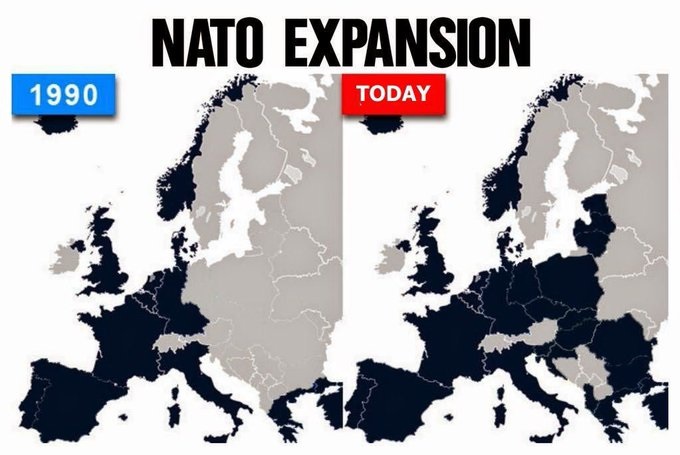
It doesn’t take a genius to figure out what Putin was worried about. He was worried about NATO expansion and, in particular, the emergence of a hostile military alliance backed by Washington-groomed Nazis occupying territory on his western flank. Was that unreasonable of him? Should he have embraced these US-backed Russophobes and allowed them to place their missiles on his border? Would that have been the prudent thing to do?
So, what can we deduce from Putin’s list of demands?
First, we can deduce that he is not trying to reconstruct the Soviet empire as the MSM relentlessly insists. The list focuses exclusively on security-related demands, nothing else.
Second, it proves that the war could have easily been avoided had Zelensky simply maintained the status quo and formally announced that Ukraine would remain neutral. In fact, Zelensky actually agreed to neutrality in negotiations with Moscow in March, but Washington prevented the Ukrainian president from going through with the deal which means that the Biden administration is largely responsible for the ongoing conflict. (RT published an article today stating clearly that an agreement had been reached between Russia and Ukraine in March but the deal was intentionally scuttled by the US and UK. Washington wanted a war.)
Third, it shows that Putin is a reasonable leader whose demands should have been eagerly accepted. Was it unreasonable of Putin to ask that “The Parties shall refrain from deploying their armed forces and… military alliances.. in the areas where such deployment could be perceived by the other Party as a threat to its national security”? Was it unreasonable for him the ask that “The Parties shall eliminate all existing infrastructure for deployment of nuclear weapons outside their national territories”?
Where exactly are the “unreasonable demands” that Putin supposedly made?
There aren’t any. Putin made no demands that the US wouldn’t have made if ‘the shoe was on the other foot.’
Forth, it proves that the war is not a struggle for Ukrainian liberation or democracy. That’s hogwash. It is a war that is aimed at “weakening” Russia and eventually removing Putin from power. Those are the overriding goals. What that means is that Ukrainian soldiers are not dying for their country, they are dying for an elitist dream to expand NATO, crush Russia, encircle China, and extend US hegemony for another century. Ukraine is merely the battlefield on which the Great Power struggle is being fought.
There are number points we are trying to make in this article:
Who started the war? Answer– Ukraine started the war
Was the Russian invasion a violation of international law? Answer– No, the Russian invasion should be approved under United Nations Article 51
Could the war have been avoided if Ukraine declared neutrality and met Putin’s reasonable demands? Answer– Yes, the war could have been avoided
The last point deals with the Minsk Treaty and how the dishonesty of western leaders is going to effect the final settlement in Ukraine. I am convinced that neither Washington nor the NATO allies have any idea of how severely international relations have been decimated by the Minsk betrayal. In a world where legally binding agreements can be breezily discarded in the name of political expediency, the only way to settle disputes is through brute force. Did anyone in Germany, France or Washington think about this before they acted? (But, first, some background on Minsk.)
The aim of the Minsk agreement was to end the fighting between the Ukrainian army and ethnic Russians in the Donbas region of Ukraine. It was the responsibility of the four participants in the treaty– Germany, France, Russia and Ukraine– to ensure that both sides followed the terms of the deal. But in December, former German Chancellor Angela Merkel said in an interview with a German magazine, that there was never any intention of implementing the deal, instead, the plan was to use the time to make Ukraine stronger in order to prepare for a war with Russia. So, clearly, from the very beginning, the United States intended to provoke a war with Russia.
On September 5, 2014, Germany, France, Ukraine and Russia all signed Minsk, but the treaty failed and the fighting resumed. On February 12, 2015, Minsk 2 was signed, but that failed, as well. Please, watch this short segment on You Tube by Amit Sengupta who gives a brief rundown of Minsk and its implications: (I transcribed the piece myself and any mistakes are mine.) …………………. [Transcription on original]
There’s no way to overstate the importance of the Minsk betrayal or the impact it’s going to have on the final settlement in Ukraine. When trust is lost, nations can only ensure their security through brute force. What that means is that Russia must expand its perimeter as far as is necessary to ensure that it will remain beyond the enemy’s range of fire. (Putin, Lavrov and Medvedev have already indicated that they plan to do just that.) Second, the new perimeter must be permanently fortified with combat troops and lethal weaponry that are kept on hairtrigger alert. When treaties become vehicles for political opportunism, then nations must accept a permanent state of war. This is the world that Merkel, Hollande, Poroshenko and the US created by opting to use ‘the cornerstone of international relations’ (Treaties) to advance their own narrow warmongering objectives.
We just wonder if anyone in Washington realizes whet the fu** they’ve done?
Russia Loses World’s Largest Nuclear Submarine, NewsWeek, BY BRENDAN COLE ON 2/6/23
The Russian Navy has confirmed it has decommissioned its nuclear-powered strategic submarine Dmitry Donskoy, which formed part of Moscow’s formidable Cold War weapon system.
There had been speculation for months about the fate of the submarine, which had been launched in 1980 and whose NATO reporting name was Typhoon.
In 2021, Russia’s state news agency Tass reported that the vessel would stay in service until 2026.
It was the first of six Akula-class Northern Fleet submarines laid down at the Sevmash shipyard in Severodvinsk on the White Sea which were commissioned in the 1980s.
At 574 feet long, Dmitry Donskoy‘s status as the world’s largest submarine was overtaken by the 608-feet-long Belgorod nuclear submarine, which was commissioned in July 2022. Dmitry Donskoy had a displacement of around 53,000 tons and was modernized and re-equipped in 2002 with the “Bulava” missile.
While it was reported in July 2022 that the vessel had been terminated, no official confirmation was expected until the end of the year. The vessel’s last reported activity was in the sea trials of SSN Krasnoyarsk in September 2022.
On Monday, Vladimir Maltsev, head of the Russian Movement for Navy Support, told TASS that the vessel had been “decommissioned” and would “await utilization at a naval base in Severodvinsk together with two other units of this project.”
The class was the backbone of the Soviet Union’s second-strike nuclear deterrent, with 20 massive R-39 “Rif” SLBMs (submarine-launched ballistic missile) having up to 200 warheads in total. The Drive described it as the “most deadly single weapon system” Russia had designed in the Cold War. Newsweek has contacted the Russian defense ministry for comment.
ELISE WU Paris, 06 Feb 2023 20:26, (Montel) French energy minister Agnes Pannier-Runacher has confirmed plans to extend the lifetimes of existing nuclear plants beyond 60 years where possible.
This commentary is by Ann Darling of Easthampton, Massachusetts, a climate activist and retired social worker. She lived for 35 years in the Brattleboro area, but after getting her son through high school, she left to be farther away from the Vermont Yankee nuclear power plant. She is a member of the Citizens Awareness Network.
In a recent commentary, Tom Evslin outlines what he sees as hopeful approaches to addressing our energy needs and addressing climate change.
While I agree there are many things in development that appear promising, I don’t agree that nuclear power should be part of “the answer.”
The climate chaos we are already experiencing is just the beginning. We have already wasted a lot of time. The litmus test of what makes a good energy source to address climate change has at least four criteria.
In addition to using less energy, we need to focus on energy sources that are:
1) quickly built and brought to scale.
2) low-carbon, with minimal environmental impact, including non-carbon pollutants.
3) relatively inexpensive so we can make the biggest impact within our limited resources .
4) safe.
In addition, these need to be deployed in an environmentally just way, but that’s another commentary.
No matter the energy source, we always should consider its entire fuel chain or life-span cycle, from extraction to power generation to waste, not just its impact at the point of power generation. This is an incredibly important mind shift we all need to make.
There is no energy source that does not create problems somewhere in its fuel-chain life span. The issue is, how much and what kind? Can the earth heal from these harmful impacts, and how can people help that happen?
Solar, wind, geothermal, storage, etc., paired with efficiency and conservation come close to meeting these four tests. Yes, there are problems, like the pollution caused by lithium mining and how to safely recycle the components of solar panels. So the question with them is how we can use our intelligence and resources to mitigate these harms and make them affordable and easy to access.
On the other hand, nuclear fission and nuclear fusion do not come close to meeting these tests. Fission is what runs our current nuclear reactor fleet and the still-on-the-design-table small modular reactors. Harnessing nuclear fusion, which powers our sun, has been in the spotlight lately because of a recent advance in development, but it is still decades away from being useful as a power source, if it ever will be.
Nuclear fission reactors are far from carbon-free, contrary to what nuclear industry marketing would have us believe. Once we consider the process of getting the uranium out of the ground, milling and refining it, using it, and then dealing with the waste, nuclear is a net carbon emitter. Plus, the mining, milling and refining expose communities to highly toxic materials that cause cancer and other diseases. There is always risk of nuclear catastrophe (as in Fukushima).
Places where lower-level radioactive waste from reactors goes are leaking sacrifice-zones that despoil entire regions (think Hanford, Washington; Oak Ridge, Tennessee; or Barnwell, South Carolina).
And last but not least, there is no safe place for the deadly high-level waste (“spent” fuel) to go. Plus, reactors take a really long time to build, and small modular reactors are completely untested. Nuclear is the most expensive way to generate electricity there is, and it can exist only with huge subsidies and tax credits from the government. That’s your tax dollars underwriting private industry. (And then there’s the link to nuclear weapons; the civilian nuclear power industry creates the materials that make nuclear weapons.)
Fusion? I’m sorry, but no. According to Dr. Ian Fairlie, a UK expert on radioactivity in the environment, “Fusion reactors would … be subject to most of the major problems associated with fission reactors, including large-scale cooling demands, high construction and operational costs and lengthy construction times — stretching to decades. The structure, damaged by neutron bombardment, would need to be replaced regularly, resulting in large amounts of radioactive wastes for which there is no current solution.”
We simply do not have the time to fiddle around with something that will take decades and that is quite likely not to work and/or will create huge and dangerous problems for life on earth.
Let’s be practical in the face of climate-induced threats to life on earth. We have limited resources. Every dollar that goes into perpetuating nuclear power in any form is in essence being stolen from bringing less expensive, safer, less carbon-intensive, and more quickly built energy sources to bear on the climate emergency we have created.
Nuclear power never was and is not now an answer to anything our ailing planet needs.






 nuclear-news