One Year After Russia Annexed Crimea, Locals Preferred Moscow To Kiev
Kenneth Rapoza, Senior Contributor, Mar 20, 2015, https://www.forbes.com/sites/kenrapoza/2015/03/20/one-year-after-russia-annexed-crimea-locals-prefer-moscow-to-kiev/?sh=6b884a88510d
The U.S and European Union may want to save Crimeans from themselves. But the Crimeans are happy right where they are.
One year after the annexation of the Ukrainian peninsula in the Black Sea, poll after poll shows that the locals there — be they Ukrainians, ethnic Russians or Tatars are mostly all in agreement: life with Russia is better than life with Ukraine.
Little has changed over the last 12 months. Despite huge efforts on the part of Kiev, Brussels, Washington and the Organization for Security and Cooperation in Europe, the bulk of humanity living on the Black Sea peninsula believe the referendum to secede from Ukraine was legit. At some point, the West will have to recognize Crimea’s right to self rule. Unless we are all to believe that the locals polled by Gallup and GfK were done so with FSB bogey men standing by with guns in their hands.
In June 2014, a Gallup poll with the Broadcasting Board of Governors asked Crimeans if the results in the March 16, 2014 referendum to secede reflected the views of the people. A total of 82.8% of Crimeans said yes. When broken down by ethnicity, 93.6% of ethnic Russians said they believed the vote to secede was legitimate, while 68.4% of Ukrainians felt so. Moreover, when asked if joining Russia will ultimately make life better for them and their family, 73.9% said yes while 5.5% said No.
In February 2015, a poll by German polling firm GfK revealed that attitudes have not changed. When asked “Do you endorse Russia’s annexation of Crimea?”, a total of 82% of the respondents answered “yes, definitely,” and another 11% answered “yes, for the most part.” Only 2% said they didn’t know, and another 2% said no. Three percent did not specify their position.
With two studies out of the way, both Western-based, it seems without question that the vast majority of Crimeans do not feel they were duped into voting for annexation, and that life with Russia will be better for them and their families than life with Ukraine. A year ago this week, 83% of Crimeans went to the polling stations and almost 97% expressed support for reunification with their former Soviet parent. The majority of people living on the peninsula are ethnic Russians.
The U.S. made a big deal about the rights of ethnic minorities there known as the Tatars, which account for around 10% of the population. Of the 4% total that said they did not endorse Russia’s annexation, the vast majority — 55% — said that they feel that way because they believe it should have been allowed by Kiev in accordance with international law. Another 24% said the referendum vote was “held under pressure”, which means political or military threats to vote and vote in favor.
The GfK survey also asked if the Ukrainian media have given Crimea a fair assessment. Only 1% said that the Ukrainian media “provides entirely truthful information” and only 4% said it was “more often truthful than deceitful.”
For now, the Gallup and GfK polls show a deeply divided Ukraine. The division of political allegiances ultimately threatens Ukraine’s territorial integrity. Only 19% in the east and 26.8% in the southeast think Ukraine should join the European Union, while 84.2% in the west believe Ukraine is a natural fit with the E.U.. Nearly 60% in the north agree that E.U. is the place to be, and just under half in the center part of the country want E.U. integration.
NATO integration is even less supported in the southeast and east, and a little over a third in the center and north agree that Ukraine should join the Western military powers. In the west, that number rises to 53%.
Those numbers also coincide with Ukraine’s trust or distrust with Washington. The pro-integration west, north and center portions of Ukraine all view the U.S. role in the crisis as mostly positive. Well under a third say so in the east and southeast, and almost no one, including the Tatars, believe so in Crimea, GfK poll data suggests.
Interestingly enough, despite Russia’s involvement in the separatist movement in eastern Ukraine, only 35.7% of people polled there said they viewed Russia’s involvement as mostly positive while 71.3% of Crimeans were more in line with Russia’s world view, according to the year old poll from Gallup.
This week, the State Department’s press secretary Jen Psaki said sanctions on Russia will continue until Crimea is returned to Ukraine. Both the State Department and Treasury Department did not clarify whether that was an actual policy statement, nor whether that included the sectoral sanctions which were applied in a third round of sanctions last July following the downing of Malaysian flight MH17 over east Ukraine.
Budget cuts have left UK’s military’s stores bare: General says Britain would run out of ammo in a day if it fought Russia. Britain buying ammo from South Asia to support Ukraine.
- General Sir Richard Barrons said years of cuts have left cupboards almost bare
- Meanwhile, Ben Wallace said military spending may have to rise for two decades
Daily Mail, By KATHERINE LAWTON 3 Feb 23,
Britain’s ammo stocks would run out in a day if it fought Russia – as a top former General said years of cuts have left military’s stores bare.
The warning from General Sir Richard Barrons comes a day after Defence Secretary Ben Wallace said the UK’s forces have been ‘hollowed out’, adding that military spending may have to rise for two decades, owing to global threats.
According to The Sun, Britain is buying ammo from South Asia to support Ukraine.
Dr Jack Watling, at military think tank Rusi, said Ukraine had been firing around 6,000 shells a day, but we rely on imported explosives for tank and artillery shells.
Our ammo plants, run by defence contractor BAE, would take a year to make a day’s shells for Ukraine, sources said.
Meanwhile, it was also revealed that Britain has no working heavy artillery guns after giving all serviceable AS90 self-propelled items to Ukraine.
General Barrons said the Army requires £3 billion more a year to rejoin Nato’s top tier.
In his column for The Sun, he wrote: ‘This is truly shocking. But it is true. And we must fix it.
‘The UK spends more on defence than any EU ally and our brave Armed Forces have long been one of Britain’s most influential levers around the world.
‘Yet for decades they have been hollowed out by spending cuts.’
…………………………… Mr Wallace also responded to urgent calls from former Prime Minister Boris Johnson to send fighter jets to Ukraine.
‘I’m open to examining all systems, not just jets. But these things don’t always happen overnight,’ he added.
Of Ukraine’s fighters he said: ‘Even if tomorrow we announced we were going to put them in fast jets, that would take months.
‘You’re suddenly having to learn to pilot a fast jet, so there is no magic wand.’
Prime Minister Rishi Sunak and Mr Wallace want to send a squadron of tanks to the country, which could arrive by the end of next month.
The MoD said it was boosting ammo stockpiles to ‘more than pre-invasion levels’ with an extra £560 million from the Treasury.
Defence chiefs have pledged all 30 working AS90s to Kyiv and are now urgently seeking K9 Thunders and Archer guns to replenish their stocks, it was recently reported. ……….
https://www.dailymail.co.uk/news/article-11708161/Britain-run-ammo-day-fought-Russia-Cuts-left-militarys-stores-bare.html
China expresses dissatisfaction and protest over US shooting down civilian airship; US sets bad precedent
The Pentagon earlier said on Friday that the balloon did not pose a “military or physical” threat.
It’s widely known that US aircraft, appearing in civilian or military purposes, operate around China much more frequent than Chinese aircraft do around the US
Global Times, By Chen Qingqing and Liu Xuanzun, Feb 05, 2023
China expressed strong dissatisfaction and protest on Sunday against the US’ move to shoot down a non-threatening Chinese airship for civilian use, calling the US’ move an overreaction and vowing to reserve the right to take necessary actions. By turning an unintentional accident into an incident that has been hyped by the US officials and media, Washington is adding new uncertainties into the already-intense relations with China, creating a bad precedent for blurring the line between civilian and military uses, experts said.
The Chinese Foreign Ministry expressed strong dissatisfaction and protested against the US’ use of force to shoot down a Chinese civilian unmanned airship, urging the US to properly handle the incident.
The Chinese side has verified the situation and communicated with the US side multiple times, saying the unintended entry of the airship into US airspace was due to force majeure and the incident was totally an accident, the ministry said.
The US military on Saturday local time shot down a “suspected Chinese spy balloon” off the Carolina coast following an authorization of the Biden administration after the airship has been flying over the US for days. The action was hailed by the US President Joe Biden as “a success,” according to US media reports.
The “balloon episode” went viral on the US social media. A number of US hawks on China-related matters have been hyping the use of balloon for spying purpose and deliberately distorted it as “a direct assault on the US national sovereignty.”
“The US attack on Chinese civilian unmanned airship by force is an obvious overreaction,” Senior Colonel Tan Kefei, a spokesperson at China’s Ministry of National Defense, said in a statement on Sunday.
China will reserve the right to take necessary measures in dealing with similar situations, Tan said.
Tan’s remarks mean that if a foreign airship accidentally enters the Chinese airspace, the Chinese forces could also shoot it down in a similar manner, observers said.
Biden was first briefed on the balloon Tuesday and has been receiving updates from his national security team, CNN said. The Pentagon earlier said on Friday that the balloon did not pose a “military or physical” threat………………………………………….
Overreaction, bad precedent
The US shooting down the Chinese civilian balloon is also considered an overreaction from a technical point of view, said military aviation experts.
Despite admitting that the balloon did not pose a military or physical threat, an F-22 fighter of the US Air Force fired an AIM-9X air-to-air missile and shot down the balloon, supported by F-15 fighters, tankers and warships, the Pentagon said on the day on its website.
The missile was fired from the F-22 from an altitude of 58,000 feet (17,678 meters) when the balloon was 60,000 and 65,000 feet, the Pentagon said.
This is like shooting a mosquito with a cannon, which is not only overreacting but also impractical, a Chinese military expert who requested anonymity told the Global Times on Sunday.
Compared with an unmanned balloon that flies with the wind, the US interception method that featured an advanced stealth fighter jet and fired a missile is too costly………………………………….
It’s widely known that US aircraft, appearing in civilian or military purposes, operate around China much more frequent than Chinese aircraft do around the US, Lü noted. …………
more https://www.globaltimes.cn/page/202302/1284857.shtml
West Blocked Ukraine Peace Deal, Says Former Israeli PM
BY NOAH CARL, 5 FEBRUARY 2023, https://dailysceptic.org/2023/02/05/west-blocked-ukraine-peace-deal-says-former-israeli-pm/
Last September, Fiona Hill and Angela Stent wrote this in Foreign Affairs: “According to multiple former senior U.S. officials, in April 2022, Russian and Ukrainian negotiators appeared to have tentatively agreed on the outlines of a negotiated interim settlement.”
In the end, of course, no such settlement was agreed. Which may be, at least in part, because Boris Johnson advised Zelensky not to sign it during his “surprise visit” to Kiev in early April.
As you may recall, one of Zelensky’s “close associates” told Ukrainska Pravda that Johnson was an “obstacle” to negotiations because he’d brought two simple messages: “Putin is a war criminal, he should be suppressed, not negotiated with. And secondly, if you are ready to sign any agreements on guarantees with him, then we are not. We can with you, but not with him, he will still abandon everyone.”
According to Roman Romanyuk, writing in Ukrainska Pravda:
Behind this visit and Johnson’s words lies much more than a simple reluctance to engage in agreements with Russia. The collective West, which back in February suggested that Zelenskyi surrender and run away, now felt that Putin is actually not as all-powerful as they imagined him to be. Moreover, right now there was a chance to “press him”. And the West wants to use it.
It should be noted that Romanyuk disagrees that Johnson’s visit was the main reason the deal fell through. In his view, concerns that “Ukrainian society might not accept such a deal” loomed larger. Others interpret the evidence differently.
Putin himself has claimed the West scuttled negotiations, noting in his September 21st speech that “after certain compromises were coordinated, Kiev was actually ordered to wreck all these agreements”.
Now, the former Israeli PM Naftali Bennett has lent credence to this view, claiming that the West “blocked” a draft peace deal between Russia and Ukraine. The revelation came in a long interview (in Hebrew) posted on Bennett’s YouTube channel.
Bennett’s words cannot be dismissed as mere speculation, given that he played a central role mediating between the two sides, after a request from Zelensky at the war’s outset.
In the interview, Bennett states that he believed Israel’s national interest would be served by a policy of neutrality, which is why he accepted the request to mediate. Toward this end, he sought to understand the interests of both sides.
“Putin’s perception,” he says, “was wait, when the wall came down, we reached an agreement with NATO that they wouldn’t expand … why are you introducing Ukraine into NATO?” Later in the interview, he states that “the war broke out because of the demand to join NATO”.
After a sequence of phone calls with the two leaders, Bennett flew to Moscow on March 7th. (Meanwhile, Russian and Ukrainian negotiators were holding talks at Gomel in Belarus.)
He says that Putin then “made two big concessions”. He promised not to “take out” Zelensky, and he “renounced disarmament of Ukraine”. The same day, Zelensky also “made a big concession” – he “relinquished joining NATO”. Describing these as “huge steps on each side”, Bennett’s impression was that “both sides very much want a ceasefire”.
According to the former Prime Minister, Putin was “very pragmatic”, and “so was Zelensky”. As an example of Putin’s pragmatism, he mentions that Putin “totally understood Zelensky’s political constraints”. Asked whether Putin is “gung ho to fight at all costs”, Bennett replies “no” because “he has goals to achieve”.
Regarding the various Western leaders involved, he says that “Boris Johnson adopted the aggressive line”, whereas “Macron and Scholz were more pragmatic”, and “Biden was both”.
Then we get to the most interesting part. “I think there was a legitimate decision by the West,” Bennett explains, “to keep striking Putin”, to take the “more aggressive approach”. “So they blocked it?” the interviewer asks. “Yes. They blocked it.”
Bennet’s account obviously comports closely with Romanyuk’s observation that the West felt there was a chance to “press” Putin.
One reason to be sceptical is that, insofar as Bennett’s mediation efforts ultimately failed, he has an incentive to blame outside forces (in this case, the West). For now, we can’t be sure exactly what happened. But the revelations are striking, consistent as they are with the earlier report in Ukrainska Pravda – down to the detail of Johnson being particularly hawkish.
Nuclear too expensive and not needed — Beyond Nuclear International

Detailed research shows mistake in pursuing nuclear power
Nuclear too expensive and not needed — Beyond Nuclear International
Energy scientists show obsolescence of nuclear power in an all-renewable future
From Claverton Energy Group
Sizewell C is much more expensive and slower to build than proven and reliable alternative low carbon solutions says an energy think tank that examined nuclear projects in the United Kingdom. Even the unfinished twin reactors at Hinkley C can’t compete with renewables.
Baseload generators such as nuclear power plants are not needed in an all-renewable future and their use will almost certainly increase overall costs to consumers says an elite Claverton Energy Group of experts. Professor Mark Barrett, from University College London (UCL), who has modeled the comparative costs of nuclear and renewable power, using hour-by-hour wind and solar data with 35 years of weather data, said:
“Nuclear power is more expensive and slower to build than renewables, particularly offshore wind. 7 GW of wind will generate about 40% more electricity than Hinkley at about 30-50% of the cost per kWh and will be built in half the time. Neither wind nor nuclear plants operate all the time, so both will need backup. Modeling shows the total cost of renewable generation to be less than nuclear and to be just as able to provide continuous power even with wind and solar droughts.”
This detailed modeling of the entire heat, power and transport system in the UK, has been carried out by a number of top-flight university researchers and shows that:
Continue readingSaudi Arabia: The Next Nuclear Power?
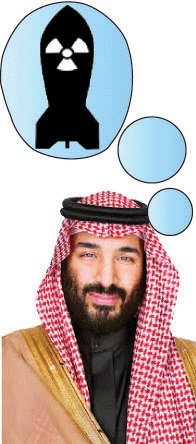
The idea that Saudi Arabia will seek atomic weapons remains a concern. In 2018, Crown Prince Mohammed bin Salman said his country could develop nuclear weapons as a response to Iran’s nuclear program.
As Iran edges closer to gaining the ability to build nuclear weapons, Saudi Arabia is beginning to make similar moves.
FEBRUARY 05, 2023 Author: CHLOE DOMAT
Saudi Arabia plans to develop its own nuclear power industry using local uranium, according to energy minister Prince Abdulaziz bin Salman.
Recent field studies have shown promising uranium resources in the kingdom, he said during a speech at the Future Minerals Forum held in Riyadh in January.
“This would involve the entire nuclear fuel cycle: the production of yellowcake, low enriched uranium and the manufacturing of nuclear fuel both for our national use and, of course, for export,” Abdulaziz said, citing potential joint ventures “in accordance with international commitments and transparency standards.”
Saudi Arabia is investing heavily in the mining industry, touting resources including aluminum, phosphate, gold, copper and uranium worth about $1.33 trillion. In 2022, its mining revenue increased 27% and there are dozens of exploration licenses accessible to foreign companies. Overall, the kingdom wishes to attract $32 billions of investments to the mining sector.
“Equipped with robust bilateral relationships with relevant countries and the funds to bring in foreign partners, Saudi Arabia is likely to advance its nuclear game plan with the support of external players,” says Bayly Winder, Penn Kemble Fellow at the nonprofit National Endowment for Democracy. “Saudi Arabia initiated a bidding process for its first nuclear power station with interested parties including South Korea, China, Russia and France. The Saudi and American governments are also working on a partnership framework for clean-energy development”
The idea that Saudi Arabia will seek atomic weapons remains a concern. In 2018, Crown Prince Mohammed bin Salman said his country could develop nuclear weapons as a response to Iran’s nuclear program.
“The risk of regional escalation will continue to exist, but the Saudis are well aware of the sensitivities involved in nuclear energy buildup,” adds Winder.
The United Arab Emirates is currently the only Arab country operating a nuclear energy plant.
Iran says France should inform the world how Israel obtained nuclear arms
February 4, 2023, https://www.tehrantimes.com/news/481592/Iran-says-France-should-inform-the-world-how-Israel-obtained
TEHRAN- Iranian Foreign Ministry Nasser Kanaani on Friday night attacked French President Macron for his disparaging remarks about Iran’s peaceful nuclear program while meeting the Israeli prime minister in Paris.
“The French president vilifies Iran’s peaceful nuclear activities at a time when he seems to have overlooked that the Zionist regime has dozens of nuclear warheads, does not accept any international surveillance, having a dark history of occupation and military aggression, and is the greatest threat to regional and global peace and security,” Kanaani remarked.
The spokesman emphasized that instead of feigning concern over Iran’s peaceful nuclear activities, which are governed by the International Atomic Energy Agency, France should inform the world about how the Zionist regime obtained nuclear weapons.
France is internationally responsible for aiding Israel to get access to nuclear arms.
Nasser Kanaani condemned Macron’s meeting with Benjamin Netanyahu, the prime minister of a regime that its name is synonymous with organized terror, bloodshed, devastation, and displacement of women and children in West Asia, especially Palestine.
Kanaani also urged the French authorities to change their wrong strategy, get back to the tenet of respect for one another, and stop jeopardizing bilateral relations.
Military probing link between nuclear silo work, cancers.
https://www.coloradopolitics.com/news/military-probing-link-between-nuclear-silo-work-cancers-out-west-roundup/article_e52dd2fa-a0e4-11ed-83ec-dbc142e08bdc.html The Associated Press, 5 Feb 23,
Military probing whether cancers linked to nuclear silo work
WASHINGTON — Nine military officers who had worked decades ago at a nuclear missile base in Montana have been diagnosed with blood cancer and there are “indications” the disease may be linked to their service, according to military briefing slides obtained by The Associated Press. One of the officers has died.
All of the officers, known as missileers, were assigned as many as 25 years ago to Malmstrom Air Force Base, home to a vast field of 150 Minuteman III intercontinental ballistic missile silos. The nine officers were diagnosed with non-Hodgkin lymphoma, according to a January briefing by U.S. Space Force Lt. Col. Daniel Sebeck.
Missileers ride caged elevators deep underground into a small operations bunker encased in a thick wall of concrete and steel. They remain there sometimes for days, ready to turn the launch keys if ordered to by the president.
In the slide presentation, Sebeck said the “disproportionate numbers of missileers presenting with cancer, specifically lymphoma” was concerning.
In a statement to the AP, Air Force spokeswoman Ann Stefanek said that “senior leaders are aware of the concerns raised about the possible association of cancer related to missile combat crew members at Malmstrom AFB.”
Stefanek added: “The information in this briefing has been shared with the Department of the Air Force surgeon general and our medical professionals are working to gather data and understand more.”
Last year President Joe Biden signed the PACT Act, which greatly expanded the the types of illnesses and toxic exposures that would be considered presumptive — meaning a service member or veterans would not face an uphill battle to convince the government that the injury was tied to their military service in order to received covered care.
Morocco committed to elimination of nuclear weapons – Envoy speaks at African seminar on the Treaty on the Prohibition of Nuclear Weapons, in Pretoria
05.02.2023 by APA News https://www.journalducameroun.com/en/morocco-committed-to-elimination-of-nuclear-weapons-wmds-envoy/—
Morocco supports “serious, efficient and joint actions” for the total elimination of nuclear weapons and weapons of mass destruction (WMDs) around the world, the kingdom’s top envoy in South Africa has said.Speaking during an African regional seminar on the universalisation of the Treaty on the Prohibition of Nuclear Weapons in Pretoria, Moroccan ambassador Youssef Amrani said his country is “firmly committed to the total elimination of nuclear weapons and weapons of mass destruction”, noting that the recent resurgence of the nuclear threat was “a challenge that requires serious, efficient and joint actions.”
“Morocco reaffirms its unwavering support for multilateral initiatives aimed at combating the arms race, promoting the strengthening of disarmament agreements aimed at limiting weapons of mass destruction, as well as promoting the efforts of the international community to prevent the proliferation of nuclear weapons and the elimination of weapons of mass destruction,” Amrani said.
The ambassador’s comments come against the backdrop of heightened global tensions over the threat of a nuclear war in the aftermath of the Russia-Ukraine war.
Ambassador Amrani said Morocco was committed to the complete general and irreversible disarmament, stressing that multilateralism and regional and international cooperation remained the key to providing effective responses to the global threats of proliferation of WMDs.
He stressed that, as a promoter and provider of international peace and security, Morocco is convinced that global peace and stability can only be achieved on the basis of peaceful coexistence, constructive and sincere dialogue on the basis of mutual respect.
He said Morocco considered the existence of WMDs as a permanent threat with devastating risks that have “a continuous impact on the future of the world and future generations.”
He noted that the kingdom remained convinced that nuclear weapons and WMDs do not guarantee effective peace and security at the regional and international levels.
Celebrities Protect The Interests Of The Empire
By Caitlin Johnstone OEN 2 Feb 23
The failings of the status quo are hidden in mainstream culture, and people aren’t permitted to consider the possibility that there might be a better way for things to be. People don’t know, and they don’t know that they don’t know. They’re kept in the dark about what’s possible.
………………………………………… Most people on this planet couldn’t give a sh*t who governs Crimea, but one small group insists we risk every life in existence on earth “- every bee, every frog, every tree, every child “- for their current t-shirt-of-the-week issue. It’s so arrogant.
It’s one thing to draw a line and say “The world must never let anyone cross this point, even if it means risking nuclear armageddon.” It’s quite another to make that line something as trivial as the question of who governs Crimea. It’s not legitimate to risk all life over that. This is especially true because the US empire provoked this war and because even the Crimeans themselves prefer to be Russian. But even if none of that was the case, it still wouldn’t be legitimate for the US empire to risk the lives of people in Africa or South America by backing an offensive on Crimea.
All these armchair warriors saying “We need to be brave and take a stand!” are willing to gamble billions of lives who do not consent to being gambled over a war they’re not even fighting in. All while refusing to deeply contemplate what nuclear war would entail. They’re the worst kind of cowards.
I just want the rapidly rising threat of nuclear war to be treated, reported on, and discussed like the supremely important issue that it is. It’s the single most important matter in the world and it just gets casually mentioned here and there like it’s just another issue.
………… Even if you believe that all this nuclear brinkmanship is justified and good, you still need to fully acknowledge the reality of the risk and the unfathomable horrors that it would unleash upon our world. And you need to do it with all the respect and solemnity the subject deserves.
……………….. The only people who say “Putin can end this war at any time by withdrawing” are those who deny the US empire’s aggressions which led to this conflict, which is just a nonsense garbage position based on lies. They don’t actually want peace, they just want victory for the empire. The real unbiased position which supports peace is wanting both Russia and the western empire to begin engaging in diplomacy, de-escalation and detente to end this war. But empire simps will call you treasonously biased if you support anything other than total Russian defeat.
This dopey propaganda-addled notion that the west did nothing wrong and Putin attacked Ukraine solely because he is evil and hates freedom actually prevents peace from happening. If one side only acknowledges the reality of the aggressions of the other side, peace is impossible. If you don’t understand how a war was started and perpetuated, then you can’t understand how peace can be started and perpetuated. The empire deliberately works to prevent the public from obtaining this understanding, because the empire wants war.
It’s not okay for grown adults to act like Putin is just running around invading countries willy nilly because he’s a crazed madman. You’ve got a whole internet of information at your fingertips. Use it…………………….
………… the people who put on all the shows, movies and music almost everyone consumes, thereby engineering mainstream culture to the benefit of the super wealthy. It shapes the way the people think, speak, act and vote. What they feel entitled to. What they think is possible.
A rich celebrity who makes millions of dollars a year in a fun, easy and egoically gratifying job is not going to be spotlighting all the lives who are being destroyed by the status quo systems which elevated them. They’re not going to favor the revolutionary changes that are needed. They’re not going to be calling for a massive, sweeping overhaul of the systems which are crushing ordinary people to death and creating widespread misery; at most they’re going to be telling you to vote Democrat or Republican and quibbling about minor disagreements on tax rates. But these are the people with the loudest voices in our society “- not just the loudest, but many orders of magnitude more amplified and influential than the voices of the ordinary people who are suffering under existing systems. These loudly-amplified rich celebrities shape and direct mainstream culture……….more https://www.opednews.com/articles/2/Celebrities-Protect-The-In-Assholes_China_China-230203-537.html
 | |||
| |||
US set to boost military presence near China
Washington and the Philippines have announced plans for four more American bases. 5 Feb 23, https://www.rt.com/news/570878-us-philippines-military-bases/
The US military will be deployed to four new bases in “strategic areas” of the Philippines, the two countries announced on Thursday. The agreement was reached during the ongoing visit of US Defense Secretary Lloyd Austin, who met Philippine President Ferdinand ‘Bongbong’ Marcos Jr in Manila.
The two nations are set to “accelerate the full implementation” of the Enhanced Defense Cooperation Agreement (EDCA), a framework regulating the deployment of US troops to the Philippines, which is listed among Washington’s “major” non-NATO allies.
“The United States has allocated over $82 million toward infrastructure investments at the existing five sites under the EDCA, and is proud that these investments are supporting economic growth and job creation in local Philippine communities,” the Pentagon said in a statement.
Apart from further development of the existing bases, the US military will be deployed to four new sites in unspecified “strategic areas of the country.”
“The United States and the Philippines have committed to moving quickly in agreeing to the necessary plans and investments for the new and existing EDCA locations. The Philippine-US Alliance has stood the test of time and remains ironclad. We look forward to the opportunities these new sites will create to expand our cooperation together,” the Pentagon added.
The move comes amid mounting tensions in the region, namely around Taiwan and the South China Sea, a busy waterway subject to overlapping maritime and territorial claims by multiple nations, including China. The Philippines, a former US colony and long-standing Washington ally, has maintained close economic ties with Beijing.
China has already condemned the US-Philippines plan, accusing Washington of stirring up further tension. The Chinese Embassy in the Philippines expressed hope that Manila would be “vigilant and resists from being taken advantage of.”
“The United States, out of its self interests and zero-sum game mentality, continues to step up military posture in this region. Its actions escalate regional tension and undermine regional peace and stability,” the embassy said in a statement.
“Such moves contradict the common aspiration of regional countries to seek peace, cooperation and development, and run counter to the common aspiration of the Filipino people to pursue sound economic recovery and a better life in cooperation with China,” it added.
Twin threats to the Marshallese — Beyond Nuclear International

Art reflects trauma of nuclear testing and climate change
Twin threats to the Marshallese — Beyond Nuclear International
Youth activists paint pictures of their forgotten history and perilous present
From Reverse The Trend and the Marshallese Educational Initiative
Last summer, Reverse The Trend and Marshallese Educational Initiative showcased a series of paintings by Marshallese youth that reflect the twin existential threats of nuclear testing and climate change as part of the Amnesia Atómica Exhibit in New York City’s Times Square.
The paintings expose the trauma experienced by youth living in diaspora in the United States who are learning about the ongoing biological, ecological, and cultural consequences of US nuclear testing on their homelands — a history not taught in US schools.
Joining other youth from affected communities and using art as activism, Marshallese youth are reversing the trend and engaging leaders and their communities to act on these twin threats.
The Amnesia Atómica exposition centered around artist Pedro Reyes’s ZERO NUKES, a 30-foot-tall inflatable sculpture serving as a beacon to bring experts, political leaders, and engaged citizens together to address the nuclear threat.
It was commissioned by the Bulletin of the Atomic Scientists, which focuses on three main areas—nuclear risk, climate change, and disruptive technologies—and equips the public, policymakers, and scientists with the information needed to reduce man-made threats to our existence.
The sculpture was designed to serve as a central platform for a series of public programs and events to spotlight the voices of activists, artists, scientists, and community organizations in the anti-nuclear field, and drive conversations around non-proliferation and disarmament.
Amnesia Atómica was curated by Pedro Alonzo, who specializes in ambitious artworks in public spaces.
We are also sharing our documentary, “A Journey Home.” The film is based on a community poem written by six Marshallese students — ranging from high school to undergraduate — living in Springdale, Arkansas. It is a reflection on the many meanings of home: as Arkansas, as the Marshall Islands, and as Earth that needs to be protected and cultivated for the next generation…………more https://beyondnuclearinternational.org/2023/02/05/twin-threats-to-the-marshallese/—
The logic behind the terror: Why does Ukraine keep attacking civilian areas in Donetsk?
Rockets have hit peaceful neighborhoods once again. Why does Kiev continue its policy, if not purely out of hate?
By Vladislav Ugolny, a Russian journalist based in Donetsk 4 Feb 23 https://www.rt.com/russia/570954-logic-behind-ukrainian-terrorism/
At least ten rockets hit central areas of Donetsk on Saturday morning, damaging three residential buildings, a local Russian official has reported in his Telegram channel.
One of the projectiles fired by Ukrainian forces hit an apartment building in the Kievsky district. While rescuers continue to search for survivors under the rubble, preliminary information suggests that there were three people in one of the apartments.
There was no information on casualties at the time of writing, but the absence of victims would be unusual; indeed, Ukrainian shelling of the capital of the Donetsk People’s Republic intensified weeks before the Russian attack in February 2022, and has taken a heavy toll ever since.
The suffering of Donbass residents
According to the human rights commissioner of the DPR, Daria Morozova, at least 1,091 civilians were killed and another 3,533 were recorded as injured last year as a result of combat operations. The figures do not include places such as Mariupol, where the full scale of the tragedy has yet to be assessed.
The 4,624 people mentioned above were victims of regular artillery strikes on urban areas of Donetsk and Gorlovka.
When Donetsk residents are asked why the Ukrainian Armed Forces continue to attack civilians, people usually have no explanation other than the desire of the Ukrainian government and military to destroy Donbass and its people. This is supported by a massive campaign to dehumanize local residents and a number of hateful statements by Ukrainian politicians. “We will kill them with nuclear weapons,” warned former Prime Minister Yulia Timoshenko, while ex-president Pyotr Poroshenko has vowed: “Our children will go to school, while their children will go sit in basements. That’s how we will win this war.”
Ukrainian forces continue to bomb Donbass despite the shortage of shells experienced by both sides of the conflict. However, while Russia can solve this issue by activating its military-industrial complex, Ukraine is entirely dependent on foreign supplies.
It should make a lot more sense for Ukraine to use scarce ammunition on military targets rather than on peaceful residential areas. Even if a lot of the time, Kiev’s forces misfire. A typical example is a Ukrainian shell landing in the frozen Kalmius River that divides Donetsk.
How Ukraine explains the attacks
Whenever Ukrainian artillery hits a civilian object – for example, a flower market – or kills civilians, officials in Kiev deny it. Unofficial voices resort to false claims that no such thing ever happened. Over the past eight years, the latter have come up with several memes allegedly proving that the Ukrainian Army wasn’t involved – with explanations such as “the air conditioner exploded.” Even if Ukrainian forces manage to hit a military facility, such as a warehouse, they usually deny involvement, claiming that “someone smoked in the wrong place” and that the explosion wasn’t related to the conflict. Thus, an information environment is created that denies the fact that Kiev attacks cities.
The Ukrainian side claims the attacks on civilians are “self-inflicted” – implying that the Russian Army attacks cities under its control, supposedly to blame Ukrainian forces and demonize them in the eyes of the population, as well as for propaganda purposes. This kind of post-truth has given rise to a whole area of fact-checking, where journalists collaborate with open-source intelligence to calculate the trajectory of the strikes.
For Donbass residents, all this is extremely painful. Discussions of terrorist attacks on civilian infrastructure often end in profanities. According to Donbass locals, Ukrainians keep on attacking Donetsk simply because they can. Meanwhile, people are just trying to survive and are waiting for the front to move away from the area. Other details don’t concern them.
However, this is a distorted view of the situation; there is every reason to believe that the regular shelling of cities in Donbass is part of Ukrainian strategy and follows military logic. Perhaps Kiev’s “hybrid war” era military doctrine has adopted terrorist methods. So, how do these attacks on the civilian population help Ukraine?
Psychological pressure
Let’s take a clear example. In June 2022, the units of the first corps of the People’s Militia of the DPR were dislodged from their permanent locations because of the battle for Lisichansk – they had to storm a huge section of the front from Popasnaya to Verkhnekamenka, moving from south to north. The Russian Armed Forces then lacked personnel and had to use troops from Donetsk. Ukraine intensified strikes on the city to force the leadership to return the units back to their locations.
A similar thing is happening now. Some areas are under pressure – in particular, the fighters of the Wagner Group are pressing in Soledar and Artyomovsk (known in Ukraine as Bakhmut). They are advancing backed by the artillery of the Russian Armed Forces. Ukrainians use civilian strikes to provoke politicians, hoping that they will influence the military and interfere with the army’s plans. In June, this plan failed and the Ukrainians, taking advantage of the lack of counter-battery fire in the Donetsk region, committed a number of atrocities.
Commenting on the situation in a private conversation, one fighter explained why the army didn’t take the bait: “Normally, no military man – from simple soldier to general – suffers if the enemy attacks the city. This sounds harsh, but it’s better for the enemy to attack the city than the army’s manpower. This would be the usual military logic, but there is one key detail: 95% of our corps are made up of local residents who are worried about their cities. So, after completing the mission in Lisichansk, our soldiers were very angry when they got back to Donetsk.”
This is all very close to home for fighters from Donbass. In the case of a fast-paced conflict without a stable front line, such attacks would have motivated the soldiers, by enraging them. Perhaps this explains the near-complete silence of the Ukrainian artillery in the first month of the Russian military campaign. In those days, when the front line was mobile, it was better not to further motivate the enemy.
However, in positional warfare, fighters are conscious of a permanent threat to their relatives and other civilians in their hometowns. Motivated warriors who identify themselves as “defenders” feel as if they don’t have enough strength to break through. This acts to discourage. Concern for those who are not on the front line returns the soldier to his other life, behind the front lines, and distracts him from battle. By itself, this does not break morale, but soldiers are also affected by constant adrenaline swings, a risk of death or injury to themselves or their brothers in arms, the cold and damp conditions, the monotony of their work (for example, a good soldier digs more often than shoots), and numerous other factors.
Russia doesn’t have a strong memory of World War I – it has been replaced by that of World War II. However, the current fighting resembles the trench warfare of the early 20th century. With the possibility to adjust and fine-tune firing using Chinese drones and the chance to search the internet for how to repair military equipment. The rest of it – mud, trenches, the frozen front line – is like World War I, including politicians demanding a large-scale and ambitious offensive.
Why can’t the strikes be stopped?
At the end of July 2022, such an event began in the Donetsk region. Its main goal was to free the city from artillery strikes. The Donetsk corps were successful for several days, but then became stuck in positional battles. By the end of January, six months into the operation, the army had barely advanced 10km (6 miles).
The fighters were unable to break through the pre-established line of defense, and the forces only managed to wedge and slowly push through the three lines of fortifications near the villages of Vodianoye and Opitnoe, north of Donetsk airport. However, the fighters cannot give up on storming these fortifications – the strikes on Donetsk and Makeyevka must end for good.
As a result, there have been signs of an emerging contradiction. On the one hand, military leaders who are interested in achieving military goals and saving manpower, and on the other, politicians who express the interests of the civilian population and want to put a swift end to the artillery terror. Politicians want the public to like them. They don’t want to deal with the consequences of hostilities, hoping for things to return to normal so they can receive funding to restore the affected regions. As a result, they view the situation quite differently from the military.
Through manipulation, propaganda and informational and psychological influence, Ukrainians have made cunning use of the differences between civilian and military interests. This comes down to a grotesque choice between “killing the army in Avdeevka” and “allowing the Ukrainian Armed Forces to wipe Donetsk off the face of the Earth.” If politicians push the army to force the assault, the latter will make more mistakes, which will reduce their power. This, in turn, favors Kiev.
Perhaps seeking rational reasons behind the artillery strikes in Donbass is pointless – maybe it’s just the manifestation of rage on behalf of Ukrainian nationalists. However, if we ask ourselves “who benefits from this,” there is a creeping suspicion that terrorizing the population with NATO ammunition is a strategy initiated by Ukraine’s top military leadership. Firstly, these attacks tie up the forces of the Russian Army and distract it from concentrating on other areas. Secondly, they negatively affect the combat spirit of the fighters from Donbass. And finally, they allow political factors to intervene in military strategy, dealing a serious blow to its quality.
Victory or Valhalla: NATO troops in “huge war games” 80 miles from Russia
The SunFebruary 5, 2023 Brit soldiers brave -12C temperatures in brutal Nato war games with tanks & helicopters just 80 miles from Russia British soldiers are facing temperatures as low as -12 as they take part in Nato war games just 80 miles from Russia. Flying in Chinook helicopters and charging round the snow-covered forests […]
Victory or Valhalla: NATO troops in “huge war games” 80 miles from Russia — Anti-bellum
Iran and the West clash over IAEA report on Fordow nuclear plant
The latest row comes as the IAEA chief hopes for progress in a potential visit to Tehran in February.
Tehran, Iran – Iran and the Western parties to its 2015 nuclear deal have once more clashed over the country’s nuclear programme, this time after a report by the International Atomic Energy Agency (IAEA) on the sensitive Fordow uranium enrichment site.
The global nuclear watchdog said in a confidential report on Wednesday leaked by Western media that the interconnection between two cascades of advanced IR-6 centrifuges at Fordow had been changed in a way that was “substantially different” from what Iran had declared.
The agency also pointed out this is inconsistent with Iran’s obligations under a safeguards agreement required by the Treaty on the Non-Proliferation of Nuclear Weapons (NPT).
Iran’s nuclear chief, Mohammad Eslami, dismissed the report on Thursday by calling it “incorrect” and claiming an agency inspector had made a mistake.
“We immediately offered explanations that were communicated the same day and the agency inspector also became aware of their mistake,” he said, denouncing the fact that confidential IAEA reports are regularly leaked to the media.
But the E3 – France, Germany and the United Kingdom – and the United States, Western signatories to Iran’s 2015 nuclear accord with world powers that also included China, Russia and the EU, rejected Iran’s stance in a statement on Friday.
“We judge Iran’s actions based on the impartial and objective reports of the IAEA, not Iran’s purported intent,” they said, calling on Iran to fully cooperate with the agency.
“We recall that the production of high-enriched uranium by Iran at the Fordow Enrichment Plant carries significant proliferation-related risks and is without any credible civilian justification.”…………………………..
The Fordow site is so important that enrichment there had been forbidden under the Joint Comprehensive Plan of Action (JCPOA), as the nuclear accord is officially known. But Iran has gradually abandoned any limits set in the accord after the US unilaterally withdrew from it in 2018 and imposed sanctions.
Talks to restore the deal remain deadlocked since September, with the US publicly maintaining it does not currently prioritise advancing the talks following deadly protests in Iran, while Tehran claims Washington is secretly sending messages to reach an agreement.
The latest clash on Fordow comes as IAEA Director General Rafael Grossi had said last month he hopes to visit Tehran in February to hold talks with Iranian officials on the unresolved cases of nuclear particles found years ago at several Iranian sites.
1 This Month

of the week – Shut Down Drone Warfare!


Tell the Ukrainian Government to Drop Prosecution of Peace Activist Yurii Sheliazhenko

Petition to revoke the licensing of the Near Surface Nuclear Disposal Facility (NSDF) at Chalk River. https://www.ourcommons.ca/petitions/en/Petition/Details?Petition=e-7247
To see nuclear-related stories in greater depth and intensity – go to https://nuclearinformation.wordpress.com
-
Archives
- April 2026 (44)
- March 2026 (251)
- February 2026 (268)
- January 2026 (308)
- December 2025 (358)
- November 2025 (359)
- October 2025 (376)
- September 2025 (257)
- August 2025 (319)
- July 2025 (230)
- June 2025 (348)
- May 2025 (261)
-
Categories
- 1
- 1 NUCLEAR ISSUES
- business and costs
- climate change
- culture and arts
- ENERGY
- environment
- health
- history
- indigenous issues
- Legal
- marketing of nuclear
- media
- opposition to nuclear
- PERSONAL STORIES
- politics
- politics international
- Religion and ethics
- safety
- secrets,lies and civil liberties
- spinbuster
- technology
- Uranium
- wastes
- weapons and war
- Women
- 2 WORLD
- ACTION
- AFRICA
- Atrocities
- AUSTRALIA
- Christina's notes
- Christina's themes
- culture and arts
- Events
- Fuk 2022
- Fuk 2023
- Fukushima 2017
- Fukushima 2018
- fukushima 2019
- Fukushima 2020
- Fukushima 2021
- general
- global warming
- Humour (God we need it)
- Nuclear
- RARE EARTHS
- Reference
- resources – print
- Resources -audiovicual
- Weekly Newsletter
- World
- World Nuclear
- YouTube
-
RSS
Entries RSS
Comments RSS
 nuclear-news