USA tries to prevent a Russian offensive in Ukraine by offering a sort of war endgame deal with Russia
Crimea is a particular point of discussion. There is a widespread view in Washington and Kyiv that regaining Crimea by military force may be impossible. Any Ukrainian military advances this year in Zaporizhzhia oblast, the land bridge that connects Crimea and Russia, could threaten Russian control. But an all-out Ukrainian campaign to seize the Crimean Peninsula is unrealistic, many U.S. and Ukrainian officials believe. That’s partly because Putin has indicated that an assault on Crimea would be a tripwire for nuclear escalation.

By John Helmer, Moscow,26 Jan 23 http://johnhelmer.org/blinken-concedes-war-is-lost-offers-kremlin-ukrainian-demilitarization-crimea-donbass-zaporozhe-and-restriction-of-new-tanks-to-western-ukraine-if-there-is-no-russian-offensive/#more-70535
David Ignatius has been a career-long mouthpiece for the US State Department. He has just been called in by the current Secretary of State Antony Blinken to convey an urgent new message to President Vladimir Putin, the Security Council, and the General Staff in Moscow.
For the first time since the special military operation began last year, the war party in Washington is offering terms of concession to Russia’s security objectives explicitly and directly, without the Ukrainians in the way.
The terms Blinken has told Ignatius to print appeared in the January 25 edition of the Washington Post. The paywall can be avoided by reading on.
The territorial concessions Blinken is tabling include Crimea, the Donbass, and the Zaporozhye, Kherson “land bridge that connects Crimea and Russia”. West of the Dnieper River, north around Kharkov, and south around Odessa and Nikolaev, Blinken has tabled for the first time US acceptance of “a demilitarized status” for the Ukraine. Also, US agreement to restrict the deployment of HIMARS, US and NATO infantry fighting vehicles, and the Abrams and Leopard tanks to a point in western Ukraine from which they can “manoeuvre…as a deterrent against future Russian attacks.”
This is an offer for a tradeoff – partition through a demilitarized zone (DMZ) in the east of the Ukraine in exchange for a halt to the planned Russian offensive destroying the fortifications, rail hubs, troop cantonments, and airfields in the west, between the Polish and Romanian borders, Kiev and Lvov, and an outcome Blinken proposes for both sides to call “a just and durable peace that upholds Ukraine’s territorial integrity”.
Also in the proposed Blinken deal there is the offer of a direct US-Russian agreement on “an eventual postwar military balance”; “no World War III”; and no Ukrainian membership of NATO with “security guarantees similar to NATO’s Article 5.”
Blinken has also told the Washington Post to announce the US will respect “Putin’s tripwire for nuclear escalation”, and accept the Russian “reserve force includ[ing] strategic bombers, certain precision-guided weapons and, of course, tactical and strategic nuclear weapons.”
President Putin has offered a hint of the Russian reply he discussed with the Stavka and the Security Council last week.
Putin told a meeting with university students on Wednesday, hours after Blinken’s publication. “I think that people like you,” the president said, “most clearly and most accurately understand the need for what Russia is now doing to support our citizens in these territories, including Lugansk, Donetsk, the Donbass area as a whole, and Kherson and Zaporozhye. The goal, as I have explained many times, is primarily to protect the people and Russia from the threats that they are trying to create for us in our own historical territories that are adjacent to us. We cannot allow this. So, it is extremely important when young people like you defend the interests of their small and large Motherland with arms in their hands and do so consciously.”
Read on, very carefully, understanding that nothing a US official says, least of all through the mouths of Blinken, Ignatius, and the Washington Post is trusted by the Russians; and understanding that what Putin and the Stavka say they mean by Russia’s “adjacent historical territories” and the “small and large Motherland” has been quite clear.
Follow what Blinken told Ignatius to print, before Putin issued his reply. The propaganda terms have been highlighted in bold to mean the opposite — the public positions from which Blinken is trying to retreat and keep face.
January 25, 2023
Blinken ponders the post-Ukraine-war order
By David Ignatius
The Biden administration, convinced that Vladimir Putin has failed in his attempt to erase Ukraine, has begun planning for an eventual postwar military balance that will help Kyiv deter any repetition of Russia’s brutal invasion.
Secretary of State Antony Blinken outlined his strategy for the Ukrainian endgame and postwar deterrence during an interview on Monday at the State Department. The conversation offered an unusual exploration of some of the trickiest issues surrounding resolution of a Ukraine conflict that has threatened the global order.
Blinken explicitly commended Germany’s military backing for Ukraine at a time when Berlin is getting hammered by some other NATO allies for not providing Leopard tanks quickly to Kyiv. “Nobody would have predicted the extent of Germany’s military support” when the war began, Blinken said. “This is a sea change we should recognize.”
He also underlined President Biden’s determination to avoid direct military conflict with Russia, even as U.S. weapons help pulverize Putin’s invasion force. “Biden has always been emphatic that one of his requirements in Ukraine is that there be no World War III,” Blinken said.
Russia’s colossal failure to achieve its military goals, Blinken believes, should now spur the United States and its allies to begin thinking about the shape of postwar Ukraine — and how to create a just and durable peace that upholds Ukraine’s territorial integrity and allows it to deter and, if necessary, defend against any future aggression. In other words, Russia should not be able to rest, regroup and reattack.
Blinken’s deterrence framework is somewhat different from last year’s discussions with Kyiv about security guarantees similar to NATO’s Article 5. Rather than such a formal treaty pledge, some U.S. officials increasingly believe the key is to give Ukraine the tools it needs to defend itself. Security will be ensured by potent weapons systems — especially armor and air defense — along with a strong, noncorrupt economy and membership in the European Union.
The Pentagon’s current stress on providing Kyiv with weapons and training for maneuver warfare reflects this long-term goal of deterrence. “The importance of maneuver weapons isn’t just to give Ukraine strength now to regain territory but as a deterrent against future Russian attacks,” explained a State Department official familiar with Blinken’s thinking. “Maneuver is the future.”
The conversation with Blinken offered some hints about the intense discussions that have gone on for months within the administration about how the war in Ukraine can be ended and future peace maintained. The administration’s standard formula is that all decisions must ultimately be made by Ukraine, and Blinken reiterated that line. He also backs Ukraine’s desire for significant battlefield gains this year. But the State Department, Pentagon and National Security Council are also thinking ahead.
Crimea is a particular point of discussion. There is a widespread view in Washington and Kyiv that regaining Crimea by military force may be impossible. Any Ukrainian military advances this year in Zaporizhzhia oblast, the land bridge that connects Crimea and Russia, could threaten Russian control. But an all-out Ukrainian campaign to seize the Crimean Peninsula is unrealistic, many U.S. and Ukrainian officials believe. That’s partly because Putin has indicated that an assault on Crimea would be a tripwire for nuclear escalation.
The administration shares Ukraine’s insistence that Crimea, which was seized by Russia in 2014, must eventually be returned. But in the short run, what’s crucial for Kyiv is that Crimea no longer serve as a base for attacks against Ukraine. One formula that interests me would be a demilitarized status, with questions of final political control deferred. Ukrainian officials told me last year that they had discussed such possibilities with the administration.
As Blinken weighs options in Ukraine, he has been less worried about escalation risks than some observers. That’s partly because he believes Russia is checked by NATO’s overwhelming power. “Putin continues to hold some things in reserve because of his misplaced fear that NATO might attack Russia,” explained the official familiar with Blinken’s thinking. This Russian reserve force includes strategic bombers, certain precision-guided weapons and, of course, tactical and strategic nuclear weapons.
Blinken’s refusal to criticize Germany on the issue of releasing Leopard tanks illustrates what has been more than a year of alliance management to keep the pro-Ukraine coalition from fracturing. Blinken has logged hundreds of hours — on the phone, in video meetings and in trips abroad — to keep this coalition intact.
This cohesiveness will become even more important as the Ukraine war moves toward an endgame. This year, Ukraine and its allies will keep fighting to expel Russian invaders. But as in the final years of World War II, planning has already begun for the postwar order — and construction of a system of military and political alliances that can restore and maintain the peace that Russia shattered.
Click to follow Putin’s remarks in the official Kremlin translation.
Highlighted in bold type in Blinken’s text is the phrase, “a strong, noncorrupt economy and membership in the European Union”. This is Blinken’s message to the Kremlin that the US wants to preserve Ukraine’s agricultural economy, its grain export ports, and the trade terms agreed with the European Union before the war. It is also Blinken’s acknowledgement that Vladimir Zelensky’s move early this week to force the resignations and dismissals of senior officials means the US is calling the shots in Kiev and Lvov.
Nothing is revealed in Blinken’s offer “for the Ukrainian endgame and postwar deterrence” of how, and who on the US and Russian sides, to negotiate directly on the particulars. Instead, there is the hint that if the Russians agree to trust the Americans and delay the planned offensive, and if they allow the rail lines to remain open between Poland and Lvov, the Americans will reciprocate by keeping the Abrams and Leopard tank deliveries in verifiable laagers west of Kiev.
As Russian officials have been making clear for months, no US terms of agreement can be trusted on paper, and nothing at all which Blinken says. A well-informed independent military analyst comments on the Russian options: “The best response is continue the special military operation, destroy the Ukrainian military in their present pockets, complete de-electrification and destruction of the logistics, then either take everything east of the Dnieper or establish a de facto DMZ, including Kharkov. Blinken and the others cannot be trusted to follow through if they think they have a chance to stall for time. The Ukrainian Nazis are conspicuously absent from this proposal – and they remain to be dealt with. We know there will be no end to trouble if the Russian de-nazification objective against them stops now.”
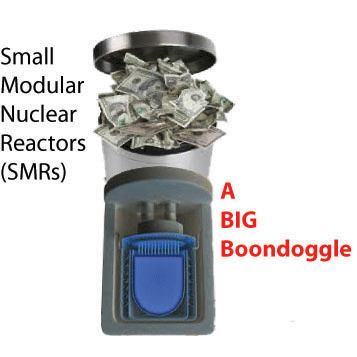
As SMR developer X-energy moves to go public, merger partner Ares cautions investors about risks
Utility Dive Stephen Singer, Editor, Jan. 27, 2023
Dive Brief:
- The partner in a merger with a small modular nuclear reactor developer going public has cautioned investors that changing markets and a “limited operating history” may ultimately be unfavorable to the business.
Ares Acquisition Corp., a special purpose acquisition company, warned in an S-4 filing with the U.S. Securities and Exchange Commission Wednesday of “limited operating experience for reactors of this type, configuration and scale” that could lead to higher than expected construction costs, maintenance requirements, operating expenses or changes in the timing of delivery. X Energy Reactor Co. announced the merger in December.- The market for SMRs generating electric power and high-temperature heat is not yet established and “may not achieve the growth potential we expect or may grow more slowly than expected,” Ares said. It’s backed by private equity firm Ares Management Corp.
Dive Insight:
The S-4 filing, which provides a preliminary proxy statement and spells out details of the renamed X-Energy business and market risks, provides boilerplate cautions to investors who require transparency and discussion of as many potential risks as possible. It highlights challenges in a still-emerging industry. The U.S. Nuclear Regulatory Commission on Jan. 19 certified NuScale Power’s SMR design, the first of its type to win federal approval………………………………
Ares said the market for SMRs, and particularly for SMRs using advanced nuclear technologies such as those employed in the Xe-100 — an 80 MWe reactor that can be scaled into a ‘four-pack’ 320 MWe power plant — has not yet been established. SMRs using advanced nuclear technologies have not been proven at scale, it said……………………..
Ares also warned that it may not attract customers for its SMR technology — a “relatively new and unproven technology” — as quickly as it expects, “or at all,” and acquiring customers may be more expensive than it currently anticipates.
In addition, Ares said the time and funding needed to bring X-energy’s nuclear fuel, TRISO-X, to market at scale may “greatly exceed” expectations………………….
Critics of SMRs have raised issues nearly identical to what Ares cited, calling out the reactors over the projected cost and time needed for siting and other approvals.
“Small modular reactors may be viable one day, but they are not today, will not be tomorrow and may never make as much economic sense as renewable sources of electricity,” the Institute for Energy Economics and Financial Analysis says. “We should stick to carbon-free energy sources that make financial and environmental sense.”………. more https://www.utilitydive.com/news/ares-acquisition-x-energy-smr-sec-investor-warning/641337/
Can Talks with China about Nuclear Weapons Be Constructive?
January 26, 2023 Gregory Kulacki https://blog.ucsusa.org/gregory-kulacki/can-talks-with-china-about-nuclear-weapons-be-constructive/
Politico reported US Secretary of State Antony Blinken is “under pressure” to “raise administration concerns” about the size of China’s nuclear arsenal when he travels to Beijing in early February.
Constructive conversations on nuclear weapons policy are urgently needed. Both governments are upgrading their nuclear capabilities. Chinese military planners worry about US preparations to use nuclear weapons first to forestall defeat in a conventional war, as well as US efforts to undermine China’s ability to retaliate. US military planners are concerned about the construction of new Chinese missile silos, which will significantly increase the probability and magnitude of Chinese nuclear retaliation if the United States uses nuclear weapons first.
The nuclear aspect of what some US observers describe as a new Cold War with China is different than the US nuclear contest with the Soviet Union. It’s not about numbers. Chinese leaders don’t express interest in numerical parity. President Biden’s remarks on China’s nuclear weapons policy suggest he thinks they do. That’s unfortunate. If a desired outcome of Blinken’s visit is to start a dialogue on nuclear weapons, he will need to focus less on the numbers and more on why Chinese leaders built the silos.
What Chinese leaders want – what they have wanted since they decided to develop nuclear weapons in 1955 – is to be able to use conventional military force without undue concern the United States will use nuclear weapons to stop them. Being able to credibly threaten to use nuclear weapons to prevent or defeat Chinese conventional military initiatives has been a cornerstone of US defense policy in East Asia since the Korean War.
Chinese efforts to negate US first use threats are an important part of Chinese nuclear strategy. Chinese leaders believe if they can convince US decision-makers they will retaliate, then they can safely ignore US threats to use nuclear weapons first.
Chinese military planners have always been concerned their comparatively small nuclear force could tempt US decision makers to try to wipe it out at the beginning of a war. Continued US investment in ballistic missile defense creates additional doubt about US respect for China’s ability to retaliate.
The bulk of China’s current nuclear force consists of missiles launched from trucks. Recent technological advances increase the possibility the United States could destroy or disable those missiles with conventional munitions. Switching to silos makes that far less likely.
Current US projections of a large increase in the size of China’s nuclear force assume the new silos are an addition, not a replacement. They also assume everyone of those silos will contain a new missile and every one of those missiles will carry multiple warheads. But China does not need that many warheads to achieve its strategic objective. Even if the silos sit empty, US military planners must assume they’re not, and US decision-makers must assume China can retaliate if the United States uses nuclear weapons first.
If Secretary Blinken’s only objective is to talk about numbers, his Chinese interlocutor can tell China’s leaders their decision to build the silos was a strategic success. It is hard to see how that makes the United States or its Asian allies safer.
It would be wiser if Blinken said the United States no longer needs to threaten to use nuclear weapons first to keep the peace. Instead of handing Chinese leaders a strategic victory, he would convey a surprising US confidence in its conventional forces. That’s more likely to restrain Chinese leaders than what they continue to see as empty US threats to start a nuclear war; threats revolutionary leader Mao Zedong famously described as a “paper tiger.”
As paradoxical as it may seem to a US strategic culture obsessed with size, forgoing the option to use nuclear weapons first may be the best way to get Chinese leaders to respect the ability of the United States to defend its allies, and to begin a constructive conversation about nuclear weapons.
Kramatorsk radiological accident

The Kramatorsk radiological accident was a radiation accident that happened in Kramatorsk, in the Ukrainian SSR from 1980 to 1989. A small capsule containing highly radioactive caesium-137 was found inside the concrete wall of an apartment building, with a surface gamma radiation exposure dose rate of 1800 R/year.[1] The capsule was detected only after residents requested that the level of radiation in the apartment be measured by a health physicist.[1]
The capsule was originally part of a radiation level gauge and was lost in the Karansky quarry in the late 1970s. The search for the capsule was unsuccessful and ended after a week. The gravel from the quarry was used in construction.[2] The caesium capsule ended up in the concrete panel of apartment 85 of building 7 on Mariyi Pryimachenk Street (at the time under the Soviet name Gvardeytsiv Kantemirovtsiv), between apartments 85 and 52.[1]
Over nine years, two families lived in apartment 85.[1] A child’s bed was located directly next to the wall containing the capsule.[1] The apartment was fully settled in 1980. A year later, an 18-year-old woman who lived there suddenly died. In 1982, her 16-year-old brother followed, and then their mother. Even after that the flat did not attract much public attention, despite the fact that the residents all died from leukemia. Doctors were unable to determine root-cause of illness and explained the diagnosis by poor heredity. A new family moved into the apartment, and their son died from leukemia as well. His father managed to start a detailed investigation, during which the vial was found in the wall in 1989.
By the time the capsule was discovered, four residents of the building had died from it and 17 more had received varying doses of radiation.[2] Part of the wall was removed and sent to the Institute for Nuclear Research, where the caesium capsule was removed, identified by serial number and disposed of.[1]
Urgent public health warning issued over lost radioactive capsule in Western Australia

“It emits both beta rays and gamma rays so if you have it close to you, you could either end up with skin damage including skin burns,” .
“And if you have it long enough near you, it could cause acute radiation sickness.
DFES have issued a warning for people to stay at least five metres away from it if they see something that resembles the capsule.
https://www.abc.net.au/news/2023-01-27/radioactive-capsule-lost-in-wa-emergency-public-health-warning/101901472 By Cason Ho 28 Jan 23
A missing radioactive capsule lost somewhere between Perth and a Pilbara mine site over an area of 1,400 kilometres has sparked an urgent health warning.
Key points:
- A capsule containing a radioactive substance has been lost
- The capsule is 6mm in diameter and 8mm wide
- People are being urged not to get close to the capsule
In an emergency press conference on Friday afternoon, WA’s chief health officer urged people to stay away from the capsule if they see it because of its radioactive properties.
The capsule is tiny – 6mm diameter by 8mm high.
The radioactive gauges are commonly used in mining. It went missing from a truck sometime after January 10.
WA radioactive substance risk alert
The radioactive capsule could be anywhere along the more than 1,400 km journey between Malaga, in Perth and Newman in WA’s remote north
Any motorists who have travelled along the Great Northern Highway between Newman and Perth since January 10 should check their tyres, in case the capsule has become lodged in them.
Chief Health Officer Andy Robertson said the capsule was lost while it was being transported, somewhere between a mine site north of Newman and Malaga, north east of Perth.
It is believed the capsule fell through the gap left by a bolt hole, after the bolt was dislodged when a container collapsed as a result of vibrations during the trip.
Authorities are searching Great Northern Highway in a desperate effort to find the capsule, which is smaller than a 10-cent piece.
DFES said the capsule “cannot be weaponised” but are still urging caution due to potentially serious health consequences.
Radiation equivalent to 10 X-rays an hour
Mr Robertson said it does emit a “reasonable” amount of radiation.
He says the radiation emitted is equivalent to receiving 10 X-rays in one hour, if you were within one metre of it, or the amount of natural radiation a body is exposed to over a year.
The half-life of the substance is 30 years.
“It emits both beta rays and gamma rays so if you have it close to you, you could either end up with skin damage including skin burns,” he said.
“And if you have it long enough near you, it could cause acute radiation sickness.
“Now that will take a period of time but obviously we are recommending people not be close to it or hang on to it.”
Mr Robertson advised anyone who finds the capsule not to go near it, and to rather call DFES on 133 337.
The Department of Fire and Emergency Services is leading search efforts, coordinating a team involving the Department of Health, WA Police, and other subject matter experts.
DFES Country North chief superintendent David Gill said there would be “challenges” in locating such a small object.
“The start and finish of the transportation from the mine site north of Newman, and the transport depot in Perth, are among some of the locations that are searched, and being searched yesterday, but the capsule remains unfound,” he said.
“There are challenges here. It is 1,400 kilometres between the mine site … to the north of Newman, and Perth.”
DFES have issued a warning for people to stay at least five metres away from it if they see something that resembles the capsule.
People are urged to avoid coming into contact with it, and immediately contact DFES.
Appeals Court Tosses Suit from Environmentalists, Midland Oil Company Contesting Nuclear Waste Storage Permit
Various suits against the NRC and the storage site linger in courts across the country.
The Texan BRAD JOHNSON 27 Jan 23
The D.C. Circuit Court of Appeals tossed a challenge from anti-nuclear organization Beyond Nuclear, environmental groups the Sierra Club and Don’t Waste Michigan, and a Midland-based oil company against the approval of a spent nuclear fuel interim storage permit for a facility in West Texas.
In September 2021, the Nuclear Regulatory Commission (NRC) approved a permit application for the storage of spent nuclear fuel at an Andrews County facility. Interim Storage Partners is jointly owned by Orano USA and Waste Control Specialists — the latter of which has operated a storage facility for low-level radioactive waste at the site for more than a decade.
During the second special session of 2021, Gov. Greg Abbott and the Texas Legislature abruptly passed legislation banning the storage of high-level radioactive waste, including spent nuclear fuel, in response to the NRC. That led to the state suing the NRC over the permit, a case still pending in court.
But the permit approval also sparked other lawsuits from a collection of activists, interest groups, and Fasken Oil & Ranch, the Midland company, consolidated into one proceeding.
On Wednesday, the court dismissed the group’s various claims and tossed the suit; Beyond Nuclear contended that the NRC acted “arbitrarily and capriciously,” the environmental groups alleged the agency “ignor[ed] deficiencies in the project’s environmental impact statement,” and Fasken asserted that it was wrongfully denied the ability to insert into the record its arguments against issuance of the permit by the NRC.
Kevin Kamps, a spokesman for Beyond Nuclear, told The Texan, “We are certainly disappointed and unfortunately the ruling focuses on a procedural technicality.” Kamps said that there is a similar permit and suit in development in New Mexico for a planned interim storage site there. He’s also optimistic that a ruling in the State of Texas’ suit will help their case here, potentially creating contradicting court decisions.
He added that “we’re not going anywhere” and hopes that courts will consider whether the NRC even has the authority from Congress to grant these permits — which he argues the agency doesn’t…………………. more https://thetexan.news/appeals-court-tosses-suit-from-environmentalists-midland-oil-company-contesting-nuclear-waste-storage-permit/
France promises to speed up handover of colonial archives and clean up nuclear test sites in Algeria
https://www.middleeastmonitor.com/20230126-france-promises-to-speed-up-handover-of-colonial-archives-and-clean-up-nuclear-test-sites-in-algeria/ January 26, 2023
France has promised to speed up the handover of its colonial archives to Algeria, and to clean up the sites where it conducted nuclear tests in the Sahara Desert in the 1960s, the ministry of foreign affairs in Algiers has announced.
The announcement was made at the end of a meeting on Wednesday of the 9th session of the Algeria-France political consultations in the Algerian capital. The meeting was chaired by the Secretaries General of the Algerian and French Ministries of Foreign Affairs, Amar Belani and Anne-Marie Descotes, with the participation of representatives from several sectors in each country.
The consultations were in preparation for the upcoming visit of Algerian President Abdelmadjid Tebboune to Paris in May, at the invitation of his French counterpart, Emmanuel Macron.
There was no immediate French comment on the Algerian announcement.
According to Algerian officials, France still holds 98 per cent of their country’s archives, which date back to the colonial era which lasted from 1830 to 1962, and inevitably go back to the Ottoman era that preceded it.
Between 1960 and 1966, the French colonial authorities conducted a series of nuclear explosions in the Algerian Sahara, four of which were in the atmosphere and thirteen were underground, according to French officials. Algerian historians and officials insist that the number is greater and that the effects still threaten the health of the regional population and the safety of the environment.
At the end of December, Tebboune called on France to clean up its nuclear waste at the test sites in Tamanrasset and Reggane, and to take care of the victims of the tests in the area.
Japan’s Plan To Discharge Water From Fukushima Nuclear Plant Faces Pacific Opposition
By BenarNews, By Stephen Wright
Officials from Pacific island nations will meet Japan’s prime minister in March in an effort to halt the planned release of water from the tsunami-damaged Fukushima Daiichi nuclear plant into the Pacific Ocean, a regional leader said.
Plans to dispose of Fukushima water over four decades are a source of tension between Japan and Pacific island nations and a possible complication for the efforts of the United States and its allies to show a renewed commitment to the Pacific region as China’s influence grows.
The planned discharges “are a very serious issue that our leaders have accepted must be stopped at all costs,” Henry Puna, secretary-general of the 18-nation Pacific Islands Forum, said Thursday at a press conference in the Solomon Islands capital Honiara.
The Japanese government’s timetable for disposal of Fukushima water indicates that releases could begin as soon as April this year – part of an effort to decommission the stricken power station over several decades. Water contaminated by the nuclear reactors damaged in a 2011 tsunami is stored in dozens of large tanks at the coastal Fukushima plant.
Japan’s method involves putting the contaminated water through a purification process known as the Advanced Liquid Processing System, which it says will reduce all radioactive elements except tritium to below regulatory levels. The treated water would then be diluted by more than 100 times to reduce the level of tritium – radioactive hydrogen used to create glow-in-the-dark lighting and signs……………………………
Data doubts
Five scientists working with the Pacific Islands Forum last week criticized the quality of data they had received from Tokyo Electric on the treated water in the tanks and expressed doubts about how well the purification process works.
Over more than four years, only a quarter of tanks had been tested for radiation, and testing rarely covered more than nine types of radiation out of 64 types that should be tested for, said the five scientists, who include Woods Hole Oceanographic Institution’s senior scientist Ken Buesseler.
“The accident is not over; this is not normal operations for a reactor. Therefore, extraordinary efforts should be made to prove operations are safe and will not cause harm to the environment,” the scientists’ presentation said.
The Pacific Islands Forum has described the scientists as independent nuclear experts. The forum’s secretariat didn’t respond to a question about whether the scientists are compensated for their work with the forum.
Nigel Marks, a materials scientist at Australia’s Curtin University and former nuclear reactor engineer, who is not advising the forum, said he is sympathetic to concerns that Tokyo Electric’s data could be more complete.
“But at the same time some recognition for Japan’s unique situation must be acknowledged,” he said. “The authorities have done their very best that technology allows. Eventually they reach a point where there is too much water to store.”
Puna said the Pacific islands delegation would meet with Japanese Prime Minister Fumio Kishida around March 7. They want a delay in water releases, at the very least, while more research is carried out, he said.
“There are serious gaps in the scientific evidence on the safety or otherwise of the proposed release,” Puna said. “I am pleased that the Japanese prime minister has finally agreed to meet with a high-level delegation from our region.”
Decades of Fukushima water discharges, Puna said, could “damage our livelihoods, our fisheries livelihoods, our livelihood as people who are dependent very much and connected to the ocean in our culture and identity.”
Mihai Sora, a Pacific analyst at Australia’s Lowy Institute, said it’s hard to imagine a more alarming proposition for Pacific island nations given the “toxic legacy” of nuclear weapons testing and waste dumping in the Pacific.
The timing, amidst regional geopolitical competition that has traditional powers falling over themselves to demonstrate who’s a better partner to the Pacific, could scarcely be worse,” Sora said.
The United States, United Kingdom and France carried out more than 300 nuclear detonations in the Pacific from 1946 to 1966, according to the International Disarmament Institute at Pace University in New York, which exposed thousands of military personnel and civilians to radiation and made some atolls uninhabitable.
“Decades of hard-won regional goodwill towards Japanese Pacific engagement are at risk with this single policy initiative,” Sora said……………….
Japan’s embassy in Suva, Fiji didn’t respond to a request for comment. https://www.eurasiareview.com/28012023-japans-plan-to-discharge-water-from-fukushima-nuclear-plant-faces-pacific-opposition/
The WHO is urging countries to start stockpiling medicines for ‘nuclear emergencies’ after the EU’s latest warning on Ukraine war.
Fortune, BYORIANNA ROSA ROYLE, January 28, 2023
The World Health Organization (WHO) has issued guidance on how to survive a nuclear catastrophe, just hours after the EU warned that Russia “is at war with the West”.
Included in the guidance is a list of medicines that nations should stockpile for “radiological or nuclear emergencies”.
The global health body also shared how the stockpiles which could “prevent or reduce exposure to radiation” should be handled.
Dr Maria Neira, WHO’s acting assistant director-general warned that governments need to make treatments for radiation and nuclear exposure available quickly.
“It is essential that governments are prepared to protect the health of populations and respond immediately to emergencies,” she added.
Potential scenarios considered in the publication include radiological or nuclear emergencies at nuclear power plants, as well as intentional uses of radioactive materials with malicious intent.
These emergencies could result in exposure to deadly radiation doses, yet many countries are underprepared, according to the document.
It stressed: “It is therefore extremely important that governments respond rapidly to such threats.”……………….. https://fortune.com/2023/01/27/how-to-survive-nuclear-catastrophe-who-medicine-stockpile-warning/
Donald Trump warns of NUCLEAR WAR as Joe Biden sends 31 tanks to Ukraine

omigawd! It’s a weird world when we find Donald Trump saying something sensible!
Former president Donald Trump has hit out at Joe Biden’s decision to send 31 M1 Abrams tanks to Ukraine ahead of a fresh Russian attack as he admitted they could lead to a nuclear war
Mirror, By Liam BucklerNews Reporter, 27 Jan 2023
Donald Trump has warned of a nuclear war as President Biden prepares to send 31 battle tanks to Ukraine in the war against Russia.
Biden’s administration confirmed on Wednesday it would be sending 31 M1 Abrams tanks to Ukraine after President Volodymyr Zelensky’s demand for more heavy armour.
The US are also providing 500 armoured vehicles as part of the help to Ukraine in addition to the $26 billion already committed to Kyiv since Russia’s invasion nearly a year ago.
But in a post to Truth Social, the former president believes sending the thanks could lead to a possible nuclear war.
Donald Trump wrote on Thursday: “‘FIRST COME THE TANKS, THEN COME THE NUKES. Get this crazy war ended, NOW. So easy to do!”
President Zelensky made a visit to the US in December to personally plead for more tanks and weapons as he believed Ukraine were struggling to make inroads with their Soviet-era T-72 tanks.
It comes after Germany confirmed they would send 14 Leopard 2 tanks to Kyiv. Berlin’s decision to send 14 of the world’s most deadly tanks to Ukraine means other western countries can follow suit with their own Leopard 2s.
Germany had been trying to persuade the US to send tanks to Ukraine but top officials in Biden’s administration were wary of the move as they require extensive training.
However, Biden has since u-turned after he originally said last March: “‘The idea that we’re going to send in offensive equipment and have planes and tanks and trains going in with American pilots and American crews, just understand … that’s called World War III, okay?
“Let’s get it straight here, guys. We will not fight the third world war in Ukraine.”
His remarks were similar to Donald Trump who believes giving tanks to Ukraine will be followed by “nukes.”
However, Mr Biden told reporters the tanks will “enhance Ukraine’s capacity to defend its territory and achieve its strategic objectives.”
The tanks heading to Ukraine are set to “take time” as they are “extremely, extremely complex to operate and maintain.”…………….. https://www.mirror.co.uk/news/us-news/donald-trump-warns-nuclear-war-29063832
1 This Month
Chernobyl: The Lost Tapes – A good documentary on Chernobyl on SBS available On Demand for the next 3 weeks– https://www.sbs.com.au/ondemand/tv-program/chernobyl-the-lost-tapes/2352741955560

of the week–London Campaign for Nuclear Disarmament

Tell the Ukrainian Government to Drop Prosecution of Peace Activist Yurii Sheliazhenko
To see nuclear-related stories in greater depth and intensity – go to https://nuclearinformation.wordpress.com
-
Archives
- April 2026 (139)
- March 2026 (251)
- February 2026 (268)
- January 2026 (308)
- December 2025 (358)
- November 2025 (359)
- October 2025 (376)
- September 2025 (257)
- August 2025 (319)
- July 2025 (230)
- June 2025 (348)
- May 2025 (261)
-
Categories
- 1
- 1 NUCLEAR ISSUES
- business and costs
- climate change
- culture and arts
- ENERGY
- environment
- health
- history
- indigenous issues
- Legal
- marketing of nuclear
- media
- opposition to nuclear
- PERSONAL STORIES
- politics
- politics international
- Religion and ethics
- safety
- secrets,lies and civil liberties
- spinbuster
- technology
- Uranium
- wastes
- weapons and war
- Women
- 2 WORLD
- ACTION
- AFRICA
- Atrocities
- AUSTRALIA
- Christina's notes
- Christina's themes
- culture and arts
- Events
- Fuk 2022
- Fuk 2023
- Fukushima 2017
- Fukushima 2018
- fukushima 2019
- Fukushima 2020
- Fukushima 2021
- general
- global warming
- Humour (God we need it)
- Nuclear
- RARE EARTHS
- Reference
- resources – print
- Resources -audiovicual
- Weekly Newsletter
- World
- World Nuclear
- YouTube
-
RSS
Entries RSS
Comments RSS
 nuclear-news