Pacific Island Forum could sideline Japan over nuclear waste plan
Lydia Lewis, RNZ Pacific Journalist, lydia.lewis@rnz.co.nz 11 Jan 23,
Japan is at risk of losing its status as a Pacific Islands Forum Dialogue Partner over Tokyo’s nuclear waste dumping plan.
Japan is due to start dumping one million tonnes of nuclear waste from the damaged Fukushima Daiichi nuclear power plant into the Pacific Ocean in only a few months.
According to Japan’s government, the wastewater is to be treated by an Advanced Liquid Processing System, which will remove nuclides from the water.
It says the water to be discharged into the ocean is not contaminated.
Last year, the Pacific Islands Forum demanded Japan share pivotal information about the plan.
Secretary General Henry Puna said this month that, in order to keep its status, Japan needs to ramp up communication and transparency over the issue.
The message to Japan is, “hey look, has there been a change in your attitude to the Pacific?” he told RNZ Pacific.
“It’s a bit daunting, talking to a big sovereign country like Japan, and also a good, long-standing friend of the Pacific,” Puna said.
The “preferred course of action” is to engage in a “friendly manner” with Japan…………….
“In fact, we are very serious and we will take all options to get Japan to at least cooperate with us by releasing the information that our technical experts are asking of them.
“Because all we want is to be in a position where our experts can say, ‘okay, look, the release is harmless, you can go ahead’, or ‘there are some issues that we need further discussion and further scientific research with Japan’,” he said.
- Search
- Listen Live
live stream
live stream
live stream
- PlaylistYour playlist Launch player Close
2:24 pm today
Pacific Island Forum could sideline Japan over nuclear waste plan
2:24 pm today Share this
Lydia Lewis, RNZ Pacific Journalist
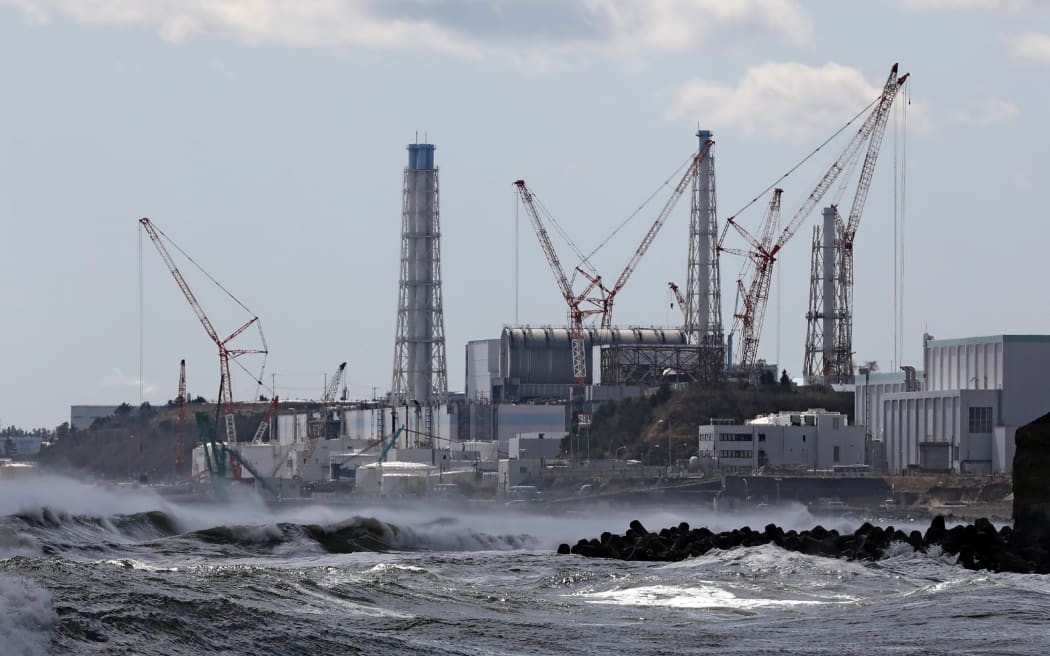
The Tokyo Electric Power Company’s Fukushima Daiichi nuclear power plant is seen from Futaba Town, Fukushima prefecture on March 11, 2020. Photo: STR / JIJI PRESS / AFP
Japan is at risk of losing its status as a Pacific Islands Forum Dialogue Partner over Tokyo’s nuclear waste dumping plan.
Japan is due to start dumping one million tonnes of nuclear waste from the damaged Fukushima Daiichi nuclear power plant into the Pacific Ocean in only a few months.
According to Japan’s government, the wastewater is to be treated by an Advanced Liquid Processing System, which will remove nuclides from the water.
It says the water to be discharged into the ocean is not contaminated.
Last year, the Pacific Islands Forum demanded Japan share pivotal information about the plan.
Secretary General Henry Puna said this month that, in order to keep its status, Japan needs to ramp up communication and transparency over the issue.
The message to Japan is, “hey look, has there been a change in your attitude to the Pacific?” he told RNZ Pacific.
“It’s a bit daunting, talking to a big sovereign country like Japan, and also a good, long-standing friend of the Pacific,” Puna said.
The “preferred course of action” is to engage in a “friendly manner” with Japan.
“We’re long-standing friends, and Japan is a very important partner for us in the Pacific,” he said.
“This issue strikes at the very heart of our being as Pacific people. We will not let it go.
“In fact, we are very serious and we will take all options to get Japan to at least cooperate with us by releasing the information that our technical experts are asking of them.
“Because all we want is to be in a position where our experts can say, ‘okay, look, the release is harmless, you can go ahead’, or ‘there are some issues that we need further discussion and further scientific research with Japan’,” he said.
Anger at lack of cooperation
“They’re breaking the commitment that their Prime Minister and our leaders have arrived at when we had our high level summit in 2021,” Puna said.
“It was agreed during that summit that we would have access to all independent scientific and verifiable scientific evidence before this discharge can take place.
“So far, unfortunately, Japan has not been cooperating,” Puna said.
His last conversation with Tokyo was just before Christmas with their ambassador in Suva.
“Japan has come back since then, to indicate that they are amenable to a meeting with our panel of experts in Tokyo sometime early next month.
“But it’s important for us to avoid the frustrations that have been happening to date.
“I have made it clear to Japan that we will not agree to such a meeting unless Japan gives us an undertaking now or before the meeting that they will provide all information that our experts will request of them and provide them in a timely manner because time is of the essence,” Puna said.
What is a ‘Forum Dialogue Partner’?
There are 21 partners, with Japan joining in 1989.
The purpose of the Forum Dialogue Partner mechanism (formally known as the Post Forum Dialogue mechanism), established by Forum Leaders in 1989, is to invite selected countries outside of the Pacific Islands region with significant cooperation and engagement and political or economic interests, to participate in a dialogue with Forum Leaders, according to the Forum website
Other partners include the United States, China, the UK, France, and the European Union…………………………………
Tokyo Electric Power Company has confirmed it will speak with RNZ Pacific on January 18.
US marine laboratories opposed to Japan’s plan.
The US National Association of Marine Laboratories, an organisation of more than 100 member laboratories, expressed its opposition in a new paper.
They say there is a lack of adequate and accurate scientific data supporting Japan’s assertion of safety, and an abundance of data demonstrating serious concerns about releasing radioactively contaminated water.
They called on the Government of Japan and International Atomic Energy Agency scientists to more fully and adequately consider the options recommended by the Pacific Islands Forum’s Expert Panel. https://www.rnz.co.nz/international/pacific-news/482298/pacific-island-forum-could-sideline-japan-over-nuclear-waste-plan
Georgia’s Vogtle nuclear plant startup delayed due to vibrating pipe
Vogtle is the only nuclear plant under construction in the United States. Its costs and delays could deter other utilities from building such plants
Midland Daily News, JEFF AMY, Associated Press, Jan. 11, 2023
ATLANTA (AP) — Startup of a nuclear power plant in Georgia will be delayed since its operator found a vibrating pipe in the cooling system during testing.
Georgia Power Co., the lead owner of Plant Vogtle near Waynesboro, announced the delay Wednesday. The company said that the third reactor at the plant is scheduled to begin generating electricity for the grid in April. The unit of Atlanta-based Southern Co. had previously given a startup deadline of March.
The problem was found during startup testing in a pipe that is part of the reactor’s automatic depressurization system, said Georgia Power spokesperson Jacob Hawkins. He said the pipe needs to be braced with additional support. “
Southern Nuclear Operating Co., which will operate the reactor on behalf of Georgia Power and other owners, must get approval for a license modification from the U.S. Nuclear Regulatory Commission, the company said in an investor filing. “It’s not a safety issue,” he said.
The plant includes two operating nuclear reactors and the first two nuclear reactors being built from scratch in the United States in decades. The fourth reactor is still under construction and is supposed to start generating electricity sometime in 2024.
The delay will cost Georgia Power and other co-owners at least $30 million.
A third and a fourth reactor were approved for construction at Vogtle by the Georgia Public Service Commission in 2012, and the third reactor was supposed to start generating power in 2016. The cost of the third and fourth reactors has climbed from an original cost of $14 billion to more than $30 billion…………
Georgia Power customers are already paying part of the financing cost and state regulators have approved a monthly rate increase as soon as the third reactor begins generating power. But the Georgia Public Service Commission will decide later who pays for the remainder of the costs.
Vogtle is the only nuclear plant under construction in the United States. Its costs and delays could deter other utilities from building such plants….https://www.ourmidland.com/news/article/Georgia-nuclear-plant-startup-delayed-due-to-17711807.php
China’s role in UK nuclear sector poses challenges for net zero push, say think tanks
City AM, NICHOLAS EARL 11 Jan 23,
China’s continued foothold in the UK’s nuclear energy sector poses headaches for the UK government as it looks to attract overseas investment to meet its ambitious green energy goals, several think tanks have warned.
Sophia Gaston, head of foreign policy and UK resilience at Policy Exchange told City A.M. the so-called golden era of Chinese investment in critical infrastructure is “well and truly over.”
This was reflected, she said, in the government’s decision late last year to buy out state-backed China General Nuclear Power Group’s (CGN) 20 per cent stake in Sizewell C.
The policy expert now called on the government to remove Chinese investments from both Hinkley Point C – where CGN still has a one-third stake – and for a potential new power plant at the defunct Bradwell B site, which is two-thirds owned by CGN.
“Securing alternative investors for the Hinkley and Bradwell nuclear sites must be seen as critical priorities for the government and a key opportunity for British diplomacy,” she said…………………………………………………..
Concerns over the role of China in the UK’s energy sector intensified this week, after senior MPs on leading Westminster bodies called on the Government to reduce China’s influence in the North Sea.
CGN and the government were approached for comment. https://www.cityam.com/chinas-role-in-uk-nuclear-sector-poses-challenges-for-net-zero-push-say-think-tanks/
Sweden makes regulatory push to allow new nuclear reactors
WHBL, By Syndicated Content, By Niklas Pollard and Anna Ringstrom, 11 Jan 23,
STOCKHOLM (Reuters) -Sweden is preparing legislation to allow the construction of more nuclear power stations to boost electricity production in the Nordic country and bolster energy security, Prime Minister Ulf Kristersson said on Wednesday.
Kristersson has made expanding nuclear power generation a key goal for his right-wing government, seeking to reverse a process of gradual closures of several reactors in the past couple of decades………………
The proposed new legislation, which still needs to be passed by parliament, would allow new reactors to be constructed at additional locations across Sweden and was seen being in place in March next year…………..
The new legislation would scrap existing rules that caps the total number of reactors at ten and prohibits reactor construction in other locations than where they currently exist, opening the door to building smaller reactors that many see as the most cost-effective nuclear option.
Any expansion of nuclear power in Sweden could take many years given the complexity of such projects while energy demand is expected to rise sharply in coming years…………. https://whbl.com/2023/01/11/sweden-makes-regulatory-push-to-allow-new-nuclear-reactors/
NATO member sending banned cluster bombs to Ukraine – media
https://www.rt.com/news/569679-ukraine-t%C3%BCrkiye-cluster-munitions/ 11 Jan 23, Türkiye has been supplying Kiev with weapons that are banned in many countries, sources told Foreign Policy magazine
Ukraine has been receiving consignments of controversial cluster munitions from Türkiye, Foreign Policy magazine has reported. Kiev had been asking Washington for the Cold-War-era weapons for months.
The shipments have been taking place since November, current and former US and European officials told the outlet. It was unclear how many of the munitions had been received, or whether they had yet been used on the battlefield.
The weapons in question are called dual-purpose improved conventional munitions, or DPICMs. They were designed during the Cold War era, when NATO was planning to deploy them against a large-scale Soviet invasion of Europe. The rounds are filled with dozens of submunitions, intended to strike personnel and light-armored targets, scattering over a large area for increased lethality.
Like many other cluster munitions, DPICMs tend to produce long-lasting hazards, as some submunitions can fail to detonate and have the potential to maim or kill somebody years after being deployed.
US law prohibits the exportation of any cluster weapons with a failure rate over a certain threshold. The same regulations require guarantees that cluster munitions will not be used in areas where civilians may be present. Washington has repeatedly rejected requests from Kiev for the supply of DPICMs.
Most European NATO members are signatories of the 2008 Convention on Cluster Munitions (CCM), which bans this type of weapons. Türkiye is not one of them, but has observer status in the Geneva-based organization that oversees the implementation of the treaty. It has indicated that it abides by the rules, though it’s not obliged to.
According to Foreign Policy, the weapons supplied to Ukraine were manufactured during the Cold War under a co-production agreement with the US. Turkish companies made 155mm and 122mm cluster artillery rounds, the magazine claimed.
Neither Russia nor Ukraine are parties to the CCM, and both have reportedly used their Soviet-made cluster munitions in their armed conflict. In March, a Tochka-U missile with a cluster payload killed more than 20 people and injured dozens more in the city of Donetsk. Moscow blamed Kiev for the attack, but this was denied. International watchdog Human Rights Watch (HRW) later stated that it could not investigate the incident.
“Ukraine already has a massive problem on its hands, and it’s only magnifying it by introducing this weapon,” Mark Hiznay, a senior researcher in the Arms Division for HRW, told Foreign Policy, commenting on Kiev’s effort to get more cluster weapons.
1 This Month


Tell the Ukrainian Government to Drop Prosecution of Peace Activist Yurii Sheliazhenko

Petition to revoke the licensing of the Near Surface Nuclear Disposal Facility (NSDF) at Chalk River. https://www.ourcommons.ca/petitions/en/Petition/Details?Petition=e-7247


of the week – STOP SMALL MODULAR REACTORS IN CANADA
To see nuclear-related stories in greater depth and intensity – go to https://nuclearinformation.wordpress.com
-
Archives
- March 2026 (204)
- February 2026 (268)
- January 2026 (308)
- December 2025 (358)
- November 2025 (359)
- October 2025 (376)
- September 2025 (258)
- August 2025 (319)
- July 2025 (230)
- June 2025 (348)
- May 2025 (261)
- April 2025 (305)
-
Categories
- 1
- 1 NUCLEAR ISSUES
- business and costs
- climate change
- culture and arts
- ENERGY
- environment
- health
- history
- indigenous issues
- Legal
- marketing of nuclear
- media
- opposition to nuclear
- PERSONAL STORIES
- politics
- politics international
- Religion and ethics
- safety
- secrets,lies and civil liberties
- spinbuster
- technology
- Uranium
- wastes
- weapons and war
- Women
- 2 WORLD
- ACTION
- AFRICA
- Atrocities
- AUSTRALIA
- Christina's notes
- Christina's themes
- culture and arts
- Events
- Fuk 2022
- Fuk 2023
- Fukushima 2017
- Fukushima 2018
- fukushima 2019
- Fukushima 2020
- Fukushima 2021
- general
- global warming
- Humour (God we need it)
- Nuclear
- RARE EARTHS
- Reference
- resources – print
- Resources -audiovicual
- Weekly Newsletter
- World
- World Nuclear
- YouTube
-
RSS
Entries RSS
Comments RSS
 nuclear-news