Adam Tooze: Why Nuclear Fusion Is Not the Holy Grail

Of course, the amount of energy necessary to generate the laser beam is multiples larger—in the case of this laser beam, somewhere between 150 times larger than the amount that actually reaches the fuel materials. So this is still a powerfully net negative reaction that we have going on here; it uses more energy than it produces
It’s directly related to the military industrial complex, and so the synergies are there. It’s also very expensive; it requires a lot of capital investment, so the engineering companies like getting in on this.
A recent breakthrough is good news, but renewables are still the better bet.
FP.com By Cameron Abadi, a deputy editor at Foreign Policy. 9 Jan 23
Last month in California, a nuclear reactor produced 3.15 megajoules of energy using only 2.05 megajoules of energy input. That surplus has been treated as a major breakthrough in the future of energy because it was produced through the process of nuclear fusion. Experts have talked for decades about nuclear fusion’s potential as a carbon neutral source of energy without any of nuclear energy’s toxic waste.
What were the economics behind this breakthrough technology? Might it provide a status boost to old-fashioned engineering relative to computer engineering? And what’s the path from laboratory success to industrial use? Those are a few of the questions that came up in my recent conversation with FP economics columnist Adam Tooze on the podcast we co-host, Ones and Tooze. What follows is an excerpt, edited for length and clarity.
For the full conversation, look for Ones and Tooze wherever you get your podcasts.
………………… Adam Tooze: It’s a project that goes back originally to some really far-out thinking in the 1950s about uses that could be made of atomic bombs for the purposes of power generation. And the original idea was literally to organize a continuous stream of atomic explosions underground—you know, find some suitably stable caves, and explode several atomic bombs a day to keep a huge mass of water boiling to generate lots of steam. Anyway, that’s where it started.
But out of all of this, from the late 1960s onward, came more serious programs in fusion energy, which essentially focused on lasers. And that’s what this National Ignition Facility is—it is the ultimate fire lighter, right? Basically it’s a gigantic torch or something—the sort of effect that you generate as a Boy Scout or a Cub Scout or whatever, when you start a fire by concentrating the heat of the sun using a magnifying glass. So that’s essentially what we’re doing. And the stunning success of the current round of experiments announced by the U.S. Department of Energy to the public a few weeks ago now is that now for the first time ever, the amount of energy generated by the fusion reaction is larger than the amount of energy fired at it by the laser.
Of course, the amount of energy necessary to generate the laser beam is multiples larger—in the case of this laser beam, somewhere between 150 times larger than the amount that actually reaches the fuel materials. So this is still a powerfully net negative reaction that we have going on here; it uses more energy than it produces……….
CA: How long are we still from having fusion as a workable source of energy? What is the path generally from basic research to industrial use?
AT: I think the only honest answer to this in general is that we do not know the answer to this. You know, there was somebody talking to the New York Times and it really took me aback because this expert assumed that the answer was half a century away. …. it could easily be many decades.
……….. AT: I think, fundamentally- it’s gee whiz, final frontier, extraordinary stuff. And the physics involved are mind-blowing; the engineering is crazy and so much more exciting than just a solar panel sitting beat up in a field somewhere or on a roof or a windmill slowly turning.
It’s directly related to the military industrial complex, and so the synergies are there. It’s also very expensive; it requires a lot of capital investment, so the engineering companies like getting in on this. You know, as much as this National Ignition Facility is a public project, the $3.5 billion were mainly not spent on scientists. It was mainly spent on extremely complex raw materials and labor necessary to build the facilities, and much of that goes to the private sector. So there was a huge private sector stake in these kinds of projects.
But having said all of that, our experience both at the level of economics and at the level of politics with this particular set of technologies—those to do with nuclear power, fission, and fusion—over the last 50 years has been sobering. And on the whole, they appear at this point to be both massively unpopular technologies and, in some cases, hugely politicized technologies as well as incredibly expensive in terms of capital costs—not in terms of operating them but in terms of capital cost to build them.
…………… it’s pretty difficult to see what the case is for investing in new capacity when the costs are as explosively uneconomic.
So that is why I find it difficult to make the case for either conventional atomic power or fusion power as an immediately practical or relevant answer to the issues facing Western countries in the chase for a solution to the problem of the energy transition and decarbonization. And we are lucky, extraordinarily lucky, that renewable technologies have come on as quickly as they have. We should double down on this. We should invest even more.
CA: Can this kind of breakthrough serve to raise the status of materials engineering relative to computer engineering or even financial engineering? Is the old-fashioned kind of engineering in need of that kind of status boost in our society?
AT ………..I actually looked at the data for the National Science Foundation, and it turns out that among Ph.D.s of all types, it’s the humanities and the social sciences that we need to worry about because the share of doctorates in engineering—and this is distinct from computer science—is in fact on the rise and has been very dramatically over the last 20 years…. https://foreignpolicy.com/2023/01/08/adam-tooze-why-nuclear-fusion-is-not-the-holy-grail/
The C-17A Has Been Cleared To Transport B61-12 Nuclear Bomb To Europe
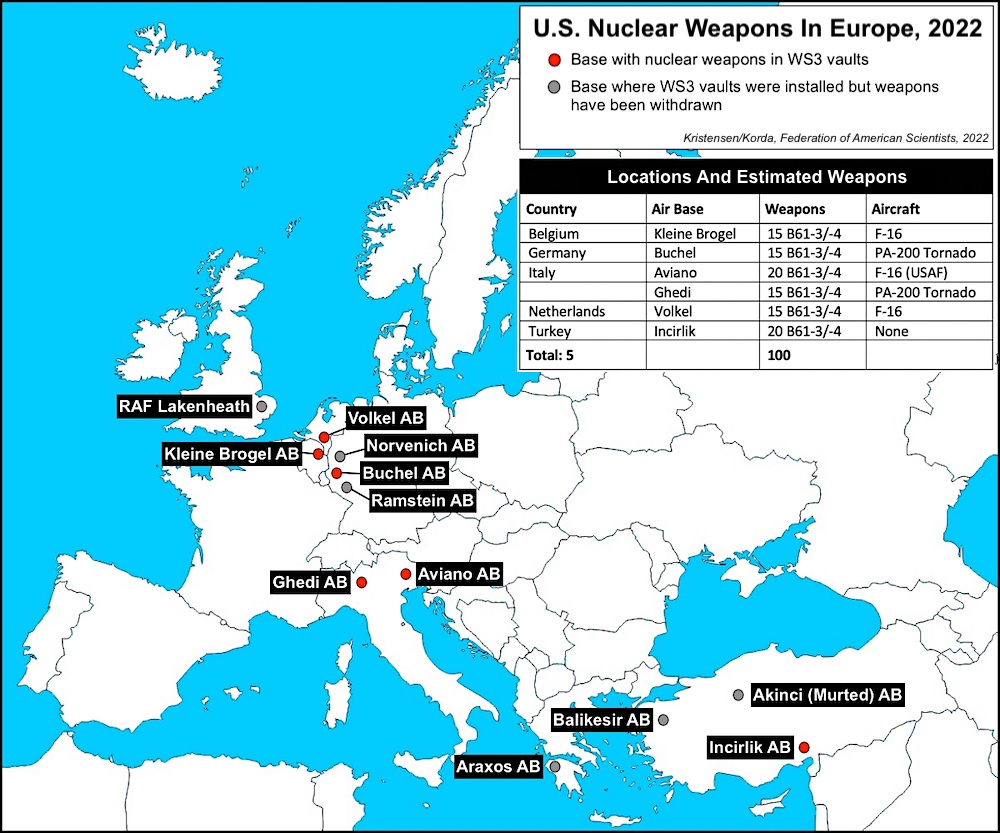
By Hans Kristensen • January 9, 2023 https://fas.org/blogs/security/2023/01/c17-cleared-to-transport-b61-12/
In November 2022, the Air Force updated its safety rules for airlift of nuclear weapons to allow the C-17A Globemaster III aircraft to transport the new B61-12 nuclear bomb.
The update, accompanied by training and certification of the aircraft and crews, cleared the C-17A to transport the newest U.S. nuclear weapon to bases in the United States and Europe.
The C-17As of the 62nd Airlift Wing at Joint Base Lewis-McChord serve as the Prime Nuclear Airlift Force (PNAF), the only airlift wing that is authorized to transport the Air Force’s nuclear warheads.
The updated Air Force instruction does not, as inaccurately suggested by some, confirm that shipping of the weapons began in December. But it documents some of the preparations needed to do so.
Politico reported in October last year that the US had accelerated deployment of the B61-12 from Spring 2023 to December 2022. Two unnamed US officials said the US told NATO about the schedule in October.
But a senior Pentagon official subsequently dismissed the Politico report, saying “nothing has changed on the timeline. There is no speeding up because of any Ukraine crisis, the B61-12 is on the same schedule it’s always been on.”
Although the DOD official denied there had been a change in the schedule, he did not deny that transport would begin in December.
The B61-12 production scheduled had slipped repeatedly. Initially, the plan was to begin full-scale production in early-2019. By September 2022, the National Nuclear Security Administration (NNSA) was still awaiting approval to begin full-scale production. Finally, in October 2022, NNSA confirmed to FAS that the B61-12 was in full-scale production.
The B61-12 is intended as an upgrade and eventual replacement for all current nuclear gravity bombs, including the B61-3, -4, -7, and probably eventually also the B61-11 and B83-1. To that end, it combines and improves upon various aspects of existing bombs: it uses a modified version of the B61-4 warhead with several lower- and medium-yield options (0.3-50 kilotons). It compensates for its smaller explosive yield (relative to the maximum yields of the B61-7 and -11) by including a guided tail-kit to increase accuracy, as well as a limited earth-penetration capability.
At this point in time, it is unknown if B61-12 shipments to Europe have begun. If not, it appears to be imminent. That said, deployment will probably not happen in one move but gradually spread to more and more bases depending on certification and construction at each base.
There are currently six active bases in five European countries with about 100 B61 bombs present in underground Weapons Storage and Security Systems (WS3) inside aircraft shelters. A seventh site in Germany (Ramstein Air Base) is active without weapons present and an eighth site – RAF Lakenheath – has recently been added to the list of WS3 sites being modernized. The revitalization of Lakenheath’s nuclear storage bunkers does not necessarily indicate that US nuclear weapons will return to UK soil, especially since as recently as December 2021, NATO’s Secretary General stated that “we have no plans of stationing any nuclear weapons in any other countries than we already have . . . ” However, the upgrade could be intended to increase NATO’s ability to redistribute the B61 bombs in times of heightened tensions, or to potentially move them out of Turkey in the future. In addition, four other sites have inactive (possibly mothballed) vaults (see map above).
This research was carried out with generous contributions from the John D. and Catherine T. MacArthur Foundation, the New-Land Foundation, the Ploughshares Fund, the Prospect Hill Foundation, the FTX Future Fund and Longview Philanthropy, the Stewart R. Mott Foundation, the Future of Life Institute, Open Philanthropy, and individual donors.
Pacific states entitled to claims against Japan for discharge of radioactive nuclear wastewater

As a contracting party to the United Nations Convention on the Law of the Sea, the Convention on Early Notification of a Nuclear Accident, and the Convention on Nuclear Safety, Japan has knowingly violated them all by making such a dangerous decision. Without exhausting all safe means of disposal, disclosing all information, or fully consulting with surrounding countries and international organizations, the Japanese government went ahead and unilaterally decided to dump its wastewater into the ocean in a flagrant attempt to pass on the disastrous consequences to other Pacific countries. Those countries have every right to defend their rights and interests through legal means.
Li Weichao http://eng.chinamil.com.cn/view/2023-01/06/content_10210311.htm
“We must remind Japan that if the radioactive nuclear wastewater is safe, just dump it in Tokyo, test it in Paris and store it in Washington, but keep our Pacific nuclear-free.” Vanuatu’s famous politician Motarilavoa Hilda Lini spoke for all people living in the Pacific region when making this statement.
The Japanese government announced in April 2021 that it will begin dumping the nuclear wastewater stored at Fukushima into the ocean from the spring of 2023. As that day is approaching, the international community is voicing waves of objection, and people living in the Pacific region have consistently expressed their strong protest. Analysts said if Japan did discharge the wastewater into the Pacific Ocean as planned, the Pacific countries would have the right to claim damages.
Japan decided to just dump the wastewater into the ocean in order to save trouble and money, at the price of transferring nuclear contamination to the whole world, which is extremely irresponsible and selfish. South Pacific countries have suffered enough from nuclear contamination. From 1946 to 1958, the US conducted 67 nuclear weapon tests on the Marshall Islands, the aftermaths of which are still haunting the local residents in the form of radioactive poisoning, contamination of marine species, and leak from radwaste landfill.
The Fukushima nuclear station had the highest-level nuclear accident that produced an enormous amount of nuclear wastewater – more than 1.3 million tons in storage right now. Even though Japanese politicians claimed that the wastewater is safe enough for drinking after being treated with the Advanced Liquid Processing System (ALPS), that’s simply not true.
A Japanese NGO recently released an article saying that treated nuclear wastewater still contains 64 kinds of radioactive substances, including tritium, which, once released into the ocean, will contaminate the marine environment and spread through the food chain, till eventually taking a toll on human health and the ecological environment. A report released by Greenpeace, an international environmental protection organization, showed that the technology currently adopted by Japan cannot get rid of the Sr90 and C14 in the wastewater, which are even more damaging than tritium with their half-life of 50 years and 5,730 years respectively.
It’s foreseeable that dumping Fukushima’s more than 1.3 million tons of nuclear wastewater into the ocean is a murderous move for people living along the ocean and will put the marine ecology at stake with irreversible outcomes. A renowned environmental protection organization of Pacific island countries said that such an irresponsible move of transboundary pollution is no different from waging a nuclear war against the people and the islands in the Pacific region.
As a contracting party to the United Nations Convention on the Law of the Sea, the Convention on Early Notification of a Nuclear Accident, and the Convention on Nuclear Safety, Japan has knowingly violated them all by making such a dangerous decision. Without exhausting all safe means of disposal, disclosing all information, or fully consulting with surrounding countries and international organizations, the Japanese government went ahead and unilaterally decided to dump its wastewater into the ocean in a flagrant attempt to pass on the disastrous consequences to other Pacific countries. Those countries have every right to defend their rights and interests through legal means.
In fact, there are already precedents for claims of this kind. For instance, the International Arbitration Tribunal ruled in 1938 and 1941 that Canada’s Trail Smelter should compensate America’s State of Washington for the damages caused by the SO2 it emitted. The “Trail Smelter case” is generally considered the basis for holding countries committing transboundary pollution accountable. Countries along the Pacific Ocean can totally refer to it and pursue claims against Japan after scientifically measuring the damages imposed upon them.
The ocean is the common wealth and symbiotic home for humanity. Dumping nuclear wastewater into it is not Japan’s internal affair. Right now the IAEA is still conducting a comprehensive evaluation of the wastewater at Fukushima, and Japan’s pushing for the dumping plan reveals its intention to make it a fait accompli regardless of the concerns of other parties. Japan’s egregious atrocities in history have already caused horrendous miseries to the surrounding countries. Does it plan to add another entry to its infamous track record now?
Editor’s note: Originally published on news.cri.cn, this article is translated from Chinese into English and edited by the China Military Online. The information and opinions in this article do not necessarily reflect the views of eng.chinamil.com.cn.
Going nuclear? MPSC to hire outside firm to study Michigan’s energy future (but will the firm have vested interests?)

by: Matt Jaworowski, Jan 9, 2023
GRAND RAPIDS, Mich. (WOOD) — The Michigan Public Service Commission is looking for a consulting firm to conduct a study on whether the state should consider allowing a new nuclear power plant.
The study is a requirement of Michigan’s appropriations bill passed last July, giving the MPSC $250,000 to find an outside team to run the study. The goal is to spell out the advantages and disadvantages of operating a nuclear energy plant in Michigan and its economic and environmental impact.
The bidding window will for consulting firms opens on March 3. The study must be submitted to the Legislature by April 2024………………………… more https://www.upmatters.com/news/michigan-news/going-nuclear-mpsc-to-hire-outside-firm-to-study-michigans-energy-future/
Philippines looking at Chinese investors for cooperation on nuclear energy
By JON VIKTOR D. CABUENAS, GMA Integrated News, January 9, 2023 The Philippines is banking on Chinese investors to participate in the planned venture into nuclear energy, along with cooperation in other areas such as renewable energy, the Department of Energy (DOE) said Monday…………………………………..
The briefing was made after a state visit by President Ferdinand “Bongbong” Marcos Jr. to Beijing, China last week, where Malacañang said he secured $13.76-billion worth of investments in the energy sector.
………………………………… Malacañang last week said the government is set to update its nuclear energy roadmap, with Marcos pushing for its adoption in a bid to lower power rates.
The President, along with his running mate Vice President Sara Duterte, have been pushing for the adoption of nuclear energy, which they said would lower electricity rates and help secure a steady power source.
His predecessor, former President Rodrigo Duterte, last March issued Executive Order 164, directing the conduct of relevant studies for the adoption of a National Position for a Nuclear Energy Program.
The DOE in November said, however, that the Philippines will have to wait a decade to see a working nuclear power plant given the time needed for feasibility studies and other factors.
“At this point we cannot say how fast they (Chinese commitments) will be implemented but the President has committed that he’s going to make sure that there will be a systematic handholding of investors,” Lotilla said…… https://www.gmanetwork.com/news/money/economy/856790/philippines-looking-at-chinese-investors-for-cooperation-on-nuclear-energy/story/
Djibouti signs Treaty on the Prohibition of Nuclear Weapons
https://www.icanw.org/djibouti_tpnw_signature 9 Jan 23,
Djibouti has become the first new signatory to the Treaty on the Prohibition of Nuclear Weapons (TPNW) in 2023. At the UN headquarters in New York on 9 January, the country’s ambassador to the United Nations, Mohamed Siad Doualeh, signed the landmark treaty, bringing the total number of signatories to 92. Djibouti will now commence its domestic ratification process in order to become a state party.
ICAN Executive Director, Beatrice Fihn, welcomed Djibouti’s decision: “The steady increase in adherence to the landmark nuclear ban treaty reflects the strong desire of the international community to strengthen the global norm against nuclear weapons and see more rapid progress on disarmament.”
To date, 33 African countries have signed the TPNW, of which 15 have also ratified it. The TPNW complements and reinforces the 1996 Treaty of Pelindaba, which established Africa as a nuclear-weapon-free zone. The states parties to the Treaty of Pelindaba have called upon all African Union member states “to speedily sign and ratify the [TPNW]”.
Support for the TPNW
Djibouti has historically been a strong supporter of the TPNW. In 2016, Djibouti voted in favour of the UN General Assembly resolution that established the mandate for states to begin negotiations on “a legally binding instrument to prohibit nuclear weapons, leading towards their total elimination,” participated in the negotiation of the TPNW in 2017 and was among 122 states that voted in favour of its adoption.
More recently, in a statement to the United Nations in October 2022, Djibouti announced that it would adhere to the TPNW as part of its “commitment to peace and disarmament”. It also encouraged other states that have not yet signed it to do so. In December 2022, Djibouti voted in favour of an annual UN General Assembly resolution calling on all states to sign, ratify, or accede to the TPNW “at the earliest possible date”.
1 This Month

10 March A LIVE WEBINAR THE REAL EFFECTS OF NUCLEAR POWER
What the Industry Isn’t Telling Us
1:00 PM Mountain, 2 pm Central, 3 pm Eastern. Live on the Keepers of the Water Facebook page


18 March Webinar @ 1 PM EST: An Assessment of SMR Projects: The Case of Canada
register for the zoom:
https://us02web.zoom.us/webinar/register/WN_o8BIIOUvQ2ONJR1nta65DQ#/registration


of the week – STOP SMALL MODULAR REACTORS IN CANADA
To see nuclear-related stories in greater depth and intensity – go to https://nuclearinformation.wordpress.com
-
Archives
- March 2026 (5)
- February 2026 (268)
- January 2026 (308)
- December 2025 (358)
- November 2025 (359)
- October 2025 (376)
- September 2025 (258)
- August 2025 (319)
- July 2025 (230)
- June 2025 (348)
- May 2025 (261)
- April 2025 (305)
-
Categories
- 1
- 1 NUCLEAR ISSUES
- business and costs
- climate change
- culture and arts
- ENERGY
- environment
- health
- history
- indigenous issues
- Legal
- marketing of nuclear
- media
- opposition to nuclear
- PERSONAL STORIES
- politics
- politics international
- Religion and ethics
- safety
- secrets,lies and civil liberties
- spinbuster
- technology
- Uranium
- wastes
- weapons and war
- Women
- 2 WORLD
- ACTION
- AFRICA
- Atrocities
- AUSTRALIA
- Christina's notes
- Christina's themes
- culture and arts
- Events
- Fuk 2022
- Fuk 2023
- Fukushima 2017
- Fukushima 2018
- fukushima 2019
- Fukushima 2020
- Fukushima 2021
- general
- global warming
- Humour (God we need it)
- Nuclear
- RARE EARTHS
- Reference
- resources – print
- Resources -audiovicual
- Weekly Newsletter
- World
- World Nuclear
- YouTube
-
RSS
Entries RSS
Comments RSS
 nuclear-news