European NATO members should reduce reliance on US – Macron
https://www.rt.com/news/568736-european-nato-reliance-macron/ 23 Dec 22, The countries should bolster their own defense to become less dependent on both the bloc and Washington, the French president says.
French President Emmanuel Macron has said European NATO members should become more autonomous and less dependent on the US-led alliance regarding their own security. He made the remarks late Wednesday, as he spoke to reporters in Paris after returning from a summit in Amman, Jordan.
“An alliance isn’t something I should depend on. It’s something that I should choose, something I work with,” Macron stated. “We must rethink our strategic autonomy.”
Macron identified “technology and defense capabilities” as areas in which European nations should seek to reduce their dependence on the alliance, and the US in particular. He added, however, that member states should not endeavor to break away from the bloc or develop an alternative to it.
“There is no European security architecture without strategic autonomy, inside NATO and with NATO, but not dependent on NATO,” he said.
Macron also touched upon the ongoing hostilities between Russia and Ukraine, in which the latter has received wide-ranging Western support. While reiterating his support for the “absolute defense of Ukraine,” he said once again that Moscow’s security concerns should be also addressed.
“When I speak of guarantees, I’m talking about all of these countries, for us, but also for Russia,” Macron stated. “This means that one of the essential points we must address – as President Putin has always said – is the fear that NATO comes right up to its doors, and the deployment of weapons that could threaten Russia.”
In recent weeks, the French president has repeatedly said that the conflict must eventually end with negotiations, which should yield security guarantees for everyone, including Russia. This stance triggered a barrage of criticism from Ukraine and some EU nations, with Poland, Slovakia, and the Baltic states openly opposing Macron’s suggestion.
Russia has signaled on several occasions that it is ready to talk with Ukraine – and the West as a whole – while insisting that its own interests must be taken into account if negotiations are to occur. Moscow has blamed the lack of diplomatic efforts to end the conflict on Kiev. On Wednesday, the head of Russia’s Federation Council, Valentina Matvienko, said there is “no background for negotiations to take place in the near future: There is nothing [to discuss] and with no one.”
Senior officials in Kiev have repeatedly issued belligerent statements, with Ukrainian President Vladimir Zelensky pledging to re-capture the former Ukrainian regions of Donetsk, Lugansk, Kherson, and Zaporozhye – which joined Russia in early October – as well as Crimea, which broke away from Kiev in 2014. Zelensky has even ‘banned’ himself from negotiating with Russian President Vladimir Putin.
Canada’s Federal environment minister rejects impact assessment for small modular nuclear reactor on the Bay of Fundy.
Coalition for Responsible Energy Development in New Brunswick (CRED-NB), December 23, 2022
SAINT JOHN, NEW BRUNSWICK – In a deeply disappointing decision for the environment and public oversight, Steven Guilbeault, federal Minister of Environment and Climate Change, has ruled against a full federal Impact Assessment (IA) for a small modular nuclear reactor (SMR) proposed by New Brunswick Power at Point Lepreau in New Brunswick.
This decision comes in response to a request submitted by the Coalition for Responsible Energy Development in New Brunswick (CRED-NB) on July 4, 2022, calling for an IA for this first-of-its-kind nuclear project in Canada. Letters of support for CRED-NB’s request were submitted by the Wolastoq Grand Council, and Indigenous organizations representing the Peskotomuhkati Nation and the Mi’gmaq First Nations in New Brunswick and over 300 public interest groups and individuals.
In rejecting the need for an IA for the proposed SMR project, the Minister found it would be “unwarranted” as the concerns raised by Indigenous peoples and members of the public would be considered as part of the licensing process by the nuclear regulator and within New Brunswick’s Clean Environment Act.
“The Minister’s choice not to designate the SMR for an assessment goes against their commitments to sound, science-based decision-making and public participation,” noted Ann McAllister of CRED-NB, reacting to the news of the Minister’s decision. “This lack of a precautionary approach is especially dismaying given that sodium-cooled nuclear technology – of which this SMR is one – has a known history of accidents and has never been successfully commercialized, despite repeated attempts over the decades.”
“The mechanism we had to uphold environmental justice has been denied,” reacted Kerrie Blaise, an environmental lawyer who assisted CRED-NB with the IA request. “The many unknowns and the potential for not only severe but irreversible impacts to the health of communities and the environment will not be subject to a rigorous public and cumulative effects assessment that an IA provides. This is quite simply something that cannot be achieved by the nuclear regulator in their license-specific assessment.”
“By refusing an IA for the SMR project at Point Lepreau, the Minister suggested the concerns about the project raised by CRED-NB would be dealt with by a provincial Environmental Impact Assessment,” said Dr. Susan O’Donnell,Adjunct Professor at the University of New Brunswick and St. Thomas University, and CRED-NB member. “The provincial process is not as comprehensive as the federal IA. However in its submission, the Government of New Brunswick stated that a provincial EIA would address all the concerns raised in the CRED-NB request, and that the premier has confirmed that a provincial EIA review, including public consultation, will be required before the project can proceed. We look forward to that comprehensive provincial review in the new year.”
Pressure from the nuclear industry lobby changed federal environmental assessment law in 2019, exempting SMRs below a certain threshold from undergoing a full environmental IA. The only way for thisproject to have undergone an IA, was at the direction of the Minister. The Minister’s decision sets an unfortunate precedent, weakening our impact assessment laws and ability for broad public participation.
Dishonesty: British authorities knew it was wrong to proceed with the thermal oxide reprocessing plant (Thorp) at Sellafield.
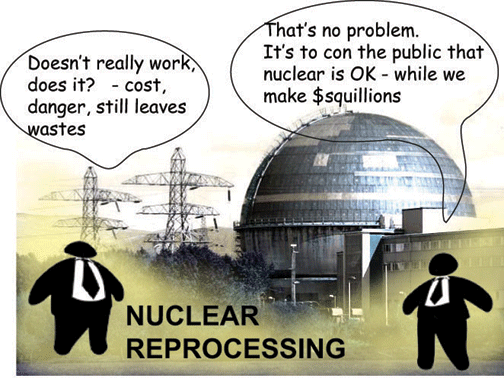
Letter William Walker: In 1993, a government official told me that “it
was sometimes right to do the wrong thing”. For reasons of political
expediency, it was right to give political consent for the operation of the
thermal oxide reprocessing plant (Thorp) at Sellafield.
This huge facility, not mentioned in Samanth Subramanian’s fine long read, had been built over
the previous decade to reprocess British and foreign, especially Japanese,
spent nuclear fuels. Abandoning it would be too embarrassing for the many
politicians and their parties that had backed it, expensive in terms of
compensation for broken contracts, and damaging to Britain’s and the
nuclear industry’s international reputation.
It was wrong to proceed, as
the government well knew, because the primary justification for its
construction – supply of plutonium for fast breeder reactors (FBRs) – had
been swept away by the abandonment of FBRs in the 1980s (none were built
anywhere).
Because returning Thorp’s separated plutonium and radwaste to
Japan would be difficult and risky.
Because decommissioning Thorp would
become much more costly after its radioactive contamination.
Because there was a known win-win solution, favoured by most utilities – store the spent
fuel safely at Sellafield prior to its return to senders, avoiding the many
troubles that lay ahead.
Guardian 22nd Dec 2022
Exposing the dishonest spiel that nuclear waste is “manageable”

Tom Smith, Chair, Nuclear Decommissioning Authority, 2017-20.
Samanth Subramanian captures perfectly the vast scale and longevity of the
effort needed to clean up Sellafield (The long read, 15 December).
As Britain and other states with nuclear power industries grapple with how to
go about an effective, safe and economical nuclear clean-up, it might be
better to explain the challenges with less reliance on suggestions that in
its early days the nuclear industry never thought about decommissioning
(though the point has validity).
Instead, we need more honesty about the fact that nuclear power inescapably generates large quantities of hazardous human-made waste, the worst of which will remain hazardous probably beyond
Homo sapiens’ time on the planet.
The industry’s solution to this is a network of deep disposal facilities. But none have yet been created, their
cost is enormous and there is no certainty that they will perform the
long-term task required of them. These are considerations that sadly
receive little attention in current debates about the need for new
nuclear-generation capacity.
Coincidentally, you published a letter (14 December) suggesting that nuclear radiation is less dangerous than
emissions from a wood-burning stove, a curious comparison to make.
Wood-burning stoves are pollutants, no question, but they could never lead
to a Windscale, Three Mile Island, Chornobyl or Fukushima. Nor will
decommissioning them cost billions and take decades.
Guardian 22nd Dec 2022
Campaign groups want answers on increase in radioactive particles found onDounreay foreshore.
Highlands Against Nuclear Transport (HANT) and the
Nuclear Free Local Authorities Scottish Forum have written to site managing
director Mark Rouse and Nicole Paterson, the chief executive of the
Scottish Environment Protection Agency (Sepa). The campaigners claim the
information about the particles is “sketchy, incomplete and out-of-date”
and want the Dounreay Stakeholder Group (DSG) and the local and national
press to receive regular reports about their detection and retrieval.
John O’Groat Journal 22nd Dec 2022
‘Historic’ agreement reached at UN conference to halt biodiversity loss by 2030
‘Historic’ agreement reached at UN conference to halt biodiversity loss by 2030
The global framework comes on the day the United Nations Biodiversity Conference, or COP15, is set to end in Montreal.

Despite the hype, we shouldn’t bank on nuclear fusion to save the world from climate catastrophe

Robin McKie, https://www.theguardian.com/commentisfree/2022/dec/17/dont-bank-on-nuclear-fusion-to-save-the-world-from-a-climate-catastrophe-i-have-seen-it-all-before
Last week’s experiment in the US is promising, but it’s not a magic bullet for our energy needs
“…….. For almost half a century, I have reported on scientific issues and no decade has been complete without two or three announcements by scientists claiming their work would soon allow science to recreate the processes that drive the sun. The end result would be the generation of clean, cheap nuclear fusion that would transform our lives.
Such announcements have been rare recently, so it gave me a warm glow to realise that standards may be returning to normal. By deploying a set of 192 lasers to bombard pellets of the hydrogen isotopes deuterium and tritium, researchers at the US National Ignition Facility (NIF) in Livermore, California, were able to generate temperatures only found in stars and thermonuclear bombs. The isotopes then fused into helium, releasing excess energy, they reported.
It was a milestone event but not a major one, although this did not stop the US government and swaths of the world’s media indulging in a widespread hyping jamboree over the laboratory’s accomplishment. Researchers had “overcome a major barrier” to reaching fusion, the BBC gushed, while the Wall Street Journal described the achievement as a breakthrough that could herald an era of clean, cheap energy.
It is certainly true that nuclear fusion would have a beneficial impact on our planet by liberating vast amounts of energy without generating high levels of carbon emissions and would be an undoubted boost in the battle against climate change.
The trouble is that we have been presented with such visions many times before. In 1958, Sir John Cockcroft claimed his Zeta fusion project would supply the world with “an inexhaustible supply of fuel”. It didn’t. In 1989, Martin Fleischmann and Stanley Pons announced they had achieved fusion using simple laboratory equipment, work that made global headlines but which has never been replicated.
To this list you can also add the International Thermonuclear Experimental Reactor (Iter), a huge facility being built in Saint-Paul-lès-Durance in Provence, France, that was supposed to achieve fusion by 2023 but which is over 10 years behind schedule and tens of billions of dollars over budget.
In each case, it was predicted that the construction of the first commercially viable nuclear fusion plants was only a decade or two away and would transform our lives. Those hopes never materialised and have led to a weary cynicism spreading among hacks and scientists. As they now joke: “Fusion is 30 years away – and always will be.”
It was odd for Jennifer Granholm, the US energy secretary, to argue that the NIF’s achievement was “one of the most impressive scientific feats of the 21st century”. This is a hard claim to justify for a century that has already witnessed the discovery of the Higgs boson, the creation of Covid-19 vaccines, the launch of the James Webb telescope and the unravelling of the human genome. By comparison, the ignition event at the NIF is second-division stuff.
Most scientists have been careful in their responses to the over-hyping of the NIF “breakthrough”. They accept that a key step has been taking towards commercial fusion power but insist such plants remain distant goals. They should not be seen as likely saviours that will extract us from the desperate energy crisis we now face – despite all the claims that were made last week.
Humanity has brought itself to a point where its terrible dependence on fossil fuels threatens to trigger a 2C jump in global temperatures compared with our pre-industrial past. The consequences will include flooding, fires, worsening storms, rising sea levels, spreading diseases and melting ice caps.
Here, scientists are clear. Fusion power will not arrive in time to save the world. “We are still a way off commercial fusion and it cannot help us with the climate crisis now,” said Aneeqa Khan, a research fellow in nuclear fusion at Manchester University. This view was backed by Tony Roulstone, a nuclear energy researcher at Cambridge University. “This result from NIF is a success for science, but it is still a long way from providing useful, abundant clean energy.”
At present, there are two main routes to nuclear fusion. One involves confining searing hot plasma in a powerful magnetic field. The Iter reactor follows such an approach. The other – adopted at the NIF facility – uses lasers to blast deuterium-tritium pellets causing them to collapse and fuse into helium. In both cases, reactions occur at more than 100 million C and involve major technological headaches in controlling them.
Fusion therefore remains a long-term technology, although many new investors and entrepreneurs – including Bill Gates and Jeff Bezos – have recently turned their attention to the field, raising hopes that a fresh commercial impetus could reinvigorate the development of commercial plants.
This input is to be welcomed but we should be emphatic: fusion will not arrive in time to save the planet from climate change. Electricity plants powered by renewable sources or nuclear fission offer the only short-term alternatives to those that burn fossil fuels. We need to pin our hopes on these power sources. Fusion may earn its place later in the century but it would be highly irresponsible to rely on an energy source that will take at least a further two decades to materialise – at best.
America’s complicated problem of disposing of tons of plutonium bomb cores, as the government to spend $1.7 billion on more plutonium bomb cores

The nuclear security agency’s draft statement comes as the Senate approved a military spending bill that seeks to funnel $1.7 billion to the lab’s pit operations, an unprecedented funding amount.
Weehler said the government should hold off on producing pits, which will generate more waste, until it has figured out a safe and effective way to dispose of the radioactive material it already has.
LANL would aid in diluting plutonium in controversial disposal plan
https://www.santafenewmexican.com/news/local_news/lanl-would-aid-in-diluting-plutonium-in-controversial-disposal-plan/article_e6cb6380-6d26-11ed-9a6c-731a070c9235.html By Scott Wyland swyland@sfnewmexican.com, Dec 17, 2022
The federal government has released a draft environmental impact statement on its plans to dilute and dispose of surplus plutonium, plans that worry some activists, residents and state officials because the radioactive material would be trucked at least twice through New Mexico, including the southern edge of Santa Fe.
The U.S. Energy Department’s nuclear security agency placed a notice of the 412-page draft in the Federal Register on Friday, providing details on the plutonium disposal it first announced two years ago but had kept mostly silent about.
Agencies want to get rid of 34 metric tons of plutonium bomb cores, or pits, that are left over from the Cold War and being kept at the Pantex Plant in Amarillo, Texas.
Plans call for shipping the material to Los Alamos National Laboratory, where it would be converted to oxidized powder, then transported to Savannah River Site in South Carolina so crews can add an adulterant to make it unusable for weapons.
From there, it would go to the Waste Isolation Pilot Plant, an underground disposal site in Carlsbad. This “downblending” is required because WIPP only takes waste below a certain radioactive level.
The public will have a chance to weigh in, both with written comments and at several public hearings scheduled for early next year.
Critics have spoke out against the plan for more than a year, arguing it puts communities along the trucking routes at risk and should be reconsidered.
Cindy Weehler, who co-chairs the watchdog group 285 ALL, said the environmental review confirms her concerns about the region becoming a hub for material that is more radioactive than the transuranic waste — contaminated gloves, equipment, clothing, soil and other materials — the lab now ships to WIPP.
“The preferred option is still to do this 3,300-hundred-mile road trip and have the two operations occur at two different labs,” Weehler said.
The impact statement offers possible alternatives, such as doing all the downblending at the lab or Savannah River to reduce transportation, but it makes clear the original plan is the preferred method.
The National Nuclear Security Administration has been quiet about the dilute-and-dispose plans, other than to acknowledge an environmental impact statement was underway.
This silence has frustrated residents, state and local officials and community advocates like Weehler.
If all the downblending is done at the lab, it would keep the plutonium from being hauled through a dozen states, so that would be better for many neighborhoods across the country, Weehler said.
However, dangerous radioactive substances would still go through Los Alamos and Santa Fe counties twice, she said.
Whether the oxidized powder leaves the lab in pure form or is adulterated, it would be hazardous to breathe in if the containers were breached in an accident, she said.
The draft statement said the powder would go into a steel canister, which would be placed into a reinforced 55-gallon drum known as a “criticality control container.” As many as 14 control containers can be put into a heavily fortified Trupact shipping container.
The lab has an operation known as ARIES for oxidizing plutonium on a small scale. Boosting the quantity would require installing more glove boxes — the sealed compartments that allow workers to handle radioactive materials — and other equipment to the plutonium facility, the statement said. The additions would expand the facility to 6,800 feet from 5,200 feet.
Structures would have to be built to accommodate the work, including a logistical support center, an office building, a warehouse, a security portal and a weather enclosure for the plutonium facility’s loading dock, the statement says.
The idea of doing away with surplus plutonium began after the Cold War. In 2000, the U.S. and Russia agreed to each eliminate 34 metric tons of the plutonium so it could no longer be used in nuclear weapons.
Russia reportedly withdrew from the pact later, but the U.S. decided to stick with its commitment.
The Energy Department originally sought to build a Savannah River facility that could turn Cold War plutonium into a mixed oxide fuel for commercial nuclear plants. But after billions of dollars in cost overruns and years of delays, the Trump administration scrapped the project in 2018 and decided to go with diluting and disposing of the waste.
One nuclear waste watchdog questioned why the leftover pits must be removed from Pantex at all.
That facility should be able to continue storing the plutonium safely, just as it has since the 1990s, said Don Hancock, director of nuclear waste safety for the nonprofit Southwest Research and Information Center.
“If it’s not safe to be at Pantex, then that raises some severe questions about the safety of the Pantex plant for its assembly and disassembly mission” for nuclear weapons, Hancock said.
Hancock said he opposes the government using WIPP as the sole disposal site for the diluted plutonium and other nuclear waste.
The nuclear security agency’s draft statement comes as the Senate approved a military spending bill that seeks to funnel $1.7 billion to the lab’s pit operations, an unprecedented funding amount.
Weehler said the government should hold off on producing pits, which will generate more waste, until it has figured out a safe and effective way to dispose of the radioactive material it already has.
“This is just a commonsense thing,” she said. “We have the weaponry we need.”
Bank of America, investors, thrilled and delighted with the nuclear arms race

Above: Banks investing in nuclear weapons
These 3 stocks will benefit from the nuclear arms race – Bank of America
Stock Markets (Dec 20, 2022,
The U.S. defense stocks are likely to continue outperforming the market, thanks to the ongoing conflict in Ukraine and a potential conflict in Taiwan, according to Bank of America analysts.
One particular area of the defense sector to be monitored closely is the one focused on the development of nuclear weapons.
“We expect concerns of nuclear proliferation to drive secular and governmental defense spending, particularly as the US moves away from nation-state conflicts, like in the Middle East, and focuses attention on near-peer threats. We expect US defense companies to see much of the upside from increased demand for nonstrategic nuclear weapons,” the analysts said in a client note……………….
As Europe lacks the industrial footprint the US has cultivated, we expect that US defense primes will be called upon to fill demand, reflecting a significant upside to these names,” they added.
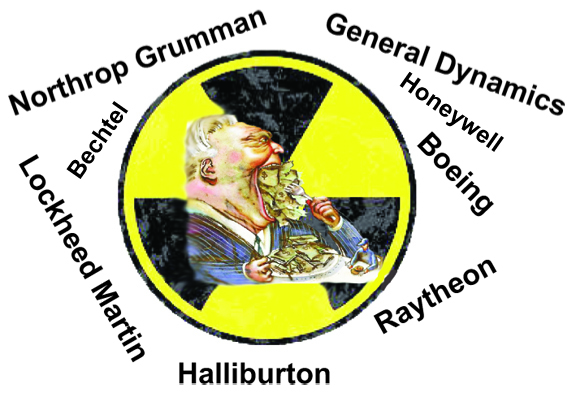
Along these lines, the analysts see Northrop Grumman (NYSE:NOC), Boeing (NYSE:BA), and Lockheed Martin (NYSE:LMT) benefiting from the increased demand as these three have the largest nuclear operations.
“This reinforces our Buy rating on Northrop Grumman. We remain Neutral on Boeing and Lockheed Martin on account of continued supply chain challenges and operational hurdles,” the analysts concluded. https://au.investing.com/news/stock-market-news/these-3-stocks-will-benefit-from-the-nuclear-arms-race–bank-of-america-432SI-2747010
Small nuclear reactors – the nuclear industry’s last ditch chance to thrive?
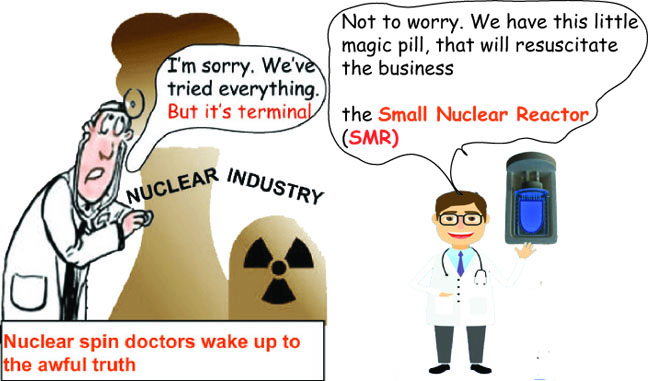
if this purported renaissance doesn’t flourish, there is unlikely to be another.
Nuclear power has one last chance to flourish in the U.S.
Climate urgency, energy security and government support make this a make-or-break moment for atomic energy
Japan Times, BY LIAM DENNING, BLOOMBERG 19 Dec 22,
Once again, we are on the cusp of a nuclear renaissance. Actually realizing one requires something nuclear power isn’t known for: Speed.
………. There are two sides to a mooted renaissance. One is a new lease on life for existing plants. More than 10 reactors have closed over the past decade, largely because cheap shale gas depressed the price of electricity and burgeoning renewables also muscled in.
……….. The last reactor came online in 2016. Not only was it the first in 20 years, its construction kicked off more than 40 years ago………
Nuclear power’s fall from grace is often traced to the Three Mile Island accident in 1979, which stoked distrust from the public and excessive zeal from regulators. But nuclear power was struggling already. Many projects had been canceled before 1979, in part because it was already taking a decade to plan, license and construct a plant. Capital costs soared well before Three Mile Island, more than doubling in real terms between 1971 and 1978, flouting the conventional wisdom of greater scale leading to efficiencies.
…………………………. The bankruptcy of the Washington Public Power Supply System in the early 1980s exemplified this collision of rosy demand assumptions with new economic realities, saddling ratepayers with billions in costs for abandoned, half-built plants. The same thing happened as recently as 2017 with the abandonment of two unfinished projects in South Carolina. Two other new reactors have actually been built in Georgia and are due to switch on next year. But they are far from being good PR; massively over-budget and delayed, they owe their completion to regulators offloading much of the cost onto ratepayers.
Meanwhile, as much as climate change bolsters the case for nuclear power, it has also bolstered alternatives. Not just renewable power and batteries, but conservation now enhanced by distributed energy technologies and sophisticated demand-management tools. Unlike nuclear power, the cost of such technologies has been falling fast.
……………… Competing clean technology cost trends and whatever else the 2020s throw up lie between now and the likely start of new projects at scale in the 2030s.
This is why the current renaissance centers on developing small modular reactors, or SMRs……… Companies such as NuScale Power and TerraPower LLC, founded by Bill Gates, aim to deploy initial commercial projects in the late 2020s.
…………….. Despite being talked about for years, however, SMRs haven’t arrived yet. “There are no good cost estimates (for SMRs) because no one’s actually built one,” says Jonathan Koomey, a researcher studying energy technology costs and co-author of a forthcoming book “Solving Climate Change.” Given nuclear power’s track record, he adds, “what’s needed is a construction time and cost that we could predict with accuracy.”Even under good circumstances — and there are signs of cost issues already — initial SMR projects likely won’t operate for several more years. That means commercialization at scale is probably at least a decade away. What will the cost of competing technologies be by then?
………… government must underwrite that risk to some degree. For the existing plants, and those new ones in Georgia, that involved guaranteed recovery of costs for regulated utilities. Today, it is subsidies and development grants and loans……………………
We are in a moment where all the stars have seemingly aligned: climate urgency, energy security concerns, new technology, new subsidies, and government intervention in energy markets writ large. The corollary is that, with our grids undergoing fundamental change and net-zero targets bearing down on us, if this purported renaissance doesn’t flourish, there is unlikely to be another. https://www.japantimes.co.jp/opinion/2022/12/19/commentary/world-commentary/u-s-nuclear-reactors/
Bill Gates’ Natrium project stalled, lacks Russian fuel – call for tax-payer funding for nuclear fuel development
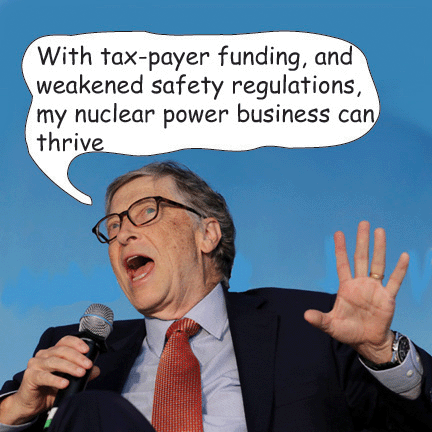
Russia’s war has stalled a next-gen US nuclear reactor backed by Bill Gates – because it’s lost its sole supplier of uranium
Markets Insider, George Glover , Dec 19, 2022,
- TerraPower has delayed a demo of its flagship nuclear reactor project in Wyoming by at least two years.
- The nuclear innovation company said it’s unable to get uranium fuel from any source other than Russia.
- TerraPower has received backing from Bill Gates and the US DOE for its advanced nuclear plant design.
……………..Its CEO Chris Levesque said the war has hit supplies of high-assay low-enriched uranium, or HALEU. That means the Natrium nuclear plant that TerraPower is building in Wyoming won’t go into demonstration service in 2028 as planned.
…………. Efforts to get US manufacturers in commercial production and to find alternative suppliers have not worked out, he said.
“Given the lack of fuel availability now, and that there has been no construction started on new fuel enrichment facilities, TerraPower is anticipating a minimum of a two-year delay to being able to bring the Natrium reactor into operation,” Levesque added.
……… Natrium project is expected to cost $4 billion to build, with around half of that funding coming from the US Energy Department.
TerraPower plans to fuel Natrium with HALEU , which has a higher level of enrichment than the 5%-enriched uranium-235 fuel used by American nuclear reactors already in operation.
The company assumed it would use Russian supplies for its first core load because the US doesn’t have the capacity to enrich uranium-235 right now, according to Levesque.
But Russia’s invasion of Ukraine in February cut off the fuel source, after the US, the EU and other western allies imposed sanctions on Moscow.
TerraPower and the Department of Energy are now looking for alternative sources of HALEU – and want lawmakers to approve a $2.1 billion funding package to support low-enriched uranium production in the US, Levesque said. https://markets.businessinsider.com/news/commodities/russia-war-in-ukraine-bill-gates-nuclear-startup-uranium-fuel-2022-12
Nuclear fusion – expensive, far away in time, and not clean, not safe

Nuclear fusion ‘holy grail’ is not the answer to our energy prayers, Dr Mark Diesendorf questions the claim that nuclear fusion is safe and clean, while Dr Chris Cragg suspects true fusion power is a long way off. https://www.theguardian.com/environment/2022/dec/19/nuclear-fusion-holy-grail-is-not-the-answer-to-our-energy-prayers
You [The Guardian] report on the alleged “breakthrough” on nuclear fusion, in which US researchers claim that break-even has been achieved (Breakthrough in nuclear fusion could mean ‘near-limitless energy’, 12 December). To go from break-even, where energy output is greater than total energy input, to a commercial nuclear fusion reactor could take at least 25 years. By then, the whole world could be powered by safe and clean renewable energy, primarily solar and wind.
The claim by the researchers that nuclear fusion is safe and clean is incorrect. Laser fusion, particularly as a component of a fission-fusion hybrid reactor, can produce neutrons that can be used to produce the nuclear explosives plutonium-239, uranium-235 and uranium-233. It could also produce tritium, a form of heavy hydrogen, which is used to boost the explosive power of a fission explosion, making fission bombs smaller and hence more suitable for use in missile warheads. This information is available in open research literature.
The US National Ignition Facility, which did the research, is part of the Lawrence Livermore National Laboratory, which has a history of involvement with nuclear weaponry. – Dr Mark Diesendorf
University of New South Wales
As someone who once wrote a critical report for the European parliament on fusion power back in the late 1980s, I hate to rain on Arthur Turrell’s splendid parade (The carbon-free energy of the future: this fusion breakthrough changes everything, 13 December).
It is indeed good news that the US National Ignition Facility has got a “net energy gain” of 1.1 MJ from an inertial confinement fusion device using lasers. In this regard, what is really valuable is that the community can now concentrate on this type of reactor, rather than other designs like the tokamak.
However, I am prepared to bet that a true fusion power station is unlikely to be running before my grandchildren turn 70. After all, it has taken 60-odd years and huge amounts of money to get this far.
Dr Chris Cragg
London
Arthur Turrell writes that achieving “net energy gain” has a psychological effect akin to a trumpet to the ear. Well, it might do to him but not to me. Yes, it’s a fantastic achievement for those scientists and engineers who have worked to achieve this proof on concept; well done them. But it will make not one jot of a positive difference to the challenges my children and grandchildren will face as a result of the climate crisis.
We only have years to achieve the changes that are necessary to avoid social catastrophe due to what’s happening to the biosphere, and that’s assuming it’s not already too late. Even the optimists understand that it will be decades before fusion power can contribute to the grid, regardless of this achievement.
Meanwhile the headlines that followed this result, Turrell’s psychological trumpet, simply serve to reassure and detract from the urgency of what needs to be done now.
Dick Willis
Bristol
It is great news that scientists have succeeded in getting more energy out of fusion than they put in. It brings to mind a quote from a past director of the Central Electricity Generating Board: “One day you may get more energy out of nuclear fusion than you put in, but you will never get more money out than you put in.”
Martin O’Donovan
Ashtead, Surrey
Iran after a region free of nuclear weapons, Kharrazi says
TEHRAN, Dec. 19 (MNA) – Expressing Iran’s readiness to return to its JCPOA obligations, the head of Iran’s Foreign Policy Strategic Council said that for decades, Iran has been after a region free of nuclear weapons……………………………..
Iran ready to return to its JCPOA obligations
He also referred to IAEA technical team’s visit to Tehran, saying, “Now Iran is ready to return to its JCPOA obligations. Many problems have been solved so far except for the safeguard issues, and we hope that these issues will be resolved during this visit.”
For decades, Iran has been after a region free of nuclear weapons, he said, stressing that Israel’s nuclear weapons should also be destroyed and it should join safeguard.
Today, Iran has the necessary nuclear capability, but the country has no intention to build nuclear weapons, he underlined. https://en.mehrnews.com/news/195126/Iran-after-a-region-free-of-nuclear-weapons-Kharrazi-says
Propaganda drive: Nuclear Power 2.0 Eyes Opportunity, Steep Climb in Coal Country
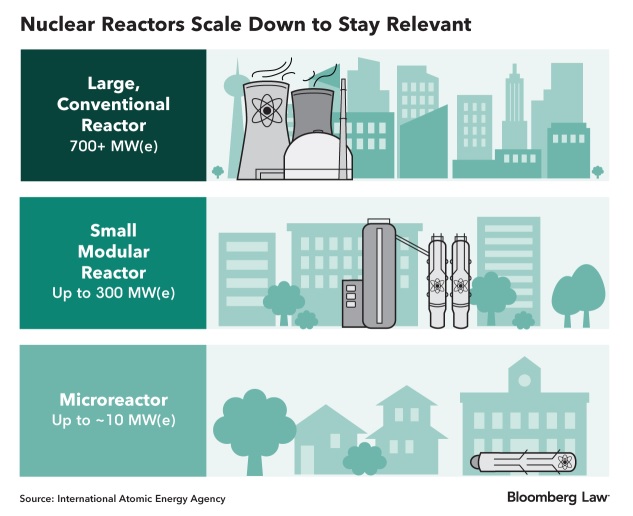
Daniel Moore, Bloomberg Law, 19 Dec 22
The nuclear power industry sees its future in coal country……….
But realizing that vision—now backed by the Biden administration and Congress, with billions earmarked for the plan in last year’s historic infrastructure law—depends on winning over some of the most nuclear-skeptical places in the country. So the Energy Department is on an education mission to gain local support across rural America for what it believes can be a nuclear revival.
“We really, over time, have underestimated the role that social science, political science, sociology, psychology, human geography can all play in our decision-making,” explains Kathryn Huff, the department’s 36-year-old assistant secretary of nuclear energy.
……….. About 80% of nearly 400 operating or shuttered coal power plant sites across the country could be converted to nuclear power plant sites, the Energy Department estimated in September.
………… But in West Virginia, which has no operating nukes, only 38% of residents support building new reactors, according to a public opinion project by the University of Oklahoma and University of Michigan. The state has the second-smallest portion of people who say they see a benefit from nuclear, according to the project, which was funded by the Energy Department and pulled data from 2006 to 2020.
……….. SMRs are key to changing that mindset, with the selling point that they’re not your parent’s nuclear reactors……………………..
A trio of academic studies with 30 researchers will guide the department’s nuclear energy office on community outreach at a DOE-funded test reactor near a shuttered coal plant in Wyoming; a new siting process for temporary nuclear waste storage facilities; and advanced nuclear possibilities in the Arctic, where past nuclear tests have generated deep distrust among indigenous groups.
A trio of academic studies with 30 researchers will guide the department’s nuclear energy office on community outreach at a DOE-funded test reactor near a shuttered coal plant in Wyoming; a new siting process for temporary nuclear waste storage facilities; and advanced nuclear possibilities in the Arctic, where past nuclear tests have generated deep distrust among indigenous groups.
………………… spent nuclear fuel requires on-site storage in bulky steel casks, while a permanent home requires geologic assessments spanning millions of years. And when aging plants do close—as 13 plants have in the last decade—cleanup crews must carefully dismantle the components.
………… The nuclear waste problem is a “gaping hole in the ship of the US nuclear industry,” said Edward McGinnis, who spent almost 30 years at the Energy Department
……. Without a permanent home for waste, “then it’s very difficult to say we should have another generation of nuclear power because we don’t know how to solve the problem of waste from the first generation,” said Tom Isaacs, a nuclear waste expert….
Clean Energy Goal
Lyman from the Union of Concerned Scientists said the number of new local jobs that would come from SMRs are overstated, in part because the largely premanufactured reactors are much smaller and come with lower costs than existing reactors. But he said the unproven plants would still bring potential environmental hazards.
………..Finding markets is crucial for advanced reactors, which hope to roll out by the end of the decade. The department plans to plow as much as $3.2 billion into demonstrating reactors by TerraPower in Wyoming and X-energy in Washington state.
………………………………………….. Environmental groups are sharply split on the issue, said Gary Zuckett, who lobbied for the 1996 West Virginia law that banned nuclear construction until a permanent waste storage facility was established. Zuckett, executive director of West Virginia Citizen Action, considers himself somewhere “in the middle,” as he believes safely operating nuclear plants should stay online to maintain zero-emissions power until more solar and wind can be built.
But communities are concerned about plugging reactors into coal sites, he said.
“I personally don’t see nuclear as our savior,” Zuckett said. “We don’t have a safe, permanent repository for all of this high-level nuclear waste that will be deadly for generations, and so should we really be making more of this?”
Federal incentives could be poured into wind and solar, which are ready to deploy now, said Jim Kotcon, an associate professor at West Virginia University and a leader of the state’s Sierra Club chapter.
“We should adopt the fastest, cheapest, safest and cleanest sources first,” Kotcon said. “Nuclear is none of those.”
……………………………………….. To tackle waste siting, Oklahoma and Michigan researchers hope to define a process for winning consent from communities to host a hypothetical temporary waste site. The DOE is offering $16 million for additional consent-based siting efforts and assessing nearly 1,700 pages of comments in response to a request for information.
The amount of waste SMR generate is the subject of debate—a controversial study in May found small reactors could generate more waste than the industry has led people to believe.
………………………………… Energy Department officials express optimism the appeal to community engagement will work………………………..
The department “will have momentum by the time this administration is done,” Huff said. “It doesn’t matter what political winds shift.”
To contact the reporter on this story: Daniel Moore in Washington at dmoore1@bloombergindustry.com
To contact the editor responsible for this story: Gregory Henderson at ghenderson@bloombergindustry.com https://news.bloomberglaw.com/environment-and-energy/nuclear-power-2-0-eyes-opportunity-steep-climb-in-coal-country
1 This Month
26 April – Chernobyl: Inside the Meltdown airs on National Geographic on Sunday 26th April from 4pm

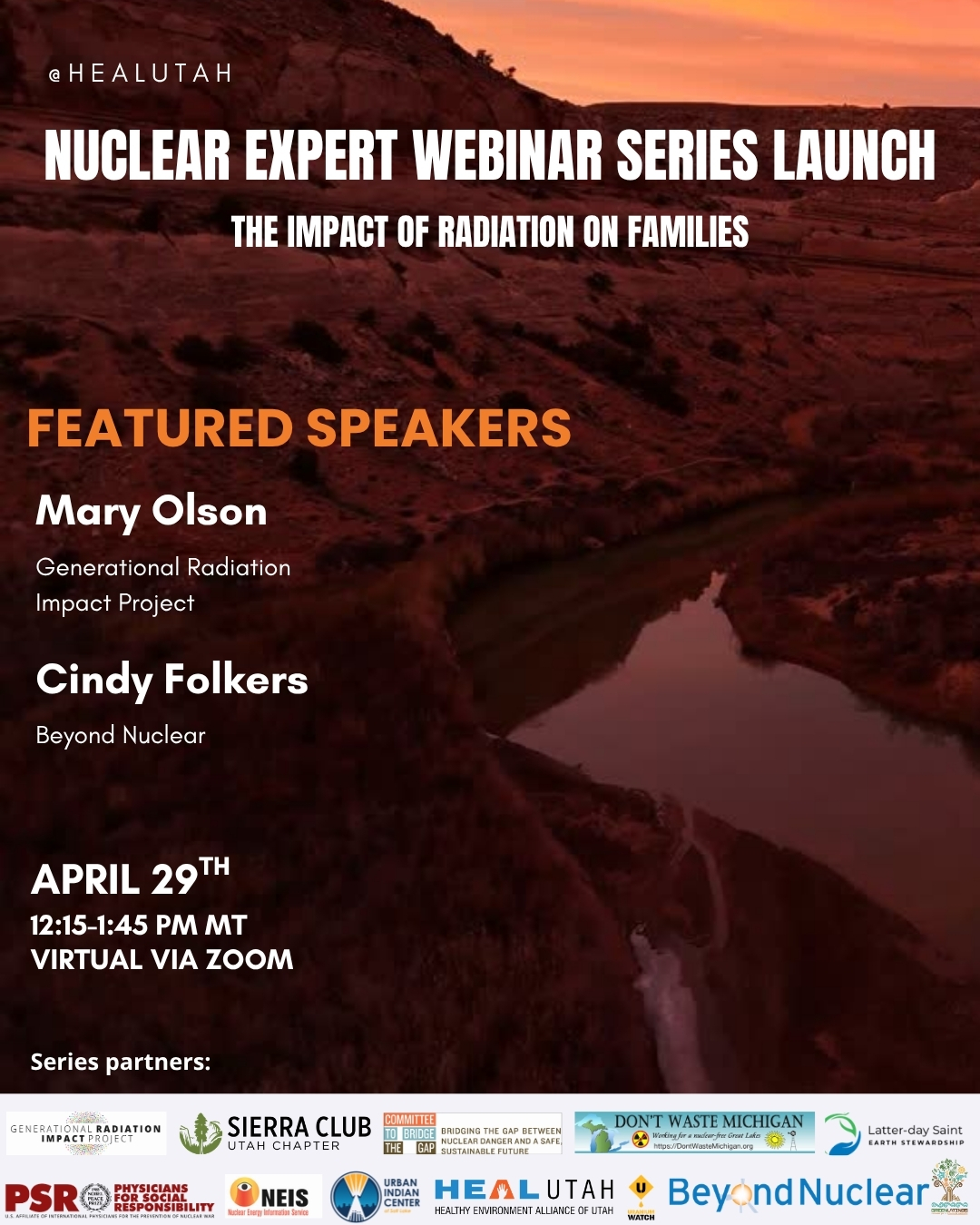
29 April – Nuclear Expert Webinar #1 – Radiation Impacts on Families with Mary Olson and Cindy Folkers
- 12:15 PM MT – 1:45 PM MT
- Location: Virtual – REGISTER TODAY

4 May -West Suburban Peace Coalition to discuss Iran war at May Educational Forum
Monday, May 4, 7:00 – 8:00 PM Central Standard Time
Title: : How Trump’s Narrative Tries to Shape the Reality of the War on Iran.
Contact Walt Zlotow, zlotow@hotmail.com 630 442 3045 for further information
14 May – online event From Bombs to Data Centres: the Face of Nuclear Colonialism

Pine Ridge Uranium is the real threat, not Tehran- Tell Burgum: Stop the Extraction.
Chernobyl: The Lost Tapes – A good documentary on Chernobyl on SBS available On Demand for the next 3 weeks– https://www.sbs.com.au/ondemand/tv-program/chernobyl-the-lost-tapes/2352741955560
To see nuclear-related stories in greater depth and intensity – go to https://nuclearinformation.wordpress.com
-
Archives
- April 2026 (317)
- March 2026 (251)
- February 2026 (268)
- January 2026 (308)
- December 2025 (358)
- November 2025 (359)
- October 2025 (376)
- September 2025 (257)
- August 2025 (319)
- July 2025 (230)
- June 2025 (348)
- May 2025 (261)
-
Categories
- 1
- 1 NUCLEAR ISSUES
- business and costs
- climate change
- culture and arts
- ENERGY
- environment
- health
- history
- indigenous issues
- Legal
- marketing of nuclear
- media
- opposition to nuclear
- PERSONAL STORIES
- politics
- politics international
- Religion and ethics
- safety
- secrets,lies and civil liberties
- spinbuster
- technology
- Uranium
- wastes
- weapons and war
- Women
- 2 WORLD
- ACTION
- AFRICA
- Atrocities
- AUSTRALIA
- Christina's notes
- Christina's themes
- culture and arts
- Events
- Fuk 2022
- Fuk 2023
- Fukushima 2017
- Fukushima 2018
- fukushima 2019
- Fukushima 2020
- Fukushima 2021
- general
- global warming
- Humour (God we need it)
- Nuclear
- RARE EARTHS
- Reference
- resources – print
- Resources -audiovicual
- Weekly Newsletter
- World
- World Nuclear
- YouTube
-
RSS
Entries RSS
Comments RSS
 nuclear-news