What’s not to like about nuclear fusion?
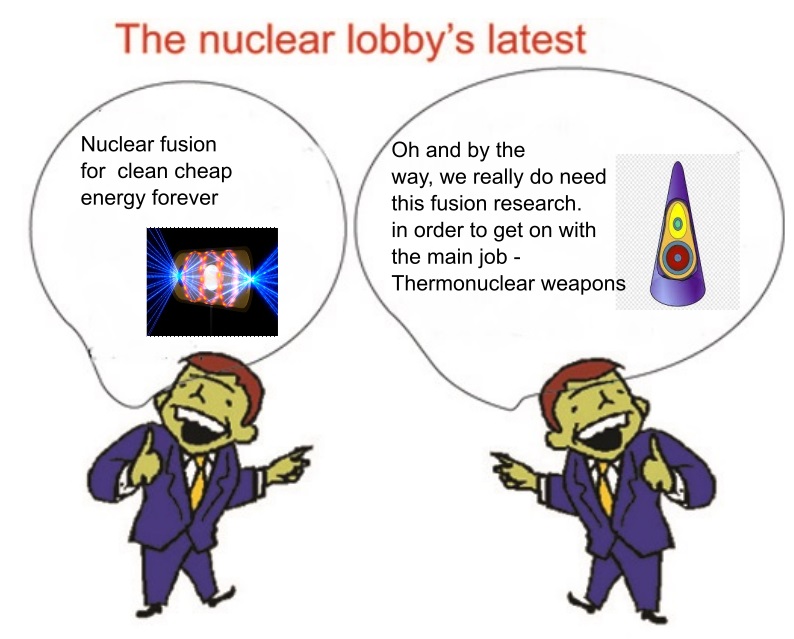
If one of these approaches is eventually successful in generating electricity continuously, the earliest we could expect commercial nuclear fusion reactors would be around 2050
The proponents remain silent about its applications to nuclear weapons. Fusion produces a stream of neutrons that can convert the common form of uranium, Uranium-238, into Plutonium-239, and common thorium into Uranium-233. Both Pu-239 and U-233 are nuclear (fission) weapons explosives
https://johnmenadue.com/whats-not-to-like-about-nuclear-fusion/— Mark Diesendorf , Dec 27, 2022
Headlines shout ‘Breakthrough in nuclear fusion could mean “near-limitless energy”’ and, one with a note of caution, ‘At last, we’ve found our energy source for the future (if we have one)’.
The publicity followed an experiment, conducted at the Lawrence Livermore National Laboratory in California, in which slightly more fusion energy output was obtained than the vast amount of energy input.
Nuclear fusion results from forcing together the nuclei of light atoms, against their electrostatic forces of repulsion, to form heavier nuclei, with the release of energy. It is the reaction that gives our Sun and the other stars their energy. In the centres of stars, the nuclei are forced together by the immense pressure due to gravity. But in the laboratory on Earth, confining the system and achieving controlled fusion is much more difficult.
One approach is to heat the system to hundreds of millions of degrees while confining it with intense magnetic fields. This is the method used in a multinational, multi-billion dollar experiment to build the International Thermonuclear Experimental Reactor (ITER), currently under construction in France. The researchers and investor governments hope that the huge size of the system will eventually enable energy break-even.
Another method, the one used at Livermore, is to bombard a pellet comprising two isotopic forms of hydrogen, deuterium and tritium, with 192 high-powered lasers. Energy breakeven was achieved for a fraction of a second.
If one of these approaches is eventually successful in generating electricity continuously, the earliest we could expect commercial nuclear fusion reactors would be around 2050, probably too late to contribute to climate mitigation and almost certainly unnecessary. By 2050, the whole world’s electricity generation will likely be renewable, mostly from wind and solar photovoltaics supplemented by hydro. This can be achieved at a fraction of the cost of any nuclear energy technology, fission or fusion.
The hype for fusion claims limitless, safe, zero-carbon energy, negligible nuclear wastes, and no risk of devastating nuclear accidents. So, what’s not to like about nuclear fusion?
The proponents remain silent about its applications to nuclear weapons. Fusion produces a stream of neutrons that can convert the common form of uranium, Uranium-238, into Plutonium-239, and common thorium into Uranium-233. Both Pu-239 and U-233 are nuclear (fission) weapons explosives.
Even more dangerous is the potential use of the neutron stream to convert lithium, which is common, into large quantities of tritium, a rare isotope of hydrogen. Tritium is an essential component of compact nuclear weapons, enabling them to be made small enough to fit into missiles. The principal purpose of the Lawrence Livermore Lab is research and development of nuclear weapons. Indeed, a former member of the research staff described it to me as ‘a nuclear bomb factory’.
The desirability of ‘near-limitless energy’ also needs critical examination. The economic system is driven, to a large degree by energy consumption, and vice versa. Energy and economy are closely coupled. Furthermore, economic activity is a major driver of environmental impacts. Already, at the present level of global GDP and global energy consumption, we have massive impacts on our forests, soils, freshwater, biodiversity and biogeochemical flows such as phosphorus and nitrogen. Although we humans are totally dependent upon nature, we (especially rich countries and rich individuals) are destroying our life support system. A further expansion of energy consumption and associated economic activity, even if energy generation is zero-carbon, could finish the job of destroying human civilisation this century.
There is growing evidence of the need for the world to transition to a steady-state economic system, that is, one with no growth in the use of energy, materials and land, and no growth in population. The interdisciplinary field of ecological economics is based on this goal. Since low-income countries must continue to grow, this means that the rich countries must commence a process of planned degrowth to an ecologically sustainable, socially just socioeconomic system. Planned degrowth, which is very different from a recession, is discussed in recent books by Jason Hickel (Less is More), Giorgos Kallis (The Case for Degrowth) and Matthias Schmelzer (The Future is Degrowth).
Sunak’s wrongheaded renewables tax risks trashing Britain’s wind and solar ambitions.
DR NINA SKORUPSKA: Sunak’s wrongheaded renewables tax risks trashing
Britain’s wind and solar ambitions. The Government must change course,
otherwise we will see winters even more painful than this one.
Call it what you will – a windfall tax, a clawback, a levy – the fact remains that the
Electricity Generator Levy (EGL), in its current form, is set to cause
irreparable damage to Britain’s green energy industry by stalling
investment. In principle, our sector is certainly not against the
Government’s policy to require generators to help pay for energy bill
support.
However, we would question the wisdom of subjecting the cheaper,
greener renewable power sector to a more punishing tax regime than its oil
and gas counterparts. It is an inexplicable disparity – our sector is key
to tackling the volatile costs of fossil fuels at the heart of rising
energy bills. Treatment should be fair and equitable in relation to the oil
and gas sector.
Telegraph 23rd Dec 2022
Dounreay pushes forward plans to build new 37-metre-high stack at prototype fast breeder reactor.
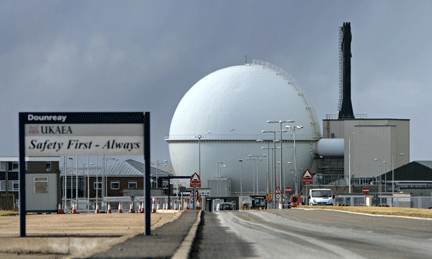
Dounreay pushes forward plans to build new 37-metre-high stack at reactor.
Dounreay’s operators are looking to clear the way to progress long-delayed
plans to replace the discharge stack at the site’s prototype fast reactor.
Dounreay Site Restoration Limited (DSRL) is seeking Highland Council’s
agreement to approve a design for the system to vent authorised emissions
of gases, including radionuclides. Last year, it awarded a £7 million
contract to US conglomerate Jacobs to carry out the work.
Concrete foundations and a steel framework would support the proposed new 37-metre
high stack which would house a plant room containing an extract fan, filter
units, stack sampling and control panels. The contract involves removal of
the existing vent and the design, manufacturing, testing, installation and
commissioning of its replacement. The new stack is earmarked to go up on
the seaward side of the reactor and be in place by October 2024.
John O Groat Journal 21st Dec 2022
UK tipped to export even more energy to France despite blackout fears.
UK tipped to export even more energy to France despite blackout fears.
France’s nuclear power output has plunged to a 30-year low – and the UK is
expected to continue to part ways with its energy supplies despite shortage
fears this winter.
A nuclear expert has warned that the UK may have to send
more energy across the Channel to help keep the lights on in France. This
is despite fears that Britain could be weeks away from its own shortages
this winter.
France has taken 16 of its 56 nuclear reactors offline due to
corrosion issues, causing nuclear power output levels to plummet in recent
months. Making matters worse, Paris confirmed last week that maintenance
halts at two of Electricite de France SA’s reactors – and that it will last
for an extra four months. It may also have to carry out lengthy repairs at
seven other reactors next year, too.
Under normal circumstances, France is
a net exporter of energy, sending some of this to the UK via
interconnectors. While the exchange of energy from the UK to France has
been happening regularly for a number of months, Dr Paul Dorfman, a nuclear
expert from Sussex University, has warned that the UK could ramp up its
exports to France, despite its own domestic energy issues.
Express 24th Dec 2022
https://www.express.co.uk/news/science/1711900/uk-energy-france-nuclear-blackout-edf
The Ukraine Arms Drain
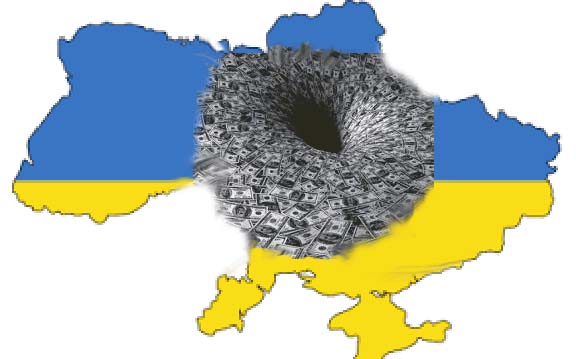
New Eastern Outlook, Brian Berletic 23 Dec 22
After months of feigned confidence and optimism from both the West and Ukraine’s senior military leadership, cracks are beginning to appear. During Ukrainian Commander-in-Chief General Valery Zaluzhny’s recent interview with the Economist, Ukraine’s desperate need for additional arms and the consequences for not receiving them was made very clear.
The discussion revolved around the desperate need for resources – everything ranging from air defense missiles to tanks, armored vehicles, artillery pieces and artillery shells themselves – all things that both the West and now Ukraine are admitting are in short supply, and perhaps cannot be supplied any time in the near or intermediate future.
From “Extending Russia” to “Demilitarizing” NATO
Washington’s proxy war against Russia in Ukraine is the manifestation of the RAND Corporation’s 2019 paper “Extending Russia” which recommended US policymakers to “provide lethal aid to Ukraine” hoping it would expand hostilities in eastern Ukraine and “increase the costs to Russia, in both blood and treasure, of holding the Donbass region.”
The paper had hoped that Russian losses in equipment and lives in the Donbass would replicate the costs the Soviet Union suffered in Afghanistan. While the Russian Federation is indeed facing mounting costs in Ukraine, it can easily be argued that the US, the rest of NATO, and most of all – Ukraine itself – are suffering at least as much if not more.
What’s perhaps more important than how much either side is losing in the conflict is how much either side can afford to lose because of their respective military industrial capacity to regenerate manpower and equipment throughout the fighting. After nearly a year of fighting, it is clear that Russia’s stockpiles and military were prepared for this type of protracted, intense, large-scale military conflict. Ukraine and its Western sponsors were not.
Ukraine’s General Zaluzhny shared with the Economist a “wishlist” of weapons he claimed he needed in order to restore the February 23, 2022 borders of what Kiev claims is Ukraine. The list included 300 tanks, 600-700 infantry fighting vehicles, and 500 howitzers – numbers NATO couldn’t provide Ukraine no matter how much it wants to.
This “wishlist” follows Ukraine expending a massive reserve made up of weapons, vehicles, and ammunition the collective West transferred to Ukraine ahead of the so-called Kharkov and Kherson offensives. In addition to losing multiple brigades worth of men, huge amounts of equipment were also lost as Russian ground forces withdrew and instead used long-range weapons to strike at Ukrainian forces now out from behind well-laid defenses.
The temporary political points Ukraine’s offensives gained by taking territory came at the cost of expending the vast majority of what the West could afford to transfer to Ukraine.
A growing number of admissions are now being made regarding the limits of Western aid to Ukraine……………………………………………….. more https://journal-neo.org/2022/12/23/the-ukraine-arms-drain/
1 This Month

of the week – Shut Down Drone Warfare!


Tell the Ukrainian Government to Drop Prosecution of Peace Activist Yurii Sheliazhenko

Petition to revoke the licensing of the Near Surface Nuclear Disposal Facility (NSDF) at Chalk River. https://www.ourcommons.ca/petitions/en/Petition/Details?Petition=e-7247
To see nuclear-related stories in greater depth and intensity – go to https://nuclearinformation.wordpress.com
-
Archives
- April 2026 (91)
- March 2026 (251)
- February 2026 (268)
- January 2026 (308)
- December 2025 (358)
- November 2025 (359)
- October 2025 (376)
- September 2025 (257)
- August 2025 (319)
- July 2025 (230)
- June 2025 (348)
- May 2025 (261)
-
Categories
- 1
- 1 NUCLEAR ISSUES
- business and costs
- climate change
- culture and arts
- ENERGY
- environment
- health
- history
- indigenous issues
- Legal
- marketing of nuclear
- media
- opposition to nuclear
- PERSONAL STORIES
- politics
- politics international
- Religion and ethics
- safety
- secrets,lies and civil liberties
- spinbuster
- technology
- Uranium
- wastes
- weapons and war
- Women
- 2 WORLD
- ACTION
- AFRICA
- Atrocities
- AUSTRALIA
- Christina's notes
- Christina's themes
- culture and arts
- Events
- Fuk 2022
- Fuk 2023
- Fukushima 2017
- Fukushima 2018
- fukushima 2019
- Fukushima 2020
- Fukushima 2021
- general
- global warming
- Humour (God we need it)
- Nuclear
- RARE EARTHS
- Reference
- resources – print
- Resources -audiovicual
- Weekly Newsletter
- World
- World Nuclear
- YouTube
-
RSS
Entries RSS
Comments RSS
 nuclear-news