US purchases $290 million of drug for use in radiological and nuclear emergencies
The Hill, BY JULIA MUELLER – 10/06/22,
he Department of Health and Human Services (HHS) says it has spent $290 million on a drug to treat radiation sickness in the event of a nuclear emergency.
The HHS Administration for Strategic Preparedness and Response announced in a Tuesday release that it bought the drug Nplate from Amgen USA Inc. “as part of long-standing, ongoing efforts to be better prepared to save lives following radiological and nuclear emergencies.”………………..
The new purchase follows growing international concern over the potential use of nuclear weapons in Russia’s war on Ukraine. …….https://thehill.com/policy/healthcare/3676691-us-purchases-290-million-of-drug-for-use-in-radiological-and-nuclear-emergencies/
Britain’s new Energy Secretary suffering from the ‘nuclear fusion delusion’

In his speech to the 2022 Conservative Party Conference, the Britain’s
newly-appointed Energy Secretary has shown that, like those in office
before him, he too is suffering from the ‘fusion delusion’.
To the Nuclear Free Local Authorities (NFLA), the condition represents a mistaken
belief in someone in high political office that fusion can address the
nation’s future energy needs by providing access to cheap, green power in
defiance of the reality that the technology is far from being
scientifically certain, far from being economically viable, potentially
unsafe, too costly, and still comes with a legacy of nuclear waste – and
that it will in any case come decades too late to address Britain’s
immediate energy / cost-of-living crisis or the urgent need to curb carbon
emissions to arrest the worsening climate emergency.
In his first conference speech as Energy Secretary, Jacob Rees-Mogg lauded the merits of
fusion energy and announced that a new pilot plant will be established on
the site of the former West Burton A coal-fired power plant in
Nottinghamshire describing it as a ‘beacon of bountiful green
energy…proving the commercial viability of fusion energy to the world’.
NFLA 6th Oct 2022
Crops growing 30 miles outside of Chernobyl are still contaminated with dangerous levels of strontium .
https://www.washingtonpost.com/politics/2022/04/20/does-russia-sell-nearly-1-billion-uranium-us-year/ 7 Oct 22, Crops grown near Chernobyl are still contaminated, more than three decades after the worst nuclear disaster in history.
Almost half the grain analyzed by scientists in Ivankiv, about 30 miles from the power plant, showed levels of strontium 90 far above recommended levels.
It was also present at unsafe levels in firewood and wood ash used to fertilize crops.
The Ukrainian government stopped testing goods for strontium 90 in 2013.
A radioactive isotope, it collects in the teeth, bones and marrow like calcium, and can cause numerous kinds of cancer.
Black pigmentation in Chernobyl’s Eastern Tree Frogs

Chernobyl is spawning MUTANT frogs: Bizarre black amphibians are spotted near the nuclear plant – 36 years after its catastrophic meltdown
- Eastern tree frogs are meant to have bright green skin
- But scientists working near Chernobyl have found many with black skin
- They think the dark skin may have helped them to survive the exclusion zone
https://www.dailymail.co.uk/sciencetech/article-11290735/Chernobyl-spawning-MUTANT-frogs-Bizarre-black-amphibians-spotted-near-nuclear-plant.html By SHIVALI BEST FOR MAILONLINE and MICHAEL HAVIS, 7 October 2022
Mutant black frogs are spawning near the Chernobyl power plant, 36 years after its catastrophic meltdown unleashed one of the worst nuclear disasters in history.
Eastern tree frogs are meant to have bright green skin but scientists working near Chernobyl have found many with darker or black pigmentation.
In 1986, the site in northern Ukraine – then under Soviet rule – witnessed the largest release of radioactive material into the environment in human history.
Now scientists think the mutated frogs’ darker skin may have helped them survive in the exclusion zone, which today restricts access to 1,0000 sq miles around ground zero.
Germán Orizaola, a researcher at Spain’s University of Oviedo, who co-authored the new study, said: ‘We become aware of these frogs the very first night we worked in Chernobyl.
‘We were looking for this species near the damaged power plant and we detected many frogs that were just black.
‘We know that melanin is responsible for dark or black colouration in many organisms, including frogs.
‘At the same time, we know that melanin protects from the damage caused by different types of radiation, from UV to ionizing radiation – the kind at Chernobyl.’
For their study, Dr Orizaola and his co-author, Pablo Burraco, collected more than 200 male frogs from 12 different breeding ponds with different levels of radiation.
They found that frogs within the exclusion zone were much darker than those from outside it.
And though there was no correlation between the darkest frogs and the most irradiated places today, there was a correlation with the worst-affected places from the time of the accident.
In other words, the darker frogs had stood a better chance of survival when disaster struck in 1986, making them more numerous today.
Dr Orizaola said: ‘With this species it’s possible to find, under normal circumstances, a small percentage of frogs with unusual colouration.
UK government sees energy conservation measures as making Britain a ‘nanny state’
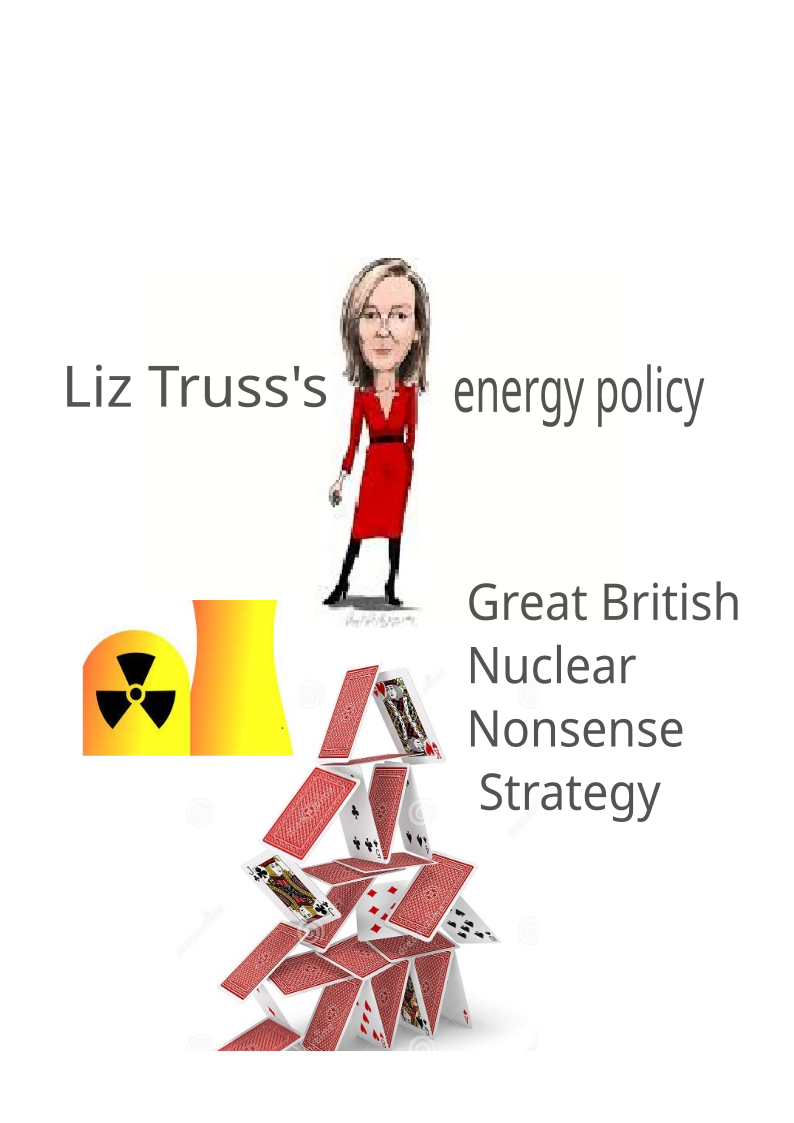
Liz Truss blocks energy saving campaign ‘on ideological grounds’.
Minister says government views public information campaign as ‘nanny
state’. Liz Truss has blocked plans for a public information campaign
asking people to save energy over the winter, reportedly because she is
“ideologically opposed” to the idea.
Ministers on Friday morning claimed
the idea was “nanny state” and confirmed that they would not be urging
people to keep an eye on their usage despite warnings from National Grid of
possibly rolling blackouts. Business secretary Jacob Rees-Mogg is said to
have been keen on a £15 million campaign as a relatively cost-effective
way of reducing the UK’s energy usage at a time of surging prices and
scarcity.
Independent 7th Oct 2022
Poland Goes Nuclear as NATO Breaks Past Promises

Originally posted on Centinel2012: Armstrong Economics Blog/War Re-Posted Oct 6, 2022 by Martin Armstrong The war in Ukraine escalated as a direct result of NATO’s interference. Russia felt backed into a corner, on the defensive, and felt it had no choice but to invade Ukraine in response to heightened tensions with NATO. Even the pope…
Poland Goes Nuclear as NATO Breaks Past Promises — Calculus of Decay
Hypocrisy and “Tactical” Nukes

Originally posted on Bracing Views: Don’t worry, it’s just a “little” tactical nuke! W.J. Astore With Russia issuing warnings about using all weapons at its disposal to protect its position in Ukraine, it’s a good time to talk about the distinction between “tactical” and “strategic” nuclear weapons. Put bluntly, there’s no real distinction. All nuclear…
Hypocrisy and “Tactical” Nukes — Calculus of Decay
Lessons from Hiroshima and nuclear power
https://beyondnuclear.org/lessons-from-hiroshima-and-nuclear-power October 6, 2022,
Illinois has become the first state to mandate the teaching of Asian American history in public schools to counteract the increase in Asian hate crimes.
This week’s guests on Nuclear Hotseat created a curriculum to teach 6th graders about Hiroshima, Nagasaki, nuclear energy, and the entire nuclear fuel chain. It has already been used as a pilot project in Spring of 2022 – and now it’s available for any teachers, anywhere, to incorporate into their classrooms as of the 2022-2023 school year.
- Hiroshima-born Dr. Yuki Miyamoto is a second generation Hibakusha – daughter of an atomic bomb survivor. She is a professor at DePaul University in Chicago, where she teaches nuclear discourse and environmental ethics at DePaul.
- Aiko Kojima Hibino serves as a board member of Raise Your Hand for Illinois Public Education, the nonprofit that engages, informs, and empowers parents to protect and strengthen public education. Aiko will start teaching “Nuclear Problems and Society” course for first-year college students starting in 2023.
Hurricane Ian caused devastation in Florida last week. Yet one 100% solar-powered town modeled exactly the path we must take — renewables not nuclear — as it survived Ian virtually unscathed, reports Linda Pentz Gunter in this week’s Nuclear Hotseat Hot Story.
Zaporizhzhia on the brink: How deteriorating conditions at the nuclear power plant could lead to disaster
Bulletin, By Zakhar Popovych, Denys I. Bondar, M.V. Ramana | October 7, 2022, Soon after it started its invasion of Ukraine on February 24, 2022, the Russian military occupied the southern part of the Zaporizhzhia region. The occupied area includes the territory of the Zaporizhzhia Nuclear Power Plant (NPP), the largest in Europe. During the summer, the area around the Zaporizhzhia NPP was hit multiple times by missiles and artillery. These affected all high-voltage electric power lines that connect the facility to the grid, so the plant was forced to work for some time in island mode, using the minimal power produced by one of the reactors to maintain functions essential to the plant’s safety. After the International Atomic Energy Agency (IAEA), the UN’s nuclear watchdog, conducted its inspection on September 1st, Ukrainian maintenance teams were allowed by the Russian military to repair the power lines and refill the diesel fuel storage tanks needed for emergency power generators. This made it possible to supply the facility with external power for the reactor cooling and other maintenance systems.
On September 10, the three of us had a conversation via Zoom with Pavlo Oleshuk, a representative of Atomprofspilka, the nuclear energy and industry workers’ union of Ukraine. Oleshuk is an experienced member of the team that operates the Rivne NPP in northwest Ukraine. As an organizer with the union, he has been in close and constant contact with the employees who directly operate the Zaporizhzhia NPP.
Oleshuk’s descriptions gave us new insight into the working and living conditions of his colleagues at the beleaguered plant. Such details have been otherwise difficult to get as plant operators have avoided talking in public ever since Russian forces seized the plant. Our discussion with Oleshuk lasted for more than two hours, and we offer here the main insights.
At the time we talked to Oleshuk, one of the reactors at the Zaporizhzhia NPP was still operating. However, shortly after our conversation, EnergoAtom, the Ukrainian state nuclear power plant operator, decided to shut down all reactors there. Despite this decision, there is a continued risk of a major nuclear incident as the plant requires permanent cooling. Furthermore, as our discussion with Oleshuk reveals, other factors exacerbate the fragility of the situation at the Zaporizhzhia NPP.
Context. Oleshuk began with a description of Zaporizhzhia NPP and the city of Energodar, which means literally “the gift of energy.”………………………………………………….
Working under threats and intimidation. The Zaporizhzhia NPP, the city of Energodar, and the surrounding areas have all been under Russian occupation for the past few months. According to Oleshuk’s sources at the plant, Russian armed forces first took control of the nearby territory and peacefully approached the personnel of the power plant claiming that they would not intervene with the operations of the plant. But once the armed forces entered the plant’s premises, so did personnel from the FSB—Russia’s principal security agency and successor to the old KGB—and a couple of experts from Rosatom, the Russian state nuclear energy corporation. …………………
For their part, the FSB personnel, unlike regular soldiers, violated the rules about who can access different areas of the plant and went everywhere within the premises, including inside radiation-controlled zones. But rather than taking control over the plant’s operations, the FSB agents seem to have been tasked with finding the so-called “ringleaders” who are organizing protests against the occupation ………………..
Over time, many more nuclear power plant workers have left Energodar for other cities that are still under the control of the Ukrainian government, creating a shortage of personnel at the Zaporizhzhia NPP. Even though some nuclear power plant maintenance functions can be carried out remotely, most cannot. As a result, there are concerns about the safety of these reactors and their associated systems.
Living without supplies. Because it is in Russian-occupied territory, residents of Energodar can no longer get their supplies from Ukraine-controlled territories, although they are located just across the Dnipro River. Instead, they must get them from other occupied territories—which means that even the supply of basic groceries is intermittent, with some food products simply no longer available………………….
Another major problem for the residents of Energodar is the collapse of utilities. ………………………
The supply of water supply has also become a problem since it relies exclusively on electric pumps and there are no water towers in Ukraine because the electricity supply was always considered to be reliable and abundant. ……………….
Outlook. With winter coming, the future is grim for the workers of the Zaporizhzhia NPP who still live in Energodar. Like other satellite cities, Energodar relies on the Zaporizhzhia NPP for most of its energy needs, including for heating……………………..
If both nuclear and thermal power plants cannot resume operation, then Energodar’s inhabitants will not be able to heat their living premises. The Ukrainian winter is cold with temperatures often being less than 20 degrees Celsius below zero (-4 degrees Fahrenheit). Plant workers don’t know how they will survive the winter.
Making an already desperate situation worse, there has been a loss of leadership and governance. The mayor of Energodar, Dmytro Orlov, was initially arrested by the Russians, but later managed to flee the city. The occupying forces did try to take over the city hall, but effectively the local authority has largely collapsed. The inhabitants are now left on their own.
According to Oleshuk, the situation is simply no longer tenable for the plant workers who are exhausted and stressed out. …………………more https://thebulletin.org/2022/10/zaporizhzhia-on-the-brink-how-deteriorating-conditions-at-the-nuclear-power-plant-could-lead-to-disaster/
First containers sealed into Dounreay low level waste vaults
First containers sealed into Dounreay low level waste vaults. Dounreay’s
waste team is carrying out the first in a series of campaigns to seal the
waste into place in the low level waste vaults.
As part of the waste disposal process, the spaces between the containers in the low level waste
vault are being filled with grout. The team undertook a series of trials to
confirm that the grout would readily flow between the containers and also
tested the membranes that will be used to seal the grout shutters. A first
campaign of grouting has now been completed within the vault and 16 waste
packages have been sealed into their final positions. Further grouting
campaigns of increasing size are planned.
NDA 5th Oct 2022
https://www.gov.uk/government/news/first-containers-sealed-into-dounreay-low-level-waste-vaults
October 7 Energy News — geoharvey

Opinion: ¶ “Michigan Has Potential To Reduce Emissions By Over 94%” • The 2030 Report: How Michigan Should Meet Its Climate Change Goals outlines the most feasible and ambitious set of policies that would help Michigan reduce health-harming pollution and greenhouse gases while putting the state on a strong path for meeting its climate goals. […]
October 7 Energy News — geoharvey
Does Russia sell nearly $1 billion in uranium to the U.S. a year?

If you can follow all this – well good luck to you!
https://www.washingtonpost.com/politics/2022/04/20/does-russia-sell-nearly-1-billion-uranium-us-year/ Analysis by Glenn KesslerThe Fact Checker, April 20, 2022 ,
“We are still sending about $100 million every month to Russia to buy uranium.”
— Sen. John Barrasso (R-Wyo.), interviewed on Fox News, April 13
“In 2021 Russian imports [of uranium] cost almost $1 billion, money that helped underwrite Mr. Putin’s war machine.”
— Barrasso, in an opinion article in the Wall Street Journal, April 12
The Biden administration has imposed sweeping sanctions on Russia since Moscow’s invasion of Ukraine, including eliminating preferential trading privileges and banning imports of Russian oil, liquefied natural gas and coal. So we were surprised to hear these numbers from Barrasso — that Russia received nearly $1 billion for uranium products in 2021 and is on track to earn $1.2 billion this year. The uranium is generally used as fuel to generate electricity in nuclear power plants.
Barrasso, the senior Republican on the Senate Energy and Natural Resources Committee, represents Wyoming, which has uranium mines that would benefit from a ban on Russian uranium. In fact, the domestic uranium mining industry has all but come to a halt, with production falling to an all-time low in 2019, as nuclear energy increasingly has relied on imports. That constituency might have made Barrasso a suspect source, though we have found that he does not routinely make up his numbers.
The Facts
Continue readingTwo Belgian nuclear reactors fail in a week
By Anne-Sophie Gayet | EURACTIV.com, Oct 7, 2022
Doel 2 nuclear reactor automatically stopped on Thursday after a short circuit in the operating system of the control rods, following the Thiange 3 reactor, which has been down since Monday.
Doel 2 nuclear reactor stopped working on Thursday after a short circuit which caused one of the control rods to be lowered, triggering an incident in the nuclear section of the reactor.
Engie says there is no safety threat, and the reactor should be operational again from Saturday morning.
…………… Doel 2 and Doel 1, which were supposed to be shut down earlier, have been prolonged for another 10 years and are now set to shut down in 2025.
Belgium has also agreed to extend the life of Doel 4 by ten years after it was due to be shut down in 2025.
The amendment to the law on nuclear phase-out to extend the life of Doel 4 will be voted on in parliament at the end of 2023.
The extension of Thiange 3 will also be voted on in parliament at the end of next year. Thiange 3 is the biggest Thiange reactor, with a capacity of 1038 MW, followed by Thiange 2 (1008 MW) and Thiange 1 (962 MW).
(Anne-Sophie Gayet | EURACTIV.com) https://www.euractiv.com/section/energy-environment/news/two-belgian-nuclear-reactors-fail-in-a-week/
The government’s price isn’t right for plutonium-contaminated land in Palomares (Almeria)
https://euroweeklynews.com/2022/10/07/the-governments-price-isnt-right-for-plutonium-contaminated-land-in-palomares-almeria/By Linda Hall • 07 October 2022
FIFTY-SIX years on, Palomares is still suffering the effects of its infamous “nuclear incident.”
This occurred on January 17 in 1966 when four unarmed thermonuclear bombs were released after two US aircraft crashed in mid-air over the Mediterranean.
One bomb was found far out to sea but three fell on Palomares, releasing plutonium and contaminating an area of two square kilometres. The US army decontaminated some of the land but much remains untreated.
Spain’s central government announced in early October that it would soon be completing its estimate of the value of the plutonium-affected properties it intends to acquire.
“This would appear to be the first step in the clean-up plan drafted more than 10 years ago,” provincial media sources said.
Buying up the land was in the public interest “to safeguard residents’ health and permit a close watch on the land”, the government said, allocating €345,127 for the compulsory purchase of 324,073 square metres of land.
According to the same sources, the 30 owners involved, who include developers and agricultural growers, dismissed the €1 per square metre compensation as “laughable.”
They maintained that this was particularly risible after Spain’s Energy, Environmental and Technological Research Centre (CIEMAT) recommended a price of €17 per square metre of rural land and €83 for building land in a 2007 report to the Nuclear Safety Council.
Most of the land in question is located within the Cuevas del Almanzora boundaries although five properties belong to Vera.


1 This Month

of the week – Shut Down Drone Warfare!


Tell the Ukrainian Government to Drop Prosecution of Peace Activist Yurii Sheliazhenko

Petition to revoke the licensing of the Near Surface Nuclear Disposal Facility (NSDF) at Chalk River. https://www.ourcommons.ca/petitions/en/Petition/Details?Petition=e-7247
To see nuclear-related stories in greater depth and intensity – go to https://nuclearinformation.wordpress.com
-
Archives
- April 2026 (107)
- March 2026 (251)
- February 2026 (268)
- January 2026 (308)
- December 2025 (358)
- November 2025 (359)
- October 2025 (376)
- September 2025 (257)
- August 2025 (319)
- July 2025 (230)
- June 2025 (348)
- May 2025 (261)
-
Categories
- 1
- 1 NUCLEAR ISSUES
- business and costs
- climate change
- culture and arts
- ENERGY
- environment
- health
- history
- indigenous issues
- Legal
- marketing of nuclear
- media
- opposition to nuclear
- PERSONAL STORIES
- politics
- politics international
- Religion and ethics
- safety
- secrets,lies and civil liberties
- spinbuster
- technology
- Uranium
- wastes
- weapons and war
- Women
- 2 WORLD
- ACTION
- AFRICA
- Atrocities
- AUSTRALIA
- Christina's notes
- Christina's themes
- culture and arts
- Events
- Fuk 2022
- Fuk 2023
- Fukushima 2017
- Fukushima 2018
- fukushima 2019
- Fukushima 2020
- Fukushima 2021
- general
- global warming
- Humour (God we need it)
- Nuclear
- RARE EARTHS
- Reference
- resources – print
- Resources -audiovicual
- Weekly Newsletter
- World
- World Nuclear
- YouTube
-
RSS
Entries RSS
Comments RSS
 nuclear-news