Black pigmentation in Chernobyl’s Eastern Tree Frogs
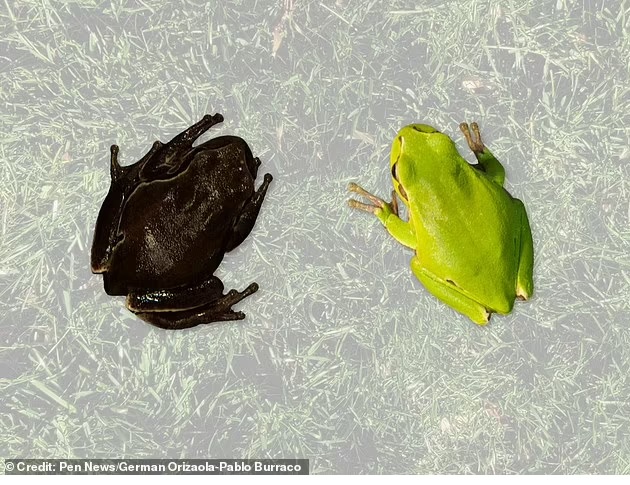
Chernobyl is spawning MUTANT frogs: Bizarre black amphibians are spotted near the nuclear plant – 36 years after its catastrophic meltdown
- Eastern tree frogs are meant to have bright green skin
- But scientists working near Chernobyl have found many with black skin
- They think the dark skin may have helped them to survive the exclusion zone
https://www.dailymail.co.uk/sciencetech/article-11290735/Chernobyl-spawning-MUTANT-frogs-Bizarre-black-amphibians-spotted-near-nuclear-plant.html By SHIVALI BEST FOR MAILONLINE and MICHAEL HAVIS, 7 October 2022
Mutant black frogs are spawning near the Chernobyl power plant, 36 years after its catastrophic meltdown unleashed one of the worst nuclear disasters in history.
Eastern tree frogs are meant to have bright green skin but scientists working near Chernobyl have found many with darker or black pigmentation.
In 1986, the site in northern Ukraine – then under Soviet rule – witnessed the largest release of radioactive material into the environment in human history.
Now scientists think the mutated frogs’ darker skin may have helped them survive in the exclusion zone, which today restricts access to 1,0000 sq miles around ground zero.
Germán Orizaola, a researcher at Spain’s University of Oviedo, who co-authored the new study, said: ‘We become aware of these frogs the very first night we worked in Chernobyl.
‘We were looking for this species near the damaged power plant and we detected many frogs that were just black.
‘We know that melanin is responsible for dark or black colouration in many organisms, including frogs.
‘At the same time, we know that melanin protects from the damage caused by different types of radiation, from UV to ionizing radiation – the kind at Chernobyl.’
For their study, Dr Orizaola and his co-author, Pablo Burraco, collected more than 200 male frogs from 12 different breeding ponds with different levels of radiation.
They found that frogs within the exclusion zone were much darker than those from outside it.
And though there was no correlation between the darkest frogs and the most irradiated places today, there was a correlation with the worst-affected places from the time of the accident.
In other words, the darker frogs had stood a better chance of survival when disaster struck in 1986, making them more numerous today.
Dr Orizaola said: ‘With this species it’s possible to find, under normal circumstances, a small percentage of frogs with unusual colouration.
No comments yet.
1 This Month

of the week – Shut Down Drone Warfare!


Tell the Ukrainian Government to Drop Prosecution of Peace Activist Yurii Sheliazhenko

Petition to revoke the licensing of the Near Surface Nuclear Disposal Facility (NSDF) at Chalk River. https://www.ourcommons.ca/petitions/en/Petition/Details?Petition=e-7247
To see nuclear-related stories in greater depth and intensity – go to https://nuclearinformation.wordpress.com
-
Archives
- April 2026 (114)
- March 2026 (251)
- February 2026 (268)
- January 2026 (308)
- December 2025 (358)
- November 2025 (359)
- October 2025 (376)
- September 2025 (257)
- August 2025 (319)
- July 2025 (230)
- June 2025 (348)
- May 2025 (261)
-
Categories
- 1
- 1 NUCLEAR ISSUES
- business and costs
- climate change
- culture and arts
- ENERGY
- environment
- health
- history
- indigenous issues
- Legal
- marketing of nuclear
- media
- opposition to nuclear
- PERSONAL STORIES
- politics
- politics international
- Religion and ethics
- safety
- secrets,lies and civil liberties
- spinbuster
- technology
- Uranium
- wastes
- weapons and war
- Women
- 2 WORLD
- ACTION
- AFRICA
- Atrocities
- AUSTRALIA
- Christina's notes
- Christina's themes
- culture and arts
- Events
- Fuk 2022
- Fuk 2023
- Fukushima 2017
- Fukushima 2018
- fukushima 2019
- Fukushima 2020
- Fukushima 2021
- general
- global warming
- Humour (God we need it)
- Nuclear
- RARE EARTHS
- Reference
- resources – print
- Resources -audiovicual
- Weekly Newsletter
- World
- World Nuclear
- YouTube
-
RSS
Entries RSS
Comments RSS
 nuclear-news
Leave a comment