Nuclear fuel reprocessing plant hit by 26th postponement

THE ASAHI SHIMBUN, by Shuichi Doi, Makoto Takada, Ryo Sasaki, Junichi Miyagawa and Takuro Yamano.) September 29, 2022 ,
ROKKASHO, Aomori Prefecture—Frustration, impatience and costs continue to soar as Japan’s nuclear fuel cycle policy has again reached an impasse.
The completion date for a spent nuclear fuel reprocessing plant here, a key component in the cycle policy, was pushed back for the 26th time.
Japan Nuclear Fuel Ltd., the operator of the facility, notified Aomori Prefecture and Rokkasho village of the latest delay on Sept. 7.
The reprocessing plant was scheduled for completion in the first half of fiscal 2022…………….
ENDLESS SAFETY FLAWS
Construction of the reprocessing plant started in 1993, followed by a string of problems.
A water leak was reported at a storage pool for spent nuclear fuel in 2001. Rainwater was found leaking into an emergency power source building in 2017.
The NRA decided to suspend screening of the plant in light of these and other safety flaws.
As recently as in July this year, equipment to cool highly radioactive waste fluid stopped working for eight hours.
The construction cost of the reprocessing plant was initially estimated at 760 billion yen ($5.34 billion). The price tag is now 3.1 trillion yen.
The total sum, including the 40-year running costs and the expenses needed to scrap the plant following its closure, is projected to reach 14.4 trillion yen.
Masuda indicated the price may rise further.
“Nuclear power may not be adopted in Japan if electricity production costs keep rising,” Masuda told a news conference.
The operator’s basic safety policy for the reprocessing plant met the NRA’s new standards in July 2020. But the facility’s design, submitted in December that year, is still being studied.
So far, the NRA has said data is missing and the design contains insufficient precautions.
At one time, Japan Nuclear Fuel was supposed to submit a document, but it failed to even prepare it.
At a news conference in January this year, NRA Chairman Toyoshi Fuketa, alluding to the safety problems, raised serious doubts about Japan Nuclear Fuel’s chances of finishing construction by the first half of fiscal 2022.
“It appears overly ambitious,” Fuketa said. “It seems impossible to foretell the schedule under these circumstances.”
DEADLOCK OVER POLICY
Despite all the setbacks, the government continues to pursue the nuclear fuel cycle policy.
Under the plan, spent nuclear fuel would be reprocessed at the Rokkasho plant, and extracted plutonium could be reused for nuclear power generation……………………………
About 3,000 tons of spent nuclear fuel from plants around Japan is now stored at the reprocessing plant, nearing its capacity.
Spent fuel kept at Japan’s nuclear plants has reached around 80 percent of capacity as well.
If reactors resume operations while the reprocessing plant is still not functioning, Japan could quickly run out of space to store spent nuclear fuel, and the power plants could be forced to suspend operations.
A final dumpsite for highly radioactive waste generated from reprocessing the spent fuel has also not been determined. https://www.asahi.com/ajw/articles/14718632
Two UK nuclear stations were due for closure in 2014. Now EDF wants to extend their lifetime yet again.

EDF considers extending life of two UK nuclear plants due to energy crisis. Hartlepool and Heysham 1, operational for four decades, are due to close in 2024 but EDF says that is under review.
Guardian Alex Lawson Energy correspondent, 29 Sep 2022
France’s EDF is considering extending the life of two British nuclear power plants due to the severity of the energy crisis.
EDF said on Wednesday that it would review whether there was a case to keep open the Hartlepool nuclear power plant in County Durham and Heysham 1 on the north-west coast of England near Lancaster. Both plants had been scheduled to close in March 2024.
EDF operates all of Britain’s eight nuclear power plants, five of which are still providing power to the grid, about 13% of the UK’s electricity. The entire fleet is due to shut by 2028 apart from Sizewell B, which will close in 2035.
When EDF took over the nuclear fleet in 2009, Heysham 1 and Hartlepool were due to run until 2014. After technical reviews, that was extended to 2019 and then, in 2016, a further five-year extension was approved after further reviews.
Sources said any extra lifespan for the stations was likely to be far shorter than previous extensions……..
EDF said it had decided to launch the review “in light of the severity of the energy crisis and the results of recent graphite inspections” and said an extension would “depend on the results of graphite inspections over the coming months”…………………………………………………………
Some power-generation companies, including those on nuclear, old solar and windfarm contracts have landed an unexpected windfall from the jump in electricity prices while their costs have not risen, triggering calls for a windfall tax……………………….. https://www.theguardian.com/environment/2022/sep/28/edf-considers-extending-life-of-two-uk-nuclear-plants-due-to-energy-crisis-hartlepool-heysham
Both sides need to acknowledge their mistakes, especially regarding Crimea and the Donbass
At the end of this presentation, we see that the blame is shared, but not equally. The West recognized the 2014 coup; it tried to stop the ensuing massacre, but ultimately let the full nationalists continue it; it armed Ukraine instead of forcing it to comply with the Minsk 1 and 2 agreements. Russia, for its part, built a bridge that locks the Sea of Azov without consultation. Peace will only be preserved if both sides recognize their mistakes.
Are we able to do this?
Crimea, which had already voted in a referendum to become part of the future independent Russia when the USSR was dissolved, six months before the rest of the Ukrainian Soviet Republic declared its independence, voted again in a referendum. For four years, Crimea was claimed by both Russia and Ukraine. Moscow argues that between 1991 and 1995, it and not Kiev was paying pensions and salaries of officials in Crimea. In fact, Crimea was always Russian, even if it was considered part of Ukraine. In the end, it was Russian President Boris Yeltsin who, in the midst of a severe economic crisis, decided to abandon Crimea to Kiev. However, Crimea then voted for a constitution recognizing its autonomy within Ukraine, which Kiev never accepted. The second referendum, in 2014, overwhelmingly proclaimed independence. The Crimean Parliament then called for the attachment of its state to the Russian Federation, which the latter accepted. To strengthen the continuity of its territory, Russia built, without consulting Ukraine, a gigantic bridge linking its metropolis to the Crimean peninsula across the Sea of Azov, effectively privatizing this small sea.
How to Stop the Escalation to War,
Voltaire.net, by Thierry Meyssan, Translation, Roger Lagassé, 27 Sept 22,
The Ukrainian conflict is turning into a war between the West on one side and Russia and China on the other. Each side is convinced that the other one wants its loss. And fear is a bad advisor. Peace can only be preserved if each side recognizes its mistakes. This must be a radical change, because today neither Western discourse nor Russian actions correspond to reality.
o political leader wants a war on his territory. When they do, it is usually out of fear. Each side fears the other, rightly or wrongly. Of course, there are always a few elements that push for a cataclysm, but they are fanatical and in the minority.
This is exactly the situation in which we find ourselves. Russia is convinced, rightly or wrongly, that the West wants to destroy it, while the West is identically convinced that Russia is conducting an imperialist campaign and will eventually destroy its freedoms. In the shadows, a very small group, the Straussians, want confrontation.
This is not to say that World War III is just around the corner. But if no political leader radically changes his or her foreign policy, we are walking directly into the unknown and must prepare for absolute chaos.
To clear up misunderstandings, we must listen to the narratives of both sides.
Moscow believes that the overthrow of democratically elected President Viktor Yanukovych was a coup d’état orchestrated by the United States. This is the first point of divergence as Washington interprets the events as a “revolution”, the “EuroMaidan” or “Dignity” revolution. Eight years later, numerous Western testimonies attest to the involvement of the US State Department, the CIA and the NED, Poland, Canada and finally NATO.
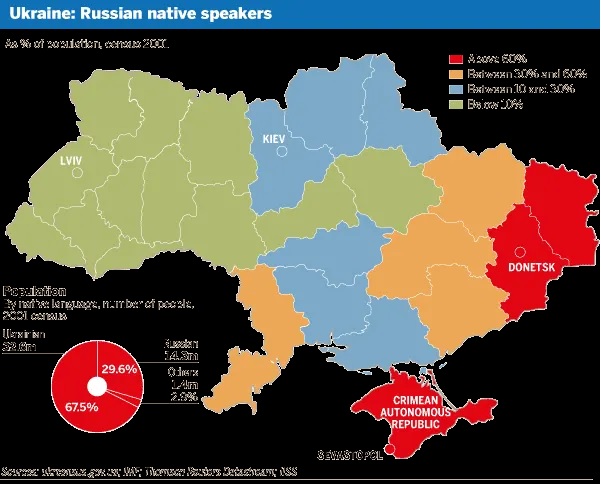
The people of Crimea and Donbass refused to endorse the new power, which included many “integral nationalists”, successors of the defeated of the Second World War.
Crimea, which had already voted in a referendum to become part of the future independent Russia when the USSR was dissolved, six months before the rest of the Ukrainian Soviet Republic declared its independence, voted again in a referendum. For four years, Crimea was claimed by both Russia and Ukraine. Moscow argues that between 1991 and 1995, it and not Kiev was paying pensions and salaries of officials in Crimea. In fact, Crimea was always Russian, even if it was considered part of Ukraine. In the end, it was Russian President Boris Yeltsin who, in the midst of a severe economic crisis, decided to abandon Crimea to Kiev. However, Crimea then voted for a constitution recognizing its autonomy within Ukraine, which Kiev never accepted. The second referendum, in 2014, overwhelmingly proclaimed independence. The Crimean Parliament then called for the attachment of its state to the Russian Federation, which the latter accepted. To strengthen the continuity of its territory, Russia built, without consulting Ukraine, a gigantic bridge linking its metropolis to the Crimean peninsula across the Sea of Azov, effectively privatizing this small sea.
Crimea is home to the port of Sevastopol, which is indispensable to the Russian navy. The latter represented nothing in 1990, but became a power again in 2014.
The West recognized the Soviet referendum in Ukraine in 1990, but not the one in 2014. Yet the right of peoples to self-determination does apply to the Crimeans. The West argues that many Russian soldiers were present without wearing their uniforms. True, but the results of the two referendums in 1990 and 2014 were similar. There is no room for suspicion of fraud.
To show that they did not accept this “annexation”, the West collectively imposed sanctions on Russia, without authorization from the Security Council. These sanctions violate the UN Charter, which gives exclusive authority to the Security Council.
The Donetsk and Luganks oblasts have also rejected the 2014 coup government. They proclaimed their autonomy and posed as resisters to the “Nazis” in Kiev. Equating “integral nationalists” with “Nazis” is historically justified, but does not allow non-Ukrainians to understand what is going on.
The “integral nationalist” was created in Ukraine by Dmytro Dontsov at the very beginning of the 20th century. Initially, Dontsov was a left-wing philosopher, only gradually moving to the extreme right. He was a paid agent of the Second Reich during the First World War, before participating in the Ukrainian government of Symon Petliura, which arose during the Russian Revolution of 1917. He participated in the Paris Peace Conference and accepted the Treaty of Versailles. During the inter-war period, he exercised a mastery over Ukrainian youth and became a propagandist of fascism, then of Nazism.
He became violently anti-Semitic, preaching for the massacre of the Jews long before this theme was supported by the Nazi authorities, who spoke only of expulsion until 1942. During the Second World War, he refused to take over the leadership of the Organization of Ukrainian Nationalists (OUN), which he entrusted to his disciple Stepan Bandera, assisted by Yaroslav Stetsko.
Almost all the documents about his activity within Nazism have been destroyed. It is not known what he did during the war, except for his active participation in the Reinhard Heydrich Institute after the latter’s assassination. The newspapers of this anti-Semitic organ gave him a lot of space
At the Liberation, he fled to Canada, under the protection of the Anglo-Saxon secret services, and then to the United States. At the end of his life, he was still as virulent as ever and had evolved into a form of Viking mysticism, preaching the final confrontation against the “Muscovites. Today, his books, especially his Nationalism, are required reading for militiamen, especially those in the Azov Regiment. Ukrainian “integral nationalists” massacred at least 3 million of their fellow citizens during World War II.
Washington reads this history differently. For it, the “integral nationalists” certainly made mistakes, but they were fighting for their independence against both the German Nazis and the Russian Bolsheviks. The CIA was therefore right to host Dmytro Donsov in the USA and to employ Stepan Bandera on Radio Free Europe. And even more, to create the World Anti-Communist League around the Ukrainian Nazi Prime Minister, Yaroslav Stetsko, and the leader of the Chinese anti-communist opposition, Chiang Kai-shek. Today, again according to Washington, these facts belong to the past.
In 2014, with President Petro Poroshenko, the Kiev government cut off all aid to the “Muscovites” of Donbass. It stopped paying pensions to its citizens and salaries to their civil servants. It banned the Russian language, spoken by half of Ukrainians, and launched punitive military operations against these “sub-humans”, killing 5,600 and displacing 1.5 million in 10 months. In the face of these horrors, Germany, France and Russia imposed the Minsk agreements. The aim was to bring the Kiev government to its senses and to protect the people of the Donbass.
Noting that the first agreements had not been followed by effect. Russia had the Minsk 2 agreement endorsed by the Security Council. This was resolution 2202, adopted unanimously. During the explanations of vote, the United States developed its interpretation of this period. For them, the “resistance” in Donbass were only “separatists” supported militarily by Moscow. They therefore specified that the Minsk 2 agreement (February 12, 2015) did not replace the Minsk 1 agreements (September 5 and 19, 2014), but added to them. They thus demanded that Russia withdraw the troops it had deployed without uniform in the Donbass. Germany and France had a joint statement added, co-signed by Russia, guaranteeing the “binding” implementation of this set of “commitments.”
However, shortly afterwards, President Poroshenko declared that he had no intention of implementing anything and resumed hostilities, a position that the government of President Zelensky has reiterated. In the seven years following resolution 2202, 12,000 new victims were killed, according to Kiev, or 20,000, according to Moscow.
During this period, Moscow did not intervene. President Vladimir Putin not only withdrew his troops, but also forbade an oligarch to send mercenaries to support the people of Donbass. The latter have been abandoned by the guarantors of the Minsk agreements and by the other members of the Security Council.
In the Russian way of politics, one waits until one is in a position to do something before announcing it. So Moscow did not say anything, but prepared for what was to come. Suffering from the sanctions it had endured since the annexation of Crimea, it expected the West to tighten them when it intervened to implement resolution 2202. So Putin approached other sanctioned states, including Iran, to circumvent the sanctions on him and prepare to circumvent others. Anyone who regularly visits Russia will have noticed that the Putin administration is developing food autarky, including for meat and cheese, which his country had previously lacked. Russia has moved closer to China in banking, which we have wrongly interpreted as a move against the dollar. In reality, it was a preparation for the exclusion of the SWIFT system.
When President Putin launched his army into Ukraine, he made it clear that he was not declaring a “war” to annex Ukraine, but was implementing a “special military operation” under Resolution 2202 and his “responsibility to protect” the civilian population of Donbass.
As expected, the West responded with economic sanctions that severely disrupted the Russian economy for two months. Then things turned around and these sanctions turned out to be profitable for Russia, which had prepared for them for a long time.
On the ground, the West sent a lot of weapons, then deployed military advisors and some special forces. The Russian army, three times smaller in number than the Ukrainian army, began to suffer. It has therefore just decreed a partial mobilization to send new troops without having to dismantle its national defence system.
Nato, for its part, has developed a plan to mobilize a core group of states and an expanded group of its more distant allies. The idea is to spread the financial effort over as many partners as possible until Russia is exhausted.
Moscow responded by announcing that if the West took a further step, it would use its new weapons.
The Russian and Chinese armies have mastered hypersonic launchers, which the West lacks. Moscow and Beijing can destroy any target, anywhere in the world, in a matter of minutes. It is impossible to stop them, and this imbalance will last at least until 2030, according to US generals. Russia has already said that it will strike first at the British Foreign Office, which it considers to be the head of its enemies, and the Pentagon, which it considers to be its armed wing. In the event of an attack, the Russian and Chinese armies would first destroy the United States’ strategic communication satellites (CS3). The latter would lose in a few hours the possibility of guiding nuclear missiles and therefore of retaliating. There is little doubt about the outcome of such a war.
……………Engaging in this confrontation is not impossible. In the United States, the Straussians, a very small group of unelected politicians, are determined to bring about the apocalypse. In their view, the United States will no longer be able to exercise dominance over the entire world, but it can still achieve it over its allies. To do this, they must not hesitate to sacrifice some of their own, if their allies suffer even more than they do and if, in this way, they remain the first (not the best).
As in all conflicts, people are afraid and some individuals push them to war.
Russia has just held four referendums on self-determination and annexation, both in the two republics of Donbass and in two oblasts of Novorossia. The view of the G7, whose foreign ministers were attending the UN General Assembly in New York, was immediately to denounce the referendums as invalid because they were held in a war situation, which is a debatable opinion. So they went on to denounce a violation of the sovereignty and territorial integrity of Ukraine and the principles of the UN Charter. These last points are false. By definition, the right of peoples to self-determination does not violate the sovereignty and territorial integrity of the state from which they can, if they wish, separate. Moreover, all the members of the G7 (except Japan) have signed the Helsinki Final Act, in which they undertake to defend all these principles simultaneously.
It is particularly odious to note the way in which the G7 interprets the right to self-determination to its advantage. For example, the United Nations General Assembly has condemned the illegal occupation by the United Kingdom of the Chagos Archipelago. It ordered that it be returned to Mauritius by October 22, 2019. Not only has this not been done, but one of the Chagos Islands, Diego Garcia, is still illegally leased to the United States to house the largest military base in the Indian Ocean. Moreover, France illegally transformed its colony of Mayotte into a department in 2009. It held a referendum in violation of General Assembly resolutions 3291, 3385 and 31/4, which affirm the unity of the Comoros and prohibit referendums in only one of its parts, the state of the Comoros and the French colony of Mayotte. It is precisely to avoid decolonization that France has organized this referendum, given that it has installed a maritime military base there and above all a military interception and intelligence base.
From a Russian point of view, these referendums, if internationally recognized, would put an end to military operations. By refusing them, the West is prolonging the conflict. Their intention is to see the rest of Novorossia fall into the hands of Russia. If Odessa becomes Russian again, Moscow will have to accept the accession of the adjacent Transnistria to the Russian Federation. Transnistria is not Ukrainian, but Moldovan, hence its current name of Dniester Moldavian Republic.
Russia refuses to accept a Moldavian territory that has historical reasons to proclaim itself independent. But it did not accept it either with South Ossetia and Abkhazia, which also have historical reasons to proclaim themselves independent, but are Georgian. Neither Moldova nor Georgia have committed crimes comparable to those of modern Ukraine.
At the end of this presentation, we see that the blame is shared, but not equally. The West recognized the 2014 coup; it tried to stop the ensuing massacre, but ultimately let the full nationalists continue it; it armed Ukraine instead of forcing it to comply with the Minsk 1 and 2 agreements. Russia, for its part, built a bridge that locks the Sea of Azov without consultation. Peace will only be preserved if both sides recognize their mistakes.
Are we able to do this? https://www.voltairenet.org/article218093.html
Pilgrim power plant owner Holtec still considering dumping nuclear waste into Cape Cod Bay
Holtec International has 1.1 million gallons of radioactive wastewater to get rid of.
Boston.com By Susannah Sudborough, September 28, 2022 ,
The company working to decommission the Pilgrim Nuclear Power Plant in Plymouth is still considering dumping radioactive waste into Cape Cod Bay despite pushback from activists, lawmakers, and the EPA.
Holtec International has 1.1 million gallons of leftover wastewater from the plant, which closed in 2019, that it needs to get rid of.
NBC 10 Boston reported Tuesday that a representative from Holtec gave an update on the company’s plans at a town hall meeting Monday evening.
“When you do liquid discharges, it is diluted with seawater to non-detectable levels pretty quickly once it’s released, and doing it in small batches is actually the safest manner,” Holtec spokesman Patrick O’Brien told the news station.
But activists from Save Our Bay, a coalition of conservation groups, local leaders, and citizens who oppose the proposed dumping, say Holtec wants to dump the nuclear waste in Cape Cod Bay simply because it’s cheaper.
While O’Brien denied to NBC 10 Boston that dumping is the cheaper option, the group, which protested in Plymouth before the meeting Monday, says the waste will make the bay’s and local waters unsafe.
“The contaminated water will inevitably flow into Plymouth, Duxbury, and Kingston Bays. The bays are semi-enclosed, and circulation currents tend to keep the water in them. It [does] not quickly flush out and disperse in the ocean, but is likely to end up in the sediments at the bottoms of the bays or beaches,” the group wrote on its website.
Additionally, Save Our Bay says, the nuclear waste could contaminate the fish, oysters, clams, and mussels that support the local aquaculture industry, making a major local product dangerous.
The loss of the local fishing and potentially tourism, due to contaminated waters would devastate the local economy, the group says.
Save Our Bays is not alone in opposing the proposed dumping. In January 2022, Sen. Elizabeth Warren, Sen. Ed Markey, Rep. Bill Keating, and Rep. Seth Moulton sent a letter to Holtec stating their opposition.
Additionally, in July, the EPA wrote to the company saying it doesn’t think the company is allowed to dump the waste according to its permit.
According to The Boston Globe, Nuclear Regulatory Commission rules say Holtec can dump the water as long as its radioactivity is not above specified limits……………………….
A decision could come early next year, NBC 10 Boston reported. https://www.boston.com/news/local-news/2022/09/28/pilgrim-power-plant-owner-considering-dumping-nuclear-waste-into-cape-cod-bay-holtec-international-plymouth/—
Missile strike near Ukrainian nuclear plant raises new fears. But the real question is why is it there at all?
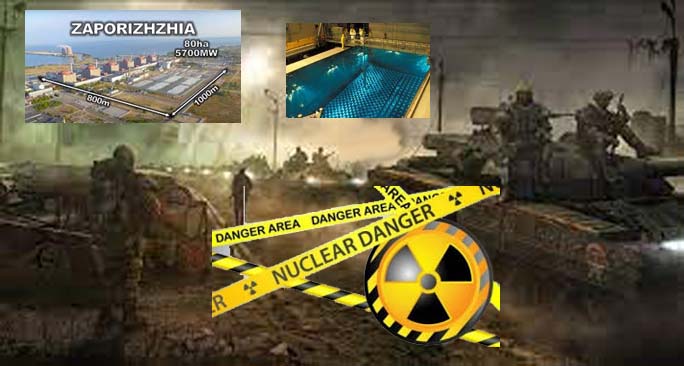
https://beyondnuclearinternational.org/2022/09/26/another-close-call/ By Linda Pentz Gunter, 28 Sept 22,
“What is Russia thinking?” asked CNN news anchor Ana Cabrera of her guest, retired Air Force colonel, Cedric Leighton, after reports that Russian missiles landed within 328 yards of the South Ukraine nuclear power plant on September 19.
But here’s the question that should have been asked — but rarely is: why are we still using such a profoundly dangerous technology to generate electricity? What are WE thinking? (We will leave aside here the conflicting accusations about who is shelling the reactors. The point is their very presence in a war zone and all that implies.)
Nothing has brought that risk into sharper focus than the Russian invasion of Ukraine, where 15 operational reactors at four sites are sitting duck targets that could release a radioactive nightmare if struck — whether accidentally or deliberately — by either side as battle rages.
When the invasion began on February 24, it was the closed Chornobyl site — scene of the world’s worst, and most notorious, nuclear power plant disaster in 1986 — that was first occupied. Although none of the four reactors there are operating any longer, there is a significant radioactive waste inventory on site. This was stirred up by Russian forces and their heavy equipment. Soldiers even dug sleeping trenches, apparently unaware of the radiation exposure risks that resulted.
This time around, however, Chornobyl is of lesser concern than the four other nuclear sites in Ukraine, although it remains a potential disaster scene largely due to the irradiated fuel stocks on site.
The four active nuclear sites — at Rivne and Khmelnitsky in western Ukraine, and South Ukraine and Zaporizhzhia in the south and eastern regions— are generally described as “newer” than Chornobyl, but this is only true in the technological sense. Chornobyl was an old Soviet RBMK design, lacking containment. Incredibly, Russia still reportedly operates 10 Chornobyl-style RBMK reactors, albeit modified to try to avoid the fatal design flaws that contributed to the 1986 explosion and meltdown.
The operating reactors in Ukraine are VVER pressurized water reactors similar to those used in the United States, for example. The VVER is also a Russian design but with an actual containment, so in theory, more robust than the old RBMKs. However, there is a great deal of doubt that the VVERs, like any reactor today, are robust enough to withstand an onslaught of missiles under war conditions.
Yet, in another sense, the VVER reactors are far older than Chornobyl Unit 4 was when it exploded. That reactor had only been operating approximately two years when disaster struck. The present day 1,000 megawatt reactors in Ukraine have been operational mostly since the 1980s, accumulating much larger radioactive inventories.
As Beyond Nuclear has continued to warn, the radiological — and therefore health — consequences of a major breach of one of these reactors would be far worse than those of the 1986 Chornobyl accident.
But it needn’t take a war. The dangers presented by commercial nuclear power plants are inherent. They are there every day. They are made worse by warfare, which increases the likelihood of a nuclear disaster — and that same war now also increases the danger that nuclear weapons might be used.
And yet, as we continue to “play with fire”, as even IAEA chief, Rafael Grossi described the insanity of shelling near or at nuclear plants in Ukraine, the obvious connection isn’t made.
We’ve seen scientists and media outlets map out how far a deadly radioactive plume would spread if, say, Zaporizhzhia suffered a fatal missile strike. But scarcely if ever do they go on to observe that we are only holding our collective breath so tightly because of the persistent threat that these reactors pose on any given day.
We don’t need to use nuclear power today. We never needed it. And it is a totally insane way to boil water.
Linda Pentz Gunter is the international specialist at Beyond Nuclear and writes for and curates Beyond Nuclear International.
“A broken system allows nine nations to hold the world hostage” — IPPNW peace and health blog

Molly McGinty speaks for IPPNW at the UN: “We reject the complacency of nuclear-armed states and their allies, and thank those who have paved the path to abolition.” [IPPNW’s Associate Program Director Molly McGinty delivered the following remarks at the High-Level Meeting of the International Day for the Total Elimination of Nuclear Weapons on 26 […]
“A broken system allows nine nations to hold the world hostage” — IPPNW peace and health blog
Save the fish: Nuclear Free Local Authorities call for acoustic deterrent at Sizewell C
https://www.nuclearpolicy.info/news/save-the-fish-nuclear-free-local-authorities-call-for-acoustic-deterrent-at-sizewell-c/ 28 Sept 22, The Nuclear Free Local Authorities have written to the Environment Agency calling for the developers of a new nuclear power plant at Sizewell C to be required to install an acoustic fish deterrent to save local fish stocks from destruction should the plant become operational.
The Environment Secretary George Eustace has recently decided that EDF Energy should be required to install a similar device at Hinkley Point C, a new nuclear plant currently being built on the Somerset coast, and as Sizewell C would be built to the same design the NFLA can see no reason why the same condition should not be applied to the Suffolk plant.
Councillor David Blackburn, Chair of the NFLA Steering Committee, has just written to the Environment Agency responding to a consultation over the permits that will be issued to EDF by the Environment Agency now that a Development Consent Order has been granted by a government minister.
Commenting he said: “We are still a very long way from Sizewell C becoming operational and it is far from a done deal. Most of the finance is not in place, there remains doubts about the safety and reliability of the proposed EDR reactor, EDF appears to be having cold feet given its financial position and poor operational performance at home, and local activists are looking to challenge the decision to go-ahead in the courts.
“I hope that the decision to grant approval can be successfully challenged in the courts or that EDF’s many troubles elsewhere may still kibosh the plan, but if somehow, despite the odds, this insane plan goes ahead it is important that we ensure that high standards are encapsulated in the conditions attached to the operation of Sizewell C to protect the natural environment and the people who live in adjoining communities – at least as far as is possible when your neighbour is a huge nuclear power plant.”
Although the NFLA submission to Environment Agency covers many points but two particular concerns are plans for long-term salination and the welfare of marine life.
Councillor Blackburn further explained: “We are grateful to Sizewell C for their advice on our response to this consultation; we completely share their concerns about the adverse impact of this plant on the lives of local people and the local environment. Our two key points in our response are that should EDF Energy look to desalination as a long-term solution to the lack of potable water that an extensive public consultation should take place prior to a decision on approval and that an acoustic fish deterrent should be installed at Sizewell C.
“The Environment Secretary has creditably recently upheld his inspector’s decision to require EDF Energy to install an Acoustic Fish Deterrent at Hinkley Point C. The EPR reactors proposed for Sizewell C will be the same as those proposed for Hinkley Point C. Both sites will be heavily reliant upon sucking in vast amounts of seawater to cool the plant, the impact on local sea life is likely to be similarly destructive. Accordingly, the NFLA believes that an acoustic fish deterrent, which projects sound waves to deter fish entering the plant, should be installed at Sizewell C as a condition of any permit issued by the Environment Agency giving the go ahead.”
New Zealand Calls It Quits On Aiding Ukraine’s Military
https://www.zerohedge.com/geopolitical/new-zealand-calls-it-quits-aiding-ukraines-military BY TYLER DURDEN, WEDNESDAY, SEP 28, 2022.
At a moment Washington continues what’s essentially an endless arms and financial aid pipeline to Ukraine, and as some defense officials express concerns over the Pentagon’s own dwindling stockpiles, one country says it’s giving up on arming Kyiv.
New Zealand, which is one of the “Five Eyes” intelligence-sharing partners which includes the US, now says it can no longer keep up with supplying what Ukraine is asking for without depleting its stockpiles.
“The New Zealand government has expanded sanctions on key Russians, but cannot provide further military assistance as it has nothing Ukraine wants,” The Canberra Times reports Tuesday.
Defense Minister Peeni Henare said his country stands “ready to provide further lethal aid if Ukraine’s needs matched its stockpiles.”
The top defense official then confirmed it is currently the case that the military cannot keep up:
Asked on Tuesday whether New Zealand had considered further military support, Mr Henare said the requests didn’t match “on our current assessment and according to the requests in the donor meetings I’ve been on”.
“On those donor calls, they’ve come asking and it’s for HIMARS, land-to-air defence systems and also land-to-sea defence systems,” he said.
So far, New Zealand’s contribution has been meager – given also it’s a tiny Pacific island nation – compared to European countries, and has been focused on defensive equipment such as body armor.
“If they were things we were to procure, they would take years but that hasn’t stopped us providing military aid,” PM Jacinda Ardern commented this week on the logistical challenges in procuring and then shipping weapons abroad.
But as a major non-NATO ally of the United States and major intelligence-sharing partner, New Zealand is without doubt assisting the US mission in support of Ukrainian forces in this arena. It is also vowing more sanctions, and has typically signed off on whatever fresh US and EU anti-Russia sanctions are rolled out.
White House requests Ukraine nuclear security funding to expand assistance due to nuclear power plant concerns
By Phil Mattingly, CNN, September 27, 2022,
The White House requested $35 million be included in the short-term government funding bill to assist Ukraine’s nuclear security as US officials continue to closely watch the precarious conditions around Europe’s largest nuclear power plant, according to an administration official.
The additional funds would serve to bolster the significant assistance already provided by the US National Nuclear Security Administration to Ukrainian officials in the months since Russia invaded the country, the official said. It comes as US officials and their international counterparts have been on high alert over the potential for a nuclear accident at the Zaporizhzhia nuclear power plant in southern Ukraine.…………………….
The facility, held by Russian troops since March, has for weeks served as an increasingly hazardous flashpoint in the war. Shelling at and around the site has damaged infrastructure, cut power lines and drawn a sustained international effort to de-escalate the situation. Russia and Ukraine have blamed each other for the shelling…………………… https://edition.cnn.com/2022/09/27/politics/ukraine-funding-request-nuclear-power-plant/index.html
Iran Nuclear Deal Talks at Dead End, Biden Admin Tells Congress in Classified Briefing
Adam Kredo • September 28, 2022, The Biden administration’s negotiations with Iran over a revamped version of the 2015 nuclear deal have hit a dead end, jeopardizing the likelihood of a new agreement, senior U.S. officials informed Congress during a classified briefing…………………………………. more https://freebeacon.com/national-security/iran-nuclear-deal-talks-at-dead-end-biden-admin-tells-congress-in-classified-briefing/
Maryland couple pleads guilty to selling nuclear-related secrets
The couple was charged with selling nuclear information to a foreign country.
abc news, By Aaron Katersky and Luke Barr, September 28, 2022,
Jonathan and Diana Toebbe pleaded guilty for a second time on Tuesday to federal charges that they tried to sell secrets about U.S. submarine nuclear propulsion systems to a foreign country.
The couple originally pleaded guilty in February but a judge threw out the plea agreements last month after deciding the sentences called for were too low……………………………………………….
The new plea agreement appeared to call for a sentence of about 12 years in prison, four times as long as Diana Toebbe’s prior agreement. Magistrate Judge Robert Trumble accepted her plea but noted a different judge would determine whether the new sentencing terms were sufficient.
Jonathan Toebbe, 43, also pleaded guilty to a single count of conspiring to communicate restricted data pursuant to an agreement that calls for a sentence of up to 17 years in prison. https://abcnews.go.com/Politics/maryland-couple-pleads-guilty-selling-nuclear-related-secrets/story?id=90581860
Subsidies to Nuclear Power in the Inflation Reduction Act still won’t save the poor economics of nuclear power – Cato Institute
Subsidies to Nuclear Power in the Inflation Reduction Act, Cato Institute By David Kemp and Peter Van Doren, 28 SEpt 22, Last month, the United States enacted the Inflation Reduction Act (IRA),……… The act includes many provisions to subsidize clean power plants, including nuclear generators.
Many believe that nuclear is the perfect solution to climate change…….. Our recent working paper examines the economics of nuclear power and concludes that it is very high‐cost relative to natural gas generators. Most importantly in the context of climate change, we also determine that the potential climate benefits of nuclear are insufficient to offset its costs.
From the 1960s to 1980s, many nuclear power plants were built, but nuclear construction costs rose dramatically resulting in a severe decline in new construction. Very few plants have been built in the United States and Western Europe in the past several decades. In fact, the most recent projects in the West (the United States, France, the United Kingdom, and Finland) have experienced numerous issues with quality control, supply chains, and labor force management, leading to a more than doubling of construction schedules and costs. The fact that nuclear construction costs increased dramatically in countries with different regulatory regimes suggests that the problem is not simply overly cautious regulators.[1]………………..
Nuclear power is capital intensive. Thus, its levelized cost of electricity (LCOE) depends mostly on its construction cost. To model different scenarios, our calculations use three levels of construction costs for nuclear. The highest level (a cost of $9,000 per kilowatt of capacity constructed) represents the average construction costs of the West’s most recent projects. The middle and low levels ($6,700 and $4,000 per kilowatt, respectively) envision substantial reductions in nuclear construction costs through some combination of regulatory reform, improvements to construction management, or innovation. The low level, which is nearly 65 percent lower than the most recent nuclear project in the United States (the Vogtle plant in Georgia where ongoing construction has reached costs of about $11,000 per kilowatt), is particularly optimistic. Whether such a reduction is achievable is not known, but historically US nuclear construction costs have increased as new capacity has been built………………………………………………………..
The IRA expands subsidies to new nuclear plants through two options for tax credits, a production tax credit (PTC) and an investment tax credit (ITC)……………………………………………………………………………………..
The IRA subsidies are not sufficient to change the economics of nuclear power. ………..https://www.cato.org/blog/subsidies-nuclear-power-inflation-reduction-act
The Insanity That Grips Washington – militarism applauded in New York Times
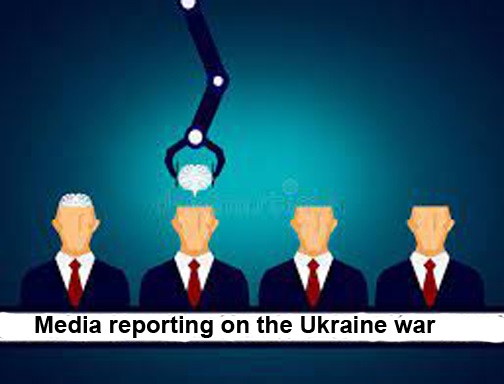
You know you’re living in a profoundly sick society when the world’s most influential newspaper runs propaganda for World War III while voices pushing for truth, transparency and peace are marginalized, silenced, shunned, and imprisoned, writes Caitlin Johnston.
https://consortiumnews.com/2022/09/28/the-insanity-that-grips-washington/ By Caitlin Johnstone, CaitlinJohnstone.com, 28 Sept 22,
The New York Times, which consistently supports every American war, has published an op-ed by a neoconservative think tanker titled “Biden’s Cautious Foreign Policy Imperils Us“.
This would be Joseph Biden, the president of the United States who has been consistently vowing to go to war with the People’s Republic of China if it attacks Taiwan, and whose administration has been pouring billions of dollars into a world-threatening proxy war in Ukraine which it knowingly provoked and from which it has no exit strategy.
With this administration’s acceleration toward global conflict on two different fronts, one could easily argue that Biden actually has the least cautious foreign policy of any president in history.
“In the aftermath of Vladimir Putin’s recent nuclear threat and call-up of reservists, it was reassuring for the leader of the free world to be unflinching,” writes the article’s author Kori Schake, who then adds, “Rhetoric aside, the administration has signaled in numerous other ways that Putin’s threats have constrained support for Ukraine.”
As though the possibility of nuclear war should not constrain U.S. proxy warfare in that country. As though the crazy thing is not the U.S. government’s insane nuclear brinkmanship with Russia, but its reluctance to go further.
More Money for War
Schake criticizes the fact that while Biden has been saying a PRC attack on Taiwan would mean a direct U.S. hot war with China, the U.S. military would need far more funding and far greater expansion to be able to win such a war, so it should definitely do those things instead of simply not rushing into World War Three.
“But worse are the real gaps in capability that call into question whether the United States could indeed defend Taiwan,” Schake writes, adding:
“The ships, troop numbers, planes and missile defenses in the Pacific are a poor match for China’s capability. The director of national intelligence, Avril Haines, has assessed that the threat to Taiwan between now and 2030 is ‘acute,’ yet the defense budget is not geared to providing improved capabilities until the mid-2030s. More broadly, the Biden administration isn’t funding an American military that can adequately carry out our defense commitments, a dangerous posture for a great power. The Democratic-led Congress added $29 billion last year and $45 billion this year to the Department of Defense budget request, a measure of just how inadequate the Biden budget is.”
As Shchake discusses the urgent need to explode the U.S. military budget [already at $777.7 billion] in order to defend Taiwan, The New York Times neglects to inform us that Schake’s employer, the American Enterprise Institute (AEI), has been caught accepting a small fortune from Taiwan’s de facto embassy while churning out materials urging the U.S. government to go to greater lengths to arm Taiwan.
In a 2013 article titled “The Secret Foreign Donor Behind the American Enterprise Institute,” The Nation’s Eli Clifton reports that, thanks to a filing error by AEI, the Taipei Economic and Cultural Representative Office was found to have been one of the think tank’s top donors in 2009. Had that filing error not been made, we never would have learned this important information about AEI’s glaring conflict of interest in its Taiwan commentary.
AEI is one of the most prominent neoconservative think tanks in the United States, with extensive ties to Bush-era neocons like John Bolton, Paul Wolfowitz, and the Kristol and Kagan families, and has played a very active role in pushing for more war and militarism in U.S. foreign policy. Dick Cheney sits on its board of trustees, and Mike Pompeo celebrated his one year anniversary as C.I.A. director there.
Epitome of the Revolving Door
Schake herself is as intimately interwoven with the military-industrial complex as anyone can possibly be without actually being a literal Raytheon munition.
Her resume is a perfect illustration of the life of a revolving door swamp monster, from a stint at the Pentagon, to the university circuit, to the National Security Council, to the U.S. Military Academy, to the State Department, to the McCain-Palin presidential campaign, to the Hoover Institution, to the International Institute for Strategic Studies, to her current gig as director of foreign and defense policy studies at AEI.
Her entire career is the story of a woman doing everything she can to promote war while being rewarded with wealth and prestige for doing so.
And now here she is being granted space in The New York Times, a news media outlet of unrivaled influence where enemies of U.S. militarism and imperialism are consistently denied a platform, to tell us all that the Biden administration is endangering us not with its insanely reckless hawkishness, but by being too “cautious”.
One of the craziest things happening in the world today is the way westerners are being trained to freak out all the time about Russian propaganda, which barely exists in the west, even as we are hammered every day with extreme aggression by the immensely influential propaganda of the U.S.-centralized empire.
You know you are living in a profoundly sick society when the world’s most influential newspaper runs propaganda for World War Three while voices pushing for truth, transparency and peace are marginalized, silenced, shunned, and imprisoned.
Nuclear news -week to 26 September

Some bits of good news – Good News on AIDS, Ocean Conservation in Indonesia, and Clean Air Zones in Spain.Coronavirus. World –
over 609 million confirmed cases and over 6.5 million deaths. USA 395 117 new cases . The highest numbers of new weekly deaths were reported from the United States of America. President Joe Biden says “The pandemic is over” . As the Americans say – Go figure
26 September – International Day for the Total Elimination of Nuclear Weapons: dismantle the warheads and build a common security. International Day for the Total Elimination of Nuclear Weapons 2022: History, Significance and Celebration.
SCOTT RITTER: Reaping the Whirlwind
‘Naïve’ to think Russia will lose war, says Dr Jordan Peterson – https://www.youtube.com/watch?v=BnxxELn00gk The Ukraine war could open the nuclear Pandora’s box. The deadly game of nuclear escalation. Unlocked: NATO prolongs the Ukraine proxy war, and global havoc. World powers must take Putin’s threat seriously, stop the escalation and seek a diplomatic solution.
Small modular reactors: What is taking so long?
World’s richest countries fall short on renewable energy targets.
UKRAINE. Holding ground, losing war. War fears at another Ukraine nuclear site . In effect if not juridically, Ukraine was becoming a member of the NATO alliance.THE WORLD SPLIT APART.
Vladislav Ugolny: Ukraine is targeting civilians for retribution in the east while its Western backers turn a blind eye. HISTORIC CONTEXT OF THE REFERENDA IN UKRAINE.
JAPAN. Fukushima: Japan attempts to safely remove nuclear fuel from crippled reactors.
UK.
- Nuclear industry Beating Retreat at Bradwell? Is UK government’s nuclear power policy scientifically feasible? – asks House of Commons Science and Technology Committee .
- Busting The Times’ spin on “Great British Nuclear” and “a new atomic age for the UK”. UK government PR exercise “Great British Nuclear” headed for financial failure.
- UK government to change the rules – so that billions of pounds of pension funds can go to dodgy new nuclear projects.
- Sizewell C: Planning shake-up – getting rid of environmental assessment ‘runs roughshod over objectors’.
- Nuclear Free Local Authorities (NFLA) want government assurances about new rules on compensation liability for nuclear accidents.
- UK’s nuclear waste cleanup operation could cost £260bn. Operation Sellafield: inside Britain’s deadliest clean-up job.
- Liz Truss could break fracking election pledge to bypass local opposition.
- Hinkley Mud still needs more testing for radiation. Continuing campaign to stop the dumping of Hinkley nuclear power station mud off Cardiff coast.
- USA.
- Brainwashed for War With Russia.
- 64 years later, the Golden Rule takes to the water again to challenge nuclear arms.
- US Media Held Murdered Russian Journalist to a Dangerous Standard.
- Nukes Are Our Corporate Death Wish…the Sun is the People’s Cure.
- Nuclear Weapon Development and Manufacturing Needs More Cybersecurity, Watchdog Says.
- Getting serious about the threat of high altitude nuclear detonations.
- NuScale Faces Class Action Lawsuit Brought by Former Employees.
- Pentagon opens sweeping review of clandestine psychological operations.
- Nevada files motion regarding Yucca Mountain Nuclear Waste Project, launches dedicated website with educational resources.
- A Nebraska county of only 625 people contained nearly 100 deep underground nuclear missiles, so the US Air Force halted a green-power project that would have revitalized its
- economy. It was set to be Nebraska’s largest wind project.
PACIFIC ISLANDS. Marshall Islands calls off talks after no US response on nuclear legacy plan. At U.N., Micronesia denounces Japan plan to release Fukushima water into Pacific.
RUSSIA. Moscow unlikely to use nuclear weapons, say ex-Russian generals. Putin flirts again with grim prospect of nuclear war – this time he might mean it.
POLAND. Poland distributes iodine pills as fears grow over Ukraine nuclear plant.
SOUTH KOREA. US-S.Korea to stage joint military drills with nuclear-powered US carrier.
GERMANY. Environment Minister reaffirms the phaseout of nuclear power.ITALY. Far-right leader Giorgia Meloni favours return to nuclear power and increased gas production.
NEW ZEALAND. New Zealand will push for total ban on nuclear weapons – Jacinda Ardern. World shouldn’t give up on nuclear disarmament, says Prime Minister Jacinda Ardern. https://www.youtube.com/watch?v=tb_CkO2tD80
BELGIUM. Belgium shuts down one reactor, in line with its “40 years life” rule for nuclear reactors.
AUSTRALIA Aukus plan to expedite Australia’s nuclear sub construction an act of nuclear proliferation under ‘naval nuclear propulsion’ cover: Chinese mission to UN .
HISTORIC CONTEXT OF THE REFERENDA IN UKRAINE.
Popular Resistance, By Moon of Alabama., September 24, 2022, Educate!
Voting for membership in the Russian Federation has started in four oblast of Ukraine:
………………….. The Ukrainian regime has resorted to pure terrorism to prevent the votes from happening:
” Ukrainian partisans, sometimes working with special operations forces, have blown up warehouses holding ballots and buildings where Russian proxy officials preparing for the vote held meetings. Ukrainian officials have acknowledged that they are engaged in a campaign to assassinate key Russian administration officials; more than a dozen have been blown up, shot and poisoned, according to Ukrainian and Russian officials.“
Such behavior by the Zelenski regime against its still Ukrainian compatriots will only encourage the people in the four oblast to vote for an alignment with Russia.
The propaganda in the ‘west’ will declare that the vote is irregular and that the results, likely to be pro-Russian, will be fake.
But a view on historic election outcomes since Ukrainian independence in 1991 show clear geographic preferences in east and south Ukraine for pro-Russian policies:
[ The original here shows a graphic chart illustrating voting patterns over the years]
The graphic above is from research published by the Eurasian Research Institute of the International Hoca Ahmet Yesevi Turkish-Kazakh University. Its author writes:
“As we can see, the have always been a clear-cut geographical split in the way the regions of Ukraine vote for particular candidates. The East and West division or also referred as Southeast and Northwest division was always present throughout the electoral history of the independent Ukraine. It is conventionally believed that the eastern part of Ukraine is more influenced by Russia politically, economically and culturally. Therefore, the presidential candidates proposing more pro-Russian agenda usually gain much more political support in eastern regions than in other parts of Ukraine.
On the other hand, the western part of the country has traditionally been more pro-European with strong reference to traditional core Ukrainian ethnic traditions and values. Consequently, presidential candidates with pro-European political agenda and traditional Ukrainian appeal usually had strong support in western regions of the country. It is interesting to note that preferences of the electorate were not related to the geographical origin or background of the presidential candidates and any candidate could easily become popular in the east as well as in the west. Moreover, the same candidate could be both pro-eastern and pro-western in different periods of time as did Leonid Kuchma in 1994 and 1999, who is the only Ukrainian president to serve two consecutive terms from 1994 to 2005.“
The division is consistent with ethnic and linguistic differences between those parts of Ukraine.
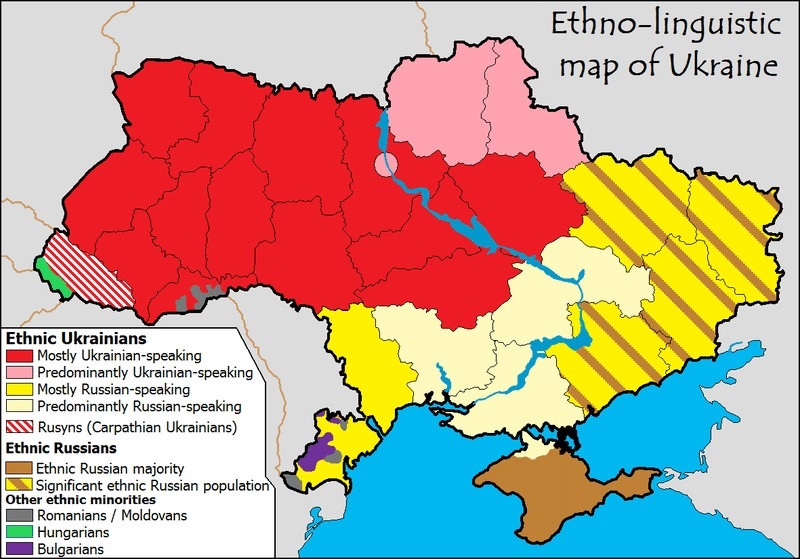
In 2014, after the violent fascist coup in Kiev, one of the first laws implemented by the new government removed the Russian language from official use. Instead of overcoming the differences between its people it only sealed the predominant split in Ukraine.
The election promise of the current Ukrainian president Vladimir Zelenski to make peace with the Russia aligned rebellious Donbas region by adhering to the Minsk 2 agreements was rewarded with a large share of southeastern votes for his presidency. However, after having been threatened with death by fascists, Zelenski has made a 180 degree turn and has since posed as Ukrainian nationalist. In consequence he has lost all support in southeastern Ukraine.
The southeastern parts of today’s Ukraine have for centuries been part of the central Russian empire. They were only attached to the Soviet Republic of Ukraine under Lenin’s rule in 1922 and, in the case of Crimea, in 1954 under Nikita Khrushchev who himself had grown up in the Donbas region.

A likely high turnout and majority vote for membership in the Russian Federation will only correct the historic misalignment created by those illogical transfers.
https://popularresistance.org/historic-context-of-the-referenda-in-ukraine/
1 This Month
23 April – WEBINAR – Why new nuclear reactors are the wrong tools for decarbonization Thursday, April 23 • 1 AM – 2 AM AEST

Pine Ridge Uranium is the real threat, not Tehran- Tell Burgum: Stop the Extraction.
Chernobyl: The Lost Tapes – A good documentary on Chernobyl on SBS available On Demand for the next 3 weeks– https://www.sbs.com.au/ondemand/tv-program/chernobyl-the-lost-tapes/2352741955560
To see nuclear-related stories in greater depth and intensity – go to https://nuclearinformation.wordpress.com
-
Archives
- April 2026 (231)
- March 2026 (251)
- February 2026 (268)
- January 2026 (308)
- December 2025 (358)
- November 2025 (359)
- October 2025 (376)
- September 2025 (257)
- August 2025 (319)
- July 2025 (230)
- June 2025 (348)
- May 2025 (261)
-
Categories
- 1
- 1 NUCLEAR ISSUES
- business and costs
- climate change
- culture and arts
- ENERGY
- environment
- health
- history
- indigenous issues
- Legal
- marketing of nuclear
- media
- opposition to nuclear
- PERSONAL STORIES
- politics
- politics international
- Religion and ethics
- safety
- secrets,lies and civil liberties
- spinbuster
- technology
- Uranium
- wastes
- weapons and war
- Women
- 2 WORLD
- ACTION
- AFRICA
- Atrocities
- AUSTRALIA
- Christina's notes
- Christina's themes
- culture and arts
- Events
- Fuk 2022
- Fuk 2023
- Fukushima 2017
- Fukushima 2018
- fukushima 2019
- Fukushima 2020
- Fukushima 2021
- general
- global warming
- Humour (God we need it)
- Nuclear
- RARE EARTHS
- Reference
- resources – print
- Resources -audiovicual
- Weekly Newsletter
- World
- World Nuclear
- YouTube
-
RSS
Entries RSS
Comments RSS
 nuclear-news