WHAT HAPPENED AT CAMP LEJEUNE
I grew up drinking and bathing in the toxic waters around a military base in North Carolina. Thirty years later, I went back to investigate.
BY LORI LOU FRESHWATER, AUG 21, 2018
In the autumn of 1980, a contractor showed up to grade a parking lot. He had no idea he was about to start digging up the radioactive bodies of dead beagles. But the forked bucket on his bulldozer started pulling up more than soil, and it turned out he was digging in a pit of strontium-90 and dog carcasses that had been buried in an ash-gray tomb: a nest of dead dogs and laboratory waste labeled “Radioactive Poison.”
The new parking lot was on the site of the former Naval Research Laboratory dump and its associated incinerator in Camp Lejeune, North Carolina—and it was just one of many areas contaminated by an assortment of hazardous waste and chemicals on the base.
About half a mile away from the dump, soon to be known as Site 19, my friends and I were living in our neighborhood, called Paradise Point. We spent our time putting other girls’ bras into freezers at slumber parties, playing the Telephone Game, riding our bikes all over the place: to the golf course to steal a cart, to swim at the pool, to play soccer on Saturdays.
During the same autumn the dead beagles were found, I was sitting in front of a fake backdrop of rusty colored leaves, a slight 11-year-old girl with spaces between my teeth and freckles spritzed across my nose and cheeks, to take my school photo.
Under normal circumstances, this entirely unremarkable fifth-grade photo, in a plaid shirt and fragile gold necklace, would have likely ended up where most school photos do, in an old album or a drawer or simply lost to time. Instead, the photo would become a marker in the medical history of my family and my community, a reminder of the crime that was being committed on the day the photo was taken—and also for decades before, and for years after.
The place was Camp Lejeune, a United States Marine Corps base wrapped around the New River in Onslow County that served as an amphibious training base where Marines learned to be “the world’s best war fighters,” picking up skills that would allow them (for example) to make surprise landings on the shores of far away countries. From the 1950s until at least 1985, the drinking water was contaminated with toxic chemicals at levels 240 to 3400 times higher than what is permitted by safety standards.
There may never be a true accounting of the suffering caused at Lejeune. As with many other hometown environmental disasters, the Marines and family members poisoned on this military base were not born here, nor did they settle here to make a permanent life and raise their children. Instead, they were often here just for a short time, literally stationed at Lejeune for weeks, months, or, at most, a few years. From the 1950s through at least 1985, an undetermined number of of residents, including infants, children, and civilian workers and personnel, were exposed to trichloroethylene (TCE), tetrachloroethylene (PCE), vinyl chloride, and other contaminants in the drinking water at the Camp Lejeune. These exposures likely increased their risk of cancers, including renal cancer, multiple myeloma, leukemias, and more. It also likely increased their risk of adverse birth outcomes, along with other negative health effects. Now the sick and the dying are all over the world, and an untold number will never be notified about what happened. Instead, we are left to rely on scientific models and data trickling out of public-health agencies and the slow process of adding one story at a time, person-by-person, to the cold data representing an environmental and public-health disaster.
In 1989, the Environmental Protection Agency placed 236 square miles of North Carolina’s coastal soil and water on the list of toxic areas known as Superfund sites. The agency cited “contaminated groundwater, sediment, soil and surface water resulting from base operations and waste handling practices” as reasons for including it on the National Priorities List.
Camp Lejeune remains a sprawling Superfund site, and it is also the place where my mom and I spent years drinking a terrible mix of chemicals from our faucet. In the book A Trust Betrayed: The Untold Story of Camp Lejeune, author Mike Magner gives special attention to my mother’s story: “A woman with the ironic name of Mary Freshwater may have had the most ghastly experiences at Camp Lejeune.”
Of course, I share her ironic name, which can still seem like more of a curse. Nearly my entire childhood was consumed by tragedy. The chemical contamination can be linked to the deaths of my two baby brothers, Rusty and Charlie, and to my mom’s own difficult final years, when she was dying from two types of acute leukemia. My mother also suffered from mental illness, which was intensified—understandably—by our family’s brutal losses. Sometimes it seems that, behind me, there is nothing but inescapable grief. …………………..more https://psmag.com/.amp/environment/what-happened-at-camp-lejeune
Fighting at Ukraine nuclear plant brings chances of a meltdown to a ‘coin toss’, expert says

“If you lose both the offsite power and the backup diesel generators, there are other emergency measures that could be employed, but you only have a few hours to be able to set those up before the core might start to melt,”
By Samantha Hawley and Flint Duxfield for ABC News Daily, 2 Aug 22,
As calls continue for an end to military activity around Ukraine’s Zaporizhzhia power plant, experts are warning there is significant risk of a nuclear accident.
Key points:
- Nuclear experts are becoming increasingly concerned of a nuclear disaster at Russian-occupied Zaporizhzhia nuclear power plant in Ukraine
- A team from the UN’s nuclear watchdog arrived at the facility overnight
- Europe’s biggest nuclear power plant has been shelled repeatedly in recent weeks, and Ukrainian staff are reportedly working under threat
This week the Russian military, which has controlled the facility since March, agreed to a safety inspection by experts from the United Nations’ International Atomic Energy Agency (IAEA), who arrived overnight.
Despite this, the director of Nuclear Power Safety at the Union of Concerned Scientists, Edwin Lyman, said there was a significant possibility the situation could end badly.
“It’s probably a coin toss at this point,” he said.
While the fate of Europe’s biggest nuclear power plant has been thrust into the spotlight in recent weeks, Dr Lyman told ABC News Daily he became concerned the minute Russia set its sights on the facility in early March.
“When Russia started lobbing artillery shells at the plant and when a fire broke out, it was of extreme concern because one thing the nuclear power plant doesn’t handle too well is a large fire,” he said.
The fire was quickly contained, but as Russian forces took control of the plant, safety concerns only continued to grow.
Since then, there have been reports around 9,000 of the plant’s staff have been forced to continue working at gunpoint, and that some have been beaten and tortured.
“There is evidence that the Russians were intimidating the staff, not allowing them to report safety issues, accusing them of being spies or saboteurs and of physical abuse,” Dr Lyman said.
“These are obviously very poor conditions for the staff to work in.”
Plant under attack
In the past fortnight there have been further reports of shelling of the plant, with both sides claiming the other was at fault.
Ukraine has accused Russia of using the plant as a military base to launch attacks against Ukrainian positions.
Meanwhile, Russian Defence Ministry spokesman Igor Konashenkov said this week that nine shells fired by the Ukrainian artillery in two separate attacks had landed in the nuclear plant’s grounds.
While Dr Lyman doesn’t believe these kinds of attacks are likely to cause a major problem for the reactors themselves, he said there is still a risk they could damage other vital parts of the plant or make it difficult to maintain the reactors.
“The most dangerous parts of the plant, like the nuclear fuel in the reactors, is contained and under a fairly strong reinforced concrete containment building,” he said.
“Even if you had direct artillery fire on the containment, unless it was a sustained shelling, deliberately trying to destroy it, then it probably wouldn’t cause that much damage.”
However, Dr Lyman warned other parts of the plant were more susceptible to artillery fire.
“The turbine that’s used to convert the hot water or the steam that’s generated by the nuclear reactor into electricity are in less-protected buildings,” he said.
A power plant in need of power
A greater concern than artillery fire, experts believe, is the potential for the plant to lose its offsite power connection, something that has already happened twice in the past few weeks.
While it might seem strange that a power plant’s most vital input is electricity, external power is crucial in cooling the reactors to prevent them from overheating.
To reduce risk of meltdown, four of the plant’s six reactors have already been put into cold shutdown since the outbreak of the war.
But because the plant is responsible for around 20 per cent of Ukraine’s energy supply, shutting the remaining reactors would be a significant loss for the country.
The plant does have three external electricity supply lines, but these have all lost connection in recent weeks due to the conflict.
Last week, the company responsible for the plant, Energoatom, said fires at a nearby thermal power station had caused the nuclear plant’s last remaining electricity power line to be disconnected twice.
Ukrainian President Volodymyr Zelenskyy said the plant’s 20 backup diesel generators had to be “immediately activated” to avert a “radiation disaster”.
“If the diesel generators hadn’t turned on, if the automation and our staff of the plant had not reacted after the blackout, then we would already be forced to overcome the consequences of the radiation accident,” Mr Zelenskyy said in his nightly briefing.
Dr Lyman said the fact that the site has already lost offsite power showed how precarious the situation was.
“If you lose both the offsite power and the backup diesel generators, there are other emergency measures that could be employed, but you only have a few hours to be able to set those up before the core might start to melt,” he said.
Meltdown could happen in hours
One simulation of the reactors losing power showed they would have just over an hour before the cooling systems stopped working.
It predicted that the reactor would heat up so quickly that it would take less than five hours for it to break through the reactor vessel.
Even if that occurs, experts say a strong protective casing around the reactors means a Chernobyl-style disaster isn’t likely………………………
Ukraine prepares for radiation leaks
The Ukrainian government has begun preparations for the possibility of a radiation leak.
In recent weeks it has run emergency drills in nearby towns and distributed iodine tablets to residents.
Iodine helps prevent radiation from amassing in the thyroid, leading to thyroid cancer; a phenomena witnessed after the Chernobyl meltdown in hundreds of Ukrainian children.
While Dr Lyman believes it is a sensible precaution, he warned it would not be enough to protect people in the case of a leak.
“In nuclear reactors, you have a sea of a soup of hundreds of different types of radioactive isotopes, all of which interact in different ways of the body,” he said.
“So you can’t do much about that except to either evacuate to avoid exposure or to shelter for a long time in a structure that’s shielded against radiation.
“That’s why the best thing is to prevent any release in the first place.”
Overnight inspectors from the IAEA travelled to the city of Zaporizhzhia.
Experts from the team will remain on site to provide an impartial, neutral and technically sound assessment of the situation.
“I worried, I worry and I will continue to be worried about the plant until we have a situation which is more stable, which is more predictable,” IAEA head Rafael Grossi, who personally led the mission, told reporters after returning to Ukrainian-held territory…………………
https://www.abc.net.au/news/2022-09-02/fears-nuclear-disaster-zaporizhzhia/101394618
Ukraine accused of targeting possible route of nuclear inspectors

Zelensky cannot risk experts assessing the damage and announcing the cause?
Rt.com, 30 Aug 22, Kiev’s forces have hit the Zaporozhye plant’s resort house where the delegation could stay, a local council member has claimed.
Ukrainian forces are shelling a route that the International Atomic Energy Agency (IAEA) inspection mission could take to reach the Zaporozhye Nuclear Power Plant this week, local authorities claimed on Tuesday.
Zaporozhye Region council member Vladimir Rogov told RIA Novosti that “Ukrainian nationalists are targeting locations that could be visited by the IAEA mission in Energodar,” where the plant is located. He added that “[Ukrainian President Vladimir] Zelensky’s regime also started a military operation in the south of the country,” which raises concerns for the safety of the IAEA mission.
……………………On Monday, IAEA chief Rafael Grossi announced that an expert group would visit the NPP this week to assess the damage sustained by the plant and check the safety and security systems. Zaporozhye Nuclear Power Plant has been under Russian control since March.
Moscow has repeatedly accused Ukrainian forces of attacking the plant, while warning that the shelling could trigger a disaster that would eclipse the Chernobyl incident. Kiev insists, however, that Russian forces are shelling the site while stationing military hardware there.
On Sunday night, Ukrainian forces shelled Energodar, the city where the plant is located, local officials said. They claimed that the attack, which injured nine people and deliberately hit a number of residential houses, was meant to torpedo the upcoming IAEA mission. “This provocation by Kiev-controlled militants is aimed at derailing the visit of the IAEA chief to the Zaporozhye NPP,” they said at the time………. https://www.rt.com/russia/561775-ukraine-shelling-un-iaea-zaporozhye-nuclear/
Pentagon admits ‘likelihood’ of Ukrainian shelling near nuclear plant
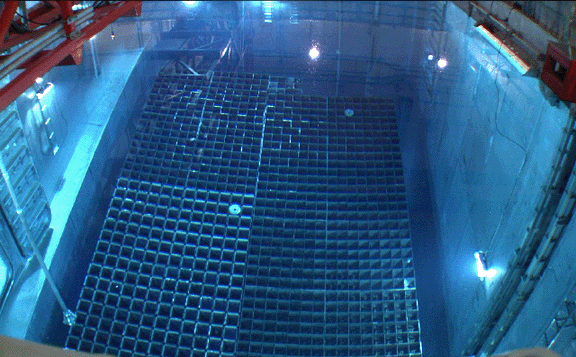
the biggest danger is not a reactor meltdown, but Ukrainian artillery striking the open-air spent fuel storage, which would result in a radioactive release
US officials responded to questions about Kiev’s forces targeting Zaporozhye,
https://www.rt.com/russia/561769-pentagon-ukraine-nuclear-shelling 30 Aug 22,
A senior US military official admitted on Monday that Ukrainian forces may have struck the area around the Zaporozhye Nuclear Power Plant, but insisted that this was only in response to Russian fire allegedly coming from the area. Earlier in the day, the Russian authorities said a Ukrainian artillery shell damaged the roof of the building storing reactor fuel.
“What I know for sure is that the Russians are firing from around the plant,” the unnamed official told reporters during a background briefing at the Pentagon. “I also know that there are rounds that have impacted near the plant.”
The official said it was “hard to explain, I guess” how the US was monitoring the situation around the nuclear power plant, Europe’s largest.
“And I don’t want to say that the Ukrainians haven’t fired in that vicinity either because I think there’s probably a likelihood that they have, but in good – in a number of cases, it’s returning fire of the Russians who are firing from those locations,” he said.
Russian forces established control of the Zaporozhye NPP in early March. National guard and nuclear protection specialists secured the site while the Ukrainian staff continued to operate without hindrance. The government in Kiev claims that Russian forces turned the plant into a military base from which they were attacking Ukrainian targets, but also that Russian troops were shelling themselves in a false-flag ploy to make Ukraine look bad.
The US official claimed “the Ukrainians are very aware of the potential impacts of striking the nuclear power plant and they’re going out of their way not to do that.”
Moscow has provided evidence to the UN of repeated Ukrainian attacks on the Zaporozhye NPP and the nearby town of Energodar since July, using kamikaze drones and even US-supplied artillery. The latest attack came on Monday, when a round breached the roof of a building where fresh reactor fuel was being stored, a member of the local administration said.
On Sunday, a drone was shot down over the plant, while Ukrainian artillery strikes on Energodar injured nine civilian residents.
Kiev has demanded that Russia hand the Zaporozhye NPP back over to Ukrainian control, or at least demilitarize a 30-kilometer area around it. On Monday, US National Security Council spokesman John Kirby also urged demilitarization, as well as a shutdown of the reactors. The US has previously echoed Kiev’s accusations that Moscow wants to “steal Ukraine’s electricity” by shutting down the plant or disconnecting it from the Ukrainian grid.
According to Russian nuclear experts, the biggest danger is not a reactor meltdown, but Ukrainian artillery striking the open-air spent fuel storage, which would result in a radioactive release.
International Atomic Energy Agency (IAEA) chief Rafael Grossi is personally leading the mission that is supposed to visit the plant this week.
1 This Month
23 April – WEBINAR – Why new nuclear reactors are the wrong tools for decarbonization Thursday, April 23 • 1 AM – 2 AM AEST


Pine Ridge Uranium is the real threat, not Tehran- Tell Burgum: Stop the Extraction.
Chernobyl: The Lost Tapes – A good documentary on Chernobyl on SBS available On Demand for the next 3 weeks– https://www.sbs.com.au/ondemand/tv-program/chernobyl-the-lost-tapes/2352741955560
To see nuclear-related stories in greater depth and intensity – go to https://nuclearinformation.wordpress.com
-
Archives
- April 2026 (275)
- March 2026 (251)
- February 2026 (268)
- January 2026 (308)
- December 2025 (358)
- November 2025 (359)
- October 2025 (376)
- September 2025 (257)
- August 2025 (319)
- July 2025 (230)
- June 2025 (348)
- May 2025 (261)
-
Categories
- 1
- 1 NUCLEAR ISSUES
- business and costs
- climate change
- culture and arts
- ENERGY
- environment
- health
- history
- indigenous issues
- Legal
- marketing of nuclear
- media
- opposition to nuclear
- PERSONAL STORIES
- politics
- politics international
- Religion and ethics
- safety
- secrets,lies and civil liberties
- spinbuster
- technology
- Uranium
- wastes
- weapons and war
- Women
- 2 WORLD
- ACTION
- AFRICA
- Atrocities
- AUSTRALIA
- Christina's notes
- Christina's themes
- culture and arts
- Events
- Fuk 2022
- Fuk 2023
- Fukushima 2017
- Fukushima 2018
- fukushima 2019
- Fukushima 2020
- Fukushima 2021
- general
- global warming
- Humour (God we need it)
- Nuclear
- RARE EARTHS
- Reference
- resources – print
- Resources -audiovicual
- Weekly Newsletter
- World
- World Nuclear
- YouTube
-
RSS
Entries RSS
Comments RSS
 nuclear-news