Plunging costs of renewable energy – as nuclear power costs increase
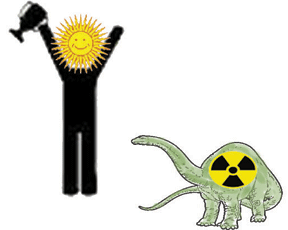
The tumbling cost of renewable energy means transitioning away from fossil
fuels over the next 30 years will save the world “at least $12 trillion”,
according to researchers at the University of Oxford.
The decarbonisation
of the energy system will not only see a major reduction in the cost of
producing and distributing energy, but will also allow for greater levels
of energy to be produced and therefore help expand energy access around the
planet.
The faster the transition to renewables occurs, the greater the
potential for savings, the team found, and urged governments to recognise
the enormous boost to the global economy, that abandoning fossil fuels will
bring about.
“There is a pervasive misconception that switching to clean,
green energy will be painful, costly and mean sacrifices for us all – but
that’s just wrong,” said Professor Doyne Farmer, who leads the team that
conducted the study at the Institute for New Economic Thinking at the
Oxford Martin School. The research team analysed thousands of transition
cost scenarios produced by major energy models and examined data on: 45
years of solar energy costs, 37 years of wind energy costs and 25 years for
battery storage.
They said the research reveals that the real cost of solar
energy dropped twice as fast as the most ambitious projections in these
models, revealing that, over the past 20 years, previous models “badly
overestimated the future costs” of renewable energy technology compared to
the reality of cheap renewables we are already seeing today.
The research also suggests nuclear power will play a diminishing role in the future
global energy mix due to the rising costs of building reactors. “The costs
of nuclear have consistently increased over the last five decades, making
it highly unlikely to be cost competitive with plunging renewable and
storage costs,” the researchers said. Meanwhile, the study showed the costs
for storage technologies, such as batteries and hydrogen electrolysis, are
also likely to fall dramatically.
Independent 13th Sept 2022
No comments yet.
1 This Month


Tell the Ukrainian Government to Drop Prosecution of Peace Activist Yurii Sheliazhenko

Petition to revoke the licensing of the Near Surface Nuclear Disposal Facility (NSDF) at Chalk River. https://www.ourcommons.ca/petitions/en/Petition/Details?Petition=e-7247


of the week – STOP SMALL MODULAR REACTORS IN CANADA
To see nuclear-related stories in greater depth and intensity – go to https://nuclearinformation.wordpress.com
-
Archives
- March 2026 (204)
- February 2026 (268)
- January 2026 (308)
- December 2025 (358)
- November 2025 (359)
- October 2025 (376)
- September 2025 (258)
- August 2025 (319)
- July 2025 (230)
- June 2025 (348)
- May 2025 (261)
- April 2025 (305)
-
Categories
- 1
- 1 NUCLEAR ISSUES
- business and costs
- climate change
- culture and arts
- ENERGY
- environment
- health
- history
- indigenous issues
- Legal
- marketing of nuclear
- media
- opposition to nuclear
- PERSONAL STORIES
- politics
- politics international
- Religion and ethics
- safety
- secrets,lies and civil liberties
- spinbuster
- technology
- Uranium
- wastes
- weapons and war
- Women
- 2 WORLD
- ACTION
- AFRICA
- Atrocities
- AUSTRALIA
- Christina's notes
- Christina's themes
- culture and arts
- Events
- Fuk 2022
- Fuk 2023
- Fukushima 2017
- Fukushima 2018
- fukushima 2019
- Fukushima 2020
- Fukushima 2021
- general
- global warming
- Humour (God we need it)
- Nuclear
- RARE EARTHS
- Reference
- resources – print
- Resources -audiovicual
- Weekly Newsletter
- World
- World Nuclear
- YouTube
-
RSS
Entries RSS
Comments RSS
 nuclear-news
Leave a comment