Lantern ceremony in Winnipeg calls attention to threat of nuclear weapons
Ceremony marked 77th anniversary of Hiroshima bombing
Cameron MacLean · CBC News ·: Aug 07 22
Winnipeggers lit lanterns and set them afloat on the fountain outside the Manitoba Legislature on Saturday evening to call attention to the threat of nuclear war.
The lantern ceremony marks the 77th anniversary of the United States dropping an atomic bomb on the Japanese city of Hiroshima on Aug. 6, 1945.
This year, organizers of the event in Winnipeg hope to put pressure on the Canadian government to sign the 2017 United Nations Treaty on the Prohibition of Nuclear Weapons.
“We’ve seen in recent years that more and more the danger of nuclear confrontation is growing,” said Glenn Michalchuk, chair of Peace Alliance Winnipeg, in an interview with Keisha Paul on CBC Manitoba’s Weekend Morning Show……………………..
The event was sponsored by Peace Alliance Winnipeg, Japanese Cultural Association of Manitoba, Council of Canadians Winnipeg chapter and the Winnipeg Quakers.
https://www.cbc.ca/news/canada/manitoba/winnipeg-lantern-ceremony-nuclear-weapons-1.6544065
IAEA alarmed at danger to Zaporizhzhia nuclear plant as shelling continues in Ukraine war
The UN nuclear watchdog has called for an immediate end to all military
action near Ukraine’s Zaporizhzhia nuclear plant after it was hit by
shelling, causing one of the reactors to shut down and creating a “very
real risk of a nuclear disaster”. Rafael Mariano Grossi, director general
of the International Atomic Energy Agency, said he was “extremely
concerned” by reports of damage at the plant and called for IAEA experts
to be allowed to inspect the damage.
“I’m extremely concerned by the
shelling yesterday at Europe’s largest nuclear power plant, which
underlines the very real risk of a nuclear disaster that could threaten
public health and the environment in Ukraine and beyond,” he said. The
Ukrainian nuclear power company Energoatom said the attack had damaged a
power cable and forced one of the reactors to stop working, and that
“there are still risks of leaking hydrogen and radioactive substances,
and the risk of fire is also high”. The shelling “has caused a serious
risk for the safe operation of the plant”, Grossi said.
Observer 6th Aug 2022
Reuters 6th Aug 2022
USA hostility to China on yet another front
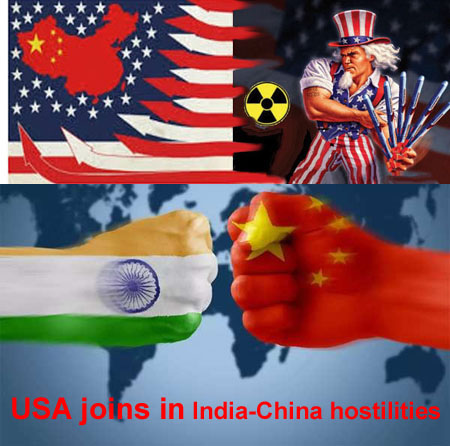
US to take part in military exercise near India’s disputed border with China
By Vedika Sud, Barbara Starr, Sahar Akbarzai and Kathleen Magramo, CNN
Updated 12:29 AM EDT, Sat August 06, 2022
(CNN)The United States is to take part in a joint military exercise with India less than 100 kilometers (62 miles) from the South Asian country’s disputed border with China.
The military drills will be held in mid-October at an altitude of 10,000 feet in Auli in the Indian state of Uttarakhand and will focus on high-altitude warfare training, according to a senior Indian Army officer with knowledge of the matter.
Auli is about 95 kilometers from the Line of Actual Control (LAC), an inhospitable piece of land where the disputed border between India and China is roughly demarcated.
The drills will take place as part of the 18th edition of an annual joint exercise known as “Yudh Abhyas” — or “War Practice”.
Relations between India and China have been strained since a bloody clash between their soldiers in the Himalayas in June 2020 left at least 20 Indian troops and four Chinese soldiers dead…………………….
Asked about the joint exercises, a US Department of Defense spokesperson told CNN that the partnership with India was “one of the most important elements of our shared vision for a free and open Indo-Pacific region.”…………..
Any military provocations between Indian and China could have grave consequences. Both have nuclear weapons……………. more https://amp.cnn.com/cnn/2022/08/06/india/india-us-military-exercise-line-of-actual-control-china-intl-hnk
Renewables are booming – REN21 Global Review

As the new annual REN21 global review illustrates, renewables are booming
most places, supplying 28% of global electricity, with PV solar especially
lifting off fast, including, at last, in Australia and, crucially, Africa,
north and south. In all, there’s over 1TW of PV in place globally.
The scale and reach of some of the new projects planned is very dramatic. For
example, there is a proposal for a 20GW PV array in north Australia which
would send power to Singapore.
Meanwhile, wind also continues to boom,
offshore especially, with ever larger, taller devices, as well as floating
units. There are some huge projects planned. For example, up to 20GW of
offshore wind has been proposed by Denmark for islands off NE Europe,
including 10GW linked to an artificial ‘hydrogen island’ in the North
Sea, on its part of the Dogger Bank. Denmark also plans two other offshore
wind-based energy islands for the North Sea and Baltic Sea with the
potential for some hydrogen production.
Clearly hydrogen is becoming a
regularly featured energy vector, in part since it can be stored in a range
of ways and the cost of producing it by electrolysis using renewable power
is falling.
However, although, batteries still rule the roost, at least for
short-term storage, there are also other energy storage options, some of
which may offer advantages in the newly emerging flexible energy systems,
including heat stores of various types and some intriguing gravity-based
systems. Bew and updated studies of the long term global potential of
renewables are emerging.
Prof. Mark Jacobson and his team at Stanford
University have produced an updated set of 100% wind, water and solar
energy 2050 scenarios covering 145 countries. Because battery costs have
dropped dramatically and because four-hour batteries are now readily
available, it is now justifiable to include a larger penetration of
batteries than in the previous studies’. So less demand response and very
long term storage is needed, reducing costs.
Renew Extra 6th Aug 2022
https://renewextraweekly.blogspot.com/2022/08/global-renewables-review.html
Door-to-door searches are being conducted to find pro-Russian “collaborators” in Nikolaev, a local official has said
Rt 7 Aug 22, The southern Ukrainian city of Nikolaev resorted to drastic measures this weekend to expose what the local authorities call “collaborators” and “separatists” – people who harbor pro-Russian sentiments or help Moscow’s forces in any way.
On Friday, the head of the local military administration, Vitaly Kim, placed the entire city – home to almost half a million people before the start of the Russian military operation – on a two-day lockdown. Kim announced a “prolonged curfew,” which came into force Friday evening and is expected to last until Monday.
During this time, residents of Nikolaev are prohibited from going outside or visiting any public places without special permits. In case of an emergency, a police escort is provided, Ukrainian news agency UNIAN said.
Law enforcement agencies will use this time to search for “collaborators” and “separatists,” Anna Zamazeeva, the head of the Nikolaev regional council, said. The operation is already in full swing, and the police will reveal the results no sooner than Monday, according to the official………. ……………. https://www.rt.com/russia/560380-ukraine-witch-hunt-disloyal-residents/
Climate Endgame: Risk of Human Extinction ‘Dangerously Underexplored’
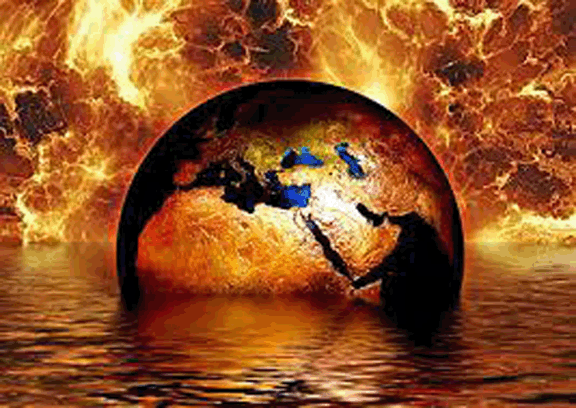
Reader Supported News, Damian Carrington/Guardian UK, 5 Aug 22,
Scientists say there are ample reasons to suspect global heating could lead to catastrophe
he risk of global societal collapse or human extinction has been “dangerously underexplored”, climate scientists have warned in an analysis.
They call such a catastrophe the “climate endgame”. Though it had a small chance of occurring, given the uncertainties in future emissions and the climate system, cataclysmic scenarios could not be ruled out, they said.
“Facing a future of accelerating climate change while blind to worst-case scenarios is naive risk management at best and fatally foolish at worst,” the scientists said, adding that there were “ample reasons” to suspect global heating could result in an apocalyptic disaster.
The international team of experts argue the world needs to start preparing for the possibility of the climate endgame. “Analysing the mechanisms for these extreme consequences could help galvanise action, improve resilience, and inform policy,” they said.
Explorations in the 1980s of the nuclear winter that would follow a nuclear war spurred public concern and disarmament efforts, the researchers said. The analysis proposes a research agenda, including what they call the “four horsemen” of the climate endgame: famine, extreme weather, war and disease.
They also called for the Intergovernmental Panel on Climate Change to produce a special report on the issue. The IPCC report on the impacts of just 1.5C of heating drove a “groundswell of public concern”, they said.
“There are plenty of reasons to believe climate change could become catastrophic, even at modest levels of warming,” said Dr Luke Kemp at the University of Cambridge’s Centre for the Study of Existential Risk, who led the analysis. “Climate change has played a role in every mass extinction event. It has helped fell empires and shaped history.
“Paths to disaster are not limited to the direct impacts of high temperatures, such as extreme weather events. Knock-on effects such as financial crises, conflict and new disease outbreaks could trigger other calamities.”
The analysis is published in the journal Proceedings of the National Academy of Sciences and was reviewed by a dozen scientists. It argues that the consequences of global heating beyond 3C have been underexamined, with few quantitative estimates of the total impacts. “We know least about the scenarios that matter most,” Kemp said.
A thorough risk assessment would consider how risks spread, interacted and amplified, but had not been attempted, the scientists said. “Yet this is how risk unfolds in the real world,” they said. “For example, a cyclone destroys electrical infrastructure, leaving a population vulnerable to an ensuing deadly heatwave.” The Covid pandemic underlined the need to examine rare but high-impact global risks, they added.
Particularly concerning are tipping points, where a small rise in global temperature results in a big change in the climate, such as huge carbon emissions from an Amazon rainforest suffering major droughts and fires. Tipping points could trigger others in a cascade and some remained little studied, they said, such as the abrupt loss of stratocumulus cloud decks that could cause an additional 8C of global warming.
The researchers warn that climate breakdown could exacerbate or trigger other catastrophic risks, such as international wars or infectious disease pandemics, and worsen existing vulnerabilities such as poverty, crop failures and lack of water. ……………………………….
more https://www.rsn.org/001/climate-endgame-risk-of-human-extinction-dangerously-underexplored.html—
Right direction’: Iran nuclear officials optimistic on deal
Negotiators from Iran, the United States and the European Union resumed indirect talks over Tehran’s nuclear deal after a months-long standstill.
Aljazeera, 7 Aug 22, Top negotiators in renewed talks to revive the 2015 Iran nuclear deal indicated they are optimistic about the possibility of reaching an agreement to impose limits on Tehran’s uranium enrichment.
“We stand five minutes or five seconds from the finish line,” Russian Ambassador Mikhail Ulyanov told reporters outside Vienna’s Palais Coburg on Sunday, four days into the talks. He said there are “three or four issues” left to be resolved.
……….. Enrique Mora, the European Union’s top negotiator, also said he is “absolutely” optimistic about the talks’ progress so far.
“We are advancing and I expect we will close the negotiations soon,” he told Iranian media.
Negotiators from Iran, the United States and the EU resumed indirect talks over Tehran’s tattered nuclear deal Thursday after a months-long standstill in negotiations…………………………….
more https://www.aljazeera.com/news/2022/8/7/iran-nuclear-deal-negotiators-optimistic-about-possible-agreement
Peace campaigners gather in Aberdeen on anniversary of Hiroshima nuclear bombing
Members of the Aberdeen Campaign for Nuclear Disarmament met outside Marischal College to mark the anniversary of Hiroshi
Jon Hebditch 7 AUG 2022 Peace activists gathered in Aberdeen city centre to mark the detonation of the first atomic bomb used in war time. Members of Aberdeen Campaign for Nuclear Disarmament (CND) met with others outside Marischal College to mark the anniversary of the dropping of the ‘Little Boy’ munition on the Japanese city of Hiroshima in August 1945…………………. https://www.aberdeenlive.news/news/aberdeen-news/peace-campaigners-gather-aberdeen-anniversary-7433023
—
Is Nuclear Winter Coming?
Consortium News 4 Aug 22
This Saturday, on the 77th anniversary of the first use of a nuclear weapon in Hiroshima, on Aug. 6, 1945, six scientists who were scoffed at in 1983 for determining the earth would suffer from a “nuclear winter” in the event of nuclear war, will be presented with the Future of Life Award.
The Future of Life Institute will celebrate the scientists who discovered and spread the word about the shocking scientific prediction of nuclear winter: that firestorms set off by a major nuclear war would envelop the earth in soot and smoke blocking sunlight for years, sending global temperature plunging, ruining ecosystems and agriculture and killing billions of people through famine.
The awards will be presented at an event beginning at 7 p.m. Saturday at Pioneer Works in Brooklyn, N.Y. (Information about attending free here). Consortium News will be covering the event.
Panel 1 – The Science
The first conversation, moderated by physician-scientist and Future of Life Institute Director Dr. Emilia Javorsky, features nuclear winter pioneers Alan Robock, Brian Toon and Richard Turco. What have new cutting-edge climate models revealed about the climate impact in the aftermath of a nuclear war? What do new agricultural models predict about survival rates in various countries? And what about the impact of a nuclear war confined to one country or one continent?
Panel 2 – The Communication
The second discussion, chaired by MIT professor and Future of Life Institute president Max Tegmark, will feature nuclear winter pioneers John Birks and Georgiy Stenchikov as well as Ann Druyan, the Award-winning American documentary producer and director who co-wrote Cosmos with her late husband Carl Sagan. This panel focuses on the fascinating story of how nuclear winter was initially discovered and communicated to the public, and how the science helped persuade Reagan and Gorbachev to back down from the nuclear brink, despite attempts to silence the discovery……………………………… more https://consortiumnews.com/2022/08/04/is-nuclear-winter-coming/
“Unprecedented:” US Senate finally passes landmark $A540 billion climate bill —

The US Senate has passed a landmark climate bill – the biggest in its history, although a fraction of what Joe Biden wanted to do. The post “Unprecedented:” US Senate finally passes landmark $A540 billion climate bill appeared first on RenewEconomy.
“Unprecedented:” US Senate finally passes landmark $A540 billion climate bill — RenewEconomy
Hiroshima Anniversary: Radioactive Particles from UK Nuclear Bomb makers continue to wash up on the beach — RADIATION FREE LAKELAND

Cumbria Wildlife Trust Invited Families today to St Bees for eating foraged food from the beach, wild swimming and digging in the sand where radioactive particles continue to wash up on the beach from the UK’s nuclear bomb programme. Today is the anniversary of Hiroshima. The United States detonated two atomic bombs over the Japanese […]
Hiroshima Anniversary: Radioactive Particles from UK Nuclear Bomb makers continue to wash up on the beach — RADIATION FREE LAKELAND
August Energy News — geoharvey

Opinion: ¶ “30 Million EV Battery Packs In 2027?” • There are expected to be about 10 million EV battery packs shipped in 2022 globally, according to research firm Juniper Research. The company forecasts that number will rise to 30 million in 2027. A simple calculation shows that Juniper Research belives 25.8% of the global […]
August 7 Energy News — geoharvey
Nuclear weapons will not bring peace or security, only dangers

We can honour the victims of Hiroshima and Nagasaki by supporting the prohibition treaty, says RAE STREET https://morningstaronline.co.uk/article/f/nuclear-weapons-will-not-bring-peace-or1 6 Aug, 22,
THIS is the month when we commemorate the fearful nuclear bombings of the people of Hiroshima and Nagasaki.
Alas, the myth is still put out that the bombs were dropped to end the second world war. That is not true.
By the time the bomb was ready for use, Japan was ready to surrender. As General Dwight D Eisenhower said, Japan was at that very moment seeking some way to surrender with minimum loss of face, and “it wasn’t necessary to hit them with that awful thing.”
Thus, the bomb on Hiroshima was dropped on August 6 before it was publicly stated that the Japanese had surrendered.
The Soviet Union entered the war in Asia on August 9. Later the same day, the US dropped a second bomb on Nagasaki.
We now know the horrors that nuclear bombs inflict. We have heard from the Hibaksha, the survivors. Now instead of heeding the survivors of those bombs, the Hibaksha, that nuclear weapons should be ended, governments across the world have developed more destructive nuclear bombs.
Britain, part of the US Trident submarine system, carries warheads on multiple missiles, with 15 times the power of the bomb used on Hiroshima.
Proponents of nuclear weapons, including the Nato military alliance, claim that they keep the peace and repeatedly talk of nuclear deterrents.
But the US has the largest nuclear arsenal in the world, and it did not stop the attack on the Twin Towers; nor did Trident stop terrorist attacks in Britain.
What is never mentioned is the death and destruction which has been brought about with the development of nuclear weapons, mainly on indigenous peoples.
This starts with the beginning of the cycle with uranium mining where native people in the US, in Canada, in Australia and the Congo, among others, have been forced into mining.
They and their families have suffered serious illness and even death. Above-ground testing has also brought suffering to native peoples.
After the French testing in the Pacific, mothers gave birth to “jellyfish” babies which died within a few hours. In the US above-ground testing meant that many of the “downwinders,” including the Western Shoshone, became seriously ill.
Although above-ground tests have now ended following the Comprehensive Test Ban Treaty, uranium mining has not ceased.
It continues except for Greenland where the Inuit, now in government, have banned uranium mining.
In 2022, with the war in Ukraine, we are now in more danger than ever before of a further use of nuclear weapons. If ever one of these highly destructive current bombs were exploded either by intent or accident, it would be a worldwide catastrophe.
There would be fires and radioactive fallout and fatal illnesses from acute radiation sickness, cancer and genetic damage which can be passed on to offspring.
At the same time, nuclear fireballs would send up enormous quantities of dust high into the atmosphere, blotting out the sun which would lead to nuclear winter.
And the contaminated ground would be unsuitable for food production leading to food shortages. In effect, if people had not died any other way, they would die of hunger.
Yet our current government not only supports the replacement of Trident but in the Integrated Defence Review increased the cap on Britain’s stockpile for 2025 from 180 to 260.
They even changed the scenario for nuclear use to “emerging technologies that could have a comparable impact,” possibly cyber-attacks but maybe some conventional weapons?
Starmer, once more making himself into a Tory by default, said via his shadow defence minister that Trident was “non-negotiable.”
Even the cost should have made him hesitate on this. It is estimated that the cost in public money — our money — will be £205 billion (and rising) to replace Trident.
And that when working people are struggling and across the world people starve; where we also urgently need funding for the transition from fossil fuels.
Nato too still holds a policy of first use of nuclear weapons and through the US, which has always dominated Nato policy, keeps “nuclear sharing,” weapons on the territory of five states: Belgium, Germany, Italy, the Netherlands and Turkey.
Without any public debate, we now know that nuclear bombs and nuclear capable aircraft are to be brought back to Lakenheath in Suffolk.
But the majority world wants nuclear disarmament. In January 2021, the UN-negotiated Treaty on the Prohibition of Nuclear Weapons came into force which now has 138 signatories — but not the Nato nuclear-armed states which were prevented by Nato.
Sixty-six states have now ratified the treaty. Our government and the Labour Party should be supporting the treaty because nuclear weapons will not bring peace or security, only dangers.
That way we would honour the memory of the victims of Hiroshima and Nagasaki. Our politicians should be looking at how to develop “common security,” putting funding and resources into dialogue and negotiation and respecting the security of everyone.
Hiroshima marks 77th anniversary of atomic bombing amid nuclear threat

By Reito Kaneko Kyodo News. 6 Aug 22, Hiroshima marked the 77th anniversary of its atomic bombing by the United States on Saturday, amid heightened concern in Japan and elsewhere over repeated Russian threats to resort to nuclear weapons amid the war in Ukraine.
Mayor Kazumi Matsui cautioned in a Peace Declaration at a memorial ceremony in the western city that even as civilian lives are being lost in the Russian aggression, reliance on nuclear deterrence is gaining momentum around the world.
“We must immediately render all nuclear buttons meaningless,” he said.
U.N. Secretary General Antonio Guterres was also present at the annual ceremony at the Peace Memorial Park near ground zero, becoming the first U.N. chief to attend since his predecessor Ban Ki Moon in 2010.
Prime Minister Fumio Kishida, who represents a constituency in Hiroshima, decried in his remarks the apparently declining momentum toward a world without nuclear weapons, calling on humanity not to repeat the tragedy of using nuclear weapons……………………………..
The combined number of officially recognized survivors of the two nuclear attacks, known as hibakusha, stood at 118,935 as of March, down 8,820 from a year earlier, the Ministry of Health, Labor and Welfare said. Their average age was 84.53. https://english.kyodonews.net/news/2022/08/5ad7cbefa68e-hiroshima-marks-77th-anniv-of-atomic-bombing-amid-nuclear-threat.html
NUCLEAR POWER – WEAPONS AND WAR –

“Now I am become death, the destroyer of worlds.” – J. Robert Oppenheimer, scientist and “father of the bomb”
On the morning of 6 August 1945, the first atomic bomb, code-named “Little Boy” was dropped by the United States on the Japanese city of Hiroshima. Three days later the United States dropped a plutonium bomb code-named “Fat Man” on the city of Nagasaki. 140,000 people (almost all civilians) died in Hiroshima either immediately or within a few days. Deaths in Nagasaki were about 74,000. The survivors lived on, some with horrifying burns scars, some to die of radiation-induced illnesses
Following the war, many scientists involved in the atomic bomb project, turned to the “atoms for peace” program – nuclear power. They did this partly out of guilt, partly to continue to be employed. (Where would a nuclear physicist get a job, otherwise? Well, some were happy to continue with nuclear weapons development)
Nuclear weapons are an inevitable by-product of the nuclear power industry.
Like climate change, nuclear weapons development is now at the point of a global emergency.
Time to close down the whole insane nuclear industry charade, before it kills us all.
1 This Month
26 April – Chernobyl: Inside the Meltdown airs on National Geographic on Sunday 26th April from 4pm
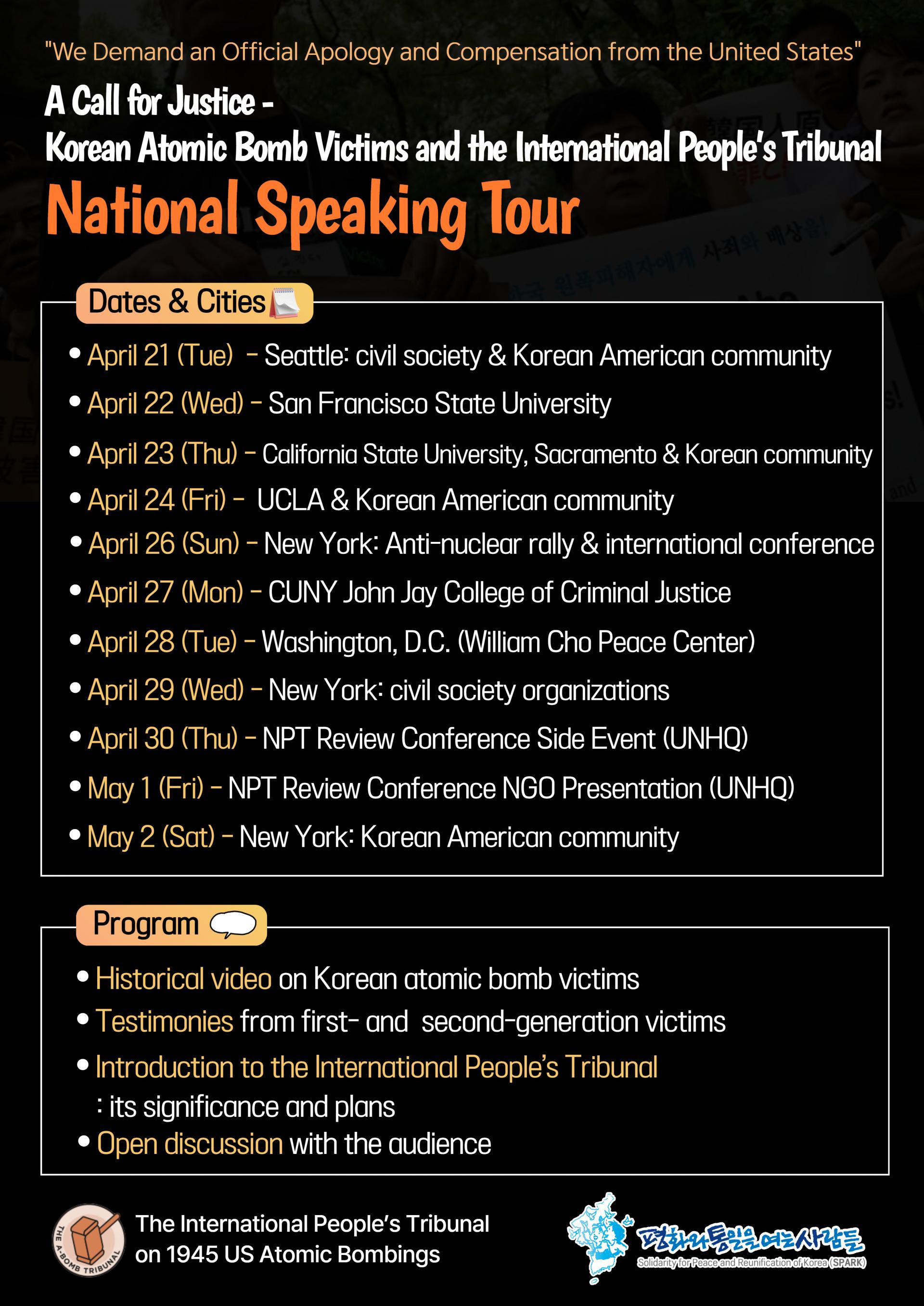
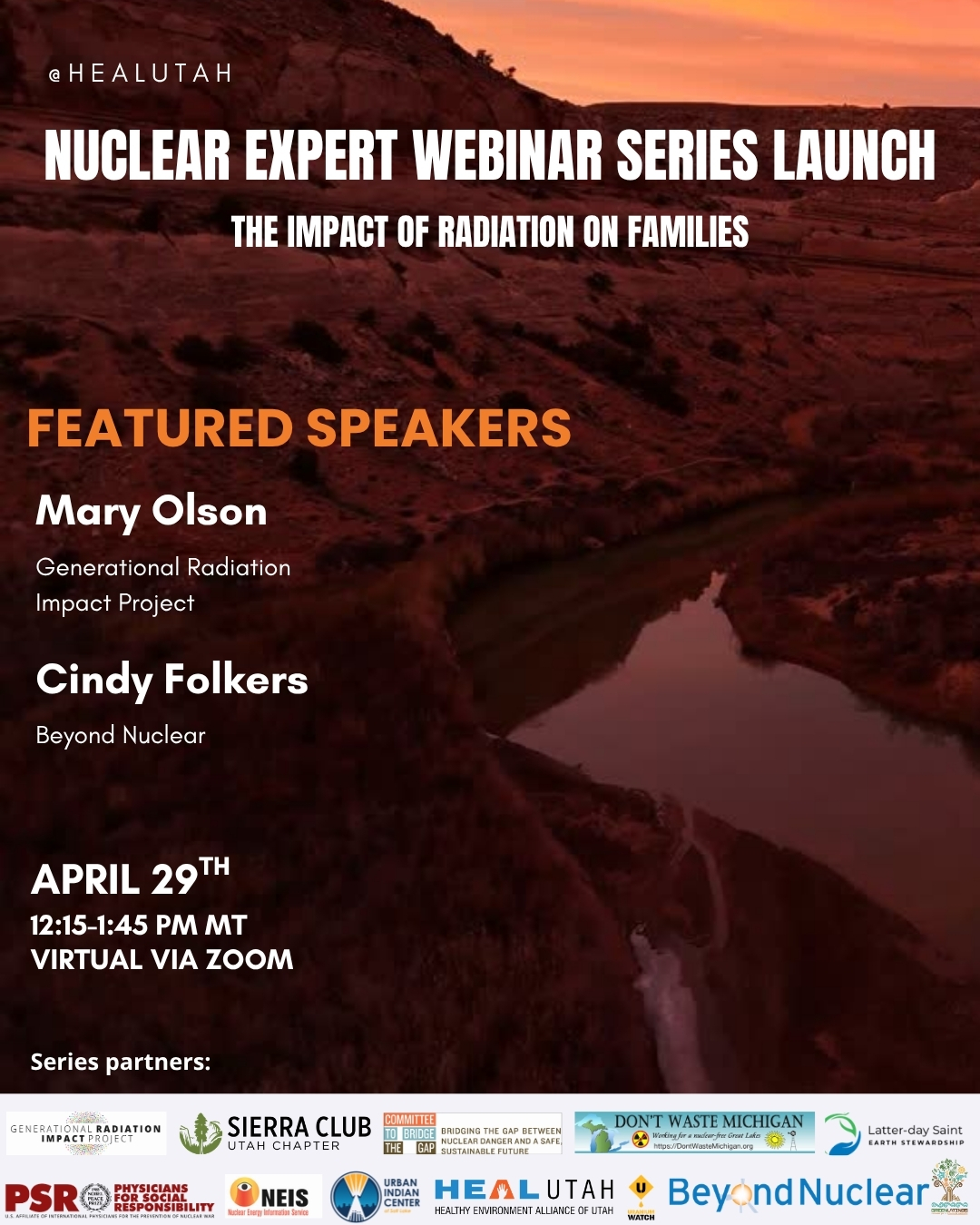
29 April – Nuclear Expert Webinar #1 – Radiation Impacts on Families with Mary Olson and Cindy Folkers
- 12:15 PM MT – 1:45 PM MT
- Location: Virtual – REGISTER TODAY

4 May -West Suburban Peace Coalition to discuss Iran war at May Educational Forum
Monday, May 4, 7:00 – 8:00 PM Central Standard Time
Title: : How Trump’s Narrative Tries to Shape the Reality of the War on Iran.
Contact Walt Zlotow, zlotow@hotmail.com 630 442 3045 for further information
14 May – online event From Bombs to Data Centres: the Face of Nuclear Colonialism

Pine Ridge Uranium is the real threat, not Tehran- Tell Burgum: Stop the Extraction.
Chernobyl: The Lost Tapes – A good documentary on Chernobyl on SBS available On Demand for the next 3 weeks– https://www.sbs.com.au/ondemand/tv-program/chernobyl-the-lost-tapes/2352741955560
To see nuclear-related stories in greater depth and intensity – go to https://nuclearinformation.wordpress.com
-
Archives
- April 2026 (288)
- March 2026 (251)
- February 2026 (268)
- January 2026 (308)
- December 2025 (358)
- November 2025 (359)
- October 2025 (376)
- September 2025 (257)
- August 2025 (319)
- July 2025 (230)
- June 2025 (348)
- May 2025 (261)
-
Categories
- 1
- 1 NUCLEAR ISSUES
- business and costs
- climate change
- culture and arts
- ENERGY
- environment
- health
- history
- indigenous issues
- Legal
- marketing of nuclear
- media
- opposition to nuclear
- PERSONAL STORIES
- politics
- politics international
- Religion and ethics
- safety
- secrets,lies and civil liberties
- spinbuster
- technology
- Uranium
- wastes
- weapons and war
- Women
- 2 WORLD
- ACTION
- AFRICA
- Atrocities
- AUSTRALIA
- Christina's notes
- Christina's themes
- culture and arts
- Events
- Fuk 2022
- Fuk 2023
- Fukushima 2017
- Fukushima 2018
- fukushima 2019
- Fukushima 2020
- Fukushima 2021
- general
- global warming
- Humour (God we need it)
- Nuclear
- RARE EARTHS
- Reference
- resources – print
- Resources -audiovicual
- Weekly Newsletter
- World
- World Nuclear
- YouTube
-
RSS
Entries RSS
Comments RSS
 nuclear-news