No one can win a nuclear war: Putin
https://www.canberratimes.com.au/story/7843236/no-one-can-win-a-nuclear-war-putin/ 2 Aug 22, Russian President Vladimir Putin says there can be no winners in a nuclear war and no such war should ever be started.
The Kremlin leader made the comment in a letter to participants of a conference on the nuclear non-proliferation treaty (NPT), more than five months into his war on Ukraine.
“We proceed from the fact that there can be no winners in a nuclear war and it should never be unleashed, and we stand for equal and indivisible security for all members of the world community,” he said.
His words to the NPT forum appeared aimed at striking a reassuring note and portraying Russia as a responsible nuclear power.
They contrasted with earlier statements by Putin and other Russian politicians that have been interpreted in North America and Europe as implicit nuclear threats.
In a speech on February 24, as he launched the Russian invasion of Ukraine, Putin pointedly referred to Russia’s nuclear arsenal and warned outside powers that any attempt to interfere would “lead you to such consequences that you have never encountered in your history”.
Days later, he ordered Russia’s nuclear forces to be put on high alert.
The world is facing a level of danger from nuclear weapons not seen since the height of the Cold War, UN Secretary General Antonio Guterres said at the start of the NPT conference on Monday.
The NPT is subject to review every five years, and the 10th review was to have taken place in 2020 but was postponed on account of the pandemic.
CIA director William Burns said in April that given the setbacks Russia had suffered in Ukraine, “none of us can take lightly the threat posed by a potential resort to tactical nuclear weapons or low-yield nuclear weapons”.
Russia, whose military doctrine allows for the use of nuclear weapons in the event of an existential threat to the Russian state, has accused the US of leading a “proxy war” against it by arming Ukraine and imposing sanctions.
Earlier on Monday, a Russian foreign ministry source questioned the seriousness of comments by US President Joe Biden calling for talks on a nuclear arms control framework to replace a treaty expiring in 2026.
“Is this a serious statement or has the White House website been hacked?” a Russian foreign ministry source told Reuters.
Nuclear news this week

I had trouble finding “good news” for today. So, I’ll put in a thought of my own. My own country, Australia, today gives some hope, For the first time, we have a government really trying to include our First Nations people in decision-making. Not only is Australia headed for a referendum to bring indigenous voices into our Parliament – with hope to redress the wrongs of 200 years, but also the hope that indigenous knowledge and culture will advise and further the mighty task of healing our damaged environment.
Coronavirus and Climate – it’s all drastically bad- the mind boggles – best for readers to do their homework on these.
Nuclear. Ironically, as nations ramp up their nuclear weaponry – comes the anniversary of the nuclear bombing of Hiroshima and Nagasaki. https://www.youtube.com/watch?v=tZSENcK-en4 At some commemorations. survivors like Setsuko Thurlow will be speaking. Like the survivors of Auschwitz, these first witnesses may not be with us much longer. It is all-important that their message is remembered, and that denialism of these truly awful horrors does not prevail.
The World Does Not Want a Global NATO.
Deterrencelessness: Nuclear threats neither credible nor viable.
UN Nuclear Review: a prime time to stop the new arms race. Ukraine War Hangs Over UN Meeting on Nuclear Treaty’s Legacy. U.N. nuclear conference to start Monday as Ukraine’s Zaporizhzhya plant in “alarming” state, watchdog says.
For Warmongers It’s Always 1938. US airman who rescued film of A-bomb horrors is honoured at last.
Small nuclear reactors will bleed us dry and won’t solve climate change – unfounded promises.
The future of global catastrophic risk events from climate change.
UKRAINE. Russia accused of waging war out of working nuclear power plant in Ukraine. How professional lobbyists have worked to generate enthusiasm in Washington for a long proxy military conflict in Ukraine. High risks at Chornobyl.
FRANCE. French finance minister and MPs clash over future of nuclear power. France should “rethink the temperature thresholds of rivers”. Nuclear giant EDF and waste company Veolia continue to do business with Russia – the nuclear industry gets uranium from Russia, and sends wastes there. Protest against radioactivity-contaminated water, at French nuclear site.
ASIA. Nuclear Weapons Policies of Japan and South Korea Challenged.
JAPAN. Backlash over dumping of nuclear waste-water to the ocean . Japan to push for nuclear arms reduction at NPT review conference. Kishida to call for nuke-free world in historic address at U.N. treaty conference.
UK.
- Small nuclear reactors the solution to climate problems? The facts suggest otherwise.
- EDF forced to redesign UK nuclear reactors after horror leaks at Chinese sites.
- Campaign groups in Wales join to fight nuclear power plans.
- Scotland’s government dithering about nuclear power.
- Rolls Royce hyping up risky and unproven small nuclear reactors.
- Glascow City Council not informed when nuclear weapons convoys pass through city.
- Latest Research – Baseload generators such as Sizewell C nuclear power plants are not needed in an all-renewable future and their use would simply increase costs. A new nuclear power station needs a vast supply of water. But where will Sizewell C get it from? Grief for the abuse of nature that will come with Sizewell C nuclear station.
- Hinkley Point B nuclear power station to close permanently, due to safety concerns. UK to be left for 1000s of years with Hinkley Point B’s legacy of nuclear waste.
- Undersea nuclear waste dump off Cumbria would imperil marine life, experts warn. Is it environmentally sound to bury a massive stockpile of nuclear waste beneath the ocean floor? Probably not
USA.
- How Would Space Be Used In War? https://www.youtube.com/watch?v=Ng2kLh2Ez3Y
- Western states join New Mexico in resisting nuclear waste storage without state consent. Nuclear Waste Cleanup: Hanford Site Cleanup Costs Continue to Rise, but Opportunities Exist to Save Tens of Billions of Dollars.
- Westinghouse could get a 40 year license renewal for its nuclear fuel fabrication plant , despite safety concerns. SC nuclear fuel plant gets 40-year operating license – a ‘‘license to pollute”. Dead fish near SC nuclear fuel site were an early warning. Then came the spills and accidents.
CANADA. Pickering nuclear station is closing as planned, despite calls for refurbishment.
IRAN Iran will keep IAEA cameras turned off until nuclear deal is restored. Lawmaker Says Iran Nuclear Talks Will Resume In Coming Days.
AUSTRALIA. Australia urged to prove it is a safe nuclear custodian as Aukus comes under scrutiny at UN. Fleet of nuclear submarines will be sent by Britain to Australia as a warning to China. Indonesia warns of perils of nuclear-powered submarines in submission to the UN.
The World Does Not Want a Global NATO.

Although NATO’s member states may believe that they possess global authority, the overwhelming majority of the world does not.
It is clear that NATO’s claim to be “a bulwark of the rules-based international order” is not a view which is shared by most of the world
Most of the world rejects NATO’s policies and global aspirations and does not wish to divide the international community into outdated Cold War blocs, writes Vijay Prashad.
Consortium News, By Vijay Prashad. Tricontinental: Institute for Social Research ” 29 July 22..………………….. At No Cold War, an international platform seeking to bring sanity to international relations, we have been closely observing the shifting tenor of the war in Ukraine and the U.S.-driven pressure campaign against China.
We have published three previous briefings from this platform in our newsletters; below, you will find briefing No. 4, The World Does Not Want a Global NATO, which details the emerging clarity in the Global South regarding the U.S.-European attempt to drive a belligerent agenda around the world.
This new clarity relates not only to the militarisation of the planet, but also to the deepening conflicts in trade and development, as evidenced by the G7’s new initiative, the Partnership for Global Infrastructure and Development, which clearly targets China’s Belt and Road Initiative.
In June, member states of the North Atlantic Treaty Organisation (NATO) gathered in Madrid for their annual summit. At the meeting, NATO adopted a new Strategic Concept, which had last been updated in 2010. In it, NATO names Russia as its “most significant and direct threat” and singles out China as a “challenge [to] our interests.” In the words of NATO Secretary General Jens Stoltenberg, this guiding document represents a “fundamental shift” for the military alliance, its “biggest overhaul… since the Cold War.”
Monroe Doctrine for the 21st Century?
Although NATO purports to be a “defensive” alliance, this claim is contradicted by its destructive legacy – such as in Serbia (1999), Afghanistan (2001) and Libya (2011) – and its ever-expanding global footprint.
At the summit, NATO made it clear that it intends to continue its global expansion to confront Russia and China. Seemingly oblivious to the immense human suffering produced by the war in Ukraine, NATO declared that its “enlargement has been a historic success… and contributed to peace and stability in the Euro-Atlantic area,” and extended official membership invitations to Finland and Sweden.
However, NATO’s sights extend far beyond the “Euro-Atlantic” to the Global South. Seeking to gain a foothold in Asia, NATO welcomed Japan, South Korea, Australia and New Zealand as summit participants for the first time and stated that “the Indo-Pacific is important for NATO.”
On top of this, echoing the Monroe Doctrine (1823) of two hundred years ago, the Strategic Concept named “Africa and the Middle East” as “NATO’s southern neighbourhood,” and Stoltenberg made an ominous reference to “Russia and China’s increasing influence in [the Alliance’s] southern neighbourhood” as presenting a “challenge.”
Most of World Seeks Peace
Although NATO’s member states may believe that they possess global authority, the overwhelming majority of the world does not. The international response to the war in Ukraine indicates that a stark divide exists between the United States and its closest allies on the one hand and the Global South on the other.
Governments representing 6.7 billion people – 85 percent of the world’s population – have refused to follow sanctions imposed by the U.S. and its allies against Russia, while countries representing only 15 percent of the world’s population have followed these measures. According to Reuters, the only non-Western governments to have enacted sanctions on Russia are Japan, South Korea, the Bahamas and Taiwan – all of which host U.S. military bases or personnel.
There is even less support for the push to close airspace to Russian planes spearheaded by the U.S. and European Union. Governments representing only 12 percent of the world’s population have adopted this policy, while 88 percent have not.
U.S.-led efforts to politically isolate Russia on the international stage have been unsuccessful. In March, the U.N. General Assembly voted on a nonbinding resolution to condemn Russia’s invasion of Ukraine: 141 countries voted in favour, five countries voted against, 35 countries abstained and 12 countries were absent. However, this tally does not tell the full story. The countries which either voted against the resolution, abstained, or were absent represent 59 percent of the world’s population. Following this, the Biden administration’s call for Russia to be excluded from the G20 summit in Indonesia was ignored.
Meanwhile, despite intense backing from NATO, efforts to win support for Ukraine in the Global South have been a complete failure. On June 20, after several requests, Ukrainian President Volodymyr Zelensky addressed the African Union; only two heads of state of the continental organisation’s 55 members attended the meeting. Shortly thereafter, Zelensky’s request to address the Latin American trade bloc, Mercosur, was rejected.
It is clear that NATO’s claim to be “a bulwark of the rules-based international order” is not a view which is shared by most of the world. Support for the military alliance’s policies is almost entirely confined to its member countries and a handful of allies which together constitute a small minority of the world’s population. Most of the world’s population rejects NATO’s policies and global aspirations and does not wish to divide the international community into outdated Cold War blocs. https://consortiumnews.com/2022/07/29/the-world-does-not-want-a-global-nato/
A US airman who rescued film of A-bomb horrors is honoured at last
Guardian, Rory Carroll, @rorycarroll72, Sun 31 Jul 2022
Cameraman Daniel McGovern copied footage of Hiroshima and Nagasaki devastation to ensure lessons were learned
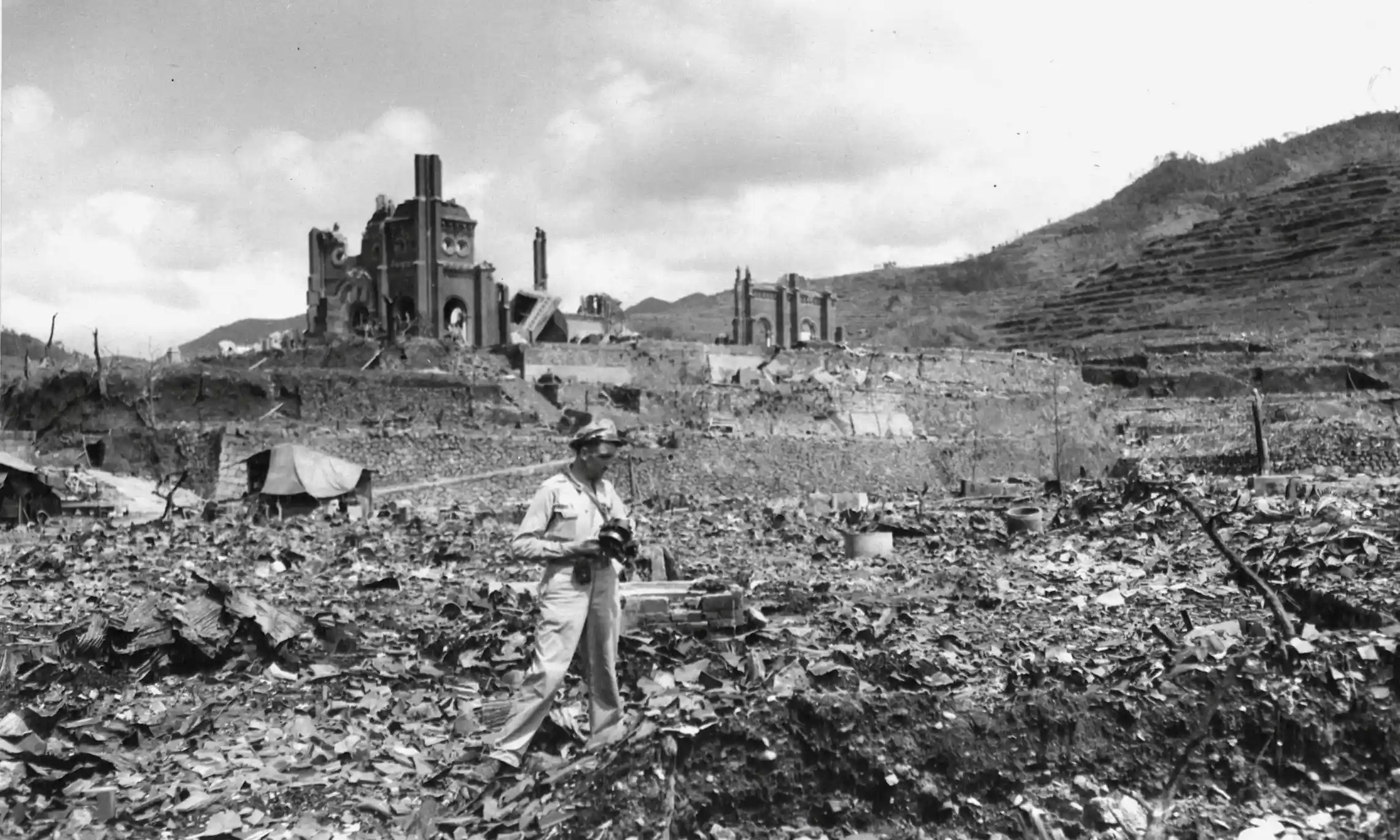
The photograph shows devastation in Nagasaki after the atomic bomb: a scorched wilderness where there was once a city. At its centre stands a lone man with a camera.
It was 9 September 1945 and Lt Daniel McGovern, a US Army Air Force cameraman, was documenting ground zero, the point directly below the bomb’s detonation four weeks earlier. Few would recognise McGovern, but the vision of apocalypse is familiar from documentary footage of Hiroshima and Nagasaki at the end of the second world war.
The footage will be shown again this week and next for the 77th anniversaries of the atomic bombings that obliterated the Japanese cities and showed the reality of nuclear war: blasted landscapes, burnt skeletons, radiation sickness.
But those haunting images might not exist were it not for McGovern. As part of the US Strategic Bombing Survey – which studied the impact of bombing – McGovern supervised Japanese and American camera crews in Hiroshima and Nagasaki. Back in the US, he saved the footage from suppression by making secret copies.
Only now, decades later, has his full story emerged. Joe McCabe, a journalist from McGovern’s native County Monaghan in Ireland, has pieced together his remarkable life in a biography, Rebels to Reels, published earlier this month after 20 years of research, including interviews with McGovern before his death in 2005………………………………………………….
The fields around Nagasaki were bleached white and the city looked as if a “massive anvil” had flattened it, he later told McCabe. At a ruined school he filmed the bodies of children amid piles of skulls. “Hundreds of kids had been sucked out through the windows. We were always finding bones.”
He filmed harrowing scenes at overwhelmed hospitals, including the agony of a 16-year-old boy named Sumiteru Taniguchi. “His whole back just looked like a bowl of bubbling tomatoes.”
Other patients had rashes, hair loss and bleeding from the nose and mouth – a mysterious malady later identified as radiation sickness.
McGovern also captured the phenomenon of people who had been atomised yet left shadows caused by radiant heat. The two atomic bombs are estimated to have killed more than 200,000 people.
McGovern’s teams amassed 100,000ft of colour footage and enlisted the help of a Japanese newsreel service, Nippon Eigasha, which had 26,000ft of black-and-white footage, much shot before the Americans had arrived. The Irishman helped edit the Japanese footage into a documentary called Effects of the Atomic Bomb on Hiroshima and Nagasaki, and planned to turn the colour footage into another one.
Authorities in Washington, however, classified the material as secret in 1946. “They didn’t want the American public seeing the horrors,” McGovern said. He discreetly made copies at the Pentagon. He stored one set at an air force motion picture depository in Dayton, Ohio, and kept another set himself.
Years passed – McGovern witnessed rocket tests and debunked theories of aliens at Roswell as “a load of crap” – and then in 1967 a US Congressional committee that included Robert Kennedy asked to see the atomic bomb footage. The material had been declassified but no one could find the originals. McGovern, by now a lieutenant colonel, directed the authorities to his copies.
In 1970 the general public got its first glimpse of some of the footage. It had been incorporated into a film called Hiroshima Nagasaki – August 1945 that premiered at New York’s Museum of Modern Art.
The auditorium was packed. At the end, no one made a sound. https://www.theguardian.com/world/2022/jul/31/us-airman-daniel-mcgovern-cameraman-hiroshima-nagasaki
Small nuclear reactors will bleed us dry and won’t solve climate change – unfounded promises

there is every reason to believe that if and when a NuScale SMR is built, its final cost too will vastly exceed current official estimates.
Unfounded promises — Beyond Nuclear International Small Modular Reactors epitomize culture that embraces exaggeration
By M.V. Ramana
In 2006, Elizabeth Holmes, founder of a Silicon Valley startup company called Theranos, was featured in Inc magazine’s annual list of 30 under 30 entrepreneurs. Her entrepreneurship involved blood, or more precisely, testing blood. Instead of the usual vials of blood, Holmes claimed to be able to obtain precise results about the health of patients using a very small sample of blood drawn from just a pinprick.
The promise was enticing and Holmes had a great run for a decade. She was supported by a bevy of celebrities and powerful individuals, including former U.S. secretaries of state Henry Kissinger and George Shultz, James Mattis, who later served as U.S. secretary of defense, and media mogul Rupert Murdoch. Not that any of them would be expected to know much about medical science or blood testing. But all that public endorsement helped. As did savvy marketing by Holmes. Theranos raised over $700 million from investors, and receive a market valuation of nearly $9 billion by 2014.
The downfall started the following year, when the Wall Street Journal exposed that Theranos was actually using standard blood tests behind the scenes because its technology did not really work. In January 2022, Holmes was found guilty of defrauding investors.
The second part of the Theranos story is an exception. In a culture which praises a strategy of routine exaggeration, encapsulated by the slogan “fake it till you make it”, it is rare for a tech CEO being found guilty of making false promises. But the first part of Theranos story—hype, advertisement, and belief in impossible promises—is very much the norm, and not just in the case of companies involved in the health care industry.
Small Modular Nuclear Reactors
Nuclear power offers a great example. In 2003, an important study produced by nuclear advocates at the Massachusetts Institute of Technology identified costs, safety, proliferation and waste as the four “unresolved problems” with nuclear power. Not surprisingly, then, companies trying to sell new reactor designs claim that their product will be cheaper, will produce less—or no—radioactive waste, be immune to accidents, and not contribute to nuclear proliferation. These tantalizing promises are the equivalent of testing blood with a pin prick.
And, as was the case with Theranos, many such companies have been backed up by wealthy investors and influential spokespeople, who have typically had as much to do with nuclear power as Kissinger had to with testing blood. Examples include Peter Thiel, the Silicon Valley investor; Stephen Harper, the former Prime Minister of Canada; and Richard Branson, the founder of the Virgin group. But just as the Theranos product did not do what Elizabeth Holmes and her backers were claiming, new nuclear reactor designs will not solve the multiple challenges faced by nuclear power.
One class of nuclear reactors that have been extensively promoted in this vein during the last decade are Small Modular Reactors (SMRs). The promotion has been productive for these companies, especially in Canada. Some of these companies have received large amounts of funding from the national and provincial governments. This includes Terrestrial Energy that received CAD 20 million and Moltex that received CAD 50.5 million, both from the Federal Government. The province of New Brunswick added to these by awarding CAD 5 million to Moltex and CAD 25 million in all to ARC-100.
All these companies have made various claims about the above mentioned problems. Moltex, for example, claims that its reactor design “reduces waste”, a claim also made by ARC-100. ARC-100 also claims to be inherently safe, while Terrestrial claims to be cost-competive. Both Terrestrial and ARC-100 claim to do well on proliferation resistance. In general, no design will admit to failing on any of these challenges.
Dealing with any of these challenges—safety enhancement, proliferation resistance, decreased generation of waste, and cost reduction—will have to be reflected in the technical design of the nuclear reactor. The problem is that each of these goals will drive the requirements on the reactor design in different, sometimes opposing, directions.
Economics
The hardest challenge is economics. Nuclear energy is an expensive way to generate electricity. In the 2021 edition of its annual cost report, Lazard, the Wall Street firm, estimated that the levelized cost of electricity from new nuclear plants will be between $131 and $204 per megawatt hour; in contrast, newly constructed utility-scale solar and wind plants produce electricity at somewhere between $26 and $50 per megawatt hour according to Lazard. The gap between nuclear power and renewables is large, and is growing larger. While nuclear costs have increased with time, the levelized cost of electricity for solar and wind have declined rapidly, and this is expected to continue over the coming decades.
Even operating costs for nuclear power plants are high and many reactors have been shut down because they are unprofitable. In 2018, NextEra, a large electric utility company in the United States, decided to shut down the Duane Arnold nuclear reactor, because it estimated that replacing nuclear with wind power will “save customers nearly $300 million in energy costs, on a net present value basis.”
The high cost of constructing and operating nuclear plants is a key driver of the decline of nuclear power around the world. In 1996, nuclear energy’s share of global commercial gross electricity generation peaked at 17.5 percent. By 2020, that had fallen to 10.1 percent, a 40 percent decline.
The high costs described above are for large nuclear power plants. SMRs, as the name suggests, produce relatively small amounts of electricity in comparison. Economically, this is a disadvantage. When the power output of the reactor decreases, it generates less revenue for the owning utility, but the cost of constructing the reactor is not proportionately smaller. SMRs will, therefore, cost more than large reactors for each unit (megawatt) of generation capacity. This makes electricity from small reactors more expensive. This is why most of the early small reactors built in the United States shut down early: they just couldn’t compete economically.
SMR proponents argue that the lost economies of scale will be compensated by savings through mass manufacture in factories and as these plants are built in large numbers costs will go down. But this claim is not very tenable. Historically, in the United States and France, the countries with the highest number of nuclear plants, costs went up, not down, with experience. Further, to achieve such savings, these reactors have to be manufactured by the hundreds, if not the thousands, even under very optimistic assumptions about rates of learning. Finally, even if SMRs were to become comparable in cost per unit capacity of large nuclear reactors, that would not be sufficient to make them economically competitive, because their electricity production cost would still be far higher than solar and wind energy.
…………………………………………. Cost escalations are already apparent in the case of the NuScale SMR, arguably the design that is most developed in the West. The estimated cost of the Utah Association of Municipal Power Systems project went from approximately $3 billion in 2014 to $6.1 billion in 2020—this is to build twelve units of the NuScale SMR that were to generate 600 megawatts of power. The cost was so high that NuScale had to change its offering to a smaller number of units that produce only 462 megawatts, but at a cost of $5.32 billion. In other words, the cost per kilowatt of generation capacity is around $11,500 (US dollars). That figure is around 80 percent more than the per kilowatt cost of the infamous Vogtle project at the time its construction started. Since that initial estimate of $14 billion for the two AP1000 reactors, the estimated cost of the much delayed project has escalated beyond $30 billion. As with the AP1000 reactors, there is every reason to believe that if and when a NuScale SMR is built, its final cost too will vastly exceed current official estimates. ……………
Timelines
The other promise made by SMR developers is how fast they can be deployed. GE-Hitachi, for example, claims that an SMR could be “complete as early as 2028” at the Darlington site. ARC-100 described an operational date of 2029 as an “aggressive but achievable target”.
Again, the historical record suggests otherwise. Consider NuScale. In 2008, the company projected that “a NuScale plant could be producing electricity by 2015-16”. As of 2022, the company projects 2029-30 as the date for start of generation. Russia’s KLT-40S, a reactor deployed on a barge, offers another example. When construction started in 2007, the reactor was projected to start operations in October 2010. It was actually commissioned a whole decade later, in May 2020.
The SMR designs being considered in Canada are even further off. In December 2021, Ontario Power Generation chose the BWRX-300 for the Darlington site. That design is based on GE-Hitachi’s Economical Simplified Boiling Water Reactor (ESBWR) design, which was submitted for licensing to the U.S. Nuclear Regulatory Commission in 2005. That ESBWR design was changed nine times; the NRC finally approved revision 10 from 2014. If the Canadian Nuclear Safety Commission does its due diligence, it might be 2030 or later before the BWRX-300 is even licensed for construction. That assumes that the BWRX-300 design remains unchanged. And, then, of course, there will be the inevitable delays (and cost escalations) during construction. ………….
Waste, Proliferation and Safety
Small reactors also cause all of the usual problems: the risk of severe accidents, the production of radioactive waste, and the potential for nuclear weapons proliferation. …………
…………… small modular reactor proposals often envision building multiple reactors at a site. The aim is to lower costs by taking advantage of common infrastructure elements. The configuration offered by NuScale, for example, has twelve reactor modules at each site, although it also offers four- and six-unit versions. With multiple reactors, the combined radioactive inventories might be comparable to that of a large reactor. Multiple reactors at a site increase the risk that an accident at one unit might either induce accidents at other reactors or make it harder to take preventive actions at others. This is especially the case if the underlying reason for the accident is a common one that affects all of the reactors, such as an earthquake. In the case of the accidents at Japan’s Fukushima Daiichi plant, explosions at one reactor damaged the spent fuel pool in a co-located reactor. Radiation leaks from one unit made it difficult for emergency workers to approach the other units. ……………………………
Claims by SMR proponents about not producing waste are not credible, especially if waste is understood not as one kind of material but a number of different streams. A recent paper in the Proceedings of the National Academy of Sciences examined three specific SMR designs and calculates that “relative to a gigawatt-scale PWR” these three will produce up to 5.5 times more spent fuel, 30 times more long-lived low and intermediate level waste, and 35 times more short-lived low and intermediate level waste. In other words, in comparison with large light water reactors, SMRs produce more, not less, waste per unit of electricity generated. As Paul Dorfman from the University of Sussex commented, “compared with existing conventional reactors, SMRs would increase the volume and complexity of the nuclear waste problem”.
Further, some of the SMR designs involve the use of materials that are corrosive and/or pyrophoric. Dealing with these forms is more complicated. For example, the ARC-100 design will use sodium that cannot be disposed of in geological repositories without extensive processing. Such processing has never been carried out at scale. The difference in chemical properties mean that the methods developed for dealing with waste from CANDU reactors will not work as such for these wastes.
Many SMR designs also make the problem of proliferation worse. Unlike the CANDU reactor design that uses natural uranium, many SMR designs use fuel forms that require either enriched uranium or plutonium. Either plutonium or uranium that is highly enriched in the uranium-235 isotope can be used to make nuclear weapons. Because uranium enrichment facilities can be reconfigured to alter enrichment levels, it is possible for a uranium enrichment facility designed to produce fuel for a reactor to be reconfigured to produce fuel for a bomb. All else being equal, nuclear reactor designs that require fuel with higher levels of uranium enrichment pose a greater proliferation risk—this is the reason for the international effort to convert highly enriched uranium fueled research reactors to low enriched uranium fuel or shutting them down.
Plutonium is created in all nuclear power plants that use uranium fuel, but it is produced alongside intensely radioactive fission products. Practically any mixture of plutonium isotopes could be used for making weapons. Using the plutonium either to fabricate nuclear fuel or to make nuclear weapons, require the “reprocessing” of the spent fuel. Canada has not reprocessed its power reactor spent fuel, but some SMR designs, such as the Moltex design, propose to “recycle” CANDU spent fuel. Last year, nine US nonproliferation experts wrote to Prime Minister Justin Trudeau expressing serious concerns “about the technology Moltex proposes to use.”
The proliferation problem is made worse by SMRs in many ways. ……………………..
Conclusion
The saga of Theranos should remind us to be skeptical of unfounded promises. Such promises are the fuel that drive the current interest in small modular nuclear reactors………
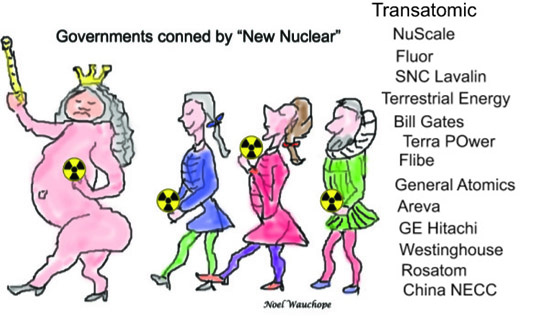
Rather than seeing the writing on the wall, unfortunately, government agencies are wasting money on funding small modular reactor proposals. Worse, they seek to justify such funding by repeating the tall claims made by promoters of these technologies…… https://beyondnuclearinternational.org/2022/07/31/unfounded-promises00
Dead fish near SC nuclear fuel site were an early warning. Then came the spills and accidents
The State, BY SAMMY FRETWELL, JULY 30, 2022
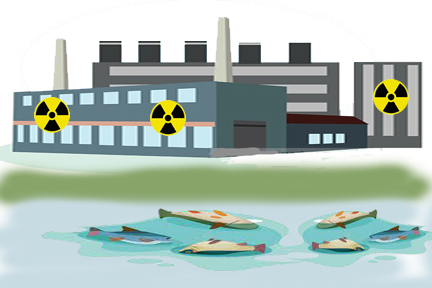
Dead fish floated in a small pond near a nuclear fuel factory one day in 1980, raising concerns about the Columbia plant’s danger to the surrounding environment. A cocktail of contaminants had been documented in groundwater, which seeps into creeks and ponds, and it appeared that one of these pollutants — ammonia — had contributed to the fish kill in Gator Pond, according to environmental studies. It was a disturbing discovery that foreshadowed a variety of environmental and safety troubles the Westinghouse nuclear fuel plant would deal with over the next 40 years.
Since 1980, more than 40 environmental and safety problems have been tied to the Westinghouse plant, ranging from groundwater pollution to nuclear safety violations that endangered plant workers, according to a review of news accounts and public records by The State. Despite those issues, the U.S. Nuclear Regulatory Commission approved a final environmental study Friday that said the future environmental impact of the plant would be small to moderate. The NRC recommended a new license for the plant to operate for an additional 40 years, a decision that greases the skids for final license approval this fall.
John Grego, who is with the Friends of Congaree Swamp organization that supports Congaree National Park, said the fuel factory has had too many troubles of all kinds through the years. “The variety of problems is what troubles me, that this occurred in so many aspects of their culture,’’ Grego said. “It just seems to suggest systemic problems with the safety culture at Westinghouse. You had these long-standing problems that weren’t remediated, problems that weren’t reported.’’
Some of the pollution tied to Westinghouse was not known to the public or government regulators for years, which has incensed some Lower Richland residents who live near the plant. Some residents of the predominantly African-American community have said they were left out of the loop for too long.
Only in recent years, when a flurry of safety issues at the plant arose, did many people learn about past pollution. A key community concern is whether water pollution from the plant could one-day contaminate their drinking water wells. State regulators said mechanisms are now in place to hold Westinghouse more accountable, while resolving past environmental problems. The company struck a binding agreement with the state Department of Health and Environmental Control in 2019 to investigate and clean up pollution on the property. The company also is nearing completion of an investigative study of the site’s environmental problems, according to a statement Friday from DHEC.
……………………… Congaree Riverkeeper Bill Stangler was skeptical. Stangler said he is not confident Westinghouse will improve the operation, despite recent assurances and agreements with state regulators to clean up and do a better job. The plant is located near the Congaree River. “They have a long track record of problems at that facility that would raise anyone’s eyebrows,’’ Stangler said. “It’s concerning if you have an interest in the environment; it’s concerning if you are someone who lives in the surrounding area. Time after time we have seen that they haven’t followed the rules, and they have had problems.’’
………………………
Troubles at Westinghouse began in the 1970s, not long after the plant opened, when a wastewater pond leaked. But problems continued steadily after the 1980 fish kill, sometimes little known to the public. After the company reported a leak of uranium through a hole in the plant floor in 2018, federal and state regulators learned that the company had spilled toxins into the ground in 2008 and in 2011 without telling them or the public. The company said it was not required to report the spills. Contaminants such as fluoride, uranium, solvents and ammonia have been found in groundwater on the Westinghouse site. Technetium, a nuclear pollutant, also has been discovered on the soggy property, but no one has yet pinpointed the cause of the pollution.
Some of the biggest troubles at Westinghouse have revolved around nuclear safety inside the plant. The company has run into trouble through the years for failing to make sure nuclear materials it manages didn’t trigger small bursts of radiation, which can endanger workers. Records show the NRC has expressed concerns multiple times with Westinghouse over the issue, known as criticality safety
……………………… Government records also show that people working at the plant falsified records, including as recently as 2009. In some cases, employees have been injured or threatened by nuclear accidents.
…………………. News accounts and government records also show that Westinghouse has, at times, had trouble handling and keeping track of nuclear material it is responsible for…………………………………………. https://www.thestate.com/news/local/environment/article263945551.html
UN Nuclear Review: A Prime Time to Stop the New Arms Race
The real solution to the threat of nuclear war is in plain sight, but still the powerful weapons makers and war profiteers refuse to yield.
https://medium.com/@codepink/un-nuclear-review-a-prime-time-to-stop-the-new-arms-race-6e3303aa0ccd By Marcy Winograd and Medea Benjamin, 31 July 22,
In the run-up to August’s United Nation’s 10th Annual Review of the landmark Nuclear Non-Proliferation Treaty (NPT), a review undertaken every five years, Secretary of State Antony Blinken’s State Department issued a surprising reaffirmation of the U.S. commitment to this treaty and the “ultimate goal of a world without nuclear weapons.”
The NPT, designed to “further the goal of achieving nuclear disarmament,” entered into force in 1970 and was extended indefinitely in 1995. It has now been signed by 191 nations, including the U.S. and Russia.
If only Blinken’s verbal support for the NPT was U.S. policy, as opposed to wishful thinking or trickery.
As treaty signatories and civil society representatives from around the world gather for a month in New York to evaluate the treaty’s implementation, the White House, Congress, and military contractors will move ahead on a near $2 trillion nuclear rearmament program euphemistically termed “nuclear modernization.”
Modernization is a kitchen upgrade. New touch-to-open cabinets. New LED recessed lighting.
It is not 600 new–instead of funeralized–intercontinental ballistic missiles (ICBM’s) on hair trigger alert to replace the Minuteman III in the midwest. Each of these “modern missiles” would span the length of a bowling lane with new warheads that are 20 times more powerful than the bombs that incinerated Hiroshima and Nagasaki.
Modernization is not a new sea-launched nuclear cruise missile that carries both conventional and nuclear warheads with the same radar profile to confuse “the enemy.”
Modernization is not 100 new stealth air-launched nuclear missiles like the B-21 Raider, also capable of carrying both conventional and nuclear weapons.
Ahh, but these nuclear weapons are just upgrades, not new systems, right?
Semantic back-flips aside, U.S. nuclear “modernization” means the development of new weapon systems with new nuclear warheads and a new arms race. What the State Department failed to mention in its reaffirmation of the NPT was that the U.S. nuclear rearmament program violates the spirit and intent of Article 6 of the NPT, which prohibits the pursuit of new nuclear weapons.
Instead of pursuing world peace and climate preservation for our children, US leaders are chasing a reckless foreign policy.
In April, the Wall Street Journal published a commentary titled “The U.S. should show it can win a nuclear war.”
More recently, the City of New York, home of the United Nations, released, however well-intentioned, a so-called public service announcement on how to survive a nuclear attack, referring to it as “the big one”, as though it were an earthquake. No mention was made of blinding flashes of light or widespread radiation that blisters the skin or immediate incineration. Instead, New Yorkers were instructed to get inside, stay inside and stay tuned. Tuned to what? Our fading heartbeats?
According to the International Committee to Abolish Nuclear Weapons (ICAN), a nuclear war between the US and Russia would lead to over 34-million dead and 57 million injured in the first few hours — and a dark subzero winter of famine and soot blocking the sun for those who survived.
No mention is made of this nightmare scenario, however, in the 2019 Joint Chiefs Nuclear Operations Publication (3–72), a Strangelovian document briefly released then deleted from the website of the Joint Chiefs of Staff. The vanishing unclassified document, preserved by the Federation of American Scientists, reflects the Pentagon’s delusional thinking that a nuclear war can be limited and won. Mark Milley, then Secretary of the Army, now Chair of the Joint Chiefs, signed off on the chilling statements below:
“A nuclear weapon could be brought into the campaign as a result of perceived failure in a conventional campaign, potential loss of control or regime, or to escalate the conflict to sue for peace on more-favorable terms.”
“Using nuclear weapons could create conditions for decisive results and the restoration of strategic stability …”
UN treaty signatories, along with NGO conference delegates, should use the month-long NPT operations review to speak truth to power.
First, they should speak out against the dangerous proxy war in Ukraine between the U.S./NATO and Russia that could lead to a nuclear confrontation. The delegates should denounce Russian President Vladmir Putin for ordering the invasion of Ukraine and call on all parties in the war to engage in a negotiated settlement.
One miscalculation, one moment of confusion, one intentional launch of a short-range nuclear warhead, followed by a retaliatory long-range nuclear weapon, could burn us alive and blanket the world in ash.
Delegates should also call on the United States and NATO to denuclearize Europe. This would entail removing US nuclear weapons from Belgium, the Netherlands, Germany, Italy and Turkey; scrapping plans to redeploy nuclear weapons to the United Kingdom, where for 14 years nuclear storage facilities rightfully have sat empty; and removing the provocative anti-ballistic missiles from Romania and Poland, both of which are perilously close to Russia’s border.
On the broader issue of disarmament, attendees at the UN meetings should shout “Come to your senses!” to the President Biden, Secretary of State Antony Blinken, National Security Advisor Jake Sullivan, Secretary of Defense Lloyd Austin and Chair of the Joint Chiefs of Staff Mark Milley for supporting nuclear rearmament. Delegates should denounce members of Congress who recently voted for the $840 billion dollar military budget that includes $30 billion as another down payment on the nuclear rearmament program.
Participants at the UN gathering could also call on President Biden to declassify his Nuclear Posture Review. Every administration is obligated by US law to release a new Nuclear Posture Review outlining the administration’s nuclear policy.
To date, Biden’s Nuclear Posture Review remains a secret.
Classified.
Declassifying the Review would allow the people of the United States, and the world, to know whether President Biden is committed to keeping his campaign promise of no first use of nuclear weapons and if he abides by the Joint Statement he signed with Putin in 2021 and the Joint Agreement he signed in 2022 with five nuclear weapons states, including Russia and China, committing the US to the NPT because “a nuclear war can never be won and must never be fought.”
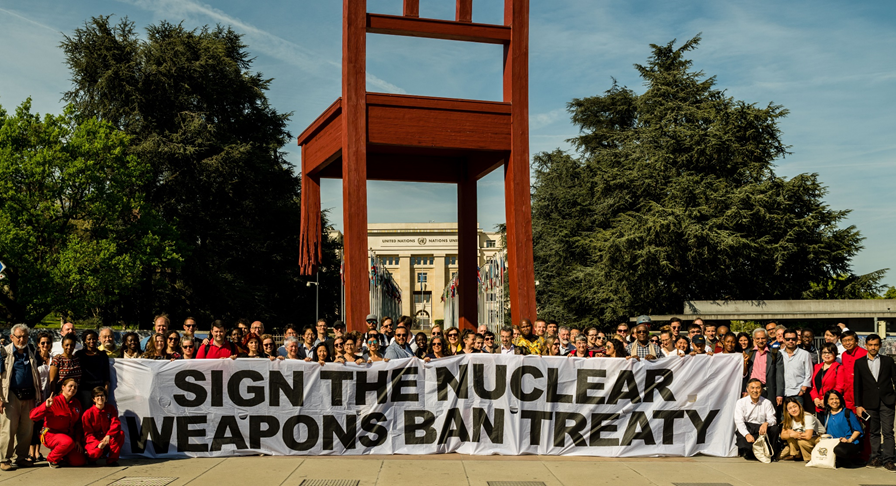
The real solution to the threat of nuclear war is in plain sight. It is the UN Treaty on the Prohibition of Nuclear Weapons, the first legally binding international agreement to comprehensively prohibit nuclear weapons. It was adopted in July 2017 and entered into force in January 2021, after it was ratified by 50 states. None of the nuclear states have signed it.
The NPT Review Conference is a golden opportunity for the participants, and the public in general, to call on all nations to sign the UN Treaty on the Prohibition of Nuclear Weapons and to once and for all embrace the Nuclear Non-Proliferation Treaty to, in the treaty’s words, “pursue negotiations in good faith on effective measures relating to cessation of the nuclear arms race at an early date and to nuclear disarmament.”
Take Action: Email the White House to demand President Biden’s Nuclear Posture Review be made public. Call your US Senators (202) 224–3121 to urge them to vote NO on the 2023 military budget or NDAA.
Marcy Winograd of Progressive Democrats of America served as a 2020 DNC Delegate for Bernie Sanders and co-founded the Progressive Caucus of the California Democratic Party. Coordinator of CODEPINKCONGRESS, Marcy spearheads Capitol Hill calling parties to mobilize co-sponsors and votes for peace and foreign policy legislation.
Medea Benjamin, co-founder of Global Exchange and CODEPINK: Women for Peace, is the author of the 2018 book, “Inside Iran: The Real History and Politics of the Islamic Republic of Iran.” Her previous books include: “Kingdom of the Unjust: Behind the U.S.-Saudi Connection” (2016); “Drone Warfare: Killing by Remote Control” (2013); “Don’t Be Afraid Gringo: A Honduran Woman Speaks from the Heart” (1989), and (with Jodie Evans) “Stop the Next War Now (Inner Ocean Action Guide)” (2005).
1 This Month

of the week – Shut Down Drone Warfare!


Tell the Ukrainian Government to Drop Prosecution of Peace Activist Yurii Sheliazhenko

Petition to revoke the licensing of the Near Surface Nuclear Disposal Facility (NSDF) at Chalk River. https://www.ourcommons.ca/petitions/en/Petition/Details?Petition=e-7247
To see nuclear-related stories in greater depth and intensity – go to https://nuclearinformation.wordpress.com
-
Archives
- March 2026 (230)
- February 2026 (268)
- January 2026 (308)
- December 2025 (358)
- November 2025 (359)
- October 2025 (376)
- September 2025 (257)
- August 2025 (319)
- July 2025 (230)
- June 2025 (348)
- May 2025 (261)
- April 2025 (305)
-
Categories
- 1
- 1 NUCLEAR ISSUES
- business and costs
- climate change
- culture and arts
- ENERGY
- environment
- health
- history
- indigenous issues
- Legal
- marketing of nuclear
- media
- opposition to nuclear
- PERSONAL STORIES
- politics
- politics international
- Religion and ethics
- safety
- secrets,lies and civil liberties
- spinbuster
- technology
- Uranium
- wastes
- weapons and war
- Women
- 2 WORLD
- ACTION
- AFRICA
- Atrocities
- AUSTRALIA
- Christina's notes
- Christina's themes
- culture and arts
- Events
- Fuk 2022
- Fuk 2023
- Fukushima 2017
- Fukushima 2018
- fukushima 2019
- Fukushima 2020
- Fukushima 2021
- general
- global warming
- Humour (God we need it)
- Nuclear
- RARE EARTHS
- Reference
- resources – print
- Resources -audiovicual
- Weekly Newsletter
- World
- World Nuclear
- YouTube
-
RSS
Entries RSS
Comments RSS
 nuclear-news