Nuclear industry veteran to lead nuclear waste group’s board – ( the revolving industry-govt door)
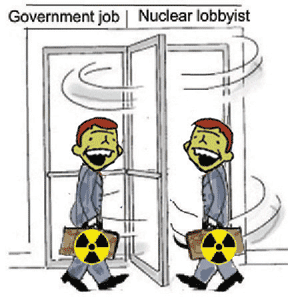
Nuclear expert to lead nuke waste group’s board,
The new chair of the Nuclear Waste Management Organization’s board of directors is a familiar face with an extensive background in the nuclear industry.
Glenn Jager, who was previously a vice-chair on the group’s board, is a retired chief nuclear officer with Ontario Power Generation and has worked in the nuclear sector for more than 30 years, the agency said this week in news release.
The Nuclear Waste Management Organization is to select a site next year for a proposed underground facility to store spent fuel rods from nuclear reactors.
One of the sites under consideration is a remote area 35 kilometres west of Ignace. The other is in South Bruce in southwestern Ontario in the vicinity of an existing nuclear-power station.
When They Announce WW3 Let’s Just Say ‘Nah’: Notes From The Edge Of The Narrative Matrix
Caitlin Johnstone, 25 July 22 All of human civilization is being organized around a “great power competition” between the US-centralized empire and the China/Russia/Iran bloc, and that “competition” stands to benefit ordinary humans in no way, shape or form. It will hurt all of us and help none of us.
There’s no valid reason why powerful nations can’t simply work together toward their mutual benefit. But it would mean the US empire giving up its plans of total global domination, so it’s not even being considered.
This conflict is slated to last throughout the 21st century, and it already has a massive body count. The war in Ukraine is a direct result of this “great power competition”, and the economic warfare between the empire and Russia will starve many more. This is a terrible thing.
Our world is being steered toward a dark and dangerous path full of impoverishment, starvation and proxy warfare, and fraught with the possibility of nuclear exchanges. They’re playing games with our lives, and because we’ve bought into the propaganda, we’re letting them………………………………………..
The more things heat up with the Russia/China/Iran bloc the more we’re going to find ourselves hammered with culture war wedge issue bullshit by the social engineers of the oligarchic empire so we don’t start asking inconvenient questions and making inconvenient demands. Inconvenient questions like “Why are we being impoverished so that you can wage a proxy war in Ukraine that we stand nothing to gain from?” and inconvenient demands like “Stop endangering all our lives with nuclear brinkmanship or we’ll fucking eat you.”…………………………
The world will never know peace as long as there are systems in place which financially incentivize war. Hoping for peace without opposing those systems is like jumping off a cliff and hoping gravity doesn’t do what it always inevitably does. https://caitlinjohnstone.substack.com/p/when-they-announce-ww3-lets-just?utm_source=substack&utm_medium=email
No operational need, and no climate case for the nuclear power industry -The Electricity Journal
Amory Lovins: Nuclear power is being intensively promoted and increasingly
subsidized in both old and potential new forms. Yet it is simultaneously
suffering a global slow-motion commercial collapse due to intrinsically
poor economics. This summary in a US context documents both trends,
emphasizing the absence of an operational need and of a business or climate
case.
The Electricity Journal (accessed) 23rd July 2022
https://www.sciencedirect.com/science/article/pii/S1040619022000483
Russia’s Rosatom to take legal action against Finland company, over terminated €7 billion nuclear power plant project.
Russian state entity plans claim over Finnish nuclear project, Jack Ballantyne 22 July 2022 Russian state entity Rosatom is preparing to launch an arbitration against a Finnish company that cited the war in Ukraine when it terminated a contract for work on a €7 billion nuclear power plant project…………… (Subscribers only) more https://globalarbitrationreview.com/article/russian-state-entity-plans-claim-over-finnish-nuclear-project
What happened in Vienna — Beyond Nuclear International

An inspiring reflection of ideals
What happened in Vienna — Beyond Nuclear International
Nuclear Power Plants Are Struggling to Stay Cool
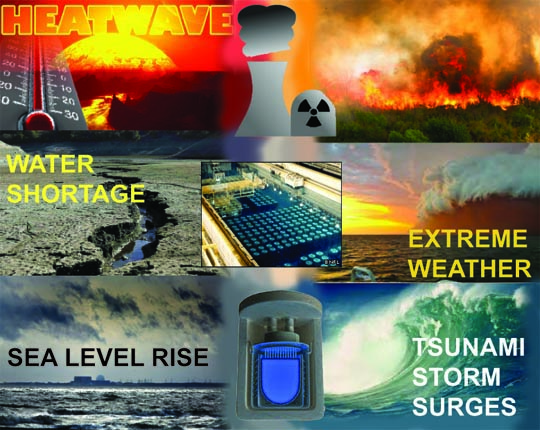
Wired, 22 July 22”……………………………. Amidst a slow-burning heat wave that has killed hundreds and sparked intense wildfires across Western Europe, and combined with already low water levels due to drought, the Rhône’s water has gotten too hot for the job. It’s no longer possible to cool reactors without expelling water downstream that’s so hot as to extinguish aquatic life. So a few weeks ago, Électricité de France (EDF) began powering down some reactors along the Rhône and a second major river in the south, the Garonne. That’s by now a familiar story: Similar shutdowns due to drought and heat occurred in 2018 and 2019. This summer’s cuts, combined with malfunctions and maintenance on other reactors, have helped reduce France’s nuclear power output by nearly 50 percent…………………
Nuclear technicians are known to refer to their craft as a very complicated way of boiling water, producing steam that spins turbines. But much more is usually required to keep the reactor cool. That’s why so many facilities are located by the sea and along big rivers like the Rhône.
Plenty of other industries are affected by hotter rivers, including big factories and power plants that run on coal and gas. But nuclear plants are unique because of their immense size and the central role they play in keeping energy grids online in places like France. And warming and dwindling rivers are not the only climate challenges they face. On the coasts, a combination of sea level rise and more frequent and intense storms means heightened flooding risks. Scientists have also pointed to other, more unusual challenges, like more frequent algal blooms and exploding jellyfish populations, which can clog up the water pipes.
……………………… The nuclear industry and environmental groups continue to disagree on whether existing regulations capture the latest science, particularly on the topic of sea level rise.
……………….. . In 2019, the NRC began approving 20-year extensions to some reactors—starting with the Turkey Point power plant in South Florida. Environmental groups filed interventions to halt the plan, arguing that a combination of more intense hurricanes and sea level rise would threaten the low-lying plant in ways that regulators had not adequately considered. In February, the NRC reversed the extension for Turkey Point and other plants pending a more extensive environmental review.
So far, most production cuts are due to warming waters—not just in the Rhône and Garonne, but in places like the Tennessee River in the US, and in the coastal seas where many more plants are sited. In recent years, nuclear plants across Northern Europe have been forced to shut down or reduce output because seawater became too warm to safely cool the reactor cores. Over the past decade, the Millstone power plant in Connecticut saw a series of shutdowns on hot summer days until regulators raised the temperature limit of its cooling waters by 5 degrees Fahrenheit.
………………………. the impact is growing as temperatures continue to rise. In an analysis published in Nature Energy last summer, a Stanford researcher found that there had been eight times the number of heat-related outages in the 2010s compared with the 1990s. In a 2011 study on the impact of warming on nuclear cooling systems, EDF scientists projected a 3 degree Celsius increase in the Rhône’s temperature by 2050, spelling more potential for shutdowns during heat waves.
,,,,,,,,,,,,,,,,,,,,,,, “The key issue is when we start building new plants, how can we take into account the impact of climate change for the full lifespan of the plant to 2080 or 2100,” Laconde says, noting that France’s new generation of reactors, recently announced by President Emmanuel Macron, are mostly being built by the coasts.
,,,,,,,,,,,,,,,,,,,,,,,,,, in France, regulators are expecting a long summer ahead. While the heat may pass, low water levels can persist, resulting in cutbacks that last for weeks or months. EDF recently told reporters that it expects more cuts in the coming months as water levels continue to fall—leaving the country hoping for the relief of cold, hard rains. https://www.wired.com/story/nuclear-power-plants-struggling-to-stay-cool/
La Hague is still threatened by wildfires Monday afternoon: firefighters mobilized on July 18 not far from the Orano nuclear site
by Christophe Meunier, After being mobilized all day Sunday July 17, 2022 on landage fires in Herquemoulin, the firefighters of the Channel had to fight against another fire this night, still in the sector of La Hague. The second fire regained strength during the afternoon on Monday. The nearby Orano La Hague site has significant means of protection if it were to be threatened by flames.
Up to 108 firefighters were mobilized this Sunday, July 17, 2022 on a landage fire in Herquemoulin, in the La Hague sector, which broke out around 3 a.m. It was only at the end of the evening, after 10 p.m., that the system was lightened. Thirty firefighters, three forest fire tanker trucks, a firefighters’ van, a water carrier and the command echelon remained on site to maintain surveillance of the site. This surveillance is maintained this Monday morning. But in the meantime, the means of the SDIS had to be mobilized on another fire……………….
It was shortly before midnight that a new brush fire broke out in the La Hague sector, this time in Vauville, at a place called Les Pierres-Poquelées. About sixty firefighters, from Saint-Lô, Carentan, La Haye, La Hague, Barneville, Granville, Cherbourg, Bricquebec, Canisy, St Pierre, Valognes but also from Calvados, were engaged in this new operation. Six tank trucks and a fire engine were deployed on site. A command post was set up in Beaumont-Hague at the RD 901/RD 403 roundabout. “The personnel faced unfavorable conditions linked to the topography, the night and the wind “, indicated the Departmental Service Channel Fire and Rescue……………………..
The two fires that have occurred since Sunday in the La Hague sector are both near the Orano waste reprocessing site. ………………………….
France3 18th July 2022
Money Pit: Zelensky govt signals intent to default on tens of billions in foreign debts
Despite countless billions flooding into Ukraine, Kiev can’t pay its debts.
Jordan Schachtel Jul 21, 22, The Dossier, Western governments have allocated well over $100 billion to prop up Ukraine in its war against Russia, with countless billions more flooding into the country at an increasing pace. Yet as each day passes, it’s becoming more and more clear that all of the money awarded and assigned to Ukraine continues to dissolve into a black hole of secrecy, corruption, deceit, and now, default.
On Wednesday, Ukraine finance ministry asked foreign creditors to accept a delay in its debt repayments, requesting a two year freeze on billions of dollars in Eurobonds. Per the Financial Times, “a rescheduling would amount to a Ukrainian default” on Kiev’s tens of billions in foreign debt.
Financial Times @FinancialTimes: Although western financial support has increased since May, Kyiv is still counting on Ukraine’s central bank to buy its debt by selling foreign reserves or printing money, at the risk of setting off an inflationary spiral.
….. Despite all of the money coming in from around the world, Ukraine’s budget deficit has spiraled out of control. Zelensky’s office now claims to have a $9 billion monthly budget deficit, up 80% from just last month.
……………………. In addition to the government as a whole, Ukraine’s state-owned infrastructure and national energy companies have also announced their intent to default on international bonds. Earlier this week, Kiev announced that it has sold some $12+ billion in gold reserves since the start of the war.
The Western government creditors of Ukraine released a joint statement in support of Ukraine’s debt freeze, adding that they “will continue to closely coordinate and assess the situation with the support of the IMF and the World Bank.”
Translation: Western governments will continue to print huge amounts of cash and launch it in the direction of the Ukraine operation. ……. https://dossier.substack.com/p/money-pit-zelensky-govt-signals-intent
The brutal reality of the US-UK ‘Special Relationship’, and the persecution of Julian Assange

In an exclusive article, the world’s leading public intellectual says the handover of global imperial power from Britain to the US is at the root of the UK’s continued persecution of Julian Assange.
Declassified UK, NOAM CHOMSKY, 21 JULY 2022,
The abject submission of British authorities to the Master in Washington in the case of journalist Julian Assange is painful to observe but – unfortunately – not difficult to understand.
The roots go back to the Second World War, when Britain handed the mantle of world domination over to its former colony. The US had long surpassed the UK as an economic power and had displaced it from “our little region over here,” as Secretary of War Henry Stimson described the Western hemisphere. But it had not yet become a truly global power.
At the time, British officials were well aware that the UK was becoming a “junior partner” to the US, now subject to its will, which was often exercised crudely.
Given their own ample experience with imperial arrogance, brutality and hypocrisy, British diplomats could easily read between the lines when their American counterparts protested that US global domination is “part of our obligation to the security of the world…what was good for us was good for the world”, as Abe Fortas, a leading figure in the New Deal administrations, put it.
The British Foreign Office, parsing this apparent altruistic concern, concluded that Washington was, in fact, guided by “the economic imperialism of American business interests” and was “attempting to elbow us out…under the cloak of a benevolent and avuncular internationalism”.
UK officials continued that their American counterparts believe “that the United States stands for something in the world – something of which the world has need, something which the world is going to like, something, in the final analysis, which the world is going to take, whether it likes it or not.” What true believers in the historical profession call “Wilsonian idealism”.
From then, Britain takes it, whether it likes it or not. Things could have gone a different way at various points in modern history, recently if Jeremy Corbyn hadn’t been destroyed by a vicious media campaign. But today’s British authorities just take the orders and Julian Assange is one of the victims.
Intricate handover
While Britain had become the “junior partner” by 1945, the handover process had played out in an extended and intricate way.
One of the reasons why the now-famous Second Amendment of the US Constitution called for “a well regulated militia” was fear that “the Brits are coming”. The first foreign policy goal of the new Republic, apart from cleansing what became the national territory, was to take Cuba.
The British Navy was in the way. But, as the great grand strategist John Quincy Adams explained, over time British power would decline while that of the US would increase and Cuba would then fall into US hands by the laws of “political gravitation”.
This did happen in 1898 when the US intervened to prevent Cuba’s liberation from Spain and turn it into a virtual colony. This is called “the liberation of Cuba” in preferred doctrine…………………………………………..
The vast gap between law and practice is illustrated by the Assange case. Here Britain, adopting its usual role of “junior partner,” has been savagely supporting the effort of the inheritors of the Framers to infringe radically on freedom of the press. The media response has ranged from tepid to cowardly.
The precedent is all too clear. If the states that claim, with some justice, to be in the forefront of defence of freedom are granted licence to crush it when it interferes with state power and violence, the limited freedoms that have been won by popular struggle suffer a severe blow everywhere. https://declassifieduk.org/the-brutal-reality-of-the-us-uk-special-relationship/—
Time for the UK government to tell the truth about nuclear power
Targeting scarce public resources at ailing nuclear initiatives flies in the face of all known data, says Prof Andy Stirling
The UK is sadly becoming habituated to an officially sponsored attrition of truth about nuclear power. Despite intensifying propaganda, even government data shows this military-backed technology to be, in reality, an expensive, slow, unreliable, risky and unpopular way to deliver affordable, secure, zero-carbon energy.
The gap in efficacy and competitiveness between nuclear and other options is continually growing. Supporting nuclear, rather than energy efficiency, wind and solar, slows down climate action, bleeds taxpayers, forgoes jobs and forces unnecessarily large and regressive burdens on consumers.
BEIS says: “Nuclear is the only form of reliable, low-carbon generation
which has been deployed at scale to date.”
The] manifest falsity of this starkly unqualified statement is extraordinary. As the government’s own
data also shows, the costs of managing variable supply are rapidly diminishing and are already far smaller than the competitiveness gap between nuclear and renewables.
Current renewable contributions to UK electricity far surpass the peak achieved by nuclear. When did it become acceptable in British public life that a supposedly democratic government should so seriously misrepresent reality in a formal policy document?
In a period when stakes are unprecedentedly high for climate, economy, energy security and hard-pressed households, it is time to renew reasoned scientific and democratic debate in this field and prevent this national self-harm by unaccountable special interests.
Guardian 21st July 2022
EDF worried that its delays in building Hinkley Point C nuclear station might lessen the huge subsidies it gets from the UK government
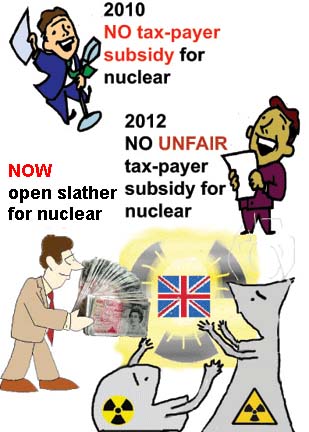
EDF pushes UK government to alter Hinkley Point C penalty clauses. EDF is trying to alter a key subsidy contract to avoid missing out on trillions of pounds in guaranteed revenue after the Covid-19 pandemic caused further delays to Hinkley Point C, the first new nuclear power station under construction in the UK in almost 30 years.
The French utility is in negotiations with the British government over penalty clauses in a
controversial agreement struck in 2013 to finance the building of the plant in Somerset.
EDF started work on the 3.2 gigawatt plant in 2016 but has repeatedly pushed back its completion date while costs have spiraled. In the latest setback, EDF warned in May that the first of Hinkley’s two reactors would not be completed until June 2027, 18 months behind schedule. It attributed 12 months of the delay to Covid-related problems, when it had to reduce staff on site from 5,000 to 1,500.
But the company cautioned that there was the possibility of a further 15-month delay to September 2028,
adding that date could slip again if there was another wave of pandemic or there were knock-on effects from the war in Ukraine.
Penalty clauses in the subsidy agreement — which guarantees a price that is more than double
those offered to developers of rival technologies such as offshore wind — would reduce the 35-year term if Hinkley is not generating electricity by May 2029.
EDF would lose one year of guaranteed payments for every year of delay up to 2033. If the delays extended beyond that date the government has the option to terminate the subsidy contract. EDF has already pushed the construction budget of Hinkley up several times with the revision in May raising the total cost by a further £3bn to as much as £26bn in 2015 prices, compared to an estimate of £18bn in 2016. Crooks said about a third of May’s revision to the budget was Covid-related. About £500mn was down to performance being “less than we would expect”, he added. The other cost overruns were due to issues such as completion of some of the outstanding design work and a failure to accurately estimate the quantities of materials, such as the number of bolts needed, to complete the build.
FT 21st July 2022
https://www.ft.com/content/cb715de2-1c95-4a13-8b48-33717b1dcc44
US Military Analyst: West Can’t Afford Ukraine Spending, Will Run Out of Ammo to Send to Kiev

Sputnik News 22 July 22…………………….What goals are the US and EU pursuing by pouring more money into the Ukrainian military?
Scott Ritter: The hope is to transform the conflict that is ongoing in Ukraine as a result of the Russian special military operation into a protracted conflict that can lead to a stalemate that would result in significant Russian costs, both in terms of manpower and military equipment, but also financial costs, and thereby weaken Russia. Ultimately what they are visualizing would be a Ukraine strong enough to evict Russia from its borders.
It’s not possible, this is fantasy in the extreme, but it’s politically inspired fantasy, meaning that the United States and its European allies have invested so much political capital into propping up the Ukrainian military and the Ukrainian government and the Ukrainian economy that even though most sound analysts understand that not only is Ukraine losing the conflict, but they can never win the conflict. Politically, Western politicians cannot divorce themselves from these policies. So in order to maintain a public perception at home of the chance of a Ukrainian victory, they will continue to squander the wealth of their respective nations.
Why are Western states prolonging the hostilities despite the growing discontent of their populations with economic problems?
Scott Ritter: There’s an old saying in the United States that I believe translates into most politics: “when you’re explaining, you’re losing.” And right now, these politicians would have to explain to their constituents why they were wrong about Ukraine, why they were wrong about Russia. And especially here in the United States, we’re dealing with the lead-up to very critical midterm elections. No politician wants to be explaining anything to anybody. They want to be shaping perceptions that build upon past performances. This is all about domestic politics. This has nothing to do with reality.
Why are Western states prolonging the hostilities despite the growing discontent of their populations with economic problems?
Scott Ritter: There’s an old saying in the United States that I believe translates into most politics: “when you’re explaining, you’re losing.” And right now, these politicians would have to explain to their constituents why they were wrong about Ukraine, why they were wrong about Russia. And especially here in the United States, we’re dealing with the lead-up to very critical midterm elections. No politician wants to be explaining anything to anybody. They want to be shaping perceptions that build upon past performances. This is all about domestic politics. This has nothing to do with reality. So it sounds good for a politician to be telling his or her constituents that we are providing the Ukrainians with the best equipment possible to include the top of the line fighter aircraft. What they really should be saying is we are guaranteeing that every Ukrainian pilot we train will die at the hands of the Russian Air Force, because that’s what the ultimate outcome will be.
The thing about, especially American, generals is that they are political animals. They didn’t get that fourth star necessarily because of their military competence. They got it because they impressed a politician with their political acumen. And so what we have is a general playing politics, a general who is saying what the politicians want to hear. And that’s not what his role is. His role is to provide sound military assessment, military advice to the politicians.
But if an American military officer did that today, they couldn’t agree with anything that the Biden administration or the US Congress was seeking to do in Ukraine, and therefore they would never get promoted. They would never get a good job. I don’t like to denigrate serving military officers, but this is a political decision, not a military decision, even though the man making it wears a military uniform.
Can the West collectively really afford such spending now, at a time of harsh polarization and soaring prices?
Scott Ritter: No, they can’t afford it. And we have some nations that are starting to realize this. The German defense minister, who is very hawkish against Russia, has acknowledged that Germany simply has no more weapons to give and they’re not in a position to build new weapons. They’re worrying about other economic realities. The same holds true with the United States.
At some point time in time, we are going to run out of materiel to give to Ukraine. I read somewhere that with all the HIMARS multiple launch rocket systems we’re providing to Ukraine, we’re also providing Ukraine with one third of the ammunition stockpiles for the HIMARS, meaning that we, the United States, only have two thirds of our ammunition stores available if we had to go to war, which means we will run out of ammunition.
This is insane, literally insane to be sacrificing the national security of the United States or of a European nation so that politicians can look and sound good for the next couple of weeks. But it will not change the equation on the battlefield in Ukraine. The Ukrainian Army is in an impossible situation. They literally cannot recover from the debacle that has befallen them.
The sad thing is that Ukrainian leaders are buying into the fiction provided by the West of if they just get more weapons, they can successfully defend against Russia. This means that more Ukrainian soldiers are going to die, more Russian soldiers are going to die, and tragically, more Ukrainian civilians are going to suffer.
Leaders of the Group of Seven recently pledged to stand with Ukraine “for as long as it takes.” How feasible is this pledge?
Scott Ritter: When the Group of Seven made that, one of the leaders was a guy named Boris Johnson. He’s not the leader anymore. The other guy was a gentleman whose last name was Draghi. He’s not the leader anymore. I think as the summer and the winter come along, more and more of these leaders are going to be removed from office because it’s an unsustainable policy. Politicians have a proclivity for saying things that have no basis in reality. It’s very inexpensive for a politician to say “we are going to support you forever.”
Forever in what sense? Boris Johnson is not supporting them forever – he’s out of power. Draghi is not supporting them forever – he’s out of power. And just about everybody who was on that stage at the G7 meeting will be out of power. Suddenly, we have a whole new definition of what “forever” means. It means “not now, not anymore.” https://sputniknews.com/20220721/us-military-analyst-west-cant-afford-ukraine-spending-will-run-out-of-ammo-to-send-to-kiev-1097671398.html
EDF seeks guarantees from UK government to keep its big subsidies
EDF is seeking to amend the controversial subsidy contract for its £26
billion Hinkley Point C nuclear plant so that it will not be penalised even
if the plant does not start to generate power until 2030.
Hinkley was
supposed to start up in 2025 but EDF has pushed this back to mid-2027,
primarily blaming Covid disruption, and warned of the risk of a further
15-month delay. Stuart Crooks, managing director of Hinkley Point C, said
at least some of this delay was now “likely” to materialise as the
project battles issues including labour shortages.
He revealed that EDF was
seeking extra leeway in the already contentious subsidy contract to protect
its revenues even if the plant suffers additional delays and does not start
up this decade. Further delays would also raise the prospect of additional
increases in costs, which have risen from £18 billion when it got the
go-ahead in 2016 to as much as £26 billion at 2015 prices.
Times 22nd July 2022
https://www.thetimes.co.uk/article/edf-seeks-hinkley-delay-guarantees-2g6tqt522
Leaked documents – Facebook ‘Bot’ adviser secretly in the pay of USA regime change agency.
Mint Press News KIT KLARENBERG 14 July, 22
Documents shared with MintPress reveal that Valent Projects – a shadowy communications firm that advises social media platforms such as Facebook on alleged state-backed online influence campaigns – has itself received $1.2 million from U.S. intelligence front USAID, for “counter disinformation and communications support.”
This relationship has hitherto never been publicly acknowledged, and the resulting income is not reflected in the company’s published accounts…………………..
Valent Projects is the creation of Amil Khan, a veteran BBC and Reuters journalist turned British intelligence-adjacent information warfare professional. For many years, Khan worked on secret Foreign Office projects in Syria. There, he ran covert psyops campaigns targeting domestic and international audiences, trained ostensibly independent opposition journalists and activists to communicate effectively with the media, and provided propaganda support to numerous armed groups trained, funded, and armed by London and Washington………………………………………………………………………………………..
UKRAINE ON THE BRAIN
On June 7, it was revealed that Khan was also working closely with British journalist Paul Mason in an effort to deplatform The Grayzone, as part of a wider personal crusade against the anti-war, anti-imperialist left over the matter of Ukraine.
Leaked emails between the pair exposed how Mason suggested subjecting The Grayzone – which he baselessly and bizarrely believed to be a Chinese and Russian intelligence operation – to “relentless deplatforming” via “full nuclear legal” attacks, official probes by government bodies, and cutting the website and its contributors off from online donation sources such as PayPal.
…………………………………. the conflict in Ukraine has grown the power of Western governments to directly dictate what is and is not true, and what their populations are and are not allowed to know, exponentially. Yet, their ability to distort and censor overseas is limited, if not outright waning – and that’s where Valent Projects comes in.
As such, the leaked documents reviewed by MintPress illuminate a hitherto unexplored purpose of online suppression and deplatforming: regime change. By filtering out troublesome viewpoints and inconvenient facts in target countries, governments can be destabilized, and who or what replaces them entrenched in power, with domestic and foreign audiences deprived of access to any and all critical viewpoints.
As the New Cold War grows considerably hotter every day, Khan’s services will surely become ever-increasingly in demand. Neither he nor his state and quasi-state sponsors can be allowed to succeed.
Kit Klarenberg is an investigative journalist and MintPresss News contributor exploring the role of intelligence services in shaping politics and perceptions. His work has previously appeared in The Cradle, Declassified UK, and Grayzone. Follow him on Twitter @KitKlarenberg. https://www.mintpressnews.com/valent-facebook-influence-ops-regime-change-leak/281403/
Shinzo Abe Failed to Rearm Japan. Let’s Keep It That Way

Houston Chronicle July 20, 2022, Koichi Nakano,
Japan had barely begun processing the shock of the former Japanese prime minister Shinzo Abe’s assassination by a gunman on July 8 before attention turned to whether his quest to remilitarize Japan, including the revision of its pacifist Constitution, would survive him.
Japan’s longest-serving prime minister, Mr. Abe was a towering presence at home and an influential statesman abroad. He advocated a more globally engaged Japan, was a driving force in the Quad alliance between the United States, Australia, India and Japan and is credited by some with initiating the very idea of the wider Indo-Pacific region.
He also envisioned a more militarily robust Japan, centered on his unfulfilled dream of revising its postwar Constitution, which prohibits his country from maintaining an offensive armed forces capability. His supporters have vowed to make these dreams — driven largely by fear of a more powerful China — a reality.
Yet it’s time for Japan to bid farewell not only to Mr. Abe but also to his nationalist rearmament agenda. Japan’s political and economic resources should be focused not on revising the Constitution and increasing defense spending but on maintaining peace through diplomacy and shoring up an economy left shaky by years of Mr. Abe’s trickle-down policies.
Critically, at a time when the United States is focused on confronting China, a humbler, more pacifist Japan could have an important role to play by re-engaging with Beijing to help decrease tensions between China and the United States.
Mr. Abe was shot while campaigning on behalf of his Liberal Democratic Party for parliamentary elections that were to be held just two days later. He leaves behind a personal legacy far more controversial and checkered than is warranted by the simplistic, fawning tributes that followed his demise.
………………………………… few aspects of Mr. Abe’s career threatened to alter Japan’s national character and role in the region as much as his crusade against Article 9, which renounces war as a means of solving international disputes and limits Japan’s military to a self-defense role. Mr. Abe unnerved millions of Japanese who see no reason to depart from a commitment to peace that kept Japan out of any direct involvement in war since 1945, allowing it to focus on becoming an economic power.
Mr. Abe failed to change the article despite two stints in power, from 2006 to ’07 and from 2012 to ’20. He settled instead for a reinterpretation that allows Japan to help close allies militarily under certain conditions but has been criticized as unconstitutional.
Japan looks no closer to revising Article 9 today, especially with the L.D.P.’s right wing now deprived of its uncontested standard-bearer. A commitment to peace runs deep in a country that was taken to war by a military government, causing huge suffering in Asia and ending in Japan’s total defeat and the distinction of being the only country attacked with nuclear weapons.
……………….. Attention now turns to Prime Minister Fumio Kishida, but it’s a measure of just how smothering Mr. Abe’s presence was — he forbade open dissent among party leaders — that the Japanese don’t really know what to expect from Mr. Kishida, who represents L.D.P. moderates who have opposed constitutional revision. After the election, Mr. Kishida promised greater defense spending and pledged renewed attention on Article 9 but gave no hint that this was more than a courteous nod to the departed Mr. Abe.
But there is no doubt that Mr. Kishida’s hand is strengthened. Mr. Abe left no clear right-wing successor, and his death throws the faction into disarray, allowing Mr. Kishida an opportunity to assert more control over the national agenda.
………………………
Stripping away the safeguards of Article 9 and remilitarizing Japan would only further inflame tensions with China and risk an arms race with potentially devastating consequences for Japan and the region. On the contrary, a reaffirmed commitment to peace would allow domestic resources to be focused on the economy and open the door for better relations with Japan’s neighbors founded on peace through diplomacy.
It’s time to beat Mr. Abe’s swords into plowshares. https://www.houstonchronicle.com/opinion/outlook/article/Opinion-Shinzo-Abe-failed-to-rearm-Japan-17320399.php
1 This Month

of the week – Shut Down Drone Warfare!


Tell the Ukrainian Government to Drop Prosecution of Peace Activist Yurii Sheliazhenko

Petition to revoke the licensing of the Near Surface Nuclear Disposal Facility (NSDF) at Chalk River. https://www.ourcommons.ca/petitions/en/Petition/Details?Petition=e-7247
To see nuclear-related stories in greater depth and intensity – go to https://nuclearinformation.wordpress.com
-
Archives
- March 2026 (244)
- February 2026 (268)
- January 2026 (308)
- December 2025 (358)
- November 2025 (359)
- October 2025 (376)
- September 2025 (257)
- August 2025 (319)
- July 2025 (230)
- June 2025 (348)
- May 2025 (261)
- April 2025 (305)
-
Categories
- 1
- 1 NUCLEAR ISSUES
- business and costs
- climate change
- culture and arts
- ENERGY
- environment
- health
- history
- indigenous issues
- Legal
- marketing of nuclear
- media
- opposition to nuclear
- PERSONAL STORIES
- politics
- politics international
- Religion and ethics
- safety
- secrets,lies and civil liberties
- spinbuster
- technology
- Uranium
- wastes
- weapons and war
- Women
- 2 WORLD
- ACTION
- AFRICA
- Atrocities
- AUSTRALIA
- Christina's notes
- Christina's themes
- culture and arts
- Events
- Fuk 2022
- Fuk 2023
- Fukushima 2017
- Fukushima 2018
- fukushima 2019
- Fukushima 2020
- Fukushima 2021
- general
- global warming
- Humour (God we need it)
- Nuclear
- RARE EARTHS
- Reference
- resources – print
- Resources -audiovicual
- Weekly Newsletter
- World
- World Nuclear
- YouTube
-
RSS
Entries RSS
Comments RSS
 nuclear-news