Two key committees of the European Parliament strike down EU plans to label nuclear and gas as green investment .

MEPs strike down EU plans to label nuclear and gas as green investment.
https://www.euronews.com/my-europe/2022/06/14/meps-strike-down-eu-plans-to-label-nuclear-and-gas-as-green-investment By Jorge Liboreiro & Alice Tidey • Updated: 14/06/2022
The European Commission’s highly controversial plan to label gas and nuclear as sustainable energy sources was on Tuesday struck down by two key parliamentary committees.
The Economic and Monetary Affairs Committee and the Environment, Public Health and Food Safety Committee rejected the proposal on Tuesday, with 76 MEPs voting to object and 62 voting in favour.
In a statement, MEPs on the committees said they “recognise the role of nuclear and fossil gas in guaranteeing stable energy supply during the transition to a sustainable economy.”
“But, they consider that the technical screening standards proposed by the Commission, in its delegated regulation, to support their inclusion do not respect the criteria for environmentally sustainable economic activities as set out in Article 3 of the Taxonomy Regulation,” the statement added.
They also requested that any new or amended delegated acts be subject to public consultation and impact assessments.
The objection will be put before the whole plenary in the first week of July. If the hemicycle replicates the outcome of the committees, the Commission’s plan will be officially scrapped.
The move pits lawmakers against a majority of member states, led by France, who had supported the inclusion of both gas and nuclear in the EU taxonomy.
A smaller group comprising Luxembourg, Spain, Austria and Denmark was vehemently opposed to the label, while Germany, which is highly dependent on gas, objected to the inclusion of nuclear as sustainable.
The committees’ rejection was welcomed by climate activists. Greenpeace EU sustainable finance campaigner Ariadna Rodrigo said in a statement that “MEPs stood with Ukraine today by voting to stop feeding Putin’s war machine with more money and inflaming the climate and nature crisis.”
“After more than 100 days of this devastating war, the European Parliament must now once and for all reject the greenwashing of fossil gas and nuclear energy in July. Do not give this shameful gift to Putin and his lobbyists,” she also said.
Mariana López Dávila, Programme Manager on Sustainable Finance, Environmental Coalition on Standards (ECOS) also commented, saying the vote “shows the Parliament’s willingness to stay true to science, and gives us hope that the EU can still lead the world into a truly sustainable future.”
“However, the veto is not yet a done deal. Members of the European Parliament stand a unique chance to walk the talk, and avoid greenwashing well-meaning investments into environmentally-harming projects,” she added.
Adopted in 2021, the taxonomy is a catalogue that helps private and public investors make informed choices about climate-conscious investments.
It covers a long list of projects that make a “substantial contribution” to at least one environmental objective of the EU’s climate policy while avoiding significant harm to any of the others.
Sectors already labelled as green under the taxonomy include solar energy, geothermal, hydrogen, wind power, hydropower and bioenergy.
The Commission later proposed to add gas and nuclear, arguing the two sources could be used as a temporary bridge to wean the EU off coal and achieve climate neutrality by 2050.
Pope Francis again says that the West provoked or failed to prevent Russia’s invasion of Ukraine.

Pope Doubles Down On NATO-Ukraine Comments: Russian Invasion Was “Provoked” https://www.zerohedge.com/geopolitical/pope-doubles-down-ukraine-war-comments-russian-invasion-was-provoked
BY TYLER DURDEN, WEDNESDAY, JUN 15, 2022 –Pope Francis has doubled down on prior controversial statements suggesting the Russia-Ukraine conflict is largely NATO’s fault, asserting also that “war cannot be reduced to distinction between good guys and bad guys” – as the Vatican’s own headline to the interview reads.
In statements published Tuesday by the Jesuit magazine La Civiltà Cattolica, the Roman Catholic leaders said that the Russian invasion was “perhaps somehow provoked” while again saying there were signs that NATO had been “barking at the gates of Russia” in the run-up.
The pontiff still condemned what he called the “ferocity and cruelty of the Russian troops” while warning against a pure ‘good vs. evil’ fairytale narrative of the conflict.
Just like with his initial similar comments made at the start of May, these latest statements have triggered outrage among Western pundits who’ve called for escalating military support to Ukraine at the expense of dialogue with Moscow toward negotiating a settlement to end the war:
“We need to move away from the usual Little Red Riding Hood pattern, in that Little Red Riding Hood was good and the wolf was the bad one,” Francis said. “Something global is emerging and the elements are very much entwined.”
That’s when in the interview he provided more context to his early May statements on the war. He said that a couple months prior to the Feb.24 invasion, he met with a “wise” head of state – though Francis didn’t name him or her:
“…a wise man who speaks little, a very wise man indeed … He told me that he was very worried about how Nato was moving. I asked him why, and he replied: ‘They are barking at the gates of Russia. They don’t understand that the Russians are imperial and can’t have any foreign power getting close to them.'”
“He concluded, ‘The situation could lead to war.’ This was his opinion. On 24 February, the war began. That head of state was able to read the signs of what was happening.”
He added: “We do not see the whole drama unfolding behind this war, which was, perhaps, somehow either provoked or not prevented.”
The Pope also reiterated that the arms industry in the West is benefitting from the bloodshed: “I also note the interest in testing and selling weapons. It is very sad, but at the end of the day that is what is at stake,” he said in the interview.
“Someone may say to me at this point: but you are pro-Putin! No, I am not. It would be simplistic and erroneous to say such a thing. I am simply against turning a complex situation into a distinction between good guys and bad guys, without considering the roots and self-interests, which are very complex. While we witness the ferocity and cruelty of Russian troops, we should not forget the problems, and seek to solve them,” he explained.
According to Vatican News, the pontiff additionally described that even beyond Ukraine-Russian, “the world is at war…
“We see what is happening now in Ukraine in a certain way because it is closer to us and pricks our sensibilities more. But there are other countries far away—think of some parts of Africa, northern Nigeria, northern Congo—where war is ongoing and nobody cares. Think of Myanmar and the Rohingya. The world is at war. Today, for me, World War III has been declared.”
The last time he suggested the West is at least equally to blame for the unfolding Ukraine war, an avalanche of op-eds and condemnations were issued by US and Western officials suggesting that somehow liberal Pope Francis too has been ‘compromised’ by Putin (ironically a smear typically reserved for Trump or Republicans in general).
Nuclear-armed nations spent $82.4bn on weapons in 2021
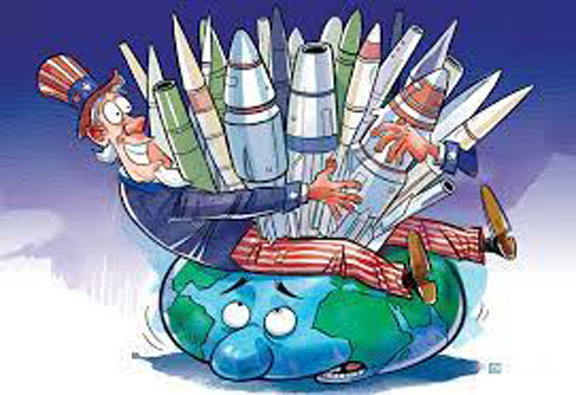
Nuclear-armed nations spent $82.4bn on weapons in 2021 https://www.aljazeera.com/news/2022/6/15/nuclear-armed-nations-spent-82bn-on-weapons-in-2021
International Campaign to Abolish Nuclear Weapons accuses nuclear-armed nations of ‘obscene’ spending and notes extensive industry lobbying.
The world’s nine nuclear-armed countries spent $82.4bn upgrading their atomic weaponry in 2021, eight percent more than the year before, a campaign group has said.
The biggest spender was the United States, which accounted for more than half the total spending, followed by China, Russia, the United Kingdom and France, the International Campaign to Abolish Nuclear Weapons (ICAN) said in its annual report on nuclear spending.
“Nuclear-armed states spent an obscene amount of money on illegal weapons of mass destruction in 2021, while the majority of the world’s countries support a global nuclear weapons ban,” the group said in its report. “This spending failed to deter a war in Europe and squandered valuable resources that could be better used to address current security challenges, or cope with the outcome of a still raging global pandemic. This corrupt cycle of wasteful spending must be put to an end.”
ICAN noted that nuclear weapons producers also spent millions lobbying on defence, with every $1 spent lobbying leading to an average of $256 in new contracts involving nuclear weapons.
“The exchange of money and influence, from countries to companies to lobbyists and think tanks, sustains and maintains a global arsenal of catastrophically destructive weapons,” the report said.
On Monday, the Stockholm International Peace Research (SIPRI) warned that all nine nuclear-armed countries were increasing or upgrading their arsenals, and that the risk of such weapons being deployed appeared higher now than at any time since the height of the Cold War.
Russia, which invaded Ukraine in February, has openly threatened to use its nuclear weapons.
ICAN estimates North Korea spent $642m on nuclear weaponry in 2021 even as its economy struggled under United Nations sanctions and the pandemic-linked closure of borders.
Pyongyang walked away from denuclearisation talks after the collapse of a summit with then-US President Donald Trump in 2019, and has carried out a record number of missile launches this year. There are concerns it is preparing for its first nuclear weapons tests since 2017.
There is no official confirmation on the amount North Korea spends on nuclear weapons or its arsenal. SIPRI estimates it has as many as 20 warheads.
Nuclear weapons spending, 2021
Source: International Campaign to Abolish Nuclear Weapons
- United States $44.2bn
- China $11.7bn
- Russia $8.6bn
- UK $6.8bn
- France $5.9bn
- India $2.3bn
- Israel $1.2bn
- Pakistan $1.1bn
- North Korea $642m
Many of UK’s coastal buildings may soon need to be abandoned due to sea level rise, – and what about the nuclear reactors?

Sea level rise threatens many coastal buildings in UK.
Is the UK government completely stupid? Not only are existing nuclear reactors at risk of flooding, but they plan new ones in the same threatened coastal areas?
Nearly 200,000 properties in England may have to be abandoned due to rising sea levels by 2050, a report says. It looks at where water will cause most damage and whether defences are technically and financially feasible.
There is consensus among scientists that decades of sea level rise are inevitable and the government has said that not all properties can be saved.
About a third of England’s coast will be put under pressure by sea level rise, the report says. “It just won’t be possible to hold the line all around the coast,” says the report’s author Paul Sayers, an expert on flood and coastal risks, adding that tough decisions will have to be made about what it is realistic to protect.
BBC 15th June 2022
https://www.bbc.co.uk/news/science-environment-61795783
The estimate of nearly 200,000 homes and businesses at risk of abandonment comes from researchers at the Tyndall Centre, in the University of East Anglia, published in the peer-review journal Oceans and Coastal Management.
Guardian 15th June 2022
The deteriorating nuclear order
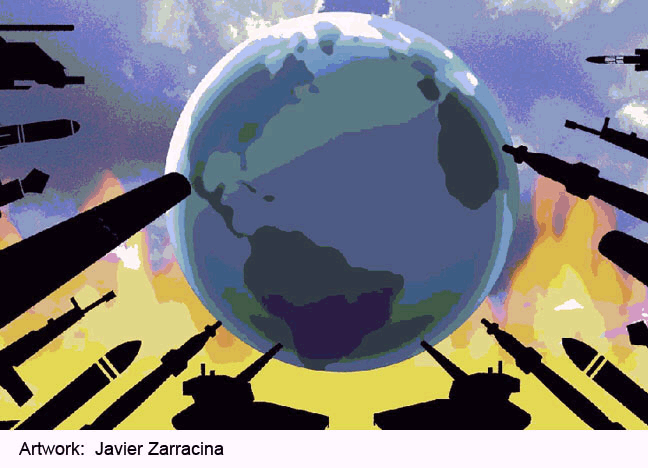
We’re returning to a time when nuclear threats were the norm — and the world flirted with Armageddon.
Politico, BY IVO DAALDER, June 15, 2022
“A nuclear war cannot be won and must never be fought.”
So said the leaders of China, France, Russia, the United Kingdom and the United States for the very first time, just five months ago. Today, however, the prospect of nuclear weapons use is perhaps greater than any time since the Cuban missile crisis of 1962.
Just weeks after co-signing the joint statement on preventing nuclear war, Russian President Vladimir Putin launched a war of aggression against a neighbor that had given up its nuclear weapons in return for Russia’s explicit assurance “to respect the independence and sovereignty and the existing borders of Ukraine [and] refrain from the threat or use of force against the territorial integrity and political independence of Ukraine.”
At the onset of war, Putin made an explicit threat to “those who stand in our way,” saying that the “consequences will be such as you have never seen in your entire history.” And just three days later, he said he’d raise the alert level of its nuclear forces — though there are no indications that he did.
Russia has sought to enhance the threat of using nuclear weapons for years now.
Realizing its conventional capabilities were no longer a match for the U.S. and NATO, some time ago, Moscow adopted a military doctrine in which its use of so-called tactical weapons might persuade an adversary to back down. And with progress in its war against Ukraine stymied by determined Ukrainian forces backed with sophisticated Western weapons, the possibility that Putin might decide to “escalate to deescalate” has become especially alarming.
But it’s not just Russian behavior and threats that are lowering the nuclear threshold. There are an increasing number of other worrying developments on the nuclear front, starting with actions taken by other established nuclear powers.
For one, the U.S. is in the midst of a massive nuclear modernization program, costing upward of $1 trillion and including new land-based missiles, a new strategic bomber and new missile-carrying nuclear submarines. It’s also deployed low-yield nuclear warheads to give Washington the capability to respond to any limited nuclear use by Russia — though few believe a nuclear exchange is or can remain limited.
China’s also modernizing and expanding its nuclear forces at a fast clip. It’s been digging new missile silos in the Gobi Desert, and the Pentagon estimates that it will deploy 1,000 nuclear warheads by the end of the decade — effectively ending its long-standing policy of relying on a minimal deterrent.
Britain, too, has announced that it’s increasing its nuclear capabilities, boosting its possible future sea-launched warhead numbers by 40 percent. And France has embarked on a major new modernization program of nuclear missiles and submarines.
But it’s not only the established nuclear powers that are expanding capabilities — newer and aspirant powers are as well.
Pakistan and India have growing nuclear arsenals that, in a few years, may equal those of France or Britain. North Korea not only has resumed nuclear material production but has also expanded the mission of its growing nuclear forces from deterring attack to advancing its national interests. And Iran now possesses enough material for a nuclear bomb as prospects of returning to the nuclear deal restraining it have all but vanished.
This increasing nuclearization around the world is putting new pressure on the nonproliferation regime.
The more countries look to the nuclear option to ensure security, the more the incentive for other countries to follow. For example, Iran’s emergence as a nuclear threshold state increases the pressure on countries like Saudi Arabia, Egypt and Turkey to reconsider their non-nuclear status…………………..
Pakistan and India have growing nuclear arsenals that, in a few years, may equal those of France or Britain. North Korea not only has resumed nuclear material production but has also expanded the mission of its growing nuclear forces from deterring attack to advancing its national interests. And Iran now possesses enough material for a nuclear bomb as prospects of returning to the nuclear deal restraining it have all but vanished.
This increasing nuclearization around the world is putting new pressure on the nonproliferation regime.
The more countries look to the nuclear option to ensure security, the more the incentive for other countries to follow. For example, Iran’s emergence as a nuclear threshold state increases the pressure on countries like Saudi Arabia, Egypt and Turkey to reconsider their non-nuclear status. https://www.politico.eu/article/nuclear-weapons-russia-war-ukraine-united-states-china/
Stop Sizewell C group questions UK government’s reasons for designating the project under the Regulated Asset Base model – and its secrecy about the plan.
The Secretary of State is intending to designate a company which no one knows who the owners will be. EDF and the government – both apparently intending to be minority partners in Sizewell C with 20% stakes – are continuing to negotiate with each other behind closed doors.
| BEIS has today published draft reasons for designating NNB Generation Co (Sizewell C Co) as the first step towards the company being able to use a RAB funding model. All financial figures have been redacted. The BEIS press statement says “by publishing the draft reasons for designating Sizewell C under the RAB model, the government is going beyond the transparency requirements set out in legislation.” Stop Sizewell C said: “It’s outrageous that ministers are hiding the cost to electricity bill payers and the public purse of Sizewell C, while claiming to be transparent. By redacting the finances, it is impossible to know if the Secretary of State’s judgement on Value for Money is sound. We fail to understand why the government would not impose conditions related to the EPR reactor technology, when it has such a catastrophic track record, and one of the only working examples has been offline for almost a year in China” Additionally we note the following: The Secretary of State is intending to designate a company which no one knows who the owners will be. EDF and the government – both apparently intending to be minority partners in Sizewell C with 20% stakes – are continuing to negotiate with each other behind closed doors. The government intends to take a special share in Sizewell C, as a means of “protecting national security interests”, yet there is no mention of removing China General Nuclear from the project. The Value for Money assessment acknowledges that the (secret) figures provided by NNB require “uplift” (page 22 “ Given that largescale infrastructure projects have a tendency to cost more and take longer to build than expected, the analysis has applied appropriate uplifts to these assumptions”), and conclude that “the estimated return on government investment is positive in the majority of scenarios modelled” (page 22). With no indication of the size of that majority, or the various cost burdens, it is therefore clear that the return was negative in at least some scenarios. The only cost for Sizewell C in the public domain is the original estimate of £20 billion, published over two years ago. Since then there have been major changes to the project and huge price hikes in construction materials. Despite references to lessons learned at other EPR projects, there are no specific conditions linked to design adaptations that will be required for Hinkley Point C and Sizewell C’s reactors basedon the experience of Taishan 1, where problems have led to the reactor being offline for almost a year. (EDF reports, p116 “In addition [to fuel failure], a phenomenon occurring between the assemblies and a component enclosing the core has been identified, which would be linked to hydraulic stresses” and the French regulator, ASN, refers to (p14) “various anomalies observed on the cores of the EPR reactors of Taishan“. Such adaptations could have a serious impact on both cost and timescales. A government condition was attached to an (unused) offer of loan guarantees for Hinkley Point C, that the Flamanville EPR should be operating by December 2020. It is not expected to be operating until mid 2023 at the earliest. Finland’s Olkiluoto EPR is still testing at reduced capacity. Stop Sizewell C 14th June 2022 https://stopsizewellc.org/designation/ |
Hinkley Point C nuclear supply engineers go on strike
| Plating engineers creating products to supply to the Hinkley Point C nuclear power station go on strike today [13 June] in a pay dispute. Dozens of workers at Darchem Engineering, in Stockton-Upon-Tees, will walk out today after welders working for same firm were given an additional pay supplement, while the engineers weren’t. Further strikes are planned for 20,21,28 and 29 June. Industrial action could lead to big delays at Hinkley Point C – the £25 billion nuclear reactor in Somerset. GMB 14th June 2022 https://www.gmb.org.uk/news/hinkley-point-supply-engineers-strike |
UK government’s new financing plan for %20 tax-payer funded Sizewell C nuclear project will increase costs and delays, – is aimed to cut China out.
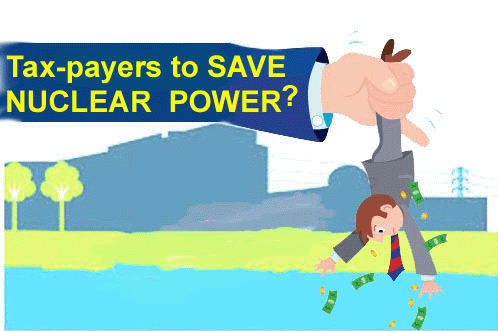
The government has bought an option to take a 20% stake in the Sizewell C nuclear power plant in a move that could ease China’s state nuclear company out of the project. Ministers took a £100m option to invest in Sizewell C’s holding company in January and said on Tuesday it would convert that into equity if the project reaches a final investment decision.
The venture on the Suffolk coast is jointly owned by EDF and China General Nuclear Power. The government is understood to be keen toremove CGN from the project amid concerns over China’s involvement in critical UK infrastructure. The business secretary, Kwasi Kwarteng, set out the taxpayer-funded financing model for Sizewell C and future projects on Tuesday.
The strategy the government plans to use – a regulated asset
base model – involves taxpayers taking on risk alongside private investors. The government is
attempting to inject urgency into a notoriously slow-moving industry amid a
drive to boost Britain’s domestic energy supplies.
In April Boris Johnson set out plans to approve up to eight reactors by the end of the decade. A
decision on whether to grant Sizewell C planning consent was last month delayed until 8 July. Research by the University of Greenwich Business School seen by the Guardian last month showed the project could cost UK taxpayers more than double government estimates and take five years longer to build.
Guardian 14th June 2022
Two European Parliamentary committees oppose inclusion of nuclear power and gas as environmentally sustainable
MEPs from the two responsible committees on Tuesday opposed the inclusion
of gas and nuclear power on the list of environmentally sustainable
economic activities. On Tuesday, at a joint meeting of the Committee on
Economic and Monetary Affairs and the Committee on the Environment, Health
and Food Safety, MEPs adopted by 76 votes for, 62 against and 4 abstentions
an objection the Commission’s proposal to include specific nuclear and gas
activities in the list of environmentally sustainable economic activities
covered by the EU taxonomy.
European Parliament 14th June 2022
The US-led bloc is unwilling to fight Russia directly and treats Ukraine as a proxy, Dutch PM admits.

NATO pledges more heavy weapons for Ukraine
The US-led bloc is unwilling to fight Russia directly and treats Kiev as a proxy, Dutch PM admits. Rt.com 15 June 22, Ukraine must get more NATO heavy weapons, the military bloc’s head said on Tuesday, ahead of a meeting of a US-led ‘contact group’ set up to discuss the plan’s logistics. NATO is trying to adapt to the “constantly changing” demands from Kiev, according to the American envoy to the bloc.
“Ukraine should have more heavy weapons and NATO allies and partners have provided heavy weapons … and they are also stepping up,” its Secretary General Jens Stoltenberg said on Tuesday in The Hague, where he met with leaders of seven member states ahead of the NATO summit scheduled for the end of June……….
Meanwhile, US Permanent Representative to NATO Julianne Smith was reported as saying that NATO states are trying to adapt to Kiev’s demands for additional weapons, which are constantly changing.
According to the Pentagon, initial efforts to supply Ukraine focused on portable anti-tank and anti-aircraft missiles, but are now shifting to tanks and heavy artillery due to the nature of the current fighting in Donbass.
Mikhail Podolyak, adviser to Ukrainian President Volodymyr Zelensky, has said that Kiev urgently needs 1,000 howitzers, 300 multiple-launch rocket systems, 500 tanks, 2,000 armored vehicles, and 1,000 drones.
While the US has pledged only four HIMARS rocket launchers, the Pentagon’s policy chief, Colin Kahl, on Tuesday revealed that they would be supplied with heavy guided missiles, with a range of 70 kilometers. ……..
Russia attacked the neighboring state in late February, following Ukraine’s failure to implement the terms of the Minsk agreements, first signed in 2014, and Moscow’s eventual recognition of the Donbass republics of Donetsk and Lugansk. The German- and French-brokered Minsk Protocol was designed to give the breakaway regions special status within the Ukrainian state.
The Kremlin has since demanded that Ukraine officially declare itself a neutral country that will never join the US-led NATO military bloc. Kiev insists the Russian offensive was completely unprovoked and has denied claims it was planning to retake the two republics by force. https://www.rt.com/news/557173-ukraine-heavy-weapons-nato/
Japan gov’t to skip 1st U.N. nuclear ban meeting next week
KYODO NEWS 15 June 22, – Japan will not join the first meeting of parties to a U.N. treaty banning nuclear weapons to be held in Vienna next week, Prime Minister Fumio Kishida said Wednesday, despite high expectations for its attendance as the only nation that has suffered atomic bombings.
Japan, which has not signed the Treaty on the Prohibition of Nuclear Weapons, did not complete the procedures for taking part in the three-day meeting, including as an observer, by the Tuesday deadline.
Survivors of the U.S. atomic bombings of Hiroshima and Nagasaki in August 1945, as well as member nations of the U.N. treaty, had hoped that the Japanese government would participate in the gathering that kicks off next Tuesday………………. https://english.kyodonews.net/news/2022/06/740ac3501176-japan-govt-to-skip-1st-un-nuclear-ban-meeting-next-week.html
UK government’s outrageous secrecy on the costs to consumers of the Regulated Asset Base model for funding new nuclear reactors – Stop Sizewell C Group.

The new Sizewell C nuclear power station could receive funding through a
new Government scheme that enables companies to charge consumers to cover
construction costs. Business and Energy Secretary Kwasi Kwarteng has
announced that the £20billion twin reactor will be considered to receive
finance through the Regulated Assets Base (RAB) model……………
However, Alison Downes, of campaign group
Stop Sizewell C, which is opposed to the plans, said: “It’s outrageous that
ministers are hiding the cost to electricity bill payers and the public
purse of Sizewell C, while claiming to be transparent. “By redacting the
finances, it is impossible to know if the secretary of state’s judgement on
value for money is sound.
East Anglian Daily Times 14th June 2022
Fear the fallout of UK government’s unwise Regulated Asset Base funding for new nuclear reactors
As if consumer energy bills aren’t high enough already. The government
seems hell bent on pushing them up some more. It’s poised to press the
button on its regulated asset base funding model for new nuclear power
plants: the financial bedrock of Boris Johnson’s fantasy plans to approve
eight new reactors by 2030.
The prototype is EDF’s Sizewell C, the £20
billion project nicely located on a Suffolk flood plain. By July 8
ministers will decide whether to approve the development consent order for
the 3,200MW nuke, said to be capable of powering six million homes. The
prelude to that?
Business secretary Kwasi Kwarteng going into overdrive on
the techie document front, not least over the joys of the RAB financing
model. As the law firm Slaughter and May noted in a briefing document, “a
major criticism is that . . . risk is passed on to the end consumer during
the construction phase and in a manner that may not best incentivise
developers to minimise the risk of cost overruns”.
Times 15th June 2022
https://www.thetimes.co.uk/article/fear-the-fallout-of-nuclear-funding-hszhd8lfz
An imminent radiological threat – UK’s planned Hinkley and Sizewell nuclear reactors – same design as flawed EPR reactor in China

June 14 marks the first real public reports of the accident at the
Taishan-1 nuclear reactor in China, and the Nuclear Free Local Authorities
have questioned whether the recent findings from the ongoing investigation
indicate that the EPR reactor design intended for Hinkley Point C and
Sizewell C has a ‘fatal flaw’.
Located almost 90 miles west of Hong
Kong, the Taishan-1 and 2 reactors were the first of their kind to enter
service, being of the same EPR (European Pressurised Reactors) design
intended for the Hinkley Point C and Sizewell C plants.
Designed and installed by EDF-subsidiary Framatome, building work started in 2009 and
they began commercial operations in December 2018 and September 2019,
respectively. The project is operated by Taishan Nuclear Power Joint
Venture Co. Ltd, which is jointly owned by CGN (70%) and Framatome, a
subsidiary of EDF (30%).
In late May 2021, American media outlets reported
the venting of radioactive gas at Taishan-1 following an equipment failure.
Rather than authorising an immediate shutdown, Chinese authorities
responded with obfuscation by increasing the safety limits at which the
reactor could operate. Frustrated the French operator reached out to the
international community for technical know-how and equipment to address the
problem, and in memo to the Department of Energy EDF described the
situation at Taishan-1 as ‘an imminent radiological threat to the site
and to the public’.[1]
International pressure finally prevailed and
Taishan-1 was shut-down. The reactor has ever since remained offline whilst
investigations have continued. Information remains hard to come by, but
French nuclear regulators – the ASN or Autorité de sûreté nucléaire
– have revealed that Taishan-1 suffered from two deficiencies which are
unrelated – the failure of springs in the fuel rods and excessive
vibration due to the design of the pressure vessel.
NFLA 14th June 2022
Anger that European Parliament may consider ”greenwashing” nuclear and gas.

It is time to retake the streets. In July, the European Parliament will
vote on a new taxonomy for gas and nuclear and a coalition of grassroot
groups and NGOs from across the world will show up and demand MEPs stop
this unbelievable act of greenwashing.
The Movement Hub 13th June 2022
-
Archives
- February 2026 (228)
- January 2026 (308)
- December 2025 (358)
- November 2025 (359)
- October 2025 (376)
- September 2025 (258)
- August 2025 (319)
- July 2025 (230)
- June 2025 (348)
- May 2025 (261)
- April 2025 (305)
- March 2025 (319)
-
Categories
- 1
- 1 NUCLEAR ISSUES
- business and costs
- climate change
- culture and arts
- ENERGY
- environment
- health
- history
- indigenous issues
- Legal
- marketing of nuclear
- media
- opposition to nuclear
- PERSONAL STORIES
- politics
- politics international
- Religion and ethics
- safety
- secrets,lies and civil liberties
- spinbuster
- technology
- Uranium
- wastes
- weapons and war
- Women
- 2 WORLD
- ACTION
- AFRICA
- Atrocities
- AUSTRALIA
- Christina's notes
- Christina's themes
- culture and arts
- Events
- Fuk 2022
- Fuk 2023
- Fukushima 2017
- Fukushima 2018
- fukushima 2019
- Fukushima 2020
- Fukushima 2021
- general
- global warming
- Humour (God we need it)
- Nuclear
- RARE EARTHS
- Reference
- resources – print
- Resources -audiovicual
- Weekly Newsletter
- World
- World Nuclear
- YouTube
-
RSS
Entries RSS
Comments RSS
 nuclear-news