Russia makes another offer to besieged Ukrainian forces

https://www.sott.net/article/467013-Russia-makes-another-offer-to-besieged-Ukrainian-forces RT, Fri, 22 Apr 2022,
Ukrainian troops and members of the Neo-Nazi Azov battalion, who remain at the surrounded Azovstal steel plant in Mariupol, can still surrender to the Russian military, the Defense Ministry explained on Friday.
A day earlier, Moscow announced the capture of Mariupol, with President Vladimir Putin calling off the assault on Azovstal, which remains the last holdout of the Ukrainian forces in the strategic port city. Russian troops should “seal the area so that a fly cannot get through,” he instead ordered.
In its fresh statement, the Defense Ministry pointed out that the offer to surrender for those inside the facility remained in place. “At any given moment, Russia is ready to introduce a ceasefire and announce a humanitarian pause in order to stage the evacuation of civilians (if they’re really in the underground structures of the steel plant) and troops of the Ukrainian armed forces and nationalist battalions.”
The commander of the Ukrainian marines, holed up at the plant, had earlier claimed that “hundreds” of civilians were trapped at the premises. He didn’t explain why the people would voluntarily decide to hide out together with Ukrainian troops, who are under attack by Russian forces.
The Ukrainian fighters and foreign mercenaries only need to raise white flags along the perimeter of Azovstal to be able to surrender. “This humanitarian offer by Russia remains in force 24/7,” according to the statement.
Their lives are guaranteed to be spared, and they will also be provided with medical assistance – just like other combatants, who chose to stop resisting earlier, the Russian side insisted.
According to the ministry, the humanitarian corridors, organized by the Russian forces in Mariupol, have allowed the evacuation of 143,631 Ukrainian civilians, 341 foreign citizens as well as 1,844 Ukrainian servicemen.
Those figures are more proof that claims by Ukraine and the West that Russia is hampering civilian evacuation, or is reluctant to provide necessary conditions for combatants to surrender, are absolutely groundless, it added.
The 2,000 fighters, according to Russia’s estimates, that are holed up at the Azovstal steelworks have been given several opportunities to lay down their arms in recent days, but they have refrained from availing of them.
Intercepted communications from the steel plant suggest that the Ukrainian troops and nationalist battalion fighters are short on food and water and are eager to surrender, but can’t do so without an order from Kiev over fears of being court-martialed.
However, Ukrainian authorities have so far been reluctant to give such a command. On Thursday, President Volodymyr Zelensky claimed that there was still “a military way” to recover Mariupol, but added that it would require the “help of our partners,” apparently referring to Kiev’s backers in the West.
Russia attacked the neighboring state in late February, following Ukraine’s failure to implement the terms of the Minsk agreements, first signed in 2014, and Moscow’s eventual recognition of the Donbass republics of Donetsk and Lugansk. The German and French brokered protocols were designed to give the breakaway regions special status within the Ukrainian state.
The Kremlin has since demanded that Ukraine officially declare itself a neutral country that will never join the US-led NATO military bloc. Kiev insists the Russian offensive was completely unprovoked and has denied claims it was planning to retake the two republics by force.
”Decommissioming” of UK’s dead nuclear reactors is likely to cost the tax-payer much more than planned for.
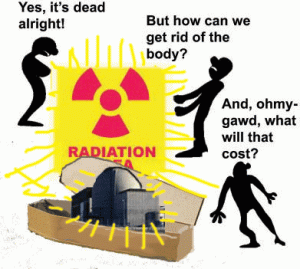
significant additional taxpayer support has been required, and more is likely to be necessary.
there is a risk that the taxpayer will have to make further
contributions.
A report from the UK’s National Audit Office examines whether the
government’s arrangements for decommissioning Britain’s fleet of
advanced-gas-cooled reactors offers value for money.
The UK has eight second generation nuclear power stations accounting for around 16% of total
UK electricity generation in 2020. Seven of the eight stations are Advanced
Gas-cooled Reactors (AGRs), the design of which built on that of the first
generation of now closed Magnox reactors.
Under current plans, all the AGR
stations will have stopped generating electricity by 2028. Decommissioning
is envisaged to take just over 100 years under current plans. The Nuclear
Liabilities Fund (the Fund) was established to meet the costs of
decommissioning all seven AGRs plus a pressurised water reactor at Sizewell
B, but significant additional taxpayer support has been required, and more
is likely to be necessary.
The UK government has provided a guarantee to
underwrite the Fund if its assets are insufficient to meet the total costs
of decommissioning. In 2020, government contributed £5.1 billion ($6.8bn)
to strengthen the Fund’s position and the Fund has recently requested a
further £5.6 billion. The Fund’s assets were valued at £14.8 billion at
the end of March 2021. The aim is that growth in the Fund’s investments
will be sufficient to meet the long-term costs of decommissioning
(currently £23.5 billion).
However, cost estimates have doubled in real
terms since 2004/5. If this trend is maintained and investment growth is
not sufficient, there is a risk that the taxpayer will have to make further
contributions. Last year, the government entered into new arrangements to
decommission the seven AGR nuclear power plants, making EDF Energy
responsible for defueling. The decommissioning of the AGR nuclear power
stations, a 66-page report published by the National Audit Office (NAO)
examines whether these arrangements will lead to better value for money.
The NAO scrutinises public spending to help Parliament hold government to
account and improve public services. It says that while the arrangements
could deliver savings, their success will ultimately depend on the relevant
parties working collaboratively to overcome risks.
Nuclear Engineering International 20th April 2022
https://www.neimagazine.com/features/featurearrangements-for-decommissioning-the-agrs-9640510/
How do we assess thre dangers of nuclear power plants in wartime?
For a night on March 3, Russian military forces seized the Zaporizhzhia
nuclear power plant in Ukraine, damaged its infrastructure, and spread fear
of a nuclear catastrophe. Fortunately, the attack did not threaten
sensitive areas of the nuclear power plant, and radiation levels around the
plant did not raise concern.
Still, the crisis underscored the danger posed
by a war that crosses paths with a nuclear power plant. Since this may be a
case of when, not if, the next wartime attack on a nuclear power plant
happens, scholars and policymakers would be wise to revisit concepts for
assessing and protocols for responding to nuclear power plant crises in war
zones.
Here are some unanswered questions that warrant immediate
consideration: How should experts redefine the boundaries between nuclear
security and nuclear safety? How can experts better understand and assess
the dangers of wartime attacks on nuclear power plants? How does war impact
nuclear safety management? How can a wartime nuclear accident lower the
nuclear threshold?
Bulletin of Atomic Scientists 19th April 2022
Four unanswered questions about the intersection of war and nuclear power
UK’s Nuclear Free Local Authorities join in Wales’call to Japan not to dump radiactive wastewater at sea
The Nuclear Free Local Authorities (NFLA) have joined with leading Welsh
anti-nuclear environmental campaign groups in writing to senior Japanese
Government ministers urging them not to dump radioactive waste from the
Fukushima disaster at sea.
Operated by the Tokyo Electric Power Company
(TEPCO), the Fukushima Daiichi Nuclear Power Plant was hit by an earthquake
and a tsunami on 11 March 2011. A disaster unfolded with three nuclear
meltdowns, three hydrogen explosions and a release of radiation from three
reactors, and Government authorities were forced to evacuate 154,000 people
from the surrounding area over a 20-mile radius. An average of 150 tons of
radioactive water was produced each day last year as rainwater and
groundwater flowed into the damaged reactor buildings mixing with seawater
which has been used to cool the melted nuclear fuel.
One million tons of this water is now stored in barrels on the site. Although the contaminated
water is treated it cannot remove deadly tritium, a beta-emitting
radioactive isotope of hydrogen, and other radioactive materials.
NFLA 21st April 2022
America’s nuclear waste dump in New Mexico is found to have serious safety issues.
The U.S. government´s nuclear waste repository in New Mexico has major
issues in fire training and firefighting vehicles, with its fleet in
disrepair after years of neglect, according to an investigation by the U.S.
Energy Department´s Office of Inspector General.
The investigation was
spurred by allegations regarding fire protection concerns at the
repository, which is the backbone of a multibillion-dollar effort to clean
up Cold War-era waste from past nuclear research and bomb making at
national laboratories and defense sites across the U.S.
Daily Mail 21st April 2022
Russia tests nuclear-capable missile that Vladimir Putin says will make enemies ‘think twice’
SBS, 22 Apr 22, The Sarmat, dubbed Satan 2 by Western analysts, is among Russia’s next-generation missiles that Russia’s president has called “invincible”. But the Pentagon says it is not concerned by the test launch.
Russian President Vladimir Putin said Wednesday that Russia has successfully tested the Sarmat intercontinental ballistic missile, saying the weapon capable of carrying nuclear charges will make Kremlin’s enemies “think twice.”
The Sarmat, dubbed Satan 2 by Western analysts, is among Russia’s next-generation missiles that Mr Putin has called “invincible,” and which also include the Kinzhal and Avangard hypersonic missiles.
Last month, Russia said it used Kinzhal for the first time in warfare to strike a target in Ukraine,
which Russia invaded on February 24………..
The Sarmat has been under development for years and so its test-launch is not a surprise for the West, but it comes at a moment of extreme geopolitical tension over the war in Ukraine.
Russia’s nuclear forces will start taking delivery of the new missile “in the autumn of this year” once testing is complete, Russian news agency TASS quoted Dmitry Rogozin, head of the Roscosmos space agency, as saying on Wednesday………
Mr Barrie said the Sarmat’s ability to carry 10 or more warheads and decoys, and Russia’s option of firing it over either of the Earth’s poles, posed a challenge to ground and satellite-based radar and tracking systems.
The Pentagon said the test was not seen as threatening to the United States and its allies.
Moscow “properly notified” Washington of the test following its obligations………….
Igor Korotchenko, editor in chief of Russia’s National Defence magazine, told RIA news agency it was a signal to the West that Moscow was capable of meting out “crushing retribution that will put an end to the history of any country that has encroached on the security of Russia and its people”. https://www.sbs.com.au/news/article/russia-tests-nuclear-capable-missile-that-vladimir-putin-says-will-make-enemies-think-twice/uks3pn9hn
Greenpeace chief urges Yoon to reevaluate nuclear-focused decarbonization plan
Greenpeace chief urges Yoon to reevaluate nuclear-focused decarbonization plan https://en.yna.co.kr/view/AEN20220422004700315
All News 11:20 April 22, 2022 SEOUL, April 22 (Yonhap) — The leader of Greenpeace urged President-elect Yoon Suk-yeol on Friday to “reevaluate” his nuclear-focused decarbonization plan in a letter sent to him on the occasion of Earth Day.
Yoon’s transition team is pushing to modify the country’s carbon neutrality plans that the outgoing Moon Jae-in administration declared with a goal to reduce its greenhouse gas emissions by 40 percent from the 2018 levels by 2030 and reach carbon neutrality by 2050.
The overhaul will likely include reversal of Moon’s nuclear phase-out policy and changes in energy mix.
“We urge you to reevaluate whether nuclear energy could be safe, fast, and affordable enough to achieve the 1.5 degree C temperature goal,” Greenpeace International Executive Director Norma Torres said in the letter.
She said, “Korea already has the highest nuclear power plant density in the world … we wonder whether further nuclear expansion will be acceptable by the public.”
Torres also said, “The unsolved nuclear waste problem is also a major issue you need to consider in your nuclear focused decarbonization plan.”
South Korea, instead, needs a new, ambitious energy transition strategy to employ more renewable energy coupled with an ambitious fossil fuel and nuclear phase-out plan, according to her.
“Needless to say, your term from 2022 to 2027 is a critical time to decide whether Korea will pull its weight and therefore contribute to the global mission to prevent disastrous climate change in time or not,” she said.
Today: Are we in West being manipulated on a grand scale with deceptive propaganda about the war in Ukraine?

Today I’m posting two videos from Regis Tremblay. I’m sure that Western viewers will hate these, and call the ”Russian propaganda”. And I wish that I could believe that, too,
But I do have an awful fear. Swamped as I am by the tsunami of TV, radio, news, barrage of hyper-emotional depiction of the Ukrainian war, – I cannot help my fearful thought that Regis Tremblay’s speakers are telling the truth.
It’s a painful thought – but I think that the anglophone world, and NATO – the European countries are pulling a giant confidence trick on us all, as we all are led into this frenzy of endless weapons-buying to further the destruction of Ukraine. We are standing by, cheering, as Zelensky and the Ukrainian people are used as pawns, sacrificed, in the cause of the USA discrediting and disrupting Russia
Tomorrow – Webinar to Learn About the Impacts of Radiation from Rocky Flats Nuclear Weapons Plant on the Environment and Health — RADIATION FREE LAKELAND

Below is an invitation from Physicians for Social Responsibility Colorado The invitation is to join this really interesting and important Webinar – starts at 8.30 Mountain Time Zone – 3.30pm Greenwich Mean Time April 23, 2022 Symposium on Rocky Flats:Impacts on the Environment and Health presented as a full-day webinar Histoautoradiograph of lung tissue of […]
Tomorrow – Webinar to Learn About the Impacts of Radiation from Rocky Flats Nuclear Weapons Plant on the Environment and Health — RADIATION FREE LAKELAND
German chancellor: NATO-Russia clash could trigger third world war, nuclear war — Anti-bellum
Scholz’s logic at times (see below) is not only tortuous but torturous. His main message, though, seems unequivocal. Der SpiegelApril 22, 2022 “There Cannot Be a Nuclear War” Excerpts from interview. The SPD is a party of peace, but it has never been pacifist. The two great postwar Social Democratic chancellors, Willy Brandt and Helmut […]
German chancellor: NATO-Russia clash could trigger third world war, nuclear war — Anti-bellum
The US Cries About War Crimes While Imprisoning A Journalist For Exposing Its War Crimes

https://caitlinjohnstone.substack.com/p/the-us-cries-about-war-crimes-while?s=w. 20 Apr 22, In what his lawyers have described as a “brief but significant moment in the case,” a British magistrates’ court has signed off on Julian Assange’s extradition to the United States, bringing the WikiLeaks founder one step closer to a US trial under the Espionage Act which threatens press freedoms worldwide.
The extradition case now goes to UK Home Secretary Priti Patel for approval, which will likely be forthcoming as Patel is a reliably loyal empire manager. After that point, Assange’s legal team will be able to launch an appeal.
This is happening at the same time the United States and the United Kingdom are loudly demanding accountability for alleged war crimes by the Russian military in Ukraine, which is interesting because attempting to bring accountability for war crimes is precisely why Julian Assange is in prison.
“He is a war criminal,” President Biden said of Vladimir Putin following allegations of war crimes in Bucha, Ukraine earlier this month. “I think it is a war crime. … He should be held accountable.”
Biden: Putin should face war crimes trial for Bucha killings 4 April 2022
Wikileaks 5 April – 12 years ago today 5 Julian Assange published the Collateral Murder video detailing the gunning down of civilians, children & 2 Reuters journalists. Assange faces a 175 year sentence if extradited for revealing this and other war crimes
This is why the US government is trying to extradite Julian Assange: for revealing the US massacre of civilians, including two Reuters journalists in Iraq
And that’s all I’d like to say here today, really. That this discrepancy is very interesting.
I mean, can we take a moment to deeply appreciate the irony of this? Because it’s so obscene and outrageous it’s actually hard to take in unless you really let it absorb. The most powerful government in the world, which serves as the hub of the most powerful empire that has ever existed, is working to extradite a journalist for exposing its war crimes while simultaneously rending its garments over war crime allegations against another government.
I mean, damn. You would think a power structure that had recently been caught red-handed committing war crimes and is currently in the process of imprisoning a journalist for exposing those war crimes would at least have the sense not to yell too loudly about war crimes for a little while. But this is how confident the empire is in its ability to control the narrative.
Really take it in. Really digest it. The more you think about it, the freakier it gets. Not only is the empire persecuting a journalist for exposing its war crimes while at the same time demanding that others be held accountable for war crimes, it is also attacking the free press for reporting the truth about the powerful while at the very same time engaging in a massive propaganda operation which holds that it is involved in Ukraine to protect its freedom and democracy.
I mean, the gall. The absolute temerity. The balls on this empire, man.
I have said it before and I will say it again: Assange exposed many ugly realities about the powerful in his work with WikiLeaks, but everything that he has managed to expose thereafter simply by forcing them to prosecute him far surpasses the revelations in those publications.
If the highest form of journalism is exposing the darkest secrets of the most powerful people in the world, then Julian Assange is the highest form of journalist.
Big Tech monopolies — Facebook, Google, and Amazon control media in the interests of American militarism

Former Intelligence Officials, Citing Russia, Say Big Tech Monopoly Power is Vital to National Security, Glenn Greenwald, Substack 20 Apr 22,
When the U.S. security state announces that Big Tech’s centralized censorship power must be preserved, we should ask what this reveals about whom this regime serves.
A group of former intelligence and national security officials on Monday issued a jointly signed letter warning that pending legislative attempts to restrict or break up the power of Big Tech monopolies — Facebook, Google, and Amazon — would jeopardize national security because, they argue, their centralized censorship power is crucial to advancing U.S. foreign policy.
The majority of this letter is devoted to repeatedly invoking the grave threat allegedly posed to the U.S. by Russia as illustrated by the invasion of Ukraine, and it repeatedly points to the dangers of Putin and the Kremlin to justify the need to preserve Big Tech’s power in its maximalist form. Any attempts to restrict Big Tech’s monopolistic power would therefore undermine the U.S. fight against Moscow.
While one of their central claims is that Big Tech monopoly power is necessary to combat (i.e., censor) “foreign disinformation,” several of these officials are themselves leading disinformation agents: many were the same former intelligence officials who signed the now-infamous-and-debunked pre-election letter fraudulently claiming that the authentic Hunter Biden emails had the “hallmarks” of Russia disinformation (former Obama Director of National Intelligence James Clapper, former Obama CIA Director Michael Morrell, former Obama CIA/Pentagon chief Leon Panetta). Others who signed this new letter have strong financial ties to the Big Tech corporations whose power they are defending in the name of national security (Morrell, Panetta, former Bush National Security Adviser Fran Townsend)………………….
Why would these former national security and intelligence officials be so devoted to preserving the unfettered power of Big Tech to control and censor the internet? One obvious explanation is the standard one that always runs Washington: several of them have a financial interest in serving Big Tech’s agenda.
Unsurprisingly, Apple CEO Tim Cook has himself pushed the claim that undermining Big Tech’s power in any way would threaten U.S national security. And there is now an army of well-compensated-by-Silicon-Valley former national security officials echoing his message. A well-researched Politico article from September — headlined: “12 former security officials who warned against antitrust crackdown have tech ties” — detailed how many of these former officials who invoke national security claims to protect Big Tech are on the take from the key tech monopolies:………………………………….
Big Tech censorship of political speech is not random. Domestically, it is virtually always devoted to silencing any meaningful dissent from liberal orthodoxy or official pieties on key political controversies. But in terms of foreign policy, the censorship patterns of tech monopolies virtually always align with U.S. foreign policy, and for understandable reasons: Big Tech and the U.S. security state are in a virtually complete union, with all sorts of overlapping, mutual financial interests:
Note that this censorship regime is completely one-sided and, as usual, entirely aligned with U.S. foreign policy. Western news outlets and social media platforms have been flooded with pro-Ukrainian propaganda and outright lies from the start of the war. A New York Times article from early March put it very delicately in its headline: “Fact and Mythmaking Blend in Ukraine’s Information War.” Axios was similarly understated in recognizing this fact: “Ukraine misinformation is spreading — and not just from Russia.”…………….
there is little to no censorship — either by Western states or by Silicon Valley monopolies — of pro-Ukrainian disinformation, propaganda and lies. The censorship goes only in one direction: to silence any voices deemed “pro-Russian,” regardless of whether they spread disinformation….Their crime, like the crime of so many other banished accounts, was not disinformation but skepticism about the US/NATO propaganda campaign………………
It is unsurprising that Silicon Valley monopolies exercise their censorship power in full alignment with the foreign policy interests of the U.S. Government. Many of the key tech monopolies — such as Google and Amazon — routinely seek and obtain highly lucrative contracts with the U.S. security state, including both the CIA and NSA. Their top executives enjoy very close relationships with top Democratic Party officials. And Congressional Democrats have repeatedly hauled tech executives before their various Committees to explicitly threaten them with legal and regulatory reprisals if they do not censor more in accordance with the policy goals and political interests of that party.
Needless to say, the U.S. security state wants to maintain a stranglehold on political discourse in the U.S. and the world more broadly. They want to be able to impose propagandistic narratives without challenge and advocate for militarism without dissent. To accomplish that, they need a small handful of corporations which are subservient to them to hold in their hands as much concentrated power over the internet as possible.
If a free and fair competitive market were to arise whereby social media platforms more devoted to free speech could fairly compete with Google and Facebook— as the various pending bills in Congress are partially designed to foster — then that new diversity of influence, that diffusion of power, would genuinely threaten the ability of the CIA and the Pentagon and the White House to police political discourse and suppress dissent from their policies and assertions. By contrast, by maintaining all power in the hands of the small coterie of tech monopolies which control the internet and which have long proven their loyalty to the U.S. security state, the ability of the U.S. national security state to maintain a closed propaganda system around questions of war and militarism is guaranteed………………………….
The life and slow death of nuclear power plants

The UK government and EDF have pledged 20% of the cost each, but the additional 60% is yet to be found. Some of that is a levy on our electricity bills for a decade before Sizewell generates a single Kwh.
once planning permission is given, construction of a small-scale wind farm, 10MW or less, could take less than two months.

A further elephant in the room is that the costs of new nuclear are highly “back loaded”, i.e., that by building them you commit to high levels of expenditure at the end of their working life, to remove the fuel rods, decommission, remove and store nuclear waste.
The Life and Death of nuclear power plants By NEWSROOM, Apr 18, 2022, By Peter Rowberry with additional reporting by Newsroom
It seems that the policy [in the UK] to build new nuclear power stations has caused some friction at the heart of the cabinet, with the Prime Minister trying to get the agreement of the Chancellor to spend at least £100 billion on eight new nuclear power stations. This didn’t stop the government issuing its energy security strategy last week.
Such a huge commitment merits careful scrutiny. Hinkley Point C was one of eight announced by the British government in 2010 with a nuclear site licence granted in November 2012. EDF’s board approved the project in July 2016 and on 15 September 2016 the UK government approved the project in principle. Construction work on-site began by late September 2016. Completion of the reactor bases was completed in June 2019 for reactor 1 and June 2020 for reactor 2. The two bases required a total of 633,700 cubic feet of concrete.
Hinkley C is the only one of the 2010 eight designated sites to have commenced construction. The UK government strategy paper calls for 8 further new nuclear plants but does not name locations. This is similar to the Brown government’s announcement in 2008 which the coalition government pinned down in 2010. With only 1 of 8 since 2010 actually under construction the conclusion is the new 8 suggested could be decades from coming online.
Earlier costs for Hinkley C were estimated at around £18 billion. The current cost estimate is around £22 to £23 billion, and the first reactor will not be complete until June 2026 at the earliest, and the second at least six months later.
This timetable is currently being reviewed, with a fault found in similar nuclear reactors in China meaning the design may need to be changed. EDF have not commented on whether this will affect the timescale for completing the project. These delays, and the consequent impact on other nuclear projects, such as Sizewell C and Wylfa, have resulted in serious failures to meet the government obligations to move to low carbon generation and taken up time, time which we are now desperately short of if we are to meet our target of reducing carbon emissions by 50% by 2030 and to net zero by 2050.
The building of the two reactors that form the Sizewell C project is still not fully financed. Nor has the planning process been completed. All the work in progress so far is on vast quantities of paper and construction cannot commence until Sizewell C plant receives planning permission.
There remains considerable opposition to Sizewell C over the high cost of nuclear energy and environmental issues. The cost of a plant that is over 10 years away from generating power will start hitting electricity bills sometime soon. The BBC reported “Legislation allowing construction and financing costs to be added to customer bills, as Sizewell C is built over the next decade, is due for a second reading in the House of Commons next month.”
The UK government and EDF have pledged 20% of the cost each, but the additional 60% is yet to be found. Some of that is a levy on our electricity bills for a decade before Sizewell generates a single Kwh. The government’s plans to have eight nuclear reactors up and running by 2030 seem naively optimistic. New nuclear is not a quick fix, as our near neighbours will attest. The Finnish reactor, Olkiluoto 3, was started in 2005, but only went onto the grid seventeen years later, on 15 March this year.
Of the eight nuclear power plants announced back in 2010, Hinkley Point C might be generating by 2026 (16 years) and Sizewell C by 2032, subject to planning permission (22 years) None of the other 6 proposed nuclear plants are anywhere near getting off the ground.
France, a country which historically generates a large percentage of its electricity from nuclear, is in the process of building only one new reactor, a third at the Flamanville site. EDF, the state-owned energy giant, began work in December 2007 and the cost was estimated to be €3.3 billion. It is now expected to cost more than €12.7 billion and it is yet to generate a single kilowatt of power.
In contrast, according to the European Wind Energy Association, once planning permission is given, construction of a small-scale wind farm, 10MW or less, could take less than two months. A larger 50MW facility may take six months, although considerably smaller in scale, this is substantially quicker than any new nuclear. This has not stopped president Macron from announcing that his government will support the building of between six and fourteen new reactors.
A further elephant in the room is that the costs of new nuclear are highly “back loaded”, i.e., that by building them you commit to high levels of expenditure at the end of their working life, to remove the fuel rods, decommission, remove and store nuclear waste. The UK Nuclear Decommissioning Authority currently spend around £3 billion a year for Site Licence Companies to make the current decommissioned reactors safe.
The Nuclear Provision is the best estimate of how much it will cost to clean up 17 of the UK’s earliest nuclear sites over a programme lasting over 120 years……………………………………………………
All of this will be less significant if nuclear could deliver low carbon electricity at an affordable price. The biggest issue on the cost of nuclear energy is the so called “strike price”, the price which the government has agreed to pay the owners, EDF, for electricity from their nuclear stations. Originally EDF said that electricity from nuclear could be produced at around £24 per megawatt hour. The strike price is now set at £92. It has also been agreed that the strike price should rise in line with inflation, which as we know has reached a thirty-year high and is likely to continue to be high for the foreseeable future.
Although the cost of the raw materials for building wind turbines has increased, copper and steel in particular, the cost of generation by renewables has steadily decreased over time. The latest strike price for offshore wind is around £40 per megawatt hour and less for onshore wind. There have been several missed opportunities and poor decisions by both the Labour and Conservative parties and both party’s obsession with new nuclear have put us in a position where we need urgent action. In February 2004 the Labour party undertook a £40 billion project to update schools, but, despite intense lobbying, energy efficiency did not form part an integral part of that plan.
The Conservative party made changes to the planning system to make it virtually impossible to get permission to build onshore wind farms, although that policy has now been reversed. They also brought an end to the “feed in tariff (FITs)” for local solar power and increased VAT from 5% to 20% on solar installations – now VAT is zero as part of Sunak’s Spring statement.
Although FITs were replaced by the Smart Export Guarantee, this was significantly less financially attractive and has reduced the incentive to install Solar photovoltaic cells…………………………… more https://newsnet.scot/news-analysis/the-life-and-death-of-nuclear-power-plants/
Investigations continue into possible stress corrosion in several of EDF’s nuclear reactors in France.
EDF has said it found indications of possible stress corrosion on the
auxiliary circuits of four French nuclear power reactors totalling 4.8 GW
in capacity, namely Chinon 3, Cattenom 3, Flamanville 2 and Golfech 1. The
signs of possible corrosion were detected during ultrasonic inspections of
parts of the piping at its Chinon 3 (905 MW), Cattenom 3 and Flamanville 2
(1.3 GW each) reactors, the French state-owned utility said in a statement
at the end of last week.
The units are among six reactors that EDF
considers as “priority” for these checks, with the other three being
Flamanville 1 (1.3 GW) and Bugey units 3 and 4 (880 MW each). Meanwhile,
inspections carried out on the safety injection system circuit at Golfech 1
(1.3 GW) during planned maintenance also detected indications of possible
corrosion, EDF added. A spokeswoman told Montel on Tuesday that the utility
was carrying out further investigations to find out whether it was
corrosion or not.
Montel 19th April 2022
https://www.montelnews.com/news/1313964/edf-finds-indications-of-possible-corrosion-on-4-reactors-
New Mexico Governor concerned over plans for plutonium waste being disposed of in Carlsbad.
Adrian Hedden, Carlsbad Current-Argus, 20 Apr 22,
New Mexico Gov. Michelle Lujan Grisham signaled support for an activist group opposing a plan at the Waste Isolation Pilot Plant to dispose of diluted, weapons-grade plutonium in the underground nuclear waste repository near Carlsbad.
Lujan Grisham, in an April 8 letter to U.S. Secretary of Energy Jennifer Granholm, shared a petition circulated by Santa Fe-based group 285 All in opposition of the plan and called on the federal Department of Energy to “take action” to address the concerns.
The plan proposed by the DOE would see 35 metric tons of down-blended plutonium waste sent from the Pantex Plant near Amarillo, Texas to Los Alamos National Laboratory in northern New Mexico for processing.
It would then be sent to the DOE’s Savannah River in South Carolina for final preparation and then to the WIPP site in southeast New Mexico for disposal…………..
Critics of the proposal argued the plan would transport nuclear waste across New Mexico multiple times, and the inclusion of down-blended plutonium would mark an “illegal” expansion of WIPP’s statutorily allowed waste streams.
The petition expressing those fears was signed by 1,146 people in New Mexico and delivered to Lujan Grisham’s office in Santa Fe on March 1.
In her letter to Granholm, Lujan Grisham called on the agency which owns and operates WIPP to consider the concerns raised in the petition. https://www.currentargus.com/story/news/2022/04/20/carlsbad-waste-isolation-pilot-plant-plutonium-disposal-concern-michelle-lujan-grisham/7309367001/
-
Archives
- February 2026 (228)
- January 2026 (308)
- December 2025 (358)
- November 2025 (359)
- October 2025 (376)
- September 2025 (258)
- August 2025 (319)
- July 2025 (230)
- June 2025 (348)
- May 2025 (261)
- April 2025 (305)
- March 2025 (319)
-
Categories
- 1
- 1 NUCLEAR ISSUES
- business and costs
- climate change
- culture and arts
- ENERGY
- environment
- health
- history
- indigenous issues
- Legal
- marketing of nuclear
- media
- opposition to nuclear
- PERSONAL STORIES
- politics
- politics international
- Religion and ethics
- safety
- secrets,lies and civil liberties
- spinbuster
- technology
- Uranium
- wastes
- weapons and war
- Women
- 2 WORLD
- ACTION
- AFRICA
- Atrocities
- AUSTRALIA
- Christina's notes
- Christina's themes
- culture and arts
- Events
- Fuk 2022
- Fuk 2023
- Fukushima 2017
- Fukushima 2018
- fukushima 2019
- Fukushima 2020
- Fukushima 2021
- general
- global warming
- Humour (God we need it)
- Nuclear
- RARE EARTHS
- Reference
- resources – print
- Resources -audiovicual
- Weekly Newsletter
- World
- World Nuclear
- YouTube
-
RSS
Entries RSS
Comments RSS
 nuclear-news
