Iran’s foreign minister says nuclear deal closer ‘than ever’
Iran’s foreign minister says nuclear deal closer ‘than ever’, DUBAI, March 23 (Reuters) – Iranian Foreign Minister Hossein Amirabdollahian said on Wednesday that the Islamic Republic and world powers are closer than ever to reviving a 2015 nuclear deal………..
Reporting by Dubai Newsroom; editing by Michael Georgy, Toby Chopra, William Maclean https://www.reuters.com/world/middle-east/irans-foreign-minister-says-nuclear-deal-closer-than-ever-2022-03-23/
Very low Arctic sea ice
Arctic sea ice has reached its maximum extent for the year, peaking at
14.88m square kilometres (km2) on 25 February. It is the 10th smallest
winter peak in the 44-year satellite record. The provisional data from the
National Snow and Ice Data Centre (NSIDC) shows that this year’s Arctic
maximum extent was recorded on 25 February – marking the third earliest
maximum in the satellite record. While the past six months have been fairly
uneventful in the Arctic in general, the Earth’s other pole has seen a
record-breaking melt season.
For the first time since the satellite record
began, the Antarctic extent fell below 2m km2 this year. Unusually, the
Arctic winter peak and the Antarctic summer minimum occurred on exactly the
same day.
Carbon Brief 22nd March 2022
Europeans stocking up on anti-radiation pills

People across Europe are stocking up on iodine tablets against the
backdrop of fears that the Russian invasion of Ukraine may “go
nuclear.” Following antagonistic comments from President Vladimir Putin,
people living in many former Eastern Bloc states, including Poland,
Bulgaria, and Czechia, have been flocking to pharmacists to stock their
cupboards with iodine tablets, Reuters reports. There have been similar
reports of iodine selling out in pharmacies in Finland, which shares a
border with Russia.
IFL Science 22nd March 2022
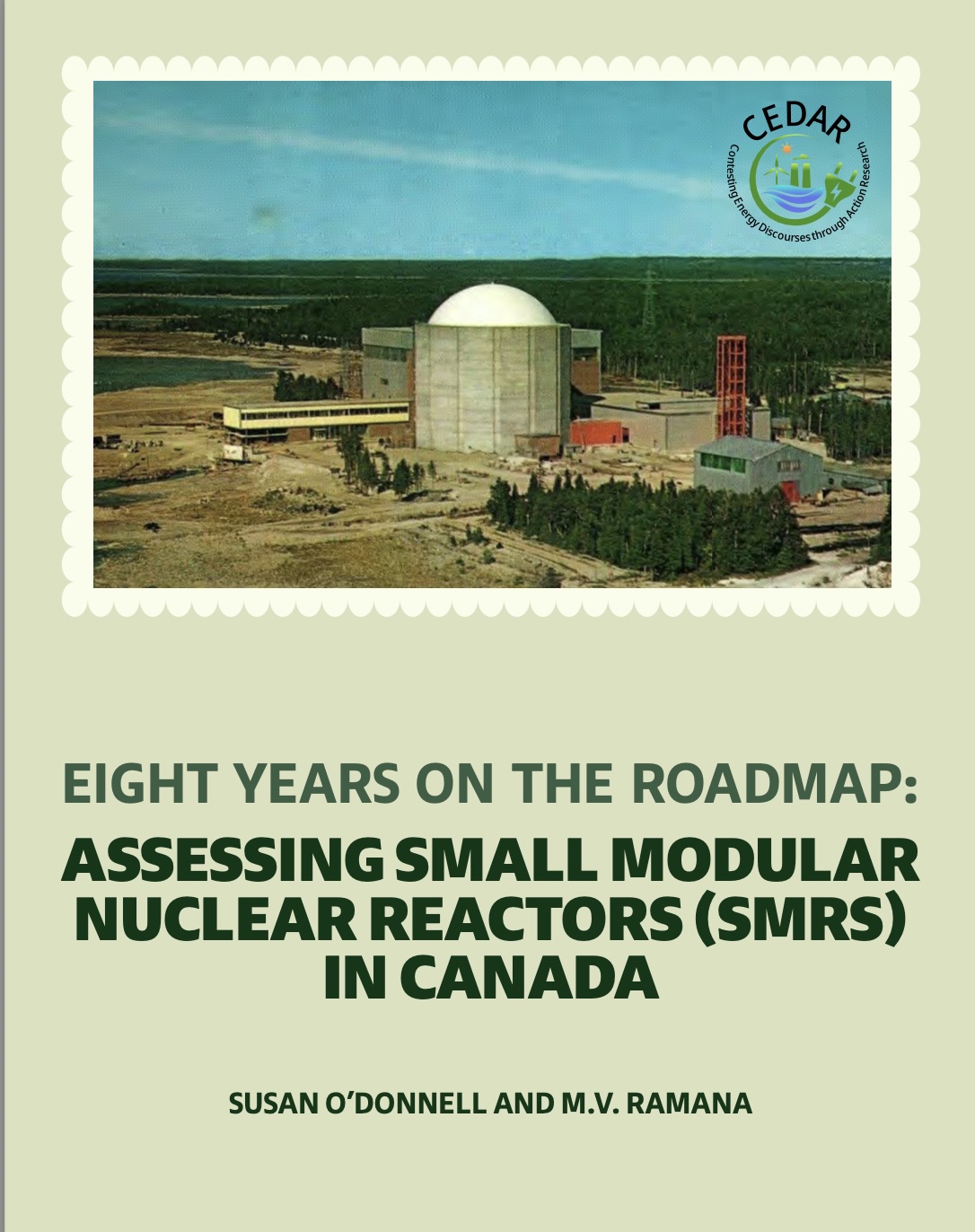
British public in the dark about what ”Modular” nuclear reactors really means (hint -they’re like Lego pieces)
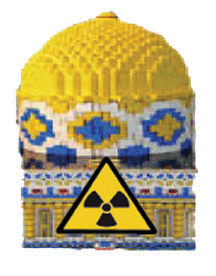
What does “modular” mean here? I haven’t the faintest. Isn’t it to
do with university courses? I’ve been quizzing friends and so far only
two even took a stab: one thought it might mean being able to have them
together, or not, or something. The other thought it might mean
“portable”. My guess is that the British population shares my
ignorance, but thinks you don’t say “small reactors” without
inserting “modular”. Obviously, we’ll have to ramp these modularities
up. On multiple occasions. Onwards, then, to my next small, modular item.
Times 23rd March 2022
https://www.thetimes.co.uk/article/this-craze-for-modular-must-be-a-fission-thing-s35qx0ktq
Opinion: U.S. pressure on India over Ukraine doomed to fail — Anti-bellum
Global TimesMarch 22, 2022 Biden’s criticism of India’s neutrality on Russia exposes US hypocrisy India’s refusal to follow the US’ lead in condemning and sanctioning Russia over the Ukraine crisis has increasingly irritated Washington. After White House officials issued warnings to New Delhi on multiple occasions, US President Joe Biden singled out India for its […]
Opinion: U.S. pressure on India over Ukraine doomed to fail — Anti-bellum
Editorial: Washington conducts international Inquisition over Ukraine — Anti-bellum
Global TimesMarch 22, 2022 US is reestablishing a new Inquisition using Russia-Ukraine crisis as excuse: Global Times editorial The US, leading several attendants, is launching a round of international mobilization to condemn Russia. After US Secretary of State Antony Blinken accused China of standing “on the wrong side of history” in the Russia-Ukraine conflict, British […]
Editorial: Washington conducts international Inquisition over Ukraine — Anti-bellum
March 23 Energy News — geoharvey

World: ¶ “French Energy Giant TotalEnergies To Stop Buying Russian Oil By Year-End” • French energy giant TotalEnergies said it would stop buying Russian oil and oil products by the end of 2022 at the latest, according to a press release from the company. Due to European logistics capacities, it will take two to three […]
March 23 Energy News — geoharvey
Thought for the day. UK Conservative govt ready to nationalise nuclear power
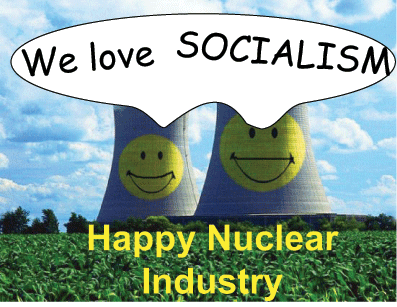
You didn’t know? Boris Johnson is a Socialist at heart. After so many perambulations around those minefields of how to make the tax-payer fund (otherwise unaffordable) nuclear power, the UK might soon take the plunge – be honest, and just nationalise the whole thing, as they do in Russia, China, France
Boris Johnson determined to show ‘leadership’ on nuclear power
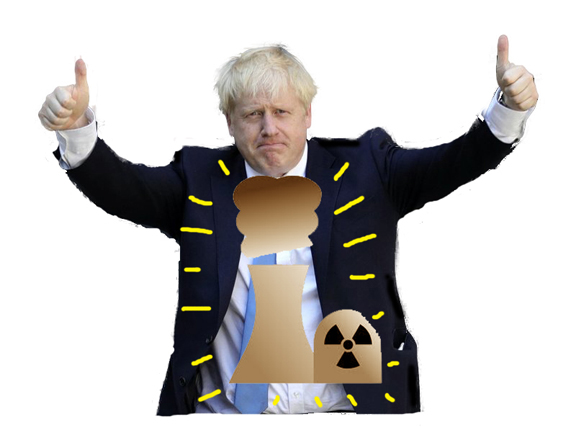
Johnson announces aim for UK to get 25% of electricity from nuclear power. PM meets industry bosses to discuss new power stations, with several reactors slated for closure as energy demand rises, Guardian, Jasper Jolly and Rob Davies 22 Mar 22,
Boris Johnson has told nuclear industry bosses that the government wants the UK to get 25% of its electricity from nuclear power, in a move that would signal a significant shift in the country’s energy mix.
Johnson on Monday met executives from major nuclear utilities and technology companies including the UK’s Rolls-Royce, France’s EDF, and the US’s Westinghouse and Bechtel to discuss ways of helping to speed up the development of new nuclear power stations.
The UK generates about 16% of its power from nuclear power stations, but several reactors are slated for closure, while electricity demand is expected to rise steadily in the next decade. That would mean large investments in new power stations would be required just to keep the share of nuclear constant, let alone increase it to a record level of just over a quarter of electricity use.
Also present at the meeting were a series of big pension companies and insurers, including Aviva, Legal & General and Rothesay Life, alongside major foreign investors including Australia’s Macquarie and the Canada Pension Plan Investment Board. Ministers have wrestled for years with how to attract private capital to invest in nuclear – but companies have balked at putting pension and insurance cash at risk.

The government is considering changes to insurance rules set by the EU and copied by the UK to make it easier for insurers and pensions to invest. The UK is switching to a “regulated asset base” model, which it hopes will give long-term investors more certainty on returns, a change it hopes will address limitations to the current rules, known as Solvency II.
The government wanted to show the nuclear and investment industries that it had a “clear ambition for more nuclear” in part to balance out intermittent renewable power sources, according to a government source briefed on the discussion.
………………..According to an aide who was present at the meeting, Johnson told industry heads and financiers that there had been a “chronic absence” of leadership by successive British governments on nuclear energy and that the country was “being left for dead” by other nations, such as France, on the issue.
Speaking after the meeting, Tom Greatrex, the chief executive of the Nuclear Industry Association (NIA), said: “Accelerating nuclear projects is absolutely essential to keep energy costs down, cut expensive gas imports and strengthen our energy security as we move towards net zero.
“That means urgently investing in a fleet of large and small nuclear stations, alongside renewable investment, to deliver the clean, sovereign power we need.”
The UK has struggled to build new nuclear power stations in recent decades, with the Japanese conglomerate Hitachi in 2020 pulling out of plans to build a new reactor at Wylfa, north Wales, and geopolitical tensions making the government less keen on attracting Chinese investment to Sizewell C on the Suffolk coast.
Meanwhile the existing nuclear fleet has been in steady decline, with Hunterston B in Scotland retiring earlier this year, Hinkley Point B in Somerset due to follow suit in the summer, and Heysham I and Hartlepool I due to shut down in 2024.
At that point, nuclear capacity is expected to fall as low as 3.6GW.A cross-party group of MPs that campaigns on nuclear issues has called for the government to increase its annual nuclear power capacity to 15GW by 2030 and 30GW by 2050, far above the 12.7GW installed at nuclear power’s peak in 1995.
Major obstacles include difficulty in securing funding from private investors and a ban on new nuclear projects, which was among the factors that scuppered the Wylfa project in north Wales.projects in Scotland, imposed by the devolved government, which prevents Hunterston B being replaced.
The government is examining a plan to revise the financing model for major projects, which was among the factors that scuppered the Wylfa project in north Wales.
Under plans for Sizewell being discussed by Whitehall officials and EDF, the government could take a stake in a development company that will push it through various stages of planning and bureaucracy, sharing the costs with EDF.
Private sector investors such as the insurance funds L&G and Aviva would then be lured in at a later stage in return for a government-backed funding model called the regulated asset base (Rab), diluting the taxpayer and EDF.
Legislation on Rab funding – the same model used to fund airports such as Heathrow and water companies – is due to progress through parliament next month. https://www.theguardian.com/environment/2022/mar/21/johnson-announces-aim-for-uk-to-get-25-of-energy-from-nuclear-power
Renewable energy: Austria, a leader of anti-nuclear advocacy in Europe
Renewable energy: Austria, a leader of anti-nuclear advocacy in Europe, https://www.france24.com/en/tv-shows/focus/20220321-renewable-energy-austria-a-leader-of-anti-nuclear-advocacy-in-europeBy:
Vianey LORIN|Anthony MILLS, The EU is proposing to put nuclear power on its list of sustainable energy sources. But Austria is threatening to file a case with the Court of Justice of the European Union to get that text annulled. The country has never embraced nuclear energy and is even home to the world’s only power station to have been built but never fired up. Austria produces more than 75 percent of its electricity from renewable energy and is a leader of anti-nuclear advocacy in Europe. Our correspondents report.
Russia about to announce an export ban on uranium
Putin goes nuclear: Biden faces crisis as Russia BANS uranium exports in sanction response
US PRESIDENT JOE BIDEN is currently facing a nuclear crisis as Russia announces an export ban on uranium. Express UK, By ANTONY ASHKENAZ Mar 21, 2022 Russian President Vladimir Putin has hit back the US for the crippling sanctions placed by Joe Biden on Russia following the invasion of Ukraine. Earlier this month, the US dealt a major blow to Moscow by announcing a ban on Russian oil and gas, the country’s largest export. Now as a response to the embargo, Russia is considering halting the sale of uranium to the US.
When he was asked about how he felt about imposing a ban on the export of uranium, Mr Novak said: “This issue is also on the agenda, it is being studied.”
Uranium, which is a key component of nuclear weapons and nuclear energy, is another energy resource mined in Russia.
The US energy industry relies on Moscow and its key allies Kazakhstan and Uzbekistan for roughly half of the uranium powering its nuclear power plants.
Mr Biden has faced intense lobbying from the nuclear industry to continue buying Russian uranium despite Putin’s invasion of Ukraine.
Russia has known uranium deposits of 500,000 tonnes and accounts for 9 percent of the world’s uranium production, according to the World Nuclear Association.
Uranium is primarily used for its nuclear properties, both as a fuel for power plants and for nuclear weapons.
Earlier this month, at a White House address, Mr Biden said: ‘We’re banning all imports of
Russian gas, oil and energy’…………….
sources noted that these sanctions do not include a ban on imports of uranium for nuclear
power plants……….. https://www.express.co.uk/news/science/1584053/putin-news-russia-nuclear-nightmare-uranium-exports-ban-ukraine-invasion
Deal on Ukrainian nuclear safety to come ‘soon,’ says IAEA chief
Deal on Ukrainian nuclear safety to come ‘soon,’ says IAEA chief, https://www.politico.eu/article/deal-ukraine-nuclear-safety-iaea-chief-russia-war/
Agency hopes to send experts to Ukraine to get ‘credible, objective’ on the ground information.
The International Atomic Energy Agency (IAEA) is closing in on a deal to guarantee the safety and security of nuclear facilities in Ukraine, according to its chief Rafael Mariano Grossi.
“We are negotiating, we are approaching what we want to be the final stages of our consultations,” Grossi told European lawmakers on Monday, adding he hoped to reach a deal “very soon.”
The discussions, which started on March 10, are “very delicate” diplomatically, he said.
The future framework will make “no political references to the situation in the plants or no connection that could be construed as legitimizing the presence of anybody in a foreign territory,” according to Grossi, responding to concerns that it could be used by Moscow to legitimize control over parts of Ukraine’s territory.
He added that it will require Russia and Ukraine to “observe some of the rules … that have been repeatedly violated with enormous risk for the population, local, regional, European populations” since Russia’s invasion of Ukraine in late February.
Russian troops have taken control of the decommissioned Chernobyl nuclear power plant and the active nuclear power station at Zaporizhzhia, prompting fears of potential nuclear disaster and large-scale environmental damage.
Grossi has repeatedly expressed his concerns about nuclear safety as the conflict unfolds, but at no point has the IAEA warned of explicit and immediate danger outside Ukraine.
Speaking to MEPs on Monday, he stressed that “nuclear power plants are very robust, they can sustain an airplane that falls on them.” It would take “massive means” to get to the core of a reactor. He also repeated that targeting nuclear plants would constitute a breach of international law.
Once the framework is agreed, Grossi said he hopes to send IAEA experts to Ukraine “to facilitate the situation there, also as a deterrent to new, complicated, dangerous occurrences taking places.”
Experts will also look to gather “credible, objective information” about the situation on the ground, he said, noting that it is becoming “increasingly difficult” to ascertain the facts of the situation “because there are conflicting narratives about what is happening.”
Western countries importing Russian uranium and nuclear supplies – WITH NO SANCTIONS.
Weekly Data: Cutting nuclear links with Russia may be harder than cutting fossil fuel imports, https://www.energymonitor.ai/sectors/power/weekly-data-russian-uranium-supply-chains
Russia’s war in Ukraine and Western countries’ subsequent sanctions are wreaking havoc on fossil fuel supply chains – but uranium deliveries for nuclear power remain untouched, for now.
By Mirela Petkova, As the EU looks for ways to reduce its dependence on Russian gas and oil in response to Russia’s invasion of Ukraine, the future of nuclear energy is also becoming uncertain. This may seem surprising at first. Nuclear power generated almost a quarter of the total electricity produced in the bloc in 2020 and the European Commission recently allowed for the classification of some nuclear power plants as green investments under the EU Taxonomy for green investment.
Energy Monitor’s Weekly Data shows Russia is the second-biggest source of uranium, the raw material for nuclear fuel, for EU member states. The supply chain is diversified, as countries such as Niger, Kazakhstan and Canada also contribute significant amounts.
Domestic production remains low, with uranium originating outside the EU 27 accounting for 95% of total consumption, according to the European Atomic Energy Community. However, getting the uranium is not the only element of fuelling nuclear plants – it also must be enriched. Russia provides about 35% of enriched uranium globally and according to the World Nuclear Association (WNA) has the biggest enrichment capacity in the world, with China ranked second. Among EU members, countries with enrichment capacities include Germany, the Netherlands and France.
Furthermore, a significant number of nuclear reactors in Europe are Russian-designed – 18 out of 103, in five of the 13 nuclear EU member states. According to the WNA, there are Russian-designed reactors in Bulgaria and Finland (two each), Hungary and Slovakia (four each), and the Czech Republic (six).
Those reactors contribute significantly to some of the countries’ electricity supplies. In the case of the Czech Republic, nuclear power makes up one-third of electricity production, and Hungary’s four reactors account for almost half its electricity needs. Europe’s Russian-designed nuclear plants depend largely or wholly on Russian companies for fuel fabrication.
The supply chain situation is different, but just as difficult, across the Atlantic. Despite US President Joe Biden’s executive order in early March 2022 to stop imports of Russian oil and gas, uranium for nuclear power plants has not been targeted. The reliance on Russia is slightly smaller than the EU’s – according to the US Energy Information Administration (EIA), in 2020, Russia accounted for 16% of US uranium imports, with Uzbekistan and Kazakhstan accounting for 8% and 22%, respectively.
US domestic uranium production has declined steeply in recent years, with the EIA being unable to publish quarterly production figures in the last two years due to a low reporting threshold. As Republican Senator John Barrasso from Wyoming proposes legislation to ban imports of Russian uranium, the US could find itself cut off from Russian imports.
Back in Europe, while the war in Ukraine has made clear the EU must work to diversify its energy supplies, the bloc’s dependence on Russian uranium fuel and enrichment has, so far, flown under the radar. Either way, looking ahead, Russia’s reserves of uranium pale in comparison with countries such as Australia, Kazakhstan and Canada.
Chernobyl radiation monitors ‘not working’
Chernobyl radiation monitors ‘not working’ https://www.cessnockadvertiser.com.au/story/7667680/chernobyl-radiation-monitors-not-working/?cs=6981Australian Associated Press 21 Mar 22,
Ukraine’s nuclear regulatory agency says the radiation monitors around the Chernobyl nuclear power plant, site of the world’s worst meltdown in 1986, have stopped working.
In a statement on Monday, the agency also said there are no longer firefighters available in the region to protect forests tainted by decades of radioactivity as the weather warms.
The plant was seized by Russian forces on February 24.
According to Monday’s statement, the combination of risks could mean a “significant deterioration” of the ability to control the spread of radiation not just in Ukraine but beyond the country’s borders in weeks and months to come.
Management of the Chernobyl plant said on Sunday that 50 staff members who had been working non-stop since the Russian takeover have been rotated out and replaced.
Nuclear energy development not possible in USA, unless it is tax-payer funded?

What Is Holding U.S. Nuclear Energy Back? OilPrice.com 21 Mar 22,
”……….There are three basic business risks associated with nuclear power for an investor-owned utility: financing, operating, and sales. (Four if you add in new construction risk which is not inconsequential.) The simple reason no US investor-owned utility — apart from Southern Company’s Plant Vogtle—- is building or considering new nuclear investments is the first risk, financing. To paraphrase a former NYC mayoral candidate, the capital costs are “too damn high”. By any metric, nuclear power is economically uncompetitive. According to the recent Lazard study comparing the cost of new power generation, it is about three times more costly than natural gas and five times more costly than new wind and solar.
This begs an obvious question. How can we have more of something if it is wildly, economically uncompetitive? The answer is simple: eliminate the consideration of economics from new power plant development. Take for example a large nuclear construction project at Turkey’s four-unit Akuyu nuclear power station. In the US that is a $40+billion capital project. No US investor-owned utility has the balance sheet to handle multiple unit projects of that size. Only the US government has the borrowing capacity for projects of that magnitude and risk. This, in turn, suggests that new nuclear power plant development will only occur in the US If we compromise on our free enterprise principles and take new nuclear plant development out of the private sector entirely. These enormous financing risks are now impossible to comfortably absorb in a corporate setting where they must be constantly balanced against shareholder interests. ….’
1 This Month
26 April – Chernobyl: Inside the Meltdown airs on National Geographic on Sunday 26th April from 4pm

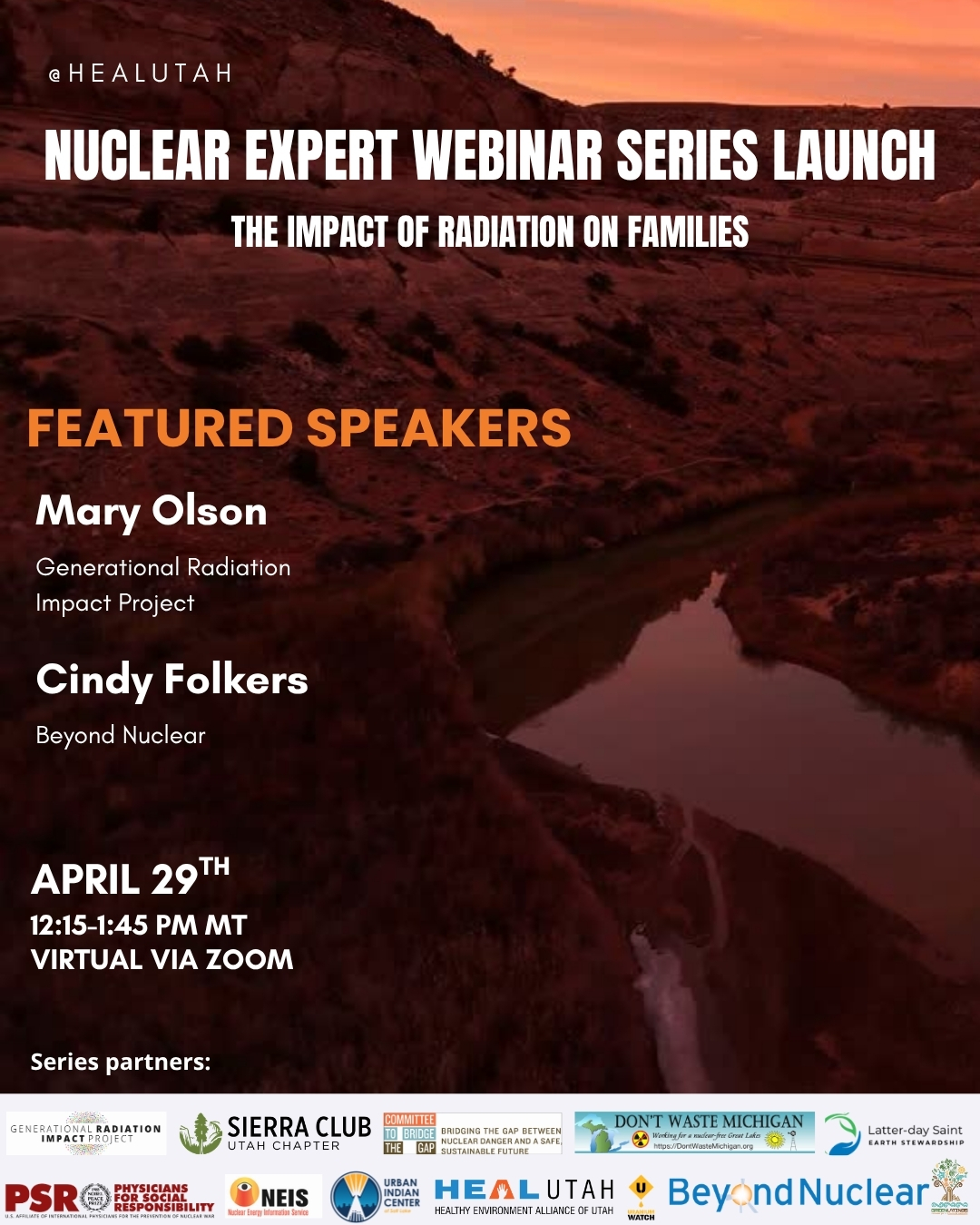
29 April – Nuclear Expert Webinar #1 – Radiation Impacts on Families with Mary Olson and Cindy Folkers
- 12:15 PM MT – 1:45 PM MT
- Location: Virtual – REGISTER TODAY

4 May -West Suburban Peace Coalition to discuss Iran war at May Educational Forum
Monday, May 4, 7:00 – 8:00 PM Central Standard Time
Title: : How Trump’s Narrative Tries to Shape the Reality of the War on Iran.
Contact Walt Zlotow, zlotow@hotmail.com 630 442 3045 for further information
14 May – online event From Bombs to Data Centres: the Face of Nuclear Colonialism

Pine Ridge Uranium is the real threat, not Tehran- Tell Burgum: Stop the Extraction.
Chernobyl: The Lost Tapes – A good documentary on Chernobyl on SBS available On Demand for the next 3 weeks– https://www.sbs.com.au/ondemand/tv-program/chernobyl-the-lost-tapes/2352741955560
To see nuclear-related stories in greater depth and intensity – go to https://nuclearinformation.wordpress.com
-
Archives
- April 2026 (317)
- March 2026 (251)
- February 2026 (268)
- January 2026 (308)
- December 2025 (358)
- November 2025 (359)
- October 2025 (376)
- September 2025 (257)
- August 2025 (319)
- July 2025 (230)
- June 2025 (348)
- May 2025 (261)
-
Categories
- 1
- 1 NUCLEAR ISSUES
- business and costs
- climate change
- culture and arts
- ENERGY
- environment
- health
- history
- indigenous issues
- Legal
- marketing of nuclear
- media
- opposition to nuclear
- PERSONAL STORIES
- politics
- politics international
- Religion and ethics
- safety
- secrets,lies and civil liberties
- spinbuster
- technology
- Uranium
- wastes
- weapons and war
- Women
- 2 WORLD
- ACTION
- AFRICA
- Atrocities
- AUSTRALIA
- Christina's notes
- Christina's themes
- culture and arts
- Events
- Fuk 2022
- Fuk 2023
- Fukushima 2017
- Fukushima 2018
- fukushima 2019
- Fukushima 2020
- Fukushima 2021
- general
- global warming
- Humour (God we need it)
- Nuclear
- RARE EARTHS
- Reference
- resources – print
- Resources -audiovicual
- Weekly Newsletter
- World
- World Nuclear
- YouTube
-
RSS
Entries RSS
Comments RSS
 nuclear-news