World’s biggest bunker where billionaires could survive in luxury for 10 years
World’s biggest nuclear bunker where billionaires could survive in luxury for 10 years
The Oppidum is the world’s largest nuclear bunker and is located in a secret location in the Czech Republic where its billionaire owners could live out nuclear armageddon By John James. , 25 MAR 2022
The World’s richest people plan to sit out a nuclear apocalypse in the world’s largest luxury bomb shelter which lies in a secret location in the Czech republic.
Since Russia invaded Ukraine last month, interest in nuclear shelters has skyrocketed spurred on in part by Vladimir Putin’s reckless rhetoric, but the elites of the world have been planning for years.
The Oppidum (which is a fantastically ominous name for a bunker in anyone’s book) is located in a quaint valley in the Czech Republic surrounded by high walls that ensure it can’t be identified by the irradiated masses.
The massive 323,000 square foot structure extends well into the ground and is kitted out with all the luxury items you’d expect including a swimming pool, wine cellar and helipad.
The whole building is fitted with a network of secret tunnels leading to the cavernous vaults beneath the above-ground building so when a bomb hits you can be safely hidden fast.
It was first built during the height of the Cold War as part of combined efforts from the governments of the Soviet Union and what was Czechoslovakia.
Its location is than two hours from both London and Moscow by private jet providing easy access for those in the world’s centre of power – even if they might not see eye to eye when they get there.
The bunker is also self-sufficient and is claimed that residents could survive there for as long as ten years.
…………… While residents stay in the shelter, they are constantly guarded by security who it is claimed have a constant link to the outside world through the Oppidum control centre.
The reality of life after nuclear fallout is that you’re going to be spending a lot of time underground starved of natural light, but the paranoid architects have even thought of this.
A state of the art subterranean garden is included in the bunker which is lit up by simulated natural light.
Biden keeping up the big spend on nuclear weapons

Biden steers away from big change to US nuclear weapons policy
Washington’s ‘posture review’ maintains deliberate ambiguity over when arms might be used, Ft.com Demetri Sevastopulo in Alice Springd\s 25 Mar 22,
President Joe Biden has decided against making a major change to US nuclear weapons policy following pressure from European and Asian allies not to undermine their security amid the nuclear threat from Russia and China.
After a months-long review that had sparked anxiety from France to Japan, Biden this week decided on a declaratory policy that the “fundamental purpose” of nuclear weapons was to deter, or respond to, a nuclear attack on the US or its allies, according to three people familiar with the decision.
US allies last year expressed concern following speculation that Biden might declare that the “sole purpose” of nuclear weapons was to prevent or respond to a nuclear attack. They said such a change — which Biden supported before becoming president — would weaken the extended deterrence that the US provides to allies around the world with its nuclear umbrella. Critics also argued the potential shift would embolden Russia.
Please use the sharing tools found via the share button at the top or side of articles. Copying articles to share with others is a breach of FT.com T&Cs and Copyright Policy. Email licensing@ft.com to buy additional rights. Subscribers may share up to 10 or 20 articles per month using the gift article service. More information can be found here.
https://www.ft.com/content/4c72b45d-37ac-431f-838c-cf8704cad6c3
One senior US official said the allies’ views played a big role in influencing Biden. She said the president had strong views on nuclear risk reduction and might have been considering a larger change in declaratory policy but that he received a lot of input from allied capitals that resulted in the outcome, which was also influenced by the threat from Moscow and growing concerns about China’s expanding nuclear arsenal.
The outcome will be outlined in the administration’s “Nuclear Posture Review”, which is designed to determine what kind of nuclear weapons the US should have and provide guidance about scenarios for possible use.
The NPR will also say that the US would only use nuclear weapons in “extreme circumstances” — echoing language that was included in nuclear reviews conducted by both the Obama and Trump administrations. But the Trump administration arguably lowered the threshold for possible use by saying that “extreme circumstances” could include a non-nuclear attack.
…………………………………………………….US policy on the situations under which nuclear weapons would be used has been intentionally vague for decades to keep adversaries guessing. The US official said the NPR would contain a level of strategic ambiguity.
Arms control advocates wanted Biden to shift to a “no first use” policy or “sole purpose” formulation that they argued would reduce the risk of nuclear war. But critics countered that providing more clarity about when the US would use nuclear weapons would just embolden adversaries.
Jeffrey Lewis, a nuclear weapons expert at Middlebury Institute of International Studies, said Biden had largely kept existing nuclear posture intact. He said the Obama and Trump administrations had used language about the “fundamental role” of nuclear weapons in their posture reviews.
“If this is the biggest change in the Nuclear Posture Review, I want my tax money back,” Lewis said. “The phrase reflects a longstanding, bipartisan tradition of trying to have it both ways. US officials want to give the impression that our nuclear weapons are for deterrence while also holding open the option of using them first ……………………….
https://www.ft.com/content/4c72b45d-37ac-431f-838c-cf8704cad6c3
So far, Zaporizhzhya’s nuclear reactors are being managed safely under Russian control

As Russian military forces shelled the Zaporizhzhya Nuclear Power Plant
(ZNPP) in southern Ukraine on March 4, 2022, a fire broke out on the site.
Among the six reactor units at the complex, auxiliary buildings attached to
the Zaporizhzhya Unit 1 reactor were damaged. Fortunately, the damage did
not threaten the safety of the unit. And a recent assessment by the
International Atomic Energy Agency indicates that, although management of
the plant by a Russian military commander is less than ideal, “regular
staff have continued to operate the Zaporizhzhya [nuclear power plant]”
and “at least 11 representatives of the Russian state [nuclear power]
company Rosatom were also present there, without interfering with the
operation of the nuclear facilities.”
Even so, Russia’s military
attacks on the Zaporizhzhya plant raise great concerns about the
possibility of nuclear accidents. Some experts have suggested the attack on
Zaporizhzhya could have caused a huge catastrophe; others were much more
conservative in their estimates of possible radiation releases from such an
attack. To illustrate the potential damage from a military attack on a
nuclear power plant, we simulated and analyzed hypothetical releases from a
core meltdown and spent fuel pool fire at one unit, Zaporizhzhya 1, if an
attack by missiles or artillery had disabled cooling systems there.
Bulletin of Atomic Scientists 23rd March 2022
Could an attack on Ukrainian nuclear facilities cause a disaster greater than Chernobyl? Possibly, simulations show.
UK does NOT need more nuclear power. Electricity demand has fallen
| Andrew Warren: In seeking justification for “rigging” the UK electricity market in favour of more nuclear power, It is beingcategorically argued that electricity demand is expected to rise over the next decade (“Johnson in ‘gung ho’ push for more nuclear power as energy crisis bites”, Report, March 21). Strangely enough, that was precisely the reason given back in 2006, when the then Labour government first committed to a “family” of further nuclear power stations. Based on the official forecasts issued in 2006, we should by now be consuming at least 15 per cent more electricity than we were then. But we are not. Right now, UK electricity consumption has in fact gone down by over 15 per cent since 2006. In other words, all that expectation of demand growth which was used to justify new nuclear power stations was grossly exaggerated, in practice by over 30 per cent. In the interim, no new nuclear power stations have been added to the system. The system hasn’t collapsed, and it’s also far less carbon intensive. Surely, we aren’t getting fooled again by the same spurious rhetoric about endless consumption growth? In that immortal phrase of the 1970s: “Save it. You know it makes sense”. FT 24th March 2022https://www.ft.com/content/41942796-1da4-469a-af7c-a331673ae494 |
The work of Ukraine-based European Institute of Chernobyl.
Chernobyl nuclear power plant: Worker reveals risk of accident as Russians force staff to do 24-hour shifts , i News, By Isabella Bengoechea March 25, 2022
”………………………………………………i has been working with the European Institute of Chernobyl, a Ukraine-based NGO that focuses on research, popularisation and dissemination of information about the Chernobyl disaster through scientific, educational, social and cultural projects and initiatives, with the aim of preventing new nuclear catastrophes happening in future.
The public organisation, which began its work in 2017, also focuses on protecting the rights and interests of participants in the liquidation of the fallout of the Chernobyl accident, as well as citizens affected by the disaster.
Last April, the group launched an information campaign and programme of events to commemorate the 35th anniversary of the disaster. Partnered with the National Museum of Chernobyl, the International Atomic Energy Agency (IAEA), groups representing liquidators and former Pripyat [abandoned town nearest to the Chernobyl plant] residents, as well as music and art projects.
Valeriy Korshunov, the founder of the Institute, has criticised the International Atomic Energy Agency for what he sees as an insufficiently robust response to Russia’s aggressive actions against Ukraine’s nuclear power plants.
“At the time of the Chernobyl accident there was silence from the Russians, from the Soviet government, they were trying to hide the situation. So in every project about Chernobyl, we’re saying we need to learn the lessons of Chernobyl.
It founded a project in the past year called Help Chernobyl, organising legal benefits, subsidies and medical operations to help the liquidators of the Chernobyl disaster during the Covid-19 pandemic.
Last April, the group launched an information campaign and programme of events to commemorate the 35th anniversary of the disaster. Partnered with the National Museum of Chernobyl, the International Atomic Energy Agency (IAEA), groups representing liquidators and former Pripyat [abandoned town nearest to the Chernobyl plant] residents, as well as music and art projects.
Valeriy Korshunov, the founder of the Institute, has criticised the International Atomic Energy Agency for what he sees as an insufficiently robust response to Russia’s aggressive actions against Ukraine’s nuclear power plants.
“At the time of the Chernobyl accident there was silence from the Russians, from the Soviet government, they were trying to hide the situation. So in every project about Chernobyl, we’re saying we need to learn the lessons of Chernobyl.
“But now we know we haven’t learnt it first time, because we’re seeing similar things now. And Russia and Rosatom are tyring to hide what happened at Chernobyl, what happened at Zaporizhzhya which was shelled and captured by Russia this month.”
“The IAEA must do a lot more in this situation. The shelling of the Zaporizhzhya nuclear power plant is an act of nuclear terrorism. The IAEA need to do something about this but they are silent.”
The State Nuclear Regulatory Inspectorate of Ukraine said this week: “Right now the enemy is trying to seize the Slavutych city and is conducting shelling of the checkpoints. Personnel working at the Chernobyl NPP facilities, as well as at facilities and enterprises located in the Exclusion Zone live in Slavutych.
“The current situation endangers the lives and health of Chernobyl NPP employees and their families, creates significant psychological and moral pressure on operational personnel ensuring nuclear and radiation safety of the Chernobyl NPP facilities, and makes it impossible to ensure the personnel rotation.”
It added: “The information received from the Chornobyl NPP indicates that the operational personnel maintain the safety parameters of the facilities at the NPP site within the standard values. At the same time, the Russian military continue to grossly violate the radiation safety requirements and strict access control procedures at the NPP and in the Exclusion Zone, which leads to deterioration of the radiation situation at the site. https://inews.co.uk/news/inside-chernobyl-nuclear-power-plant-accident-risk-1540986
In UK, some welcome news, in Government support for energy saving

Welcome green tax cuts struggled to counter the sense of a Chancellor that
does not fully understand the scale of the interlocking environmental, cost
of living, and security crises the UK is facing. First, the good news,
because we could certainly do with some. Chancellor Rishi Sunak’s decision
to make the scrapping of VAT on energy-saving materials one of the central
planks of his Spring Statement is hugely welcome news. The fact
energy-saving materials has been defined to include clean technologies such
as solar panels and heat pumps, as well as insulation is similarly welcome.
And the decision to extend this tax cut for at least five years, giving
installers and manufacturers a clear signal that demand is likely to soar
and they should rapidly scale up capacity accordingly, is arguably most
welcome news of all. In addition, the doubling of the support fund for
Local Authorities to £1bn to help households in fuel poverty is also
undoubtedly welcome, even if it smacks a little of providing two buckets,
rather than one, to help tackle a forest fire. There was no grand vision
for driving sustainable growth, insulating the UK from surging global
fossil fuel prices, or helping people manage the transition to a net zero
emission economy. There was little sense of the UK’s place in an
increasingly dangerous world and how it could become a trailblazer for the
shift away from hydrocarbons that can help defang petrostate autocracies.
Most surprisingly of all, there was far too little to help the millions of
households that through no fault of their own are facing the looming shadow
of genuine poverty. It was, just like Sunak’s eve of COP26 Budget, a
significant opportunity missed.
Business Green 23rd March 2022
https://www.businessgreen.com/blog-post/4047134/spring-statement-bad-deeply-worrying
 | ReplyForward |
Welcome green tax cuts struggled to counter the sense of a Chancellor that
does not fully understand the scale of the interlocking environmental, cost
of living, and security crises the UK is facing.
First, the good news,
because we could certainly do with some. Chancellor Rishi Sunak’s decision
to make the scrapping of VAT on energy-saving materials one of the central
planks of his Spring Statement is hugely welcome news.
The fact energy-saving materials has been defined to include clean technologies such
as solar panels and heat pumps, as well as insulation is similarly welcome.
And the decision to extend this tax cut for at least five years, giving
installers and manufacturers a clear signal that demand is likely to soar
and they should rapidly scale up capacity accordingly, is arguably most
welcome news of all.
In addition, the doubling of the support fund for
Local Authorities to £1bn to help households in fuel poverty is also
undoubtedly welcome, even if it smacks a little of providing two buckets,
rather than one, to help tackle a forest fire.
There was no grand vision
for driving sustainable growth, insulating the UK from surging global
fossil fuel prices, or helping people manage the transition to a net zero
emission economy. There was little sense of the UK’s place in an
increasingly dangerous world and how it could become a trailblazer for the
shift away from hydrocarbons that can help defang petrostate autocracies.
Most surprisingly of all, there was far too little to help the millions of
households that through no fault of their own are facing the looming shadow
of genuine poverty. It was, just like Sunak’s eve of COP26 Budget, a
significant opportunity missed.
Business Green 23rd March 2022
https://www.businessgreen.com/blog-post/4047134/spring-statement-bad-deeply-worrying
IAEA concerned that Russia is shelling Ukrainian checkpoints in the city of Slavutych, near Chernobyl
 IAEA concerened that Russia IAEA concerened that Russia |
Ukraine informed the International Atomic Energy Agency (IAEA) today that
Russian forces were shelling Ukrainian checkpoints in the city of Slavutych
where many people working at the nearby Chornobyl Nuclear Power Plant (NPP)
live, putting them at risk and preventing further rotation of personnel to
and from the site, Director General Rafael Mariano Grossi said.
Ukraine’s regulatory authority said the shelling was endangering “the homes and
families of those operational personnel that ensure the nuclear and
radiation safety” of the Chornobyl NPP, which is under the control of
Russian forces since 24 February.
Slavutych is located outside the
Exclusion Zone that was established around the NPP after the 1986 accident.
Director General Grossi expressed concern about this development, which
comes just a few days after technical staff at the Chornobyl NPP were
finally able to rotate and go to their homes in Slavutych and rest after
working for nearly four weeks without a change of shift, and he said the
IAEA would continue to closely monitor the situation. Staff now working at
the site also come from Slavutych.
IAEA 24th March 2022
London. Anti-nuclear campaigners have won a victory for free expression
ANTI-NUCLEAR campaigners have won a victory for free expression after
forcing Transport for London (TfL) to back down from refusing to consider a
peace advert on the network.
TfL initially refused an application from the
Campaign for Nuclear Disarmament (CND) for advertising space across the
capital but has been forced to reconsider following a threat of legal
action by the Public Interest Law Centre.
The application, originally
submitted in 2021, is for an advert showing a nuclear weapon broken in two
by CND’s famous peace symbol. It asks: “Why are we getting more nuclear
weapons when we could be investing in healthcare, renewable energy,
education?”
TfL had ruled the advert could not be carried because it
“promotes a party political cause or electioneering.” Acting for CND,
the law centre argued that the advertisement was not party political and
that TFL’s refusal to carry it was potentially in breach of the right to
free expression under Article 10 of the European Convention on Human
Rights. TfL has acknowledged that the original decision was incorrect, that
the advert was not party political, and have invited CND to resubmit the
advert for consideration.
Morning Star 24th March 2022
https://morningstaronline.co.uk/article/b/anti-nuclear-campaigners-win-victory-for-free-expression
International Atomic Energy Agency’s grave concern over safety of Ukraine’s nuclear reactors
| The International Atomic Energy Agency’s (IAEA’s) Director General Rafael Mariano Grossi has said “we cannot afford to lose any more time” in concluding an agreed framework for ensuring nuclear safety and security in Ukraine. Grossi, who expressed “grave concern” about the situation, has been seeking to secure an agreement with the two sides since meeting the foreign ministers of Russia and Ukraine two weeks ago in Turkey. He said the IAEA “is ready and able to deploy immediately and provide indispensable assistance for ensuring nuclear safety and security in Ukraine”. World Nuclear News 24th March 2022 https://www.world-nuclear-news.org/Articles/IAEA-ready-to-deploy-to-Ukraine-immediately |
Saskatchewn ponders new small nuclear reactors, but opposition unsure about safety and environmental impacts
‘Will be changed very shortly’: Premier confident nuclear energy generation will be coming to Sask. Wayne Mantyka, CTV News Regina Video Journalist, 25 Mar 22, ”………………………….. In 2019, Saskatchewan signed an agreement with Ontario and New Brunswick toward evaluation of new SMR technology. On Monday, SaskPower will announce the next steps in the decision making process and will also now assess reactors on the market and consider possible locations.
The opposition NDP would like to see more public discussions before any final decisions are made.“We’ve been clear about where we’re at on the opportunity and the challenges that SMRs may provide in Saskatchewan,” NDP MLA Aleana Young said. “Of course energy security is of massive concern to everyone in Saskatchewan as is the condition of our grid and the necessity for clean base load power, but there are going to be a huge number of people in the province who have questions and who have concerns.”
“We’re not like Ontario. We don’t have existing nuclear power facilities and this needs to be a real conversation with people in Saskatchewan, not just about the business case and dollars and cents but about the environment and all of the implications for our communities,” Young added.
SaskPower has not made a decision about generating nuclear energy. If the idea wins public support and proves feasible, a small modular reactor could be operating in the province as early as 2030………………. https://regina.ctvnews.ca/will-be-changed-very-shortly-premier-confident-nuclear-energy-generation-will-be-coming-to-sask-1.5833828
With threats of nuclear war and climate disaster growing, America’s ‘bunker fantasy’ is woefully inadequate
With threats of nuclear war and climate disaster growing, America’s ‘bunker fantasy’ is woefully inadequate
The Conversation March 25, 2022 David L. Pike
Professor of Literature, American University At the end of the Academy Award-nominated film “Don’t Look Up,” with a meteor hurtling toward Earth, the movie’s three scientist-protagonists gather with family and friends for a last supper around a dinner table in central Michigan.
Having exhausted their efforts at action, they eat the food they’ve prepared and purchased, give thanks and pray before “dying neighborly” – to borrow a phrase coined by poet and writer Langston Hughes in 1965.
“Dying neighborly” was something of a common refrain in the small number of stories told by those writers and artists in the 1960s and 1980s who recognized the dangers of nuclear war but were unwilling or unable to accept the only measure recommended by the government: to buy or build your own shelter and pretend that you’d survive.
These stories didn’t get as much attention or acclaim as “Don’t Look Up.” But they continue to influence how the climate emergency or nuclear war is depicted in books and films today.
Shelter or die?
Faced with a Congress unwilling to fund large-scale sheltering measures, the Kennedy administration decided instead to encourage the private development of the individual shelter industry and to establish dedicated spaces within existing public structures.
Although in Europe and elsewhere, vast public shelters were built, the community bomb shelter was almost universally rejected in the U.S. as communistic. As a result, sheltering was available primarily to the military, government officials and those who could afford it. The practicality and the morality of private shelters were debated publicly. The morality or survivability of nuclear war itself seldom was………………………..
The opposite of dying neighborly was the mainstream debate over the right to shoot someone you didn’t want intruding into your private shelter.
| This debate was dramatized in a 1961 episode of “The Twilight Zone,” in which desperate neighbors storm the entrance to the basement shelter of the only suburban family with enough foresight to build one.Yet as musician Bob Dylan recalled of the mostly working-class region of Minnesota where he was raised, nobody was much interested in building shelters because, “It could turn neighbor against neighbor and friend against friend.”…………. Until culture finds effective ways of telling other stories than the one I call the “bunker fantasy,” it will be difficult to sustain effective action in response to the climate emergency or the persistent threat of nuclear war………………………..https://theconversation.com/with-threats-of-nuclear-war-and-climate-disaster-growing-americas-bunker-fantasy-is-woefully-inadequate-179625 |
World’s richest men enthuse over new nuclear power, despite its poor progress

The world’s richest people are going nuclear, By Lizette Chapman, SMH, March 24, 2022 — In recent weeks, some of Silicon Valley’s most famous technologists have hailed a historically polarising energy source — nuclear power — as a solution to both cutting carbon emissions and weaning the world off now-controversial Russian gas.

Billionaire entrepreneur Elon Musk wrote on Twitter that nuclear is “critical” to national security, while the risk of radiation is overplayed. And venture capitalist Marc Andreessen called for “1,000 new state-of-the-art nuclear power plants in the US and Europe, right now.”
The war galvanised a sentiment which has been building in recent years in the startup world, where billionaires including Bill Gates, Jeff Bezos and Peter Thiel have opened their wallets to back next-generation nuclear companies. None of the advanced reactor startups has yet produced an operating commercial product, but some believe that the combination of tech advances and a new urgency around ditching fossil fuels could be a catalyst for the sector — which has mostly languished in regulatory purgatory since the 1970s.
“We wouldn’t be having a conversation about innovation in nuclear power today without the investment and thinking of the leaders of Silicon Valley,” said Josh Freed, who specialises in climate and energy at public policy think tank Third Way in Washington.
Last year, venture investors ploughed a record $US3.4 billion into nuclear startups — more than in every year over the past decade combined, according to research firm PitchBook. That number reflects very early-stage startups as well as more mature companies like Commonwealth Fusion Systems and Helion Energy, both of which raised funding rounds of $US500 million or more in 2021. In the previous decade there was an average of fewer than 10 deals a year. Last year the number jumped to 28.
“We wouldn’t be having a conversation about innovation in nuclear power today without the investment and thinking of the leaders of Silicon Valley,” said Josh Freed, who specialises in climate and energy at public policy think tank Third Way in Washington.
Last year, venture investors ploughed a record $US3.4 billion into nuclear startups — more than in every year over the past decade combined, according to research firm PitchBook. That number reflects very early-stage startups as well as more mature companies like Commonwealth Fusion Systems and Helion Energy, both of which raised funding rounds of $US500 million or more in 2021. In the previous decade there was an average of fewer than 10 deals a year. Last year the number jumped to 28.
Iran blames US for delays in reaching nuclear deal
Iran blames US for delays in reaching nuclear deal
Iran’s foreign minister says his country is ready to reach a lasting agreement with world powers and is blaming the latest failure to revive Tehran’s tattered nuclear deal on an allegedly “unrealistic vision” by the United States
ByThe Associated Press, 25 March 2022 BEIRUT — Iran’s foreign minister claimed Thursday that his country is ready to reach a lasting agreement with world powers, blaming the latest failure to revive Tehran’s tattered nuclear deal on an allegedly “unrealistic vision” by the United States.
Speaking during a visit to Beirut, Hossein Amirabdollahian urged the U.S. to stop “wasting time.”
Nuclear negotiations nearly reached completion on the deal earlier this month before Russia demanded that its trade with Iran be exempted from Western sanctions over Ukraine, throwing the process into disarray. Negotiators have yet to reconvene in the Austrian capital, and its unclear exactly what hurdles lie ahead…………………
On Monday, Iran’s supreme leader, Ayatollah Ali Khamenei, signaled support for Tehran’s nuclear negotiations to secure sanctions relief — a rare reference to the still-halted talks as world powers near a diplomatic turning point.
And last Friday, news of Tehran’s decision to reprocess a fraction of its stockpile of highly enriched uranium into material that can be used in medicine — instead of enriching further, to weapon-grade levels — appears to signal the negotiations may still see the parties return to Vienna and reach a deal. https://abcnews.go.com/International/wireStory/iran-blames-us-delays-reaching-nuclear-deal-83652616
No surety that Europe will favour nuclear power, following Ukraine crisis
Will the Ukraine War change Europe’s thinking on nuclear? Energy Monitor
The war is prompting countries like Belgium to delay nuclear phase-outs to be less dependent on Russia, but for countries like Germany, Russia’s missile attacks on nuclear plants reaffirm concerns about safety.
”……………………………………………………….
Changed thinking on nuclear?
Grossi (of IAEA)N says it is too early to know exactly how the Ukraine crisis will impact Europe’s thinking on nuclear power in the long term, although last week’s developments in Belgium and Germany give some clues. “The gas and power price crisis has already lasted for some months now and a lot of governments have in mind that something should be done,” he says. “The current situation isn’t sustainable and solutions have to be found.”
As the energy price crisis has unfolded, fuelled by the economic recovery from the pandemic, its impact is already clear in the outcome of a long-running debate over an EU taxonomy for green investments. In the end, both gas and nuclear were included on the list. It was a demonstrable comeback for nuclear power in Europe after fears that Brexit would tip the balance of opinion against it in the remaining EU 27.
However, when the European Commission came out with its REPowerEU strategy on how to wean the EU off of Russian gas on 8 March, nuclear was strangely absent. The strategy had been in the works since the start of the year as a response to rising energy prices, but it was quickly retooled with a Russia focus following the outbreak of the war.
New nuclear power plants will not solve today’s energy security problems, he [Grossi] acknowledges, because they will take at least ten years to build and come online, but at the very least the Commission should be advising against taking existing plants offline, he says……….
recent decommissionings, coupled with fewer new plants being built as they struggle to attract investment, means the number of nuclear reactors operating globally fell to a 30-year low in 2020, according to the World Nuclear Industry Status Report. A total of 55 new reactors are currently being constructed in 19 countries, but they are almost all outside Europe. China, India and Russia are building the most new plants. The only plants being built in the EU are one in France and one in Slovakia.
The very different reactions in Belgium and Germany this past month show it is hard to predict how the Ukraine crisis will impact European policy on nuclear power. Much may depend on whether the nuclear plants in Ukraine stay safe in the coming weeks and months.
Were any kind of nuclear incident to occur, it would likely be game over for nuclear power in Europe – no matter its climate benefits.
Nagasaki survivor calls for joint resistance to nuclear threat amid Russian invasion
Nagasaki survivor calls for joint resistance to nuclear threat amid Russian invasion
March 25, 2022 (Mainichi Japan)
NAGASAKI — Under a blue sky in early March, about 400 people including atomic bombing survivors, or hibakusha, and high school students gathered in front of the Peace Statue at Nagasaki Peace Park holding signs bearing messages such as “Peace for Ukraine” and “No War.”
In the emergency rally on March 6 to protest Russia’s invasion of Ukraine, participants expressed their anger at Moscow for shunning peace and even hinting at the use of nuclear weapons. The rally was called by five organizations of A-bomb survivors in the city of Nagasaki, one of which is the Nagasaki Prefecture peace movement center’s hibakusha liaison council.
Koichi Kawano, 82, chairman of the council, asked with concern, “Can a superpower get away with doing whatever it wants? If the international community is powerless, we the people have no choice but to raise our voices.”
For more than 40 years, Kawano and other A-bomb survivors have been staging sit-ins in front of the Peace Statue in Nagasaki to call for peace and anti-nuclear actions on the ninth of every month — a tribute to Aug. 9, 1945, the day when the U.S. dropped the atomic bomb on the city. Around 100 people participate in each sit-in, but some 400 gathered for this emergency rally, largely because two anti-nuclear groups, which had taken separate paths due to policy differences, got together.
One of the groups is the Japan Congress against A- and H-Bombs (Gensuikin) which Kawano heads as co-chair. The other is the Japan Council against Atomic and Hydrogen Bombs (Gensuikyo). The former is affiliated with the now-defunct Japan Socialist Party (JSP) and the latter with the Japanese Communist Party (JCP).
…………… A-bomb survivors involved in anti-nuclear and peace movements have aged. Kawano himself is now in his 80s. Many hibakusha organizations nationwide have begun to dissolve and their membership continues to decline, and there is concern that the movement will taper off. Senji Yamaguchi, Sumiteru Taniguchi, Sunao Tsuboi, and other longtime leaders of the movement have all passed away…………………….. (Japanese original by Yuki Imano, Kyushu News Department) https://mainichi.jp/english/articles/20220325/p2a/00m/0na/040000c
1 This Month
26 April – Chernobyl: Inside the Meltdown airs on National Geographic on Sunday 26th April from 4pm
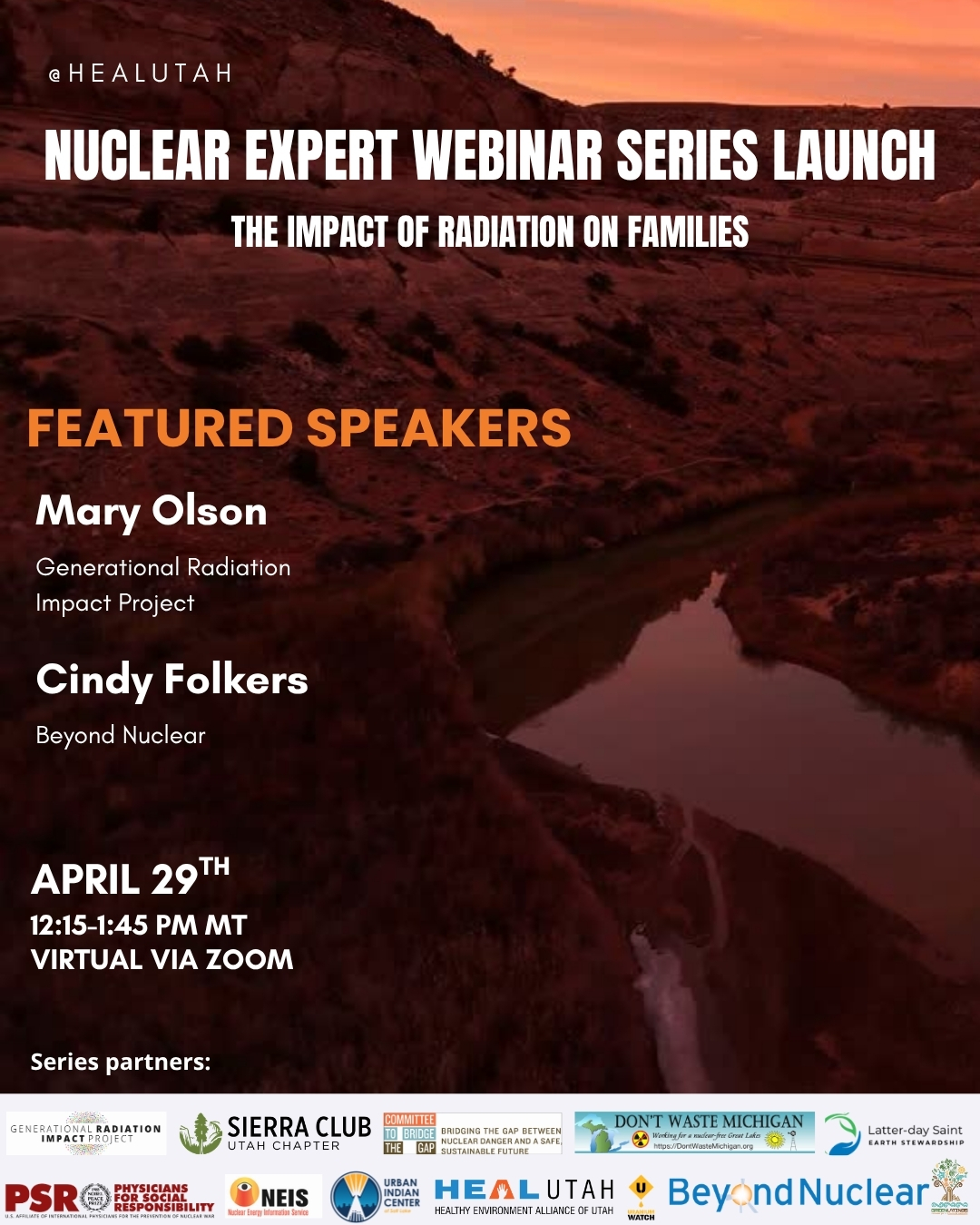
29 April – Nuclear Expert Webinar #1 – Radiation Impacts on Families with Mary Olson and Cindy Folkers
- 12:15 PM MT – 1:45 PM MT
- Location: Virtual – REGISTER TODAY

4 May -West Suburban Peace Coalition to discuss Iran war at May Educational Forum
Monday, May 4, 7:00 – 8:00 PM Central Standard Time
Title: : How Trump’s Narrative Tries to Shape the Reality of the War on Iran.
Contact Walt Zlotow, zlotow@hotmail.com 630 442 3045 for further information
14 May – online event From Bombs to Data Centres: the Face of Nuclear Colonialism

Pine Ridge Uranium is the real threat, not Tehran- Tell Burgum: Stop the Extraction.
Chernobyl: The Lost Tapes – A good documentary on Chernobyl on SBS available On Demand for the next 3 weeks– https://www.sbs.com.au/ondemand/tv-program/chernobyl-the-lost-tapes/2352741955560
To see nuclear-related stories in greater depth and intensity – go to https://nuclearinformation.wordpress.com
-
Archives
- April 2026 (317)
- March 2026 (251)
- February 2026 (268)
- January 2026 (308)
- December 2025 (358)
- November 2025 (359)
- October 2025 (376)
- September 2025 (257)
- August 2025 (319)
- July 2025 (230)
- June 2025 (348)
- May 2025 (261)
-
Categories
- 1
- 1 NUCLEAR ISSUES
- business and costs
- climate change
- culture and arts
- ENERGY
- environment
- health
- history
- indigenous issues
- Legal
- marketing of nuclear
- media
- opposition to nuclear
- PERSONAL STORIES
- politics
- politics international
- Religion and ethics
- safety
- secrets,lies and civil liberties
- spinbuster
- technology
- Uranium
- wastes
- weapons and war
- Women
- 2 WORLD
- ACTION
- AFRICA
- Atrocities
- AUSTRALIA
- Christina's notes
- Christina's themes
- culture and arts
- Events
- Fuk 2022
- Fuk 2023
- Fukushima 2017
- Fukushima 2018
- fukushima 2019
- Fukushima 2020
- Fukushima 2021
- general
- global warming
- Humour (God we need it)
- Nuclear
- RARE EARTHS
- Reference
- resources – print
- Resources -audiovicual
- Weekly Newsletter
- World
- World Nuclear
- YouTube
-
RSS
Entries RSS
Comments RSS
 nuclear-news