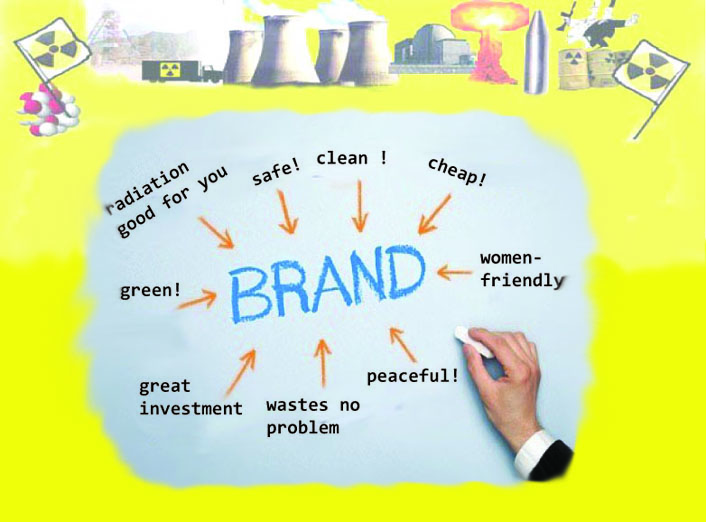
Thought for the day – branding nuclear ”GOOD” for a gullible world.
In science fiction, it’d be hard to believe! But in the real world today – in the midst of a war crists, with nuclear sites threatened, they are rebranding nuclear power as a good idea!!! Come in – suckers !!!
More Evidence That The US Is Trying To Prolong This War- Caitlin Johnstone lays it bare

Tucked all the way down in the eighteenth paragraph of the article, we find a much more interesting revelation: that Washington’s top diplomat has made no attempt to contact his counterpart in Moscow since the war began on the 24th of February.
Caitlin Johnstone, https://caitlinjohnstone.substack.com/p/more-evidence-that-the-us-is-trying?s=r—
26 Mar 22, The Washington Post has a new article out bemoaning the fact that Russian military commanders are declining calls from the Pentagon to discuss their operations in Ukraine (I dunno guys, might have something to do with the fact that the US is sharing extensive military intelligence on exactly those operations directly with the Ukrainian government). Tucked all the way down in the eighteenth paragraph of the article, we find a much more interesting revelation: that Washington’s top diplomat has made no attempt to contact his counterpart in Moscow since the war began on the 24th of February.
“Secretary of State Antony Blinken has not attempted any conversations with his counterpart, Russian Foreign Minister Sergei Lavrov, since the start of the conflict, according to U.S. officials,” The Washington Post reports.
So the US government is continuing its policy of refusing to attempt any high-level diplomatic resolutions to this war despite its public hand-wringing about the horrific violence that’s being inflicted upon the people of Ukraine. This revelation fits nicely with a recent report by Bloomberg’s Niall Ferguson that sources in the US and UK governments have told him the real goal of western powers in this conflict is not to negotiate peace or end the war quickly, but to prolong it in order “bleed Putin” and achieve regime change in Moscow.
Building on an earlier report from The New York Times that the Biden administration “seeks to help Ukraine lock Russia in a quagmire,” Ferguson writes that he has reached the conclusion that “the U.S. intends to keep this war going,” and says he has other sources to corroborate this:
“The only end game now,” a senior administration official was heard to say at a private event earlier this month, “is the end of Putin regime. Until then, all the time Putin stays, [Russia] will be a pariah state that will never be welcomed back into the community of nations. China has made a huge error in thinking Putin will get away with it. Seeing Russia get cut off will not look like a good vector and they’ll have to re-evaluate the Sino-Russia axis. All this is to say that democracy and the West may well look back on this as a pivotal strengthening moment.”
I gather that senior British figures are talking in similar terms. There is a belief that “the U.K.’s No. 1 option is for the conflict to be extended and thereby bleed Putin.” Again and again, I hear such language. It helps explain, among other things, the lack of any diplomatic effort by the U.S. to secure a cease-fire. It also explains the readiness of President Joe Biden to call Putin a war criminal.
Earlier this month when The Intercept’s Ryan Grim was able to get a word in edgewise at a White House press briefing amid the throngs of mass media reporters demanding to know why Biden still hasn’t started World War 3, Press Secretary Jen Psaki gave a very revealing answer.
“So, aside from the request for weapons, President Zelensky has also requested that the US be more involved in negotiations toward a peaceful resolution to the war. What is the U.S. doing to push those negotiations forward?” asked Grim.
“Well, one of the steps we’ve taken — a significant one — is to be the largest provider of military and humanitarian and economic assistance in the world, to put them in a greater position of strength as they go into these negotiations,” Psaki answered, completely dodging the question of whether the US was actually doing anything to help negotiate peace.
As we’ve discussed previously, the US government has a well-documented history of working to draw Moscow into costly military quagmires with the goal of preoccupying its military forces and draining its coffers. Former US officials are on record publicly boasting about having done so in both Afghanistan and Syria. This is an agenda geared toward sapping the Russian government, manufacturing international consent for unprecedented acts of economic warfare designed (though perhaps ineptly) to crush the Russian economy, to foment discord and rebellion, and ultimately to effect regime change in Moscow.
The US empire doesn’t care about Ukrainian lives, and it’s insulting that its operatives continually pretend to. The empire will happily feed every man, woman and child in the entire nation into the mouth of this war if it means unseating a disobedient leader from a nuclear-armed seat of power which has become unacceptably cozy with Beijing and intolerably comfortable with intervening against US imperial agendas. And all the Ukrainian-flag-waving propagandized westerners with their #StandWithUkraine Instagram activism and blue and yellow profile pics will cheer for it every step of the way.
I hope this brutal proxy war ends and peace comes to Ukraine very quickly. But from what we’re seeing today there appears to be an immense globe-spanning power structure holding its foot against the door of the only exit from this horror.
Dozens Of Men Got Sick During A Secret Training Exercise At A Nuclear Site In 1991. They’re Still Fighting For Answers.

Was the soil or water contaminated with any radiation or toxic pollutants? The government’s own documents give conflicting answers.
the captain on duty at the guard post told him that “the water and streams at [the Savannah River Site] were ‘hot,’ which I interpreted to mean contaminated or radioactive
Perhaps more important than detailing what TSD had done so far, Anglen’s evaluation showed what officials had not done before and after the exercise: They had not checked the water or soil for radiation, heavy metals, or other pollutants.
No blood or urine samples were taken, nor were tests for radiation or chemical exposure ordered for the people who reported symptoms in the hours, days, or weeks after the incident.
“I had mucus running from my nose to the ground and was coughing uncontrollably to the point that I nearly threw up.” https://www.buzzfeednews.com/article/zahrahirji/dozens-of-men-got-sick-during-a-secret-training-exercise-at

Zahra Hirji, BuzzFeed News Reporter March 25, 2022 The secret government training exercise started off as planned: Dozens of special agents transporting dangerous nuclear cargo by truck responded to a simulated attack.
Then the coughing began.
After wading neck-deep through a creek in pursuit of the mock attackers, Tim Lamey suddenly got dizzy and started coughing so hard he could barely breathe.
Another agent, Farmer Roberts, ran through the creek in a different location. “I had to stop. I started coughing, really I mean uncontrollably. You know, it was very obvious to me that something wasn’t right,” he told BuzzFeed News.
Nearby, Anthony Gunter crossed a dried-up creek bed and fell into the dust. “It took my breath,” he said. “My lungs got full. My eyes were full.”
The Southern Cross Exercise, held at a South Carolina nuclear facility owned by the Department of Energy, would see at least 28 people report symptoms that included coughing, difficulty breathing, dizziness, headaches, sneezing, nosebleeds, rashes, and vomiting. They fell ill in April 1991, mostly along the Meyers Branch creek stretch of the heavily polluted Savannah River Site. Larger than the five boroughs of New York City, this vast federal facility contains production and processing plants for tritium and plutonium 239, highly radioactive components for nuclear weapons. It was then, and still is, a Superfund site.
The sudden and mysterious illnesses that arose during those fateful training exercises have never before been reported. Neither has the decadeslong search for the truth of what caused the wave of sickness, led by the individuals who fell ill, not the government that was supposed to protect them. As the US launches into a new Cold War complete with Russia brandishing nuclear weapons, this case is a stark reminder of the risks faced by the multitudes of people needed to maintain such a dangerous arsenal.
Continue readingBig ‘doomsday plane’ for the Big Nobs, in the event of nuclear war, arrives in Britain
US ‘Doomsday Plane’ capable of surviving nuclear war arrives in Britain
Boeing aircraft can fly non-stop for six days with equipment designed to withstand electromagnetic blast https://www.thenationalnews.com/world/uk-news/2022/03/25/us-doomsday-plane-capable-of-surviving-nuclear-war-arrives-in-britain/ Thomas Harding. Mar 25, 2022
An aircraft known as the “Doomsday Plane” that is capable of enduring the aftermath of a nuclear detonation has landed in Britain.
The arrival of the US Nightwatch plane from Andrews Air Force Base, Washington, comes amid fears of a nuclear strike by Russia, with its invasion of Ukraine stalled.
The aircraft, call sign GRIM99, is described as the Flying Pentagon and could be used as a centre of operations during a nuclear war.
Capable of flying 150 hours non-stop with the aid of airborne refuelling, the Boeing 747 is officially known as the National Emergency Airborne Operations Centre and is one of four such planes on constant standby.
Much of the aircraft’s equipment is secret, but it is known to carry nuclear and thermal shielding and enough communications for a US defence chief to direct a war.
It is used to transport the US defence secretary during a conflict, providing a back-up to the Pentagon. Its livery paintwork is similar to the US president’s Air Force One.
The four aircraft are based in Nebraska and have been operational since 1980. Each stands six storeys high and has four powerful General Electric engines equipped with huge fuel tanks to avoid the need to land and refuel during a nuclear exchange.
The plane’s flight deck equipment is analogue, so it can withstand jamming or the electromagnetic pulse that follows a nuclear detonation.
The “radome” hump on its back contains 67 different satellite dishes and antennae, giving the defence secretary and his commanders the ability to contact warships, submarines, aircraft and landlines around the world.
A crew of 112 people has the use of three decks, with 18 bunks beds, six bathrooms, a kitchen, conference room, briefing room and an operations centre.
The interior design is basic, with few modern-day comforts and no touch screens, as digital technology would be almost completely disabled during a nuclear exchange. However, the conference centre does have two 80-inch flat screen televisions.
It has a maximum speed of 969kph, can fly at 14,000 metres and has a take-off load of 377,000kg. The aircraft will remain in service until 2039.
Chernobyl nuclear worker gives the inside story on the dire situation for the staff as Russians took over.

Chernobyl nuclear power plant: Worker reveals risk of accident as Russians force staff to do 24-hour shifts i News, By Isabella Bengoechea, March 25, 2022 A Chernobyl worker has given the first inside account after the power plant was seized by Russian forces i News
A Chernobyl worker has given the first inside account of life at the nuclear plant since the Russian invasion and warned that exhausted staff are being forced to work 24-hour shifts, increasing the risk of an accident.
Mykola Pobiedin, foreman of the radioactive waste processing workshop at Chernobyl, who worked as a liquidator there after the 1986 disaster, described a dire safety situation where the plant was encircled by military trucks and tanks and troops patrolled with machine guns.
He compared allowing Chernobyl to be operated by exhausted staff to a bus driver who “has not slept for days” transporting passengers.
Chernobyl, the site of the worst nuclear disaster in history, was captured by Russia on the first day of invasion on 24 February.
More than 200 workers were forced to stay on site. On 20 March, about 100 were allowed to return to their homes, after nearly four weeks working under armed guard.
Personnel at Chernobyl usually work in 12-hour shifts before being replaced by the next shift.
However, because no rotation was permitted, they were forced to work for 24 hours straight with one half hour break.
Mr Pobiedin, who gave permission to be identified, spoke to i by phone from the city of Slavutych, which was built in 1986 to house workers evacuated from the plant after the disaster.
In a separate debrief, he spoke to Valeriy Korshunov, founder of the European Institute of Chernobyl, a Ukraine-based NGO which works to educate the public about the Chernobyl disaster through scientific and cultural projects, in order to prevent new nuclear disasters in future.
Mr Korshunov and his organisation hope to publicise the plight of the Chernobyl workers to draw attention to the dangerous situation Russia has inflicted on Ukraine’s nuclear sites.
He passed on his comments to i, with the permission of Mr Pobiedin and his family.
Mr Pobiedin suggested there was an increased risk of accidents as a result of the extreme fatigue of staff working at such a sensitive site.
“There may be some errors, some actions are not undertaken,” he said. “A tired person would do a mistake and it will cause issues.”
Though reluctant to cause alarm about a possible nuclear accident at Chernobyl, he added: “If you are riding a bus in which the driver has not slept for days. What could it lead to? If Europe agrees to drive with such a bus driver, then let it be…”
“There is a break for half an hour, for example to eat or for private needs, and the rest of the time people are concentrated on watching monitors. This is intellectual work; you cannot be distracted.”
Despite having managed to leave the power plant, his memories of Russia’s attack on the first day of the invasion are still stark.
“Everything started with the ‘Everyone to the bomb shelter’ alarm, which we followed,” he said.
“Then this whole situation got clear – it was a seizure.
“Then came the command ‘Everyone to the workplace!’ Well, then we started organising our life there somehow, adapting to the situation.
“The Russian military did not enter the territory of the power unit. They drove around the industrial site in their armored personnel carriers. In this way they controlled the whole situation.
“In other words, everything around us was encircled…………………………
the staff managed to keep up their spirits by attempting to carry on as normal and listening to the Ukrainian national anthem on the radio…………………………….
Since the release of the staff, only about 50 have opted to replace them – a perhaps understandable reluctance considering they would be going as hostages with no idea of when they could leave.
“I saw they arrived with backpacks,” said Mr Pobiedin. “They probably took something, but how long will it last?”
He called for the regular rotation of sufficient personnel to ensure the safety of the nuclear facilities: “The rotation is very important. We can’t let people just be there indefinitely.
“Some personnel change should be done. The Russians are not opposing to such shift changes. It should be scheduled: once a week, once every 10 days … So that people know and get prepared.
“And not so that people come and do not know how long they must stay. One does not know if it is one day, 20 days or for ever.”
While the freed workers may have breathed a sigh of relief at finally leaving, they may not have escaped the worst of their ordeals.
Many live in Slavuytsch, about 40km from Chernobyl. However the city is under intense shelling by the Russians.
Others who live in other nearby settlements are currently trapped in the city and cannot return home. When i was speaking to Mr Pobiedin, our interview was cut off halfway through after sirens went off and he had to go down into a bomb shelter. https://inews.co.uk/news/inside-chernobyl-nuclear-power-plant-accident-risk-1540986
World’s biggest bunker where billionaires could survive in luxury for 10 years
World’s biggest nuclear bunker where billionaires could survive in luxury for 10 years
The Oppidum is the world’s largest nuclear bunker and is located in a secret location in the Czech Republic where its billionaire owners could live out nuclear armageddon By John James. , 25 MAR 2022
The World’s richest people plan to sit out a nuclear apocalypse in the world’s largest luxury bomb shelter which lies in a secret location in the Czech republic.
Since Russia invaded Ukraine last month, interest in nuclear shelters has skyrocketed spurred on in part by Vladimir Putin’s reckless rhetoric, but the elites of the world have been planning for years.
The Oppidum (which is a fantastically ominous name for a bunker in anyone’s book) is located in a quaint valley in the Czech Republic surrounded by high walls that ensure it can’t be identified by the irradiated masses.
The massive 323,000 square foot structure extends well into the ground and is kitted out with all the luxury items you’d expect including a swimming pool, wine cellar and helipad.
The whole building is fitted with a network of secret tunnels leading to the cavernous vaults beneath the above-ground building so when a bomb hits you can be safely hidden fast.
It was first built during the height of the Cold War as part of combined efforts from the governments of the Soviet Union and what was Czechoslovakia.
Its location is than two hours from both London and Moscow by private jet providing easy access for those in the world’s centre of power – even if they might not see eye to eye when they get there.
The bunker is also self-sufficient and is claimed that residents could survive there for as long as ten years.
…………… While residents stay in the shelter, they are constantly guarded by security who it is claimed have a constant link to the outside world through the Oppidum control centre.
The reality of life after nuclear fallout is that you’re going to be spending a lot of time underground starved of natural light, but the paranoid architects have even thought of this.
A state of the art subterranean garden is included in the bunker which is lit up by simulated natural light.
Biden keeping up the big spend on nuclear weapons

Biden steers away from big change to US nuclear weapons policy
Washington’s ‘posture review’ maintains deliberate ambiguity over when arms might be used, Ft.com Demetri Sevastopulo in Alice Springd\s 25 Mar 22,
President Joe Biden has decided against making a major change to US nuclear weapons policy following pressure from European and Asian allies not to undermine their security amid the nuclear threat from Russia and China.
After a months-long review that had sparked anxiety from France to Japan, Biden this week decided on a declaratory policy that the “fundamental purpose” of nuclear weapons was to deter, or respond to, a nuclear attack on the US or its allies, according to three people familiar with the decision.
US allies last year expressed concern following speculation that Biden might declare that the “sole purpose” of nuclear weapons was to prevent or respond to a nuclear attack. They said such a change — which Biden supported before becoming president — would weaken the extended deterrence that the US provides to allies around the world with its nuclear umbrella. Critics also argued the potential shift would embolden Russia.
Please use the sharing tools found via the share button at the top or side of articles. Copying articles to share with others is a breach of FT.com T&Cs and Copyright Policy. Email licensing@ft.com to buy additional rights. Subscribers may share up to 10 or 20 articles per month using the gift article service. More information can be found here.
https://www.ft.com/content/4c72b45d-37ac-431f-838c-cf8704cad6c3
One senior US official said the allies’ views played a big role in influencing Biden. She said the president had strong views on nuclear risk reduction and might have been considering a larger change in declaratory policy but that he received a lot of input from allied capitals that resulted in the outcome, which was also influenced by the threat from Moscow and growing concerns about China’s expanding nuclear arsenal.
The outcome will be outlined in the administration’s “Nuclear Posture Review”, which is designed to determine what kind of nuclear weapons the US should have and provide guidance about scenarios for possible use.
The NPR will also say that the US would only use nuclear weapons in “extreme circumstances” — echoing language that was included in nuclear reviews conducted by both the Obama and Trump administrations. But the Trump administration arguably lowered the threshold for possible use by saying that “extreme circumstances” could include a non-nuclear attack.
…………………………………………………….US policy on the situations under which nuclear weapons would be used has been intentionally vague for decades to keep adversaries guessing. The US official said the NPR would contain a level of strategic ambiguity.
Arms control advocates wanted Biden to shift to a “no first use” policy or “sole purpose” formulation that they argued would reduce the risk of nuclear war. But critics countered that providing more clarity about when the US would use nuclear weapons would just embolden adversaries.
Jeffrey Lewis, a nuclear weapons expert at Middlebury Institute of International Studies, said Biden had largely kept existing nuclear posture intact. He said the Obama and Trump administrations had used language about the “fundamental role” of nuclear weapons in their posture reviews.
“If this is the biggest change in the Nuclear Posture Review, I want my tax money back,” Lewis said. “The phrase reflects a longstanding, bipartisan tradition of trying to have it both ways. US officials want to give the impression that our nuclear weapons are for deterrence while also holding open the option of using them first ……………………….
https://www.ft.com/content/4c72b45d-37ac-431f-838c-cf8704cad6c3
So far, Zaporizhzhya’s nuclear reactors are being managed safely under Russian control

As Russian military forces shelled the Zaporizhzhya Nuclear Power Plant
(ZNPP) in southern Ukraine on March 4, 2022, a fire broke out on the site.
Among the six reactor units at the complex, auxiliary buildings attached to
the Zaporizhzhya Unit 1 reactor were damaged. Fortunately, the damage did
not threaten the safety of the unit. And a recent assessment by the
International Atomic Energy Agency indicates that, although management of
the plant by a Russian military commander is less than ideal, “regular
staff have continued to operate the Zaporizhzhya [nuclear power plant]”
and “at least 11 representatives of the Russian state [nuclear power]
company Rosatom were also present there, without interfering with the
operation of the nuclear facilities.”
Even so, Russia’s military
attacks on the Zaporizhzhya plant raise great concerns about the
possibility of nuclear accidents. Some experts have suggested the attack on
Zaporizhzhya could have caused a huge catastrophe; others were much more
conservative in their estimates of possible radiation releases from such an
attack. To illustrate the potential damage from a military attack on a
nuclear power plant, we simulated and analyzed hypothetical releases from a
core meltdown and spent fuel pool fire at one unit, Zaporizhzhya 1, if an
attack by missiles or artillery had disabled cooling systems there.
Bulletin of Atomic Scientists 23rd March 2022
Could an attack on Ukrainian nuclear facilities cause a disaster greater than Chernobyl? Possibly, simulations show.
UK does NOT need more nuclear power. Electricity demand has fallen
| Andrew Warren: In seeking justification for “rigging” the UK electricity market in favour of more nuclear power, It is beingcategorically argued that electricity demand is expected to rise over the next decade (“Johnson in ‘gung ho’ push for more nuclear power as energy crisis bites”, Report, March 21). Strangely enough, that was precisely the reason given back in 2006, when the then Labour government first committed to a “family” of further nuclear power stations. Based on the official forecasts issued in 2006, we should by now be consuming at least 15 per cent more electricity than we were then. But we are not. Right now, UK electricity consumption has in fact gone down by over 15 per cent since 2006. In other words, all that expectation of demand growth which was used to justify new nuclear power stations was grossly exaggerated, in practice by over 30 per cent. In the interim, no new nuclear power stations have been added to the system. The system hasn’t collapsed, and it’s also far less carbon intensive. Surely, we aren’t getting fooled again by the same spurious rhetoric about endless consumption growth? In that immortal phrase of the 1970s: “Save it. You know it makes sense”. FT 24th March 2022https://www.ft.com/content/41942796-1da4-469a-af7c-a331673ae494 |
The work of Ukraine-based European Institute of Chernobyl.
Chernobyl nuclear power plant: Worker reveals risk of accident as Russians force staff to do 24-hour shifts , i News, By Isabella Bengoechea March 25, 2022
”………………………………………………i has been working with the European Institute of Chernobyl, a Ukraine-based NGO that focuses on research, popularisation and dissemination of information about the Chernobyl disaster through scientific, educational, social and cultural projects and initiatives, with the aim of preventing new nuclear catastrophes happening in future.
The public organisation, which began its work in 2017, also focuses on protecting the rights and interests of participants in the liquidation of the fallout of the Chernobyl accident, as well as citizens affected by the disaster.
Last April, the group launched an information campaign and programme of events to commemorate the 35th anniversary of the disaster. Partnered with the National Museum of Chernobyl, the International Atomic Energy Agency (IAEA), groups representing liquidators and former Pripyat [abandoned town nearest to the Chernobyl plant] residents, as well as music and art projects.
Valeriy Korshunov, the founder of the Institute, has criticised the International Atomic Energy Agency for what he sees as an insufficiently robust response to Russia’s aggressive actions against Ukraine’s nuclear power plants.
“At the time of the Chernobyl accident there was silence from the Russians, from the Soviet government, they were trying to hide the situation. So in every project about Chernobyl, we’re saying we need to learn the lessons of Chernobyl.
It founded a project in the past year called Help Chernobyl, organising legal benefits, subsidies and medical operations to help the liquidators of the Chernobyl disaster during the Covid-19 pandemic.
Last April, the group launched an information campaign and programme of events to commemorate the 35th anniversary of the disaster. Partnered with the National Museum of Chernobyl, the International Atomic Energy Agency (IAEA), groups representing liquidators and former Pripyat [abandoned town nearest to the Chernobyl plant] residents, as well as music and art projects.
Valeriy Korshunov, the founder of the Institute, has criticised the International Atomic Energy Agency for what he sees as an insufficiently robust response to Russia’s aggressive actions against Ukraine’s nuclear power plants.
“At the time of the Chernobyl accident there was silence from the Russians, from the Soviet government, they were trying to hide the situation. So in every project about Chernobyl, we’re saying we need to learn the lessons of Chernobyl.
“But now we know we haven’t learnt it first time, because we’re seeing similar things now. And Russia and Rosatom are tyring to hide what happened at Chernobyl, what happened at Zaporizhzhya which was shelled and captured by Russia this month.”
“The IAEA must do a lot more in this situation. The shelling of the Zaporizhzhya nuclear power plant is an act of nuclear terrorism. The IAEA need to do something about this but they are silent.”
The State Nuclear Regulatory Inspectorate of Ukraine said this week: “Right now the enemy is trying to seize the Slavutych city and is conducting shelling of the checkpoints. Personnel working at the Chernobyl NPP facilities, as well as at facilities and enterprises located in the Exclusion Zone live in Slavutych.
“The current situation endangers the lives and health of Chernobyl NPP employees and their families, creates significant psychological and moral pressure on operational personnel ensuring nuclear and radiation safety of the Chernobyl NPP facilities, and makes it impossible to ensure the personnel rotation.”
It added: “The information received from the Chornobyl NPP indicates that the operational personnel maintain the safety parameters of the facilities at the NPP site within the standard values. At the same time, the Russian military continue to grossly violate the radiation safety requirements and strict access control procedures at the NPP and in the Exclusion Zone, which leads to deterioration of the radiation situation at the site. https://inews.co.uk/news/inside-chernobyl-nuclear-power-plant-accident-risk-1540986
In UK, some welcome news, in Government support for energy saving

Welcome green tax cuts struggled to counter the sense of a Chancellor that
does not fully understand the scale of the interlocking environmental, cost
of living, and security crises the UK is facing. First, the good news,
because we could certainly do with some. Chancellor Rishi Sunak’s decision
to make the scrapping of VAT on energy-saving materials one of the central
planks of his Spring Statement is hugely welcome news. The fact
energy-saving materials has been defined to include clean technologies such
as solar panels and heat pumps, as well as insulation is similarly welcome.
And the decision to extend this tax cut for at least five years, giving
installers and manufacturers a clear signal that demand is likely to soar
and they should rapidly scale up capacity accordingly, is arguably most
welcome news of all. In addition, the doubling of the support fund for
Local Authorities to £1bn to help households in fuel poverty is also
undoubtedly welcome, even if it smacks a little of providing two buckets,
rather than one, to help tackle a forest fire. There was no grand vision
for driving sustainable growth, insulating the UK from surging global
fossil fuel prices, or helping people manage the transition to a net zero
emission economy. There was little sense of the UK’s place in an
increasingly dangerous world and how it could become a trailblazer for the
shift away from hydrocarbons that can help defang petrostate autocracies.
Most surprisingly of all, there was far too little to help the millions of
households that through no fault of their own are facing the looming shadow
of genuine poverty. It was, just like Sunak’s eve of COP26 Budget, a
significant opportunity missed.
Business Green 23rd March 2022
https://www.businessgreen.com/blog-post/4047134/spring-statement-bad-deeply-worrying
 | ReplyForward |
Welcome green tax cuts struggled to counter the sense of a Chancellor that
does not fully understand the scale of the interlocking environmental, cost
of living, and security crises the UK is facing.
First, the good news,
because we could certainly do with some. Chancellor Rishi Sunak’s decision
to make the scrapping of VAT on energy-saving materials one of the central
planks of his Spring Statement is hugely welcome news.
The fact energy-saving materials has been defined to include clean technologies such
as solar panels and heat pumps, as well as insulation is similarly welcome.
And the decision to extend this tax cut for at least five years, giving
installers and manufacturers a clear signal that demand is likely to soar
and they should rapidly scale up capacity accordingly, is arguably most
welcome news of all.
In addition, the doubling of the support fund for
Local Authorities to £1bn to help households in fuel poverty is also
undoubtedly welcome, even if it smacks a little of providing two buckets,
rather than one, to help tackle a forest fire.
There was no grand vision
for driving sustainable growth, insulating the UK from surging global
fossil fuel prices, or helping people manage the transition to a net zero
emission economy. There was little sense of the UK’s place in an
increasingly dangerous world and how it could become a trailblazer for the
shift away from hydrocarbons that can help defang petrostate autocracies.
Most surprisingly of all, there was far too little to help the millions of
households that through no fault of their own are facing the looming shadow
of genuine poverty. It was, just like Sunak’s eve of COP26 Budget, a
significant opportunity missed.
Business Green 23rd March 2022
https://www.businessgreen.com/blog-post/4047134/spring-statement-bad-deeply-worrying
IAEA concerned that Russia is shelling Ukrainian checkpoints in the city of Slavutych, near Chernobyl
 IAEA concerened that Russia IAEA concerened that Russia |
Ukraine informed the International Atomic Energy Agency (IAEA) today that
Russian forces were shelling Ukrainian checkpoints in the city of Slavutych
where many people working at the nearby Chornobyl Nuclear Power Plant (NPP)
live, putting them at risk and preventing further rotation of personnel to
and from the site, Director General Rafael Mariano Grossi said.
Ukraine’s regulatory authority said the shelling was endangering “the homes and
families of those operational personnel that ensure the nuclear and
radiation safety” of the Chornobyl NPP, which is under the control of
Russian forces since 24 February.
Slavutych is located outside the
Exclusion Zone that was established around the NPP after the 1986 accident.
Director General Grossi expressed concern about this development, which
comes just a few days after technical staff at the Chornobyl NPP were
finally able to rotate and go to their homes in Slavutych and rest after
working for nearly four weeks without a change of shift, and he said the
IAEA would continue to closely monitor the situation. Staff now working at
the site also come from Slavutych.
IAEA 24th March 2022
London. Anti-nuclear campaigners have won a victory for free expression
ANTI-NUCLEAR campaigners have won a victory for free expression after
forcing Transport for London (TfL) to back down from refusing to consider a
peace advert on the network.
TfL initially refused an application from the
Campaign for Nuclear Disarmament (CND) for advertising space across the
capital but has been forced to reconsider following a threat of legal
action by the Public Interest Law Centre.
The application, originally
submitted in 2021, is for an advert showing a nuclear weapon broken in two
by CND’s famous peace symbol. It asks: “Why are we getting more nuclear
weapons when we could be investing in healthcare, renewable energy,
education?”
TfL had ruled the advert could not be carried because it
“promotes a party political cause or electioneering.” Acting for CND,
the law centre argued that the advertisement was not party political and
that TFL’s refusal to carry it was potentially in breach of the right to
free expression under Article 10 of the European Convention on Human
Rights. TfL has acknowledged that the original decision was incorrect, that
the advert was not party political, and have invited CND to resubmit the
advert for consideration.
Morning Star 24th March 2022
https://morningstaronline.co.uk/article/b/anti-nuclear-campaigners-win-victory-for-free-expression
International Atomic Energy Agency’s grave concern over safety of Ukraine’s nuclear reactors
| The International Atomic Energy Agency’s (IAEA’s) Director General Rafael Mariano Grossi has said “we cannot afford to lose any more time” in concluding an agreed framework for ensuring nuclear safety and security in Ukraine. Grossi, who expressed “grave concern” about the situation, has been seeking to secure an agreement with the two sides since meeting the foreign ministers of Russia and Ukraine two weeks ago in Turkey. He said the IAEA “is ready and able to deploy immediately and provide indispensable assistance for ensuring nuclear safety and security in Ukraine”. World Nuclear News 24th March 2022 https://www.world-nuclear-news.org/Articles/IAEA-ready-to-deploy-to-Ukraine-immediately |
Saskatchewn ponders new small nuclear reactors, but opposition unsure about safety and environmental impacts
‘Will be changed very shortly’: Premier confident nuclear energy generation will be coming to Sask. Wayne Mantyka, CTV News Regina Video Journalist, 25 Mar 22, ”………………………….. In 2019, Saskatchewan signed an agreement with Ontario and New Brunswick toward evaluation of new SMR technology. On Monday, SaskPower will announce the next steps in the decision making process and will also now assess reactors on the market and consider possible locations.
The opposition NDP would like to see more public discussions before any final decisions are made.“We’ve been clear about where we’re at on the opportunity and the challenges that SMRs may provide in Saskatchewan,” NDP MLA Aleana Young said. “Of course energy security is of massive concern to everyone in Saskatchewan as is the condition of our grid and the necessity for clean base load power, but there are going to be a huge number of people in the province who have questions and who have concerns.”
“We’re not like Ontario. We don’t have existing nuclear power facilities and this needs to be a real conversation with people in Saskatchewan, not just about the business case and dollars and cents but about the environment and all of the implications for our communities,” Young added.
SaskPower has not made a decision about generating nuclear energy. If the idea wins public support and proves feasible, a small modular reactor could be operating in the province as early as 2030………………. https://regina.ctvnews.ca/will-be-changed-very-shortly-premier-confident-nuclear-energy-generation-will-be-coming-to-sask-1.5833828
1 This Month
Chernobyl: The Lost Tapes – A good documentary on Chernobyl on SBS available On Demand for the next 3 weeks– https://www.sbs.com.au/ondemand/tv-program/chernobyl-the-lost-tapes/2352741955560

of the week–London Campaign for Nuclear Disarmament

Tell the Ukrainian Government to Drop Prosecution of Peace Activist Yurii Sheliazhenko
To see nuclear-related stories in greater depth and intensity – go to https://nuclearinformation.wordpress.com
-
Archives
- April 2026 (139)
- March 2026 (251)
- February 2026 (268)
- January 2026 (308)
- December 2025 (358)
- November 2025 (359)
- October 2025 (376)
- September 2025 (257)
- August 2025 (319)
- July 2025 (230)
- June 2025 (348)
- May 2025 (261)
-
Categories
- 1
- 1 NUCLEAR ISSUES
- business and costs
- climate change
- culture and arts
- ENERGY
- environment
- health
- history
- indigenous issues
- Legal
- marketing of nuclear
- media
- opposition to nuclear
- PERSONAL STORIES
- politics
- politics international
- Religion and ethics
- safety
- secrets,lies and civil liberties
- spinbuster
- technology
- Uranium
- wastes
- weapons and war
- Women
- 2 WORLD
- ACTION
- AFRICA
- Atrocities
- AUSTRALIA
- Christina's notes
- Christina's themes
- culture and arts
- Events
- Fuk 2022
- Fuk 2023
- Fukushima 2017
- Fukushima 2018
- fukushima 2019
- Fukushima 2020
- Fukushima 2021
- general
- global warming
- Humour (God we need it)
- Nuclear
- RARE EARTHS
- Reference
- resources – print
- Resources -audiovicual
- Weekly Newsletter
- World
- World Nuclear
- YouTube
-
RSS
Entries RSS
Comments RSS
 nuclear-news