PM Kishida rules out Japan’s possession of nuclear weapons
PM Kishida rules out Japan’s possession of nuclear weapons
February 25, 2022 (Mainichi Japan) TOKYO — Prime Minister Fumio Kishida has ruled out the possibility of Japan possessing nuclear weapons as part of the “capacity to strike enemy bases” that his government is seeking to acquire.
At a House of Councillors Budget Committee session on Feb. 24, Kishida said, “The three non-nuclear principles (of not possessing, not producing and not permitting the introduction of nuclear weapons) are our national policy. There are no options of using or possessing nuclear arms.”…………………….. https://mainichi.jp/english/articles/20220225/p2a/00m/0na/018000c
Abandoned mines and old Yunkom nuclear test site in Donbas region of Ukraine pose ”singular threat” of radiation contamination
Abandoned mines in eastern Ukraine are filling up with water at
“alarming” rates, according to new research that has triggered fears of
a radioactive disaster. Satellite images show high levels of swelling in
the ground in the former coal mining region of Donbas, much of which is now
controlled by pro-Russian separatists.
The images have raised concerns
about water contaminated with heavy metals or radioactive material spilling
into rivers and the wider environment. Of particular concern is the high
swelling at the Yunkom mine, which was the site of a small Soviet
underground nuclear test in 1979.
The Organisation for Security and
Co-operation in Europe, the intergovernmental organisation, warned in 2017
that the mine posed a “singular threat”. “Any present destabilisation
of the mine via flooding could release up to 500 cubic metres of
radiation-contaminated mine waters into the ground-water table,” it said.
Telegraph 24th Feb 2022
Warning on faults in EPR nuclear reactors – Commission de Recherche et d’Information Indépendantes sur la Radioactivité
| French nuclear giants are heavily involved in the EPR in Taishan, China: Framatome in terms of design, construction and fuel supply, EDF in terms of operations with its participation (30%) in TNPJVC. Furthermore, the feedback from first years of operation of Taishan 1 and 2 is obviously essential for the safety of other EPRs. EDF must therefore monitor incidents affecting these facilities very closely. In June 2021, the national and international press widely reported on the affair of the problems of ruptures of nuclear fuel cladding for the Taishan 1 EPR reactor in China. This 1,750 MWe reactor of power is the first EPR to be put into commercial service in the world (in December 2018). Degradation of nuclear fuel led its operator, TNPJVC, to a shutdown “anticipated”, on July 30, 2021, i.e. around 6 months ahead of the initial duration of the cycle. Anticipation was quite relative because the sheath rupture problems had in fact been identified as early as October 2020 and the reactor should have been shut down well before July, in order to limit the radiological risks for workers and residents. The CRIIRAD had alerted on this subject in a press release1 published on June 14 2021. Several causes can be at the origin of these ruptures of sheaths. Without being exhaustive, some may implicate design flaws in the reactor, others manufacturing flaws, other more faults involving the operation and/or maintenance of the Taishan 1 reactor. Some could turn out to be generic and also concern the other EPR reactors under construction. CRIIRAD 22nd Feb 2022 http://criirad.org/Surete-nucleaire/220222_Courrier_CRIIRAD_EDF_Flamanville_EPR.pdf |
Drone and missile attacks on UAE’s Barakah nuclear plant
The United Arab Emirates’ only nuclear power plant is “well protected”
against security threats, the regulator said on Wednesday, following a
series of unprecedented drone and missile attacks on the Gulf state.
Yemen’s Iran-aligned Houthis said in 2017 they fired a cruise missile
towards the Barakah plant, a report which the UAE denied. The group has
repeatedly threatened to target critical infrastructure in the UAE.
Reuters 23rd Feb 2022
France’s nuclear company EDF fined a measly 300 million euros for its decades of deception and misuse of its position
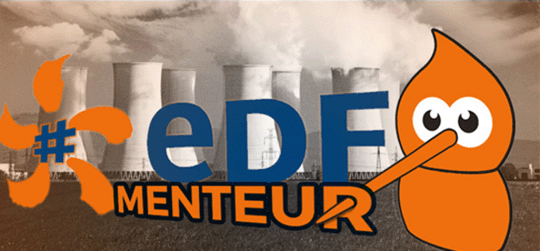
The French Competition Authority imposes a fine of 300 million euros on
EDF. The organization accuses the French company of abuse of a dominant
position and illegal collection of its customers’ data.
No less than seventeen years of anti-competitive practice. EDF was fined 300 million
euros by the Competition Authority for having misused its position as a
historical player in electricity since the opening of the market to
competition for companies in 2004, until 2021. The company does not
dispute the facts and has benefited from a negotiated procedure allowing
it to reduce the pain.
According to the law, a fine for this type of
practice could have cost it up to 10% of its annual worldwide turnover,
that is to say 7.6 billion, specifies in its decision the Authority of the
competition.
Le Figaro 22nd Feb 2022
Limitless power arriving too late: Why fusion won’t help us decarbonise — RenewEconomy

A limitless, clean source of baseload power might be within reach – without the nuclear waste of traditional fission nuclear plants. That’s good, right? Not quite. The post Limitless power arriving too late: Why fusion won’t help us decarbonise appeared first on RenewEconomy.
Limitless power arriving too late: Why fusion won’t help us decarbonise — RenewEconomy
| I first heard the standard joke about fusion as an undergraduate physics student in the 1960s: Fusion power is 50 years away – and probably always will be. More than 50 years later, we still don’t have fusion. That’s because of the huge experimental challenges in recreating a miniature sun on earth. Still, real progress is being made. This month, UK fusion researchers managed to double previous records of producing energy. Last year, American scientists came close to ignition, the tantalising moment where fusion puts more energy out than it needs to start the reaction. And small, fast-moving fusion startups are making progress using different techniques. A limitless, clean source of baseload power might be within reach – without the nuclear waste of traditional fission nuclear plants. That’s good, right? Not quite. While we’re closer than ever to making commercial fusion viable, this new power source simply won’t get here in time to do the heavy lifting of decarbonisation. We are racing the clock to limit damage from climate change. Luckily, we already have the technologies we need to decarbonise. On the megaproject front, the next step is the International Thermonuclear Experimental Reactor (ITER) being built in southern France. Far too big for any one country, this is a joint effort by countries including USA, Russia, China, the UK and EU member countries. The project is enormous, with a vessel ten times the size of the UK reactor and around 5,000 technical experts, scientists and engineers working on it. Famously, the project’s largest magnet is strong enough to lift an aircraft carrier. Even this enormous project is only expected to produce slightly more power than it uses – around 500 megawatts. The first experiments are expected by 2025. To me, this illustrates how far away commercial fusion really is. Renew Economy 25th Feb 2022https://reneweconomy.com.au/limitless-power-arriving-too-late-why-fusion-wont-help-us-decarbonise/ |
February 25 Energy News — geoharvey

Opinion: ¶ “Red-State Voters Want Clean Energy Too. Just Ask Nebraska” • Nebraska turned more than a few heads recently when its public officials adopted net-zero carbon goals for electricity. Renewable energy enjoys support among voters regardless of their politics. While Democrats may be motivated by the climate, Republicans see economic benefits. [CleanTechnica] Nebraska (Taylor […]
February 25 Energy News — geoharvey
1 This Month

10 March A LIVE WEBINAR THE REAL EFFECTS OF NUCLEAR POWER
What the Industry Isn’t Telling Us
1:00 PM Mountain, 2 pm Central, 3 pm Eastern. Live on the Keepers of the Water Facebook page

18 March Webinar @ 1 PM EST: An Assessment of SMR Projects: The Case of Canada
register for the zoom:
https://us02web.zoom.us/webinar/register/WN_o8BIIOUvQ2ONJR1nta65DQ#/registration


of the week – STOP SMALL MODULAR REACTORS IN CANADA
To see nuclear-related stories in greater depth and intensity – go to https://nuclearinformation.wordpress.com
-
Archives
- March 2026 (18)
- February 2026 (268)
- January 2026 (308)
- December 2025 (358)
- November 2025 (359)
- October 2025 (376)
- September 2025 (258)
- August 2025 (319)
- July 2025 (230)
- June 2025 (348)
- May 2025 (261)
- April 2025 (305)
-
Categories
- 1
- 1 NUCLEAR ISSUES
- business and costs
- climate change
- culture and arts
- ENERGY
- environment
- health
- history
- indigenous issues
- Legal
- marketing of nuclear
- media
- opposition to nuclear
- PERSONAL STORIES
- politics
- politics international
- Religion and ethics
- safety
- secrets,lies and civil liberties
- spinbuster
- technology
- Uranium
- wastes
- weapons and war
- Women
- 2 WORLD
- ACTION
- AFRICA
- Atrocities
- AUSTRALIA
- Christina's notes
- Christina's themes
- culture and arts
- Events
- Fuk 2022
- Fuk 2023
- Fukushima 2017
- Fukushima 2018
- fukushima 2019
- Fukushima 2020
- Fukushima 2021
- general
- global warming
- Humour (God we need it)
- Nuclear
- RARE EARTHS
- Reference
- resources – print
- Resources -audiovicual
- Weekly Newsletter
- World
- World Nuclear
- YouTube
-
RSS
Entries RSS
Comments RSS
 nuclear-news