Nuclear weapons plutonium pits development planned for Los Alamos National Laboratory, but there’s strong opposition on safety grounds.
 | |||
Nuclear weapons development coming soon to Los Alamos National Laboratory amid safety concerns https://www.currentargus.com/story/news/local/2022/01/29/los-alamos-national-lab-prepares-nuclear-weapons-development/6562490001/, Adrian Hedden, Carlsbad Current-Argus
A main component of nuclear weapons was poised to be built in New Mexico after federal regulators granted approval for a plan to prepare Los Alamos National Laboratory (LANL) for the work.
The National Nuclear Security Administration (NNSA), an arm of the U.S. Department of Energy, announced earlier this month it approved LANL’s project to prepare areas of the lab to be used in plutonium pit production – a project known as LAP4.
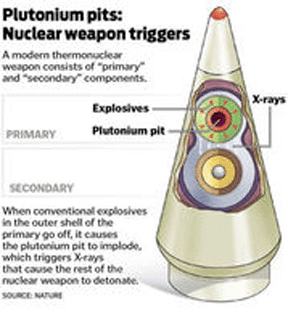
Plutonium pits are hollow spheres of plutonium that when compressed using explosives cause a nuclear detonation, per a DOE report.
The pits were first used in the 1940s during the Manhattan Project, the report read, used to detonate atomic bombs tested at the Trinity Site in south-central New Mexico and then in the bomb dropped on Nagasaki in Japan – largely credited with ending World War II.
Since the war ended, Los Alamos’ pit production was limited to research purposes, and from 2007 to 2011 the lab produced pits to replace those in 31 warheads carried on U.S. military submarines.
Between 1952 and 1989, most of the plutonium pits in the U.S. were generated at the Rocky Flats Plant near Denver amid the Cold War with a peak nuclear stockpile of 31,225 weapons outfitted with the pits reported in 1967, read the report.
Rocky Flats was shut down in 1989, and after concerns that the pits produced since the 1980s or earlier would begin to deteriorate over time, Los Alamos was called to make new ones.
The DOE called on Los Alamos to increase efforts at the lab to produce 30 pits a year by 2026, and the Savannah River Site in South Carolina was tasked with producing 50 pits annually by 2030.
That means that by that year, the U.S. would be producing 80 pits per year.
But to prepare LANL for the work, a project to remove existing equipment and glove boxes was needed to make way for pit manufacturing equipment.
That work was intended to begin this spring via a project known as the Decontamination and Decommissioning Subproject, the first of five operations to get the site ready.
equipment and infrastructure needed to safely manufacture pits for the nuclear stockpile,” said Summer Jones, NNSA assistant deputy administrator for production modernization at LANL.
“LAP4 is a complex, challenging endeavor, and getting the approval to begin the D&D subproject is a big step toward restoring this important capability.”
Opponents call for environmental review of plutonium operations
The effort to resume producing plutonium pits and thus nuclear weapons at the New Mexico lab and in South Carolina as met with controversy from government officials and watchdog groups in both states opposing the projects.
Santa Fe City Councilors passed a resolution last year calling for a “site-wide” environmental impact statement to be conducted and any safety issued be resolved and certified by the federal government before pit production was increased.
“The Governing Body (Santa Fe City Council) requests that the National Nuclear Security Administration suspend any planned expanded plutonium pit production until all nuclear safety issues are resolved, as certified by the independent Defense Nuclear Facilities Safety Board,” read the resolution.
Nuclear Watch New Mexico and Savannah River Site Watch subsequently in June 2021 filed a lawsuit in U.S. District Court for the District of South Carolina’s Aiken Division against the DOE and NNSA, arguing pit production should not be increased until site-wide environmental analysis were conducted at both facilities.
“The drastic expansion of plutonium pit production and the utilization of more than one facility to undertake this production are substantial changes from the Defendants’ long-standing approach of producing a limited number of pits at only one facility,” the suit read.
The suit argued the increased pit production was not only intended for replacing existing warheads but to develop a new warhead known as the W87-1.
This project was developed with proper environmental analysis, the suit read, or proper planning for where associated nuclear waste would be disposed of.
“The drastic expansion of plutonium pit production and the utilization of more than one facility to undertake this production are substantial changes from the Defendants’ long-standing approach of producing a limited number of pits at only one facility,” read the suit.
In southeastern New Mexico is the Waste Isolation Pilot Plant (WIPP), a repository for low-level transuranic (TRU) nuclear waste – clothing materials and equipment irradiated during nuclear activities.
But the litigants argued WIPP was already at limited capacity and its current permit with the New Mexico Environment Department (NMED) specified the repository would have to cease waste disposal by 2024 and begin the decommissioning process.
The DOE last year submitted a permit renewal application to NMED that removed the 2024 closure date, leaving WIPP’s lifetime largely open ended.
Still, the suit alleged the DOE failed to address the need for waste disposal.
“As a National Academy of Sciences has concluded, the WIPP is already oversubscribed for future waste from multiple sites and will overextend its capacity from this increase in TRU production from the pit project and other DOE projects set to generate large amounts of TRU waste,” read the suit.
“The Defendants have failed to meaningfully address this critical waste disposal question.”
No comments yet.
1 This Month



Tell the Ukrainian Government to Drop Prosecution of Peace Activist Yurii Sheliazhenko

Petition to revoke the licensing of the Near Surface Nuclear Disposal Facility (NSDF) at Chalk River. https://www.ourcommons.ca/petitions/en/Petition/Details?Petition=e-7247


of the week – STOP SMALL MODULAR REACTORS IN CANADA
To see nuclear-related stories in greater depth and intensity – go to https://nuclearinformation.wordpress.com
-
Archives
- March 2026 (222)
- February 2026 (268)
- January 2026 (308)
- December 2025 (358)
- November 2025 (359)
- October 2025 (376)
- September 2025 (258)
- August 2025 (319)
- July 2025 (230)
- June 2025 (348)
- May 2025 (261)
- April 2025 (305)
-
Categories
- 1
- 1 NUCLEAR ISSUES
- business and costs
- climate change
- culture and arts
- ENERGY
- environment
- health
- history
- indigenous issues
- Legal
- marketing of nuclear
- media
- opposition to nuclear
- PERSONAL STORIES
- politics
- politics international
- Religion and ethics
- safety
- secrets,lies and civil liberties
- spinbuster
- technology
- Uranium
- wastes
- weapons and war
- Women
- 2 WORLD
- ACTION
- AFRICA
- Atrocities
- AUSTRALIA
- Christina's notes
- Christina's themes
- culture and arts
- Events
- Fuk 2022
- Fuk 2023
- Fukushima 2017
- Fukushima 2018
- fukushima 2019
- Fukushima 2020
- Fukushima 2021
- general
- global warming
- Humour (God we need it)
- Nuclear
- RARE EARTHS
- Reference
- resources – print
- Resources -audiovicual
- Weekly Newsletter
- World
- World Nuclear
- YouTube
-
RSS
Entries RSS
Comments RSS
 nuclear-news
Leave a comment