The production, servicing and berthing of nuclear-powered submarines in or near population centres present unacceptable health risks.

Following revelations in freedom of information requests to Declassified UK records show 97,430 stable iodine tablets were pre-issued to people in Plymouth, Portland and Barrow-in-Furness from 2016-21 to protect them from radiation.
Kate Hudson, general secretary of the Campaign for Nuclear Disarmament (CND), said: “The production, servicing and berthing of nuclear-powered submarines in or near population centres present unacceptable health risks.
“Safeguarding our communities cannot be achieved through limited distribution of pills,” she said, adding that the vessels, some of which carry nuclear warheads, “need to be disarmed and decommissioned.” As Tim Deere-Jones has pointed out “I’m amazed at the way Governments and Regulators allow the “nuclear authorities” to mainstream on publicly highlighting the dangers of one or two radionuclides such as Iodine and Caesium and discuss them endlessly while avoiding the additional issues of the other 50/60 + nuclides that would be released by a meltdown or a LOCA or any other significant event.”
Radiation Free Lakeland 22nd Jan 2022
Electricite de France has become a nightmare for investors, and a danger to regional energy security.
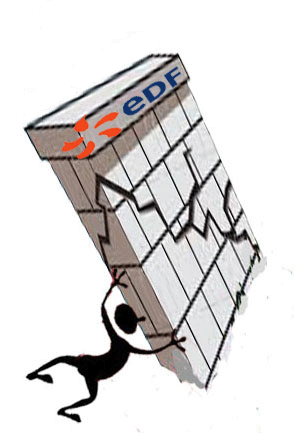
The long decline of Electricite de France SA isn’t only a political
crisis for the government in Paris, it’s a growing economic threat for
much of Europe
The giant nuclear operator, once a source of national pride
and reliable low-cost electricity, has become a nightmare for investors and
an increasingly wobbly pillar of regional energy security.
Technical problems at some of its largest reactors mean EDF is set to produce the
smallest amount of atomic power in three decades, slashing France’s
exports to neighboring countries. It’s a one-two punch for a region
that’s already reeling from record natural gas prices, and shows little
sign of abating.
Instead of helping EDF deal with its problems, the French
government is extracting billions of dollars from the company to shield
households from high energy costs. “The generic issue with EDF’s
reactors is leading to an unprecedented decline in production, which starts
being worrying,” said Nicolas Goldberg, a senior manager in charge of
energy at Colombus Consulting in Paris. “We’re going to have high
prices on the European market for a while. Everybody’s going to pay
more.”
Bloomberg 23rd Jan 2022
Hypocritical Scolding Won’t Stop a Russian War on Ukraine
 | |||
Peace cannot be found if the U.S. relies on the self-righteous assertion of principles that our government refuses to apply to itself.January 21, 2022 , Portside, Mitchell Zimmerman OTHERWORDS.ORG
As Moscow signals its apparent readiness for war over Ukraine, the U.S. government seems determined to ignore Russia’s not-so-ridiculous concerns over the military alliances of neighboring states and the prospect of nuclear weapons on its borders.
Should Americans worry about our country inserting itself into another war?
Ukraine is far away, and Russia isn’t directly threatening us. Nonetheless, the U.S. intends to arm and support Ukraine if it comes to war, and there can be no certainty whether a proxy war might escalate. Nuclear powers need to tread carefully around each other.
Let’s look at the U.S. response to Russia’s insistence that Ukraine not join NATO, the U.S.-dominated military alliance that Russia wants to keep out of its immediate periphery.
Washington rejects that demand. The U.S. representative at talks with Russia recently declared it to be among America’s “bedrock principles” that there be “no tolerance of overt or tacit spheres of influence, no restrictions on the sovereign right of nations to choose their own alliances.”
Contrary to these noble statements, America has long deemed it a bedrock principle that the United States has a sphere of influence: all of North and South America!………………
After the U.S. tried to overthrow its government, Cuba chose to ally with the Soviet Union and let the Russians put nuclear missiles in Cuba. The U.S. response was to bring the world to the brink of nuclear war rather than accept the Soviets’ move into our sphere of influence.
So much for “bedrock principles.”
The U.S. now proclaims it a “bedrock principle” that Ukraine, at least, can make an alliance with whomever they want, Russian sensibilities be damned. But suppose Mexico decided to join the Collective Security Treaty Organization, the Russian-sponsored counterpart to NATO?
Can anyone imagine the U.S. would quietly acknowledge Mexico’s right to do so?……………….
It is not unreasonable for the Russians not to want a hostile alliance — and potentially nuclear weapons — along their border. But Russia’s key interests do not reasonably include dismembering Ukraine.
Meanwhile the U.S. is not crazy for wanting Ukraine to be free to connect economically and culturally with Western Europe. But it’s not a key interest, requiring a confrontation between nuclear-armed states, to insist that Ukraine has the “right” to join NATO.
Peace cannot be found if the U.S. relies on the self-righteous assertion of principles that our government refuses to apply to itself. https://portside.org/2022-01-21/hypocritical-scolding-wont-stop-russian-war-ukraine
Design flaws in Flamanville EPR nuclear reactor vessel, and attempts to solve this
The EPR reactor vessel is not designed like the previous vessels, and the
water does not follow the flow movements observed on conventional reactors.
EDF engineers therefore had a piece of metal (deflector) installed in each
tank bottom to redirect the water correctly. But that would be
insufficient.
What solutions? The most logical solution would therefore be
to change this deflector “with the key to a work of development as
complex as ruinous, notes the weekly. And no one is sure, given the limited
space available in an EPR tank, that this repair is technically
possible”.
The other solution envisaged would therefore be to “reinforce
the fuel assemblies, reinforce the protective grids so that the blades
resist the flows”, mentioned Julien Collet.
EDF will present its plan to us
in February, so we can see if their proposals can solve the problem.
Another possibility mentioned at the end of the article: “To limit the
pressures of the water, it would be a question of running the EPR at only
60% of its power, Flamanville would then go from a capacity of 1,650
megawatts less than 1,000 and would end up, for a record bill of 13 billion
euros, less efficient than the reactors built 50 years ago.”
La Presse de la Manche 20th Jan 2022
Call for Japan to join nuclear ban treaty on first anniversary
Call for Japan to join nuclear ban treaty on 1st anniversary, https://www.asahi.com/ajw/articles/14528449
THE ASAHI SHIMBUN, January 23, 2022 Supporters of a U.N. treaty banning nuclear weapons gathered Jan. 22 in Hiroshima and Nagasaki to mark the first anniversary of the pact going into force, stepping up their calls on Japan to sign it.
Standing in front of the symbolic Atomic Bomb Dome in Hiroshima, 10 or so members of a Hiroshima-based group calling for the abolition of nuclear weapons hoisted a banner that read the “whole world should join the Treaty on the Prohibition of Nuclear Weapons.”
“Unless Japan, the only country in the world to have been ravaged by atomic bombing, speaks out in the international community, it will be impossible to eliminate nuclear weapons,” said Shuichi Adachi, a lawyer representing the group.
Participation in the rally was kept to a minimum as a safety precaution against the COVID-19 pandemic.
Tomoyuki Mimaki, a representative of the association of A- and H-bomb sufferers in Hiroshima Prefecture, expressed disappointment with a joint statement released Jan. 21 by Tokyo and Washington on the issue of nuclear weapons.
“They treated the question with kid gloves,” he said dismissively, noting that although the statement encouraged the world’s political leaders and youth to visit Hiroshima and Nagasaki, it made no reference to the treaty.
Mimaki, 72, said he sent a letter to Prime Minister Fumio Kishida, who is from a constituency in Hiroshima, urging Japanese representatives to attend the first meeting of signatory countries of the treaty in Austria in March as observers.
Attendance on the part of Japan, he said, is indispensable as Kishida has pledged that Tokyo will work as an intermediary between the nuclear and nonnuclear powers.
In Nagasaki, about 150 nuclear-bomb survivors and their supporters gathered in the Peace Park to press the Japanese government to join and ratify the treaty.
“The government continues to ignore the treaty even though many countries have signed it,” said Shigemitsu Tanaka, president of the Nagasaki Atomic-bomb Survivors Council. “We want to get the public become familiar with the treaty so we can join forces in applying pressure on the government.”
Fifty-nine countries and territories have ratified the treaty.
But the nuclear powers as well as Japan, which is protected under the U.S. nuclear umbrella for its defense purposes, have refrained from doing so.
According to the Japan Council against Atomic and Hydrogen Bombs, 627 assemblies, or 35 percent, of the 1,788 local governments, including those at the prefectural level, had adopted a resolution as of Jan. 12 calling on the Japanese government to sign and ratify the treaty.
The figure included 90 or so local governments that adopted the resolution after the treaty went into force in 2021.
“The resolution adopted by local governments reflects public opinion and thus is more visible,” said Shiro Maekawa, an official of the council who tracks the trend among local governments on the issue. “The Japanese government should hear what the public says.”
Row over plans to reform groups at nuclear sites.
Rob Edwards The Ferret, January 23, 2022,
New guidelines which campaigners say could benefit communities around nuclear sites have been boycotted by a UK Government nuclear agency.
Internal documents seen by The Ferret reveal that the Nuclear Decommissioning Authority (NDA) has rejected proposed reforms because they had caused “a great deal of bad feeling”
Guidelines aimed at making local meetings about safety at nuclear sites across the UK more transparent, accountable and representative were put forward in a nuclear industry report.
There are 29 licensed nuclear sites around the UK, six of them in Scotland. They include nuclear power stations operating and being decommissioned, nuclear submarine bases, waste and processing plants.
All of the sites have stakeholder or local liaison groups aimed at keeping local communities informed about events, including shutdowns, safety incidents and radiation leaks. But they differ greatly in how they are run…………………………..
In 2017 the 50-strong group of nuclear-free local authorities in the UK published a report questioning whether the stakeholder and local liaison groups were “fit for purpose”. It concluded that there was an “urgent need” to reform them.
This prompted the nuclear industry’s Safety Directors’ Forum, which brings together senior managers from all the civil and military nuclear sites, to commission a report. It was researched and written by the industry’s industry’s Young Nuclear Professionals’ Forum.
The resulting “Good Practice Guide” was circulated in November 2021. “Nuclear sites often have a reputation of being opaque, secretive and unwilling to engage with the public,” it said.
“This negative reputation is actively damaging, from open opposition to the site’s existence to a general lack of understanding. Active engagement is key to undoing this, the nuclear industry must be open and honest.”
The report argued that local liaison groups at several unidentified nuclear sites had “no accountability”. This included “no terms of reference being in place, no clear action management process, inadequate minute taking and infrequent meetings.”
It pointed out that while some meetings were open to the public, others were not. Some groups only invited “selected stakeholders” and “diversity and inclusion is not always encouraged”.
Some of the groups didn’t have websites. “Meetings are not always accessible and, in some cases, not comprehensible due to the extensive use of acronyms, particularly for those who do not work in the nuclear industry,” the report added.
The report recommended that the groups should all have websites, clear and published constitutions and a “diverse range of stakeholders”. There should be a co-chair independent of the industry and members of the public should be allowed to ask questions.
correspondence released under freedom of information law has disclosed how the report has upset the NDA and some of the existing groups………………………………… https://theferret.scot/nuclear-sites-reforms-row/
January 23 Energy News — geoharvey

Opinion: ¶ “No New Oil And Gas Leasing! Hearing On Climate And Offshore Drilling” • In a House Committee hearing, committee members focused on the connection between offshore drilling in the Gulf of Mexico and US climate goals. This much is clear: continuing offshore oil and gas leasing as usual will not help us meet […]
January 23 Energy News — geoharvey
200,000 pounds of lethal arms and ammunition, “directed by Biden,” arrive in Ukraine — Anti-bellum
Ukraine receives first lethal aid from USA Ukraine has received the first part of U.S. military aid, the U.S. Embassy in Ukraine said on Twitter. The first shipment of assistance recently directed by President Joe Biden to Ukraine arrived in Kyiv tonight. As noted, this shipment includes close to 200,000 pounds of lethal aid, including […]
200,000 pounds of lethal arms and ammunition, “directed by Biden,” arrive in Ukraine — Anti-bellum
Summary of the Julian Assange High Court case situation
The UK High Court will rule on the Assange Case on Monday.Here is a great summary by investigative journalist Tareq Haddad of what happens next:
1/ Breaking in Assange case: The British High Court will hand down a ruling as to whether the WikiLeaks publisher can appeal his US extradition case to the Supreme Court at 10.45am on Monday, 24 January
.2/ The ruling will determine whether the High Court “certifies” that the grounds raised by Assange’s defence have sufficient legal merit and public importance. If the application is certified, the Supreme Court appeal can proceed.
3/ If not, the case goes back to Westminster Magistrates’ Court where District Judge Vanessa Baraitser has been directed to send the case to Secretary of State Priti Patel to sign the order for extradition.
4/ She will then have two months to sign the order. If she does, only then can Assange’s defence team raise a new challenge to the High Court where they will seek to cross-appeal the points that went against them in DJ Baraitser’s January 2021 ruling.
5/ Assange’s defence also still has the option to lodge a case with the European Court of Human Rights, though I am told they are unsure whether to commence this process now or wait until the domestic appeals process is further along/exhausted.https://twitter.com/Tareq_Haddad/status/1484519655079399424
Why are they all buying into the fantasy of ”new nuclear”, and propping up ”old nuclear” – theme for January 2022?
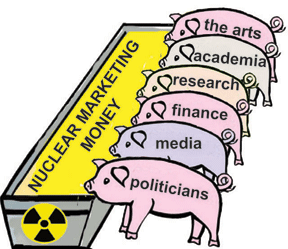
The Bitter Truth
is that the ”peaceful” ”economically viable” nuclear industry is clearly failing.
All nuclear nations are devoted to their nuclear weapons industry. So the commercial nuclear industry must be kept alive – as it is essential to the weapons industry, including in space.
The other reasons.
The macho men and ”visionary” billionaires must see their dreams fulfilled – at tax-payer expense, of course.
It is too costly to shut down old big nuclear reactors, – by propping them up – extending their licences – those costs are passed on to our grandchildren.

The slick, smart, amoral, lobbying gang are ever on the job, feeding nuclear spin to media, politicians, and us.
They have no conscience, and no wisdom, and they sure don’t care about our grandchildren.
Washington pumping up war fever

Washington pumping up war fever http://space4peace.blogspot.com/2022/01/washington-pumping-up-war-fever.html It’s nonstop in the western media. The message – war with Russia is coming.
An American friend of mine, now living in Russia, has two sons in the US Army. One of them said to him today, “your two sons are going to be fighting your beloved Russia.” So the troops are obviously being told to prepare for war. One of those sons, an Army Special Forces soldier has been sent to western Ukraine several times to train the Nazi death squads that have been brought into the Ukrainian Army since the US orchestrated coup d’état in 2014.
Russia has repeatedly stated that they have no intention of invading Ukraine – unless Ukraine first strikes Crimea or the Donbass (eastern Ukraine that borders Russia where two Russian-ethnic republics are located that have continually been targets of the right-wing Kiev government since 2014).
Russia constantly says they have no desire to take over the failed Ukrainian state – in fact Moscow says that the US-NATO have driven that country into the ground since the 2014 coup and they should help it recover. But the Washington agenda is chaos – just like Iraq, Syria, Libya and other places US-NATO have destroyed with their ‘freedom war machine’.
Let’s take a moment and look at possible reasons for the US-NATO daily agitation for war.
- The western corporate powers see their reign as ‘global rulers’ rapidly vanishing and know this is the last chance to bring down Russia and China before the ‘multi-polar’ world comes into fruition in the next few years.
- The west is led by evil, psychopaths who thirst for war. The neo-cons come to mind.
- It’s all a big public relations scheme to create a rare ‘win’ for the west. If Russia does not invade Ukraine then the US-NATO can claim it was all because they stood up to the ‘Russian bear’, proving that their out-of-date alliance still has a role in the world today.
- Western oligarchs can’t stand to let Russia have all those natural resources in the Arctic that are becoming possible to extract due to melting ice. So Russia must be broken up into smaller nations giving Mr. Big the chance to make the grab. See the RAND Corporation study that lays out the plan to balkanize Russia here. Thus there is no stopping this rush to war.
- US-NATO are bluffing. It’s all a great distraction to help take the heat off Big Pharma’s global vaccine campaign and growing international economic problems.
- You pick – give us your take in the comments.
- Now let’s review some of the reasons why war might be avoided.
If the US-NATO really went to full blown war with Russia then it would likely go nuclear. China would probably be pulled in. If this happens forget covid – kiss your family good-bye. Is the US-NATO stupid enough to try this? Yes they are but there are some sensible leaders in Europe who know this would not be such a great idea. Let’s hope they have the stuff it takes to help shut down this insanity.- The US-NATO constant aggression is a big money maker for the military industrial complex so this current war talk is a cash cow for them. But they are not stupid and know that nuclear war does not help their profit line.
- Think back to 2003 and George W. Bush’s ill-fated ‘shock and awe’ attack on Iraq that turned that nation into a chaotic failed state. Prior to the US-UK attack there were massive protests around the world for peace.
This time, as Washington-Brussels do their daily war-prep media barrage, there are few global protests. In fact there are some in the ‘US peace movement’ who buy the hype and believe Russia wants to remake the Soviet Union by invading Europe. Anyone who is actually paying real attention at this moment knows that story line is bullshit. But sadly some who should be protesting US-NATO provocations and aggression are not doing so. This weakens our ability to stop WW III.
I hope and pray that more people will speak out – and soon. Our lives depend on your courage and your action.
Just a reminder. Russia did not INVADE Crimea.

Bruce Gagnon, 21 Jan 22, Russia did not invade Crimea. They had a long-term lease with Ukraine that allowed over 20,000 military personnel at the Russian navy and air bases there.
The Russian-ethnic people of Crimea self-organized a referendum and voted 96% to seek to rejoin Russia. They saw the 2014 Nazi-led take over in Kiev during the US orchestrated coup and wanted nothing to do with the ‘new Ukraine’ regime.
See this excellent film produced by Oliver Stone https://vimeo.com/252426896?ref=fb-share
On 24 January, UK High Court will decide if Julian Assange can appeal against extradition
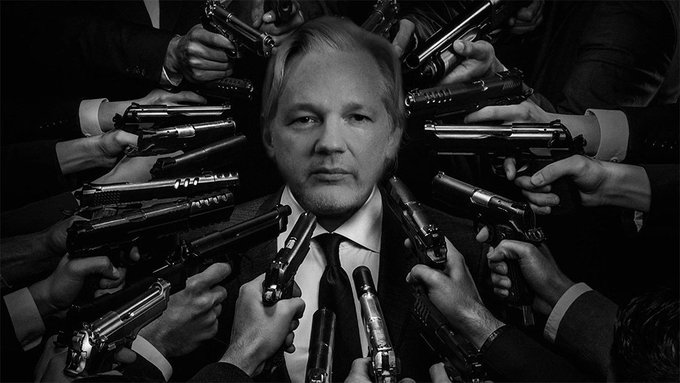
The UK High Court will deliver its decision on Monday 24 January on whether to permit Julian Assange to appeal the US extradition decision to the UK’s Supreme Court #FreeAssangeNOWhttps://t.co/p9bPgHPh2f
Nuclear energy too costly for humans — and the planet

But this [France’s small nuclear reactor] plan has a whole range of shortcomings, not least because reaching the same capacity as a single large nuclear reactor requires a great deal of these small reactors.
This high number will increase the risk of a nuclear accident many time over,” the German Federal Office for the Safety of Nuclear Waste Management (BASE) recently warned

“Without civilian nuclear power, there is no military nuclear power, and without military nuclear power, there is no civilian nuclear power,” Macron said.
Nuclear energy too costly for humans — and the planet https://www.dw.com/en/opinion-nuclear-energy-too-costly-for-humans-and-the-planet/a-60390384 21 Jan 22
Nuclear power will soon be classified as environmentally friendly under the new EU taxonomy. But nothing about it is green or safe, says DW’s Jeannette Cwienk.
I can still clearly recall that spring afternoon in late April 1986. I had been out playing in the woods and building a fort with some friends, when a rain shower forced us back home. It was a fun, carefree day.
We had no idea that just hours earlier, reactor number 4 at the Chernobyl power plant near the Ukrainian city of Pripyat had exploded.
When the news came out days later, the Chernobyl catastrophe and fears of a radiation-filled future quickly came to define my younger years.
Such memories, however, are not the only reason for my concern about the European Commission’s proposal to include nuclear energy and natural gas as environmentally-friendly technology in the EU taxonomy.
Doing so would see nuclear energy classified as sustainable, and recommend it as an option for investors — making a mockery of environmental efforts.
Who will pay for nuclear accidents?
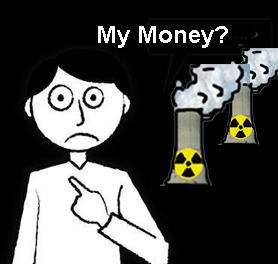
The EU Commission is completely ignoring the costs of nuclear energy. Quite apart from the funds required to build new nuclear power plants, even smaller ones, there is the far more important and apparently overlooked question of who would foot the bill in the event of an accident.
.
In Germany alone, the federal costs attached to the consequences of the Chernobyl catastrophe have been estimated at around €1 billion ($1.1 billion). Worldwide, the immediate economic ramifications of Chernobyl are estimated to have been more than €200 billion — and that doesn’t include the cost of widespread related illness.
Health costs were also not included in the €177-billion bill linked to the consequences of the March 2011 Fukushima nuclear disaster in Japan, as estimated by the Japanese government in 2017.
Most of these costs have since been covered by Japanese taxpayers, because the operating company, TEPCO, was de facto nationalized after the disaster to avoid insolvency.
Taxpayers will be forced to foot the bill
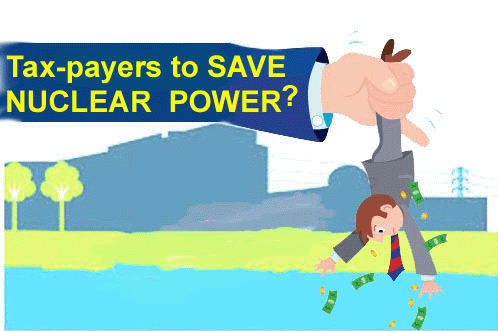
And this brings us to the heart of the problem: in Europe, the amounts that nuclear operators are required to set aside in case they’re found liable for a nuclear accident are laughably small. In the Czech Republic, nuclear power plant operators are required to have €74 million on hand in case of an accident; in Hungary, the figure is €127 million.
Even in France, the driving force for the planned “greening” of European nuclear energy and the largest consumer of nuclear energy worldwide — it makes up around 70% of its energy supply — operators are only required to set aside €700 million in case of an accident. A large nuclear accident in Europe could easily cost between €100 and 430 billion. And should that happen, the affected countries — along with their taxpayers — will be forced to foot the bill.
This situation has been met with criticism by Germany’s new finance minister and the leader of the neoliberal Free Democrat Party, Christian Lindner, who recently expressed skepticism about the place of nuclear energy in the new EU taxonomy.
“An energy source that can only be mainstream if the state is prepared to accept liability — that’s a sign from the market that it can’t be a sustainable energy source,” he said.
On Friday, the German government is likely to vote against the EU Commission’s plans — and rightly so. Austria and Luxembourg, on the other hand, have gone a courageous step further and have announced plans to take Brussels to court if the disputed sustainability plans go ahead.
Small modular reactors also a risk
In France, meanwhile, President Emmanuel Macron likes to describe nuclear power as a “stroke of luck” for climate protection. The fact that 10 of the country’s reactors are currently offline — three from the latest generation due to safety concerns — are apparently not an issue for the French government, which has been trying to allay the fears of a nuclear accident with new small modular reactors (SMR). These smaller power stations are only around one 10th of the size of a conventional nuclear site — and therefore are considered less dangerous, in the event of an accident.
But this plan has a whole range of shortcomings, not least because reaching the same capacity as a single large nuclear reactor requires a great deal of these small reactors.
“This high number will increase the risk of a nuclear accident many time over,” the German Federal Office for the Safety of Nuclear Waste Management (BASE) recently warned.
Is it really about climate protection?
BASE has also been critical of a report by the EU’s Joint Research Center, which the EU Commission has used to make its assessment about the environmental friendliness of civil nuclear power.
The EU report only partially considers the risks of nuclear energy use for humans and the environment, as well as for future generations, and some of the principles of scientific work are not correctly taken into account. According to BASE, the report cannot be relied on to comprehensively assess the sustainability of nuclear energy use.
This has raised doubts over the claim that Brussels wants to include nuclear power in the new EU taxonomy primarily for climate protection reasons. Instead, the decision seems to be down to political pressure, especially from Paris.
As a global nuclear power, France wants to hold on to its nuclear plants at all costs, as Macron clearly stated in December.
“Without civilian nuclear power, there is no military nuclear power, and without military nuclear power, there is no civilian nuclear power,” he said.
-
Archives
- February 2026 (228)
- January 2026 (308)
- December 2025 (358)
- November 2025 (359)
- October 2025 (376)
- September 2025 (258)
- August 2025 (319)
- July 2025 (230)
- June 2025 (348)
- May 2025 (261)
- April 2025 (305)
- March 2025 (319)
-
Categories
- 1
- 1 NUCLEAR ISSUES
- business and costs
- climate change
- culture and arts
- ENERGY
- environment
- health
- history
- indigenous issues
- Legal
- marketing of nuclear
- media
- opposition to nuclear
- PERSONAL STORIES
- politics
- politics international
- Religion and ethics
- safety
- secrets,lies and civil liberties
- spinbuster
- technology
- Uranium
- wastes
- weapons and war
- Women
- 2 WORLD
- ACTION
- AFRICA
- Atrocities
- AUSTRALIA
- Christina's notes
- Christina's themes
- culture and arts
- Events
- Fuk 2022
- Fuk 2023
- Fukushima 2017
- Fukushima 2018
- fukushima 2019
- Fukushima 2020
- Fukushima 2021
- general
- global warming
- Humour (God we need it)
- Nuclear
- RARE EARTHS
- Reference
- resources – print
- Resources -audiovicual
- Weekly Newsletter
- World
- World Nuclear
- YouTube
-
RSS
Entries RSS
Comments RSS
 nuclear-news