U.N. Treaty on the Abolition of Nuclear Weapons – in force one year , by January 22

Guest columnist Susan Lantz: A world without nuclear weapons, https://www.gazettenet.com/MY-TURN-lantz-nuclear-44684538, By SUSAN LANTZ 1/21/2022
Jan. 22 is the one-year anniversary of the U.N. Treaty on the Abolition of Nuclear Weapons entering into force as international law. Today, 59 countries have ratified the Treaty on the Abolition of Nuclear Weapons, with several more countries on the verge of doing the same. The importance of this cannot be overstated. With more and more countries outlawing everything to do with nuclear weapons, it becomes increasingly harder for the nine countries possessing these weapons to defend their continued existence.
While it’s long been illegal, under all military laws, to use nuclear weapons, the Treaty on the Abolition of Nuclear Weapons now also outlaws development, testing, production, stockpiling, stationing, transferring, and threatening to use nuclear weapons. These stipulations put teeth into this treaty as the ratifying countries will no longer allow any nuclear weapons to be stored within their boundaries, cross their lands or allow any nuclear parts to be manufactured within their confines. The nine nuclear-armed nations are already feeling the pressure of international will.
For instance, Germany, Norway, Sweden, Belgium, Netherlands, Italy are all likely to sign onto the Treaty on the Abolition of Nuclear Weapons eventually, with strong support already in their populations and parliaments. The United States currently has nuclear weapons in Belgium, Germany and Italy. After these countries ratify the treaty, the United States will be required to remove its weapons.
Nuclear Weapons along with Climate Change pose the two greatest existential threats to our civilization, our planet, and life as we know it. Within seconds, a nuclear holocaust could become reality by design or by accident. Many close calls have been recorded in our history of nuclear weapons over the years. There is absolutely no safe way to have them exist, as one misstep and life as we know it is doomed on our planet. Humans, plants, trees, animals could cease to exist in a radiation-filled landscape and atmosphere. Nuclear weapons are way too powerful for mere mortals to control.
So friends, celebrate this very significant anniversary of the Treaty on the Abolition of Nuclear Weapons. It brings us closer to a world without nuclear weapons and therefore a safer, saner place to inhabit. Join us this Saturday, Jan. 22 in Northampton in front of the courthouse on Main Street or in Greenfield on the Common, from 11 a.m. to noon. Bring your signs, banners, whistles, pots, pans. Bring your support, and celebrate, knowing that the peoples’ will is beginning to be heard.
Susan Lantz lives in Easthampton.
Small nuclear reactors a poor solution for UK’s and the world’s climate action.

it is difficult to see how a technology that will only be operational after the UK power system is supposed to be carbon-free will contribute to climate action in the next ten years or so. And the situation is similar globally.
Other questions around traditional nuclear power stations, such as the thorny issue of waste, would also still apply to SMRs…….
Is nuclear power the best solution to climate change? The UK, like China, the US and Canada, is attracted to nuclear power. But high costs and slow delivery means many energy experts remain unconvinced. New Statesman, By Philippa Nuttall 21 Jan 22, debate in the House of Commons on 19 January, led by a group of MPs known as the “atomic kittens”, suggested nuclear energy can be a panacea for all ills – including a solution for the climate crisis and the gas crunch. The facts suggest otherwise.
Isn’t nuclear energy a no-no after Chernobyl and Fukushima?
Disasters clearly reduce appetite among the public and policymakers for nuclear power………………
Today, new nuclear construction projects are few and far between, even in countries such as France and the US whose energy systems are heavily reliant on the technology, and the number of operational reactors is in decline globally.
Are any countries investing heavily in nuclear?
In addition to safety concerns, rising costs are a central reason why the number of new plants under construction remains limited. Since 2011, nuclear power construction costs globally have doubled or even tripled. China is, however, notable in its nuclear ambitions. The country is planning at least 150 new reactors in the next 15 years, more than the rest of the world has built in the past 35, though cost could ultimately change this direction of travel.
The price of nuclear generation has moved in the opposite direction to solar and wind
Mean levelised cost of energy in US$/MWh, 2009–20………..
Others countries such as the UK, the US and Canada also see a limited role for new nuclear as part of their response to climate change. The UK government in its 2021 net zero strategy talked about “cutting edge new nuclear power stations”, and plans to launch a £120m Future Nuclear Enabling Fund.
There are some big nuclear power stations on the cards – think Hinkley Point C or Sizewell C in the UK. But the major excitement among many nuclear enthusiasts, including plenty of UK MPs is around so-called small modular reactors (SMRs). If you believe the hype, they are the answer to all climate and energy ills………………
Rolls Royce, and companies working on the technology in other countries, argue that smaller solutions can be constructed more cheaply and come online more quickly as they can be built in a factory, transported in modules and fitted together “like meccano”, said Rolls Royce’s Alastair Evans. Large nuclear plants are built fully onsite. The idea is that the modules could then be mass produced. However, nothing is rolling off any conveyor belts yet. The only SMR up and running in the world is a 35 MW floating nuclear plant in Russia.
Sounds interesting. Are SMRs the solution to the climate crisis?
Unlikely.
“To meet the requirements of the sixth carbon budget, we will need all new cars, vans and replacement boilers to be zero carbon in operation by the early 2030s,” Virginia Crosbie, a Conservative MP from Wales and the original self-proclaimed “atomic kitten”, enthused to fellow MPs. “We must quickly move away from generating that electricity from fossil fuels… Nuclear power, which has been a neglected part of our energy mix, can bridge the gap.”
There is, however, no silver bullet to the climate crisis, and renewables, in conjunction with other existing technologies, look like a better, cheaper solution.
……….. traditional, big nuclear projects look likely to provide only a sliver of the world’s electricity in the future. They are hugely expensive to build, their construction runs over time, and they are frequently struck by technological issues. Moreover, they need to be built close to the sea or a large river for cooling reasons, highlighted Paul Dorfman from the University of Sussex. France has already had to curtail nuclear power output in periods of heatwaves and drought, which are only set to get worse as climate change takes hold. Greater storm surges and eroding coastlines also don’t make the prospect of building by the sea any easier.
SMRs solve few of these issues………… “The latest economic estimates available for SMRs are still quite expensive relative to other ‘clean’ energy alternatives, and it would be pure speculation to assume that will change dramatically until the concept has been more proven,” said Mike Hogan from the not-for-profit Regulatory Assistance Project.
……. the designs still need to get licensed, factories need to be built, orders placed, projects financed, etc,” said Hogan.
In short, it is difficult to see how a technology that will only be operational after the UK power system is supposed to be carbon-free will contribute to climate action in the next ten years or so. And the situation is similar globally.
Other questions around traditional nuclear power stations, such as the thorny issue of waste, would also still apply to SMRs…….
So what is the solution? Renewables, renewables and more renewables?
In short, yes. The costs of solar, wind power and storage continue to fall, and by 2026 global renewable electricity capacity is forecast to rise by more than 60 per cent, to a level that would equal the current total global power capacity of fossil fuels and nuclear combined, says the IEA.
Some argue nuclear can be a clean back-up option for when the wind doesn’t blow and the sun isn’t shining. But again, other options already exist, including demand response (for example, plugging in your electric car when there is lots of energy and not switching on your washing machine when the system is under strain), large-scale storage and interconnections between different countries.
Final word?
Craig Bennett, chief executive of the Wildlife Trusts, summed up the general mood of those less enthused by nuclear than Crosbie and her fans:
“If successive governments had given even half the love and attention they afford to nuclear power to scaling up home insulation, energy efficiency and smart storage technologies, it’s likely we wouldn’t be facing current challenges around energy and household bills, and we would have done a lot more good for the climate and nature.”….. https://www.newstatesman.com/environment/climate/2022/01/is-nuclear-power-a-genuine-solution-to-the-climate-crisis
France’s nuclear waste problem, and the lack of transparency on military wastes

“The lack of transparency on military nuclear waste poses a serious democratic problem” To guarantee access to the information that is lacking on the subject of the dismantling of the installations, “parliamentary involvement” is essential, believe the director of the Armaments Observatory, Patrice Bouveret, and the spokesperson for ICAN France, Jean -Marie Collin, in a forum in Le Monde.
Le Monde 20th Jan 2022
Largest increase in the UK nuclear liability regime for 50 years
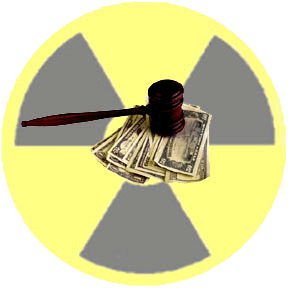
Largest increase in the UK nuclear liability regime for 50 years take, https://www.jdsupra.com/legalnews/largest-increase-in-the-uk-nuclear-6038616/, 21 Jan 22, As we flagged last year in this note, the 2004 Protocols updating the Paris Convention and Brussels Convention have finally been ratified. This is likely the biggest increase in the international nuclear liability regime for decades, and has global impact.
In the UK this means that the Nuclear Installations (Liability for Damage) Order 2016 came into effect on 1 January 2022. This immediately increases the liability cap of nuclear operators in the UK from £140m to €700m (approx. £585m), with those caps increasing annually over the next five years to €1.2bn (approx. £1bn). The UK also now has a new operator duty of care not to cause significant impairment to the environment, new categories of compensation for which an operator will be liable (including loss of profit in some instances), and material extensions to the geographical scope covered by the regime (e.g. now including the Republic of Ireland).
The extension of the limitation period for personal injury to 30 years from the date of the incident is likely the one with the largest impact after it became clear last year that insurance would not be available to cover the full period, at least for the time being. The UK Government instead stepping in and indemnifying operators to cover the insurance gap using the powers granted to the Secretary of State under the amended Nuclear Installations Act 1965.
Similar changes to the liability regime in certain other European and Scandinavian signatory countries should also have taken effect.
Please see our detailed note on the topic here for further information.
[View source.]
Scientists trace the path of radioactive cesium in the ecosystem of Fukushima

Scientists trace the path of radioactive cesium in the ecosystem of Fukushima https://phys.org/news/2022-01-scientists-path-radioactive-cesium-ecosystem.html
by National Institute for Environmental Studies In 2011, the nuclear accident at Fukushima, Japan, resulted in the deposit of radioactive cesium (radiocesium) into habitats in the vicinity. A decade after the accident, researchers from the National Institute of Environmental Studies, Japan, have collated the complicated dynamics of radiocesium within forest-stream ecosystems. Understanding radiocesium flow in the environment could help mitigate contamination and inform future containment strategies.
In the aftermath of the Fukushima nuclear accident, the Japanese government performed intensive decontamination in the human-occupied parts of the affected area by removing soil surface layers. But a major affected region consists of dense, uninhabited forests, where such decontamination strategies are not feasible. So, finding ways to avoid the spread of radioactive contaminants like radiocesium to areas of human activity that lie downstream to these contaminated forests is crucial.
The first step to this is to understand the dynamics of radiocesium flow through forest-stream ecosystems. In the decade since the accident, a vast body of research has been dedicated to doing just that. Scientists from the National Institute of Environmental Studies, Japan, sifted through the data and detangled the threads of individual radiocesium transport processes in forest-stream ecosystems. “We identified that radiocesium accumulates primarily in the organic soil layer in forests and in stagnant water in streams, thereby making them potent sources for contaminating organisms. Contamination management in these habitats is crucial to provisioning services in forest-stream ecosystems,” says Dr. Masaru Sakai, who led the study. The findings of this study was made available online on 6 July 2021 and published in volume 288 of the journal Environmental Pollution on 1st November 2021.
The research team reviewed a broad range of scientific research on radiocesium in forests and streams to identify regions of radiocesium accumulation and storage. After the accident, radiocesium was primarily deposited onto the forest canopy and forest floor. This radiocesium reaches the earth eventually—through rainfall and falling leaves—where it builds up in the upper layers of the soil. Biological activities, such as those of detritivores (insects and fungi that live off leaf debris etc.) ensure that radiocesium is circulated through the upper layers of the soil and subsequently incorporated into plants and fungi. This allows radiocesium to enter the food web, eventually making its way into higher organisms. Radiocesium is chemically similar to potassium, an essential mineral in living organisms, contributing to its uptake in plants and animals. “Fertilizing” contaminated areas with an excess of potassium provides an effective strategy to suppress the biological absorption of radiocesium.
Streams and water bodies in the surrounding area get their share of radiocesium from runoff and fallen leaves. Most radiocesium in streams is likely to be captured by the clay minerals on stream beds, but a small part dissolves in the water. Unfortunately, there is little information on the relationship between dissolved radiocesium and aquatic organisms, like fish, which could be important to the formulation of contamination management strategies. Radiocesium in streams also accumulates in headwater valleys,pools, and other areas of stagnant water. Constructions such as reservoir dams provide a way to effectively trap radiocesium but steady leaching from the reservoir sediments causes re-contamination downstream.
This complicated web of radiocesium transport is hard to trace, making the development of a one-stop solution to radiocesium contamination impossible. Dr. Sakai and team recommend interdisciplinary studies to accelerate a full understanding of radiocesium pathways in forest-stream ecosystems so that measures can be developed to reduce future contamination. “This review can serve as basal knowledge for exploring future contamination management strategies. The tangled radiocesium pathways documented here may also imply the difficulties of creating successful radiation contamination management strategies after unwished-for nuclear accidents,” explains Dr. Sakai.
Nuclear power is often touted as a solution to the energy crisis, but it is important to plan response measures to unpredictable contamination events. To address the essential need for clean energy in view of the climate crisis, contamination management in societies depending on nuclear power is integral. Fully understanding the behavior of radiocesium in ecosystems can not only lead to the successful management of existing contamination but can also ensure the swift containment of potential future accidents.
France’s nuclear company EDF accused of cover-ups over ‘serious and unexpected’ corrosion on Tricastin and other reactors.
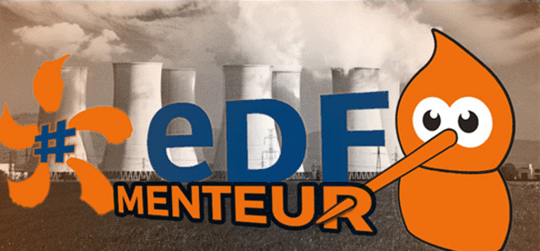
“Hugo”, nuclear whistleblower: “I accuse EDF of cover-ups”. “With this
type of attitude, our power plants are not safe”: the shocking testimony of
a member of the management of the Tricastin nuclear power plant, worried
that the culture of nuclear safety is taking a back seat to financial
imperatives within the EDF group.
Mediapart 19th Jan 2022
Nuclear reactors shut down due to ‘serious and unexpected’ corrosion
problem. EDF, which operates the French power plants, should say by the end
of January whether other facilities in the fleet could be affected by this
as yet unexplained anomaly.
Le Monde 19th Jan 2022
2021 was one of the hottest years on record – and it could also be the coldest we’ll ever see again
2021 was one of the hottest years on record – and it could also be the coldest we’ll ever see again Andrew King, 21 Jan 22,
Well, it’s official: 2021 was one of the planet’s seven hottest years since records began, the World Meteorological Organization (WMO) declared this week. The year was about 1.11℃ above pre-industrial levels – the seventh year in a row that the average global temperature rise edged over 1℃.
Hinkley Point mud dredging and dumping plan faces a legal challenge
Hinkley Point dredging plan for Portishead faces legal challenge. Plans to
dump hundreds of thousands of tonnes of sediment from Hinkley Point into
the Bristol Channel at Portishead face a legal challenge.
Environmental groups represented by Tarian Hafren say the Marine Management Organisation
unlawfully varied EDF Energy’s licence to deposit dredged material at the
Severn Estuary Marine Protection Area. The disposal site is close to
Portbury Wharf Salt Marsh, a Site of Special Scientific Interest and part
of the Severn Estuary Special Protection Area. Tarian Hafren argues that
the MMO did not have the statutory power to change the licence for dredging
to include dumping, did not give adequate reasons for doing so, failed to
examine the potential impact of the dredging on marine life, and ignored a
less harmful method of waste disposal.
High Court judge Beverley Lang ruled
that the grounds for a judicial review are arguable and the claim will be
heard this spring. Cian Ciaran for Tarian Hafren said: “The Welsh
National Marine Plan accepts no dumping in the Welsh half of the estuary,
but the Welsh authorities failed to press MMO to comply on the English
side. “As Geiger Bay, we established at court in 2018 that the Welsh
authorities were wrong to license dumping near Cardiff. Let’s now compel
the MMO to respect the protected status that’s needed for both fish
stocks and wildlife.”
Somerset Live 20th Jan 2022
https://www.somersetlive.co.uk/news/hinkley-point-dredging-plan-portishead-6514361
France’s nuclear regulator warns on the ”security fragility” of both the reactors, and the reprocessing system
“The continued operation of EDF’s nuclear reactors should not be the
adjustment variable for French energy policy”. In an interview with “Le
Monde”, Bernard Doroszczuk, the president of the Nuclear Safety Authority,
warns about the lack of margins in terms of security of electricity supply.
First, the president of the Nuclear Safety Authority (ASN), Bernard
Doroszczuk, wishes to underline a reassuring point. Despite the
complications due to the health crisis, “the level of nuclear safety and
radiation protection was completely satisfactory in 2021, he says in the
preamble to his interview with Le Monde. In particular the conduct of the
fourth ten-yearly inspections of the oldest reactors”.
The French nuclear “policeman” however warns against “an unprecedented double
fragility”: both for the reactors, but also for the installations which
manufacture, reprocess or recover the fuel.
Le Monde 19th Jan 2022
China hits back at US, Japan over nuclear transparency call
China hits back at US, Japan over nuclear transparency call, Catherine Wong SCMP, 21 Jan 22,
Beijing says Washington is the biggest threat to global stability and should make the first move by reducing its stockpile. Tokyo should also adopt a more responsible approach on nuclear policy, foreign ministry says.
China hit out at the United States and Japan on Friday after the two nations sounded alarm over China’s growing nuclear capabilities.
In a statement on the Treaty on the Non-Proliferation of Nuclear Weapons on Thursday, the two countries called on China to increase transparency and reduce nuclear risks.
“Noting the People’s Republic of China’s ongoing increase in its nuclear capabilities, Japan and the United States request [China] to contribute to arrangements that reduce nuclear risks, increase transparency, and advance nuclear disarmament,” the US and Japan said.
Chinese foreign ministry spokesman Zhao Lijian said the US was the bigger threat.
“As we all know, it is the US that is the biggest threat to global stability with the world’s biggest and most advanced nuclear stockpile,” Zhao said, adding that the US had deployed missile defence systems around the world.
“Despite possessing the world’s largest and most advanced nuclear arsenal, the US is still investing trillions of dollars to upgrade its ‘nuclear triad’, developing low-yield nuclear weapons and lowering the threshold for using nuclear weapons.”
He said the US should “mind its own business” before criticising China and cut its nuclear stockpile to set an example for other countries.
He added that China remained firmly committed to a self-defensive nuclear strategy and no-first-use policy on nuclear weapons.
Zhao also criticised Japan for storing large quantities of weapons-grade plutonium and “desperately trying to prevent the US from adopting the no-first-use policy”…….. https://www.scmp.com/news/china/diplomacy/article/3164302/china-hits-back-us-japan-over-nuclear-transparency-call
Difficulties at Orano nuclear elements site adds to France’s nuclear woes.
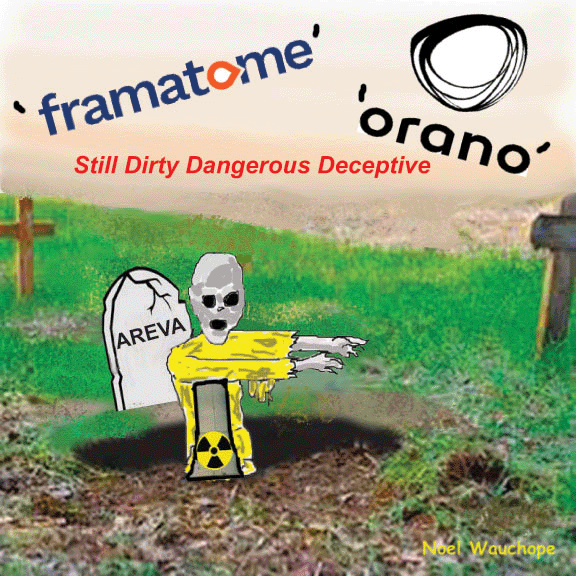
France’s nuclear sector, which lately came under additional pressure due
to newly discovered corrosion problems at some EDF (EDF.PA) sites, may need
a “Marshall plan” to survive, said the head of France’s ASN nuclear
watchdog. Difficulties also increased at Orano’s Melox site which produces
nuclear elements for plants, adding to EDF’s problems, ASN President
Bernard Doroszczuk told reporters.
Reuters 19th Jan 2022
Transistion to genuinely clean energy has succeeded in many cases, including economically

Michael Grubb: Limiting climate change will require an unprecedented
global movement to make low-carbon technologies the norm. COP26 – the UN
climate conference held last November in Glasgow – showed that
unfortunately, the world is far from ready for such a movement.
Many leaders still assume that reducing emissions and growing their countries’
economies aren’t compatible goals. Yet in many places, transitions to
clean energy technologies have succeeded far beyond expectations.
Since 2010, wind power has grown from providing under 1% to providing 10% of
electricity in Brazil, and provided 15% of the EU’s electricity demand in
2019. Solar power – described as “the most expensive way to reduce
carbon emissions” as recently as 2014 – now costs 85% less than it did
a decade ago, increasingly making it the cheapest electricity in history.
And in India, affordable energy access programmes drove sales of
high-efficiency LED bulbs from just 3 million in 2012 to 670 million in
2018, with prices also falling by 85%.
These three technologies now offer
some of the cheapest ways to produce electricity or light across much of
the world. What’s crucial is that these transitions all involved
significant government action. Plus, most went ahead despite the fact that
in many cases, early economic calculations suggested that developing
renewables would be an especially expensive way to cut emissions.
Rather than relying on research and development to bring down costs through coming
up with new inventions – or leaving the market to do so on its own
through competition – governments used subsidies and public procurement
programmes (government commitments to buy a certain volume of a new
product) to keep costs down and boost uptake.
Historically, it’s been widely assumed that reducing emissions would mean damaging countries’
economies. And low-carbon transitions do, of course, involve social and
economic challenges. But well-designed policies – such as those used to
drive the revolutions in wind, solar and LEDs – have the potential to
create huge benefits for participating countries, not just for our climate.
If we want to solve climate change, we first need to transform our economic
thinking.
Renew Economy 20th Jan 2022
Research shows planning for climate change will save billions
Research shows planning for climate change will save billions
New research suggests the key to saving billions is planning ahead for climate-related natural disasters and reducing greenhouse gas emissions.
Mayors for Peace UK / Ireland Chapter and NFLA celebrates first nuclear weapons ‘banniversary’.
Richard Outram, UK / Ireland Mayors for Peace / NFLA Secretary, Richard.outram@manchester.gov.uk / 21 Jan 22,
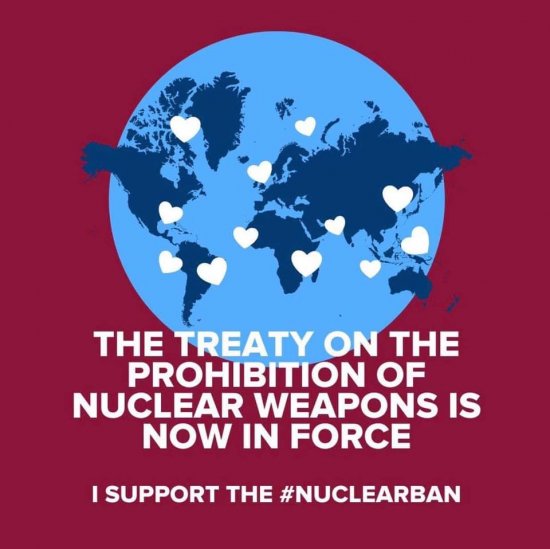
Local authorities working for peace in the UK and Ireland will be celebrating the first ‘banniversary’ of the UN treaty making nuclear weapons illegal (22January).
The United Nations Treaty on the Prohibition of Nuclear Weapons (the Treaty) entered into force on the 22 January 2021, 90 days after the fiftieth nation ratified acceptance of it.
The Treaty requires signatory states to undertake not to develop, test, produce, acquire, possess, stockpile, deploy, use, or threaten to use nuclear weapons or permit or support other states to do so. The Treaty also requires any state which is a party to the treaty to provide assistance to persons and communities affected by the use or testing of nuclear weapons and to work to clear up land contaminated by such activities which lies under its jurisdiction or control[i].
Across the world, campaigners will be celebrating the first so-called ‘banniversary’, and the huge progress that has been made in the cause of advancing nuclear disarmament over the last year, in advance of a much-anticipated First Meeting of the States Parties currently scheduled to be hosted by Vienna, Austria between 22-24 March 2022.
59 UN member states have now ratified their acceptance of the Treaty and a further 27 have signed and are currently in the process of doing so. 101 financial institutions across the world representing almost $4 trillion have also announced they will shun further investment in nuclear weapons because of the Treaty.[ii]
The UK / Ireland Chapter of the international Mayors for Peace movement and the UK / Ireland Nuclear Free Local Authorities will be amongst the many organisations celebrating the date. Both are partner organisations of ICAN (the International Campaign to Abolish Nuclear Weapons).
Born out of the frustration that the UN Non-Proliferation Treaty had failed to deliver nuclear disarmament after almost half-a-century, ICAN, a global coalition of civil society, faith and peace organisations, atomic bomb and test survivors, scientists, doctors, academics and concerned world citizens, began to work for a treaty ban.[iii] Their work led to the Treaty being adopted by 122 of the world’s states at the United Nations on 7 July 2017 and later that year, ICAN and its partners were awarded the Nobel Peace Prize.
Subsequently ICAN worked with these states to bring the Treaty into law.
Commenting, Manchester City Councillor Eddy Newman, speaking on behalf of the UK / Ireland Chapter of Mayors for Peace, said:
“In the past, similar treaties have banned germ and chemical weapons, landmines, and cluster bombs and in the last year we have already achieved so much as a world community in moving forward a nuclear weapons ban. However there remain many challenges. Yesterday (20 January), the Bulletin of Atomic Scientists announced that the Doomsday Clock remains at 100 seconds to midnight in recognition that our world faces many grave threats. One, which is existential, is the ever-present threat of nuclear annihilation. Despite world opinion favouring nuclear disarmament, the nuclear weapon armed states, amongst them the United Kingdom, continue to refuse to engage with this Treaty and continue to renege upon their solemn promise made over 50 years ago as signatories to the Non-Proliferation Treaty to do so.”
The Chair of the Nuclear Free Local Authorities Steering Committee, Leeds City Councillor David Blackburn, added:
“Although the Republic of Ireland has creditably signed the Treaty, one of our priorities as Mayors for Peace Councils and Nuclear Free Local Authorities in the UK must be to continue to put pressure on the UK Government to engage with the treaty. One way to do this is to ask our member Councils to pass resolutions calling on the government to do so. This will be a priority for both of our organisations over the coming year. Leeds and Manchester are both amongst the UK Councils which have already passed such resolutions, and we hope many more will do so in 2022.[iv]”
Doomsday Clock continues to hover dangerously
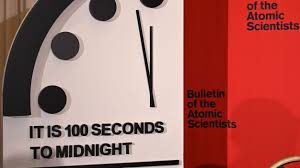
Doomsday Clock unchanged: scientists, https://www.canberratimes.com.au/story/7589207/doomsday-clock-unchanged-scientists/?cs=14232 The Doomsday Clock has remained at 100 seconds to midnight for a third year in a row as scientists said the world is “no safer” than it was this time last year.
Maintaining last year’s setting means the clock’s keepers believe the threat of global apocalypse has not cooled off in the past 12 months.
Rachel Bronson, president and chief executive of the Bulletin of the Atomic Scientists, said: “This year, in our statement, the science and security board highlights several bright spots and many disturbing trends.
The board describes a mixed-threat environment, one with positive developments counteracted by accelerating negative ones.
“Today, the members of the science and security board deem the world to be no safer than it was last year at this time, and therefore have decided to set the Doomsday Clock at 100 seconds to midnight.
“The Doomsday Clock continues to hover dangerously, reminding us how much work is needed to ensure a safer and healthier planet. We must continue to push the hands of the clock away from midnight.”
-
Archives
- February 2026 (228)
- January 2026 (308)
- December 2025 (358)
- November 2025 (359)
- October 2025 (376)
- September 2025 (258)
- August 2025 (319)
- July 2025 (230)
- June 2025 (348)
- May 2025 (261)
- April 2025 (305)
- March 2025 (319)
-
Categories
- 1
- 1 NUCLEAR ISSUES
- business and costs
- climate change
- culture and arts
- ENERGY
- environment
- health
- history
- indigenous issues
- Legal
- marketing of nuclear
- media
- opposition to nuclear
- PERSONAL STORIES
- politics
- politics international
- Religion and ethics
- safety
- secrets,lies and civil liberties
- spinbuster
- technology
- Uranium
- wastes
- weapons and war
- Women
- 2 WORLD
- ACTION
- AFRICA
- Atrocities
- AUSTRALIA
- Christina's notes
- Christina's themes
- culture and arts
- Events
- Fuk 2022
- Fuk 2023
- Fukushima 2017
- Fukushima 2018
- fukushima 2019
- Fukushima 2020
- Fukushima 2021
- general
- global warming
- Humour (God we need it)
- Nuclear
- RARE EARTHS
- Reference
- resources – print
- Resources -audiovicual
- Weekly Newsletter
- World
- World Nuclear
- YouTube
-
RSS
Entries RSS
Comments RSS
 nuclear-news