The escalating costs of decommissioning UK’s nuclear reactors pose a warning about new nuclear reactors.
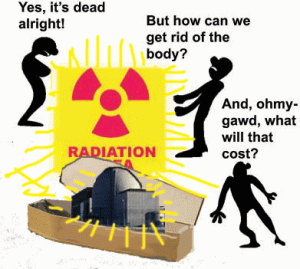
The history of the AGR fleet provides lessons for other long-term programmes carrying significant end‑of‑life liabilities, including new nuclear energy programmes.
| The government has entered into new arrangements to decommission seven AGR nuclear power stations. While the arrangements could deliver savings, their success will ultimately depend on the relevant parties working collaboratively to overcome risks, according to the National Audit Office (NAO). The Nuclear Liabilities Fund (the Fund) was established to meet the costs of decommissioning these eight stations, but significant additional taxpayer support has been required with more likely to be necessary. The UK government has provided a guarantee to underwrite the Fund in the event that its assets are insufficient to meet the total costs of decommissioning. In 2020, government contributed £5.1 billion to strengthen the Fund’s position and the Fund has recently requested a further £5.6 billion. The Fund’s assets were valued at £14.8 billion at the end of March 2021. The aim is that growth in the Fund’s investments will be sufficient to meet the long-term costs of decommissioning (£23.5 billion). However, cost estimates have doubled in real terms since 2004-05. If this upward trend is maintained and investment growth is not sufficient, there is a risk that the taxpayer will have to make further contributions. In June 2021, the AGR stations’ owner EDF Energy (EDFE) agreed to defuel each of the stations in an arrangement that the Department for Business Energy & Industrial Strategy (the Department) estimates could save the taxpayer around £1 billion. Once defueling is completed, ownership of the stations will transfer to the government’s Nuclear Decommissioning Authority (NDA) for its subsidiary Magnox Ltd to complete the rest of the decommissioning process, which is likely to take several decades. Initial ambitions that the existence of the Nuclear Liabilities Fund would help eliminate taxpayers’ exposure are being tested, with rapid increases in the estimates of decommissioning costs outstripping investment returns. The history of the AGR fleet provides lessons for other long-term programmes carrying significant end‑of‑life liabilities, including new nuclear energy programmes. National Audit Office 28th Jan 2022 https://www.nao.org.uk/report/the-decommissioning-of-the-agr-nuclear-power-stations/ |
No comments yet.
1 This Month

of the week – Shut Down Drone Warfare!


Tell the Ukrainian Government to Drop Prosecution of Peace Activist Yurii Sheliazhenko

Petition to revoke the licensing of the Near Surface Nuclear Disposal Facility (NSDF) at Chalk River. https://www.ourcommons.ca/petitions/en/Petition/Details?Petition=e-7247
To see nuclear-related stories in greater depth and intensity – go to https://nuclearinformation.wordpress.com
-
Archives
- March 2026 (251)
- February 2026 (268)
- January 2026 (308)
- December 2025 (358)
- November 2025 (359)
- October 2025 (376)
- September 2025 (257)
- August 2025 (319)
- July 2025 (230)
- June 2025 (348)
- May 2025 (261)
- April 2025 (305)
-
Categories
- 1
- 1 NUCLEAR ISSUES
- business and costs
- climate change
- culture and arts
- ENERGY
- environment
- health
- history
- indigenous issues
- Legal
- marketing of nuclear
- media
- opposition to nuclear
- PERSONAL STORIES
- politics
- politics international
- Religion and ethics
- safety
- secrets,lies and civil liberties
- spinbuster
- technology
- Uranium
- wastes
- weapons and war
- Women
- 2 WORLD
- ACTION
- AFRICA
- Atrocities
- AUSTRALIA
- Christina's notes
- Christina's themes
- culture and arts
- Events
- Fuk 2022
- Fuk 2023
- Fukushima 2017
- Fukushima 2018
- fukushima 2019
- Fukushima 2020
- Fukushima 2021
- general
- global warming
- Humour (God we need it)
- Nuclear
- RARE EARTHS
- Reference
- resources – print
- Resources -audiovicual
- Weekly Newsletter
- World
- World Nuclear
- YouTube
-
RSS
Entries RSS
Comments RSS
 nuclear-news
Leave a comment