Transistion to genuinely clean energy has succeeded in many cases, including economically
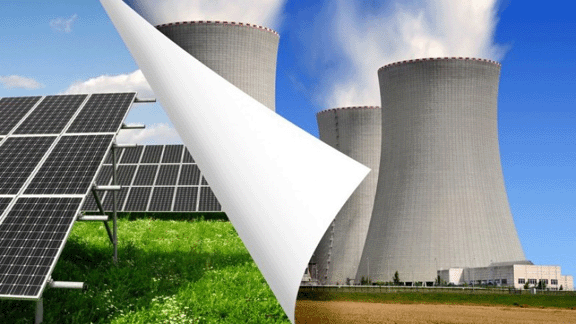
Michael Grubb: Limiting climate change will require an unprecedented
global movement to make low-carbon technologies the norm. COP26 – the UN
climate conference held last November in Glasgow – showed that
unfortunately, the world is far from ready for such a movement.
Many leaders still assume that reducing emissions and growing their countries’
economies aren’t compatible goals. Yet in many places, transitions to
clean energy technologies have succeeded far beyond expectations.
Since 2010, wind power has grown from providing under 1% to providing 10% of
electricity in Brazil, and provided 15% of the EU’s electricity demand in
2019. Solar power – described as “the most expensive way to reduce
carbon emissions” as recently as 2014 – now costs 85% less than it did
a decade ago, increasingly making it the cheapest electricity in history.
And in India, affordable energy access programmes drove sales of
high-efficiency LED bulbs from just 3 million in 2012 to 670 million in
2018, with prices also falling by 85%.
These three technologies now offer
some of the cheapest ways to produce electricity or light across much of
the world. What’s crucial is that these transitions all involved
significant government action. Plus, most went ahead despite the fact that
in many cases, early economic calculations suggested that developing
renewables would be an especially expensive way to cut emissions.
Rather than relying on research and development to bring down costs through coming
up with new inventions – or leaving the market to do so on its own
through competition – governments used subsidies and public procurement
programmes (government commitments to buy a certain volume of a new
product) to keep costs down and boost uptake.
Historically, it’s been widely assumed that reducing emissions would mean damaging countries’
economies. And low-carbon transitions do, of course, involve social and
economic challenges. But well-designed policies – such as those used to
drive the revolutions in wind, solar and LEDs – have the potential to
create huge benefits for participating countries, not just for our climate.
If we want to solve climate change, we first need to transform our economic
thinking.
Renew Economy 20th Jan 2022
No comments yet.
1 This Month

Petition to revoke the licensing of the Near Surface Nuclear Disposal Facility (NSDF) at Chalk River. https://www.ourcommons.ca/petitions/en/Petition/Details?Petition=e-7247


of the week – STOP SMALL MODULAR REACTORS IN CANADA
To see nuclear-related stories in greater depth and intensity – go to https://nuclearinformation.wordpress.com
-
Archives
- March 2026 (153)
- February 2026 (268)
- January 2026 (308)
- December 2025 (358)
- November 2025 (359)
- October 2025 (376)
- September 2025 (258)
- August 2025 (319)
- July 2025 (230)
- June 2025 (348)
- May 2025 (261)
- April 2025 (305)
-
Categories
- 1
- 1 NUCLEAR ISSUES
- business and costs
- climate change
- culture and arts
- ENERGY
- environment
- health
- history
- indigenous issues
- Legal
- marketing of nuclear
- media
- opposition to nuclear
- PERSONAL STORIES
- politics
- politics international
- Religion and ethics
- safety
- secrets,lies and civil liberties
- spinbuster
- technology
- Uranium
- wastes
- weapons and war
- Women
- 2 WORLD
- ACTION
- AFRICA
- Atrocities
- AUSTRALIA
- Christina's notes
- Christina's themes
- culture and arts
- Events
- Fuk 2022
- Fuk 2023
- Fukushima 2017
- Fukushima 2018
- fukushima 2019
- Fukushima 2020
- Fukushima 2021
- general
- global warming
- Humour (God we need it)
- Nuclear
- RARE EARTHS
- Reference
- resources – print
- Resources -audiovicual
- Weekly Newsletter
- World
- World Nuclear
- YouTube
-
RSS
Entries RSS
Comments RSS
 nuclear-news
Leave a comment