Nuclear energy too costly for humans — and the planet

But this [France’s small nuclear reactor] plan has a whole range of shortcomings, not least because reaching the same capacity as a single large nuclear reactor requires a great deal of these small reactors.
This high number will increase the risk of a nuclear accident many time over,” the German Federal Office for the Safety of Nuclear Waste Management (BASE) recently warned
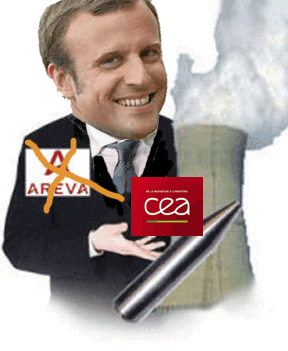
“Without civilian nuclear power, there is no military nuclear power, and without military nuclear power, there is no civilian nuclear power,” Macron said.
Nuclear energy too costly for humans — and the planet https://www.dw.com/en/opinion-nuclear-energy-too-costly-for-humans-and-the-planet/a-60390384 21 Jan 22
Nuclear power will soon be classified as environmentally friendly under the new EU taxonomy. But nothing about it is green or safe, says DW’s Jeannette Cwienk.
I can still clearly recall that spring afternoon in late April 1986. I had been out playing in the woods and building a fort with some friends, when a rain shower forced us back home. It was a fun, carefree day.
We had no idea that just hours earlier, reactor number 4 at the Chernobyl power plant near the Ukrainian city of Pripyat had exploded.
When the news came out days later, the Chernobyl catastrophe and fears of a radiation-filled future quickly came to define my younger years.
Such memories, however, are not the only reason for my concern about the European Commission’s proposal to include nuclear energy and natural gas as environmentally-friendly technology in the EU taxonomy.
Doing so would see nuclear energy classified as sustainable, and recommend it as an option for investors — making a mockery of environmental efforts.
Who will pay for nuclear accidents?
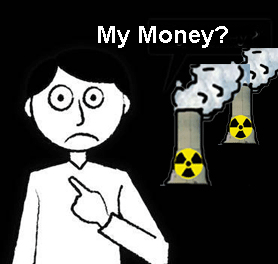
The EU Commission is completely ignoring the costs of nuclear energy. Quite apart from the funds required to build new nuclear power plants, even smaller ones, there is the far more important and apparently overlooked question of who would foot the bill in the event of an accident.
.
In Germany alone, the federal costs attached to the consequences of the Chernobyl catastrophe have been estimated at around €1 billion ($1.1 billion). Worldwide, the immediate economic ramifications of Chernobyl are estimated to have been more than €200 billion — and that doesn’t include the cost of widespread related illness.
Health costs were also not included in the €177-billion bill linked to the consequences of the March 2011 Fukushima nuclear disaster in Japan, as estimated by the Japanese government in 2017.
Most of these costs have since been covered by Japanese taxpayers, because the operating company, TEPCO, was de facto nationalized after the disaster to avoid insolvency.
Taxpayers will be forced to foot the bill
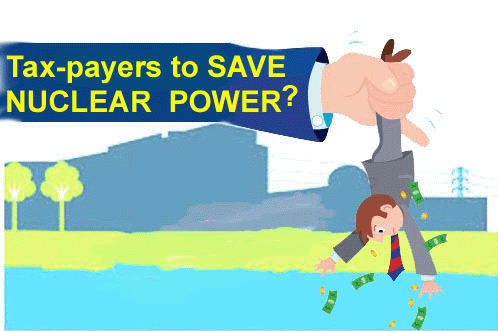
And this brings us to the heart of the problem: in Europe, the amounts that nuclear operators are required to set aside in case they’re found liable for a nuclear accident are laughably small. In the Czech Republic, nuclear power plant operators are required to have €74 million on hand in case of an accident; in Hungary, the figure is €127 million.
Even in France, the driving force for the planned “greening” of European nuclear energy and the largest consumer of nuclear energy worldwide — it makes up around 70% of its energy supply — operators are only required to set aside €700 million in case of an accident. A large nuclear accident in Europe could easily cost between €100 and 430 billion. And should that happen, the affected countries — along with their taxpayers — will be forced to foot the bill.
This situation has been met with criticism by Germany’s new finance minister and the leader of the neoliberal Free Democrat Party, Christian Lindner, who recently expressed skepticism about the place of nuclear energy in the new EU taxonomy.
“An energy source that can only be mainstream if the state is prepared to accept liability — that’s a sign from the market that it can’t be a sustainable energy source,” he said.
On Friday, the German government is likely to vote against the EU Commission’s plans — and rightly so. Austria and Luxembourg, on the other hand, have gone a courageous step further and have announced plans to take Brussels to court if the disputed sustainability plans go ahead.
Small modular reactors also a risk
In France, meanwhile, President Emmanuel Macron likes to describe nuclear power as a “stroke of luck” for climate protection. The fact that 10 of the country’s reactors are currently offline — three from the latest generation due to safety concerns — are apparently not an issue for the French government, which has been trying to allay the fears of a nuclear accident with new small modular reactors (SMR). These smaller power stations are only around one 10th of the size of a conventional nuclear site — and therefore are considered less dangerous, in the event of an accident.
But this plan has a whole range of shortcomings, not least because reaching the same capacity as a single large nuclear reactor requires a great deal of these small reactors.
“This high number will increase the risk of a nuclear accident many time over,” the German Federal Office for the Safety of Nuclear Waste Management (BASE) recently warned.
Is it really about climate protection?
BASE has also been critical of a report by the EU’s Joint Research Center, which the EU Commission has used to make its assessment about the environmental friendliness of civil nuclear power.
The EU report only partially considers the risks of nuclear energy use for humans and the environment, as well as for future generations, and some of the principles of scientific work are not correctly taken into account. According to BASE, the report cannot be relied on to comprehensively assess the sustainability of nuclear energy use.
This has raised doubts over the claim that Brussels wants to include nuclear power in the new EU taxonomy primarily for climate protection reasons. Instead, the decision seems to be down to political pressure, especially from Paris.
As a global nuclear power, France wants to hold on to its nuclear plants at all costs, as Macron clearly stated in December.
“Without civilian nuclear power, there is no military nuclear power, and without military nuclear power, there is no civilian nuclear power,” he said.
No comments yet.
1 This Month
Chernobyl: The Lost Tapes – A good documentary on Chernobyl on SBS available On Demand for the next 3 weeks– https://www.sbs.com.au/ondemand/tv-program/chernobyl-the-lost-tapes/2352741955560

of the week–London Campaign for Nuclear Disarmament

Tell the Ukrainian Government to Drop Prosecution of Peace Activist Yurii Sheliazhenko
To see nuclear-related stories in greater depth and intensity – go to https://nuclearinformation.wordpress.com
-
Archives
- April 2026 (127)
- March 2026 (251)
- February 2026 (268)
- January 2026 (308)
- December 2025 (358)
- November 2025 (359)
- October 2025 (376)
- September 2025 (257)
- August 2025 (319)
- July 2025 (230)
- June 2025 (348)
- May 2025 (261)
-
Categories
- 1
- 1 NUCLEAR ISSUES
- business and costs
- climate change
- culture and arts
- ENERGY
- environment
- health
- history
- indigenous issues
- Legal
- marketing of nuclear
- media
- opposition to nuclear
- PERSONAL STORIES
- politics
- politics international
- Religion and ethics
- safety
- secrets,lies and civil liberties
- spinbuster
- technology
- Uranium
- wastes
- weapons and war
- Women
- 2 WORLD
- ACTION
- AFRICA
- Atrocities
- AUSTRALIA
- Christina's notes
- Christina's themes
- culture and arts
- Events
- Fuk 2022
- Fuk 2023
- Fukushima 2017
- Fukushima 2018
- fukushima 2019
- Fukushima 2020
- Fukushima 2021
- general
- global warming
- Humour (God we need it)
- Nuclear
- RARE EARTHS
- Reference
- resources – print
- Resources -audiovicual
- Weekly Newsletter
- World
- World Nuclear
- YouTube
-
RSS
Entries RSS
Comments RSS
 nuclear-news
Leave a comment