In Georgia, Bloated Costs Take Over a Nuclear Power Plant and a Fight Looms Over Who Pays,
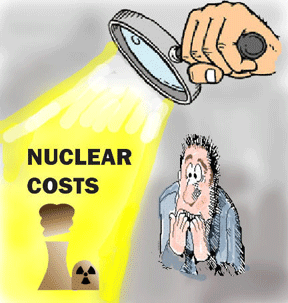
In Georgia, Bloated Costs Take Over a Nuclear Power Plant and a Fight Looms Over Who Pays,
Vogtle’s two new nuclear reactors are six years late and at least $16 billion over their original budget. The plant will have no direct carbon footprint, but critics say there are much cheaper ways to reduce emissions.
Inside Climate News, By James Bruggers, January 21, 2022 Ballooning cost overruns and construction delays at Georgia Power Co.’s Vogtle nuclear project threaten to cost the state’s electricity consumers billions of dollars in the decades to come, a new think tank report concludes.
The report, from the Institute for Energy Economics and Financial Analysis, a nonprofit advancing a sustainable energy economy, builds a case that stockholders of the company should take the lead on construction and carry much of the financial load, rather than ratepayers.
Once estimated to cost $14 billion, the price tag for two new reactors at Georgia Power’s Plant Vogtle property has climbed past $30 billion, and both units will be more than six years late in coming online, the institute reported after combing through public records including testimony at a Georgia Public Service Commission hearing in December. The plant already has two existing nuclear power units that began producing electricity in the 1980s.
Public Service Commission staff and consultants have blamed the project’s high costs and construction delays on Georgia Power, which is the lead partner in its construction and eventual operation, and a subsidiary of Southern Company, the energy policy institute found.
Georgia Power was warned in 2008 that using an unproven reactor design would likely cause overruns and delays, said David Schlissel, the report’s author and the institute’s director of resource planning and analysis. “However, the company challenged and the commission disregarded these warnings,” said Schlissel, a lawyer who has been a frequent expert witness in legal proceedings.
Commission spokesman Tom Krause said he could not comment directly on the institute’s report or the commission’s ongoing quasi-judicial proceedings that are designed to monitor the construction, which the Atlanta Journal Constitution has described as the largest project in Georgia history. The commission regulates Georgia Power, and as such, has a major say in Georgia energy policy.
Krause said future hearings, when the project is farther along, will be held to help the commission, made up of five members who are elected statewide, determine which of the Vogtle costs should be allocated to ratepayers, as opposed to shareholders.
“That will be a very significant docket before the PSC,” Krause said.
“I imagine it will be a knock-down, drag-out fight,” Schlissel said. “I have heard a fair amount of the documentation, and just reading what the PSC staff has been saying, clearly this project has been mismanaged.”
The institute, based in Lakewood, Ohio, is not an official party in those proceedings and its report was not prepared for any organization that is directly participating in them, Schlissel said.
Georgia Power’s customers have already paid more than $3.5 billion for the two units through a rider on their electric bills intended to cover financing charges, the report found.
“Our new Vogtle units will be clean energy sources and produce zero air pollution,” said Jeff Wilson, Georgia Power spokesman. “That’s why we remain fully committed to getting the job done, and getting it done right, with safety and quality our top priority.”
He also minimized the plant’s impact on customers’ rates.
The two units were originally to be placed in service in 2016 and 2017. The owners now estimate commercial operation will not begin until 2022 and 2023, according to the report. They are to be the first new commercial nuclear power units in the United States in the last three decades.
The institute’s report quoted a commission hearing in December at which an independent monitor of the project, Don Grace, told the commission that Georgia Power had on more than one occasion used low forecasts as a way to “try and continue to justify the project.”………….
Grace, in his testimony, described developing the plant as similar to driving “uphill in the snow.”
And the wheels are turning. Money is being spent and you’re trying to get to the goal of getting to the top of the hill,” he said. “But in some cases you’re making slow progress, but not at the rate you expected. And in some cases you’re actually slipping backwards somewhat.”……………………… https://insideclimatenews.org/news/21012022/georgia-power-vogtle-nuclear/
No comments yet.
1 This Month
Chernobyl: The Lost Tapes – A good documentary on Chernobyl on SBS available On Demand for the next 3 weeks– https://www.sbs.com.au/ondemand/tv-program/chernobyl-the-lost-tapes/2352741955560

of the week–London Campaign for Nuclear Disarmament

Tell the Ukrainian Government to Drop Prosecution of Peace Activist Yurii Sheliazhenko
To see nuclear-related stories in greater depth and intensity – go to https://nuclearinformation.wordpress.com
-
Archives
- April 2026 (126)
- March 2026 (251)
- February 2026 (268)
- January 2026 (308)
- December 2025 (358)
- November 2025 (359)
- October 2025 (376)
- September 2025 (257)
- August 2025 (319)
- July 2025 (230)
- June 2025 (348)
- May 2025 (261)
-
Categories
- 1
- 1 NUCLEAR ISSUES
- business and costs
- climate change
- culture and arts
- ENERGY
- environment
- health
- history
- indigenous issues
- Legal
- marketing of nuclear
- media
- opposition to nuclear
- PERSONAL STORIES
- politics
- politics international
- Religion and ethics
- safety
- secrets,lies and civil liberties
- spinbuster
- technology
- Uranium
- wastes
- weapons and war
- Women
- 2 WORLD
- ACTION
- AFRICA
- Atrocities
- AUSTRALIA
- Christina's notes
- Christina's themes
- culture and arts
- Events
- Fuk 2022
- Fuk 2023
- Fukushima 2017
- Fukushima 2018
- fukushima 2019
- Fukushima 2020
- Fukushima 2021
- general
- global warming
- Humour (God we need it)
- Nuclear
- RARE EARTHS
- Reference
- resources – print
- Resources -audiovicual
- Weekly Newsletter
- World
- World Nuclear
- YouTube
-
RSS
Entries RSS
Comments RSS
 nuclear-news
Leave a comment