We the People: What led to the Cold War?

We the People: What led to the Cold War? Fear of nuclear weapons annihilating all life on Earth, for one thing https://www.spokesman.com/stories/2021/dec/19/we-the-people-what-led-to-the-cold-war-fear-of-nuc/ 19 Dec 21 By Pip CawleyFor The Spokesman-Review
Each week, The Spokesman-Review examines one question from the Naturalization Test immigrants must pass to become United States citizens.
Today’s question: During the Cold War, what was one main concern of the United States?
There are two official answers to this question. One is that the U.S. was concerned about the spread of communism. The other is that the U.S. was concerned with the possibility of nuclear war. The myriad ways the fear of communism influenced the United States are too numerous and complex for this brief article.
Instead, I want to discuss the fear of nuclear war. It is easy to forget that since the invention and proliferation of nuclear weapons, we now have the technology available to exterminate our entire species. The fear of nuclear war was ever-present and influenced every aspect of American life. In his Nobel Prize acceptance speech, the celebrated author William Faulkner stated, “Our tragedy today is a general and universal physical fear so long sustained by now that we can even bear it. There are no longer problems of the spirit. There is only the question: When will I be blown up?”
Let’s discuss how we got to this point.
The Cold War, so named because the two major powers, the United States of America and the Union of Soviet Socialist Republics, never “heated up” or fought open war in Europe, lasted from 1945 to 1990.
Some historians argue the Cold War started during the end of World War II and that the use of the first nuclear weapons on Japan was intended, among other things, to intimidate the Soviets.
The Cold War impacted not just military concerns but was a ubiquitous concern for everyday Americans. A real fear of nuclear war was ever-present in American society. Government-backed films like “The Red Menace” reminded the public of the threat of nuclear war, and families built bomb shelters in their yards and basements.
Schools practiced drills where children were taught to hide under their desks in the case of nuclear war. Obviously, a small desk won’t protect a child from nuclear bombs, but it was part of what is called “security theater.” Security theater is the performance of security or safety measures that realistically do nothing to increase the individual’s safety but give a small sense of control and comfort. They are doing something, and even if what they’re doing is useless, it still helps them feel better.
In reality, there is nothing we could do to protect ourselves from the devastation nuclear weapons bring. Those not killed in the blast instead die of radiation exposure. If enough nuclear weapons are detonated, it will cause a nuclear winter in which the sun’s rays are blocked by clouds of dust and debris. Without warmth from the sun, temperatures on Earth would radically drop, killing all plant and animal life on the planet. This was, and still is, a new and frightening reality.
We arrived at this new reality thanks to what is called the arms race. The U.S. and the USSR sought to get or maintain a technological and tactical advantage over each other. Both countries invested immense amounts of resources to develop new and more powerful weapons. For example, if the U.S. built one aircraft carrier, the USSR would build two, which would prompt the U.S. to build three more even larger aircraft carriers, and so on. The constant one-upmanship of the arms race led to the development of nuclear weapons, first in the U.S. and then in the USSR.
Eventually, these stockpiles of weapons became so large that the two countries each had the capability of destroying all human life on Earth. If one country attacked, the other would retaliate and the conflict could eventually escalate to the use of nuclear weapons, which would then lead to our own extinction.
For that reason, the two countries agreed not to directly attack each other in what is called Mutually Assured Destruction.
Since neither side wanted to end all life on Earth, they agreed not to directly attack each other. This kept an all-out war from breaking out between the two countries.
They did wage proxy wars against each other all over the globe. The U.S. and the USSR demanded that other countries pick a side, theirs or their enemy’s. The USSR expanded its sphere of influence toward Europe, drawing an Iron Curtain across the territory.
The Soviets invaded Afghanistan and spent 10 years fighting for control of the country. On the other hand, the U.S. invaded Korea and later Vietnam in order to prevent the countries from “falling to communism.” Meanwhile, the push for decolonization in Africa led to armed conflicts, often funded or supplied by one of the major powers. In Iran and several South American countries, clandestine plans and espionage were used to unseat governmental leaders, some of whom were democratically elected, and replace them with new leaders who would be friendly to U.S. interests.
Today, the U.S. and Russia possess the most nuclear weapons, and despite disarmament treaties and downsizing of stockpiles, both still possess enough nuclear devices to destroy the planet several times over. In the years since the Cold War ended, other countries have obtained nuclear capabilities. There are nine countries with nuclear weapons; some others are seeking to obtain their own.
While fear of nuclear war no longer influences our daily lives, as it did during the Cold War, it remains a real concern in international relations.
Pip Cawley received her Ph.D. in political science from Washington State University in Pullman. This article is part of a Spokesman-Review partnership with the Thomas S. Foley Institute of Public Policy and Public Service at Washington State University
Lower output from France’s nuclear power stations is causing electricity prices to soar.
The low availability of nuclear plants in France is causing power prices
to soar, crushing the competitiveness of the nation’s companies,
according to the Uniden trade group that represents energy-intensive
industries.
Electricite de France SA this week announced new or extended
outages at four of the nation’s 56 nuclear reactors during winter, when
demand peaks. Available nuclear capacity in France is already below average
for the time of year, and the halts — combined with record natural gas and
carbon prices — have pushed power costs to fresh records, with a widening
premium over those in neighboring Germany.
Bloomberg 17th Dec 2021
Greenpeace says that TEPCO ignored risks to South Korea when assessing radiological impact of releasing Fukushima nuclear water waste.
The international environmental organization called TEPCO’s radiological
impact assessment “highly selective” in its use of IAEA guidelines. The
international environmental group Greenpeace sent an opinion to the Tokyo
Electric Power Company (TEPCO) on Thursday stating that the company’s
radiological impact assessment of contaminated water from the Fukushima
Nuclear Power Plant made convenient use of International Atomic Energy
Agency (IAEA) guidelines without considering the potential damages to
residents of neighboring countries such as South Korea.
The opinion from Greenpeace was based on its review of the draft version of a contaminated
water radiological impact assessment report released by TEPCO last month.
Hankyoreh 18th Dec 2021
http://english.hani.co.kr/arti/english_edition/e_international/1023823.html
French Environment Minister asks EDF to conduct audit on nuclear power availability, following safety shutdowns
French Environment Minister Barbara Pompili asked power utility EDF
(EDF.PA) on Friday to conduct an audit on the availability of its nuclear
power stations after the company shut down some of its reactors due to
technical problems. EDF, whose reactors provide up to 70% of the country’s
electricity needs, said on Wednesday it found faults at a nuclear power
station and shut down another plant using the same kind of reactors.
Reuters 17th Dec 2021
German experts argue that high costs, delays and toxic wastes mean that money for nuclear power would be better spent elsewhere
From CNN 19 Dec 21, ……..German politicians and experts argue that high costs and the time it takes to build new plants — no fewer than five years, and often much longer — mean money would be better spent elsewhere.
German politicians and experts argue that high costs and the time it takes to build new plants — no fewer than five years, and often much longer — mean money would be better spent elsewhere.
German officials also argue that the lack of a global plan for storing toxic waste should disqualify nuclear as a “sustainable” energy source.Christoph Hamann, an official at Germany’s federal office for nuclear waste management, emphasized that government efforts to construct sites below ground where waste can be stored indefinitely remain a work-in-progress.”We’re talking about a very toxic, high radioactive waste, which is producing problems for the next tens of thousands, or even hundreds of thousands of years. And we’re directing this problem, when using nuclear power, to future generations,” Hamann said………..
USA govt moves towards getting an interim storage for nuclear wastes
The feds have collected more than $44 billion for a permanent nuclear waste dump — here’s why we still don’t have one, CNBC, DEC 18 2021 KEY POINTS
- The federal government has more than $44 billion collected from energy customers since the 1980s specifically to be spent on a permanent nuclear waste disposal in the United States.
- Currently, nuclear waste is mostly stored in dry casks on the locations of current and former nuclear power plants around the country.
- On Nov. 30, the Office of Nuclear Energy at the U.S. Department of Energy took a preliminary step towards establishing an interim repository for nuclear waste. Some see this as a reason for optimism, others as kicking the can down the road.
The federal government has a fund of $44.3 billion earmarked for spending on a permanent nuclear waste disposal facility in the United States.
It began collecting money from energy customers for the fund in the 1980s, and the money is now earning about $1.4 billion in interest each year.
But plans to build a site in Yucca Mountain, Nevada, were scuttled by state and federal politics, and there’s been a lack of political will to find other solutions. The result is that the U.S. does not have the infrastructure to dispose of radioactive nuclear waste in a deep geologic repository, where it can slowly lose its radioactivity over the course of thousands of years without causing harm………………………………………….
After 2014, the federal government was forced to stop collecting money for the Nuclear Waste Fund because of a legal ruling. Owners and operators of nuclear power plants had challenged Department of Energy’s collection of fees, arguing that ratepayers should not be paying into a fund when the United States had no viable options for where the used fuel permanent disposal should go.
Amid all the stops and starts, the money in the Nuclear Waste Fund has been put back into the general fund and is being used for other purposes, Frank Rusco of the Government Accountability Office says. To use the funds for their original purpose would require new authorization and appropriation by Congress, he said.
“This will potentially cause a difficulty in getting a repository built,” Rusco said.
Since the federal government has not established a permanent repository for its radioactive nuclear waste, it’s had to pay utility companies to store it themselves. Currently, nuclear waste is mostly stored in dry casks on the locations of current and former nuclear power plants around the country. So far, the system is working, and in 2014, the Nuclear Regulatory Commission (NRC), the lead oversight body for the industry, has said that current storage technology would be sufficient for 100 years……………………
As of Sept. 30, the government has paid $9 billion to utility companies for their interim storage costs and the Department of Energy’s Agency Finance Report estimates it will cost another $30.9 billion until a permanent waste disposal option is completed in the United States.
hat estimate could prove to be low, Rusco said.
However, the tide may be turning back toward finding longer-term solutions.
On Nov. 30, the Office of Nuclear Energy at the U.S. Department of Energy put out a formal “request for information” for a temporary, but consolidated, nuclear waste storage in the U.S.
Unlike a permanent storage facility, which involves digging deep into the ground, a temporary facility would simply keep all the dry casks together in one place, as opposed to distributed around the country. In some cases, the local nuclear plants have been completely disassembled — but the waste is still stored on site. Consolidating it would at least save on costs.
Nuclear power is never safe or economical
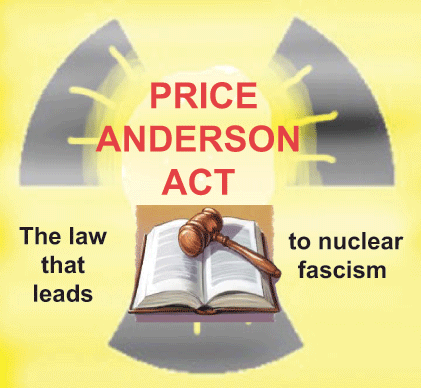
Nuclear power is never safe or economical
I hope Sen. Durbin changes his mind about promoting nuclear energy. The real carbon-free sources of electricity are wind and solar. Chicago Sun Times George Milkowski, West Ridge Nov 27, 2021 ”’
……….. When nuclear power plants were first touted in the 1950s as a new and safe method for producing electricity, it was said the electricity would be “too cheap to meter.” This is pure nonsense! If it was so safe, why weren’t any power plants built and put on line until passage of the Price-Anderson Act? The law has been amended a number of times and greatly limits the liability of operators of nuclear power plants.
Anything paid out beyond the limits set in Price-Anderson would take years of lawsuits.
Sen. Durbin wrote “It is past time for Congress to step up and develop a comprehensive, consent-based plan to store nuclear waste.” That’s an understatement. Nuclear waste is stored within a half-mile of Lake Michigan at the now-closed Zion nuclear power plant. Why is it close to the source of our drinking water? Because there is nowhere to ship it! Plans to ship such waste to a depository in Yucca Mountain in the southwest fell through when some improperly stored barrels burst into flames, releasing large amounts of high-level radioactive material.
Who does the senator think will agree to a “consent-based plan” when there is no known method of safely storing these dangerous materials for thousands of years, the time it takes for radioactive decay to make it safe for the environment?
Sen. Durbin argued that “we must ensure the nuclear fleet remains safe and economical,” but nuclear power has never been economical. As far as I know, the last time a permit was approved for a new nuclear plant was during the Obama administration. That plant in Georgia is only about half complete, although it was to be finished by now and the cost is already double the initial estimate.
The current “fleet,” as Sen. Durbin called them, of nuclear power plants were designed and engineered to last about 30 to 40 years. Most of our country’s plants are near that age. Their internal systems are constantly bombarded by radioactive particles, making the metal in the systems more brittle and prone to failure every year. Subsidizing them is a waste of taxpayer money and a dangerous gamble with our lives.
I hope Sen. Durbin changes his mind. The real carbon-free sources of electricity are renewables: wind and solar.
The climate change impact of Manchin’s “no” on Biden plan
The climate change impact of Manchin’s “no” on Biden plan
Senator Joe Manchin’s (D-W.Va.) decision Sunday to oppose President Biden’s signature climate and social policy legislation imperils the administration’s climate goals.
Humanity should not test whether Antarctica’s ice will hold out
Humanity should not test whether Antarctica’s ice will hold out
Washington Post editorial
Humanity should not test whether unrestrained warming will catastrophically reshape the world’s coastlines. As is the case with so many other potential climate consequences, allowing this gamble to play out is not worth the risk.
PFAS ‘forever chemicals’ constantly cycle through ground, air and water, study finds
PFAS ‘forever chemicals’ constantly cycle through ground, air and water, study finds
The Stockholm University study highlights the chemicals’ mobility, which has been found in penguin eggs and polar bears
Understanding cobalt’s human cost
Understanding cobalt’s human cost
After studying the impacts of mining cobalt — a common ingredient in lithium-ion batteries — on communities in Africa’s Democratic Republic of the Congo (DRC), an interdisciplinary team of researchers led by Northwestern University is calling for more data into how emerging technologies affect human health and livelihoods.
Heysham 2 nuclear power station to close earlier than planned
Heysham 2 nuclear power station will continue generating electricity
safely until 2028, however, “closing” two years earlier than originally
planned. In 2016, the sites’ operational lives were extended by seven
years to 2030. Operational dates are under constant review and since then
inspection, modelling and operational experience from other sites, have
given EDF a clearer picture of lifetime expectations for the AGR fleet as
the stations age. Heysham 1 will operate until 2024,
Lancaster Guardian 17th Dec 2021
Energy economics – getting the fuel -oil and nuclear -for continued expansion of capitalism – is costing more all the time
Dave Elliott: n an interesting article in the Ecologist, Gareth Dale
argues that the rising cost of plundering nature presents major problems
for the continued expansion of capitalism.
For example, he says the ‘energy return on energy invested’ (EROI) for fossil-fuel extraction is
plummeting: ‘In plain English, ever more energy is consumed in squeezing
each drop of oil from the bowels of the earth’. He notes that a recent
study has found that, at present, over 15% of the oil extracted was being
use to extract more oil and that this will rise as easily accessed reserves
deplete.
It’s the same for nuclear – as high grade ore reserves
deplete, the energy cost of mining/processing uranium rise, with EROI
ratios falling from 15:1 as now, to maybe 5:1 or less over time. Meantime
the EROIs for renewables are mostly higher and improving- e.g. solar was
poor in the early days, but is now at around 25:1, wind is around 50:1 on
good sites, and may get to 80:1 offshore, hydro is at around 200:1.
Renew Extra 18th Dec 2021
https://renewextraweekly.blogspot.com/2021/12/energy-resource-limits.html
French President says discussions continue with Germany about nuclear power as ”green”
French President Emmanuel Macron said on Thursday France and Germany would
continue discussions in the coming days to find a compromise on whether the
European Union should label nuclear and gas as green investments. France
wants to be able to attract green finance to fund the construction of new
nuclear power plants in France, while Germany is phasing out nuclear and
keen on switching to gas — a fossil fuel. Macron said in a joint news
conference with his German counterpart Olaf Scholz that a decision on the
subject, the so-called green taxonomy, would soon be issued by the European
Commission.
Reuters 17th Dec 2021
1 This Month

of the week – Shut Down Drone Warfare!


Tell the Ukrainian Government to Drop Prosecution of Peace Activist Yurii Sheliazhenko

Petition to revoke the licensing of the Near Surface Nuclear Disposal Facility (NSDF) at Chalk River. https://www.ourcommons.ca/petitions/en/Petition/Details?Petition=e-7247
To see nuclear-related stories in greater depth and intensity – go to https://nuclearinformation.wordpress.com
-
Archives
- April 2026 (57)
- March 2026 (251)
- February 2026 (268)
- January 2026 (308)
- December 2025 (358)
- November 2025 (359)
- October 2025 (376)
- September 2025 (257)
- August 2025 (319)
- July 2025 (230)
- June 2025 (348)
- May 2025 (261)
-
Categories
- 1
- 1 NUCLEAR ISSUES
- business and costs
- climate change
- culture and arts
- ENERGY
- environment
- health
- history
- indigenous issues
- Legal
- marketing of nuclear
- media
- opposition to nuclear
- PERSONAL STORIES
- politics
- politics international
- Religion and ethics
- safety
- secrets,lies and civil liberties
- spinbuster
- technology
- Uranium
- wastes
- weapons and war
- Women
- 2 WORLD
- ACTION
- AFRICA
- Atrocities
- AUSTRALIA
- Christina's notes
- Christina's themes
- culture and arts
- Events
- Fuk 2022
- Fuk 2023
- Fukushima 2017
- Fukushima 2018
- fukushima 2019
- Fukushima 2020
- Fukushima 2021
- general
- global warming
- Humour (God we need it)
- Nuclear
- RARE EARTHS
- Reference
- resources – print
- Resources -audiovicual
- Weekly Newsletter
- World
- World Nuclear
- YouTube
-
RSS
Entries RSS
Comments RSS
 nuclear-news