Nuclear Plants Masquerading as Climate-Friendly Shouldn’t Qualify for Green Finance

Nuclear Plants Masquerading as Climate-Friendly Shouldn’t Qualify for Green Finance
December 17, 2021 Gaye Taylor,
Bruce Power’s recent issuance of C$500 million in green bonds to help extend the life of Ontario’s biggest nuclear power plant is being touted as a critical step toward decarbonization. But it could also be seen as a dangerous and time wasting dead-end, a corruption of the very notion of green financing.
According to Jonathan Hackett, head of sustainable finance at BMO Capital Markets and co-lead green structuring agent for Bruce Power, nuclear is necessary to the net-zero transition, writes the Globe and Mail.
According to Hackett, the urgent need to green the energy and power sectors means nuclear power is a worthy recipient of green finance.
But confronting the notion that nuclear power is “green” are unresolved concerns about what to do with reactor waste products, as well as the acute dangers inherent in nuclear power plants, with the tragedy at Japan’s Fukushima plant the most recent example.
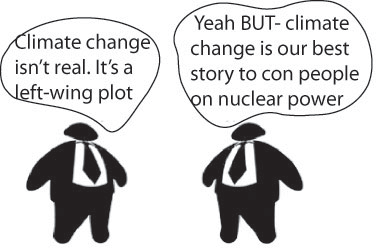
As for the claim that nuclear is essential to avoiding climate meltdown, independent experts say the world has neither the time, the funds, nor the expertise to bring the expensive and notoriously slow sector to bear in time to shift the climate crisis in any meaningful way.
And this reality doesn’t change as the hype around small modular nuclear reactors (SMRs) ramps up. “There is no SMR promoter suggesting a prototype could be licenced, built, and operating by the end of this decade,” said Mycle Schneider, author of the annual World Nuclear Industry Status Report, at a webinar hosted by University of British Columbia in October. “That means—if ever, likely not—a commercialization could start only in the second half of the 2030s.”

Noting that “the industry has never kept its promises on schedules and budgets,” Schneider added, “we have no time, money, and brainpower to waste on fantasy PowerPoint designs.”
Early this month, Ontario Power Generation and GE Hitachi triumphantly announced plans to bring an SMR into service at the Darlington nuclear generating station “as early as 2028”. But even if they managed to bring the project in on time and on budget—a practice that has never been the industry’s strong suit—the project would just be one expensive generation source in a decarbonizing economy that needs far more electricity, and vastly more energy efficiency, far faster than SMRs can deliver.
And this year’s WNISR report was only the latest to conclude that the nuclear industry outside China is already in decline, with its output in the United States dropping to its lowest level since 1995. In France, a former nuclear leader, atomic generation dropped to 1985 levels.
Faced with such an implosion in the prospects of its traditional reactors, the nuclear industry has seized upon SMRs as a ticket to a new revenue track. But SMRs will never be ready in time to shift the trajectory of the climate crisis. Even if they worked, “it would take centuries to build enough to make a difference,” Schneider said.

Schneider is not alone that view.
“Betting on nuclear as a climate solution is just sticking our heads in the sand because SMR technology is decades away, extremely expensive, and comes with a nasty pile of security and waste headaches,” Ontario Clean Air Alliance Chair Jack Gibbons wrote last year, responding to then-natural resources minister Seamus O’Regan’s full-throated endorsement of the SMR storyline.
“That our government would be this gullible is distressing, especially given the havoc already being wreaked by a changing climate,” he added.
Jonathan Porritt, founder of the UK’s Forum4theFuture, echoed Gibbons’ view in a March opinion piece for The Guardian. He warned of a nuclear sector now “straining every sinew to present itself as an invaluable ally” in the global push for net-zero by 2050.” Yet the problems that have long dogged the industry remain unchanged: “ever-higher costs, seemingly inevitable delays, no solutions to the nuclear waste challenge, security and proliferation risks.”
No comments yet.
1 This Month

of the week – Shut Down Drone Warfare!


Tell the Ukrainian Government to Drop Prosecution of Peace Activist Yurii Sheliazhenko

Petition to revoke the licensing of the Near Surface Nuclear Disposal Facility (NSDF) at Chalk River. https://www.ourcommons.ca/petitions/en/Petition/Details?Petition=e-7247
To see nuclear-related stories in greater depth and intensity – go to https://nuclearinformation.wordpress.com
-
Archives
- March 2026 (244)
- February 2026 (268)
- January 2026 (308)
- December 2025 (358)
- November 2025 (359)
- October 2025 (376)
- September 2025 (257)
- August 2025 (319)
- July 2025 (230)
- June 2025 (348)
- May 2025 (261)
- April 2025 (305)
-
Categories
- 1
- 1 NUCLEAR ISSUES
- business and costs
- climate change
- culture and arts
- ENERGY
- environment
- health
- history
- indigenous issues
- Legal
- marketing of nuclear
- media
- opposition to nuclear
- PERSONAL STORIES
- politics
- politics international
- Religion and ethics
- safety
- secrets,lies and civil liberties
- spinbuster
- technology
- Uranium
- wastes
- weapons and war
- Women
- 2 WORLD
- ACTION
- AFRICA
- Atrocities
- AUSTRALIA
- Christina's notes
- Christina's themes
- culture and arts
- Events
- Fuk 2022
- Fuk 2023
- Fukushima 2017
- Fukushima 2018
- fukushima 2019
- Fukushima 2020
- Fukushima 2021
- general
- global warming
- Humour (God we need it)
- Nuclear
- RARE EARTHS
- Reference
- resources – print
- Resources -audiovicual
- Weekly Newsletter
- World
- World Nuclear
- YouTube
-
RSS
Entries RSS
Comments RSS
 nuclear-news
Leave a comment