UK government will ”prove the potential”of advanced nuclear reactors with its Advanced Modular Reactor Research, Development and Demonstration Programme.
nuClear NewsNo 136 Dec 21, Advanced Reactors , Energy minister Greg Hands told the Nuclear2021 conference organised by the Nuclear Industry Association that the UK will build a high-temperature gas reactor (HTGR) as the centrepiece of its Advanced Modular Reactor Research, Development & Demonstration Programme.
The goal of the research programme is to “prove the potential” of advanced reactors and have a demonstration unit in operation “by the early 2030s, at the latest”. The key focus would be to produce high temperature heat which could be used for hydrogen production, to supply industrial processes and potentially district heating as well as electricity generation.
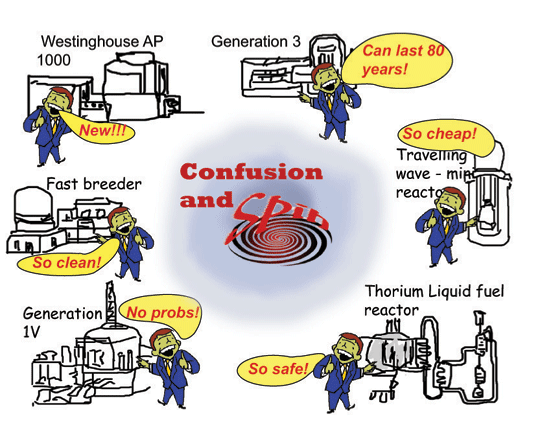
Several other reactor concepts could have been selected. The emerging category of ‘advanced’ reactors includes the lead-cooled fast reactor, molten salt reactor, supercritical water-cooled reactor, sodium-cooled fast reactor and very-high-temperature gas reactor in addition to hightemperature gas reactors.
Paul Howarth, CEO of the National Nuclear Laboratory (NNL), called it “a further signal of the resurgence of nuclear.” He added, “With the opportunity HTGRs bring to deliver high temperature heat, hydrogen and synthetic fuels, the potential of this technology to help decarbonise our industries and energy grid is significant.” He noted that NNL is “actively working on the fuel, graphite and high temperature materials required for HTGRs.”
The Advanced Modular Reactor Research, Development & Demonstration Programme counts on £170 million of government funding from a £385 million package intended to accelerate development of highly flexible nuclear technologies. (1)
In July the Government sought views on its preference to explore the potential of High Temperature Gas Reactors (HTGRs) for the Advanced Modular Reactor Research Development & Demonstration (AMR RD&D) Programme. It says the call found no significant, additional evidence to materially change the outcome of the Government’s underpinning analysis. As a result, the Programme will focus on High Temperature Gas Reactors with the ambition for this to lead to a HTGR demonstration by the early 2030s at the latest. In parallel, government continues to support the development of all AMRs as part of wider policy on advanced nuclear activities. This includes: opening the Generic Design Assessment (GDA) process to advanced nuclear technologies and developing a siting approach for further nuclear developments. (2) https://www.no2nuclearpower.org.uk/wp/wp-content/uploads/2021/12/nuClearNewsNo136.pdf
No comments yet.
-
Archives
- February 2026 (233)
- January 2026 (308)
- December 2025 (358)
- November 2025 (359)
- October 2025 (376)
- September 2025 (258)
- August 2025 (319)
- July 2025 (230)
- June 2025 (348)
- May 2025 (261)
- April 2025 (305)
- March 2025 (319)
-
Categories
- 1
- 1 NUCLEAR ISSUES
- business and costs
- climate change
- culture and arts
- ENERGY
- environment
- health
- history
- indigenous issues
- Legal
- marketing of nuclear
- media
- opposition to nuclear
- PERSONAL STORIES
- politics
- politics international
- Religion and ethics
- safety
- secrets,lies and civil liberties
- spinbuster
- technology
- Uranium
- wastes
- weapons and war
- Women
- 2 WORLD
- ACTION
- AFRICA
- Atrocities
- AUSTRALIA
- Christina's notes
- Christina's themes
- culture and arts
- Events
- Fuk 2022
- Fuk 2023
- Fukushima 2017
- Fukushima 2018
- fukushima 2019
- Fukushima 2020
- Fukushima 2021
- general
- global warming
- Humour (God we need it)
- Nuclear
- RARE EARTHS
- Reference
- resources – print
- Resources -audiovicual
- Weekly Newsletter
- World
- World Nuclear
- YouTube
-
RSS
Entries RSS
Comments RSS
 nuclear-news
Leave a comment