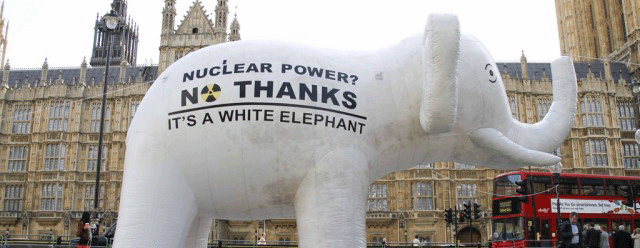
British pensioners funding France’s ”nuclear renaissance” with white elephant nuclear projects?
According to Gérard Magnin, a former EDF director, the French company sees Hinkley as ‘a way to make the British fund the renaissance of nuclear in France’. He added: ‘We cannot be sure that in 2060 or 2065, British pensioners, who are currently at school, will not still be paying for the advancement of the nuclear industry in France.’ ..……….
White elephant energy projects that are tomorrow’s HS2, The Conservative Woman, 10 Dec 21, -December 10, 2021AS someone who has in a small way been opposing the climate catastrophe narrative* and has had to study the government’s energy plans, I’m beginning to wonder why Suffolk has been chosen for not one but two white elephant energy projects. What have we done to deserve this? An even more pertinent question is ‘What the hell does this technologically-illiterate government think it is doing?…….
The proposed Sizewell C will house a pair of French-designed nuclear fission reactors of 1600MW output each which are slated to be built next to the decommissioned Sizewell A. …………
Superficially (i.e. as assessed by a typical minister who has the same knowledge of science, technology, engineering and mathematics as the average 12-year-old) Sizewell seems an obvious place to dump a pair of the new generation large nuclear reactors, that is if you ignore the fact that it will take a big bite out of the Suffolk Coastal Area of Outstanding Natural Beauty, ruin the tourist trade for decades and require the building of a temporary town to house the thousands of workers who will be imported to build it. More to the point, they’ll come in late while costing far more than the estimate.
It seems no one in government has noticed that European Pressurised Water Reactors (EPRs) like the two planned for Sizewell C are proving extremely difficult to build. For example, the Finnish Olkiluoto Nuclear Power Plant already had two reactors of a different design, so they are not nuclear tyros. They applied for planning permission for the third, the first Finnish EPR, in 2000. It was due to begin feeding power to the grid in 2010. The latest estimate is June 2022. That’s 22 years between application and delivery of electricity instead of ten. It comes as no surprise that Finland has cancelled plans for a second EPR. Another example: the Hinkley C EPRs in Somerset have a strike price of £106/MWh at 2021 prices and will, unless there are further delays, be contributing to the grid in 2026 after approval in 2008. As well as being late it is over budget: the cost estimate was £18billion in 2016, but by 2019 it was up to £22,500,000,000 and the electricity it produces will cost more than forecast.
The deadline for the UK Planning Inspectorate to submit their recommendation for Sizewell C is January 14, 2022. The minister then has three months to think it over. It will be interesting to see what he or she decides if, as is perfectly possible, we are then in the middle of a fuel and energy crisis.
Working on the Olkiluoto timescale, Sizewell C would begin to power UK homes in 2044, by which time climate hysteria may well have abated. And of course there is the matter of cost. Initial estimate for Olkiluoto was €3billion for the single reactor. Latest and nearly final estimate is €11,000,000,000. It makes HS2 look a bargain.
According to the Financial Times Her Majesty’s Government has noticed that China General Nuclear (CGN) may not be the ideal partner to be involved in building nuclear reactors in the UK: like all Chinese firms it is the tool of its owner, the Chinese State, and as such has strategic interests which may not chime with those of the UK. Permitting any foreign state-controlled company to have its hand on the off switch of the National Grid is obviously undesirable – which is unfortunate as there’s another foreign state-owned ‘partner’ in the car crash that is the UK’s nuclear development plan. Électricité de France (EDF) owns 75 per cent of Framatome, the firm responsible for the disastrous EPR design. There are various subsidies, name changes and takeovers that complicate matters but here is the underlying reality: Framatome designs, manufactures, and installs components, fuel and instrumentation and control systems. It is involved in Hinkley C, the Chinese reactors at Taishan where there have recently been safety concerns, and has recently bagged a contract to supply control and support equipment for a Russian reactor. So this foreign firm is supplying Russia and China with duplicates of the equipment which is being installed in the UK…………
And while we’re on the subject of EDF, here’s a report from the Guardian in 2017: According to Gérard Magnin, a former EDF director, the French company sees Hinkley as ‘a way to make the British fund the renaissance of nuclear in France’. He added: ‘We cannot be sure that in 2060 or 2065, British pensioners, who are currently at school, will not still be paying for the advancement of the nuclear industry in France.’ …………
DRUMS OF WAR Biden is pushing us to brink of NUCLEAR WAR over Ukraine in chilling echo of Cuban missile crisis, Russia claims

FIRES OF WAR Biden is pushing us to brink of NUCLEAR WAR over Ukraine in chilling echo of Cuban missile crisis, Russia claims, The Sun UK, Katie Davis, 10 Dec 2021
RUSSIA has warned Joe Biden is pushing the nation to the brink of NUCLEAR WAR as tensions over Ukraine hit boiling point.
Sergei Ryabkov, Russia’s deputy foreign minister, has warned a chilling echo of the 1962 Cuban missile crisis is possible as the US closely watches unrest at the border.
“You know, it really could come to that,” he said.
“If things continue as they are, it is entirely possible by the logic of events to suddenly wake up and see yourself in something similar.”
A standoff between Russia and the US brought the world close to nuclear war when Washington blocked Moscow from shipping nuclear missiles to Cuba in 1962 – and Ryabkov has warned escalating tensions between the nations risk a repeat of that.
After strained negotiations, John Kennedy and Nikita Khrushchev reached an agreement, with the Soviet leader dismantling their offensive weapons in Cuba on the condition the US would sign a public declaration to not invade the Caribbean country again.
It comes amid mounting tensions between the West and Moscow over a potential invasion of Ukraine – with growing fears war could break out.
Last week US intelligence detected Russia massing 175,000 troops on the border with Ukraine as fears of a potential invasion in early 2022 are mounting.
Meanwhile, Moscow claimed its fighter jets intercepted a US spy plane that was flying over the Black Sea.
Russia has denied that it plans to attack Ukraine.
Ryabkov’s warning comes after Joe Biden held a high-stakes call with Vladimir Putin as tensions between Washington and Moscow intensify over Ukraine.
The two-hour call between the leaders was held in a bid to de-escalate tensions – with the US President threatening sanctions over the situation at Russia’s border…………….
Russia has been demanded Ukraine not join NATO and raged that the US must stop all military activity in the region.
Ukraine commanders have warned that a Russian invasion would overwhelm the country without help from the West…………
it’s reported Britain and her allies are ready to use force to stop Russia invading Ukraine – despite warnings it would lead to the worst conflict since World War Two…………
a US senator has warned America could “rain destruction” on Russia with nuclear weapons if Putin invades Ukraine……
Senator Roger Wicker said “We don’t rule out first-use nuclear action, we don’t think it will happen, but there are certain things in negotiations, if you are going to be tough, that you don’t take off the table.”
But the Russian Embassy in Washington hit back at Wicker’s remarks, branding his suggestion that the US should consider using nuclear weapons against Moscow in the event of invasion as “irresponsible”.
“Such statements are irresponsible,” the statement, posted on Facebook, said.
“We advise all the unenlightened to read the joint statement of the Presidents of Russia and the United States of June 16, 2021 thoroughly. This document reaffirms the two countries’ commitment to the principle that a nuclear war cannot be won and must never be fought.”………. https://www.thesun.co.uk/news/16999520/biden-pushing-brink-nuclear-war-ukraine-russia/
The latest court case for Australian Julian Assange – and the death of democracy
Assange is too important to the establishment to let get away. No matter that the C.I.A. wanted to kill him; no matter that the C.I.A. spied on his privileged conversations with his lawyers; no matter that the chief witness in the computer conspiracy charge admitted he made it all up.
The Old Boy Network of trust between the rulers of the Anglo-Saxon powers was enough.
To save their hides from more exposure about how they try to violently and deceptively dominate the world, they are willing to sacrifice the last vestiges of their pretend democracy.
Julian Assange is that important to them.
Democracy Dying in the Darkness of the Assange Case https://consortiumnews.com/2021/12/10/democracy-dying-in-the-darkness-of-the-assange-case/ December 10, 2021 The establishment figures on the bench took American promises as “solemn undertakings from one government to another” because Assange is too important to let go, By Joe Lauria.
It is a very dark day indeed for the future of press freedom. If Julian Assange does not find relief at the U.K. Supreme Court, it won’t be an exaggeration to say that democracy, already on life support, is done for. The U.S., and its best ally Britain, have behaved in this affair no better than any tinpot dictator tossing a critical reporter into a dungeon.
This judgement by the High Court today to allow Assange’s extradition to the U.S. comes on U.N. Human Rights Day; the day that Washington concluded its so-called Democracy Summit and the day when the Nobel Prize was awarded to two journalists, one of whom dismissed Julian Assange and said the purpose of journalism is to support national security.
That’s exactly what the national security state wants from its journalists. And they reward them with the highest honors. Assange did the opposite. He fulfilled journalism’s supreme purpose and he may be about to pay for it with his life.
The Choices Available
The High Court could have denied extradition to a country whose intelligence service plotted to kill or kidnap him. It could have sent the case back to magistrate’s court to be reheard.
Instead Lord Chief Justice Ian Burnett and Lord Justice Timothy Holroyde found an extremely narrow way to overturn the lower court’s decision not to extradite Assange.
Continue readingEuropean Union passes sustainable taxonomy law, but postpones decision about nuclear power.

“The commission must deliver a science-based taxonomy regulation that excludes fossil gas, nuclear, and factory farming. Otherwise, the credibility of the taxonomy is ruined.”
EU green taxonomy becomes law, gas and nuclear postponed, Institutional investors have signalled they want a taxonomy that is based on science – not political compromise. euobserver, By WESTER VAN GAAL 11 Dec 21,
BRUSSELS, The first two chapters of the sustainable taxonomy, the EU’s ambitious labelling system for green investment, were passed on Thursday (9 December).
Until midnight on Wednesday, EU member states had time to reject this first set of rules – the so-called ‘first delegated act’.
But despite opposition from a group of countries, the proposal passed and will come into force on 1 January 2022. It will describe the sustainable criteria for renewable energy, car manufacturing, shipping, forestry and bioenergy and more, and include a “technology-neutral” benchmark at 100 grams of CO2 per kilowatt-hour for any investments in energy production.
The criteria for the list has mainly been compiled by the Sustainable Finance Platform, a group of 57 NGOs, scientific and financial experts, making the first part of taxonomy “science-based”…..
The European Commission will now likely unveil the second delegated act on 22 December.
This will describe how nuclear and gas will be labelled under the taxonomy. But the process has become highly-politicised over the last months.
Second act
In a meeting of member states on 29 November the project nearly faltered.
An EU diplomat, speaking anonymously, explained to EUobserver that a French-led group of 13 member states tried to block the first list “out of principle” – because the commission had not agreed to include nuclear and gas in the green taxonomy.
France and Finland pushed for nuclear to be “fully part of the taxonomy.” Ten other mainly eastern European countries want gas included. Sweden joined the group because the new rules endanger its forestry sector.
The group tried to gain a supermajority of 15 to force the commission’s hand but fell short. Germany and Italy abstained, but did not respond to requests for explanation made by EUobserver.
The commission will now decide how to label nuclear and gas before the end of the year, and it is not yet clear how the issue will pan out…………..
Whatever the commission will decide, only a supermajority in the council – 15 member states – or a parliamentary majority can block the second delegated act. Both are unlikely.
What next?
Institutional investors have already signalled they want a taxonomy based on science, not political compromise.
This will “harm the objective-scientific, transparent character of the taxonomy and increases the risk of ‘greenwashing’. Europe promised the world climate leadership, it is time to show it,” a group of banks wrote this week.
Sebastien Godinot, a senior economist at WWF and member of the EU’s Sustainable Finance Platform, said the commission must not give in to blackmail and bullying.
“The commission must deliver a science-based taxonomy regulation that excludes fossil gas, nuclear, and factory farming. Otherwise, the credibility of the taxonomy is ruined.”
But the commission may have no choice but to compromise between the gas and nuclear-supporting member states on one side, and countries opposing these on the other – while also being mindful that investors and experts from its Sustainable Finance Platform will reject a system containing contradictory political concessions. https://euobserver.com/climate/153776
Inside information from China could sink the French nuclear flagship EPR.
 | |||

Image – by Eva Stegen
Maxron says –
''we are building nuclear power plants 6 new epr klima blablabla''
Inside information from China could sink the French nuclear flagship EPR https://www.ausgestrahlt.de/blog/2021/12/09/insider-infos-aus-china-k%C3%B6nnen-franz%C3%B6sisches-atomflaggschiff-epr-versenken/ 09.12.2021 | Eva Stegen In 1989, in response to Chernobyl, development of a third generation reactor began. The European pressurized water reactor EPR has not yet generated a kilowatt hour in Europe. Despite multiple disasters, no one pulled the rip cord. Now a whistleblower reveals a system error that should be the end of the EPR.
Some people either have nerves of wire, no self-esteem or the deep certainty that any nonsense they utter will be whipped into all media via the international press agencies, just as if one did not have to check a completely absurd announcement at least once. But it is so, the French emperor is naked. He just yelled out to the press that he wanted to have six more reactor construction sites for the fiasco flagship EPR (European pressurized water reactor) when a whistleblower tore the last scrap of material off his body. It was a French nuclear engineer who had an in-depth look at the EPR reactors in Taishan, China. They are the only two – out of 200 announced – that ever went online.
There it was just ………
However, one of the two is offline again after just 2.5 years of operation. With an unknown outcome. Evidence is growing that a design flaw affecting the entire EPR series has led to Taishan 1 being switched off. The whistleblower gave the radiation research institute ‘CRIIRAD’ important detailed technical information from Taishan. CRIIRAD, in turn, put a series of questions to the French nuclear regulator, ‘Autorité de Sûreté Nucléaire’, ASN.
The silence of those who knew it
A copy was sent to the news agency ‘AFP’, but miraculously the horror news did not spread as rapidly as Macron’s ludicrous announcement to sink further billions in further ‘EPR’ flop construction sites. With every additional day on which neither the operator nor the nuclear regulatory authority deny ‘ASN’, this hypothesis of the design flaw, which affects all ‘EPR’, becomes more important.
In June 2021, a CNN report from Taishan, China caused a stir. There was talk of an “imminent radiological threat” in a letter from the French consortium partner “Framatome” to the US Department of Energy, which “CNN” has received. The Chinese security authorities were accused of having raised the radiation limit values for the outside area around the nuclear power plant in order to circumvent the shutdown of the defective reactor block.
Where do the radioactive gases come from?
As early as October 2020, defects were found on the cladding tubes of some fuel elements, which led to the escape of radioactive gases in the reactor pressure vessel. Despite the radiological risks for workers and residents, the nuclear power plant continued to operate. First of all, according to Bruno Chareyron from ‘CRIIRAD’. This duct damage is quite normal, something like that happens. In fact, however, the degree of damage to the cladding tubes and the gas leaks in the reactor have steadily worsened since it was loaded with fuel in autumn 2020.
The operators have asked the authorities to increase the limit value, above which the reactor must be shut down. The authorities would have doubled the value , but as the contamination continued to rise, the new warning threshold was exceeded at the end of May 2021. This continued until the shutdown on July 30, 2021. In August, the fuel rods began unloading. Nobody knows when or whether the reactor can ever start again.
Thanks to the whistleblower’s insider knowledge, ‘CRIIRAD’ is now able to track down the causes of the defective ducts, which the investigative satirical magazine ‘le Canard enchaîné’ described as “knots in the pipelines”. The cameras that the Chinese had brought into the heart of the EPR, in the reactor pressure vessel, were supposed to check the thesis that the zirconium cladding tubes that protect the uranium fuel rods are unusually corroded.
The operators have asked the authorities to increase the limit value, above which the reactor must be shut down. The authorities would have doubled the value , but as the contamination continued to rise, the new warning threshold was exceeded at the end of May 2021. This continued until the shutdown on July 30, 2021. In August, the fuel rods began unloading. Nobody knows when or whether the reactor can ever start again.
Thanks to the whistleblower’s insider knowledge, ‘CRIIRAD’ is now able to track down the causes of the defective ducts, which the investigative satirical magazine ‘le Canard enchaîné’ described as “knots in the pipelines”. The cameras that the Chinese had brought into the heart of the EPR, in the reactor pressure vessel, were supposed to check the thesis that the zirconium cladding tubes that protect the uranium fuel rods are unusually corroded.
In addition to the risk of pipe rupture in the primary circuit, there is also the risk that the grids, which are intended to hold the fuel elements in position in the reactor pressure vessel, are damaged by the vibrations. If this structure is weakened , Chareyron explained , it is conceivable that in the event of an earthquake the clusters of fuel and control rods would swing against the inner walls of the container. A deformation induced in this way could mean that the control rods, which are actually supposed to brake the nuclear chain reaction, cannot retract.
Bad Vibrations from Olkiluoto and the scandal forge Le Creusot
As early as 2018, the Finnish electricity supplier ‘TVO’ and the Finnish safety authority ‘STUK’ reported that during tests on the Olkiluoto EPR permanent construction site, vibrations had occurred in the primary circuit on the reactor pressure vessel .
But as early as 2007/08 hydraulic model tests at the scandal-shrouded nuclear component manufacturer in Le Creusot brought the vibration problem to light. That is why ‘CRIIRAD’ asks the nuclear supervisory authority about the failed attempt to reduce the flow of water with the help of a baffle that was attached under the reactor core in order to influence the hydraulics and thus the vibrations. The vibration problem is obviously inherent in the system and affects not only the Taishan blocks but also Olkiluoto, Flamanville and Hinkley Point C. In short, all Generation 3 reactors that were once touted as “inherently safe”.
Corecatcher not catchy
In addition to carbon-brittle forging errors, messed up welds and inferior concrete, there are also vibrations of the artfully knotted pipeline design. The once-praised core catcher, which was supposed to catch a melted reactor core, apparently also gives the engineers a headache. If a large fragment of the container were to block the slide to the catcher, the corium would not flow into the catcher, according to the confidential account. But the naked Emperor Macron never tires of loudly proclaiming his atomic illusions. If the idea of the third generation of EPR reactors, which incidentally dates back to 1989, doesn’t work, you can tell the same nonsense again. Simply use the same “climate saver” texts again, just replace generation 3 and EPR with generation 4 and SMR. Apparently, the president is sure that the news agencies and the associated copy-paste editorial offices are already creating the appropriate mental cinema for EU citizens. Because he wants taxonomy money from them, for even more atomic illusions.
‘The Catalog of Nuclear Death’: The U.S.’s Hair Raising Plan to Obliterate Russia

‘The Catalog of Nuclear Death’: The U.S.’s Hair Raising Plan to Obliterate Russia, The U.S. Air Force’s titled 1956 Atomic Weapons Requirement Study outlined all the targets it planned to hit if World War III broke out and how many bombers and nuclear weapons it would need to get the job done. In short, the report is a catalog of nuclear death. The National Interest, by WarIsBoring 10 Dec 21, Here’s What You Need to Know: The Air Force’s 1956 Atomic Weapons Requirement Study detailed the U.S.’s nuclear plan to attack Russia if the need should ever arrive.
In one scene from Stanley Kubrick’s iconic Cold War film Dr. Strangelove, an irate president Merkin Muffley refuses to get on board with a massive nuclear attack already in progress. Played by Peter Sellers, Muffley is trying to decide what to do after a rogue U.S. Air Force general sends his planes to bomb the Soviet Union.
“You’re talking about mass murder, general, not war!” Muffley angrily tells George C. Scott’s Gen. Turgidson, after the officer suggests the impending strikes could actually work. “Mr. President, I’m not saying we wouldn’t get our hair mussed,” Turgidson quips.
“But I do say no more than 10 to 20 million killed … tops,” the general stammers. “Uh, depending on the breaks.”
Released to a public faced with the ever present threat of nuclear annihilation in 1964, Kubrick probably had no idea just how close he was to the truth. Eight years earlier, the Air Force put together a report detailing how to obliterate the Soviet Union, China and their allies.
The National Security Archive at George Washington University obtained the document through a Mandatory Declassification Review and released it online on Dec. 22, 2015.
The flying branch’s blandly titled 1956 Atomic Weapons Requirement Study outlined all the targets it planned to hit if World War III broke out and how many bombers and nuclear weapons it would need to get the job done. Over the course of more than 800 pages, intelligence analysts identified more than 2,000 potential “designated ground zeroes” in the Soviet Union and elsewhere, including both military bases and cities.
“The SAC study includes chilling details,” William Burr, a nuclear researcher and analyst at the National Security Archive, wrote along with the release. “According to its authors, their target priorities and nuclear bombing tactics would expose nearby civilians and ‘friendly forces and people’ to high levels of deadly radioactive fallout.”
In short, the report is a catalog of nuclear death.
In 1956, Washington no longer had a monopoly on atomic bombs, but appeared to be winning the nuclear arms race. While Moscow had set off its first atomic weapon seven years before, the Pentagon had already started fielding even more powerful thermonuclear hydrogen bombs.
With long-range ballistic missiles still in development, the Air Force relied on a fleet of lumbering bombers and faster fighters to lob the nuclear arsenal in any actual war. The attack would come from warplanes armed with free-fall bombs or from early cruise missiles like the much maligned Snark………………
Those targets or target complexes that do not have a direct bearing on the destruction of SovBloc air power objective are part of the systematic destruction objective,” the authors explained. “The importance of the latter is not minimized.”
H-bombs would be reserved for important military targets, like air bases. American planes would drop atomic bombs on the rest……
The report includes a five-page key to every single category that might appear in the voluminous lists of bombing targets. It includes country codes for various facilities in all eight members of the Warsaw Pact. Depending on the type of target, three digit identifiers for Communist China, North Korea, North Vietnam and pre-Shah Iran might also be present.
Every single entry has a special eight-number code corresponding to an entry in a master “bombing encyclopedia.” The first four digits indicate a general zone, while the last four digits indicate the particular site or collection of sites within that particular area. This recording method theoretically allows for up to 9,999 individual targets within a given space.
The analysts clearly tried to pick out anything and everything that might have any effect on the war effort, from facilities producing cutting tools to rubber tires to the antibiotic streptomycin. Most notably, the Air Force defined “275” as the code for “population.”
Every single entry has a special eight-number code corresponding to an entry in a master “bombing encyclopedia.” The first four digits indicate a general zone, while the last four digits indicate the particular site or collection of sites within that particular area. This recording method theoretically allows for up to 9,999 individual targets within a given space.
The analysts clearly tried to pick out anything and everything that might have any effect on the war effort, from facilities producing cutting tools to rubber tires to the antibiotic streptomycin. Most notably, the Air Force defined “275” as the code for “population.”
“The authors developed a plan for the ‘systematic destruction’ of Soviet bloc urban-industrial targets that specifically and explicitly targeted ‘population’ in all cities, including Beijing, Moscow, Leningrad, East Berlin and Warsaw,” Burr pointed out. “Purposefully targeting civilian populations as such directly conflicted with the international norms of the day, which prohibited attacks on people per se (as opposed to military installations with civilians nearby).”
But other contemporary sources make it abundantly clear the Pentagon saw any person tied to a war effort as a viable military target. A now declassified 1952 U.S. Navy film on chemical and biological warfare specifically states a goal “to incapacitate the enemy’s armed forces and that portion of his human population that directly supports them.” With similar thoughts in mind, the U.S. Army had looked into radiological warfare and built deadly dirty bombs………
“The anonymous authors may not have been scientists,” Burr said. “But in light of the 1954 Castle Bravo test, which spread radioactive debris globally, they should have known better.”……. This first appeared in WarIsBoring here. https://nationalinterest.org/blog/reboot/catalog-nuclear-death-uss-hair-raising-plan-obliterate-russia-197705
.
Nuclear Command and Control Satellites Should Be Off Limits – here’s why
|

Nuclear Command-and-Control Satellites Should Be Off Limits https://www.defenseone.com/ideas/2021/12/nuclear-command-and-control-satellites-should-be-limits/187472/ Blowing up some satellites causes problems. Blowing up these could cause nuclear war. By JAMES ACTON and THOMAS MACDONALD, DECEMBER 10, 2021
When Russia blew up an old satellite with a new missile on November 15, it created an expanding cloud of debris that will menace the outer space environment for years to come.
Hypersonic fragments from the collision with Moscow’s ground-launched, anti-satellite weapon risk destroying other satellites used for communications, meteorology, and agriculture. They even pose a danger to China’s Tiangong Space Station and the International Space Station, where personnel—including Russia’s own cosmonauts—were forced to don spacesuits and flee into their escape capsules ahead of approaching debris.
But the greatest danger that this careless stunt highlighted is to a different potential target: high-altitude satellites used for nuclear command and control. Those critical satellites face the threat of being attacked by co-orbital anti-satellite weapons, that is, other spacecraft with offensive capabilities. Destroying a nuclear command-and-control satellite, even unintentionally, could lead a conventional conflict to escalate into a nuclear war. As such, the United States, China, and Russia have a shared interest in ensuring the security of each other’s high-altitude satellites.
Satellites are integral to the United States’ nuclear command-and-control system. They would be the preferred means to transmit a presidential order to use nuclear weapons and would provide the first warning of an incoming nuclear attack. Russia uses satellites for similar purposes, even if it appears not to rely on them quite as much as the United States. While little is publicly known about China’s nuclear command-and-control system, the U.S. Department of Defense has assessed that China is in the process of developing a space-based early-warning system.
The most important nuclear command-and-control satellites—those for communications and early warning—are located in high-altitude orbits. Fortunately, most are strung out about 22,500 miles above the equator—far above the debris from Russia’s ground-launched anti-satellite weapon test. These satellites, however, are growing more vulnerable, particularly to co-orbital anti-satellite weapons.
Nuclear command-and-control satellites might be attacked deliberately, as the prelude to a nuclear war. In a conventional conflict, if China, Russia, or the United States decided to use nuclear weapons first—or believed that its opponent was about to do so—it might try to degrade the adversary’s nuclear command-and-control system preemptively. China, for example, might attack U.S. early-warning satellites to weaken the United States’ homeland missile defenses. Conversely, the United States might target Chinese communication satellites to interfere with Beijing’s ability to wield its nuclear forces.
In a conventional war, however, nuclear command-and-control satellites might be attacked and threatened for altogether different reasons—creating the risk that nuclear war might be triggered inadvertently. The United States, in particular, is deeply reliant on satellites to enable conventional operations. Moreover, most, if not all, nuclear command-and-control satellites also support nonnuclear missions—making them tempting targets even in a purely conventional conflict. For example, some U.S. satellites transmit orders to both U.S. conventional and nuclear forces. Russia might attack these satellites to try to undermine the United States’ ability to prosecute a conventional war, but with the added and unintended effect of degrading the U.S. nuclear command-and-control system.
Washington would be hard pressed to determine the intent behind such attacks. It could easily misinterpret them as preparations for a nuclear war and respond accordingly. It might threaten to use nuclear weapons unless its adversary backed off. In fact, the Trump administration’s nuclear policy explicitly threatened the use of nuclear weapons in precisely this circumstance. The Biden administration can and should remove this threat as part of its ongoing Nuclear Posture Review.
To make matters worse, it might not take actual attacks against nuclear command-and-control satellites to spark this kind of escalation. Satellites in high-altitude orbits are periodically moved to different positions to optimize their performance. Especially in a conventional conflict, a repositioning operation that led one spacecraft to approach a nuclear command-and-control satellite might appear to the latter’s owner as the beginning of an attack against its nuclearcommand-and-control system. Once again, the potential consequences could be catastrophic.
“Keep-out zones” around high-altitude satellites would be a straightforward way to mitigate these risks. Specifically, the United States, China, and Russia should agree not to maneuver their spacecraft within a certain distance—we propose 430 miles—of one another’s high-altitude satellites. (Exceptions could be made to accommodate occasional repositioning under tightly controlled conditions. Most importantly, the state conducting the maneuver should warn the others at least 24 hours in advance.)
In a conflict, if the belligerents had no intention of attacking each other’s high-altitude satellites, they would have strong reasons of self-interest to respect keep-out zones. If a state did seek to launch such attacks, keep-out zones couldn’t stop it from doing so—but they would buy time that the targeted state could use to try to evade the attack.
Negotiating keep-out zones during a conflict, when they would be most useful, would be next-to impossible. So, Washington, Beijing, and Moscow shouldn’t wait—they should start negotiating right away.
James M. Acton is co-director of the Nuclear Policy Program and holds the Jessica T. Mathews Chair at the Carnegie Endowment for International Peace. Thomas D. MacDonald is a fellow in the Nuclear Policy Program.
The shutdown of Germany’s last nuclear power plant could enable Germany’s North to cover 160% of its electricity needs with renewables.

The shutdown of the last nuclear power plant in Schleswig-Holstein will boost wind power in the northern German state, its environment minister Jan Philipp Albrecht (Greens) expects. “Nuclear power is clogging our grids, especially in the direction of the south,” Albrecht told press agency dpa in an article carried by Focus Online.
Due to grid bottlenecks, offshore wind turbines would have to be switched off in some cases. “The importance of nuclear power as a whole is therefore overestimated,” he added.
After the shutdown of the nuclear plant at the end of this year, the north of Germany could cover 160 percent of its electricity needs with renewable energy and there will be more wind power exports to the south, Albrecht said.
Fears of power blackouts due to the nuclear phaseout are unfounded, he said. “After all, we will continue to massively expand renewable energies in Germany now. In the future, we will not be dependent on nuclear power being generated in France.”
Clean Energy Wire 9th Dec 2021
Turkey’s nuclear plans threaten Eastern Mediterranean ecosystems
Turkey’s nuclear plans threaten East Med ecosystems, ekathimerini.com, Elias G. Hadjikoumis, 10 Dec 21, Turkey has had plans to establish nuclear power plants since the 1970s, and these plans have become a key aspect of the country’s goal of economic development and growth. The Akkuyu Nuclear Power Plant (ANPP) is the first. Turkey and Russia ratified the agreement to construct the plant in May 2010. The agreement indicated that Akkuyu NGS Elektrik Uretim Corp, a subsidiary of Rosatom, would construct, own and operate the plant. The nuclear power plant is to comprise four reactors. While the major construction activities began in March 2018, the first reactor unit is expected to be operational in 2023 and the remaining units in 2026. Once complete, the plant is seen covering 10% of the country’s total electricity supply. Turkey also intends to build two nuclear power plants on the Black Sea coast to meet energy demands. Although the plants would give the country clean [?] energy and make it energy-independent, there are numerous negative environmental effects associated with the generation of nuclear energy, and these pose a threat to Turkey’s neighboring countries as well as Turkey itself.
Nuclear is considered a clean source of energy because no carbon dioxide is emitted during operation, however, all activities related to building and running a plant lead to the production of high amounts of CO2, including the current construction and plant development processes at Akkuyu. Additionally, the plant will use uranium as its main source of fuel, whose extraction processes release great amounts of CO2 into the atmosphere.
The power plant is located close to the Eastern Mediterranean, a region which comprises a vast set of coastal and marine ecosystems that deliver valuable benefits to all its coastal inhabitants. The region is set to experience negative environmental changes because of the huge amounts of water that will be required to cool the plant’s reactors. Pumping the seawater used to cool the four reactors back into the sea could lead to an 80% increase in water temperatures (2 to 5 degrees Celsius). The temperature rise would affect the area’s marine diversity. Environmentalists expect a decline in the number of fish because the high temperatures would probably kill most of them and reduce the egg-laying capacity of the rest. The high temperatures will also make the marine environment uninhabitable for a colony of Mediterranean monk seals and a very rare species of sea daffodil (Pancratium maritimum).
ANPP will affect countries around Turkey, especially Cyprus and Greece. Greece has already raised the alarm due to the lack of significant evaluation of the project and any protective measures for the environment and its neighbors. In fact, there were claims that the evaluation process for the plant was never concluded in Turkey. It is said that the government was influenced to hasten and conclude the evaluation process to favor its establishment in the specified site, which many consider unsafe because of the seismic activity in the area.
The European Parliament has called on the Turkish government to halt construction of the plant, citing the location of the construction site in a region prone to severe earthquakes. According to the European Parliament, the location of the site in a region prone to earthquakes poses a threat to Turkey and the entire Mediterranean region. The facility is situated 16 miles from the Ecemis fault line at the meeting point of the Eurasian and African tectonic plates. The fault was initially believed to be inactive when the nuclear plant’s site license was issued in 1976. However, scientific studies published in recent decades have shown that the fault is active. A nuclear engineering professor from an Istanbul university, one of the original nuclear engineers who signed the site license in 1976, indicates that the current construction is based on ignorant planning
and may pose a considerable threat to the Mediterranean region……………..
So far, no consultations have been held with neighboring countries. Commenting on the issue, a representative of the European Commission indicated that Turkey was not a party to international conventions, requiring countries to consult their neighbors over the environmental effects of major projects. The EU representative emphasized that Turkey is expected to align its legislation with EU requirements on such projects………
the greatest concern in the development of ANPP is radioactive waste in the East Medn region. Turkey has not yet signed the Joint Convention on the Safety of Spent Fuel Management and on the Safety of Radioactive Waste Management which came into effect in June 2001. Burying radioactive waste in the region would make it uninhabitable and in the event of an accident, the radioactive leak would be catastrophic to the environment. Local observers have already raised these issues. The observers argue that there has not been any clear explanation as to how Rosatom will dispose of the radioactive byproduct material generated by the nuclear plant. They fear that the site may even become a Russian nuclear dumpsite.
In conclusion, the nuclear project is a threat to Turkey and its neighbors. Its location in earthquake-prone areas and its anticipated negative environmental impact mean that the international community should put it on hold until a further assessment is carried out to determine its environmental viability. The project should be placed on hold because Turkey is not a signatory of international conventions and hence not obliged to consult with neighboring nations. The lack of consultations means that Turkey does not adequately account for the negative externalities arising from the plant on neighboring countries such as Greece and Cyprus.
Further assessment is needed to determine the effect of the plant on marine life and the potential negative effects owing to the vulnerability of Turkey and the Mediterranean region to earthquakes. The project was initiated and started even before a full commission and evaluation had been done and Turkey’s energy policies and prospects have a short overview, increasing the likelihood of an accident or lack of appropriate measures to contain any accidents in the region. The international community should take a strict position vis-a-vis the project, asking for close and consistent monitoring of all the nuclear development activities and future operations of the plant. https://www.ekathimerini.com/opinion/1173463/turkey-s-nuclear-plans-threaten-east-med-ecosystems/
Taishan Problems An investigation is still under way into leaks at nuclear power plant.

nuClear News No 136 Dec 21, Taishan Problems An investigation is still under way into the cause of problems at the Chinese EPR plant in Taishan. It was shut down in August after reports of damage to fuel rods. The plant is operated by CGN and owned in partnership with EDF, the two companies involved in building Hinkley Point C (HPC).
The Times (1) has reported that key safety components at HPC may need to be redesigned and the project delayed after defects were detected at a similar reactor in China. The newspaper says the scheduled start date for electricity generation, of June 2026, may have to be postponed.
The Commission for Independent Research and Information on Radioactivity (CRIIRAD), a French association created in the aftermath of the Chernobyl disaster, said that a whistleblower had reported to them that a design flaw in the reactor pressure vessel could be the cause of the problem at Taishan which means that design changes may be needed.
In a letter to the French nuclear regulator (2), ASN, CRIIRAD says: “In June 2021, the national and international press widely covered the case of the problems of ruptured nuclear fuel cladding at the Taishan 1 EPR reactor in China.”
It goes on to say there are several possible causes of the rupture some of which may involve design flaws in the reactor. A whistleblower has now told CRIIRAD that the ruptures are caused by a design flaw in the reactors pressure vessel. This will also cause problems in other EPR reactors like Hinkley Point C.
The letter continues: “If they are true, these revelations raise serious questions in terms of nuclear safety and radiation protection, both for plant workers and for residents. The existence of a generic design defect on the EPR reactor vessel could jeopardize the start-up of [other EPR reactors].”
Stop Hinkley spokesperson, Roy Pumfrey says:
“What’s been cobbled together to get Taishan started clearly isn’t working. It’s just another example of the folly of complex designs for big new nuclear reactors. Trying to identify and correct the design flaw can only lead to further delays and cost overruns for the absurdly expensive HPC project.”
“Stop Hinkley will be pressing the UK’s Office of Nuclear Regulation for a full disclosure of its investigations into this matter. And if there are expensive delays and modifications to HPC required, given the already huge cost to consumers, we will be asking government officials to investigate whether, in fact, it would be cheaper to cancel the whole thing.”
Eva Stegen, German blogger and energy consultant says the whistleblower gave the radiation research institute ‘CRIIRAD’ important detailed technical information from Taishan. With every additional day on which neither the operator nor the French nuclear regulatory authority – ASN – deny, the hypothesis that the design error affects all EPRs, Taishan’s problems become more important. She reminds us that in June 2021, a ‘CNN’ report from Taishan, China caused a stir. There was talk of an “immediate radiological threat” in a letter from the French consortium partner “Framatome” to the US Department of Energy. The Chinese security authorities were accused of having raised the radiation limit values for the outside area around the nuclear power plant in order to circumvent the shutdown of the defective reactor block.
In this context, a little-noticed communication of the Institute for Radiation Protection and Nuclear Safety – IRSN – of March 31 assumes new significance: the Institute expressed concern about “abnormally high vibrations” already observed in the primary circuit of several EPR reactors. It said the overall architecture of the primary circuit piping leads to the severe vibrations in the reactor pressure vessel due to an unfavourable distribution of the cooling water. These vibrations could lead to a pipe rupture in the primary circuit and cause significant radioactive releases. This raises the question whether the entire piping architecture should not be revised
As early as 2018, the Finnish power utility ‘TVO’ and the Finnish safety authority ‘STUK’ reported that during tests at Olkiluoto, vibrations had occurred in the primary circuit at the reactor pressure vessel.
So along with carbon-brittle misfits, botched welds and inferior concrete comes the vibration problem. The once-vaunted core catcher, which was supposed to be used to contain a melted reactor core, is apparently also giving engineers a headache. If a major fragment of the vessel were to block the chute to the catcher, the corium would not flow into the catcher. (3) https://www.no2nuclearpower.org.uk/wp/wp-content/uploads/2021/12/nuClearNewsNo136.pdf
Nuclear fusion – not as clean as they say: it produces considerable amounts of radioactive trash
NuClear News No 136 Dec 21, Fusion Waste The Committee on Radioactive Waste Management (CoRWM) has published a preliminary position on the implications for decommissioning, radioactive waste management, and radioactive waste disposal associated with fusion energy. (1) CoRWM member Claire Corkhill says: “Although nuclear fusion does not produce long lived fission products and actinides, neutron capture by the fusion reactor structural materials and components forms short, moderate and some long-lived activation products. In addition to tritium emissions and contaminated materials, it is clear that there will be a need to manage radioactive materials and wastes produced by neutron activation, within regulatory controls, over the whole life cycle of a fusion reactor.” (2)
The paper itself says: “The activation of components in a fusion reactor is low enough for the materials to be recycled or reused within 100 years.”
It continues:
“Minimising the generation of long lived activation products, and tritium inventory at source, is therefore of fundamental importance in achieving the primary objective in the waste hierarchy of waste prevention. However, it is to be recognised that future generations will be committed to managing wastes arising from decommissioning and waste management plans that are predicated on extended decay storage, such as those discussed herein.”
However, the paper goes on to says that “The primary components of the fusion reactor system are likely to require disposal, including the activated front wall, blanket, divertor and vacuum vessel materials … From a radiological perspective, it is reasonable to consider that, conceptually, wastes from a nuclear fusion power programme should be compatible with geological disposal, however, they may prove challenging for disposal in a near surface facility, given the long half-life and potential mobility of 14C and 94Nb.”
“…some key activation products of concern, such as 14C and 94Nb, which are long lived, should be limited in near surface disposal facilities, given the reliance on engineered barriers to assure containment.14C poses a particular challenge given its potential mobility in the near subsurface.
“Nuclear fusion technology is advocated as not being compromised by the burden of generating long lived nuclear wastes. It is evident that this claim is challenged by the expected generation of some significant volumes of LLW and likely ILW arisings. It may be noted that the recent call for expressions of interest to accommodate siting the STEP facility makes no mention of management of the arising radioactive waste. Future dialogue with local communities needs to ensure it is as open and transparent as possible on such matters.”
The Government is consulting on proposals for a regulatory framework for fusion. The consultation closes on 24th h December. See: https://assets.publishing.service.gov.uk/government/uploads/system/uploads/attachment_da ta/file/1032848/towards-fusion-energy-uk-government-proposals-regulatory-frameworkhttps://www.no2nuclearpower.org.uk/wp/wp-content/uploads/2021/12/nuClearNewsNo136.pdf
Even when he is silenced, immobilized, locked up and hidden from public view, Julian Assange continues to shine a light on the abusive mechanisms of power.
Assange: The Masks are Crumbling https://consortiumnews.com/2021/12/10/assange-the-masks-are-crumbling/
December 10, 2021 The U.S. and its allies don’t care about press freedom beyond the extent it can be used to conduct propaganda, writes Caitlin Johnstone after the High Court’s ruling against Julian Assange. By Caitlin Johnstone
CaitlinJohnstone.com The U.S. government has won its appeal against a lower British court’s rejection of its extradition request to prosecute Julian Assange for journalistic activity under the Espionage Act. Rather than going free, the WikiLeaks founder will continue to languish in Belmarsh Prison where he has already spent over two and a half years despite having been convicted of no crime.
“As a result, that extradition request will now be sent to British Home Secretary Prita Patel, who technically must approve all extradition requests but, given the U.K. Government’s long-time subservience to the U.S. security state, is all but certain to rubber-stamp it,” writes Glenn Greenwald. “Assange’s representatives, including his fiancee Stella Morris, have vowed to appeal the ruling, but today’s victory for the U.S. means that Assange’s freedom, if it ever comes, is further away than ever: not months but years even under the best of circumstances.”
“Mark this day as fascism casts off its disguises,” tweeted journalist John Pilger of the ruling.
This ruling, which allows the U.S. to continue working to extradite a journalist for exposing U.S. war crimes, comes on the final day of Washington’s so-called “Summit for Democracy“, where the U.S. secretary of state made a grandiose show about of press freedom playing “an indispensable role in informing the public, holding governments accountable, and telling stories that otherwise would not be told.” And then adding: “The U.S. will continue to stand up for the brave and necessary work of journalists around the world.”
This ruling also comes on UN Human Rights Day.
This ruling comes on the same day two journalists formally received the Nobel Peace Prizes they’d been awarded and demanded protections for journalists in their acceptance speeches.
This ruling comes as the U.S. government pledges hundreds of millions of dollars in support for “independent media” around the world in coordination with British state media.
This ruling comes after it was revealed that the C.I.A. drew up plans to kidnap and assassinate Assange in the Ecuadorian embassy after the 2017 Vault 7 releases embarrassed the agency.
This ruling comes after it was revealed that C.I.A. proxies spied on Assange and his lawyers at the Ecuadorian embassy, thereby making a fair trial in the United States impossible.
This ruling comes after it was revealed that the U.S. prosecution relied on false testimony from a diagnosed sociopath and convicted child molester.
This ruling comes after recent investigative reports on civilian-slaughtering U.S. airstrikes reminded us why it’s so important for the press to be able to conduct critical coverage of the most powerful military force ever assembled.
The facts are in and the case is closed: the U.S. and its allies do not care about press freedoms beyond the extent that they can be used to conduct propaganda. The way journalists who offend the powerful are dealt with by the U.S. government and the way they are dealt with by the Saudi monarchy differ only in terms of speed and messiness.
The masks are crumbling. Even when he is silenced, immobilized, locked up and hidden from public view, Julian Assange continues to shine a light on the abusive mechanisms of power. He is arguably exposing them more now than ever before.
As fascism casts off its disguises, it becomes more and more important to highlight the hypocrisy, fraudulence and depravity of the people who rule our world.
1 This Month


Tell the Ukrainian Government to Drop Prosecution of Peace Activist Yurii Sheliazhenko

Petition to revoke the licensing of the Near Surface Nuclear Disposal Facility (NSDF) at Chalk River. https://www.ourcommons.ca/petitions/en/Petition/Details?Petition=e-7247


of the week – STOP SMALL MODULAR REACTORS IN CANADA
To see nuclear-related stories in greater depth and intensity – go to https://nuclearinformation.wordpress.com
-
Archives
- March 2026 (204)
- February 2026 (268)
- January 2026 (308)
- December 2025 (358)
- November 2025 (359)
- October 2025 (376)
- September 2025 (258)
- August 2025 (319)
- July 2025 (230)
- June 2025 (348)
- May 2025 (261)
- April 2025 (305)
-
Categories
- 1
- 1 NUCLEAR ISSUES
- business and costs
- climate change
- culture and arts
- ENERGY
- environment
- health
- history
- indigenous issues
- Legal
- marketing of nuclear
- media
- opposition to nuclear
- PERSONAL STORIES
- politics
- politics international
- Religion and ethics
- safety
- secrets,lies and civil liberties
- spinbuster
- technology
- Uranium
- wastes
- weapons and war
- Women
- 2 WORLD
- ACTION
- AFRICA
- Atrocities
- AUSTRALIA
- Christina's notes
- Christina's themes
- culture and arts
- Events
- Fuk 2022
- Fuk 2023
- Fukushima 2017
- Fukushima 2018
- fukushima 2019
- Fukushima 2020
- Fukushima 2021
- general
- global warming
- Humour (God we need it)
- Nuclear
- RARE EARTHS
- Reference
- resources – print
- Resources -audiovicual
- Weekly Newsletter
- World
- World Nuclear
- YouTube
-
RSS
Entries RSS
Comments RSS
 nuclear-news