Exelon Generation Co changing its name to the more appropriate (Nuclear) Spin Co

Exelon moving nuclear plants, including Limerick, to spin-off company, https://www.readingeagle.com/2021/11/22/exelon-moving-nuclear-plants-to-spin-off-company/
The Nuclear Regulatory Commission OK’d the move on Nov. 17, By EVAN BRANDT | ebrandt@pottsmerc.com | Reading Eagle
November 22, 2021 LIMERICK — The federal Nuclear Regulatory Commission has signed off on a plan by Exelon Corp. to divest itself of its fleet of 23 nuclear power reactors, including the two at the Limerick Generating Station.
Exelon Corp. will transfer the NRC licenses to a new company, currently called HoldCo, as part of a corporate restructuring, the NRC announced on Nov. 17.
There is no money changing hands.
Exelon is not “selling” the plants, and spent fuel rod storage facilities, but rather “the transaction is taking place between corporate entities owned by Exelon,” NRC spokesman Neil Sheehan explained in response to a query from MediaNews Group.
‘It intends to separate its utilities, such as PECO, and competitive energy businesses, including its nuclear power plants, into two separate companies,’ Sheehan wrote.
“HoldCo will wholly own Exelon Generation Co. (renamed as SpinCo) and its subsidiaries. SpinCo will continue to own and operate the plants to the same extent as before the transfers. The final names for HoldCo and SpinCo will be determined prior to the completion of the transfer,” according to the Nov. 17 NRC announcement.
The new power-generation company will be named Constellation, according to a Nov. 17 press release from Exelon.
“Each of these companies will emerge as industry leaders with the financial and strategic independence to focus on best serving their respective customers and communities,” Chris Crane, president and CEO of Exelon, said in the company’s press release.
China calls on the Association of Southeast Asian Nations (ASEAN) to make Southeast Asia a nuclear-weapons-free zone
China pushes for nuclear-weapon-free Southeast Asia, KhmerTimes, Aandolu Agency ISTANBUL 22 Nov 1 – China on Monday said it is ready to work with the members of the Association of Southeast Asian Nations (ASEAN) towards a nuclear-weapon-free region besides ensuring stability in the disputed South China Sea.
“China supports ASEAN’s efforts to build a nuclear-weapon-free zone, and is prepared to sign the Protocol to the Treaty on the Southeast Asia Nuclear-Weapon-Free Zone as early as possible,” President Xi Jinping told the China-Asia summit marking 30 years of the relations between two sides.
Beijing’s demand for a nuclear-free Southeast Asia comes as the US and UK empower their ally Australia with nuclear-armed submarines under a deal called AUKUS signed in September………..
The bilateral trade between China and ASEAN has skyrocketed by 85 times to $684.6 billion in 2020 from less than $8 billion in 1991, making the two sides each other’s largest trading partners. https://www.khmertimeskh.com/50975461/china-pushes-for-nuclear-weapon-free-southeast-asia/
US warns Israel its attacks on Iran nuclear program are counterproductive .
US warns Israel its attacks on Iran nuclear program are counterproductive — NYT Times of Israel, By TOI STAFF and AGENCIES, US officials have warned Israel that its attacks against the Iranian nuclear program are counterproductive and have enabled Tehran to rebuild an even more efficient enrichment system, the New York Times reported Sunday.
Citing officials familiar with the behind-the-scenes discussion between Washington and Jerusalem, as the US continues to try and bring Iran back into the nuclear deal, the report said that Israeli officials have dismissed the warnings, saying they have “no intention of letting up.”
Noting that in the last 20 months there have been four explosions at Iranian nuclear facilities attributed to Israel, along with the killing of Iran’s top nuclear scientist, the report said US officials have cautioned their Israeli counterparts that while such efforts may be “tactically satisfying,” they are “ultimately counterproductive.”
In the wake of the explosions, which took uranium enrichments plants offline and destroyed dozens of centrifuges, the Americans noted that Iran has managed to resume enrichment within
months, often installing newer machines that can enrich uranium far faster.
However, the officials said Israel appeared unmoved by the arguments, and this was one of the many areas on which the US and Israel disagree regarding efforts to thwart Tehran’s drive to build nuclear weapons.
Further complicating matters was the fact that Iran has apparently managed to improve its defenses, particularly in the cyber field, the report said. As a consequence, cyber attacks like the Stuxnet attack that crippled centrifuges at the Natanz nuclear enrichment site for more than a year, an attack widely reported to be a joint US-Israeli effort, have become “much harder now to pull off.”………….
With the possibility of a return to the 2015 deal fading, the US was examining the possibility of hammering out an interim deal with Iran, the New York Times report said, confirming a separate report last week. “Inside the White House, there has been a scramble in recent days to explore whether some kind of interim deal might be possible to freeze Iran’s production of more enriched uranium and its conversion of that fuel to metallic form — a necessary step in fabricating a warhead,” the Times said. “In return, the United States might ease a limited number of sanctions. That would not solve the problem. But it might buy time for negotiations, while holding off Israeli threats to bomb Iranian facilities.”…………………………https://www.timesofisrael.com/nyt-us-warns-israel-attacks-on-iran-nuclear-program-are-counterproductive/
Nuclear Fusion Recedes Into Far Future For The 57th Time

Fusion Recedes Into Far Future For The 57th Time, Clean Technica, Fusion has an amazing future as a source of energy. In space craft beyond the orbit of Jupiter sometime in the next two centuries. By Michael Barnard, November 9, 2021 Fusion has an amazing future as a source of energy. Which is to say, in space craft beyond the orbit of Jupiter, sometime in the next two centuries. Here on Earth? Not so much. At least, that’s my opinion.
Nuclear electrical generation has 2.5 paths. The first is nuclear fission, the part that is the major electrical generation source that provides about 10% of the electricity in the world today.
And then there’s fusion. Where fission splits atoms, fusion merges them. Instead of radioactive fuel, there’s a lot of radioactive emissions from the merging of things like hydrogen-3, deuterium, and tritium that irradiates the containment structures. Lower radioactive waste that doesn’t last as long, but still radioactive waste for those who think that’s a concern…….
fusion generation of electricity, as opposed to big honking nuclear weapons using fusion, is a perpetual source of interest. When Lewis Strauss, then chairman of the United States Atomic Energy Commission, talked about nuclear being “too cheap to meter” in 1954, he was talking about fusion, not fission. Like everyone since the mid-1950s, he assumed that fusion would be generating power in 20 years.
And so here we are, 67 years later. How is fusion doing?
Let’s start with the only credible fusion project on the planet, the ITER Tokamak project. It’s been around for decades. It planted its roots in 1985 with Gorbachev and Reagan. 35 countries are involved. Oddly, ITER isn’t an acronym, it’s Latin for “The Way,” a typically optimistic and indeed somewhat arrogant assumption about its place in the universe.
It’s supposed to light up around 2040. That’s so far away I hadn’t bothered to think much about it, as we have to decarbonize well over 50% of our economy long before that. As a result, I had a lazy read on it. I had assumed, as most press and indeed pretty much everyone involved with it asserted, that it would be generating more energy than it consumed, when it finally lit up…………..
ITER will require about 200 MW of energy input in total running as it creates 500 MW of heat. But the exergy of heat means that if it were tapped, it would only return about 200 MW of electricity. So it might be a perpetual motion machine, but one that wouldn’t do anything more than keep its lights running as long as you fed it tritium, about $140 million worth of the stuff a year.
And it gets worse. ITER is planning at the end of this process to maintain this for less than 3000 seconds at a time. That’s 50 minutes. This is at the end of the process. As they build up to less than an hour, mostly they’ll be working on fusion that lasts five minutes, several times a day. It’s a very expensive physics experiment that will not produce climate-friendly energy. It’s going to teach us a bunch, which I completely respect, but it’s not going to help us deal with climate change.
I expected more from ITER. Not much more. I mean, it is a million-component fission reactor expected to light up in 2040 and not generate any electricity at that point. But I had assumed based on all the press that it would generate more electricity than it used to operate if you bolted a boiler and some turbines to it, even if it were grossly expensive. Apparently not. Just grossly expensive, no net new electricity………..
However, ITER is not the only fusion reactor in the game. There are startups! And we all know startups make no promises that they can’t keep and are excellent at disclosure.
Like Helion. They have a photo-shopped peanut asserting it’s a 6th prototype with regenerative power creation that’s never achieved fusion that is backed by Peter Thiel! It just received $500 million more of VC funding, with an option to get up to $2.2 billion if they hit their targets!
I’m not sure if I could have made up a paragraph less likely to make me think that there was some there there.
The website is likely intentionally lacking in anything approaching detail. It’s low-information and VC friendly, which in the energy space is Thiel’s jam. He’s the guy who, despite being partnered with Elon Musk, has never realized that electrical generation was already being disrupted by wind and solar. His acolytes in startups disrupting energy crashed and burned, because he and they never bothered to do the hard work of understanding how electricity actually works at grid scale. At least Musk was solid on solar, although he got the wrong end of it and hasn’t quite figured that out yet.
While Helion has achieved 100 million degrees Celsius, it’s with a high-energy laser pulse — not new ideas, in fact 1950s ideas, just easier now — and they are incredibly coy about duration. The assumption to be taken is that it lasts for a picosecond at a time. They talk about their prototype having worked for months, but that means it’s maintaining a vacuum and occasionally creating plasma, a precursor to fueled fusion. Many years and tens of millions of dollars in, they are promising the moon, and soon. And to be clear, they are well behind on their initial schedule…………..
fusion generating electricity appears to be as far away as ever. https://cleantechnica.com/2021/11/09/breaking-news-fusion-recedes-into-far-future-for-the-57th-time/
NATO launches war games in Latvia — Anti-bellum
Latvia Kickstarts The NATO Baltic Winter Shield 2021 Military Exercises The annual international military exercises of NATO Baltic Winter Shield 2021, kicked off in Latvia on Monday and will witness the Baltic state’s military along with allied forces bolster their combat capabilities. The collaborative exercise will include military personnel from Land Force Mechanised Infantry Brigade, […]
NATO launches war games in Latvia — Anti-bellum
This week in nuclear news – France and more

Miles too long again this week – sorry. I put the most interesting bits in bold.
Nuclear. The interesting thing right now is France’s struggle to get Europe to agree that nuclear power is ”clean” and ”green”. The background to this is that France’s nuclear industry is in a pretty bad state. Debts, scandals and safety problems. Most reactors getting near their use-by date. Strangely, the prestigious and independent Court of Audits has reported that nuclear power has a dubious future, but President Macron is ignoring that report, and promising a global nuclear revival, led by France.
Coronavirus – it’s all still happening.Climate: COP 26 is over – but global heating is all still happening, too.
Some bits of good news: The EU drafted legislation to tackle deforestation. The UK’s largest urban rewilding project was approved. Refugees in Cameroon Have Turned aTreeless Desert Camp Into a Thriving Forest.
The consumerism that destroys life is also the cause of the environmental emergency.
The 2015 Paris climate agreement – a weak ‘treaty’, but it is working up to a point. Nuclear energy: a distraction on the road to climate solutions.
Global agreements against the dumping of nuclear waste into the world’s oceans.
America’s relentless pursuit of Australian Julian Assange is a threat to any journalist who might expose a USA massacre of civilians.
Gorbachev: claims that nuclear weapons guarantee peace are a delusion. The elimination of nuclear weapons a moral imperative – Vatican. New film: The ‘Mothers of the Revolution’ Who Stared Down Nuclear Weapons. https://www.youtube.com/watch?v=OWirc-uWGgQ Voices for a World Free of Nuclear Weapons Takes a New Approach With Informative Videos for Children and Young Adults.
Low dose radiation has its medical benefits, but has harmful effects on the immune system.
Use Less Stuff Day-Thursday November 18th
ANTARCTIC. Antarctic ice sheet changed alarmingly quickly in past – and may be happening again now.
FRANCE.
- France’s Court of Audit wants a debate on nuclear power decisions – in view of delays and costs in this sector.
- The fairy tale of cheap French nuclear power. The real cost of France’s reliance on nuclear energy?
- Hidden incidents at France’s Tricastin nuclear site. The degraded state of France’s nuclear fleet, and concealment of series of accidents. Non government organisations anxious about Tricastin nuclear station, and about historic law to protect whitleblowers.
- French unions complicit with EDF in harrassments and other scandals.France has multiple nuclear problems – costs, wastes, safety and more ….. No greenwashing in Europe to save the nuclear industry!
GERMANY. Germany’s Chancellor Merkel maintains stand against nuclear power being classified as sustainable. German banks sceptical about nuclear and gas inclusion in green taxonomy.l
EUROPE. Over 100 European non government organisations urge the European Commission to block nuclear power from being accepted as a clean green investment . EU Council stresses the need to fully implement and universalise the NPT treaty.
AUSTRIA. Austria prepared to sue European Union if it includes nuclear in green finance taxonomy.
SWEDEN. The growing unsolved problem of nuclear waste – becoming desperate in Sweden.
FINLAND. Finland’s nuclear power project collapsing – unprofitable and unnecessary.
BELARUS. Belarus’ new nuclear power station has further problems, shut down at present . Belarus leader says he wants Russian nuclear-capable missile systems.
RUSSIA. Russian diplomat calls for coordinated global efforts to enact Nuclear-Test-Ban Treaty. ‘The graveyard of the Earth’: inside City 40, Russia’s deadly nuclear secret.
CANADA. Disastrous floods intensified by climate change.
UK.
- The British public wants NATO to renounce the first use of nuclear weapons. Targeting Trident: how divestment is impacting the nuclear weapons industry.
- UK’s planned Sizewell nuclear reactor at risk – same design as Taishan reactor which has been shut down since July for safety reasons.
- Regulated Asset Base model may save Hitachi’s Wylfa Newydd nuclear project. Bradwell nuclear project is likely to be scrapped, despite the Planning Inspectorate having supported the project. “Rather than contributing to net zero, Bradwell B nuclear plant would be ‘ideally placed’ to become the casualty of climate change.”
- Hinkley Point C could ‘wipe out’ 11 billion fish, Bristol Channel campaigners say.
- Rolls Royce asks to govt begin 5 year process to get regulatory approval for its small modular nuclear reactor. Rolls Royce dilutes its stake in consortium for mini reactors, as Qatar makes small investment . UK’s small nuclear reactor consortium indicates that it will be relying on tax-payer funding if it is to go ahead. Despite the frantic nuclear lobbying at COP26, Rolls Royce’s small nuclear reactors will be of zero use against greenhouse emissions – Jonathon Porritt.
- Industrial action could ‘cripple’ Clyde nuclear base.
- Plan for solar power to UK via cable from Morocco, as nuclear power closes.
- Scottish earthquake was nuclear waste ‘wake-up call‘.
JAPAN. Japan’s PM Kishida resolved to achieve nuclear-free world . Japanese municipalities are finding resistance to hosting nuclear waste dump, despite substantial government bribes.
Temperature of Fukushima Daiichi’s “frozen earth wall” rises again. Japan’s nuclear regulator inspecting seismic risks at Shika nuclear power station..
U. N. nuclear agency team to review plans for release of Fukushima water.
USA.
- Heritage Foundation – murky think tank funded by the nuclear weapons industry, wants weapons-makers to be exempt from climate and pandemic regulations.
- USA’s $1.2tn bipartisan infrastructure bill provides $6bn to prop up ailing, aging, unprofitable nuclear power plants.
- Nuclear power company First Energy prosecuted for corruption, but still finds it worthwhile to bribe politicians.
- U.S. govt brings early Christmas to Bill Gatesand the nuclear industry – tax-payer funding! Scientists Warn Experimental Nuclear Plant Backed by Bill Gates Is ‘Outright Dangerous’. X-energy, NuScale, Terra Power overselling their small nuclear reactors, which face big challenges.
- Report: Nuclear Plant Failed to Prevent Flooding During Ida. The U.S. Nuclear Regulatory Commission found violations of federal regulations at Vogtle nuclear site.
- G and E’s Humboldt Nuclear Power Plant is officially all cleaned up. Environmental groups are not so sure. Humboldt nuclear reactor is dead and gone, but its highly radioactive wastes live on.
- Kamala Harris became the first woman to have control over US nuclear weapons, but only briefly.
- NASA seeks ideas for a nuclear reactor on the moon – submissions due by February 19 2022. ”Billionaires who fly into space to produce nothing of scientific value” -on hearing that, Jeff Bezos hires lobbyist!
MARSHALL ISLANDS. “Blown to Hell: America’s Deadly Betrayal of the Marshall Islanders”
NORTH KOREA. North Korea replaces, punishes 14 cadres and technicians working on nuclear-powered submarine program. The Central Committee criticized the technicians for failing to follow party policy to “localize” production . No North Korea nuclear, ICBM tests for the time being.
KENYA. Kenya’s $5billion nuclear power dream is delayed by 10 years.
EGYPT. COP 27: Growing concern that civil society groups will have restricted access.
NEW ZEALAND. The global nuclear weapons race is back on: New Zealand needs to continue its stance for disarmament.
AUSTRALIA. New files expose Australian govt’s betrayal of Julian Assange and detail his prison torment. https://www.youtube.com/watch?v=I185pwCWNo8 Australian TV blatantly advertises weapons sales, in absurd claims about China invading Australia. Morrison’s tactless belligerence towards China, while USA moves to mend relationship to China.
“Blown to Hell: America’s Deadly Betrayal of the Marshall Islanders”

Biggest US nuclear bomb test destroyed an island—and this man’s life, https://nypost.com/2021/11/20/biggest-us-nuclear-bomb-test-destroyed-an-island-and-lives/ By Eric Spitznagel The US bomb tested near John Anjain’s (right) home in the Marshall Islands in 1954 was 1,000 times stronger than at Hiroshima, and left his wife and kids with debilitating and deadly health problems, as detailed in a new book. November 20, 2021
Just before dawn on March 1, 1954, John Anjain was enjoying coffee on the beach in the South Pacific when he heard a thunderous blast, and saw something in the sky that he said “looked like a second sun was rising in the west.”
Later that day, “something began falling upon our island,” said Anjain, who at the time was 32 and chief magistrate of the Rongelap atoll, part of the Marshall Islands. “It looked like ash from a fire. It fell on me, it fell on my wife, it fell on our infant son.”
It wasn’t a paranormal experience. Anjain and his five young sons, along with the 82 other inhabitants of Rongelap, were collateral damage from a “deadly radioactive fallout from a hydrogen bomb test… detonated by American scientists and military personnel,” writes Walter Pincus in his new book, “Blown to Hell: America’s Deadly Betrayal of the Marshall Islanders” (Diversion Books), out now.
In 1946, the US started testing atomic weapons began in Bikini Atoll, 125 miles west of Rongelap. Known as Operation Crossroads, the tests were moved to the islands from the US because officials feared “radioactive fallout could not be safely contained at
any site in the United States,” writes Pincus.
During those early tests, the Rongelapians were relocated to another island a safe distance away.
But the 1954 test was different. Not only were there no evacuations, but “Castle
Bravo,” as it was dubbed, was also the largest of the thermonuclear devices detonated during the military’s 67 tests, “a thousand times as large as the bomb that destroyed Hiroshima,” writes Pincus.
It took just hours for fallout to reach the shores of Rongelap, where it blanketed the island with radioactive material, covering houses and coconut palm trees. On some parts of the isle, the white radioactive ash was “an inch and a half deep on the ground,” writes Pincus.
The natives, who often went barefoot and shirtless, were covered in the toxic debris. It stuck to their hair and bodies and even between their toes.
“Some people put it in their mouths and tasted it,” Anjain recalled at a Washington DC hearing run by the Senate Energy and Natural Resources Committee to investigate the incident in 1977. “One man rubbed it into his eye to see if it would cure an old ailment. People walked in it, and children played with it.”
Rain followed, which dissolved the ash and carried it “down drains and into the barrels that provided water for each household,” writes Pincus.
It took three days before American officials finally evacuated the island, taking the natives to nearby Kwajalein for medical tests. Many Rongelapians were already suffering health effects, like vomiting, hair loss, and all-over body burns and blisters. Tests showed their white blood cell counts plummeting, and high levels of radioactive strontium in their systems. No one died, at least not immediately. That would come later.
After three years, the Rongelapians were allowed to return home, assured by officials that conditions were safe. But by 1957, the rate of miscarriages and stillbirths on the island doubled, and by 1963 the first residents began to develop thyroid tumors.
Though they continued to conduct annual medical tests, the US military admitted no culpability, other than awarding each islander $10,800 in 1964 as compensation for the inconvenience.
In fact, some — including the islanders — have speculated that the US government had used the Rongelapians as “convenient guinea pigs” to study the effects of high-level radiation.
For Anjain and his family, the effects were devastating. His wife and four of his children developed cancer. A sixth child, born after the fallout, developed poliomyelitis and had to use a crutch after one of his legs became paralyzed.
But the biggest tragedy befell his fifth child Lekoj, who was just one year old when Castle Bravo covered their island in nuclear dust. As a child, he was mostly healthy, other than the occasional mysterious bruise. Soon after his 18th birthday, Lekoj was flown to an American hospital, where doctors discovered he had acute myelogenous leukemia.
Anjain stayed at his son’s bedside for weeks as he underwent chemo, holding his dying son’s hand and watching him disappear.
He recounted Lekoj’s final days in a letter to the Friends of Micronesia newsletter in 1973. “Bleeding started in his ears, mouth and nose and he seemed to be losing his mind,” Anjain wrote of his son. “When I would ask him questions he gave me no
answer except ‘Bad Luck.’”
Lekoj passed away on November 15, 1972, at just 19. Newsweek called him “the first, and so far only leukemia victim of an H-bomb,” and said his death was proof that nuclear fallout “could be even more lethal to human life than the great fireball itself.”
After burying his son at a spot overlooking Rongelap Lagoon, Anjain continued to battle for financial restitution for his family and other Rongelapian survivors. In 2004, just months before his death (of undisclosed causes) at 81, he marched with 2,000 people in Japan to commemorate the 50th anniversary of the 1954 hydrogen bomb test that slowly killed his son.
In 2007, a Nuclear Claims Tribunal awarded Rongelap more than $1 billion in damages, but not a penny of it has yet been paid. And according to a 2019 Columbia University study, radiation levels on Rongelap are still higher than Chernobyl or Fukushima.
For Anjain, it was never really about the money. “I know that money cannot bring back my son,” he once said. “It cannot give me back 23 years of my life. It cannot take the poison from the coconut crabs. It cannot make us stop being afraid.”
Austria prepared to sue European Union if it includes nuclear in green finance taxonomy

Austria ready to sue EU over nuclear’s inclusion in green finance taxonomy, By Nikolaus J. Kurmayer | EURACTIV.com, 18 Nov 2021
Austria’s energy and climate minister Leonore Gewessler told EURACTIV in an exclusive interview that her country was ready to go to court if the EU decides to include nuclear power into the bloc’s taxonomy on sustainable finance.
In October, European Commission President Ursula von der Leyen announced that the EU executive would soon table proposals on gas and nuclear as part of the bloc’s sustainable finance taxonomy, a set of rules designed to provide investors with a common definition of what is green and what is not.
A group of twelve EU countries, led by France and Finland, want nuclear energy included, arguing it is a low-carbon energy source and that radioactive waste can be handled safely if appropriate measures are taken.
But Austria would be ready to challenge that decision in front of the European Court of Justice said Leonore Gewessler, the Austrian minister for climate protection and energy.
“There is no legal basis for including nuclear power in the EU taxonomy,” Gewessler said adding that, “Yes, if the EU taxonomy includes nuclear energy, we are ready to challenge that in court.”
Austria is at the centre of a five-country alliance bringing together Denmark, Germany, Luxembourg and Portugal, which seeks to prevent the inclusion of nuclear energy in the EU’s green finance rules. The alliance was launched during the COP26 climate summit in Glasgow.
Legal analysis
For Gewessler, “the credibility of the taxonomy is at stake” when deciding how to classify nuclear under the EU’s green finance rules.
The Austrian energy and climate ministry commissioned a legal analysis earlier this year, which found that “that the inclusion of nuclear energy is not compatible with the legal basis of Article 10 of the Taxonomy Regulation,” she said.
“We have a great responsibility here, in terms of taxonomy, to remain consistent and coherent” with the ambitions of the European Green Deal and maintain trust in the financial markets, she argued.
“The considerable damage caused by nuclear energy is well documented historically,” she explained, citing “the dangers of nuclear power itself” as evidenced by the Chernobyl and Fukushima disasters.
The safe disposal of spent radioactive fuel is also a matter of concern. “We have not yet found a global solution for…the question of final storage,” she said.
Besides, nuclear power “is much too expensive and much too slow to make a contribution” to the bloc’s climate goals, Gewessler continued.
The next-generation French reactor currently being built at Flamanville, whose construction started in 2007, has been massively delayed, with completion now scheduled in 2023 while costs have increased fivefold, she remarked.
Earlier this month, leading French EU lawmaker Pascal Canfin proposed letting nuclear energy and gas in the taxonomy as “transition” energy sources while the bloc pursues its long-term switch to renewable energy sources.
Canfin’s suggestion is to label gas a “transition” investment when it replaces coal and provided strict emission thresholds are met.
But Gewessler rejected that proposal too. “Just because something is less bad than coal doesn’t make it good or sustainable. It is still fossil energy,” she said………..
Austria’s neighbour Germany can always be counted on in the fight against nuclear power.
“Nuclear power cannot be a solution in the climate crisis, it is too risky, it is too slow, it is too expensive,” explained her German counterpart Svenja Schulze, caretaker minister of the environment, on 11 November.
“No climate activist should rely on nuclear power,” she added.
2021
Humboldt nuclear reactor is dead and gone, but its highly radioactive wastes live on.
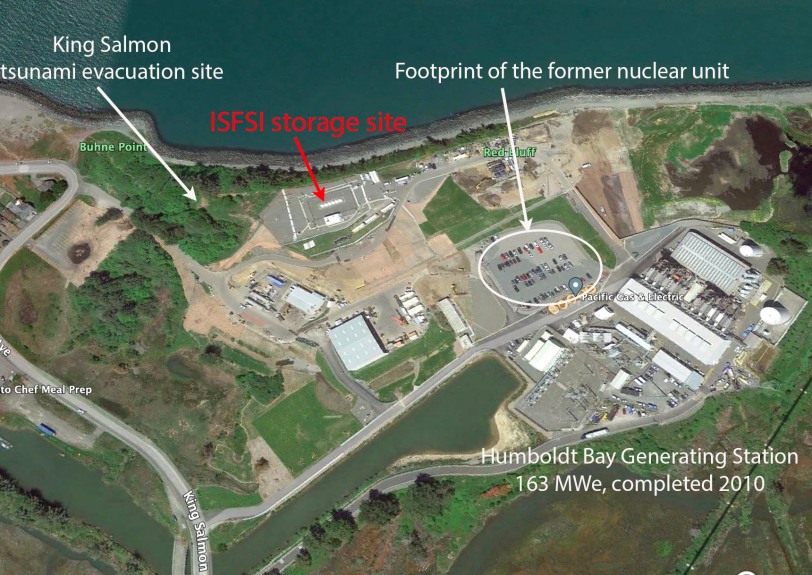
Is this the final chapter? The NRC will soon revoke the operating license for PG&E Unit #3, formally ending its official existence. But the waste is still on-site. The NRC considers cask storage a temporary solution and suggests a 40-year life span. Some hope the casks can last up to 100 years but even this is far shorter than the time needed to safely store high-level waste.
Lori Dengler | Decommissioning a nuclear power plant is a long slow process, https://www.times-standard.com/2021/11/20/lori-dengler-decommissioning-a-nuclear-power-plant-is-a-long-slow-process/By LORI DENGLER |November 20, Nothing happens quickly with a nuclear plant. Power is generated through fission, a process of splitting atoms in a controlled way. Once fission begins, it can be slowed or increased, but there’s no on-off switch and a controlled shutdown takes 6-12 hours. The radioactive byproducts last for millennia.
The fuel at PG&E’s former nuclear facility at King Salmon was small ceramic uranium oxide pellets compressed into fuel rods. A single new rod is only mildly radioactive, but when groups of rods (assemblies) are brought closely together in a reactor core, fission commences. PG&E’s Unit #3 was a boiling water reactor (BWR), where water pumped into the core was brought to a boil and steam produced electricity.
All first-generation nuclear reactors were BWRs. Built in the late 1950s to mid-1960s, seven became operational in the US and none are operating today. In the late 1960s, the second generation BWRs came online with improved efficiency, lifespan, containment, and safety features. The Fukushima-Daichi Nuclear Power Plant that failed during the 2011 Japan tsunami was this type. Of the 93 operating reactors in the US today, 31 are BWRs.
During its 13-year operational history, the Humboldt nuclear facility generated most of the county’s electricity. It was shut down yearly for refueling and maintenance and the spent fuel rods were placed in a cooling pool on the site. The pool was within the containment structure and made of steel-lined reinforced concrete several feet thick.
Spent fuel and reactor waste has been and continues to be the Achilles heel of the nuclear industry. In the early decades of the nuclear era, it was often glossed over as something that science and technology could solve. The Nuclear Regulatory Commission (NRC) classifies nuclear waste as high level or low level depending upon how long-lived the radioactive material is.
Low-level waste is produced by medical facilities, research labs, commercial facilities and in reactor operations. Often short-lived, it has radioactivity levels only slightly above background and can be safely handled with simple precautions. Small amounts can be disposed as ordinary trash and larger amounts moved on highways to approved low-level waste repositories.
It’s the high-level waste that is the big problem. High-level waste is predominately spent nuclear fuel rods. “Spent” is a misnomer as it still contains a substantial amount of energy. Unlike the new, unused fuel rods, they are now highly radioactive and very hot. That’s because once fission starts, can’t be totally stopped. Not all the uranium has been used up; it’s just no longer concentrated enough to be economically worthwhile. Fission is a complex process and creates toxic daughters such as cesium-137 and strontium-90. Fission releases neutrons which may be captured by other uranium atoms to form heavier elements such as plutonium. They aren’t as hot as the daughters but take much longer to decay. Plutonium-239 has a half-life (the time for half to be used up) of 24,100 years.
I admit to much ignorance when it comes to nuclear reactors. In talking about the Humboldt plant, I used to remark how silly it seemed that new fuel rods could be transported on highways and used ones could not. Now I understand why. There is no fission going on in the new ones and emissions are very low.
PG&E announced intentions to decommission Unit #3 in 1983. Three years later, the company requested a SAFTOR license amendment from the NRC. SAFSTOR means “possess-but-not-operate” so that the plant is maintained and monitored and much of the waste can decay before dismantling begins. In 2003, PG&E submitted an application to the NRC to begin transferring the spent fuel rods into dry cask storage.
The Humboldt plant produced 390 spent fuel assemblies in its lifetime. After several years in a storage pool, the NRC considers the waste cool enough to be moved into a dry cask storage facility on site. High-level waste repositories are known as ISFSIs (independent spent fuel storage installation). Finding an ISFSI spot on Buhne Point was problematic in many ways.
The biggest problem was that the ISFSI had to be on the PG&E site. Buhne Point site is exposed to earthquake and tsunami threats, erosion, and sea-level rise. Many people were involved with environmental and hazards studies over the years including a number of HSU geology grads. A site was selected at an elevation of 44 feet just to the west of Unit #3 with the capacity to store 37 tons of high-level waste in six casks.
I attended a community meeting about the ISFSI plan in the early 2000s. It was well attended with scientists, environmental organizations, and other community representatives. What surprised me most was that everyone agreed it was the best solution to a problem all of us wish we never had. Oh, if only time travel were possible – PG&E would be the first in line to reverse the decision to build the Humboldt nuclear facility. But given the legal realities, this was the best option.
NRC issued the Humboldt SAFSTOR license to PG&E in November 2005. By 2008, all of the spent fuel had been moved to the dry casks. The active decommissioning of the site began in 2009 and included removal of the reactor vessel, nuclear systems, containment structure, and other infrastructure. Even the soils at the site were removed. The final step was site restoration and soil remediation. It’s unclear what the footprint of the former nuclear facility may eventually become; at present, it is a parking lot.
Is this the final chapter? The NRC will soon revoke the operating license for PG&E Unit #3, formally ending its official existence. But the waste is still on-site. The NRC considers cask storage a temporary solution and suggests a 40-year life span. Some hope the casks can last up to 100 years but even this is far shorter than the time needed to safely store high-level waste.
Note: The Humboldt ISFSI is covered at http://archive.wmsym.org/2010/pdfs/10217.pdf. If anyone wants to get into the weeds with nuclear reactor technology, see https://www.amacad.org/sites/default/files/academy/pdfs/nuclearReactors.pdf.
Lori Dengler is an emeritus professor of geology at Humboldt State University, an expert in tsunami and earthquake hazards. Questions or comments about this column, or want a free copy of the preparedness magazine “Living on Shaky Ground”? Leave a message at 707-826-6019 or email Kamome@humboldt.edu. https://www.times-standard.com/2021/11/20/lori-dengler-decommissioning-a-nuclear-power-plant-is-a-long-slow-process/
Heritage Foundation – murky think tank funded by the nuclear weapons industry, wants weapons-makers to be exempt from climate and pandemic regulations

“Defense industrial base” is a buzzword that has picked up steam during the pandemic: It sends the message that, whatever happens with the economy and pandemic, we need to make sure we are in “fighting shape” — by keeping military contractors afloat. This concept was invoked to explain why, at the beginning of the pandemic, factories that produce bombs and tankers should be allowed to stay open, even amid the outbreak risk to workers. And it was also used to justify subsidies to contractors during the hardship of the pandemic.
Lockheed Martin is just one of numerous weapons manufacturers that has directly funded the Heritage Foundation. According to a report by the think tank Center for International Policy (CIP), the Heritage Foundation ranks ninth among the top think tanks that received funding from military contractors and the U.S. government from 2014 to 2019. Lockheed Martin and Raytheon were two of those major funders, both of which are among the largest weapons companies in the world and would be impacted by the new regulation.
This case provides a window into the murky world of think tanks, which are often viewed as academic and above-the-fray institutions but operate more as lobbying outfits.
Think Tank Funded by the Weapons Industry Pressures Biden Not to Regulate Military Contractors’ Emissions https://www.rsn.org/001/think-tank-funded-by-the-weapons-industry-pressures-biden-not-to-regulate-military-contractors-emissions.html
Sarah Lazare/In These Times 19 November 21The Heritage Foundation has received considerable donations from the arms industry. And now it’s trying to shield that industry from climate regulations targeting military contractors.
The Heritage Foundation, a prominent conservative think tank, is publicly opposing a new Biden administration regulation that would force the weapons industry to report its greenhouse gas emissions related to federal contracts. It turns out the Heritage Foundation also receives significant funding from the weapons industry, which makes the case worth examining — because it reveals how the arms industry pays supposedly respectable institutions to do its policy bidding at the expense of a planet careening toward large-scale climate disaster.
The regulation in question was first proposed in an executive order in May. It would require federal contractors to disclose their greenhouse gas emissions and their “climate-related financial risk,” and to set “science-based reduction targets.” In other words, companies like Lockheed Martin would have to disclose how much carbon pollution its F‑35 aircraft and cluster bombs actually cause.
In October, the Biden administration started the process to amend federal procurement rules to reflect these changes. “Today’s action sends a strong signal that in order to do business with the federal government, companies must protect consumers by beginning to mitigate the impact of climate change on their operations and supply chains,” Shalanda Young, acting director of the White House Office of Management and Budget, said at the time.The Department of Defense is the world’s biggest institutional consumer of fossil fuels and a bigger carbon polluter than 140 countries. Yet its emissions (and those of other armed forces) are excluded from UN climate negotiations, including the recent COP26 talks. The Biden administration itself supports a massive military budget, initially requesting $753 billion for the 2022 National Defense Authorization Act, a number that has since ballooned, with the Senate set to vote on a $778 billion plan. Organizers and researchers argue that, to curb the climate crisis, it is necessary to roll back U.S. militarism and dismantle the military budget.
But according to the Heritage Foundation, even this modest proposal is a bridge too far.
Continue readingNew film: The ‘Mothers of the Revolution’ Who Stared Down Nuclear Weapons
The ‘Mothers of the Revolution’ Who Stared Down Nuclear Weapons, The doc ‘Mothers of the Revolution’ chronicles the women who spent years protesting the nukes at RAF Greenham Common. One of those brave women, Rebecca Johnson, tells their story. Daily Beast, Rebecca Johnson Nov. 21, 2021 In September 1981, a ten-day walk from Wales under the banner of Women for Life on Earth arrived at the main gate of RAF Greenham Common, sixty miles west of London. Home to the 501st Tactical Missile Wing of the U.S. Air Force, this nuclear base was designated by NATO to deploy nuclear-armed cruise missiles in Europe. We called for this decision to be publicly debated.
When ignored, Women for Life on Earth grew into the Greenham Common Women’s Peace Camp. I began living there in 1982 and stayed until the 1987 U.S.-Soviet Intermediate-Range Nuclear Forces (INF) Treaty banned and eliminated all land-based medium-range nuclear weapons from Europe, including Cruise, Pershing and SS20s.
After years of being airbrushed out of histories of the Cold War, Greenham’s actions, struggles and legacy are being spotlighted in a new film, Mothers of the Revolution, from acclaimed New Zealand director Briar March. Showing contemporaneous news footage from the 1980s along with dramatized vignettes and reflections from women who got involved with the Greenham Women’s Peace Camp in the 1980s, the film weaves an illustrative narrative from the experiences of a small cross section of activists—not only from Britain, but Russia, East and West Europe, the United States, and the Pacific.
Though it’s taken a long time for our contribution to the INF Treaty to be publicly recognized, other treaties have been influenced by Greenham’s feminist-humanitarian activism and strategies, most notably the U.N. Treaty on the Prohibition of Nuclear Weapons, which entered into international law in January 2021.
While living at Greenham for five years I came to understand what we really need: Not weapons and power over others, but communities that are empowered to love, question and create. We took forward new theories and practices of nonviolence that were feminist and assertive. We didn’t suppress deep human emotions like fear, love and anger, but channelled them into power for change. We needed to be activist and analytical, passionate and diplomatic, stubborn and flexible, courageous and truthful—no matter who tried to silence us.
The cruise missiles arrived in November 1983, which felt like a bitter defeat at first. Yet we refused to give up. …………….
Were we mothers of a revolution? If anything, I think we were part of a long continuum of struggles for women’s rights and safety, following in the footsteps of the women who fought so hard to vote and live free from oppression, slavery, and misogyny. Not mothers but daughters—of all those brave feminist revolutionaries.
I’m so glad Mothers of the Revolution ends with such an inspiring call to action showing the faces and voices of a new generation of fierce Daughters who are campaigning for girls’ education, climate justice, peace, and women’s rights to live free of patriarchal perpetrators and their greedy, oppressive systems of violence. Together we can stop the destroyers and strengthen the naturally diverse, interdependent lives that share and protect our beautiful Mother Earth. That’s our revolution, and we are not finished yet. https://www.thedailybeast.com/the-mothers-of-the-revolution-who-stared-down-nuclear-weapons?ref=scroll
No greenwashing in Europe to save the nuclear industry!

No “greenwashing” to save nuclear power! While several states of the
European Union support atomic energy, a collective of associations
dismantles clichés on nuclear power and reminds us that in 2020, renewable
energies (excluding hydraulic) have exceeded the nuclear energy production.
Liberation 19th Nov 2021
The 2015 Paris climate agreement – a weak ‘treaty’, but it is working up to a point.

In many ways, the landmark climate accord, agreed to at a U.N. summit in 2015, is a weak treaty. Despite the fanfare that accompanied its signing, the agreement has no binding limits on emissions, relies on countries to set their own goals for slashing pollution, and rests on an assumption that they can be shamed into living up to their promises.
It’s not even a real treaty: To get the U.S. on board, the architects of the accord crafted it as an “executive agreement” — no Congressional approval needed.
And yet, somehow, the Paris Agreement is working. To a point. The most recent U.N. climate conference, which wrapped last weekend in Glasgow, Scotland, showed signs of progress that would have seemed unthinkable only a few years ago. Under the Paris Agreement, nations have to submit pledges (or
promises, or wishful thinking, depending on who you ask) for how much they will reduce emissions every five years.
That’s the core of the agreement:
Voluntary pledges enacted and reviewed in a soup of international peer pressure that, ideally, will push countries to steadily do more and more.The goal is to use this system of “pledge and review” to limit global warming to “well below” 2 degrees Celsius — or, ideally, 1.5 degrees Celsius.
Grist 17th Nov 2021
https://grist.org/cop26/cop26-shows-the-paris-agreement-is-kinda-sorta-working/
The fairy tale of cheap French nuclear power.
The fairy tale of cheap French nuclear power. “Bread and Games” (Panem et circenses) were the strategies used in the Roman Empire to maintain power. “Cheap gasoline, inexpensive electricity and football” are election campaign strategies that are often propagated in a democracy.
In France, the nuclear industry is in decline and the nuclear company EDF is heavily indebted. At the same time, President Macron is once again promising cheap nuclear power and wants to have new small nuclear power plants built.
A small part of the financial problems of the French nuclear industry is to be solved with EU money. In this context, the fairy tale of cheap French nuclear power is popular in France and Germany, and the use of nuclear energy is praised as a miracle weapon in the lost war against nature and the environment.
Sonnenseite 18th Nov 2021
COP 27 in Egypt: growing concern that civil society groups will have restricted access

Concern is growing over plans to host a UN climate conference in Sharm
el-Sheikh next year, in what will be a crucial summit if the world is to
limit global heating to 1.5C. Several green experts and human rights
activists have told the Observer they fear the ability of civil society
groups to protest at the summit will be curtailed by Egypt’s
authoritarian regime, reducing the pressure that can be brought to bear on
leaders and ministers from the nearly 200 countries expected to take part.
Guardian 21st Nov 2021
1 This Month
26 April – Chernobyl: Inside the Meltdown airs on National Geographic on Sunday 26th April from 4pm


Pine Ridge Uranium is the real threat, not Tehran- Tell Burgum: Stop the Extraction.
Chernobyl: The Lost Tapes – A good documentary on Chernobyl on SBS available On Demand for the next 3 weeks– https://www.sbs.com.au/ondemand/tv-program/chernobyl-the-lost-tapes/2352741955560
To see nuclear-related stories in greater depth and intensity – go to https://nuclearinformation.wordpress.com
-
Archives
- April 2026 (288)
- March 2026 (251)
- February 2026 (268)
- January 2026 (308)
- December 2025 (358)
- November 2025 (359)
- October 2025 (376)
- September 2025 (257)
- August 2025 (319)
- July 2025 (230)
- June 2025 (348)
- May 2025 (261)
-
Categories
- 1
- 1 NUCLEAR ISSUES
- business and costs
- climate change
- culture and arts
- ENERGY
- environment
- health
- history
- indigenous issues
- Legal
- marketing of nuclear
- media
- opposition to nuclear
- PERSONAL STORIES
- politics
- politics international
- Religion and ethics
- safety
- secrets,lies and civil liberties
- spinbuster
- technology
- Uranium
- wastes
- weapons and war
- Women
- 2 WORLD
- ACTION
- AFRICA
- Atrocities
- AUSTRALIA
- Christina's notes
- Christina's themes
- culture and arts
- Events
- Fuk 2022
- Fuk 2023
- Fukushima 2017
- Fukushima 2018
- fukushima 2019
- Fukushima 2020
- Fukushima 2021
- general
- global warming
- Humour (God we need it)
- Nuclear
- RARE EARTHS
- Reference
- resources – print
- Resources -audiovicual
- Weekly Newsletter
- World
- World Nuclear
- YouTube
-
RSS
Entries RSS
Comments RSS
 nuclear-news