Diverse American groups file a lawsuit against DOE opposing production of plutonium pits
What do activist groups from California, New Mexico, and South Carolina
have in common? And why might such a diverse crew have filed a group
lawsuit in June of this year, against the Department of Energy and the
National Nuclear Security Administration?
The answer to that question says
a lot about the environmental implications of nuclear weapons, and what
tactics exist to protect communities – and the world – against the
threat nuclear weapons pose.
The first plutonium pit was produced at Los
Alamos in 1945 and detonated at the Trinity test site. The second plutonium
pit was detonated in Nagasaki shortly after that, killing over 70,000
people. Plutonium pits act as the radioactive core of nuclear weapons,
existing as the central “shell” of nuclear fission chains or what
triggers the detonation. They serve a central role in the existence of
nuclear weapons. Producing plutonium pits, however, is a technically
challenging process that in the past, frequently resulted in environmental
contamination.
Beyond the Bomb 18th Oct 2021
ALL UK energy can be obtained from renewables – Prof Mark Barrett
How we can get ALL our energy from renewables – a talk by Professor Mark
Barrett- talk slides published! Professor Mark Barrett from UCL has given a
talk about how ALL UK energy can be supplied by renewables. He focused on
heat in particular.
100% Renewables 18th Oct 2021
Spain is turning rapidly away from coal and nuclear, going for renewable energy
Spain is expected to see a sharp decline in nuclear and coal power
capacity by 2030 in its turn towards renewable energy sources.
Power Technology 21st Oct 2021
https://www.power-technology.com/comment/spain-nuclear-power-phase-out/
France’s Global Chance association recommend renewable energies, see nuclear power as unsustainable
Ten-year delays, unequal access, vulnerability … For the members of the
Global Chance association, chaired by the polytechnician Bernard Laponche,
nuclear energy is not up to the challenge of ecological transition. On the
contrary, they promote renewable energies, the sources of which are “in
essence local and sovereign”.
La Croix 18th Oct 2021
https://www.la-croix.com/Debats/Lenergie-nucleaire-repond-pas-defi-climatique-2021-10-18-1201181087
Suffolk Wildlife Trust and RSPB not impressed by EDF’s bribes for environment
A joint statement by the Suffolk Wildlife Trust and RSPB has outlined the
two charities “significant concerns” with proposals for a new £20 billion
power station on the Suffolk coast.
Earlier this month EDF Energy, which
has a controlling stake in the Sizewell C project, set out £250m of
financial contributions, known as the Deed of Obligation, designed to
mitigate the impacts of the project, provide legacy benefits and compensate
some of those affected. This included £78 million to form an independent
environmental body to enhance the landscape of the area and £22m for
biodiversity improvements and the creation of wildlife and habitat areas.
However, the Suffolk Wildlife Trust and RSPB, who have been against the
construction of Sizewell C since consultations began, are still adamant
that, if built, the power station would cause considerable environmental
damage.
Suffolk Live 21st Oct 2021
https://www.suffolklive.com/news/animal-charities-warn-protected-wildlife-6092590
Couple Indicted for Trying to Sell Nuclear Secrets to Foreign Country
Couple Indicted for Trying to Sell Nuclear Secrets to Foreign Country, NewsWeek,
BY TORIA BARNHART ON 10/19/21 couple from Maryland charged with trying to sell information about nuclear-powered warships to a foreign country was indicted following their arrest earlier this month, according to the Department of Justice (DOJ).
Jonathan, 42, and Diane Toebbe, 45, of Annapolis, each faces a single count of conspiracy to communicate restrictive data and two counts of communication of restricted data.
The couple was arrested in West Virginia on October 9 by the FBI and the Naval Criminal Investigative Service (NCIS) and charged with violating the Atomic Energy Act—a federal law that assures the proper management of nuclear materials and their byproducts.
“The complaint charges a plot to transmit information relating to the design of our nuclear submarines to a foreign nation,” said Attorney General Merrick B. Garland. “The work of the FBI, Department of Justice prosecutors, the Naval Criminal Investigative Service and the Department of Energy was critical in thwarting the plot charged in the complaint and taking this first step in bringing the perpetrators to justice.”…….
Jonathan continued speaking with this person for months and agreed to sell the information for thousands of dollars in cryptocurrency,……….. https://www.newsweek.com/couple-indicted-trying-sell-nuclear-secrets-foreign-country-1640644
The value of energy efficiency in UK’s emissions reduction programme

Improving the energy efficiency of homes in deprived areas would cut seven
million tonnes of CO2 emissions per year, a Times investigation can reveal.
Despite much of the housing being older, insulating leaky boilers,
replacing inefficient lighting and installing solar panels in the poorest
30 per cent of neighbourhoods in England and Wales would be about as cost
effective as making the same improvements in the richest areas. It would
also reduce energy bills for those struggling the most. According to
analysis of Energy Performance Certificates (EPCs), for every £1,000 spent
in poorer parts of the country, 166kg of CO2 would be saved. Boris Johnson
has put both levelling up the country and a commitment to improving the
environment at the heart of his premiership.
Times 24th June 2021
October 22 Energy News — geoharvey

Science and Technology: ¶ “This Might Just Look Like Grass, But It Has The Power To Absorb A Load Of Our Carbon Emissions” • Forests, peatlands, deserts, and tundra can all absorb and hold stocks of CO₂. Of all the carbon held in land-based ecosystems, around 34% can be found in grasslands, data from the […]
October 22 Energy News — geoharvey
The French state ignores the cancers and deaths of irradiated nuclear submarine workers of Ile-Longue
The irradiated people of Ile-Longue in the face of the indifference of the state. Until 1996, workers manipulated nuclear warheads on missiles at the Brest submarine base without protection against radioactivity. Today, a group of retirees is fighting so that the early deaths of their colleagues and the serial cancers that affect them are classified as occupational diseases. And that the army admit its “inexcusable fault”.
Le Monde 16th Oct 2021
https://www.lemonde.fr/m-le-mag/article/2021/10/16/les-irradies-de-l-ile-longue-face-a-l-indifference-de-l-etat_6098600_4500055.html
RTL 19th Oct 2021
OSPAR Convention for the Protection of the North-East Atlantic discreetly postpones its commitment to reduce radioactive discharges at sea
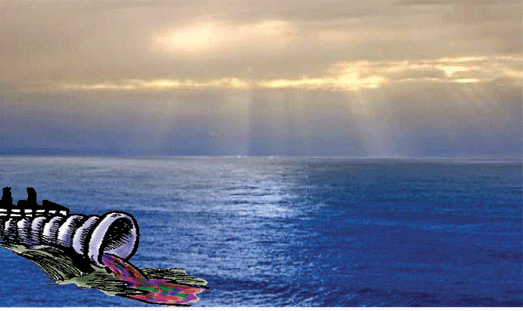
The OSPAR Convention for the Protection of the North-East Atlanticdiscreetly postpones its commitment to reduce radioactive discharges at sea from 2020 to 2050. Following the Cascais meeting of the OSPAR Convention for the Protection of the North-East Atlantic, which took place on October 1, the participating ministers discreetly postponed until 2050 the commitment made in 1998 in Sintra to reduce radioactive discharges into the sea to levels close to zero by 2020.
Once again, international commitments to the environment are being disregarded. This does not bode well for the
upcoming COP26 in Glasgow.
France is the first beneficiary of this 30-year postponement because, with its reprocessing plant at La Hague, it has the
highest radioactive discharges to the sea in Europe. And these discharges are not decreasing, as shown by the results of the citizen monitoring of radioactivity in the environment carried out by ACRO for over 25 years.
ACRO 19th Oct 2021
The OSPAR Convention for the Protection of the North-East Atlantic discreetly postpones its commitment to reduce radioactive discharges at sea from 2020 to 2050
COVID Restrictions Deny Southern Belarus Children Rare Escape From Chernobyl Radiation
COVID Restrictions Deny Southern Belarus Children Rare Escape From Chernobyl Radiation https://www.voanews.com/a/covid-restrictions-deny-southern-belarus-children-rare-escape-from-chernobyl-radiation/6278627.html
October 20, 2021 Ricardo Marquina. In Belarus, just across the border from Ukraine, many children have been living with chronic radiation sickness since a reactor at the Chernobyl nuclear power plant exploded in 1986. They have returned to school after being unable to escape contamination for yet another summer due to COVID-19 pandemic border restrictions. For VOA, Ricardo Marquina has more from the Gomel region of southern Belarus in this report narrated by Miguel Amaya.
Research shows that a rapid truly green energy transformation will achieve a near-net-zero emissions energy system

Rapidly decarbonising the global energy system is critical for addressing climate change, but concerns about costs have been a barrier to implementation. Most energy-economy models have historically underestimated deployment rates for renewable energy technologies and overestimated their costs.
The problems with these models have stimulated calls for better approaches and recent efforts have made progress in this direction. Here we take a new approach based on probabilistic cost forecasting methods that made reliable predictions when they were empirically tested on more than 50 technologies.
We use these methods to estimate future energy system costs and find that, compared to continuing with a fossil-fuel-based system, a rapid green energy transition will likely result in overall net savings of many trillions of dollars – even without accounting for climate damages or co-benefits of climate policy.
We show that if solar photovoltaics, wind, batteries and hydrogen electrolyzers continue to follow their current
exponentially increasing deployment trends for another decade, we achieve a near-net-zero emissions energy system within twenty-five years. In contrast, a slower transition (which involves deployment growth trends that are lower than current rates) is more expensive and a nuclear driven transition is far more expensive. If non-energy sources of carbon emissions such as agriculture are brought under control, our analysis indicates that a rapid green energy transition would likely generate considerable economic savings while also meeting the 1.5 degrees Paris Agreement target.
Oxford University 14th Sept 2021
Insurance industry not convinced that nuclear power is ”green”, and is wary of nuclear as an investment risk.
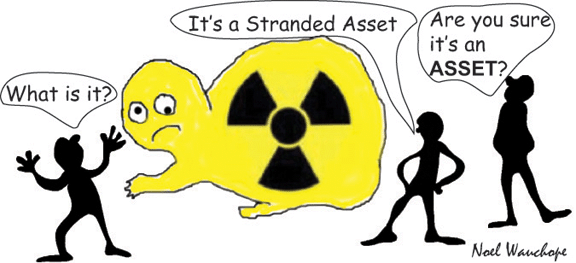
INSURANCE ASSET RISK
IAR 2021 EMEA conference: highlights from day 2
”…………what constitutes a ‘green’ asset is not yet universally accepted, and this became apparent during a panel on infrastructure investing. The question of nuclear financing crept in the debate, and although politicians may have their ideas on the topic, the jury is still out for investors.….. https://www.insuranceassetrisk.com/content/news/iar-2021-emea-conference-highlights-form-day-2.html
The nuclear industry might get taxpayers money by calling itself ”amber”, if it’s too hard to appear ”green”
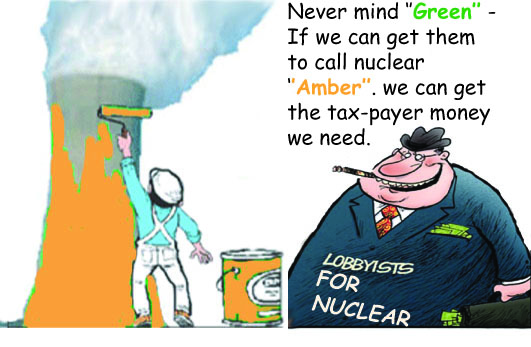
possible compromises included creating an “amber” label for activity that did not win the green label but would still secure a place in the bloc’s transition and not discourage private sector investment. ………..
Brussels to delay decision on how to classify nuclear power for green finance. Debate over energy has been supercharged by surging electricity costs, Ft.com Mehreen Khan and Sam Fleming in Brussels, 20 Oct 21
Brussels will delay long-awaited proposals on how to classify nuclear power and natural gas under the EU’s landmark labelling system for green finance, as member states demand looser rules to help counteract the continent’s energy crisis. EU financial services commissioner Mairead McGuinness told the Financial Times that Brussels would take more time before deciding how to deal with the controversial energy sources under the so-called “taxonomy on sustainable finance” that had been due this autumn.
The debate about how to classify low carbon natural gas and nuclear energy, which produces no CO2 [ ed.except in its long complex fuel and waste chains] but whose waste byproducts are toxic for the environment, has been supercharged by surging electricity costs that have prompted EU governments into emergency financial action to protect households. European leaders are due to debate the taxonomy and how to mitigate soaring prices at a summit in Brussels on Thursday.
“As we come to the end of the year there will be more pressure to resolve this,” said McGuinness. “We don’t have a ready-made solution because this is, both technically but politically . . . one of those issues where you have very divided views.” Europe’s pro-nuclear countries, led by France, and pro-gas member states in the south and east, are demanding the taxonomy rules do not penalise technologies they say are vital in securing the transition to net zero emissions. Environmental groups, however, want the system to abide by scientific criteria to ensure the rules stamp out, rather than encourage, so-called “greenwashing” in the investment industry. ………..
Europe’s energy crisis is the latest challenge to the credibility of the EU’s green labelling system which was designed to be a “gold standard” for investors to know what counts as truly sustainable economic activity. But the rules have been mired in controversy as Brussels struggles to balance science with sensitive political decisions about whether to award some activities the highest green label — penalising those that do not. Ten countries, including France, Finland, Poland and Hungary this week said it is “absolutely necessary that nuclear power was included in the taxonomy framework”.
McGuinness said it remained an “open question” as to whether the green label would be expanded to “accommodate nuclear and gas”. She said possible compromises included creating an “amber” label for activity that did not win the green label but would still secure a place in the bloc’s transition and not discourage private sector investment. ………..
The rules are being closely watched by investors and regulators in the US and UK, who have also said they will come up with their own classification systems. Within the EU, the taxonomy will be used to judge whether investments made by member states are truly green and will form the basis for an EU “green bond standard” that will be used to issue €250bn in sustainable debt under the bloc’s recovery fund. https://www.ft.com/content/898e6c53-8e85-4cfc-b00b-16a09d50b462
UK’s ”Net Zero” climate strategy fails to give concrete commits to reduce energy use, promote renewables.

| In reaction to the government’s Net Zero Strategy, Rebecca Newsom, Greenpeace UK’s head of politics, said “This document is more like a pick and mix than the substantial meal that we need to reach net zero. Extra cash for tree planting and progress on electric vehicles doesn’t make up for the lack of concrete plans to deliver renewables at scale, extra investment in public transport, or a firm commitment to end new oil and gas licences. There are only half-hearted policies and funding commitments to decarbonise our draughty homes at the speed necessary, and it fundamentally fails to grapple with the need to reduce our meat and dairy consumption to stop global deforestation. With just eight years left to halve global emissions, the government can’t just keep dining out on its ‘ambitious targets’. Until the policy and funding gaps are closed, Boris Johnson’s plea to other countries to deliver on their promises at the global climate conference next month will be easy to ignore.” Greenpeace 19th Oct 2021 https://www.greenpeace.org.uk/latest-updates/?news_type=press-release |
-
Archives
- February 2026 (228)
- January 2026 (308)
- December 2025 (358)
- November 2025 (359)
- October 2025 (376)
- September 2025 (258)
- August 2025 (319)
- July 2025 (230)
- June 2025 (348)
- May 2025 (261)
- April 2025 (305)
- March 2025 (319)
-
Categories
- 1
- 1 NUCLEAR ISSUES
- business and costs
- climate change
- culture and arts
- ENERGY
- environment
- health
- history
- indigenous issues
- Legal
- marketing of nuclear
- media
- opposition to nuclear
- PERSONAL STORIES
- politics
- politics international
- Religion and ethics
- safety
- secrets,lies and civil liberties
- spinbuster
- technology
- Uranium
- wastes
- weapons and war
- Women
- 2 WORLD
- ACTION
- AFRICA
- Atrocities
- AUSTRALIA
- Christina's notes
- Christina's themes
- culture and arts
- Events
- Fuk 2022
- Fuk 2023
- Fukushima 2017
- Fukushima 2018
- fukushima 2019
- Fukushima 2020
- Fukushima 2021
- general
- global warming
- Humour (God we need it)
- Nuclear
- RARE EARTHS
- Reference
- resources – print
- Resources -audiovicual
- Weekly Newsletter
- World
- World Nuclear
- YouTube
-
RSS
Entries RSS
Comments RSS
 nuclear-news