Who should take on the costs and risks of nuclear power?
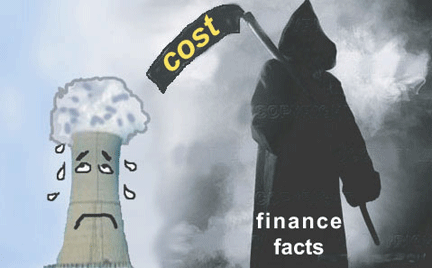
There are, of course, other alternatives that may or may not turn out to be cheaper: gas (with or without carbon capture), renewables (assuming some form of affordable energy storage can be found) or letting the market itself decide how our electricity should be generated. If nuclear really is the future you might expect investors to be more interested in it without subsidies. And of course, you don’t get something for nowt: if consumers do end up paying less for Sizewell than they will for Hinkley it will be because they have taken on more risk.
Who should pay for nuclear? Spectator, Ross Clark, 29 Oct 21, ”……………… the funding of nuclear power stations that was unveiled yesterday in the form of the Nuclear Energy Finance Bill. The proposed legislation will impose levies on energy bills in order to subsidise the construction of new nuclear power stations. The new model of funding — called Regulated Asset Base — will replace the model by which Hinkley C is being constructed: the contracts for difference, or CfD, model which was used to entice EDF to undertake the project. The carrot is a guaranteed ‘strike’ price for electricity generated by the plant as soon as it starts generating electricity.
………… it will inevitably transfer risk to the consumer — should, say, the proposed new plant at Sizewell in Suffolk end up being abandoned before it begins generating power, taxpayers will already have paid towards the plant through their bills.
With his characteristic optimism, Kwarteng claims that the new funding model will ‘save’ energy consumers £30 billion on each nuclear project. Can that really be true? It rather depends on your definition of saving money.
Kwarteng’s claim is based on the presumption that the only alternative to new nuclear power stations funded by the new model is for nuclear power stations to be funded like Hinkley by the CfD model. But Hinkley was itself horrendously expensive: EDF has been guaranteed a minimum price of £92.50 per MWh (at 2012 prices) over 35 years, the expected lifetime of the power station — around twice as high as wholesale electricity prices at the time the deal was signed.
……… it is somewhat dubious to replace a very expensive form of subsidy with one that promises to be merely expensive — and then claim that you have ‘saved’ money.
There are, of course, other alternatives that may or may not turn out to be cheaper: gas (with or without carbon capture), renewables (assuming some form of affordable energy storage can be found) or letting the market itself decide how our electricity should be generated. If nuclear really is the future you might expect investors to be more interested in it without subsidies. And of course, you don’t get something for nowt: if consumers do end up paying less for Sizewell than they will for Hinkley it will be because they have taken on more risk…………. https://www.spectator.com.au/2021/10/who-should-pay-for-nuclear/
No comments yet.
1 This Month

of the week – Shut Down Drone Warfare!


Tell the Ukrainian Government to Drop Prosecution of Peace Activist Yurii Sheliazhenko

Petition to revoke the licensing of the Near Surface Nuclear Disposal Facility (NSDF) at Chalk River. https://www.ourcommons.ca/petitions/en/Petition/Details?Petition=e-7247
To see nuclear-related stories in greater depth and intensity – go to https://nuclearinformation.wordpress.com
-
Archives
- April 2026 (114)
- March 2026 (251)
- February 2026 (268)
- January 2026 (308)
- December 2025 (358)
- November 2025 (359)
- October 2025 (376)
- September 2025 (257)
- August 2025 (319)
- July 2025 (230)
- June 2025 (348)
- May 2025 (261)
-
Categories
- 1
- 1 NUCLEAR ISSUES
- business and costs
- climate change
- culture and arts
- ENERGY
- environment
- health
- history
- indigenous issues
- Legal
- marketing of nuclear
- media
- opposition to nuclear
- PERSONAL STORIES
- politics
- politics international
- Religion and ethics
- safety
- secrets,lies and civil liberties
- spinbuster
- technology
- Uranium
- wastes
- weapons and war
- Women
- 2 WORLD
- ACTION
- AFRICA
- Atrocities
- AUSTRALIA
- Christina's notes
- Christina's themes
- culture and arts
- Events
- Fuk 2022
- Fuk 2023
- Fukushima 2017
- Fukushima 2018
- fukushima 2019
- Fukushima 2020
- Fukushima 2021
- general
- global warming
- Humour (God we need it)
- Nuclear
- RARE EARTHS
- Reference
- resources – print
- Resources -audiovicual
- Weekly Newsletter
- World
- World Nuclear
- YouTube
-
RSS
Entries RSS
Comments RSS
 nuclear-news
Leave a comment