Who should take on the costs and risks of nuclear power?
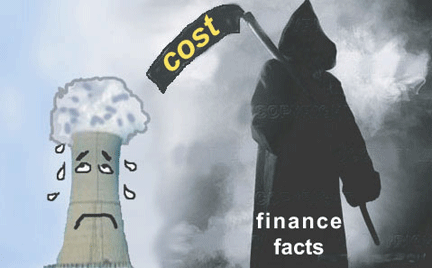
There are, of course, other alternatives that may or may not turn out to be cheaper: gas (with or without carbon capture), renewables (assuming some form of affordable energy storage can be found) or letting the market itself decide how our electricity should be generated. If nuclear really is the future you might expect investors to be more interested in it without subsidies. And of course, you don’t get something for nowt: if consumers do end up paying less for Sizewell than they will for Hinkley it will be because they have taken on more risk.
Who should pay for nuclear? Spectator, Ross Clark, 29 Oct 21, ”……………… the funding of nuclear power stations that was unveiled yesterday in the form of the Nuclear Energy Finance Bill. The proposed legislation will impose levies on energy bills in order to subsidise the construction of new nuclear power stations. The new model of funding — called Regulated Asset Base — will replace the model by which Hinkley C is being constructed: the contracts for difference, or CfD, model which was used to entice EDF to undertake the project. The carrot is a guaranteed ‘strike’ price for electricity generated by the plant as soon as it starts generating electricity.
………… it will inevitably transfer risk to the consumer — should, say, the proposed new plant at Sizewell in Suffolk end up being abandoned before it begins generating power, taxpayers will already have paid towards the plant through their bills.
With his characteristic optimism, Kwarteng claims that the new funding model will ‘save’ energy consumers £30 billion on each nuclear project. Can that really be true? It rather depends on your definition of saving money.
Kwarteng’s claim is based on the presumption that the only alternative to new nuclear power stations funded by the new model is for nuclear power stations to be funded like Hinkley by the CfD model. But Hinkley was itself horrendously expensive: EDF has been guaranteed a minimum price of £92.50 per MWh (at 2012 prices) over 35 years, the expected lifetime of the power station — around twice as high as wholesale electricity prices at the time the deal was signed.
……… it is somewhat dubious to replace a very expensive form of subsidy with one that promises to be merely expensive — and then claim that you have ‘saved’ money.
There are, of course, other alternatives that may or may not turn out to be cheaper: gas (with or without carbon capture), renewables (assuming some form of affordable energy storage can be found) or letting the market itself decide how our electricity should be generated. If nuclear really is the future you might expect investors to be more interested in it without subsidies. And of course, you don’t get something for nowt: if consumers do end up paying less for Sizewell than they will for Hinkley it will be because they have taken on more risk…………. https://www.spectator.com.au/2021/10/who-should-pay-for-nuclear/
Indonesia wants non-peaceful nuclear submarines to be subject to nuclear non-proliferation treaty (surprise, surprise, Australia doesn’t agree)
Caution over nuclear treaty covering subs, Canberra Times, Dominic Giannini, 29 Oct 21,
Caution over nuclear treaty covering subs, Canberra Times, Dominic Giannini, 29 Oct 21,
Australian officials say they don’t believe there is merit in expanding the nuclear non-proliferation treaty to nuclear-powered submarines.
Indonesian officials have said they would seek a “fourth pillar” to include the non-peaceful usage of nuclear technology, closing a “loophole” exposed by Australia’s nuclear-submarine deal with the US and UK.
They say other countries could seek to follow Australia, which would be the first non-nuclear weapons state to acquire nuclear submarines.
Foreign affairs department officials rejected the need to expand the treaty, saying the acquisition of nuclear-propelled submarines was in accordance with Australia’s non-proliferation requirements……
The Indonesians raised concerns about the potential for an arms race in the region after Australia announced its plans to acquire nuclear-powered submarines through the AUKUS partnership…….. https://www.canberratimes.com.au/story/7488125/caution-over-nuclear-treaty-covering-subs/
Jacobs joint venture wins $8bn nuclear clean-up contract in US.
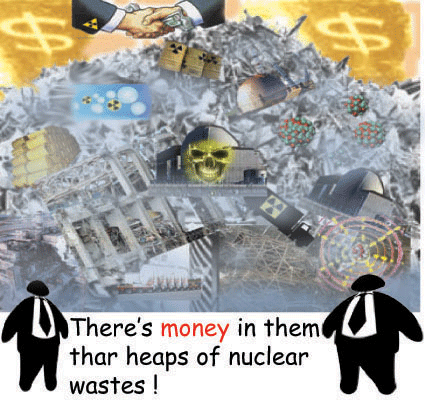
Jacobs joint venture wins $8bn nuclear clean-up contract in US, GCR, Joe Quirke, 29.10.21
The United Cleanup Oak Ridge (UCOR) consortium has landed a 10-year contract worth $8.3bn to remediate the Oak Ridge Reservation site in Tennessee.
Push for ”small nuclear power” in Colorado
Extract from –Pueblo County wants to replace Comanche coal plant with nuclear power. Local activists are worried.The county’s coal-fired power plant could close 30 years earlier than anticipated, Colorado newsline, OCTOBER 29, 2021 ”……………….. With that likely early closure of Comanche 3 (coal-powered station) , some county leaders want a nuclear power station to replace that energy production and — crucially for them — the tax base. Pueblo consumers do not actually receive any of the power generated by Comanche. County leadership believe that so-called small modular reactors technology is the clean energy source that will be deployable by 2030, and they argue that the technology has become much safer since catastrophes like the Chernobyl meltdown………..
Activists worry that county leadership is being lured into an experimental and unsafe energy alternative. They called the July town hall “secretive” and accused county leaders of having these conversations behind closed doors.
“We are being targeted because the nuclear industry, including NuScale, has a campaign going on to place nuclear power plants in old coal fired power plants all over the country. We are the foot in the door,” Campbell said. “Our commissioners are not doing their homework, they aren’t looking into the risk … in my opinion, they are being made to feel like bigwigs by people in the nuclear industry and have fallen in love with themselves.”
“That’s the one that is probably able to move forward quicker — nuclear,” said Commissioner Chris Wiseman.
It would be the first nuclear power plant in Colorado since Fort St. Vrain Generating Station stopped generating power in 1989…………..
Colorado isn’t completely sold on the idea yet, the nuclear option has been central to the conversation. In July, the county held a town hall with presenters from NuScale. Now, Wiseman is putting together a committee to look at possible alternative energy sources and hopes to have proposals before he retires from elected office at the end of next year. He leaves open the possibility that nuclear is not the answer, but rather some other emerging technology like green hydrogen……..
“Going through the neighborhoods and talking to people, it seems like people have just not been asked. When they are being used as sacrifice zones for these polluting industries that don’t serve them, no one comes and asks them,” said Giselle Herzfeld, a nonprofit organizer from Longmont who came down to Pueblo for the day of action.
Why nuclear instead of solar, wind?
Opponents of the nuclear idea want the county to more seriously consider replacing Comanche 3 with renewables such as solar, water or wind power.
“With all the creative thinking that exists in our community and around the state, I know we could come up with multiple ways of replacing that tax money,” said Pueblo activist Velma Campbell.
Too expensive, too slow: Even the baseload argument doesn’t work for nuclear.
Too expensive, too slow: Even the baseload argument doesn’t work for nuclear. ReNeweconomy, Mark Diesendorf 29 October 2021 With the Glasgow climate summit approaching and the government’s announcement that Australia would buy nuclear-powered submarines instead of diesel, the nuclear industry and News Corp have predictably renewed their campaign for nuclear power stations in Australia.
This is of concern, because every dollar invested in nuclear power makes the climate crisis worse by diverting investment from renewable energy technologies. Having recently participated in a nuclear debate, I report here on the pro-nuclear arguments and expose their weaknesses.
The old baseload myth
Nuclear proponents still claim that electricity grids need baseload power stations, such as coal or nuclear, that can run 24/7 at full rated power, except when they break down or undergo maintenance and refuelling.
But, as readers of RenewEconomy know, the variability of wind and solar can be balanced with storage, new transmission links, demand response, and/or flexible power stations that can start up in seconds to minutes and can vary their output rapidly.
The latter include hydroelectricity with a single dam, pumped hydro (with two dams), other forms of gravitational energy storage, batteries, concentrated solar thermal with storage, and open-cycle gas turbines that can burn biofuels and green hydrogen and ammonia.
Despite the claims of proponents, modern nuclear reactors cannot compete in flexibility with the above technologies and measures. Furthermore, operating in a slightly flexible mode carries economic penalties for nuclear, whose electricity already costs 3–5 times that of wind and solar PV––see Lazard and CSIRO.
Dark doldrums (Dunkelflaute in German) are extended periods of low wind and solar. In the debate, a pro-nuclear speaker modified the baseload myth by claiming falsely that a recent report on dark doldrums by the leading German solar energy research organisation, the Fraunhofer Institute, admits that solar energy has failed.
However, the only report on dark doldrums by that institute identifies the issues and then sets out the solutions to maintaining generation reliability, namely the flexible technologies and methods listed above………………………………
The scale of the disaster resulted from the choice of nuclear technology. Yet at Kamisu, on the coast to the south of Fukushima, a wind farm located in the surf survived the tsunami and continued to generate electricity until the grid went down.
Proliferation
It’s well documented (see here and here) that India, Pakistan, South Africa and North Korea used “peaceful” nuclear energy to develop nuclear weapons and to cloak that development.
Furthermore, the UK supplemented its military-produced weapons-grade plutonium with plutonium reprocessed from its first generation of nuclear power stations. In France, the military and civil nuclear industries are entwined.
In addition, the following countries used “peaceful” nuclear energy to commence the development of nuclear weapons, but fortunately discontinued their programs: Argentina, Australia, Brazil, South Korea, Sweden and Taiwan, and probably Algeria and Libya. For Australia’s attempt in the 1960s, see the books by Richard Broinowski and Wayne Reynolds.
Nuclear submarines built by the USA and UK use highly enriched uranium that could be used directly in nuclear weapons. The AUKUS alliance could lead to increased pressure from members of the Australian Strategic Policy Institute, the Lowy Institute and others for Australia to develop nuclear weapons.
Even if the Australian government rejects that scenario, the perception exists and AUKUS could lead to a regional nuclear arms race.
Nuclear wastes
The standard pro-nuclear line is that the sum total of all the world’s nuclear wastes occupies a very small volume and therefore, by implication, is not a major problem. But nowhere in the world is there an operating, long-term, underground repository for high-level wastes.
Furthermore, the pro-nuclear line ignores the vast volumes of low-level wastes at uranium mines that are uncovered allowing radioactive dust to blow in the wind. The waste mountain at the Olympic Dam uranium-copper mine is already over 150 million tonnes.
Although the number of cancers caused annually will be very small, the total summed over thousands of years will be large.
High-level nuclear power wastes are stored temporarily in pools of water at nuclear power stations. The USA spent US$13.5 billion preparing an underground repository at an unsuitable site, Yucca Mountain, and then had to abandon it.
Finland has just commenced building its repository, Sweden is still thinking about building a final repository, and that’s about it.
Retired nuclear power stations have highly radioactive sections and are a major nuclear waste problem. The cost of decommissioning them and managing their wastes is comparable with their construction cost, but the nuclear industry only pays a fraction. …………………
Energy density
Another tactic used by nuclear supporters in recent years is based on “energy density”, the claim that 100 per cent renewable electricity scenarios would occupy vast areas of land, compete with food production and reduce biodiversity.
Yet the reality is that most wind and solar farms are erected on agricultural or marginal land. Although wind farms can span large areas, the land area actually occupied by the turbines, access roads and substation typically amounts to 1 to 2 per cent of the land spanned.
Wind farms are compatible with agriculture. Although the presence of solar farms excludes some forms of agriculture, they can be erected sufficiently high above ground for sheep to shelter beneath them. Both wind and solar farms contribute valuable rent to farmers. And, of course, rooftop solar occupies no land.
Too slow for climate mitigation
If national governments commit to net zero emissions by 2050 (which is likely to be too late for keeping global heating below 1.5 degrees), then they must achieve zero emissions from all energy (electricity, transport and heat) by about 2040. This is because energy is the least difficult sector to transition to zero emissions.
Agriculture and non-energy industrial processes will need more time to reduce emissions and, if possible, to capture carbon dioxide in order to offset emissions they cannot reduce.
Achieving zero energy emissions by 2040 entails achieving zero emissions from electricity by 2035, because electrifying transport and heat will take longer than transitioning electricity to renewables. Wind and solar farms can be planned and built in just three years.
Introducing nuclear power to Australia — including convincing the electorate, local governments and local populations, and building the infrastructure — would take at least 15 years, while taking financial resources away from renewables.
So new nuclear power stations could not contribute in time to assist the rapid electricity transition needed for climate mitigation. And once 100 per cent renewable electricity is established with the bulk of energy generation by cheap solar and wind, nuclear power could not compete economically. It’s a technology whose time has passed.Dr Mark Diesendorf is honorary associate professor, Environment & Governance Group, School of Humanities & Languages at the Faculty of Arts, Design & Architecture at UNSW. https://reneweconomy.com.au/too-expensive-too-slow-even-the-baseload-argument-doesnt-work-for-nuclear/
World without nuclear weapons remains a goal after Sunao Tsuboi’s death
October 29, 2021 (Mainichi Japan) Sunao Tsuboi, a champion of the anti-nuclear movement, has died at age 96. He had served as a representative member of the Japan Confederation of A- and H-Bomb Sufferers Organizations and chairman of the Hiroshima Prefectural Confederation of A-bomb Sufferers Organizations. For many years, Tsuboi led nuclear disarmament activism and dedicated his life to calling for a world without nuclear weapons, while telling himself and others to “never give up.”
Tsuboi himself was a survivor of the atomic bombing of Hiroshima. He continued to share his experience, revealing the inhumaneness of nuclear arms………..
It was because Tsuboi and other hibakusha persistently shared stories about their experiences outside Japan that the inhumane nature of nuclear weapons became widely known across the world. And this led to the enforcement of the Treaty on the Prohibition of Nuclear Weapons, which bans nuclear arms and related activities.
When then U.S. President Barack Obama visited Hiroshima as the first sitting U.S. president to do so in May 2016, Tsuboi said to him, “It (dropping the atomic bomb) was one of the mistakes humanity made. We have to overcome that, and head for the future.”
These words stemmed from Tsuboi’s desire for peace, based on his belief that hatred is fruitless.
Grave challenges still remain after Tsuboi’s departure………..
The number of hibakusha has now declined to about 127,000 and their average age is approaching 84. Anti-nuclear activist and hibakusha Sumiteru Taniguchi, who led the movement in Nagasaki, the second city to be bombed in 1945, passed away in 2017. We will eventually enter a time when there are no hibakusha left in the world.
“An uphill path may continue, but I’m not going to give up and I’ll continue working on eliminating these dreadful weapons from the world,” Tsuboi once said. Succeeding generations must take the baton from him. https://mainichi.jp/english/articles/20211029/p2a/00m/0op/028000c
Eastern Navajo Diné Against Uranium continue their fight, especially about the effect on their water supply
Rita Capitan has been worrying about her water since 1994. It was that autumn she read a local newspaper article about another uranium mine, the Crownpoint Uranium Project, getting under way near her home. Capitan has
spent her entire life in Crownpoint, New Mexico, a small town on the eastern Navajo Nation, and is no stranger to the uranium mining that has persisted in the region for decades.
But it was around the time the article was published that she began learning about the many risks associated with
uranium mining. “We as community members couldn’t just sit back and watch another company come in and just take what is very precious to us. And that is water – our water,” Capitan said.
To this effect, Capitan and her husband, Mitchell, founded Eastern Navajo Diné Against Uranium Mining (Endaum). The group’s fight against uranium mining on their homeland has continued for nearly three decades, despite the industry’s disastrous health and environmental impacts being public knowledge for years.
Guardian 27th Oct 2021
UK pension funds and other investors not keen to invest in Sizewell nuclear power project?
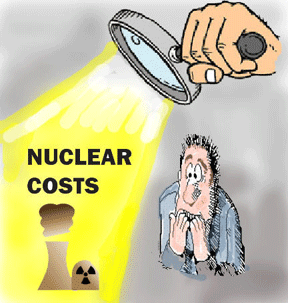
UK government to invest £1.7bn in Sizewell C nuclear power station. British taxpayers will make a final investment in the planned Sizewell C nuclear power plant project over the next three years as the government is resuming its struggling efforts to replace the country’s aging reactors. Funding is included in Wednesday’s budget, following the minister’sannouncement this week to review the new nuclear power plant funding model.
Prime Minister Rishi Sunak did not mention Sizewell C in his budget speech Wednesday. However, an accompanying Treasury document has “active negotiations” with EDF on the plant and “up to £ 1.7 billion in direct government funding to help reach a final investment decision before the next election. State funding accounts for a significant proportion of the estimated £ 20 billion.
The government hopes that its financial involvement in Sizewell C will help encourage outside investors to provide
additional funding as expected. The minister wants to attract investors from the UK, the United States, etc. to help finance nuclear reconstruction before the existing reactors retire by 2035, but analysts are questioning how pension funds and others are enthusiastic about investing.
FT 27th Oct 2021
https://www.ft.com/content/73ec90ad-8942-4daf-af01-429d7b3aa948
The nuclear lobby’s false story on small nuclear reactors

Too expensive, too slow: Even the baseload argument doesn’t work for nuclear. ReNeweconomy, Mark Diesendorf 29 October 2021
”………………………Small Modular Reactors
The nuclear industry is nowadays creating the false impression that new reactors exist that could solve the above major problems of existing reactors while contributing to climate mitigation.
The main hypotheticals are the so-called “small modular reactors” (SMRs), small enough to be distributed around a country and modular in the sense that they could be mass-produced by the thousand in factories and erected rapidly.
However, the actual situation is that SMRs don’t exist — they are paper reactors fuelled on hot air. They could not be installed in Australia for at least 15 years, if ever. By that time, given the political will, we could have an electricity system that’s entirely powered by renewable energy, mainly solar photovoltaics (PV) and wind, supplemented by hydro.
The reason why past and current generations of commercial nuclear power reactors are very big is to obtain economies of scale. Nuclear costs have been increasing while wind and especially solar costs continue to fall.
SMRs would have to be mass-produced in hundreds, possibly thousands, to overcome the loss of economy of scale and, even then, their electricity would at best cost much the same as from existing big nuclear power reactors.
There are no orders for multiple SMRs and that’s fortunate because the risk of proliferation would be greatly increased by distributing SMRs around the countryside. Reducing proliferation risk or increasing safety or improving waste management would all increase cost……………
SMRs that simultaneously solve proliferation, safety and waste management, while reducing costs, are a dangerous fantasy. https://reneweconomy.com.au/too-expensive-too-slow-even-the-baseload-argument-doesnt-work-for-nuclear/
U.S. imposes new sanctions on Iran, sanctions that are unrelated to nuclear activities
U.S. hits Iran with sanctions ahead of key nuclear talks, PBS NewsHour 29 Oct 21, WASHINGTON (AP) — The United States on Friday hit Iran with a fresh set of sanctions as President Joe Biden prepares for a key weekend meeting with European leaders to discuss the possible resumption of nuclear talks with the Islamic Republic.
The Treasury Department announced the new penalties against two senior members of Iran’s Revolutionary Guard Corps and two affiliated companies for supplying lethal drones and related material to insurgent groups in Iraq, Lebanon and Yemen and to Ethiopia, which has been fighting rival Tigray forces for almost a year.
Although the sanctions are unrelated to Iran’s atomic program, the Biden administration has said it wants to build on a potential agreement to revive the languishing 2015 nuclear deal to include Iranian support for such groups and curtail its ballistic missile development………… https://www.pbs.org/newshour/politics/u-s-hits-iran-with-sanctions-ahead-of-key-nuclear-talks
The US nuclear aresenal is becoming more destructive and possibly more risky
THE US NUCLEAR ARSENAL IS BECOMING MORE DESTRUCTIVE AND POSSIBLY MORE RISKY, Center for Public Integrity, R. Jeffrey Smith 29 Oct 21, A little-noticed, new fuze that better controls a nuclear blast’s timing will enable the United States to more easily destroy protected targets in other countries.
R. Jeffrey Smith A sophisticated electronic sensor buried in hardened metal shells at the tip of a growing number of America’s ballistic missiles reflects a significant achievement in weapons engineering that experts say could help pave the way for reductions in the size of the country’s nuclear arsenal but also might create new security perils.
The wires, sensors, batteries, and computing gear now being quietly installed on hundreds of the most powerful U.S. warheads give them an enhanced ability to detonate with what the military considers exquisite timing over some of the world’s most challenging targets, substantially increasing the probability that in the event of a major conflict, those targets would be destroyed in a radioactive rain of fire, heat, and unearthly explosive pressures.
The new components — which determine and set the best height for a nuclear blast — are now being paired with other engineering enhancements that collectively increase what military planners refer to as the individual nuclear warheads’ “hard target kill capability.” This gives them an improved ability to destroy Russian and Chinese nuclear-tipped missiles and command posts in hardened silos or mountain sanctuaries, or to obliterate hardened military command and storage bunkers in North Korea, also considered a potential U.S. nuclear target.
The increased destructiveness of the new warheads means that in some cases fewer weapons could be needed to ensure that all the objectives in the nation’s nuclear targeting plans are fully met, opening a path to future shrinkage of the overall arsenal, current and former U.S. officials said in a series of interviews, in which some spoke on condition of anonymity to discuss sensitive technology……..
Georgetown University professor Keir Lieber, and Dartmouth University associate professor Daryl Press, a consultant to the Defense Department, have estimated that the fuzes have roughly doubled the destructive power of the U.S. submarine fleet alone. …………..
Georgetown University professor Keir Lieber, and Dartmouth University associate professor Daryl Press, a consultant to the Defense Department, have estimated that the fuzes have roughly doubled the destructive power of the U.S. submarine fleet alone. ………….
Hans Kristensen, who monitors such technological efforts for the Federation of American Scientists, a nonprofit group in Washington, says that the warhead improvements in total look uncomfortably like new designs. He says in some ways this is not surprising: As the U.S. arsenal has shrunk by roughly a third due to arms agreements struck in the past two decades, “the engineers and weaponeers began looking for ways to enhance the capabilities of the weapons that would be left.” And the results, he said, “are so far removed from the Obama era’s limitation that [they are] one step short of a new nuclear weapon.” ………… https://publicintegrity.org/national-security/future-of-warfare/nuclear-weapon-arsenal-more-destructive-risky/
Prospects for renewable energy in Japan look good, future for nuclear power uncertain.
Japan looks to renewables; role of nuclear power elusive, Japan Today By Takaki Tominaga, TOKYO, 29 Oct 21,
Japan aims to increase its reliance on renewable energy in achieving net-zero emissions, but the role of nuclear power to be played toward that end appears to be elusive even in the government’s energy plan approved by the cabinet last week ahead of Sunday’s general election.
The plan outlines ways to achieve carbon neutrality by 2050 and cut greenhouse gas emissions 46 percent in fiscal 2030 from fiscal 2013 levels, an ambitious leap from the previous reduction target of 26 percent.
The government aims to have renewables account for 36 to 38 percent of Japan’s total power generation capacity in fiscal 2030, more than double the 18 percent recorded in fiscal 2019, while the percentage of fossil-fuel-fired thermal power has been slashed to 41 percent, down from 76 percent.
But the percentage for nuclear power remains unchanged at 20 to 22 percent from the previous plan, released in 2018………………
To achieve the 2030 emissions cut target, Maeda said nuclear power plants are necessary. However, Japanese political parties cannot agree on what to do with nuclear plants even though they agree on the country’s direction toward carbon neutrality.
Prime Minister Fumio Kishida said his Liberal Democratic Party will restart idled nuclear plants, providing they have adequate safety measures, in order to supply electricity stably and at a reasonable price.
In contrast, the major opposition Constitutional Democratic Party of Japan pledges to abandon nuclear power as soon as possible and will not allow any new nuclear plants to be built.
The Democratic Party for the People, a smaller opposition party, has said it will restart nuclear plants that cleared safety rules but will not allow the construction of new ones.
Following the nuclear crisis in Fukushima Prefecture triggered by a massive earthquake and tsunami, most of the nuclear plants in Japan remain offline under stricter safety regulations.
“Realistically, I think (Japan) cannot help but to heavily rely on nuclear and solar power to achieve that 2030 goal,” said Maeda, a former Foreign Ministry official.
He stressed nuclear should not be a long-term power supply given the tremendous amount of money needed in the event of an accident and falling renewable energy costs.
In the long run, energy experts have high expectations for offshore wind power.
“Producing large quantities of electricity from renewables requires a vast amount of space. Since Japan is a maritime nation with the world’s sixth-largest exclusive economic zone, it’s got to be offshore wind,” he said, adding floating turbines will hold the key.
Solar cells produced by Miyasaka, also a fellow at the University of Tokyo’s Research Center for Advanced Science and Technology, are expected to contribute to improving the space problem for renewables if they overcome durability challenges and go into commercial mass production.
Miyasaka’s perovskite solar modules are thin, flexible, and light yet capable of generating high voltages compared with silicon photovoltaics, with their characteristics enabling them to be installed or applied on unconventional places, including low load-bearing roofs, windows and automobile bodies.
In the not too distant future, Miyasaka believes people will be able to generate power by perovskite solar modules on places such as balcony floors and car bodies, store it in batteries and then use it during the night.
In building such a society, Miyasaka said the reliance on nuclear power could be reduced soon rather than later because disaster-prone Japan faces higher risks than many other countries.
“It is time for us to seriously engage in finding ways to live without nuclear power plants,” he said. https://japantoday.com/category/politics/Japan-looks-to-renewables-role-of-nuclear-power-elusive
Reinforcing security through prohibition of nuclear weapons
Reinforcing security through prohibition of nuclear weapons https://www.thelancet.com/journals/lancet/article/PIIS0140-6736(21)02227-3/fulltext, Frank Boulton
October 30, 2021 DOI:https://doi.org/10.1016/S0140-6736(21)02227-3
The Nuclear Weapons Group of Medact, the UK affiliate of the International Physicians for the Prevention of Nuclear War, commends the Editors1 for drawing attention to the first meeting of states parties to the Treaty on the Prohibition of Nuclear Weapons, which will be held in January, 2022. Publications in The Lancet have previously referred to the controversial but important public health issue of nuclear war.2, 3In our response4 to the UK Government’s 2021 integrated review of security, defence, development, and Foreign Policy, we drew attention to the dangers of raising the cap on the UK’s stockpile of weapons unilaterally to “no more than 260 warheads”,5 and to the plans to deliver new and flexible W93 warheads on upgraded mark 7 re-entry vehicles. These developments show that the UK is reinforcing a global trend towards usable nuclear options, thereby increasing the likelihood of nuclear conflict.6, 7
Beyond the devastating blast and heat effects of nuclear explosions, and the vast release of ionising radiation, lie the long-term global environmental effects of a nuclear war on cities, which contain the highest quantities of combustible materials. Specifically, the so-called nuclear winter would cause many millions (if not billions) of people, including non-combatants, to die from starvation.8 The Treaty on the Prohibition of Nuclear Weapons thereby offers a real international opportunity to reinforce the world’s security after the COVID-19 pandemic.I have received no renumeration for any work related to this Correspondence. I am a member of Medact, the UK affiliate of the International Physicians for the Prevention of Nuclear War, and until March, 2021, I was deputy speaker of the International Physicians for the Prevention of Nuclear War International Council.References; ………..
UN General Assembly First Committee approves Iran’s proposal for nuclear disarmament
UN General Assembly First Committee approves Iran’s proposal for nuclear disarmament https://www.tehrantimes.com/news/466473/UN-General-Assembly-First-Committee-approves-Iran-s-proposal
October 29, 2021 TEHRAN— Iran’s proposed biennial resolution, entitled “Pursuing the Implementation of the Agreements Reached at the NPT Review Conferences in 1995, 2000 and 2010,” has ratified by the UN General Assembly First Committee.
The proposed resolution was adopted with the support of a majority of the UN members, Fars News reported on Thursday.
The resolution calls on the NPT signatories to accelerate the implementation of their commitments to the complete destruction of their nuclear arsenal in accordance with the principles of transparency, irreversibility and international oversight.
Under the Nuclear Non-Proliferation Treaty, nuclear states have pledged to destroy all their nuclear weapons. In addition, they are legally obliged not only to refrain from any attempt to build nuclear weapons, but also to refrain from transferring such weapons to other countries, deploying them outside their territory, or cooperating with other governments to build nuclear weapons.
After decades of non-compliance with these legal obligations, the nuclear armed states have reaffirmed their commitment to take effective practical steps to destroy nuclear weapons in the final documents of the NPT Review Conferences of 1995, 2000 and 2010.
Part of the resolution proposed by Iran also emphasizes the implementation of the decision of the NPT Review Conference in 1995 to establish a nuclear-weapon-free Middle East. The decision calls on the Zionist regime to join the NPT and accept the International Atomic Energy Agency’s oversight of its nuclear facilities.
Iran’s proposed resolution also highlights the need to provide security assurances to non-nuclear states that they will not use or threaten to use nuclear weapons against them.
The United States, the Zionist regime, the European Union member states, and several of United States’ Western allies voted against the resolution, despite their explicit commitment to nuclear disarmament.
Haidar-Ali Balouji, Iran’s Permanent Representative to the UN International Committee for the Disarmament and Security at this year’s meeting, referred to the new nuclear arms race and the process of modernization of these weapons as “warning trends” and called for an end to such actions.
The resolution is expected to be presented to the UN General Assembly in about a month and will be finally adopted there.
Nuclear Waste Cleanup:DOE Needs to Better Coordinate and Prioritize Its Research and Development Efforts
Nuclear Waste Cleanup:DOE Needs to Better Coordinate and Prioritize Its Research and Development Efforts
GAO-22-104490 Oct 28, 2021. Research and development has been essential in the Department of Energy’s efforts to clean up significant contamination from decades of nuclear weapons production, but over time DOE has reduced funding designated for cleanup R&D.
We could not determine how much DOE actually spends on cleanup R&D because the agency does not track such spending (or the associated research), nor evaluate the outcomes of the research.
In addition, because DOE does not have a comprehensive approach to prioritizing cleanup R&D, individual cleanup sites have had to develop their own approaches, which may not address the needs of all cleanup sites or long-term needs.
Highlights
What GAO Found……
Why GAO Did This Study
R&D has played an essential role in EM’s efforts to clean up massive amounts of contamination from decades of nuclear weapons production and energy research. Such R&D has led to safer, more efficient, and more effective cleanup approaches. Prior studies have found that investments in R&D could reduce the future costs of EM’s cleanup efforts, which have increased by nearly $250 billion in the last 10 years. However, funding designated for nuclear cleanup R&D has declined since 2000……….
Recommendations
GAO is making four recommendations, including that DOE (1) develop a system to collect R&D information across the complex to enable monitoring and evaluation of outcomes and (2) develop a comprehensive approach to prioritizing R&D across the EM complex that follows a risk-informed decision-making framework. DOE concurred with the recommendations made in this report.
Recommendations for Executive Action………..https://www.gao.gov/products/gao-22-104490
1 This Month
10 March A LIVE WEBINAR THE REAL EFFECTS OF NUCLEAR POWER
What the Industry Isn’t Telling Us
1:00 PM Mountain, 2 pm Central, 3 pm Eastern. Live on the Keepers of the Water Facebook page



18 March Webinar @ 1 PM EST: An Assessment of SMR Projects: The Case of Canada
register for the zoom:
https://us02web.zoom.us/webinar/register/WN_o8BIIOUvQ2ONJR1nta65DQ#/registration


of the week – STOP SMALL MODULAR REACTORS IN CANADA
To see nuclear-related stories in greater depth and intensity – go to https://nuclearinformation.wordpress.com
-
Archives
- March 2026 (119)
- February 2026 (268)
- January 2026 (308)
- December 2025 (358)
- November 2025 (359)
- October 2025 (376)
- September 2025 (258)
- August 2025 (319)
- July 2025 (230)
- June 2025 (348)
- May 2025 (261)
- April 2025 (305)
-
Categories
- 1
- 1 NUCLEAR ISSUES
- business and costs
- climate change
- culture and arts
- ENERGY
- environment
- health
- history
- indigenous issues
- Legal
- marketing of nuclear
- media
- opposition to nuclear
- PERSONAL STORIES
- politics
- politics international
- Religion and ethics
- safety
- secrets,lies and civil liberties
- spinbuster
- technology
- Uranium
- wastes
- weapons and war
- Women
- 2 WORLD
- ACTION
- AFRICA
- Atrocities
- AUSTRALIA
- Christina's notes
- Christina's themes
- culture and arts
- Events
- Fuk 2022
- Fuk 2023
- Fukushima 2017
- Fukushima 2018
- fukushima 2019
- Fukushima 2020
- Fukushima 2021
- general
- global warming
- Humour (God we need it)
- Nuclear
- RARE EARTHS
- Reference
- resources – print
- Resources -audiovicual
- Weekly Newsletter
- World
- World Nuclear
- YouTube
-
RSS
Entries RSS
Comments RSS
 nuclear-news