Fear of ‘devastating’ nuclear war as world’s major powers enter a new arms race
 |
|
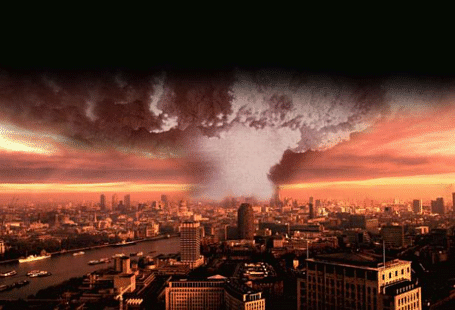
experts have called into question the reasons why nuclear-armed states are spending billions on weapons they are saying will never be used.
”The enmity created by nations threatening each other with indiscriminate, mid-20th century weapons of mass destruction prevents development of global solidarity and trust we so desperately need to address critical 21st century challenges like the climate crisis and pandemics,”
Fear of ‘devastating’ nuclear war as world’s major powers enter a new arms race
Countries including the UK have entered a new arms race, with growing stockpiles of more advanced weapons
By Taz Ali i news UK, October 24, 2021 Since the end of the Cold War, major powers across the globe made huge efforts to reduce their nuclear arsenals in efforts to ensure the world is safer from weapons of mass destruction that could wipe out entire cities.
But now, those countries including the UK have entered a new arms race, with growing stockpiles of more advanced weapons and smarter technology allowing missiles to evade defence systems, all of which experts fear could lead to a nuclear war.
“We’re in a new, multipolar nuclear arms and strategic technologies race, including the rush to weaponise space,” Lyndon Burford, a visiting research associate in the Centre for Science and Security Studies at King’s College London, told i.
He said there were multiple new risk factors, with technologies such as artificial intelligence and increasing political instability in major nuclear-armed countries.
“That could lead to nuclear war, with devastating global humanitarian, economic and ecological effects,” Dr Burford warned.
The nuclear arms race has accelerated in recent years, with the US, Russia, North Korea and China testing nuclear-capable hypersonic missiles which can potentially evade early warning systems and are harder to track.
Last month, the US and UK announced they will help Australia build a new fleet of nuclear submarines, as part of a trilateral alliance known as Aukus to counteract the influence of China.
It prompted warnings from the UN’s nuclear watchdog International Atomic Energy Agency (IAEA) that Aukus may spark off another race for nuclear submarines by other states, and that a team has been established to explore the deal’s safety and legal implications.
Matt Korda, a senior research associate for the nuclear information project at the Federation of American Scientists (FAS), told i that campaigns to modernise weapons were driven by a “global competitive environment that is being embraced by all of these nuclear arms states”………………..
Even as the pandemic devastated lives and economies around the world, the world’s nine nuclear states continued to increase spending on such weapons to a total of $72.6bn in 2020, an increase of $1.4bn from the previous year.
“This is a massive drain on public resources globally and a massive threat,” Kate Hudson, general secretary of the Campaign for Nuclear Disarmament (CND) told i.
“The very dangerous thing is that nuclear strategies have moved beyond the idea that we’d never use them, that they only exist as a deterrent. Now so-called ‘usable nukes’ are being developed and use postures outlined.”…………
“The US identifies China as a threat to its pre-eminence. What we are seeing now is the intensification of US militarisation in the Pacific.
“I assume that with the kind of build up against them, having not wanted to go into massive military spending, China will be doing more because of this intensification of activity by other great powers in what can essentially be seen as their backyard.”
Earlier this year, world-renowned naturalist Sir David Attenborough told the UN Security Council that climate change is “the biggest threat to security that modern humans have ever faced”, and few major powers would disagree with him.
Consequently, experts have called into question the reasons why nuclear-armed states are spending billions on weapons they are saying will never be used.
“The enmity created by nations threatening each other with indiscriminate, mid-20th century weapons of mass destruction prevents development of global solidarity and trust we so desperately need to address critical 21st century challenges like the climate crisis and pandemics,” said Dr Burford https://inews.co.uk/news/world/fear-of-devastating-nuclear-war-as-worlds-major-powers-enter-a-new-arms-race-1263713
No comments yet.
1 This Month

of the week – Shut Down Drone Warfare!


Tell the Ukrainian Government to Drop Prosecution of Peace Activist Yurii Sheliazhenko

Petition to revoke the licensing of the Near Surface Nuclear Disposal Facility (NSDF) at Chalk River. https://www.ourcommons.ca/petitions/en/Petition/Details?Petition=e-7247
To see nuclear-related stories in greater depth and intensity – go to https://nuclearinformation.wordpress.com
-
Archives
- April 2026 (114)
- March 2026 (251)
- February 2026 (268)
- January 2026 (308)
- December 2025 (358)
- November 2025 (359)
- October 2025 (376)
- September 2025 (257)
- August 2025 (319)
- July 2025 (230)
- June 2025 (348)
- May 2025 (261)
-
Categories
- 1
- 1 NUCLEAR ISSUES
- business and costs
- climate change
- culture and arts
- ENERGY
- environment
- health
- history
- indigenous issues
- Legal
- marketing of nuclear
- media
- opposition to nuclear
- PERSONAL STORIES
- politics
- politics international
- Religion and ethics
- safety
- secrets,lies and civil liberties
- spinbuster
- technology
- Uranium
- wastes
- weapons and war
- Women
- 2 WORLD
- ACTION
- AFRICA
- Atrocities
- AUSTRALIA
- Christina's notes
- Christina's themes
- culture and arts
- Events
- Fuk 2022
- Fuk 2023
- Fukushima 2017
- Fukushima 2018
- fukushima 2019
- Fukushima 2020
- Fukushima 2021
- general
- global warming
- Humour (God we need it)
- Nuclear
- RARE EARTHS
- Reference
- resources – print
- Resources -audiovicual
- Weekly Newsletter
- World
- World Nuclear
- YouTube
-
RSS
Entries RSS
Comments RSS
 nuclear-news
Leave a comment