War fears soar as NASA claims it needs nuclear rockets to rival China in space
 | |||
War fears soar as NASA claims it needs nuclear rockets to rival China in space
NASA has prompted fears of a conflict after pleading with the US Government to invest in nuclear-powered spacecraft to speed ahead of rivals in the space race., Express UK, By JACOB PAUL, Oct 23, 2021
The agency’s officials were testifying at a House Science, Space, and Technology subcommittee hearing on Wednesday – and called for new weapons to help the US reach Mars before powers such as Russia and China. NASA called on US lawmakers to invest more resources into researching and developing nuclear-powered rockets. They said this would which help humans reach the planet in just three to four months……….
NASA are now scrambling for the US to boost their space defences as China appears to advancing its space technology at a rapid pace……….
while the NASA are hoping to ramp up their space defence systems as they prepare to fend off China in the space race, the move would also come at high risk.
A spokesperson for Campaign for Nuclear Disarmament told Express.co.uk: “The idea of using nuclear-power in space is not new and has long been suggested as a way of getting to Mars quickly.
“But the launch into space of a nuclear reactor also risks a catastrophic spread of radioactive material if, for example, the launch vehicle were to malfunction and explode – which would be quite possible if an over competitive rush to space were to occur.
“Nuclear power has also been suggested for other applications, such as powering space weapons and military bases on the Moon and Mars. So, there really needs to be international consideration of the possible applications of nuclear power in space and their desirability. Some of the risks may well outweigh any possible advantages.” https://www.express.co.uk/news/science/1510292/world-war-three-news-space-race-mars-nasa
North Korea’s ongoing nuclear missile tests prove it’s time to normalize relations
North Korea’s ongoing nuclear missile tests prove it’s time to normalize relations
Given the history of repeated dead-end disarmament talks, déjà vu begs the question whether it is time to cut bait and accept the unacceptable. NBC NewsBy Bennett Ramberg, Former policy analyst at the U.S. State Department’s Bureau of Politico-Military Affairs
Pyongyang’s recent flurry of missile tests — most recently, a submarine-launched ballistic missile South Korea says North Korea launched Tuesday — and the apparent resumption of nuclear weapons materials production at the Yongbyon reactor are reminders that North Korea remains a central perennial problem befuddling U.S. foreign policy. Despite North Korea’s acknowledged shaky economy — further weakened by strong international economic sanctions and the coronavirus pandemic — leader Kim Jong Un’s commitment to maintaining the country’s bomb program remains unbowed.
The Biden administration’s ill-defined “calibrated approach” looks unlikely to move the nuclear-elimination needle. Nonetheless, Washington continues soldiering on — reaching out to China for help with its efforts to draw North Korea back into disarmament negotiations.
Given the history of these repeated dead-end disarmament talks, déjà vu begs the question whether it is time to cut bait: accept the unacceptable — nuclear North Korea is here to stay — and complement current U.S. military containment with an offer of diplomatic relations unconditioned by Pyongyang’s nuclear status.
History demonstrates that not only do such ties keep contacts on an even keel in normal times, they can play a critical role in resolving nuclear crisis.
This path would build on precedent. President Richard M. Nixon’s 1972 opening of relations with China, for example, did not involve questioning Beijing’s nuclear program.
Today, blunting North Korea’s nuclear threat relies on deterrence and defense — embodied in the long-standing U.S.-South Korea alliance, bolstered by nearly 30,000 U.S. troops stationed in the South, an offshore nuclear umbrella and an emerging sea-based ballistic missile defense. What’s lacking is a durable diplomatic component.
With the exception of the United States and North Korea, all nuclear weapons states have diplomatic relations……… https://www.nbcnews.com/think/opinion/north-korea-s-ongoing-nuclear-missile-tests-prove-it-s-ncna1282118
Nuclear power has no place in a green energy future-because of – time delay, success of renewables, huge costs, dangers, weapons connection, and wastes

from Yahoo News, 21 Oct 21, ”…….Practical concerns also temper enthusiasm for a nuclear future. The next generation of reactors, heralded as a game changer by supporters, still haven’t been proven in the real world. Even if those technologies are as revolutionary as advertised, skeptics say it could take decades before they make a real difference in the global energy grid — too long if the worst outcomes of climate change are to be avoided.
Renewable energy technologies can be enough on their own
“The drawbacks to nuclear are compounded by the burgeoning success of renewables — both solar and wind are getting cheaper and more efficient, year after year. There is also a growing realisation that a combination of renewables, smart storage, energy efficiency and more flexible grids can now be delivered at scale and at speed — anywhere in the world.” — Jonathon Porritt, Guardian
The world doesn’t have time to wait for next-gen nuclear
“When it comes to averting the imminent effects of climate change, even the cutting edge of nuclear technology will prove to be too little, too late. Put simply, given the economic trends in existing plants and those under construction, nuclear power cannot positively impact climate change in the next ten years or more.” — Allison Macfarlane, Foreign Affairs
A major ramp-up in nuclear technologies isn’t economically feasible
“While nuclear power may have once been cheaper than wind or solar, the economics have since changed dramatically. Nuclear power plants are very expensive to build and the economics of nuclear power are getting steadily worse. By contrast, renewables continue to come down in price.” — Ian Lowe, Conversation
There’s no way to guarantee that nuclear plants will be safe
“People around the world have witnessed the Three Mile Island, Chernobyl and Fukushima accidents. It is more than enough to believe that a safe nuclear power plant is nothing but a myth.” — Jang Daul, Korea Times
More nuclear power could lead to more nuclear weapons
“Some nations — India and Pakistan, and in all probability Israel — became nuclear powers after originally seeking nuclear technology for research or to develop nuclear power. … This is important: The technology used to turn on lights or charge mobile phones shouldn’t need to involve national or international defence apparatus.” — Editorial, Nature
Nuclear waste is still a major problem
“Nuclear waste lasts for hundreds of thousands of years before they are half-decayed. Our United States government — perhaps the longest continuous government in the world — is only 232 years old. Who will be around to manage uranium wastes?” — David Ross, Courier-Journal
Mini nuclear reactors claim to be the cheap, effective, action for reaching net zero carbon emissions: UK and others are buying this!

Mini nuclear reactors vie for key role in UK’s push to hit climate targets, Ft.com 21 Oct 21, SMRs promise huge cost savings over traditional large-scale plans, Ever since the Wylfa nuclear power plant on Anglesey stopped generating electricity in December 2015, communities on the Welsh island that are supportive of atomic power have been waiting for its revival. This week that likelihood increased when the UK government named a site near where the old reactors are being decommissioned as a possible location for a new large-scale plant or the first place in the UK to host a new technology under development, known as small modular reactors (SMRs).

One of the big selling points of SMRs is that they promise huge cost savings over traditional large-scale reactors. Rolls-Royce, the UK engineering group which is leading a consortium to produce a UK design, expects the first five SMR reactors to cost £2.2bn each, falling to £1.8bn for subsequent units. The government’s decision this week to give nuclear a central role in its net zero emissions strategy has given fresh impetus to replacing Britain’s existing reactors, which are all due to be retired by the end of 2035. Ministers committed a total of £505m in funding to the nuclear initiative, which calls for a mix of large plants, SMRs and other emerging technologies.

More than £200m of that funding is soon expected to be channelled into the consortium led by Rolls-Royce. It has been seeking private match-funding so it can submit its SMR reactor design to the extensive regulatory approval process before the end of the year. Wylfa had been earmarked for a new plant under British plans to build a new generation of large-scale reactors, financed mainly by the private sector, that dates back to 2006. But successive governments have struggled to attract private capital to these projects, where cost-overruns are commonplace because of the engineering risks in such complex structures.
So far work has only started on one: Hinkley Point C in Somerset and costs have spiralled with the latest estimate put at £23bn. The developer behind the proposed Wylfa plant, Japan’s Hitachi, pulled the plug last year after failing to reach a financing agreement with the UK government, although a US consortium is trying to resurrect it.
The UK is not alone in pushing smaller reactors. Other governments around the world looking to tap nuclear power to meet their challenging decarbonisation targets are also showing interest in the technology. Along with the promise of much lower build costs, the smaller power plants are also attractive because of their footprint. The UK, for example, has a limited number of sites suitable for large plants.
France, one of the world’s leaders in nuclear engineering, this month announced €1bn in funding for state-backed utility EDF to develop its own SMR technology by the early 2030s. The technology is similar to existing pressurised water reactors that are used in nuclear power plants today. But the key difference is that the small, modular design would allow the parts to be built in factories ready for quick assembly at the chosen location. This, SMR advocates argue, not only cuts costs and the long lead times but also avoids many of the construction risks that bedevil larger plants………..
……. Rolls-Royce is tight-lipped about its SMR fundraising but Tom Samson, who heads the consortium, said he was in talks with a “number of interested investors and developers in deploying the technology”. If the design gets regulatory approval, a process that can take up to five years, Rolls-Royce believes it could complete its first 470 megawatt SMR plant by 2031. After that it expects to build two units a year.
At 470MW the plant would have a generating capacity similar to some of Britain’s earliest reactors but would be about seven times less capable than the proposed next large-scale plant in the UK: Sizewell C on England’s east coast.
………. Among those other options are what the UK dubs “advanced modular reactors”. One of the most viable designs looks to be a high temperature gas-cooled reactor. The technology is being tested in a number of countries, including Japan. The government set a target this week of having the first advanced modular reactor demonstrator in Britain “in the early 2030s”. But analysts question whether any of these technologies would be commercialised in time to help the UK reach its 2035 target for a carbon neutral grid.
Moreover, some environmentalists argue a big challenge is the UK’s lack of experience with modularisation manufacturing techniques that are key to their economics. “We have never done it,” said Tom Burke, co-founder of E3G, a climate think-tank, arguing that modularisation would require a “very large factory” that could only be funded with a long line of orders.
Burke questioned how it would be possible to secure those orders when the first SMR is, as yet, unproven. But Rolls-Royce’s Samson remains unfazed. In contrast to future large atomic plants, which are likely to require a financing model that will be underpinned by British households through their energy bills, modularisation promises a radical shift in funding nuclear power. He conceded that government backing would be needed to help finance the initial manufacturing set-up and first orders but insisted private capital would ultimately pay for the bulk of the fleet. “This is an important transition for us. https://www.ft.com/content/7da30202-2db9-4ab3-9428-458a9d8728bd?signupConfirmation=success
The RTE (Electricity Transport Network) Energy Futures 2050 study shows that $100 renewables is feasible
The RTE (Electricity Transport Network) Energy Futures 2050 study, which
will be published on Monday, October 25, shows that it is possible to move
towards 100% renewable energy. We therefore have the choice and the study
of RTE, as well as the other recent scenarios, should allow a real
democratic debate on this issue.
Reseau Climate Action 20th Oct 2021
Greenland to reinstate its ban on uranium mining
Within weeks, Greenland’s parliament, the Inatsisartut, is expected to
pass a bill reinstating a ban on uranium mining that was lifted in 2013
following pressure from mining companies. “The Greenlandic minister with
responsibility for minerals has publicly stated that a ban on uranium
mining will put an end to all future uranium mining, full stop,” Mariane
Paviasen, a Greenland MP and leading activist in the anti-uranium mining
movement, Urani? Naamik (Uranium? No), told Green Left.
Green Left 20th Oct 2021
https://www.greenleft.org.au/content/greenland-set-restore-uranium-mining-ban
West Lothian halving its carbon emissions through energy conservation and renewables

West Lothian has nearly halved its carbon emissions in eight years,
building on the 40% cut it achieved after declaring its climate emergency
policy in September 2019. The report added: “There are a number of direct
actions that have contributed to our emissions reductions including the
implementation of energy efficiency projects, replacing street lighting
with low energy LED equivalents, investing in renewable and low carbon
technologies such as biomass boilers and solar photovoltaic (PV) panels and
reducing the volume of waste being sent to landfill.”
Edinburgh Reporter 19th Oct 2021
Large windfarm development off the coast of Suffolk
Leading utility Iberdrola announces new investment plans at today’s
Global Investment Summit. Leading renewable energy utility Iberdrola is set
to invest an additional £6bn in its offshore wind farm development off the
coast of Suffolk, the company confirmed at today’s Global Investment Summit
hosted by Boris Johnson. Speaking at the Summit, Iberdrola’s chairman and
CEO Ignacio Galán announced a new £6bn investment in offshore wind
projects, in addition to the £10bn already being invested by the company
to double renewable generation capacity between 2020 and 2025. The £6bn
investment will go towards Iberdrola subsidiary ScottishPower’s East Anglia
Hub, a wind farm development off the coast of Suffolk, consisting of three
wind farms: East Anglia ONE North, East Anglia TWO and East Anglia THREE.
Business Green 19th Oct 2021
https://www.businessgreen.com/news/4038888/iberdrola-floats-gbp6bn-boost-uk-offshore-wind-industry
UK govt teams up with Bill Gates – (coyly – no public mention of nuclear)
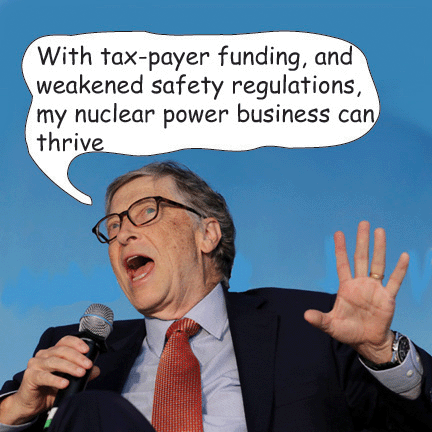
Government teams up with Bill Gates and top corporates to catalyse wave of
green [?] tech investment. Prime Minister announces £9.7bn of inward
infrastructure investment, as government launches new £400m public-private
clean tech innovation fund.
Prime Minister Boris Johnson this morning used
the Global Investment Summit as a curtain-raiser for the government’s
much-anticipated Net Zero Strategy, announcing almost £10bn of new foreign
investment in a wave of primarily low carbon infrastructure projects.
The government confirmed a new package of 18 deals worth £9.7bn, which are set
to ramp up investment in a host of clean infrastructure projects, including
offshore wind, hydrogen development, carbon capture and storage (CCS), and
green homes.
Meanwhile, Johnson shared a virtual stage with billionaire
philanthropist Bill Gates to announce the UK government has teamed up with
Gates’ Breakthrough Energy Catalyst clean tech venture to each invest
£200m in a new fund for supporting cutting edge clean tech projects. “The
world’s top investors have seen the massive potential in the UK for growth
and innovation in the industries of the future,” Johnson said. “The
fantastic £9.7bn of new investment we have secured today will power our
economic recovery, creating thousands of jobs and helping to level up
across the country.
Business Green 19th Oct 2021
Nuclear power has no place in a healthy, sustainable future – IPPNW

Nuclear power has no place in a healthy, sustainable future. IPPNW
statement for COP26 UN Climate Change Conference 2021. In the lead-up to
COP26, there has been another round of concerted and increasingly desperate
attempts to portray nuclear power as an acceptable, safe and low carbon
energy source that can help address the climate heating crisis. We reject
this deception, which serves only those with vested interests in the
nuclear power industry, and those whose motive is not safe low carbon
electricity, but maintaining or being in a position to build nuclear
weapons.
IPPNW 18 October 2021
https://www.ippnw.org/wp-content/uploads/2021/10/IPPNW-COP-26-10-18-21.docx.pdf
UK’s ”low carbon” strategy relies too much on unproven technologies – what we need is energy conservation
| Finally, we have a plan to reduce emissions, but much of it rests on technology that is yet to be tested at scale. The PM confidently claimed that we will be flying and driving everywhere, guilt-free, with zero-emission technology. This optimism – based on a techno-centric, market-driven vision of the future low carbon society – is what underlines the entire net zero strategy. Take for instance the reliance on greenhouse gas removal technologies that remain untested at scale. Between now and 2050, the government envisions removing and storing more carbon than we currently emit from all our homes today. It would of course be a mistake to dismiss out of hand the possibilities that these technologies offer, but to have them play such a central role in our strategy is a gamble. To make it work would require careful planning. A similar reliance is placed on hydrogen, which the strategy foresees us using a tremendous amount of, though we barely have any production facilities in the UK today. None of this is impossible, but climate change offers very little slack for policymakers to try to fail, so getting it right the first time is paramount. The headline-grabbing announcement of a £5,000 subsidy for heat pumps distracts us from the lack of investment in insulation and making our homes warmer. At the New Economics Foundation, we estimate that the scale of finance committed by the government in decarbonising our leaky housing stock is less than a quarter of what is actually needed by 2025. That is why we launched a campaign called the Great Homes Upgrade, calling on the government to retrofit 19m homes by 2030. Without an investment of at least 2% of GDP annually, the strategy could well remain a non-starter, but the chancellor has an opportunity to fix that in his upcoming budget and spending review. Guardian 19th Oct 2021 https://www.theguardian.com/commentisfree/2021/oct/19/government-net-zero-technology-emisssions |
Diverse American groups file a lawsuit against DOE opposing production of plutonium pits
What do activist groups from California, New Mexico, and South Carolina
have in common? And why might such a diverse crew have filed a group
lawsuit in June of this year, against the Department of Energy and the
National Nuclear Security Administration?
The answer to that question says
a lot about the environmental implications of nuclear weapons, and what
tactics exist to protect communities – and the world – against the
threat nuclear weapons pose.
The first plutonium pit was produced at Los
Alamos in 1945 and detonated at the Trinity test site. The second plutonium
pit was detonated in Nagasaki shortly after that, killing over 70,000
people. Plutonium pits act as the radioactive core of nuclear weapons,
existing as the central “shell” of nuclear fission chains or what
triggers the detonation. They serve a central role in the existence of
nuclear weapons. Producing plutonium pits, however, is a technically
challenging process that in the past, frequently resulted in environmental
contamination.
Beyond the Bomb 18th Oct 2021
ALL UK energy can be obtained from renewables – Prof Mark Barrett
How we can get ALL our energy from renewables – a talk by Professor Mark
Barrett- talk slides published! Professor Mark Barrett from UCL has given a
talk about how ALL UK energy can be supplied by renewables. He focused on
heat in particular.
100% Renewables 18th Oct 2021
Spain is turning rapidly away from coal and nuclear, going for renewable energy
Spain is expected to see a sharp decline in nuclear and coal power
capacity by 2030 in its turn towards renewable energy sources.
Power Technology 21st Oct 2021
https://www.power-technology.com/comment/spain-nuclear-power-phase-out/
France’s Global Chance association recommend renewable energies, see nuclear power as unsustainable
Ten-year delays, unequal access, vulnerability … For the members of the
Global Chance association, chaired by the polytechnician Bernard Laponche,
nuclear energy is not up to the challenge of ecological transition. On the
contrary, they promote renewable energies, the sources of which are “in
essence local and sovereign”.
La Croix 18th Oct 2021
https://www.la-croix.com/Debats/Lenergie-nucleaire-repond-pas-defi-climatique-2021-10-18-1201181087
1 This Month

of the week – Shut Down Drone Warfare!


Tell the Ukrainian Government to Drop Prosecution of Peace Activist Yurii Sheliazhenko

Petition to revoke the licensing of the Near Surface Nuclear Disposal Facility (NSDF) at Chalk River. https://www.ourcommons.ca/petitions/en/Petition/Details?Petition=e-7247
To see nuclear-related stories in greater depth and intensity – go to https://nuclearinformation.wordpress.com
-
Archives
- April 2026 (57)
- March 2026 (251)
- February 2026 (268)
- January 2026 (308)
- December 2025 (358)
- November 2025 (359)
- October 2025 (376)
- September 2025 (257)
- August 2025 (319)
- July 2025 (230)
- June 2025 (348)
- May 2025 (261)
-
Categories
- 1
- 1 NUCLEAR ISSUES
- business and costs
- climate change
- culture and arts
- ENERGY
- environment
- health
- history
- indigenous issues
- Legal
- marketing of nuclear
- media
- opposition to nuclear
- PERSONAL STORIES
- politics
- politics international
- Religion and ethics
- safety
- secrets,lies and civil liberties
- spinbuster
- technology
- Uranium
- wastes
- weapons and war
- Women
- 2 WORLD
- ACTION
- AFRICA
- Atrocities
- AUSTRALIA
- Christina's notes
- Christina's themes
- culture and arts
- Events
- Fuk 2022
- Fuk 2023
- Fukushima 2017
- Fukushima 2018
- fukushima 2019
- Fukushima 2020
- Fukushima 2021
- general
- global warming
- Humour (God we need it)
- Nuclear
- RARE EARTHS
- Reference
- resources – print
- Resources -audiovicual
- Weekly Newsletter
- World
- World Nuclear
- YouTube
-
RSS
Entries RSS
Comments RSS
 nuclear-news